Utilization of Double Random Phase Encoding for
Securing Color Images
Mohammed A. AlZain
College of Computers and Information Technology
Taif University, P.O. Box 888
Al-Hawiya-Taif, 21974, KSA
ABSTRACT
This paper investigates the Double Random Phase Encoding (DRPE) implementation in encrypting color digital images. The color optical image cipher works through splitting color plainimage into red (R), green (G) and blue (B) channels. The color plainimage RGB components are multiplied with the random phase mask (RPM) and transformed with Fourier Transform (FT). The modulated RGB components are again multiplied using the second RPM and subjected again to inverse FT. A set of experimental tests using different color images has been employed to study the security of DRPE for encrypting digital color images. Experimental results demonstrated the efficiency of DRPE for encrypting digital color images and its immunity regarding the most potential attacks.
General Terms
Security, Image Encryption.Keywords
DRPE, Fourier Transform (FT), Color image encryption
1.
INTRODUCTION
The optical cryptography methods have significant impact on the optical information processing field. Efficient and dependable security methods in transmitting and storing digital images are required for several applications such as video conferencing, pay TVs, medical images storing and transmission, military usage, police identification, online banking, and governmental systems.
The Opto-security schemes have gained a lot of advances because of their features of parallel processing and fast processing. The Optics offers several freedom degrees in optical beams can be modulated, like as the phase, amplitude, wavelength, and polarization. So, many optical encryption schemes have been introduced [1-4].
The DRPE presented in [5], may be considered the most commonly utilized optical encryption method. The Fractional Fourier transform (FrFT) was introduced as generalization for traditional encryption [6-7]. The Fourier Transform (FT) is commonly utilized in optical image encryption [8-10].
The optical DRPE color image encryption begins with splitting color plainimage into RGB components that modulated by the first RPM and FT transformed. The achieved RGB channels are secondly modulated using another RPM and again FT transformed.
The paper remainder is appeared as follows. Sec. 2 gives the main fundamentals regarding DRPE. Sect. 3 presents encryption/decryption stages. Sect. 4 gives the security study of the optical DRPE encryption. And conclusions are given in Sect. 5.
2.
DRPE FUNDAMENTALS
The DRPE depends on modifying the image spectral allocation regardless information of spectral alternation or received image in receiving side. The basic is based on putting two RPM (encoding secret keys) in setup named 4f. The DRPE encryption can be defined as [5]:
))} , ( 2 exp( ))] , ( 2 exp( ) , ( [ { ) ,
(ab FT FTXab j ab j uv
Y 1
The DRPE decryption can be defined as [5]:
)) , ( 2 exp( ))} , ( 2 exp( )) , ( ( [ { ) ,
(ab FT 1FT 1Yab j uv j ab
X 2
The exp(j2(x,y))andexp(j2(u,v))represent two RPM secret keys which will be transmitted with the encrypted color image. FT/FT−1 represents the Fourier and inverse Fourier transformations.
3.
THE OPTICAL DRPE FOR COLOR
IMAGE ENCRYPTION
The encryption/decryption stages using DRPE encryption are listed below in the next two subsections, respectively.
3.1
Encryption Stage
The color plainimage I(xi,yj) is split into R, G, and B
component asIR(xi,yj), IG(xi,yj)andIG(xi,yj), respectively. Each of RGB components is multiplied using the first
) , ( 1 i j r x y
RPM ,RPMg1(xi,yj), and RPMb1(xi,yj), and perform FT. The transformed R, G, and B components are multiplied with the secondRPMr2(ui,vj), RPMg2(ui,vj)andRPMb2(ui,vj), and then employed secondFT. The three encrypted R, G, and B componentsEr2(xi,yj), Eg2(xi,yj) and Eb2(xi,yj) are multiplexed to obtain the encrypted color imageE(xi,yj).
3.2
Decryption Stage
The encrypted color image E(xi,yj) is split into R/G/B
componentsEr(xi,yj), Eg(xi,yj) andEb(xi,yj), respectively.
The FT1 is applied to color R/G/B components, and
modulated usingRPM*r2(ui,vj),RPM*g2(ui,vj), and
) , ( *
2 i j
b u v
RPM . Another FT1 is applied to modulated R/G/B components and modulated withRPM*r1(xi,yj), RPM*g1(xi,yj)
andRPMb*1(xi,yj). The decrypted R/G/B components
) , ( 2 i j r x y
B , Bg2(xi,yj) and Bb2(xi,yj) are assembled to get the final decrypted color imageD(xi,yj).
4.
SIMULATION EXPERIMENT
several encryption performance metrics such as visually inspection, entropy estimation, statistical evaluation, differential measures, quality estimation, and noise immunity. Tests were performed using three 256×256 color Lena, House, and House images. The original test plainimages are illustrated in Fig. 1.
[image:2.595.316.536.112.327.2]a) Lena b) House c) Sailboat
Fig. 1: Color plainimages – Lena, House, and House
4.1 Visual Quality Inspection
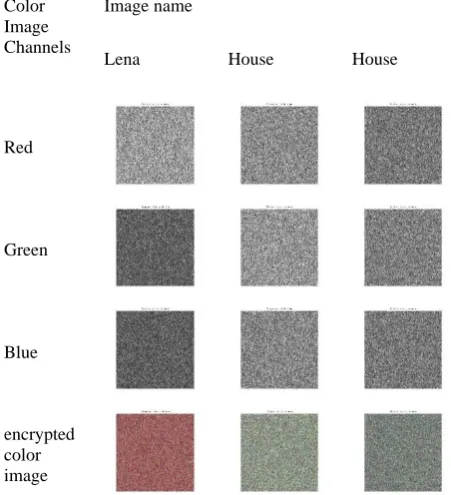
The efficiency of DRPE is investigated in encrypting color Lena, House and Sailboat images. The encryption results of optical DRPE are depicted in Fig. 2 for color Lena, House and Sailboat images. The obtained test consequences for encrypted color Lena, House and Sailboat images ensure the superiority of optical DRPE in hiding all features of their corresponding color plainimages.
Color Image Channels
Image name
Lena House House
Red
Green
Blue
[image:2.595.57.280.138.223.2]encrypted color image
Fig. 2: Encrypted color Lena, House and Sailboat color image components using optical DRPE
4.2 Histogram Test
The histogram test for is a graph which show the pixels number for each intensity value. The histogram should be uniform for an efficient encryption. Also, the histograms of encrypted color RGB components should be different from their corresponding original color RGB components. Experimental histogram tests of the original/encrypted RGB components of colored Lena, House and Sailboat images using optical DRPE are shown in Fig. 3-5. The obtained results show that the histograms of encrypted RGB components for Lena, House and Sailboat images were completely different from corresponding histograms of their original color RGB components. The encrypted RGB components histogram for color Lena, House and Sailboat
images using optical DRPE are quite uniform. So, the optical DRPE has the ability to resist any histogram based attack.
Color Image Channels
Color plainimage
Color
Plainimage
Decrypted cipherimage
Red
Green
[image:2.595.52.278.338.586.2]Blue
Fig. 3: RGB components Histogram of encrypted/decrypted color Lena image using optical
DRPE
Color Image Channels
Color plainimage
Color
Plainimage
Decrypted cipherimage
Red
Green
[image:2.595.317.537.384.590.2]Blue
Fig. 4: RGB components Histogram of encrypted/decrypted color House image using optical
DRPE
Color Image Channels
Color plainimage
Color
plainimage
Decrypted cipherimage
Green
[image:3.595.57.278.70.196.2]Blue
Fig. 5: RGB components Histogram of encrypted/decrypted color Sailboat image using optical
DRPE
4.3 Encryption Quality Tests
The encryption quality can be estimated using several estimations like correlation coefficient, histogram deviation and irregular deviation.
The correlation coefficients r is estimated among original image OI(xi,yj)and encrypted image EI(xi,yj) RGB
components as [11-12]:
EI E(EI)
E
OI E(OI)
,E E(OI) OI E(EI) EI E EI) r(OI, 2 2 (3)
where E
is expectation operator. Smallr
indicates high difference between the original image OI(xi,yj)and encryptedimage EI(xi,yj) RGB components.
The ID measure estimates the encryption efficiency in terms of how much irregular is the difference caused by encryption. The ID can be estimated as [13-15]:
, ) ( ) , ( 255 0 MxN i h E I ID i d
(4)
, ) ( )
( h
di hi M
h (5)
where h(i) is cipherimage histogram and Mhis average uniform histogram for encrypted image. Small ID values indicate good encryption quality.
The HD measure estimates the encryption quality by how it enlarges the difference among the original image OI(xi,yj)and
encrypted image EI(xi,yj)RGB components. The HD can be calculated as [13-15]:
, ) ( ) , ( 255 0 MxN i d E I HD i
(6)
where d(i) is absolute difference among the original image
) y ,
OI(xi j and encrypted image EI(xi,yj)RGB components. The
variables M and N represent image dimensions. High HD
values ensure large difference between the original image
) y ,
OI(xi j and encrypted image EI(ai,bj)RGB components.
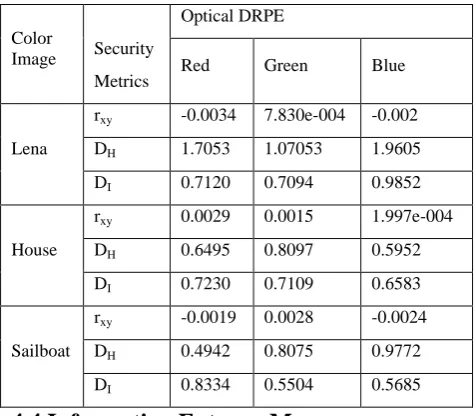
Table 1 shows the Correlation coefficients, Irregular Deviation, and histogram deviation metrics of encrypted RGB components for color Lena, House and sailboat using Optical DRPE. The resulted correlation coefficients, Irregular and histogram deviations metrics shown in Table 1 ensure good encryption quality of optical DRPE.
Table 1: Correlation coefficients, Irregular deviation, and histogram deviation metrics for encrypted RGB components for colored Lena, House and sailboat using Optical DRPE
Color
Image Security Metrics
Optical DRPE
Red Green Blue
Lena
rxy -0.0034 7.830e-004 -0.002
DH 1.7053 1.07053 1.9605
DI 0.7120 0.7094 0.9852
House
rxy 0.0029 0.0015 1.997e-004
DH 0.6495 0.8097 0.5952
DI 0.7230 0.7109 0.6583
Sailboat
rxy -0.0019 0.0028 -0.0024
DH 0.4942 0.8075 0.9772
DI 0.8334 0.5504 0.5685
4.4 Information Entropy Measure
The information entropy test is utilized for estimating encrypted R, G, and B components information amount. The information entropy measure may be estimated as [16]:
, ) P(S 1 N )log P(S E(S) i 1 2 1 i 2 i (7)
where E(S), and P(Si)are the entropy and the occurrence must be 8 bits.
[image:3.595.310.548.107.315.2]The objective of information entropy measure is to estimate information amount of encrypted RGB components for colored Lena, House and sailboat using Optical DRPE. Table 2 gives the information entropy estimates of encrypted RGB components for colored Lena, House and sailboat using Optical DRPE. The obtained results demonstrated that the information entropy values of encrypted RGB components for colored Lena, House and sailboat are near the optimal information entropy estimate of 8 bits.
Table 2: Information entropy metric of original/encrypted RGB components for colored Lena, House and sailboat using Optical DRPE
Image
Colored Plainimage
Encrypted Colored Cipherimage with DRPE Optical Encryption
Red Gree n
Blue Red Green Blue
Lena 1.97 3
1.973 1.62 8 7.309 9 7.310 9 7.589 5
House 7.41 6
7.229 7.43 5 7.597 0 7.450 5 7.672 7 Sailboa t 7.31 2
7.643 7.21 4 7.750 4 7.732 0 7.752 0
4.5 Differential Measure
[image:3.595.311.549.557.718.2]evaluated using the number of pixels changing rate (NPCR) and the unified averaging changing intensity (UACI) [40].
The NPCRR,G,B may be computed as [17-20]:
100%, N ) b , (a D ) C , (C
NPCRR,G,B 1 2 i,j R,G,B i j
(8)
where N is image pixels number and DR,G,B(ai,bj) is as:
) b , (a C ) b , (a C 1, ) b , (a C ) b , (a C 0, ) C , (C D j i 2 B G, R, j i 1 B G, R, j i 2 B G, R, j i 1 B G, R, 2 1 B G, R, (9)
where C1R,G,B(ai,bj)and C2R,G,B(ai,bj)are the corresponding color
RGB components in the two color cipherimagesC1(ai,bj) and )
b , (a
C2 i j , respectively.
The UACIR,G,B can be defined as [17-20]:
%, 100 255 ) b , (a C ) b , (a C 1 ) C , C
( , i j
2 B G, R, j i 1 B G, R, 2 1 , ,
ij B G R N UACI (10)
The NPCR/UACI experimental tests are illustrated in Table 3. The experimental tests ensure the sensitivity of optical DRPE regarding small modification in color plainimages RGB components.
Table 3: NPCR/UACI of encrypted RGB components for color Lena, House and sailboat using Optical DRPE
Image Metric
Encrypted color images with Optical DRPE
Red Green Blue
Lena
NPCR 97.7814 97.7921 99.3645
UACI 0 0 0
House
NPCR 99.5644 99.6082 99.6151
UACI 0 0 0
Sailboat NPCR 99.5125 99.6452 99.6742
UACI 0 0 0
4.6 Noise Resistance Test
The optical DRPE resistance regarding noise attacks is tested in the decryption phase using peak signal to noise ratio (PSNR), SSIM and FSIM. The employed noises are salt and pepper, additive white Gaussian noise (AWGN), and speckle noises, respectively. The PSNR is employed to test the quality of decrypted RGB components.
The PSNR may be estimated as [21-22]:
EI) MSE(OI, (255) log 10 EI) PSNR(OI, 2 10 (11)
The SSIM is utilized to test quality of decrypted image. The SSIM is computed as [23-26]:
SSIM x, y w = (2wxwy+ C1)(2σwxwy+ C2) (wx2+ wy2+ C1)(σ2wx+σw2y+ C2)
(12)
where, C1, C2 are minor constants, wx and wy are average of wx and wy regions, respectively. Σwx
2 is the region wxvariance and σwxwy is two regions covariance among
wx and wy. High SSIM values mean perfect resistance
against noise.
The FSIM is utilized to test the decrypted image quality. The FSIM is computed as [23-26]:
FSIM = x∈ΩSL x . PCm(x) PCm(x) x∈Ω
(13)
where Ω is image spatial domain, SL x is overall similarity
among two images and PCm(x) is phase congruency. High
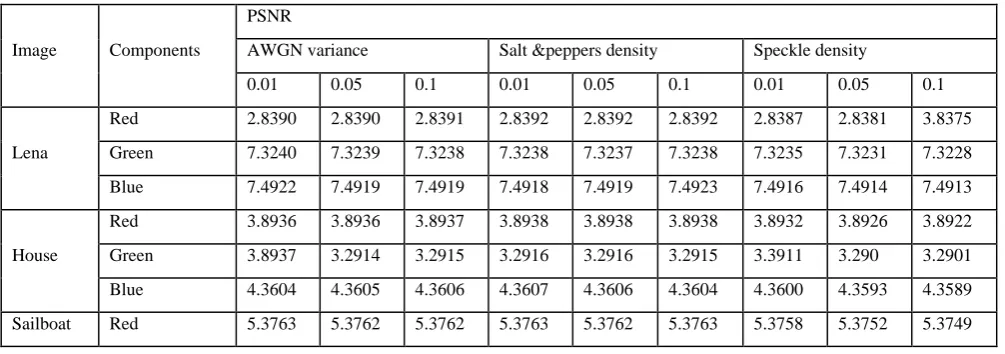
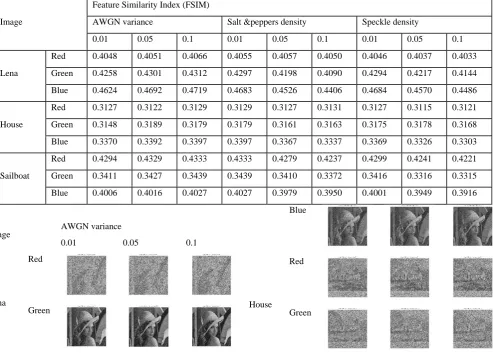
[image:4.595.48.551.596.773.2]FSIM values mean perfect resistance against noise. The noise immunity results of decrypted RGB components for color Lena, House and sailboat using Optical DRPE with AWGN with variance = 0.01, 0.05 and 0.1, speckle noise with variance = 0.01, 0.05 and 0.1, and salt & pepper with density = 0.01, 0.05 and 0.1 are shown in Tables 4-6 and Figs. 6-8. The noise resistance results using PSNR, SSIM and FSIM demonstrated the efficiency of the optical DRPE with respect to all the three different types of noise like AWGN with variance = 0.01, 0.05 and 0.1, speckle noise with variance = 0.01, 0.05 and 0.1, and salt & pepper with variance = 0.01, 0.05 and 0.1.
Table 4: PSNR of deciphered RGB components for colored Lena, House and sailboat using Optical DRPE in the presence of AWGN, Salt & peppers, and Speckle noises
Image Components
PSNR
AWGN variance Salt &peppers density Speckle density
0.01 0.05 0.1 0.01 0.05 0.1 0.01 0.05 0.1
Lena
Red 2.8390 2.8390 2.8391 2.8392 2.8392 2.8392 2.8387 2.8381 3.8375
Green 7.3240 7.3239 7.3238 7.3238 7.3237 7.3238 7.3235 7.3231 7.3228
Blue 7.4922 7.4919 7.4919 7.4918 7.4919 7.4923 7.4916 7.4914 7.4913
House
Red 3.8936 3.8936 3.8937 3.8938 3.8938 3.8938 3.8932 3.8926 3.8922
Green 3.8937 3.2914 3.2915 3.2916 3.2916 3.2915 3.3911 3.290 3.2901
Blue 4.3604 4.3605 4.3606 4.3607 4.3606 4.3604 4.3600 4.3593 4.3589
Green 4.8409 4.8410 4.8411 4.8412 4.8409 4.8405 4.8395 4.8395 4.8385
[image:5.595.52.549.149.355.2]Blue 5.3506 5.3506 5.3507 5.3508 5.3502 5.3502 5.3502 5.3492 5.3485
Table 5: SSIM of deciphered RGB components for colored Lena, House and sailboat using Optical DRPE in the presence of AWGN, Salt & peppers, and Speckle noises
Image
Feature Similarity Index (FSIM)
AWGN variance Salt &peppers density Speckle density
0.01 0.05 0.1 0.01 0.05 0.1 0.01 0.05 0.1
Lena
Red 0.0027 0.0027 0.0027 0.0027 0.0027 0.0027 0.0026 0.0026 0.0026
Green 0.0043 0.0041 0.0041 0.0041 0.0045 0.0048 0.0041 0.0043 0.0045
Blue 0.0035 0.0034 0.0034 0.0034 0.0035 0.0036 0.0034 0.0034 0.0035
House
Red 0.0029 0.0029 0.0029 0.0029 0.0030 0.0030 0.0029 0.0029 0.0028
Green 0.0029 0.0029 0.0029 0.0029 0.0029 0.0029 0.0028 0.0028 0.0028
Blue 0.0036 0.0035 0.0035 0.0036 0.0036 0.0036 0.0035 0.0035 0.0035
Sailboat
Red 0.0035 0.0035 0.0035 0.0035 0.0035 0.0036 0.0035 0.0034 0.0035
Green 0.0043 0.0042 0.0042 0.0042 0.0043 0.0045 0.0042 0.0044 0.0045
Blue 0.0056 0.0055 0.0054 0.0054 0.0057 0.0060 0.0055 0.0057 0.0059
Table 6: FSIM of deciphered RGB components for colored Lena, House and sailboat using Optical DRPE in the presence of AWGN, Salt & peppers, and Speckle noises
Image
Feature Similarity Index (FSIM)
AWGN variance Salt &peppers density Speckle density
0.01 0.05 0.1 0.01 0.05 0.1 0.01 0.05 0.1
Lena
Red 0.4048 0.4051 0.4066 0.4055 0.4057 0.4050 0.4046 0.4037 0.4033
Green 0.4258 0.4301 0.4312 0.4297 0.4198 0.4090 0.4294 0.4217 0.4144
Blue 0.4624 0.4692 0.4719 0.4683 0.4526 0.4406 0.4684 0.4570 0.4486
House
Red 0.3127 0.3122 0.3129 0.3129 0.3127 0.3131 0.3127 0.3115 0.3121
Green 0.3148 0.3189 0.3179 0.3179 0.3161 0.3163 0.3175 0.3178 0.3168
Blue 0.3370 0.3392 0.3397 0.3397 0.3367 0.3337 0.3369 0.3326 0.3303
Sailboat
Red 0.4294 0.4329 0.4333 0.4333 0.4279 0.4237 0.4299 0.4241 0.4221
Green 0.3411 0.3427 0.3439 0.3439 0.3410 0.3372 0.3416 0.3316 0.3315
Blue 0.4006 0.4016 0.4027 0.4027 0.3979 0.3950 0.4001 0.3949 0.3916
Image
AWGN variance
0.01 0.05 0.1
Lena
Red
Green
Blue
House Red
[image:5.595.54.548.384.737.2]Blue
Sailboat Red
Green
Blue
Fig. 6: Deciphered RGB components for color Lena, House and Sailboat images using Optical DRPE in the
presence of AWGN noise
Image Salt & peppers density
0.01 0.05 0.1
Lena
Red
Green
Blue
House Red
Green
Blue
Sailboat Red
Green
[image:6.595.43.548.70.749.2]Blue
Fig. 7: Deciphered RGB components for color Lena, House and Sailboat images using Optical DRPE in the
presence of Salt & peppers noise
Image Speckle density
0.01 0.05 0.1
Lena
Red
Green
Blue
House Red
Green
Blue
Sailboat Red
Green
Blue
Fig. 8: Deciphered RGB components for color Lena, House and Sailboat images using Optical DRPE in the
presence of Speckle noise
5.
CONCLUSION
19 transformed. The optical DRPE color image decryption
divides the encrypted colored image into RGB components that are FT transformed and multiplied with the second RPM conjugate. The transformed RGB components are gain multiplied by the first RPM conjugate and secondly inverse FT transformed. A set of tests are examined for studying the optical DRPE color image encryption. Test demonstrated efficiency of the optical DRPE encryption applied to color images.
6.
REFERENCES
[1] S. Kishk and B. Javidi, "Information hiding technique with double phase encoding"applied optics, 41, 5462-5470, 2002.
[2] Z. Liu Z, S. Li, W. Liu, Y. Wang, S. Liu, "Image encryption algorithm by using fractional Fourier transform and pixel scrambling operation based on double random phase encoding," Opt. Lasers Eng., vol. 51, pp. 8-14, 2013.
[3] M. R. Abuturab, "Color image security system based on discrete Hartley transform in gyrator transform domain, " Opt. Lasers Eng., vol. 51, pp. 317-324, 2013.
[4] Liu Z, Dai J, Sun X, Liu S., "Color image encryption by using the rotation of color vector in Hartley transform domains," Opt. Laser Eng., vol. 48, pp. 800–805, 2010.
[5] P. Refregier and B. Javidi, "Optical image encryption based on input plane and Fourier plane random encoding" Opt. Lett., vol. 20, pp. 767-769, 1995.
[6] R. Tao, J. Lang, Y. Wang, "Optical image encryption based on the multipleparameter fractional Fourier transform," Opt. Lett. 33, pp. 581–583, 2008.
[7] Z. Liu, S. Liu, "Double image encryption based on iterative fractional Fourier transform," Opt. Commun. vol. 275, pp. 324–329, 2007.
[8] Y. Frauel, A. Castro, T. J. Naughton, B. Javidi, "Security analysis of optical encryption," Proc SPIE, vol. 5986, pp. 25–34, 2005.
[9] Y. Frauel, A. Castro, T. J. Naughton, B. Javidi, "Resistance of the double random phase encryption against various attacks," Opt. Express, vol. 15, pp. 10253-10265, 2007.
[10]X. Peng, P. Zhang, H. Wei, B. Yu, "Known-plaintext attack on optical encryption based on double random phase keys," Opt. Lett., vol. 31, pp. 1044-1046, 2006.
[11]Ensherah A. Naeem, Mustafa M. Abd Elnaby, Naglaa F. Soliman, Alaa M. Abbas, Osama S. Faragallah, Noura Semary, Mohiy M. Hadhoud, Saleh A. Alshibeili, and Fathi E. Abd El-Samie, "Efficient Implementation of Chaotic Image Encryption in Transform Domains," Journal of Systems and Software, vol. 97, pp. 118-127, 2014.
[12]Z. Liu, Y. Zhang, W. Liu, F. Meng, Q. Wu, S. Liu, Optical color image hiding scheme based on chaotic mapping and Hartley transform, Optics and Lasers in Engineering, 51, pp. 967-972, 2013.
[13]Ensherah A. Naeem, Mustafa M. AbdElnaby, Hala S. El-sayed, Fathi E. Abd El-Samie, and Osama S. Faragallah, "Wavelet Fusion for Encrypting Images with a Few Details," Computers and Electrical Engineering, vol. 54, pp. 450-470, 2016.
[14]Heba M. Elhoseny, Hossam E. H. Ahmed, Alaa M. Abbas, Hassan B. Kazemian, Osama S. Faragallah, Sayed M. El-Rabaie, Fathi E. Abd El-Samie, "Chaotic encryption of images in the fractional Fourier transform domain using different modes of operation," Signal, Image and Video Processing Journal "Springer-Verlag" ISSN 1863-1703, 2013, DOI 10.1007/s11760-013-0490-x
[15]Elsayed M. Elshamy, Sayed El-Rabaie, Osama S. Faragallah, Osama Elshakankiry, Fathi. E. Abd El-Samie, Hala S. El-sayed, and S. F. El-Zoghdy, "Efficient Audio Cryptosystem based on Chaotic Maps and Double Random Phase Encoding," International Journal of Speech Technology, vol. 18(4), pp. 619-631, 2015, Springer.
[16]Osama S. Faragallah, "An Enhanced Chaotic Key-Based RC5 Block Cipher Adapted to Image Encryption," International Journal of Electronics, vol. 99(7), pp. 925-943, Taylor & Francis, 2012.
[17]Joshi M, Shakher C, Singh K., "Logarithms-based RGB image encryption in the fractional Fourier domain: a non-linear approach," Opt. Lasers Eng., vol. 47, pp. 721-727, 2009.
[18]Liu Z, Xu L, Liu T, Chen H, Li P, Lin C, et al., "Color image encryption by using Arnold transform and color-blend operation in discrete cosine transform domains," Opt. Commun. vol. 284, pp. 123-128, 2011.
[19]Chen W, Chen X, Sheppard CJR. "Optical color-image encryption and synthesis using coherent diffractive imaging in the Fresnel domain," Opt. Express, vol. 20, pp. 3853-3865, 2012.
[20]Q. Guo, Z. Liu, S. Liu, Color image encryption by using Arnold and discrete fractional random transforms in IHS space, Optics and Lasers in Engineering, 48, 1174-1181, 2010.
[21]Hu Y J, Lee H K, Chen K Y.D. "Difference expansion based reversible data hiding using two embedding direction, " IEEE Trans on Multimedia, vol. 10(8), pp. 1500-1512, 2008.
[22]T. Narasimmalou, R. Allen Joseph, "Discrete Wavelet Transform Based Steganography for Transmitting Images," Science And Management (lCAESM), pp. 370-375, IEEE, Villupuram, India, March 30-31, 2012.
[23]Z. Liu, Y. Zhang, S. Li, W. Liu, W. Liu, Y. Wang, S. Liu, Double image encryption scheme by using random phase encoding and pixel exchanging in the gyrator transform domains, Optics and Laser Technology, vol. 47, pp. 152-158, 2012.
[24]L. Zhang,D. X. Mou, FSIM: A Feature Similarity Index for Image Quality Assessment, Image Processing, IEEE Transactions on, 20 (8), 2378-2386, 2011.
[25]G. N. Raut, P. L. Paikrao, D. S. Chaudhari, A Study of Quality Assessment Techniques For Fused Images, IJITEE, 2 (4) , 2013.