A Data Mining Analysis of ERP System using Frequent
Pattern Growth Algorithm
Ayman G. Fayoumi
Faculty of Computing and Information Technology King Abdulaziz University, Jeddah, Saudi Arabia
ABSTRACT
Enterprise Resource Planning (ERP) system has become an inevitable necessity for organizations to automate their business processes in an integrated environment. Literatures on ERP systems suggested many dimensions to enhance the working capabilities of ERP system based on different perspectives. This paper aims to understand and analyze the effective use of datasets generated through this system, where multiple entities working together using shared database. Currently, the main challenge for ERP managers is how to deal with this generated data and makes best use of it. To address this challenge, this research presents a model that to understand and analyze ERP data, using data mining approach. Furthermore, model validation on a medium size organization that is selected as a case study is performed to validate the implementation and use of proposed framework. A data set extracted from a selected organization to perform association-mining using Frequent Pattern (FP) growth algorithm, which can generate and predict rules using experienced data. The validation outcome illustrates the usefulness of the model. In addition, results also indicate that, the analytical approach on ERP database creates constructive implications over business and it helps the organization realizing the more benefits of ERP system. Ultimately, the proposed model and its implementation can be suitable for ERP users and managers to generate rules and suggestions for the future queries in an anticipated manner.
Keywords
Data Mining, ERP database, FP-Growth Algorithm, Rules Generation
1.
INTRODUCTION
Enterprise resource planning (ERP) is known as a set of modules that integrates central business processes to incorporate and execute them through one platform [1]. Basically, it resembles a management information system that modularized an enterprise operation while connected with centralized database. It supports the information integration between several departments such as; finance, operation and maintenance, procurement, investment, manufacturing, human resource and others [2]. ERP is perceived not only as technology vehicle, but it is combination of integrated business experience, human-machine environment, information technology infrastructure, web-based applications, and other hardware and software resources [3]. Although, a proper integration of all ERP modules makes very appealing, modularization and customization might be considered as per enterprise requirements [4].
There are several studies presented for ERP implementation, deployment, and evaluation. With the current evolution of information technologies and systems, company’s interest to enhance their business capabilities with advanced analytical and learning tools has profoundly increased [5], despites the complex issues that still involved with measuring the associated high investment [6, 7]. Nevertheless, ERP
performance needs to be improved by applying latest competent methodologies on the data generated during execution of business activities [8]. Several studies presented methodologies and frameworks in order to improve the performance and capabilities of ERP systems. In [9] the evolution of ERP system in different eras highlighting the technological advancement and consequently improving the efficiency of the system was presented. The model proposed by [10] provides ERP evaluation predictor, deploying artificial neural network approach. To improve the planning process of an ERP system, value-based objectives was presented by [11], which deals with different challenging situations in organizations. In [12], integrating ERP system with decision support system environment was illustrated to offer decision making services to the ERP managers and executives, whereas its critical success factors identified and measured as well [13, 14, 15, 16].
As ERP deals with multiple individual departmental data sources, data warehouse, and data mart, managers are confronted with big amount of data. The data generated by ERP system is an organizational asset and it can, if analyze properly, be deployed for decision makers and managers for predicting the rules and solutions for the future queries. Therefore, the basic idea of this research is to develop a model can deal with the enormous amount of data generated by ERP systems, to provide analytical reports and rules generation for future concerns. As such, this study investigates a better use of ERP data, through data analytics and prediction approaches. Furthermore, the work presents a systematic approach to extract, analyze, and produce rules from ERP data. The extracted rules can provide the way to deal with ERP data effectively, considering the historical data related with customer queries and ERP user’s requests. As such, we propose and validate a framework for analyzing ERP data using data mining algorithm, which can provide a detailed analytical and statistical report and rules generation as well.
This paper is further organized as follows. In Section 2, discussion on previous work related with ERP data analysis using data mining approach is presented. A model, that shows the extraction of ERP data and implementation of data mining is illustrated in Section 3. In Section 4, we present a case study approach to validate the model and present the use of proposed framework. Using FP growth algorithm to analyze and evaluate ERP data takes place in that section as well. The section presents the systematic approach for analyzing ERP data and create association rules. Finally, we conclude in Section 5.
2.
ERP DATA ANALYSIS USING DATA
MINING APPROACH
[19] describes the major characteristics of data mining as follows:
1. Automatic discovery of patterns, 2. Prediction of likely outcomes, 3. Creation of actionable information, 4. Focus on large data sets and databases.
Data mining techniques are categorized based on the data entries and their behavior, such as classification, association, clustering, and regression [20]. Whereas each of these techniques are implemented on specific kind of datasets, problem description, and expected outcomes.
Researchers suggested that, data mining seamlessly works with ERP database. It suggests boosting ERP competencies using experienced data collected from ERP system. The effects of data mining on ERP system presented in [21] considers customer relationship management (CRM) module, which is the major part of ERP system. The author presented the three views of the ERP system’s architecture; namely Outer View, Inner View, and Knowledge Discovery View. Another perspective described in the form of web-based ERP data mining system [22]. They purposed that system is to integrate the working ERP environment with the online real-time forecast. The idea is to incorporate the ERP database using online analytical processing (OLAP), to provide decision-making abilities as per the market needs.
Grouping customers based on their queries was presented in [23] using dataset that is extracted from ERP-CRM database. The model was proposed and validated using clustering and association mining techniques to automate the data process of customer querying and execution. In addition, the concept of building intelligent ERP system using data mining technique was presented [24]. In that study, the author applied the classification algorithm, to discriminate the dataset and predict the class of dataset using decision tree algorithm. The results showed that by applying data mining the organization can develop intelligent ERP system, which can ultimately improve the product quality, reduce the production cost, and increase the overall business performance. Other related works that emphasized on the data mining tool augmented at ERP system can be explored; namely, applying data mining technique to measure the ERP system from vendor’s perspective [25], a framework of automating the process of ERP using data mining [26], data mining for measuring customer’s value [27], the building of ERP-based data warehouse [28], and ontology-based mining on ERP data [29], and so on.
In [24, 30], it was shown that the data analysis on ERP system is confronted with profound complexities. In this research, we present an enhanced framework that shows seamless data mining integration with ERP system. A case study is selected to demonstrate the proper implementation of the model along with the adequate model validation. In the next section, the proposed framework is discussed with stepwise implementation using a case study.
3.
PROPOSED FRAMEWORK AND ITS
IMPLEMENTATION – A CASE STUDY
As discussed thus far, ERP system creates large datasets, and hence proper management and analysis on those data can provide useful results to organizations in different perspectives. In this research we use the association-mining technique, as this approach is suitable for generating rules and automate the process for future transactions [23]. As shown in
Figure 1, the framework makes use of ERP centralized database to build knowledge base which can be further used as a reference for predicting solutions for upcoming queries. The framework has the novelty in a way that, it can extract the live data from centralized database. While, the data analysis can also be applied on historical data. The framework can be helpful for the ERP managers and decision makers to obtain hidden knowledge from database, which can further useful for them, in building new strategies. The data extracted from centralized database is used for data mining analysis. The steps for data mining implementation are described in subsequent sections. The purpose of data mining implementation on centralized database is to extract required data then generate rules based on experienced data. The developed knowledge base system is further joint with database in order to update the transactions detail and predicted best scenarios. In addition, the knowledge base can provide the possible assistance on queries thus been executed and hence save time while automating the business processes too.
To implement the model, a medium size customer-oriented mobile service provider was selected as a case study. The purpose of this implementation is to evaluate the model. This organization has been using ERP system for around 10. During the initial discussion with ERP project manager, the summary of discussion is presented as follows:
Exhibit 1: ERP case study
The firm is well-established organization, which comes under top three service providers operating in the country. It operates 24/7. Quality of service is of great deal to the firm. There are over 5000 employees working in almost every city of country. The calls and requests are dealt with on near to the location bases. Most of the requests are associated with mobile sim cards, services availability, billing information, lost or stolen sim or mobile, and others. Apart from dealing with the customer, the firm provides an online interface for the employees working from remote areas to connect with the company main ERP portfolio directly. ERP was mainly deployed to increase the efficiency of dealing with the customers and employees. Due to customer-oriented firm policy, the outmost firm’s strategy is based on customer’s request and wishes. Although the firm ERP system is working properly, there are still profound issues, they are namely summarized as follows:
A large amount of data is stored in data warehouse, most of the time not analyzed properly
For most requests, employees’ services are required
Most of the processes are required to be automated to reduce the human interaction
Live data analysis is needed to assess the employee’s performance and customer behavior
Proper auditing system is required to understand the company and employee’s productivity
As the main purpose of the framework is to make smart use of data analysis for generating rules, it promises to solve data analysis and automation problem of the firm besides reducing the process executing time and human interaction.
4.
IMPLEMENTATION STEPS
4.1
Data Extraction
Figure-1. Data extraction is not limited to particular query from customer or employee. It is random selection of dataset, where the only condition of data extraction is that, the selected transactions must meet the following criteria:
Query fetched from stakeholders, with all its attributes
Based on its characteristics, the query forwarded to the concerned department
The further execution of the query depends on what actions has been taken to solve the query
Selected attributes are, Customer ID, query description and list of actions taken to execute the query
4.2
Data Pre-Processing and Input File
Data pre-processing is an essential step for almost every data mining experiment. Several standard methods are supported during data pre-processing such as; data reduction, noise reduction, attributes selection, transactions selection, data
transformation, and others [20]. In this study, the pre-processing steps applied on extracted data. Initially, the data has several attributes, where not all of them are required for this experiment. Therefore, the first process applied on dataset is to select necessary attributes. To perform data pre-processing tasks, there are several tools available such as; Weka [31], Oracle Data Miner [32] and Rapid Miner [33]. Rapid Miner is deployed in this study. The tool is widely used in several previous studies with positive reviews with productive results [31, 34, 35, 36].
[image:3.595.315.555.210.450.2]The step-by-step execution of data pre-processing method shown in Figure 2. Initially, the extracted dataset imports to the Rapid miner to perform pre-processing steps. According to the requirements of the experiment, the data reduction process applied using “Attributes Selection (Step-1)” to remove the unnecessary attributes from the data sets. At the next stage, “Example Selection (Step-2)” operators connected, which helps to remove the number of transactions that are not required. Furthermore, the data has been Discretized (Step-3) in the required format, which is specifically suitable for FP growth implementation.
Fig 2: Data Pre-Processing Steps using Rapid Miner
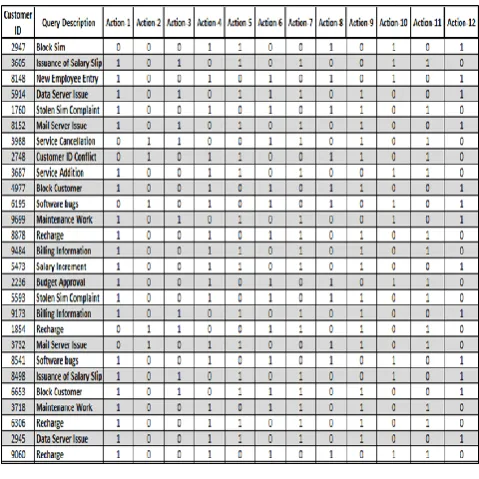
As the FP growth algorithm only use binary data entries [37], the data finally Transformed (Step-4) into binominal data entries (0, 1), where “0” denotes “False” and “1” denotes “True”. Finally, the input data file is ready to be executed considering both FP growth algorithm and Rapid Miner tool, to generate rules from pre-processed dataset. Figure 3 represents part of input data file, where number of actions taken by the ERP system is showing for each query. In the dataset, customer is used for any type of query initiated from either customer or other stakeholder. Each row belongs to the
single transaction, which denotes single customer query. After receiving the query from a customer, the firm needs to process the query based on prescribed list of activities, called as action(s) in this dataset. Those lists of action(s) taken for each query are reflected in separate column also known as attribute. As per the requirement of FP growth algorithm, the data entries are replaced with binary numbers as discussed above. In this action(s) column, the value “1” represents that particular action that was taken, while “0” denotes that action never been taken. For example, as shown in Figure 3, the first row describes that, a customer ID (2947) requested the firm to block the sim card. To execute this query successfully, some actions (4, 5, 8, 10, and 12) were taken.
Fig. 3: A Snapshot of Input Data File after Pre-Processing
4.3
FP Growth Algorithm
FP growth algorithm extract all frequent used items in the data file. These items represent consolidation of dataset that frequently took place together in the data with some association between their attributes. The detection of frequent dataset is known as “association rules”. As Rapid Miner suggest, the FP growth operator generates items that occurred very frequently. This algorithm first remove the item which is not frequent, the remaining data then will be useful for generating association rules [37]. This algorithm actually builds a tree, which helps to identify the association between the items. All frequent items then grow from that tree [33]. The FP Growth algorithm is shown in Exhibit 2.
Exhibit 2: FP-growth Algorithm [8]
Input
: constructed FP-tree
Output
: complete set of frequent patterns
Method
: Call FP-growth (FP-tree, null).
procedure
FP-growth (Tree, α)
{
1. if Tree contains a single path P then
2. for each combination do generate pattern
β
[image:3.595.56.282.502.638.2]3. Else For each header ai in the header of
Tree
do 4. Generate pattern β = ai
α with support =
ai.support;
5. Construct β.s conditional pattern base
and then
β.s conditional FP-tree Tree β
6. If Tree β = null
7. Then call FP-growth (Tree β, β)
Generating Association Rules and Result
Discussion
[image:4.595.315.569.247.549.2]The next step in the implementation phase is to apply FP growth algorithm on pre-processed data file as discussed in Section 4.2. The purpose of this algorithm is to first find out the frequent items in the dataset which takes place as much as per the given support value. Then, the number of times the first items takes place and the second item also takes place, based on the confidence value [38]. As per the specification of given datasets, the actions in the data file are considered as items. The FP growth algorithm applied on the data file to figure out the association between different actions taken to execute the query. Figure 4 shows the complete process of FP growth implementation where a combination of three operators; namely, Rapid Miner (Data Input File), FP-Growth Algorithm, and Create Association rules takes place.
Fig 4: FP Growth Implementation using Rapid Miner
The process starts with reading the data from source file and then forward it to the FP growth operator. The important parameter of this algorithm is to provide the minimum support value before executing the process. The support value is known as how many times two or more items take place together using FP growth operator. According to the data set, the operator searches those actions, which occurred frequently in the file together for different queries. It then calculates the percentage of occurrences and based on the given minimum support value, it finalizes the list of actions occurred together frequently, in the form of two-actions together, three-actions together, and so on.
At this stage, the dataset is reduced by considering only those actions took place more frequently while the remaining dataset is discarded. The frequent actions are then forwarded to the operator known as “Create Association Rule”. This operator includes algorithm using minimum confidence value, to generate association rules. The confidence value is defined as if an action takes place, then what is the probability of another action takes place too.
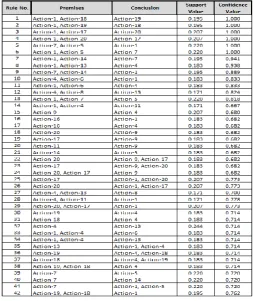
Figure 5 shows an example of list of generated rules in this experiment by giving values 0.7 and 0.2 for support and confidence respectively. Altogether, 230 rules generated in
this experiment based on the given support and confidence value.
For example, the rules can interpret as follows:
Rule No.1: If Action-1 and Action-18, executed together for any type of query, then there is 100% chances that Action-19 will be processed as well.
Rule No.14: If Action-1 and Action-4, executed together for any type of query, then there is 66.7% chances that Action-11 will be processed as well.
Rule No.42: If Action-19 and Action-18, executed together for any type of query, then there is 76.2% chances that Action-1 will be processed as well.
Fig 5: List of Association Rules
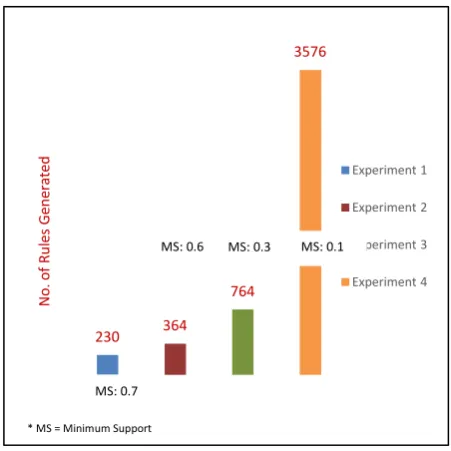
The results indicate that the list of actions is correlated, where most of them are highly correlated. As per the given results there are more than 200 rules generated which is an indication that the steps of actions taken in the ERP system are associated with each other. Repeating the experiment with different minimum support, while keeping the minimum confidence value the same. The experiments show fluctuation of number of rules generated with respect to the minimum support as shown in Figure 6. The experiment shows that, increasing the value of minimum support results in the number of rules decreased. In fact, the minimum support value displays a major factor that can be applied on selecting frequent items. Increasing the minimum support results in less frequent pattern.
[image:4.595.56.299.362.482.2]minimum support. These can further be studies by the organization to accept or reject the rule based on rules credibility. The accepted rules are useful for creating new business processes or to improve existing ones. More rules can have more choices for the managers where they provide better analysis on ERP data. Therefore, this work suggests the validity of the framework for analyzing the ERP data using data mining.
These results confirm that an organization can take decision based on generated rules. In addition, the study suggests that the list of activities performed in organizations to fulfill the requirements of the queries are correlated with each other. The rules are very much associated with the organization, in a way to forecast the forthcoming issues from ERP users and customers. Based on the generated rules, the organization can build strategies to improve their business processes such as;
The frequent actions can be improved with proper modification.
For all those actions correlated, the organization can put more emphasize on the employees who are related to perform and execute these actions.
Based on the importance and combination of different actions, an organization can spare designated team for that purpose.
[image:5.595.52.278.371.597.2] Organizations can improve methods of production or other activities, which occurred more frequently.
Fig 6: No. of Rules Generated in each Experiments for Minimum Confidence is 0.2
5.
CONCLUSION AND FUTURE WORK
ERP system is the backbone of any organization dealing with customers every day. This research explores the idea of applying data mining on ERP database. For this purpose, association-mining algorithm is applied to generate different kind of rules. To analyze the ERP data, this research proposed a framework to extract the data from ERP database and implement data mining technique. For model implementation, a mobile services provider company was selected as a case study for ERP data collection. The results indicate the positive improvement by generating number of rules associated with different actions perform to execute customer’s queries. Using
this framework, a firm can build many strategies to deal with business processes, which can ultimately improve the organizational performance. The case study of this research applied on a limited dataset. A large dataset consideration can further improve the results efficiently. The model can further be improved by integrating other kind of data mining algorithms, and/or comparing them to reflect on the accuracy of each.
6.
REFERENCES
[1] M. K. Kolkas, H. El Bakry, and A. A. Saleh, “Integrated Data Mining Techniques in Enterprise Resource Planning ( ERP ) Systems,” vol. 3, no. 2, pp. 131–150, 2014.
[2] Y.-S. Chen, C.-K. Lin, and W.-S. Chen, “Performance Evaluation of Data Mining Technologies: An Example of ERP System Adoption,” in International Conference on Frontier Computing, 2016, pp. 963–970.
[3] M. H. Olson, Management information systems: conceptual foundations, structure, and development. New York: McGraw-Hill, 1985.
[4] W.-H. Wu, C.-F. Ho, H.-P. Fu, and T.-H. Chang, “SMES implementing an industry specific erp model using a case study approach,” J. Chinese Inst. Ind. Eng., vol. 23, no. 5, pp. 423–434, 2006.
[5] F. Saleem et al., “Comparative Study from Several Business Cases and Methodologies for ICT Project Evaluation,” Int. J. Adv. Comput. Sci. Appl., vol. 7, no. 6, pp. 420–427, 2016.
[6] F. Saleem, N. Salim, A. H. Altalhi, Z. Ullah, & AL-Malaise AL-Ghamdi, A., and Z. Mahmood Khan, “Assessing the effects of information and communication technologies on organizational development: business values perspectives,” Inf. Technol. Dev., pp. 1–35, 2017.
[7] F. Saleem, N. Salim, A. G. Fayoumi, A. Alghamdi, and Z. Ullah, “Comprehensive Study of Information and Communication Technology Investments: A Case Study of Saudi Arabia,” Inf. J., vol. 16, no. 11, pp. 7875–7893, 2013.
[8] A. S. A. Alghamdi, “Rules generation from ERP database: A successful implementation of data mining,” Int. J. Comput. Sci. Netw. Secur., vol. 12, no. 3, p. 21, 2012.
[9] S. A. Alwabel, A. M. Ahmed, and M. Zairi, “The Evolution of ERP and its Relationship with E-business,” Int. J. Enterp. Inf. Syst., vol. 2, no. 4, pp. 1–23, 2005.
[10] S. Rouhani and A. Z. Ravasan, “ERP success prediction: An artificial neural network approach,” Sci. Iran., vol. 20, no. 3, pp. 992–1001, 2013.
[11] J. May, G. Dhillon, and M. Caldeira, “Defining value-based objectives for ERP systems planning,” Decis. Support Syst., vol. 55, no. 1, pp. 98–109, 2013.
[12] K. Bokovec, T. Damij, and T. Rajkovič, “Evaluating ERP Projects with multi-attribute decision support systems,” Comput. Ind., vol. 73, pp. 93–104, 2015.
[13] J. Motwani, “Critical factors for successful ERP implementation: Exploratory findings from four case studies,” Comput. Ind., vol. 56, no. 6, pp. 529–544, 2005.
230 364
764
3576
N
o
. o
f
R
ul
es
G
ene
rat
ed Experiment 1
Experiment 2
Experiment 3
Experiment 4
* MS = Minimum Support
MS: 0.1
MS: 0.7
[14] M. Al-Mashari, A. Al-Mudimigh, and M. Zairi, “Enterprise resource planning: A taxonomy of critical factors,” Eur. J. Oper. Res., vol. 146, no. 2, pp. 352–364, 2003.
[15] Z. Ullah, A. S. Al-Mudimigh, A. A. L.-M. Al-Ghamdi, and F. Saleem, “Critical success factors of ERP implementation at higher education institutes: A brief case study,” Inf., vol. 16, no. 10, 2013.
[16] J. Ram, D. Corkindale, and M. L. Wu, “Implementation critical success factors (CSFs) for ERP: Do they contribute to implementation success and post-implementation performance?,” Int. J. Prod. Econ., vol. 144, no. 1, pp. 157–174, 2013.
[17] F. Saleem and A. Malibari, “Data mining course in information system department- case study of King Abdulaziz University,” in 2011 3rd International Congress on Engineering Education: Rethinking Engineering Education, The Way Forward, ICEED 2011, 2011.
[18] M. J. Berry and G. Linoff, Data mining techniques: for marketing, sales, and customer support. John Wiley & Sons, Inc., 1997.
[19] Oracle, “Data Mining Concepts,” Oracle Data Mining Concepts, 2008. [Online]. Available: https://docs.oracle.com/cd/B28359_01/datamine.111/b28 129.pdf. [Accessed: 05-Oct-2018].
[20] J. Han, J. Pei, and M. Kamber, Data mining: concepts and techniques, 3rd ed. Elsevier, 2012.
[21] A. S. Al-Mudimigh, F. Saleem, and Z. Ullah, “The effects of Data Mining in ERP-CRM model - A case study of MADAR,” WSEAS Trans. Comput., vol. 8, no. 5, 2009.
[22] R.-S. Chen, C.-C. Chen, and C.-C. Chang, “A web-based ERP data mining system for decision making,” Int. J. Comput. Appl. Technol., vol. 17, no. 3, pp. 156–169, 2003.
[23] A. S. Mudimigh, Z. Ullah, F. Saleem, and F. N. Al-Aboud, “Data mining for customer queries in ERP model - A case study,” in NCM 2009 - 5th International Joint Conference on INC, IMS, and IDC, 2009.
[24] V. Sathiyamoorthi and V. M. Bhaskaran, “Data Mining for Intelligent Enterprise Resource Planning System,” Int. J. Recent Trends Eng., vol. 2, no. 3, pp. 1–5, 2009.
[25] I. Pawełoszek, “Data mining approach to assessment of the ERP system from the vendor’s perspective,” in Information Technology for Management, Springer, 2016, pp. 125–143.
[26] F. Al-Mudimigh, A. S., Ullah, Z., & Saleem, “A framework of an automated data mining systems using ERP model.,” Int. J. Comput. Electr. Eng., vol. 1, no. 5, 2009.
[27] S. Sumathi and S. N. Sivanandam, “Data mining in customer value and customer relationship management,” Introd. to Data Min. its Appl., pp. 321–386, 2006.
[28] X. Guo, M. Chang, Y. Dong, and L. Zhang, “The Application Research about Data Warehouse Based on ERP,” in Advances in Electronic Engineering, Communication and Management Vol. 1, Springer, 2012, pp. 137–140.
[29] H. Liu, G. Frishkoff, R. Frank, and D. Dou, “Ontology-Based mining of brainwaves: a sequence similarity technique for mapping alternative features in event-related potentials (ERP) data,” in Pacific-Asia Conference on Knowledge Discovery and Data Mining, 2010, pp. 43–54.
[30] F. Al-Mudimigh, A. S., Ullah, Z., & Saleem, “Data mining strategies and techniques for CRM systems. In System of Systems Engineering, 2009. SoSE 2009. IEEE International Conference on (pp. 1-5). IEEE.,” Syst. Syst. Eng. 2009. SoSE 2009. IEEE Int. Conf. (pp. 1-5). IEEE., 2009.
[31] M. Hall, E. Frank, G. Holmes, B. Pfahringer, P. Reutemann, and I. H. Witten, “The WEKA data mining software: an update,” ACM SIGKDD Explor. Newsl., vol. 11, no. 1, pp. 10–18, 2009.
[32] Oracle, “Oracle Data Miner.” [Online]. Available: https://www.oracle.com/technetwork/database/options/od m/dataminerworkflow-168677.html. [Accessed: 04-Oct-2018].
[33] R. M. Team, “Rapid Miner.” [Online]. Available: https://rapidminer.com/.
[34] M. Rushdi‐Saleh, M. T. Martín‐Valdivia, L. A. Ureña‐López, and J. M. Perea‐Ortega, “OCA: Opinion corpus for Arabic,” J. Am. Soc. Inf. Sci. Technol., vol. 62, no. 10, pp. 2045–2054, 2011.
[35] P. Tripathi, S. K. Vishwakarma, and A. Lala, “Sentiment analysis of english tweets using rapid miner,” in Computational Intelligence and Communication Networks (CICN), 2015 International Conference on, 2015, pp. 668–672.
[36] F. Jungermann, “Information extraction with rapidminer,” in Proceedings of the GSCL Symposium’Sprachtechnologie und eHumanities, 2009, pp. 50–61.
[37] D. Hunyadi, “Performance comparison of Apriori and FP-Growth algorithms in generating association rules,” in Proceedings of the European computing conference, 2011, pp. 376–381.
[38] R. M. Team, “Rapid Miner Documentation.” [Online]. Available:
https://docs.rapidminer.com/latest/studio/operators/mode ling/associations/create_association_rules.html.
[Accessed: 02-Oct-2018]