RISKS PRIORITIZATION USING AHP METHOD -A CASE STUDY
Dulendra Kumar Patle
1, Manish Kumar Mishra
2, R. K. Mishra
31
M.Tech Scholar, Mechanical Engineering Department
2Assistant Professor & Head, Mechanical Engineering Department
3
Professor, Civil Engineering Department
Bhilai Institute of Technology, Raipur, Chhattisgarh, India
---***---Abstract -
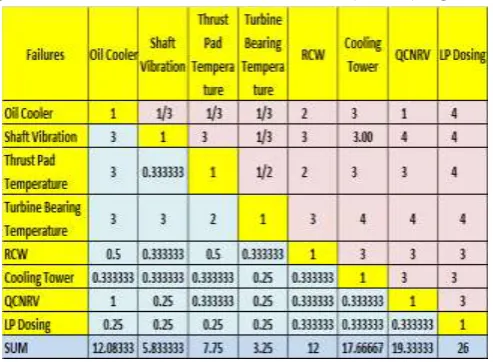
In this paper, the system of the power plant hasbeen investigated as a special type of industrial systems, which has a significant role in improving societies since the electrical energy has entered all kinds of industries, and it is considered as the artery of modern life. The electricity power generation plays the important role of every business or industrial, since it must be supplied to cove with the full consumption on demand sites. A survey has been conducted to identify the chances of failures of various machinery/ equipment which may occur in thermal Power Plant at Jaiswal Neco Industries Limited, Raipur. Many factors for failure are come to be known, out of which some major critical factors are identified for which AHP analysis is conducted. Failure Modes and Effects Analysis (FMEA) is methodology for analyzing potential reliability problems early in the development cycle where it is easier to take actions to overcome these issues, thereby enhancing reliability through design. A process or a design should be analyzed first before it is implemented and also before operating a machine the failure modes and effect must be analyzed critically. A comparative analysis of various risks factors reduces the chance of its occurrence. The main motive of this paper is risk Prioritization using AHP method, which are more severe for the Company.
Key Words: FMEA, AHP, Risk Prioritization
1. INTRODUCTION
The analysis of potential failure modes of a system or a machine is an efficient method to evaluate system to increase system efficiency and increase of user safety. An important and practical technique to identify and rank potential and actual factors of failure is FMEA. By identification and ranking of error factors, we can eliminate or mitigate them and increase durability and reliability of system and reduce maintenance costs. The existing models of quality improvement focus on existing condition of elements in institutions and the most important elements are identified finally and this leads to quality improvement but the suitable approach is prevention of failures in system and besides reducing quality, loyalty and commitment of current customers are threatened severely and the application of goods and services can be stopped. Thus, it is required to identify these failures considered as failure to meet suitable quality level and to evaluate scientifically to pass the most sensitive stage for quality improvement. Risk
management is a critical component of strategy development and execution, and a driver of firm success.
Maintenance is the crucial issue for the plant with highly complexity and a variety of machines such as thermal power plant, cement plant, oil refining plant and so on. The main of maintenance propose is to suppress the risky of plant suddenly shutdown with uncontrollable system. A thousand of equipments at each plant unit must be take care depending on maintenance policy such time based maintenance, break down maintenance etc. All equipments are mostly importance to be maintained in order to keep them working stability supposed with ill-conditioning operation.
Failure mode, effects and criticality analysis (FMECA) is the also most popular systematic assessment of a process (product) that enables us to determine the location and the mechanism of potential failures, with the aim of preventing process (product) failures. FMECA is characterized by a bottom-up approach by which any complex production system is decomposed into its constituent parts, which are successively analyzed to find all the potential failure causes and their effects.
Failure Modes and Effects Analysis (FMEA) is a technique for evaluate possible reliability troubles in the early hours at the progress cycle where it is simpler to acquire actions to overcome these matters, thereby improving consistency through design.
Failure mode, effects and criticality analysis (FMECA) is the most popular systematic assessment of a process (product) that enables us to determine the location and the mechanism of potential failures, with the aim of preventing process (product) failures. FMECA is characterized by a bottom-up approach by which any complex production system is decomposed into its constituent parts, which are successively analyzed to find all the potential failure causes and their effects.
Whereas anticipating each failure mode is not possible, the improvement squad ought to invent as extensive a record of likely failure modes as probable.
Case study
This paper is based on process FMEA which analyses the failure of Turbine auxiliaries and its effect on power generation of Power Plant. In this research the thermal power plant of Jaiswal Neco Industries Limited, Raipur is selected to analye the failure mode. The developed method can help the maintenance team for making decision in spare part management and it is friendly-user to pursuit the maintenance policy focused on critical maintaining equipments in overall systems. Some of the problem arised are:
1. Problem in Heat Exchanger of Oil System of Turbine.
a. Remains high Thrust Pad temperature of Turbine Shaft.
b. High Axial and differential expansion of turbine.
2. Found high vibration in Turbine body.
a. Problem in Recirculation cooling water pump.
b. Auxiliary power consumption of plant become high due to running of stand by pump.
c. Increase in Steam consumption of turbine due to decrease in condenser vacuum.
d. Exerts high pressure, due to running of standby pump, on oil cooler fins and reduce life of oil cooler.
Major Equipment in which problem has arised are:
OIL COOLERS
Normally two oil coolers of 100% capacity each are provided to cool entire oil supplied to turbine bearings, gearbox, and generator bearings for lubrication. Governing oil is not cooled at oil cooler. This oil is taken out before oil cooler. One cooler is put on line and another one is kept as standby. Online changeover facility is provided to take the standby cooler in to service while turbine is running without interruption of oil supply. Before changeover, it is to be ensured that the standby cooler is filled with oil and air is vented out properly. Otherwise there will be air lock and oil supply to bearings may interrupt.
SHAFT VIBRATION:
Vibration of the turbine indicates condition of turbine in running condition. Rotor rotates at high speed through set of
journal bearings. There is little clearance in between rotating and stationary parts. Due to misalignment, disturbance in balancing, rubbing of moving part etc., rotor tends to vibrate. This vibration is supposed to be within permissible limit. Excessive vibration may damage turbine and lead to extensive maintenance.
THRUST PAD/ BEARING TEMPERATURE:
Journal bearings are used to take radial load of the shaft. But it can't axial load. Shaft is permitted to float to both axial float is restricted to certain limit. Excessive axial shift may damage rotating and fixed parts. For this thrust bearing are provided. Particularly in turbine, fluid film tilting pad type thrust bearing is used.
Due to friction heat is generated in journal bearing which is cooled by help of lubricating oil. At higher temperature, babbating material of the bearing can damage. So it is required to keep the bearing temperature within safe limit. For this, temperature of bearing is monitored continuously.
TURBINE BEARING TEMPERATURE:
Journal bearing is a cylinder which surrounds the shaft and is filled with lubricating oil. It consists of a split outer shell of hard metal and a soft metal at the inner cylindrical part. In this bearing a shaft or journal rotates inside the bearing over a layer of lubricating oil, separating the shaft and bearing due to fluid dynamics principle. This lubricating oil layer supports the shaft preventing metal to metal contact. Oil is pumped into the bearing through oil pump. When rotor rotates lubricating oil is drawn up around the journal due to hydro dynamic effect of lubrication. When lubrication is introduced between two surfaces of rolling contact, it creates a large increase in pressure. Some of the failure mechanisms are
1-Overload
2-Overheating 3-Fatigue
4-Erosion
COOLING WATER SYSTEM:
1-Open or once through System
2-Closed system COOLING TOWER:
Cooling tower is a structure in which hot water is made droplets with the help of nozzle to increase contact surface of water and allowed to come in contact with atmospheric air. Atmospheric air is having certain capacity to absorb water vapors at a given temperature. Water vapors is created due to evaporation of water heat is required. This heat is obtained from remaining water. So this remaining water is cooled as heat is heat is removed from it for evaporation. Rate of evaporation and hence drop in cooling water temperature depends upon following factors.
INDUCED DRAFT COUNTER FLOW COOLING TOWER:
A mechanical fan is located at top of the tower. Water is distributed throughout the area of tower and made droplets with the help of spray nozzles. Mist eliminators are placed above distributed pipe line and nozzle to restrict escape of vapor mist to atmosphere. Hot water is allowed to flow down to the basin by gravity. When fan is started atmospheric air is socked and enters through the louvers. This air moves up and comes in contact with downward droplets. It carries the heat of water and discharge to atmosphere through the fan. Flow of air and water is in counter direction. SO the temperature between the hot water and cool air is almost same throughout the mixing area. So this type of tower is thermodynamically most suitable. Cold water is collected in a basin from where water is drawn out for further use in condenser. This complete arrangement is called as a cell. Cells are connected side by side in parallel to meet the requirement of plant.
2. METHOD AND PROCEDURE
Analytic Hierarchy Process (AHP) is one of Multi Criteria decision making method that was originally developed by Prof. Thomas L. Saaty. In short, it is a method to derive ratio scales from paired comparisons. The input can be obtained from actual measurement such as price, weight etc., or from subjective opinion such as satisfaction feelings and preference. AHP allow some small inconsistency in judgment because human is not always consistent. The ratio scales are derived from the principal Eigen vectors and the normalized principal Eigen vector is also called priority vector. Since it is normalized, the sum of all elements in priority vector is 1. The priority vector shows relative weights among the things that we compare.
The largest Eigen value is called the Principal Eigen value, which is very close to our approximation (about 1% error). The principal Eigen vector is the Eigen vector that
corresponds to the highest Eigen value. Thus the sum of Eigen vector is not one. When you normalized an Eigen vector, then you get a priority vector. The sum of priority vector is one. Prof. Saaty proved that for consistent reciprocal matrix, the largest Eigen value is equal to the number of comparisons, or . Then he gave a measure of consistency, called Consistency Index as deviation or degree of consistency using the following formula
Again, Prof. Saaty proposed that we use this index by comparing it with the appropriate one. The appropriate Consistency index is called Random Consistency Index ( ).
[image:3.595.311.558.600.781.2]He randomly generated reciprocal matrix using scale , , …, , …, 8, 9 (similar to the idea of Bootstrap) and get the random consistency index to see if it is about 10% or less. The average random consistency index of sample size 500 matrices is shown in the table below
Table 8: Random Consistency Index ( )
n 1 2 3 4 5 6 7 8 9 10 RI 0 0 0.58 0.9 1.12 1.24 1.32 1.41 1.45 1.49
Then, he proposed what is called Consistency Ratio, which is a comparison between Consistency Index and Random Consistency Index, or in formula
By now you have learned several introductory methods on multi criteria decision making (MCDM) from simple cross tabulation, using rank, and weighted score until AHP. Using Analytic Hierarchy Process (AHP), you can convert ordinal scale to ratio scale and even check its consistency.
3. CONCLUSION
A survey has been conducted to identify the chances of failures of various machinery/ equipment which may occur in thermal Power Plant at Jaiswal Neco Industries Limited, Raipur. Many factors for failure are come to be known, out of which some major critical factors are identified for which AHP analysis is conducted. From the survey conducted is it is found that Turbine Bearing Temperature, shaft vibration, problem in Cooling Tower are major concern which are to be taken in account.
REFERENCES
1. A. A. Nannikar, D. N. Raut, R. M. Chanmanwar, S. B. Kamble “FMEA for Manufacturing and Assembly Process” International Conference on Technology and Business Management March 26-28. 2012.
2. Aravinth, subramanian .s, sri vishnu . “Process Failure Mode and Effect Analysis on Tig Welding Process - A Criticality Study” International Journal of Advances in Engineering & Technology, may 2012. ©ijaet
3. B.G. Dale and P. Shaw, “Failure Mode and Effects Analysis in the U.K. Motor Industry: A State-of-Art Study,” Quality and Reliability Engineering International, Vol. 6, 184, 1990.
4. Marcello braglia, Marco frosolini1 and Roberto montanari “Fuzzy Topsis Approach for Failure Mode, Effects and Criticality Analysis”, International journal of Quality and Reliability Engineering, Int. 2003; 19:425– 443 (doi: 10.1002/qre.528)
5. Ramadhan RH, Wahhab HIA, Duffuaa SO. (1999) “The use of an analytical hierarchy process in pavement maintenance priority ranking”, Journal of Quality Maintenance Engg. 5(1): 25–39.
6. Suebsomran A., Talabgeaw S. “Critical Maintenance of Thermal Power Plant Using the Combination of Failure Mode Effect Analysis and AHP Approches” AIJSTPME (2010) 3(3): 1-6
7. Tao HU, Jian YU, Shu-zong WANG “Research on Complex System FMEA Method Based on Functional Modeling”. 8. Belton, V., Stewart, T.J., 2001: Multiple Criteria Decision
Analysis: An Integrated Approach. Kluwer Academic Publishers: Dordrecht.
9. De Brucker, K., de Winne N., Peeters C., Verbeke A. and Winkelmans W., 1995: Socio−economic evaluation of transport infrastructure: the use of multi−criteria−analysis. International Journal of Transport Economics, XXII, no 3: 261−281.
10. Drake, P.R., 1998: Using the Analytic Hierarchy Process in Engineering Education. Int. J. Engng. Ed. Vol.14, No.3, p.191−196.
11. Gomez−Limon, J., Atance, I. 2004: Identification of public objectives related to agricultural sector support. 90th European Seminar of EAAE: Mulit functional agriculture, policies and markets. Rennes (France), October 2004. 12. Kangas, J., Kangas, A., Leskinen, P., Pykäläinen, J., 2001:
MCDM Methods in Strategic Planning of Forestryon state−owned lands in Finland: Applications and Experiences. Journal of Multi−Criteria Decision Analysis.
13. Kepner, C.H., and Tregoe, B.B., 1965: The rational manager: a systematic approach to problem solving and decision making. McGraw Hill: New York.
15. Sawhney,R., Subburaman.K., Sonntag,C., Capizzi.C., Rao.P.V (2009), “ A Modified FMEA Approach to Enhance Reliability of Lean Systems”, accepted to International Journal of Quality and Reliability Management
16. Scherrer-Rathje,M., Boyle,T.A., Deflorin, P. (2009), “Lean, take two! Reflections from the second attempt at the Lean Implementation”, Business Harizons, Vol 52 Issue 1 pp. 79-88.