Centralized Electronic Voting System
Prachi Zalte
Student Dept.E&TC
SITRC
Sonali Gajare
Student Dept.E&TC
SITRC
Vaibhav Gujarathi
Student Dept.E&TC
SITRC
S. J. Pawar
Professor Dept.E&TC
SITRC
ABSTRACT
There has been a new record set by India for voter turnout at 66.38% for the General Election 2014 and awareness to vote is rising .Since then the need of project to create an electronic voting system which is centralized i.e. the voter can vote from any region and data will be automatically uploaded on a centralized server has become a necessity. Number of voters increases day-by-day as time and population in developing countries increase in decades. In day to day practice, majority of voters are busy or occupied to go for work and most of the voter’s homes are situated far away from the voting centers, also voters don’t like to wait in queues as their time is also valuable. Because of such reasons voter don’t visit the polling booth and percentage of voting is decreasing. Centralized server based voting system is very similar for the amendment of this percentage of voting, which is every person’s right. In ancient voting systems such as the electronic voting and paper based voting, there were issues of security and also the time taken to count the votes were more. Some improvements are needed in this field. The idea of Centralized Electronic Voting System can prove very useful to solve these problems. i.e. Rigging and Security problems are reduced as compared to old system. Because of the Centralized Electronic Voting System the problem of Rigging i.e. Fake Voting and security issues are solved. The voter can cast his vote from any region because of this there is no need to go to particular region for voting and due to this time is saved. As well as the simultaneous counting can be done in this system and because of this time required to display results is less.
Keywords
E-Voting Machine, ATmega328 Microcontroller, Fingerprint Sensor, Visual Basic, Authentication.
1.
INTRODUCTION
Election plays a significant role in forming governments in almost every country and India is one of them. Through Elections, people decide the authorities of different parties who will play the major role in development of a country according to the final results. All over the world there are different methods and techniques of voting that have been adopted [8]. Since the dawn of previous century elections were held in the ballot paper and boxes at which ballot paper had different symbols for each candidate respectively. Each voter has to stamp besides the symbol of their chosen candidate. But paper based voting process is very non-efficient, time-consuming, financially not suitable and many human errors occur in this system [14]. This phenomenon seized to exist after the on-coming modern systems such as Electronic Voting Machine.
The first implemented working models of EVM by Election Commission of India was mooted in the year 1977 which were devised and designed in co-operation with Bharat Electronics Limited (BEL), Bangalore and Electronics Corporation of India Limited (ECIL), Hyderabad[4]. In EVMs
the people have to just press the button besides the symbol of their chosen candidate. There are different types of voting systems that are designed to modify the voting and the counting mode easier and to overcome the disadvantages of the Paper Ballot method [8]. In Electronic Voting Machine, there is a security flaw viz. The program installed in it can be changed and modified by anyone and block the results after the voting. Also one can replace the small part of EVM to steal the percentage of votes. The loss of votes in the other candidates is the result of such malpractices.
To deal with the shortcomings of the existing voting machines a new system has been devised which is called as Centralized Electronic Voting System. In this system a database for registration of voter (i.e. Add, Search and Edit the voter’s information in this database) is created. The authentication is done by fingerprint scanner [2,5,18]. Authentication of the voter is done by matching his data from the previously made centralized data server. If the fingerprint gets matched then that person can cast his vote and therefore this data is saved and uploaded on the server at the end of Election Day. As the data is centralized i.e. the data would also be uploaded from different location for the same region. Simultaneous counting is also done and the final result would be displayed on LCD after the polling officer enters the password. There is great need for implementation of this system on large scale as it reduces manufacturing cost, voter’s efforts and vote counting time. The corresponding paper is organized as: Literature Survey, Outcome, Proposed Methodology, Result and Discussion, Conclusion and References.
2.
LITERATURE SURVEY
2.1
Issues of Existing Voting System
There are many types of problems encountered with EVM which is currently in use they are:
As INDIA is a Democratic country therefore only the eligible voters have permission to vote and their votes are counted only once. For safety problem anyone can change the program of the EVM and change the results after the polling. Also anyone can easily replaced the small part of the machine to steal the percentage of votes in the favor of chosen candidate and from a mobile phone these instructions are able to send wirelessly. By the illegal electoral list one candidate can cast the votes of all members or few amount of member in the candidate’s favor. The loss of votes for the other candidates participating and also increases the no. of vote to the candidate who performs this action are the adverse effect of it and at the time of voting this can be done externally.
2.2
Improvements
systems are developed which overcomes all the drawbacks of old systems. To develop new system review of old machines are required which is given below.
Shekhar Mishra et.al[2] presented a new voting process making use of Biometric technology for voters identification purpose. This concept of biometric technology used in the paper increases the security and stopped Rigging. But the limitation of the system is that person has to be present at the voting booth for voting because of this time and money is waste.
Dinesh Bommisetty et.al [3] proposed a system designed for E-Voting developed on Internet of Things. Because of the concept of IOT used in the paper the data is securely stored in the cloud. But the drawback is that they have used RFID cards for identification and these cards are misplaced and double voting can be done.
R. Murli Prasad et.al [4] focused on the new E-Voting process by using Aadhar card Technology for authentication purpose. The main advantage of this system is that there is no need to create new database. But Aadhar card data is confidential that’s why we cannot used it for Institute level projects.
Rajashree Raskar et.al [7] approach was based on developing a secured mobile based E-Voting system. This paper focused on the design of android application for E-Voting. Vaibhav Bhatia et.al [10] used hardware architecture developed by Microchip Technology. Infrared sensors and GSM Module are interfaced with Microcontroller. But the range problem is the main issue in GSM Technology.
Meharaj Unnissaa et.al [8] presented a new EVM based on Microcontroller. By pressing the switches it is possible to store the data of four candidates and the result of votes would be shown on the LCD. The capacity to store the data is more in this system but complexity is in hardware implementation.
[image:2.595.299.557.71.443.2]Devendra Vijay Naik [13] presented a Web based EVM and Biometric Technology. Because of Biometric Technology accuracy and security is more in this system but the system is little bit complex for implementation.
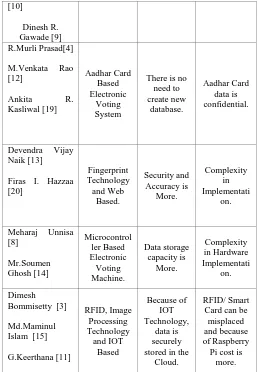
Table 1. Survey of Review Papers
Author’s Name Technology
Used Advantages
Disadvantag es
Shekhar Mishra [2] S.V.More [5] Firas Hazzaa [18] Biometric Technology Because of Fingerprint identificatio n security increases and Rigging will stopped
Person have to present
In the voting booth for
voting. Because of this time and
money is waste.
Rajashree Raskar [7]
Vaibhav Bhatia
GSM Technology
There is no need to go to
the Polling Booth for
voting.
Range problem can
occur in GSM Technology. [10] Dinesh R. Gawade [9] R.Murli Prasad[4]
M.Venkata Rao [12]
Ankita R.
Kasliwal [19] Aadhar Card Based Electronic Voting System
There is no need to create new database. Aadhar Card data is confidential.
Devendra Vijay Naik [13]
Firas I. Hazzaa [20] Fingerprint Technology and Web Based. Security and Accuracy is More. Complexity in Implementati on.
Meharaj Unnisa [8] Mr.Soumen Ghosh [14] Microcontrol ler Based Electronic Voting Machine. Data storage capacity is More. Complexity in Hardware Implementati on. Dimesh Bommisetty [3]
Md.Maminul Islam [15]
G.Keerthana [11] RFID, Image Processing Technology and IOT Based Because of IOT Technology, data is securely stored in the
Cloud.
RFID/ Smart Card can be misplaced and because of Raspberry Pi cost is
more.
3.
DESIGN AND IMPLEMENTATION
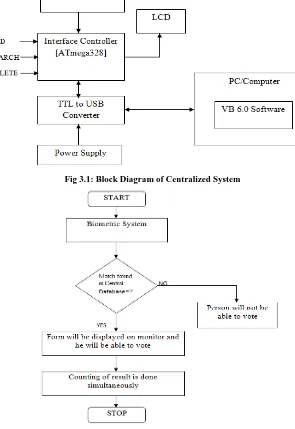
An application form will be created for registration purpose of the voter. Through this registration form data of all the voters will be collected and database will be created. This database will be available on server. At the time of voting the voter would scan his finger on fingerprint scanner which will match the template generated by the current fingerprint of the voter and the previously stored template on the database [18]. If the voter’s fingerprint matches the fingerprint previously stored then he would be further sent for casting his vote.
Fig 3.1: Block Diagram of Centralized System
Fig 3.2: Flow Chart
4.
EXPERIMENTAL RESULT
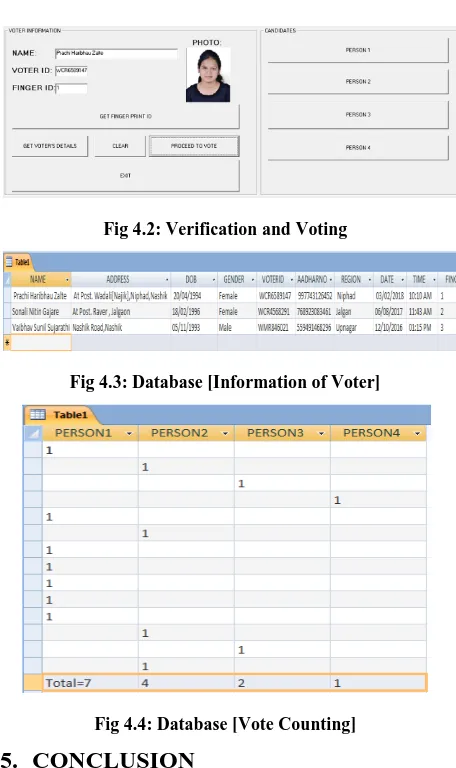
By considering above system following are the result/observations of the system; at present fingerprint data and template image is getting processed and corresponding data is fed to software for next stage processing. With dedicated design software data is getting fetched from centralized/local database related to individual voter and other important data on later part. Software is taking input from voter for recording its voter status into the database. As a result part system calculate current session voting credits and based on it winner of the voting activity will be decided.
The Process of Voting in this system is as follows:
[image:3.595.316.548.558.667.2]Fig 4.2: Verification and Voting
Fig 4.3: Database [Information of Voter]
Fig 4.4: Database [Vote Counting]
5.
CONCLUSION
Survey of review papers was carried out and many security problems that were present in the currently used voting systems were found. In currently used EVM fake voting can be done, time required for counting votes is more, this system is localized(i.e. voting cannot be done from any region), anyone can change the program installed in the EVM and block the results after the polling. These are the drawbacks of currently used voting system. In the proposed system all these drawbacks were eliminated.
Centralized Electronic Voting System has been designed for the sole purpose of minimizing hardware and creating a better interface with the user by making this system more reliable. Considering the problems of already existing system, this system is developed in such a way to overcome them with the implementation of this system in election process, surprising results can be obtained. It follows a simple procedure, consumes minimal man power, can save a lot of time, less prone to frauds and manipulations compared to already existing systems. Aim at extending this system to an advanced model in future in such a way to maximize the polling percentage can be achieved. The people who work in distant places from home towns are the ones who may not use their right to vote. If these people cast their vote that can drastically change the result. Proposed voting system is designed in such a way so that any voter can utilize his/her vote from any workplace.
6.
REFERENCES
[1] Asif Ahmad Anik and Rayeesa Jameel – “Design of Solar Power Electronic Voting Machine” , IEEE , January 2017.
[2] Shekhar Mishra and Y. Roja Peter - “Electronic Voting Machine using Biometric Finger Print with Aadhar Card Authentication” , International Journal of Engg. Science and Computing ,March 2017.
[3] Dinesh Bommisetty and Akshat Tyagi - “Raspberry Pi Voting System, A Reliable Technology for Transparency in Democracy”, International Conference on Advances in Electronics, Communication and Computer Technology, December 2016.
[4] R. Murali Prasad and Polaiah Bojja- “Aadhar based Electronic Voting Machine using Arduino”, International Journal of Computer Applications. July 2016.
[5] Trupti Umakant Pavshere and S.V.More – “A Survey on Secured E-Voting System Using Biometric”, International Journal of Advanced Research in Science, Engineering and Technology, March 2016.
[6] Anooshmita Das and Subashish Banerjee – “VOT-EL” , IEEE 2016.
[7] Rajashree Raskar S and Bhagyashree Jaykar - “Literature Survey on Secured Mobile Based E-Voting System”, International Journal of Computer Science and Information Technology Research, December 2015.
[8] Meharaj Unnisa and G.R. Hemantha - “ARM7 based Globalized Electronic Voting Machine” , BVICAM’s International Journal of Information Technology , October 2015.
[9] Sagar R. Patil and Dinesh R. Gawade - “E-Voting System using Mobile SMS” , International Journal of Research in Engineering and Technology , September 2015.
[10]Vaibhav Bhatiaand Rahul Gupta– “ Design of a GSM Based Electronic Voting Machine with Voter Tracking “, BIJIT - BVICAM’s International Journal of Information Technology, June 2015.
[11]G. Keerthana and P. Priyanka - “Impressive Smart Card Based Electronic Voting System”, International Journal of Research in Engineering and Technology , March 2015.
[12]M.Venkata Rao, Venugopal Rao Ravula and Pavani Pala- “Development of Antirigging Voting System Using Biometrics Based on Adharcard Numbering”. Amrita sai Institute of science and technology, Bathinapadu, Andhra Pradesh, INDIA. International journal of science egg. And Advance Technology, February 2015.
[13]Devendra Vijay Naik –“Smart Wireless Authentifying Voting Machine”, IEEE ICCSP 20 IS conference, 2015.
[14]Mr. Soumen Ghosh - “ Development of Microcontroller Based Electronic Voting Machine(EVM)” , IOSR Journal of Electrical and Electronics Engineering (IOSR-JEEE), April 2014.
Voting Machine (EVM) ” , International Journal of Scientific & Engineering Research, January 2014.
[16]Yousra Alkabani and Hassan Bedour – “E-Voting Attacks and Countermeasures” , IEEE 2014.
[17]Hanady Hussien and Hussien Aboelnaga - “Design of secured E-voting-voting system” Electronic and Communication Department. AAST, Cairo, Egypt 2013 IEEE.
[18]Firas Hazzaa and Seifedine Kadry – “New System of E-Voting Using Fingerprint” International Journal of
Emerging Technology and Advanced Engineering ,October 2012.
[19]Ankita R. Kasliwal and Jaya S. Gadekar – “Aadhar Based Election Voting System” , IOSR Journal of Computer Engineering (IOSR-JCE) .