The Development of Life Satisfaction:
Does Personality matter?
A five year longitudinal study
Master thesis
Enschede, January 2014
Author: Marie-Luise Müller (s0163465) University of Twente, Enschede
Faculty Behavioral science
Domain Psychology, Mental Health Promotion
Abstract
Life Satisfaction, which is supposed to predict happiness, has been widely investigated. As personality is part of one of the determinants of Life Satisfaction and provides an explanation for the stability of Life Satisfaction, it gained more interest to examine the role of personality in one’s satisfaction with life. So far, it is evident that certain personality dimensions are related to Life Satisfaction. And although many different studies examined different domains within the topic of Life Satisfaction and personality, there are still some unexplored areas. In a longitudinal research, using a representative Dutch sample (N=3146), the development of Life Satisfaction across a time period of five years was examined in relation to certain personality dimensions. Differences in the development of Life Satisfaction across five years were examined between respondents who score high/low on emotional stability and between respondents who score high/low on extraversion. Results imply that, although the extent of Lifer Satisfaction is influenced by personality, it remains stable across time, regardless of the personality dimensions. The present study also presumes that specific constellations of personality dimensions are more important for Life Satisfaction than single dimensions by itself, providing some support for the existence of a happy personality and its relation to high LS.
Samenvatting
Index of contents
Abstract ... 2
Index of contents ... 4
1 Introduction ... 5
1.1Positive Psychology and Life Satisfaction ... 5
1.2Determinants of Life Satisfaction ... 6
1.3Resilience/Stability of Life Satisfaction ... 8
1.4Life Satisfaction and Personality ...10
1.5Aims and Hypotheses of the present study ...11
2 Method ... 13
2.1 Procedure and Participants ...13
2.2 Measures ... 14
2.3 Statistical Analyses ... 16
3 Results ... 17
3.1 Connections between LS and the Big five personality dimensions ... 17
3.2 Development of LS by certain personality dimensions... 19
3.3 LS and the happy personality ... 21
4 Discussion ... 22
4.1 Connections between LS and the Big five personality dimensions ... 22
4.2 Development of LS by certain personality dimensions ... 23
4.3 LS and the happy personality ... 26
5 Strength & Limitations ... 27
6 Conclusion ... 29
Appendix ... 30
1 Introduction
The following study surveys the development of Life Satisfaction across time and the relation of the Big five personality dimensions to it. Although much is known about Life Satisfaction, including the determinants and the stability of it and the relation of the Big five personality dimensions to it, most of these studies examined the factors apart or at a single measurement occasion. It remains unanswered whether different extents of the personality dimensions play a role in the development of Life Satisfaction. Is there a difference in the development of Life Satisfaction between neurotic and non-neurotic individuals? Are neurotic individuals more erratic in their Life Satisfaction across time? The following study uses longitudinal data to provide first insights to answer these kinds of questions. To begin with, a brief elucidation of positive psychology and Life Satisfaction is given to access the topic. Furthermore, original evidence about determinants and stability is presented to better understand Life Satisfaction as a whole. Finally, the Big five personality traits and their relation to Life Satisfaction are delineated.
1.1 Positive Psychology and Life Satisfaction
For a long time, mental health was defined as the absence of mental disorders, investigating psychopathology of humans. Today, the focus on mental health as a positive state gained more attention. The World Health Organization (2004) defines mental health as “a state of well-being in which the individual realizes his or her own abilities, can cope with the normal stresses of life, can work productively and fruitfully, and is able to make a contribution to his or her community”. This change of perspective on mental health created a new psychological field, called positive psychology.
traditions: the eudaimonic tradition and the hedonic tradition (Ryan & Deci, 2001). The eudaimonic tradition focuses on the actualization of human potentials in individual and social life. Psychological well-being and social well-being fall within this tradition. The hedonic tradition views well-being as the presence of positive feelings and Life Satisfaction. The assessment of emotional well-being became the most prominent feature of hedonic psychological research. Emotional well-being (EWB) is defined as a person’s cognitive and affective (positive and negative) evaluation of his or her life (Diener, 2000). The cognitive component of EWB is called Life Satisfaction (LS) and refers to a global evaluation of one’s overall satisfaction with life. As LS is supposed to predict happiness (Diener, Oishi & Lucas, 2003), it has been widely investigated.
1.2 Determinants of Life Satisfaction
Researchers propose that LS is determined by three major factors: Life circumstances, including income level and marital status (1), intentional activities (2) and stable differences including personality factors and cognitive dispositions (3) (e.g. Diaz & Arroyo, 2011). Life circumstances, including life events and demographic conditions, are of crucial interest when examining LS. For example, Salinas-Jiménez, del Artés, and Salinas-Jiménez (2011) found that LS is positively related to income and education. Moreover, Clark, Diener, Georgellis, and Lucas (2008) described the experience of unemployment to negatively effect a person’s satisfaction with his or her life. Furthermore, marriage, as a life event, has a positive relation to LS (Lucas, Clark, Georgellis, & Diener, 2003).
1.3 Resilience/Stability of Life Satisfaction
As noted earlier (determinants of LS), different life circumstances (e.g. income level, marriage, experience of unemployment) influence an individual’s satisfaction with his or her life. Although these influences are evidenced, several studies found that an individual’s LS remains somewhat stable and resistant to life events. In detail, life events do influence an individual’s momentary LS but do not have a long-term effect on it. That is, global LS is stable across the life span.
point of LS (Diener, Lucas & Scollon, 2006). That implies that global LS indeed remains stable and resistant to positive major life changes, but regarding negative changes this resilience only applies for gently negative events (such as salary reduction). Keeping that in mind, the hedonic adaptation concept provides a reasonable explanation for the stability of LS regarding major positive and slightly negative life changes.
DeNeve and Cooper (1998) presented another explanation for the stability of LS, a so-called happy personality. The happy personality refers to the fact that the most satisfied people showed higher scores on extraversion and agreeableness and lower scores on neuroticism (Diener & Seligman, 2002). People with a happy personality experience their lives in a more positive way than other people (DeNeve & Cooper, 1998). Additionally, as noted earlier, cognitive dispositions such as hope and optimism influence an individual’s satisfaction with life (Snyder et al, 1991; Scheier & Carver, 1993). Therefore, it seems plausible that optimistic people and those with a happy personality are more likely to find a positive aspect in a negative event than pessimistic people and will thus remain more satisfied with their lives than the pessimistic individuals.
develop in individuals who do not show these personality characteristics? Does LS remain stable in these individuals as well?
1.4 Life Satisfaction and Personality
The detailed examination of LS, in terms of determinants and stability, shows that personality seems to play a crucial role in one’s satisfaction with life. As personality is part of one of the three determinants of LS and as it provides an explanation for the stability of LS, it deserves a closer consideration.
Investigating the relation between the Big five personality dimensions and LS, Hahn, Johnson and Spinath (2013) found that Extraversion (E), Conscientiousness (C) and Agreeableness (A) were positively related to LS. Neuroticism (N), on the other hand, was negatively associated with LS and Openness to experiences (O) was found to be no consistent correlate of it. Moreover, Steel, Schmidt and Shultz (2008) found that E, N and to a lesser extent C showed highest relations to LS. In particular, among the Big five personality dimensions, E and N are mostly related to LS (Diener & Lucas, 1999). Furthermore, Magee, Miller and Heaven (2013) found that an increase in E, A, C and O across a time period of 4 years was associated with higher LS, whereas an increase in N was linked to lower LS. Diener and Seligman (2002) identified that the most satisfied individuals had higher scores on E and A and lower scores on N. And although the correlations between LS and personality dimensions were moderate, Steel et al (2008) pointed out that 39 % of the variance in quality of life measures could be explained by the personality. In other words, an indiviual’s personality has a great impact on how this person perceives the quality of his/her life. Furthermore, as noted earlier, DeNeve and Cooper (1998) presented the idea of a so-called
(Watson & Clark, 1997) and happiness (Pavot, Diener & Fujita, 1990) and neurotic persons (high scores on N) are likely to be affected by negative life events (Suls, Green & Hills, 1998), it seems reasonably that people with a happy personality experience their lives in a more positive way than other people (DeNeve & Cooper, 1998). However, it seems surprising that the happy personality includes the dimensions N, E and A rather than N, E and C, as these were strongest related to LS. But, as McCrae and Costa (1991) proposed, the linkage between personality and LS seem to be direct for some dimensions and indirect for others. According to them, the presence of E and the absence of N would directly lead to satisfaction, whereas A and C exert effects indirectly on specific life situations which in turn influence satisfaction. That is, A and C may create positive conditions, such as personal bonds or high achievements, which contribute to higher satisfaction. Thus, although mere individual relations yield E, N and, to some extent, C the greatest linkage to LS, it seems that A becomes more important than C when combined with E and N, referring to the happy personality. In sum, much research is done investigating LS. The different studies explored the determinants of LS, the stability and resilience of it and the associations between the Big five personality dimensions and LS. However, none of them investigated the development of LS across time in direct relation to personality dimensions. Although we know that N, E and, to some extent, C are associated with LS, it should be interesting to investigate whether there are differences in the development of LS by different extents of the Big five personality dimensions.
1.5 Aims and Hypotheses of the present study
the development of LS, neuroticism (N) and extraversion (E) are of greatest interest, as they are mostly related to LS (Diener & Lucas, 1999). Note, for the present study the International Personality Item Pool (IPIP) was used to assess the Big five personality dimensions. The IPIP measures emotional stability (ES) rather than N. Gow, Whiteman, Pattie and Deary (2005) found a high correlation (r= -0.83) between the factor N of the NEO Five Factor Inventory and the ES factor of the IPIP. Thus, there is a high association between N and ES, leading to the conclusion that ES may be regarded as the opposite of neuroticism. Therefore, for the present study high scores on ES are interpreted as low N and low scores on ES are considered as high N. Furthermore, positive relations to ES indicate negative relations to N.
five measurement occasions. Additionally, as DeNeve & Cooper proposed the existence of a so-called happy personality, referring to the fact that the most satisfied individuals had higher scores on E and A and lower scores on N, LS was investigated in relation to this specific constellation of personality dimensions. It was hypothesized that respondents who score high on E, A and ES show greater LS than respondents who score average on these dimensions (H4).
2 Method
2.1 Procedure and Participants
The data for the present study was used from the Longitudinal Internet Studies for the Social science (LISS) panel of CentERdata, a Dutch Institute specialized in online survey research. The LISS panel is based on a representative sample of 5,000 Dutch households. Within this LISS panel, a longitudinal study is carried out once a year (the LISS core study). The LISS core study provides repeated measures of the same set of variables for the same individuals and households. The study covers eight questionnaires: Health, Politics and Values, Religion and Ethnicity, Social Integration and Leisure, Family and Household, Work and Schooling, Personality, and Economic Situation and Housing. For the present study, the data from the Personality Questionnaires from May 2008 (N=6808), May 2009 (N=5614), May 2010 (N=6084), May 2011 (N=5198) and May 2012 (N=5927) were used (five measurement occasions in total).
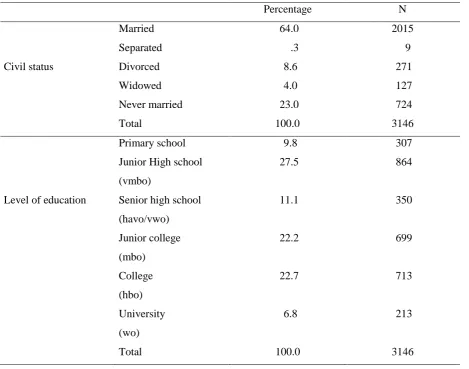
Table 1
Descriptive statistics of Civil status and Level of education (N=3146)
Percentage N
Married 64.0 2015
Separated .3 9
Civil status Divorced 8.6 271
Widowed 4.0 127
Never married 23.0 724
Total 100.0 3146
Primary school 9.8 307
Junior High school (vmbo)
27.5 864
Level of education Senior high school
(havo/vwo)
11.1 350
Junior college (mbo)
22.2 699
College (hbo)
22.7 713
University (wo)
6.8 213
Total 100.0 3146
2.2 Measures
satisfied, satisfied, slightly satisfied, slightly dissatisfied, dissatisfied and extremely dissatisfied. For the SWLS, present calculations yielded a reliability value (Cronbach’s alpha) of .88. Descriptive statistics for each measurement occasion are shown in Appendix A. The scale was part of the Personality Questionnaire.
2.4 Statistical Analyses
SPSS 22.0 was used for statistical analyses. Generally, correlation analysis was performed to examine relations and multiple regression analysis was performed to explain the variance of the dependent variable (LS) by the variance of five personality domains, wherein the variance of aspects are statistically controlled. Furthermore, repeated-measures ANOVAs were used to test mean-level differences. Overall, correlations around 0.20 were considered as low and around 0.50 as moderate.
For hypothesis 1, correlation analyses were performed to test whether, among all Big five personality dimensions, E and ES are mostly related to LS. Additionally, multiple regression analysis was performed to better understand the connections between LS and the personality dimensions. LS was used as dependent variable and E, A, C, ES and I (Block 2) were used as independent variables, while the influence of the covariates gender and age (Block 1) were evaluated. All variables for these analyses were used from the first measurement occasion, as they serve as starting point.
For hypothesis 4, the data of respondents with a happy personality was used. All respondents who had high scores on E, A and ES were considered to have the happy personality. This specific constellation of personality dimensions was found in 147 respondents. One-sample t-test was performed to test whether there is a mean-level difference in LS of respondents with a so-called happy personality compared to the average. Furthermore, serving as a comparison group, the data of respondents who scored average on E, A and ES was used. A number of 348 respondents scored average on these dimensions. For more detail comparison, descriptive statistics and frequencies were calculated.
3 Results
3.1 Connections between LS and the Big five personality dimensions
[image:17.595.66.534.628.688.2]Correlation analysis was performed to test for any relations between the Big five personality dimensions and LS, using data from the first measurement occasion. It was predicted that among all five dimensions, E and N (ES) are mostly related to LS. The analysis showed low, positive correlations of E, A, C, ES and I with LS. In detail, among all five dimensions, E, C and ES were strongest related to LS (Table 2). Hypothesis 1, among all five dimensions, E and ES are strongest related to LS could be affirmed.
Table 2
Correlation coefficients among LS and Big five personality dimensions (N=3146)
E A C ES I
LS .21* .13* .20* .42* .08*
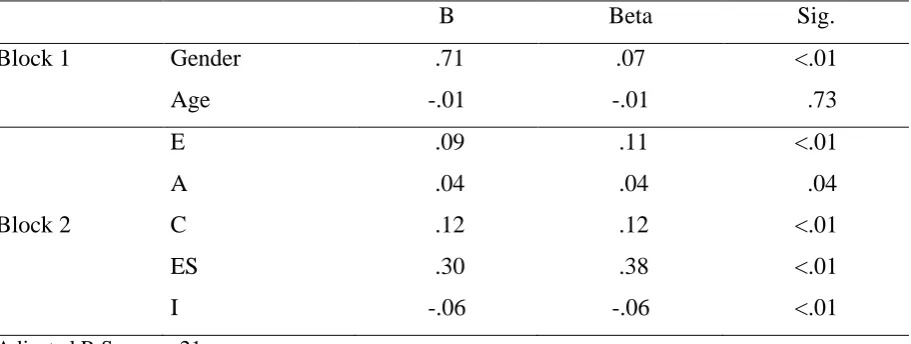
Additionally, to better understand the connections between LS and the personality dimensions, multiple regression analysis was performed to explain the variance of LS by the variance of the five personality dimensions, wherein the variance of dimensions are statistically controlled and the influence of the covariates gender and age were evaluated. Again, data from the first measurement occasion were used. Results show that there was a significant increase in R Square from Block 1 (R Square change=.01, p<.01) to Block 2 (R Square change=.21, p<.01), meaning that the combination of the five personality dimensions and the covariate gender seem to account for the variance in LS. Note, within the combination of all variables, the covariate age was not significant (Table 3). Furthermore, higher scores on E, A, C and ES were associated with higher LS. Although I showed a positive correlation with LS, in combination with the other personality dimensions an increase in I was associated with a decrease in LS (Table 3). Among the combination of all five personality dimensions, age and gender, ES was of greatest importance for LS (Table 3). Overall, the combination of the Big five personality dimensions, age and gender accounted for 21% of the variance of LS (Adjusted R Square=0.21).
Table 3
Regression coefficients of the Big five personality dimensions, age and gender* (N=3146)
B Beta Sig.
Block 1 Gender .71 .07 <.01
Age -.01 -.01 .73
E .09 .11 <.01
A .04 .04 .04
Block 2 C .12 .12 <.01
ES .30 .38 <.01
I -.06 -.06 <.01
3.2 Development of LS by certain personality dimensions
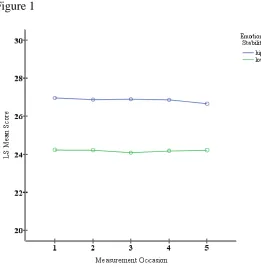
[image:19.595.76.338.424.692.2]A repeated-measures two-way ANOVA was conducted to analyse whether there are mean-level differences in LS among the five measurement occasions for respondents who score low on ES and those who score high on ES (H2). Results showed no significant differences in LS between the five measurement occasions for both groups of respondents (high/low ES) (F(3.78, 1782)=.60, p=.67). Hypothesis 2 could not be affirmed. The results imply no unstable development of LS for people who score low on ES. Nonetheless, the analysis showed significant differences in LS among the measurement occasions between high and low scorers on ES (F(1, 1782)=468.89, p<.01). As shown in Figure 1, individuals who score high on ES showed higher scores on LS among the five measurement occasions than individuals who score low on ES. Thus, people who score low on ES are less satisfied with their lives among the five measurement occasions compared to those who score high on ES.
Figure 1
Furthermore, another repeated-measures two-way ANOVA was used to test whether there are differences (increases) in LS among the five measurement occasions for respondents who score high on E and those who score low on E (H3). The results showed no significant differences in LS between the measurement occasions for both groups of respondents (F(3.72, 1821)=.75, p=.55). The results imply no increases in LS among the measurement occasions for people who score high on E. Nevertheless, the analysis showed significant differences in LS between high and low scorers on E (F(1, 1821)=143.13, p<.01). As shown in Figure 2, individuals who score high on E showed higher scores on LS among the five measurement occasions than those who score low on E. In sum, hypothesis 3 could not be confirmed. People who score high on E do not show a positive progress in LS in terms of increases in LS. Nonetheless, these individuals were more satisfied with their life among the five measurement occasions compared to those who score low on E.
Figure 2
3.3 LS and the happy personality
One sample t-test was conducted to test whether there is a mean-level difference in LS between respondents with a so-called happy personality and people who score average on E, A and ES. The LS mean score of people who scored average on the dimensions was used as test value. Results showed a significant difference in LS between these people (T(147)=11.26,
[image:21.595.74.529.565.711.2]p=.00). Individuals with a happy personality scored higher on LS (M=29.40, SD=3.66) than individuals who scored average on the dimensions (M=26.20, SD=4.39). Additionally, for more detail comparison, different descriptive statistics and frequencies were computed. First of all, frequencies of LS were compared between respondents with a happy personality and respondents who scored average on the dimensions. Results showed that among the happy personality, most of the respondents fall within the highly satisfied group, whereas most of the respondents among the average scores on E, A and ES fall within the satisfied group (Table 4). Finally, frequencies of the happy personality were computed among all respondents who were highly satisfied with their lives (N=750). This frequency analysis showed that 11.1% (N=83) of these people had the happy personality.
Table 4
Frequencies of LS among people with happy personality and people with average scores on the
dimensions (N=147, 348)
happy personality average E,A,ES
highly satisfied 56.5 % 21.6%
satisfied 34.0% 49.7%
slightly satisfied 7.5% 21.0%
slightly dissatisfied 2.0% 5.5%
dissatisfied 0.0% 2.0%
4 Discussion
Life Satisfaction, referring to the cognitive component of emotional well-being, has been widely investigated. Although much is known about LS so far, including determinants and different features of it, there are still some unexplored domains concerning LS. The last years, personality gained more interest when examining LS, as it seems to play a crucial role. Not only is personality part of one of the determinants of LS, but it provides an explanation for the stability of it as well. Many studies investigated the relation between LS and personality, trying to figure out whether our personality influences our satisfaction with life. It is evident that there is a connection between different personality dimensions and LS (e.g. Hahn, Johnson & Spinath, 2003). In more detail, extraversion and neuroticism seem to be of greatest interest concerning LS (Diener & Lucas, 1999). Although these are merely some of the various results, they provide a first impression of the importance of personality when investigating LS. However, LS remains a process throughout life, as we experience different positive and negative life events across time. And although many studies found that in general LS remains stable across life span and resistant to positive and a number of negative life events (e.g. Costa et al, 1987), it is unknown whether certain personality dimensions may influence the development of LS across time. The present study contributes to provide first insights in this unexplored domain by using longitudinal data to investigate the development of LS in consideration of the impact of certain personality dimension characteristics on it.
4.1 Connections between LS and the Big five personality dimensions
importance for LS. However, as LS is supposed to predict happiness (Diener, Oishi & Lucas, 2003) and Pavot et al (1990) pointed out that extraversion is associated with happiness, one would expect E to be of greatest interest for LS. Nonetheless, present results and previous studies (e.g. Steel et al, 2008) confirm that among all dimensions, ES is mostly related to LS. The assumption of Costa and McCrae (1991) may be helpful concerning these facts. They proposed that links between personality and satisfaction were direct for some dimensions and indirect for others. They assumed that personality dimensions influence specific life situations which in turn influence LS. Although they proposed these indirect influences for C and A, it may also account for E as well. Thus, although direct relations may be low or moderate for some dimensions, one should not conclude that these dimensions are less important, as they may have indirect influences. Another interesting, noteworthy finding may be the fact that demographic factors, such as age and gender, seem to be of little interest concerning LS. One would assume that certain age-groups (e.g. young adults) may be less satisfied with life, as life gets harder and more serious. Nonetheless, age seems to be of no relevance concerning LS. Overall, the combination of all personality dimensions, age and gender accounted only 21% of the variance in LS. This implies that, besides personality, there are additional substantial aspects to LS. However, the power of influence of the personality dimensions on LS should not be undervalued. Although effects and relations seem moderate in the first place, the virtue of indirect effects often tend to be overlooked. The association between LS and personality dimensions becomes more important when these indirect influences are considered as well.
4.2 Development of LS by certain personality dimensions
Concerning hypothesis 3, results were contrary to the expectations as well. Results showed no positively increasing development in LS for respondents who score high on E. As Watson and Clark (1997) and Pavot et al (1990) pointed out, E is related to the experience of positive emotions and happiness, which may have a positive influence on one’s LS. These facts may explain why respondents who score high on E are more satisfied with their lives than respondents who score low on E. Nonetheless, there was no difference in the development of LS between these respondents. That is, for both groups, LS remained stable across the measurement occasions. Again, this evident stability in LS may be explained by the hedonic adaptation, as noted earlier.
whether one is more or less neurotic or more or less extraverted for example. But it does matter for the extent one is satisfied with his/her life.
4.3 LS and the happy personality
Investigating satisfaction with life, DeNeve and Cooper (1998) presented a so-called happy personality. They found that the most satisfied people showed higher scores on E and A and lower scores on N. According to them, this specific constellation of personality dimensions induces higher satisfaction with one’s life. Although the present study focused on the progress of LS in consideration of the impact of personality dimensions on it, the happy personality seemed to be of interest concerning LS and deserved some attention. Thus, additionally to the investigation of the progress of LS, the present study examined LS in consideration of this specific personality dimension constellation.
whereas another is totally satisfied by being healthy. In fact, cognitive processes seem to be important concerning LS. For example, Robinson et al (2004/2005) found that the accessibility of unpleasant (e.g. negative life events) vs. pleasant (e.g. positive life event) information influences our LS. Furthermore, cognitive dispositions such as optimism effects our LS as well, meaning that an optimistic individual is more likely to be satisfied with life than a pessimistic individual (Scheier and Carver, 1993). Furthermore, Campbell, Converse and Rodgers (1976) referred to a cognitive comparison with other people, one’s own past, future, prospects and ideal. They proposed that the difference between what one has and what one wants (e.g. because other people have it) influences our own judgement of LS. In this respect, Buunk, Oldesma and DeDreu (2001) stated that individuals tend to be more satisfied with their lives when they can compare their lives advantageously with those of other people. In sum, although the happy personality seems to have a positive influence on LS, it is not a prerequisite for being highly satisfied with life. For one thing, this implies that other aspects, such as cognitive processes and dispositions for example, are important as well. For another, even more important thing, it indicates that there are aspects that positively influence LS without being a requirement for it. That means that as a certain factor is given (e.g. happy personality), it positively effects an individual’s LS, but the absence of that factor does not consequently imply a disadvantage for someone’s LS.
5 Strengths and Limitations
Additionally, it seems that the power of influence of our personality on our LS is direct as well as indirect. Future research should concentrate on both (direct and indirect) effects of our personality on LS, to better understand and clarify the relation.
6 Conclusion
Appendix A
Descriptive Statistics of LS for every measurement occasion
Mean Std. Deviation N
LS 2008 25.68 5.26 3146
LS 2009 25.60 5.25 3146
LS 2010 25.46 5.37 3146
LS 2011 25.52 5.43 3146
LS 2012 25.46 5.49 3146
Appendix B
Mean scores, standard deviation and score range for E, A, C, ES and I (rounded values)
M SD average high low
E 33 6 30-33 34- highest Lowest -29
A 39 5 37-42 43- highest Lowest -36
C 37 5 35-40 41- highest Lowest -34
ES 34 7 31-38 39- highest Lowest -30
References:
Bottan, N., & Perez-Truglia, R. N. (2011). Deconstructing the hedonic treadmill: is happiness autoregressive? Journal of Socio-Economics, 40(3), 224–236.
Campbell, A., Converse, P. E., & Rodgers, W. L. (1976). The Quality of American Life: Perceptions, Evaluations, and Satisfactions. Russell Sage Foundation.
Clark, A.E., Diener, E., Georgellis, Y., Lucas, R.E., 2008. Lags and leads in life satisfaction: a test of the baseline hypothesis. Economic Journal 118, F222–F243.
Costa, P.T., Jr., McCrae, R.T., & Zonderman, A. (1987). Environmental and dispositional influences on well-being: Longitudinal follow-up of an American national sample. British Journal of Psychology, 78, 299-306.
DeNeve, K. M., & Cooper, H. (1998). The happy personality: A meta-analysis of 137 personality traits and subjective well-being. Psychological Bulletin, 124, 197–229.
Díaz, R. & Arroyo, J. (2013). Personality factors, affect, and autonomy support as predictors of life satisfaction. Universitas Psychologica, 12(1), 41-53.
Diener, Ed. 2000. Subjective well-being: The science of happiness and a proposal for a national index. American Psychologist 55(1). 34–43.
Diener, E., Emmons, R. A., Larsen, R. J. & Griffin, S. (1985). The satisfaction with life scale. Journal of Personality Assessment, 49(1), 71-75.
Diener, E., & Lucas, RE. (1999). Personality and subjective well-being. In Ryan, R.M. & Deci, E.L. (2001). On Happiness and Human Potentials: A Review of Research on Hedonic and Eudaimonic Well-Being. Annual Reviews Psychol. (2001). 52:141-66
Diener, E., Lucas, R. E., & Scollon, C. (2006). Beyond the hedonic treadmill: Revising the adaptation theory of well-being. American Psychologist, 61, 305–314. doi:10.1037/0003- 066X.61.4.305
Diener, E., Oishi, S., & Lucas, R. E. (2003). Personality, culture, and subjective well-being: Emotional and cognitive evaluations of life. Annual Review of Psychology, 54, 403–425. Diener, E., Sandvik, E., Seidlitz, L. & Diener, M. (1993). The relationship between income and subjective well-being: Relative or absolute? Social Indicators Research, 28, 195-223. Diener, E., & Seligman, M.E.P. (2002). Very happy people. Psychological Science, 13, 81– 84.
Goldberg, L.R., & Saucier, G. (2013). International Personality Item Pool: A Scientific Collaboratory for the Development of Advanced Measures of Personality and Other Individual Differences. http://ipip.ori.org/
Gow, A.J., Whiteman, M.C., Pattie, A., Deary, I.J. (2005). Goldberg’s IPIP Big-Five factor markers: Internal consistency and concurrent validation in Scotland. Personality and Individual Differences 39 (2005) 317–329
Hahn, E., Johnson, W., Spinath, F.M. (2013). Beyond the heritability of life satisfaction: The roles of personality and twin-specific influences. Journal of Research in Personality 47 (2013) 757–767
Lucas, R. E. (2007). Long-term disability is associated with lasting changes in subjective well-being: Evidence from two nationally representative longitudinal studies. Journal of Personality and Social Psychology, 92, 717–730.
Lucas, R. E., Clark, A. E., Georgellis, Y., & Diener, E. (2003). Reexamining adaptation and the set point model of happiness: Reactions to changes in marital status. Journal of Personality and Social Psychology, 84(3), 527–539.
Lucas, R. E., Clark, A. E., Georgellis, Y., & Diener, E. (2003). Reexamining adaptation and the set point model of happiness: Reactions to changes in marital status. Journal of Personality and Social Psychology, 84, 527–539. doi:10.1037/0022-3514.84.3.527
Magee, C. A., Heaven, P. C. L., & Miller, L. (2013). Personality change predicts selfreported mental and physical health. Journal of Personality, 81, 324–334.
McCrae, R. R., & Costa, P. T. (1991). Adding Liebe und Arbeit: The full five-factor model and well-being. Personality and Social Psychology Bulletin, 17(2), 227–232.
Pavot, W., Diener, E. & Fujita, F. (1990). Extraversion and happiness. Personality and Individual Differences, 11, 1299-1306.
Robinson, M.D., & Kirkeby, B.S. (2005). Belief and feeling: Evidence for an accessibility model of emotional self-report. Psychological Bulletin, 128, 934-960.
Robinson, M.D., Vargas, P.T., Tamir, M., & Solberg, E.C. (2004). Using and being used by categories: The case of negative evaluations and daily well-being. Psychological Science, 15, 521-526.
Ryan, R. M., & Deci, E. L. (2001). On happiness and human potentials: A review of research on hedonic and eudaimonic well-being. Annual Review of Psychology, 52, 141–166.
Scheier, M.F. & Carver, C.S. (1993). On the power of positive thinking: The benefits of being optimistic. Current Directions in Psychological Science, 2, 26-30.
Change your actions not your circumstances. Journal of Happiness Studies, 7, 55–86. Snyder, C.R., Harris, C., Anderson, J.R., Holleran, S.A., Irving, L.M., Sigmon, S.T., et al (1991). The will and the ways: Development and validation of an individual differences measure of hope. Journal of Personality and Social Psychology, 60, 570-585.
Steel, P., Schmidt, J., & Shultz, J. (2008). Refining the relationship between personality and subjective well-being. Psychological Bulletin, 134, 138–161
Suls J, Green P, Hillis S. (1998). Emotional reactivity to everyday problems, affective inertia, and neuroticism. Personality and Social Psychology Bulletin, 24, 127-1 36.
Tellegen, A., Lykken, D., Bouchard, T. J., Wilcox, K. J., Segal, N. L., & Rich, S. (1988). Personality similarity in twins reared apart and together. Journal of Personality and Social Psychology, 54, 1031–1039.
Watson D, Clark LA. (1997). Extraversion and its positive emotional core. In Hogan R, Johnson J, Briggs S (Eds.), Handbook of personality psychology (pp. 767-793). San Diego, CA. Academic Press.