Bachelorthesis:
What is creativity?Janina Roppelt S1194526
Eindversie June 2014
Universiteit Twente
Faculteit der Gedragswetenschappen Opleiding Psychologie
1e Begeleider:
Prof. Dr. Frank van der Velde 2e Begeleider:
Bachelorthesis 2014 Janina Roppelt s1194526
Index
Abstract ... 3
Introduction ... 3
Research question and hypothesis ... 4
Study 1 ... 5
Method ... 5
Participants ... 5
Material ... 6
Procedure ... 6
Analysis ... 6
Results ... 7
Study 2 ... 9
Method ... 9
Participants ... 9
Material ... 9
Procedure ... 10
Analysis ... 10
Results ... 11
Data screening ... 11
Backward association of creativity ... 11
Activation strength of “creative” ... 12
Difference between studies ... 13
Difference between nationalities ... 14
Difference between genders ... 15
Difference between forward and backward association ... 17
Discussion ... 18
Conclusion/Limitations ... 19
References ... 20
Appendix ... 21
Appendix A ... 21
Appendix B ... 23
Bachelorthesis 2014 Janina Roppelt s1194526
Abstract
How can we evaluate creativity? To answer this question we need to know what creativity actually is. To lay the basis for a concept, two studies are administrated. The first one combined literature and free association to gain a set of words forward associated with creativity. This word set was used as basis for the second direct free association study to see if the original creativity term comes back (backward association). The results show that literature studies do not give a good picture of the concept. Also, there was no evidence found for a difference between study, nationality and gender. A difference was found between forward and backward association. This is important for evaluation purposes as backward association is the important part in that. This pilot study gave a first impression on how the integration of the human factor can influence the analysis of a concept and indicates that further studies should go on in this direction.
Introduction
An artist painting in his atelier; a programmer writing a program; a prisoner learning to read; or an architect creating a new kind of building. All those people can be seen as creative. And how about a computer which is creating bitcoins or a program creating beautiful color patrons; or a robot which is able to dance; when do we judge someone or something to be creative?
Before being able to evaluate creativity it has to be clear what the concept actually is. So the first question to ask is: what is creativity?
At current state, there is no real concept of creativity. Hennessey and Amabile (2010) define creativity as “the generation of products or ideas that are both novel and appropriate” but besides these two definitional criteria there seems to be low consensus about what creativity is. There are researchers working on this problem but most of them do this subject specific and communication between these groups is low. Although creativity can have subject related items, like creativity in technology is not the same than creativity in arts, a general definition and therefore more collaboration should help rather than hinder research in this topic. (Hennessey & Amabile, 2010)
Bachelorthesis 2014 Janina Roppelt s1194526 (Kaufman, 2007). While big C would describe people like Leonardo da Vinci and Einstein we are not looking for that kind of geniuses but for every day problem solving creativity.
The problem of most studies about creativity is the subjective manner in which they are conducted. That means that definitions come from the researchers and their opinions rather than from an independent source. An example for an objective beginning is the study of Jordanous (2012). The goal of the research was to make a statistic approach to the creativity concept through determining which words are used often when the subject is creativity. To realize this, scientific texts about creativity are compared to those without a creativity context. Words that occur significantly more often in creativity texts than in others are seen as part of the creativity concept. This gave a list of around 650 words. Jordanous (2012) divides the list of words in components based on Lin’s semantic similarity measure and the Chinese Whisper clustering algorithm. This method produced 14 clusters which are presented with a summary of the words in the cluster. How this step is done stays unclear. Another problem with this study is that only scientific texts are used. That may explain how words as neuropsychology got onto the list while more daily used ones were not.
Although the statistic approach is an objective one it gets mixed up with subjectivity later in the progress. Additionally it does not seem to work too well as weird words such as “refrigerator” occur in the list. To overcome this problems a different approach will be used. What the statistic research is missing is the connection to real life people and the ideas in their heads. The goal of our study is to identify if there is a general concept of creativity in peoples mind and what it is, in order to be able to evaluate on creativity.
Research question and hypothesis
In order to define creativity and set evaluation criteria it is important to know what people have in their mind when they think of creativity. The question is what the concept on creativity of the general population is.
Bachelorthesis 2014 Janina Roppelt s1194526
Study 1
In order to get to know what people actually see as creative, free association will be used. The method was first used by Freud to receive answers from his patients which were connected to their thoughts and memory but not implied from himself as therapist (Thurschwell, 2009). Free association in experiments is used to see what the participant associates most closely to a given stimulus. According to the spreading activation model of semantic processing of Collins and Loftus (1975), memory is a network of connected nodes. In this network, when a stimuli is given the first nodes activated after the corresponding nod are those most close to that one. So when ask to recall the first thing which comes to mind the participant should recall the word which has the strongest connection in his network and therefore lies the closest to the stimulus.
A limitations of free associations which has to be considered is the notion of Paul Meara (1983) that there is a large difference in the words recalled by second language speakers when compared to native speakers. The associations produced by native speakers have their basis in the semantic relations between words, whereas participants associating in a language that is not their mother tongue, are more likely to produce so-called “clang associations”, similar-sounding words.
Another point of attention mentioned by Nelson, McEvoy and Schreiber (2004) is the risk in continuous association over discrete association. The problem with more than one association at a time is that after the first answer, the second one might not connected to the original cue but to the first answer.
The goal of the first association study is to gather a selection of words that are associated with creativity, based on the literature study of Jordanous (2012) and the associations in people’s minds – the “human” list.
Method
Participants
Bachelorthesis 2014 Janina Roppelt s1194526
Material
The list of Jordanous (2012) is needed as basis of the word set from the literature. It can be found in appendix c. For the human list, no material is needed other than pen and paper to write the words down. When administering the test, participants will receive the instructions in their mother tongue, so the word pool will have to be translated into Dutch and German.
Procedure
The method of gathering a satisfactory sample of words related to creativity consists of two parts. For the first part, the list of words taken from the work of Jordanous (2012) is used. From this list, three independent researchers remove all the words that in their view do not relate to creativity. The lists made by the three researchers are compared, and only words that were deemed to be related to creativity by all three researchers are kept. This is done very strictly to gain a representative list of words which is convenient to work with.
To add a colloquial sample of words, the general public is asked to provide some words by means of free association. Dutch and German people participate individually. First, the goal of the study is explained. The participant is told that he has to give three associations for a later named word. When instructions are clear, the participant will be posed a single question in his native language: “What do you associate with creativity?” (“Wat associeer je met creativiteit?”, “Was assoziierest du mit Kreativität?”) These terms are written down and processed for further use in the second part of the study. Here, compromises are made. Since each participant is required to be made aware of the study he or she participates in, it would be too time-consuming to ask participants for only one word which is why the risk of continuous over direct association is taken here. When the results are in, three researchers once again judge the words given by the populace, removing words that are not judged by all three to bear any relation to creativity.
Analysis
Bachelorthesis 2014 Janina Roppelt s1194526 Results
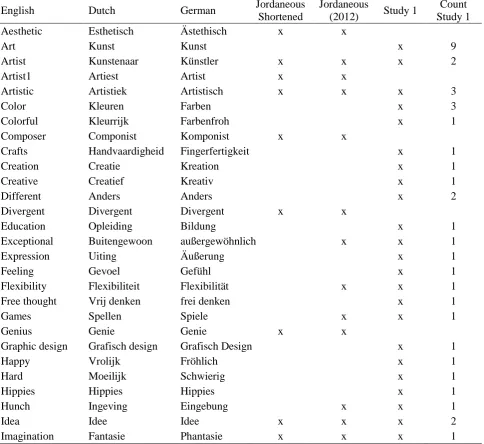
[image:7.595.70.555.334.778.2]The three independent researchers judged 32 words of Jordanous’ (2012) list to be related to creativity. From the continuous association study, 58 unique responses were judged to be in any way related to creativity. Examples for words which were erased from the list are “socks” and “jump” which seemed to be a problem of continuous association. This list of 58 words contained eight words from Jordanous (2012) which were ruled out by the independent researchers. In the following when speaking of Jordanous’ (2012) list, all 40 words are addressed. Apart from these eight words, ten others were named in both lists. The combined list consists of 80 words from which 40 are from Jordanous (2012) and 58 from the human list with 18 words overlap. All words as well as their origin and the amount of associations from the general public can be seen in table 1.
Table 1
English Dutch German Jordaneous
Shortened
Jordaneous
(2012) Study 1
Count Study 1
Aesthetic Esthetisch Ästethisch x x
Art Kunst Kunst x 9
Artist Kunstenaar Künstler x x x 2
Artist1 Artiest Artist x x
Artistic Artistiek Artistisch x x x 3
Color Kleuren Farben x 3
Colorful Kleurrijk Farbenfroh x 1
Composer Componist Komponist x x
Crafts Handvaardigheid Fingerfertigkeit x 1
Creation Creatie Kreation x 1
Creative Creatief Kreativ x 1
Different Anders Anders x 2
Divergent Divergent Divergent x x
Education Opleiding Bildung x 1
Exceptional Buitengewoon außergewöhnlich x x 1
Expression Uiting Äußerung x 1
Feeling Gevoel Gefühl x 1
Flexibility Flexibiliteit Flexibilität x x 1
Free thought Vrij denken frei denken x 1
Games Spellen Spiele x x 1
Genius Genie Genie x x
Graphic design Grafisch design Grafisch Design x 1
Happy Vrolijk Fröhlich x 1
Hard Moeilijk Schwierig x 1
Hippies Hippies Hippies x 1
Hunch Ingeving Eingebung x x 1
Idea Idee Idee x x x 2
Bachelorthesis 2014 Janina Roppelt s1194526
Imaginativeness Verbeelding Einbildung x 1
Implement Verwerkelijken verwirklichen x 1
Innovation Innovatie Innovation x x
Innovative Innovatief Innovativ x x
Insight Inzicht Einsicht x x
Inspiration Inspiratie Inspiration x x x 2
Inspire Inspireren Inspirieren x x
Intelligence Intelligentie Intelligenz x x
Interpretation Interpretatie Interpretation x 1
Invent Uitvinden Erfinden x x
Inventor Uitvinder Erfinder x x
Knowledge Kennis Wissen x x
Loose Los Lose x x 1
Mind Geest Geist x 1
Music Muziek Musik x 10
Musical Muzikaal Musikalisch x x
New Nieuw neu x x x 2
Nonsense Onzin Unsinn x 1
Novelty Nieuwigheid Neuartigkeit/
Neuheit x x x 1
Original Origineel Originell x 1
Originality Originaliteit Originalität x x
Out of the box Out of the box out of the box x 4
Painter Schilder Maler x x x 2
Passion Passie Leidenschaft x 2
Pictures Plaatjes Bilder x 1
Planning Planning Planung x 1
Poem Gedicht Gedicht x x
Poetic Poetisch Poetisch x x x 1
Potential Potentieel Potenzial x x
Process Proces Prozess x x
Regenerative Vernieuwend Erneuernd x 1
Resourceful Vindingrijk Einfallsreich x 1
Shape Vormen Gestallten x 1
Skill Vaardigheid Fähigkeit x x
Solution Oplossingen Lösung x 2
Spontaneity Spontaniteit Spontanität x 1
Spontaneous Spontaan Spontan x x
Talent Talent Talent x x
Theater Toneel Theater x 2
Thinking Denken Denken x x x 1
Thought Gedachte Gedanke x x
To paint Schilderen Malen x 3
To craft Knutselen Basteln x 3
To create Creëren Kreieren x 1
To design Ontwerpen Entwerfen x 2
Bachelorthesis 2014 Janina Roppelt s1194526
To knit Breien Stricken x 1
To make Maken Machen x 2
To play Spelen Spielen x x 1
To program Programmeren Programieren x x 1
Unconventional Onkonventioneel unkonventionell x x 1
Unique Uniek Einzigartig x 1
The Dutch and German part of this list was used as basis for study 2. For the purpose of reading, in the following all results will be presented in English.
Study 2
In study one, forward associations of creativity were collected and a list of words which are associated with creativity was gathered. All these words are associated with creativity, but is creativity also associated with them? The first study gave a list of forward associations. Through presenting this list and looking for creativity responses, backward association is tested. The original stimulus has to come back. When a word is associated in both ways, it is stronger in the concept than it would be if the activation only works in one way. Backward association is also important for the evaluation purpose as creativity is not given in that context but should be triggered.
Method
Participants
Demands for participants in the direct association study will be somewhat more stringent. The participants will mostly be drafted through the University of Twente, since there are plenty of both Dutch and German students available for participation. Only participants who have not participated in the first part will take part to avoid biases because of their knowledge of the content of the study. To prevent bias due to second language association, participants must have either Dutch or German as their native language. 50 students between age 19 and 27 (m=22,06; sd=1,963) participated. There were 29 Dutch and 21 German participants from whom 24 were man and 26 women. There were 25 technical students, 22 social studies students and 3 art students.
Material
Bachelorthesis 2014 Janina Roppelt s1194526 participant priming are reduced to a minimum. The computer needed to be supplied with a self-developed test program, which presents the words on the list in a random order.
Procedure
Because the participants are not to know that the study is focused on creativity, they are simply be told that the study is designed to investigate the concept of free association. After the introduction, the participant will be asked to take place in the cubicle. The reason for having the study under strict laboratory conditions is to reduce priming to an absolute minimum. For this reason, the cubicle is sparsely furnished, with just a desk, a chair and a computer present. The computer program responsible for taking the test is started when the participant takes his seat.
The computer administers the direct association test by presenting a participant with a single word, randomly selected from the definitive list. Because of the random presentation of the words, the effect that previous words have on the results should be minimized across the group of participants. The participant then types in one word that he closely associates with the presented word. The administration of the test lasts until every word from the definitive word list has been associated exactly once. The instructions can be found in appendix A. Afterwards the participant fills in a questionnaire about demographic variables and their thoughts on the purpose of the study. The questionnaire can be found in appendix B.
While the debriefing, the participant was explained that the main goal of the study was to analyze the concept of creativity.
Analysis
Bachelorthesis 2014 Janina Roppelt s1194526 Differences in the backwards association between the groups (study, nationality and gender) are tested with a Chi-Square test. In that analysis all words with at least one response in each group are taken into account. The hypotheses are tested on a 0.01 level of significance.
Results
Data screening
There were 3994 responses, 2319 Dutch and 1675 German. That is 80 responses per participant while one response missing in the Dutch set and five in the German one. After the translation procedure, 1087 pairs of stimuli and responses were left.
Table 2 shows the contribution of gender, nationality and study. It can be seen that there were more men than women as well as more Dutch than German people in technical studies. Table 2
Dutch German Men Women Total
Technical 22 3 15 10 25
Social 4 18 8 14 22
Arts 3 0 1 2 3
Total 29 21 24 26 50
Backward association of creativity
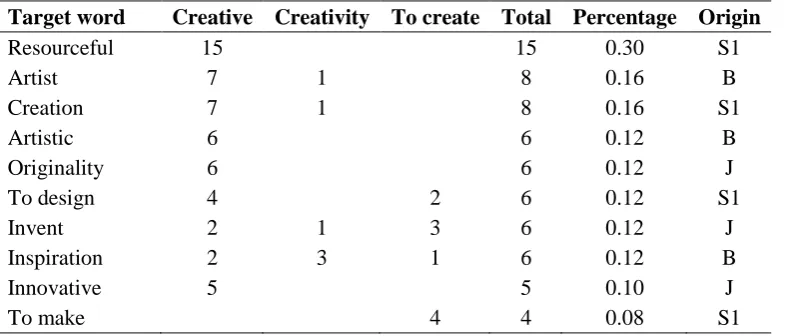
[image:11.595.67.466.611.779.2]In table 3 the target words which triggered a creativity word (creativity, creative and to create) are displayed. When comparing this to study one, it can be seen that 55.17% of this word come from the human list, 27.58% from Jordanous (2012) and 17.24% can be found in both lists. The word creativity had the highest backward association with is “resourceful”, a word which origins from the human list. The first word from Jordanous (2012) appears on place five.
Table 3
Target word Creative Creativity To create Total Percentage Origin
Resourceful 15 15 0.30 S1
Artist 7 1 8 0.16 B
Creation 7 1 8 0.16 S1
Artistic 6 6 0.12 B
Originality 6 6 0.12 J
To design 4 2 6 0.12 S1
Invent 2 1 3 6 0.12 J
Inspiration 2 3 1 6 0.12 B
Innovative 5 5 0.10 J
Bachelorthesis 2014 Janina Roppelt s1194526
To paint 2 1 3 0.06 S1
Original 3 3 0.06 S1
To craft 3 3 0.06 S1
Crafts 2 1 3 0.06 S1
Artist1 3 3 0.06 J
Graphic design 3 3 0.06 S1
Idea 3 3 0.06 B
Inspire 2 1 3 0.06 J
Out of the box 2 2 0.04 S1
To create 2 2 0.04 S1
Imagination 2 2 0.04 B
Art 1 1 0.02 S1
Imaginativeness 1 1 0.02 S1
To knit 1 1 0.02 S1
Spontaneous 1 1 0.02 J
Musical 1 1 0.02 J
Theater 1 1 0.02 S1
Innovation 1 1 0.02 J
Free thought 1 1 0.02 S1
S1 = Study one, J = Jordanous (2012), B = Both lists
Activation strength of “creative”
[image:12.595.67.457.66.365.2]In table 4, the strength of the associations of “creative” is displayed, together with the strongest backwards associations of “creative” and there association strength between each other.
Table 4
Response
Target word Creative Resourceful Artist Creation Artistic Innovative To design
Creative 1 0.02 0.04 0.02 0.04
Resourceful 0.30 - 0.06
Artist 0.14 - 0.02
Creation 0.14 - 0.02 0.02
Artistic 0.12 0.16 -
Originality 0.12 0.04 0.02
Innovative 0.10 0.02 - 0.02
To design 0.08 0.02 -
Summed strength 2 0.08 0.22 0.02 0.02 0.12 0.06
Bachelorthesis 2014 Janina Roppelt s1194526 the first column which here is 2. The sum of all remaining columns gives the estimate connectivity strength of 0.52. The estimate activation strength is the sum of these two values (2 + 0.52 = 2.52). The missing values in the matrix can be interpreted as either no connection at all or a weak connection which cannot be measured in a direct, single response free association study of this format (Nelson et al., 2004).
Difference between studies
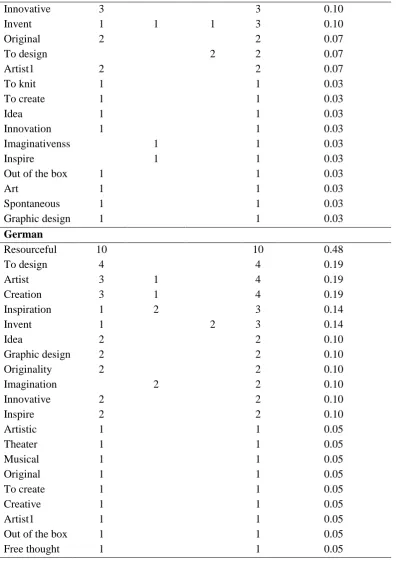
[image:13.595.67.460.338.780.2]To see if there is a difference between different study types the null hypothesis that there is no difference between the groups will be tested with a Chi-square test. The data on which the analysis is based can be seen in table 5. Because of the low amount of art students this group is left out. The comparison of technical and social studies supports the hypothesis that there is no difference between studies (X² = 5.31, df = 12).
Table 5
Creative Creativity To create Total Percentage of answers Technical
Resourceful 5 5 0.2
Artist 3 1 4 0.16
To make 4 4 0.16
Originality 4 4 0.16
To paint 2 1 3 0.12
Artistic 3 3 0.12
Innovative 3 3 0.12
Crafts 2 1 3 0.12
Creation 2 1 3 0.12
Inspiration 1 1 1 3 0.12
Original 2 2 0.08
To design 1 1 2 0.08
To craft 2 2 0.08
Invent 1 1 2 0.08
Idea 1 1 0.04
Innovation 1 1 0.04
Imaginativenss 1 1 0.04
Spontaneous 1 1 0.04
To knit 1 1 0.04
Inspire 1 1 0.04
Artist1 1 1 0.04
Art 1 1 0.04
To create 1 1 0.04
Social
Resourceful 9 9 0.41
Creation 4 4 0.18
Bachelorthesis 2014 Janina Roppelt s1194526
Invent 1 3 4 0.18
Inspiration 1 2 3 0.14
Graphic design 3 3 0.14
Artist 3 3 0.14
Originality 2 2 0.09
Idea 2 2 0.09
Artistic 2 2 0.09
Out of the box 2 2 0.09
Imagination 2 2 0.09
Innovative 2 2 0.09
Inspire 2 2 0.09
Free thought 1 1 0.05
Original 1 1 0.05
To create 1 1 0.05
Creative 1 1 0.05
Artist1 1 1 0.05
Musical 1 1 0.05
Theater 1 1 0.05
Art
Resourceful 1 1 0.33
Artist1 1 1 0.33
To craft 1 1 0.33
Artistic 1 1 0.33
Artist 1 1 0.33
Creation 1 1 0.33
Difference between nationalities
[image:14.595.69.459.597.776.2]The data for the nationalities is displayed in table 6. The hypothesis is that there is no difference between Dutch and German participants. When comparing the answers which were given, no evidence is found to reject the hypothesis (X² = 9.94, df = 15).
Table 6
Creative Creativity To create Total Percentage of answers Dutch
Resourceful 5 5 0.17
Artistic 5 5 0.17
Artist 4 4 0.14
Originality 4 4 0.14
To make 4 4 0.14
Creation 4 4 0.14
To paint 2 1 3 0.10
Crafts 2 1 3 0.10
Inspiration 1 1 1 3 0.10
Bachelorthesis 2014 Janina Roppelt s1194526
Innovative 3 3 0.10
Invent 1 1 1 3 0.10
Original 2 2 0.07
To design 2 2 0.07
Artist1 2 2 0.07
To knit 1 1 0.03
To create 1 1 0.03
Idea 1 1 0.03
Innovation 1 1 0.03
Imaginativenss 1 1 0.03
Inspire 1 1 0.03
Out of the box 1 1 0.03
Art 1 1 0.03
Spontaneous 1 1 0.03
Graphic design 1 1 0.03
German
Resourceful 10 10 0.48
To design 4 4 0.19
Artist 3 1 4 0.19
Creation 3 1 4 0.19
Inspiration 1 2 3 0.14
Invent 1 2 3 0.14
Idea 2 2 0.10
Graphic design 2 2 0.10
Originality 2 2 0.10
Imagination 2 2 0.10
Innovative 2 2 0.10
Inspire 2 2 0.10
Artistic 1 1 0.05
Theater 1 1 0.05
Musical 1 1 0.05
Original 1 1 0.05
To create 1 1 0.05
Creative 1 1 0.05
Artist1 1 1 0.05
Out of the box 1 1 0.05
Free thought 1 1 0.05
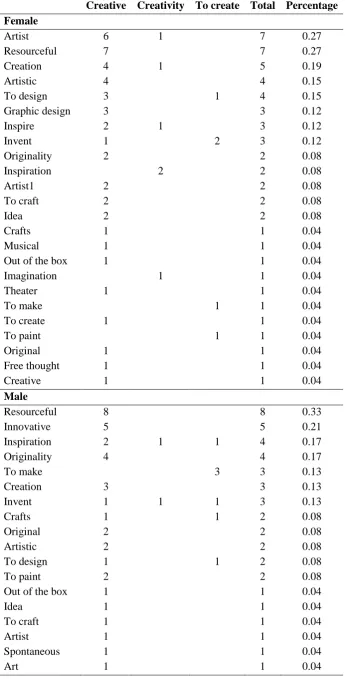
[image:15.595.67.464.69.632.2]Difference between genders
Bachelorthesis 2014 Janina Roppelt s1194526 Table 7
Creative Creativity To create Total Percentage Female
Artist 6 1 7 0.27
Resourceful 7 7 0.27
Creation 4 1 5 0.19
Artistic 4 4 0.15
To design 3 1 4 0.15
Graphic design 3 3 0.12
Inspire 2 1 3 0.12
Invent 1 2 3 0.12
Originality 2 2 0.08
Inspiration 2 2 0.08
Artist1 2 2 0.08
To craft 2 2 0.08
Idea 2 2 0.08
Crafts 1 1 0.04
Musical 1 1 0.04
Out of the box 1 1 0.04
Imagination 1 1 0.04
Theater 1 1 0.04
To make 1 1 0.04
To create 1 1 0.04
To paint 1 1 0.04
Original 1 1 0.04
Free thought 1 1 0.04
Creative 1 1 0.04
Male
Resourceful 8 8 0.33
Innovative 5 5 0.21
Inspiration 2 1 1 4 0.17
Originality 4 4 0.17
To make 3 3 0.13
Creation 3 3 0.13
Invent 1 1 1 3 0.13
Crafts 1 1 2 0.08
Original 2 2 0.08
Artistic 2 2 0.08
To design 1 1 2 0.08
To paint 2 2 0.08
Out of the box 1 1 0.04
Idea 1 1 0.04
To craft 1 1 0.04
Artist 1 1 0.04
Spontaneous 1 1 0.04
Bachelorthesis 2014 Janina Roppelt s1194526
To create 1 1 0.04
To knit 1 1 0.04
Imagination 1 1 0.04
Artist1 1 1 0.04
Innovation 1 1 0.04
Imaginativeness 1 1 0.04
Difference between forward and backward association
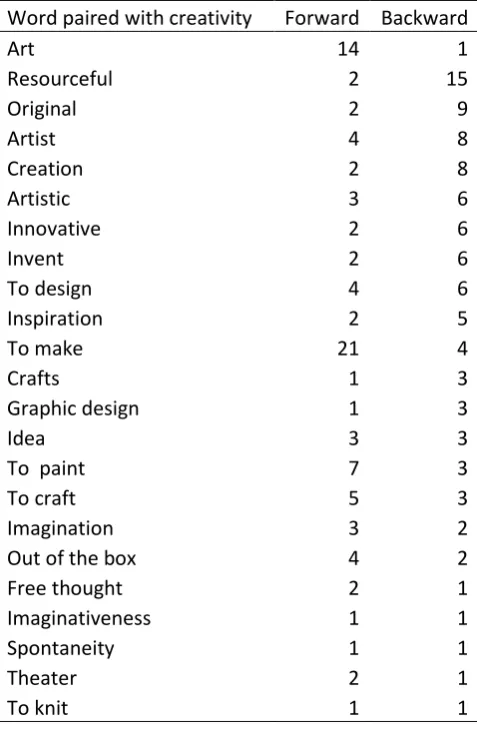
[image:17.595.72.311.389.754.2]For this analysis, both studies were used and “creativity” addresses associations with “creativity”, “creative” and “to create”. When looking at the associations of “creativity” as well as the top words in both studies, there seems to be a difference between forward and backward association. An example is the pair “creativity-art”. In the forward direction it occurs 14 times while “art-creativity”, which is a backward association, only occurs one time. On the other hand “creativity-resourceful” has only appeared two times while “resourceful-creativity” occurred 15 times. All these pairings are summarized in table 8.
Table 8
Word paired with creativity Forward Backward
Art 14 1
Resourceful 2 15
Original 2 9
Artist 4 8
Creation 2 8
Artistic 3 6
Innovative 2 6
Invent 2 6
To design 4 6
Inspiration 2 5
To make 21 4
Crafts 1 3
Graphic design 1 3
Idea 3 3
To paint 7 3
To craft 5 3
Imagination 3 2
Out of the box 4 2
Free thought 2 1
Imaginativeness 1 1
Spontaneity 1 1
Theater 2 1
Bachelorthesis 2014 Janina Roppelt s1194526 A chi-square test comparing these two types of association indicates that there is indeed a difference between words that are associated when given a creativity word and words that trigger creativity words as it is significant with p < 0,0005 (X² = 54,17, df = 22).
Discussion
The purpose of this study was to lay the basis for a concept for creativity which can be used for evaluation purposes. To achieve this goal two free association studies were administrated. The first one gave a list of words which are associated with creativity, both from the literature and human mindsets. Based on that, the second study focused on backward association, the question if creativity comes back when presenting the original words. Here, also groups were compared in order to see if there is evidence for differing concepts amongst them.
Looking at the first study it is interesting to see that only 18 words appear in both lists. The list of the independent researchers only came short eight words which were in fact in Jordanous’ (2012) list and given by participants. Also, none of these words was given more than one time. This speaks for the drastic reduction of Jordanous’ (2012) list as not much and no great associations were “missed”. If literature studies do indeed give a good picture of the creativity concept, one would expect greater overlap between 650 words from Jordaneous (2012) and 58 unique answers in the first study. Additionally, more than half of the word associated with creativity in the second study coming from the human list indicate strongly that literature studies do not give a complete picture when it comes to concepts in people’s minds.
The word which triggered most creativity words was “resourceful” with nearly twice as much answer as the second and third word. This is surprising as it doesn’t fit the current definitions of creativity and does not appear in Jordaneous’ (2012) list. This is another factor to support the study of creativity not only with the help of literature but through people and their understanding of the concept.
Bachelorthesis 2014 Janina Roppelt s1194526 When looking at the comparison between the groups, there is no evidence for a difference in study, gender or nationality. This supports the hypothesis of one concept for creativity in people’s heads which is convenient for the use of the concept for evaluation. However, the two observed nationalities, Dutch and German, are rather similar to each other. Both languages have the same roman root and have a lot of similarities in grammar and lexis. Also the cultures are close to each other. The results might change when language and culture get more distant.
Conclusion/Limitations
The results show that creativity should not be studied through literature but with the involvement of actual people, as important factors are missed otherwise. Furthermore, there is no reason to believe that there is a difference between groups when it comes to associations of creativity. This supports the hypothesis that there is indeed one creativity concept. For evaluation purposes the results on groups indicate that one scale or measurement object should be enough for a large group of people.
Before being able to develop such a tool further studies should focus on strengthening the concept with a broader set of participants. Here the emphasis should lie on backwards association as this is the relevant factor when people should think of something as being creative. Another point to research can be the possible differences between more distant groups when it comes to culture and linguistic.
Bachelorthesis 2014 Janina Roppelt s1194526
References
Collins, A. M., & Loftus, E. F. (1975). A spreading-activation theory of semantic processing. Psychological review, 82(6), 407.
Hennessey, B. a, & Amabile, T. M. (2010). Creativity. Annual review of psychology, 61, 569– 98. doi:10.1146/annurev.psych.093008.100416
Jordanous, A. (2012). A standardised procedure for evaluating creative systems: Computational creativity evaluation based on what it is to be creative. Cognitive Computation, 4(3), 246-279.
Kaufman , J.C., Lee J., Baer J., Lee S. (2007). Captions, consistency, creativity, and the consensual assessment technique: new evidence of reliability. Thinking Skills Creat.
2:96–106.
Kaufmann, G. (2003). What to measure? A new look at the concept of creativity. Scand. J. Educ. Res. 47:235–51.
Meara, P. (1983). Word association in a foreign language. Nottingham Linguistics Circular, 11, 28-38.
Nelson, D. L., McEvoy, C. L., & Schreiber, T. A. (2004). The University of South Florida free association, rhyme, and word fragment norms. Behavior Research Methods, Instruments, & Computers, 36(3), 402-407.
Bachelorthesis 2014 Janina Roppelt s1194526
Appendix
Appendix A
Experiment material
Dutch
Bachelorthesis 2014 Janina Roppelt s1194526
Bachelorthesis 2014 Janina Roppelt s1194526 Appendix B
Association Test
nummer:leeftijd:
geslacht:
land van herkomst:
studie:
Waarover denk je ging het onderzoek?
______________________________________________________________________________ ______________________________________________________________________________ ______________________________________________________________________________
Heb je nog opmerkingen met betrekking tot het onderzoek?
______________________________________________________________________________ ______________________________________________________________________________ ______________________________________________________________________________
Bedankt voor je deelname!
Appendix C
Jordaneous’ list
Thinking Computational Organisational Possess Marginal
Process Composer Epigenetic Genius Composer
Innovation Psychic Characteristic Empirical Story Artefact Associative Achievement Emergent Cognition
Idea Brain Analogy Spontaneous External
Program Novelty Ego Rate Retention
Domain Fluency Agreeableness Developmental Clarify
Cognitive Inspire Am Welsh Hemisphere
Divergent Facilitate Compositional Deem High-valued
Accomplishment Generate
Domain-relevant Influence Imaginative
Openness Chapter Framework Poetry Origence
Discovery Conscientiousness Consciousness Quantity Space-definition Primary Gene-culture Combination Intrinsic Environmental
Originality Quality Interest Career Recognise
Bachelorthesis 2014 Janina Roppelt s1194526
Ability Produce Imagination Value Observable
Knowledge Unconscious Environment Drive Culture
Individual Psychology Secondary Repertoire Discovery
Human Science Extrinsic Blind Consciousness
Novelty Understanding Danish Habitual Ambiguity
Conceptual Poem Invention Highly Society
Artefact Remote Ideational Architect Enable
New Painting Perceptual Componential Writer
Production Productivity Appropriateness Fine-tuned joke
Composition Element Unusual Cortex Routine
Musical Endeavor Deliberate Psychoanalytic Configuration
Artistic Minor Ai Adjective Consequences
Thought Primitive Synthesis Peer Examinee
Activity Innovative Transmission Schema Intellectence
Conceptual Output Notion Lack Neo-PI
Artist Musical Mathematician Genetic Psychoeconomic
Personality Structure Abstract Artificial Subnetwork Transformational Gift Imagery Locomotion Uninspiration
Skill Market Productive Pine Content
Contribution Product Hierarchy Heuristic Economic
Talent Faculty Heterarchy Keyword Protocol
Motivation Perhaps Listener Provincial Benefit
Scientific Barren Assessment Judge Selective
Genre Transformation Membership Receptivity Valuable Intellectual Ideation Inspiration Contribute Claim
Typicality Melody Myth Generative Associate
Prefrontal Phenotype Mutation Human Atom
Insight Capacity Organic Implicit Scoring
Vocational Aesthetic IQ Occupational Appreciation
Field Avocational Rater Rational Medium
Potential Association Perspective Possibility Allele
Sociocultural Semantic Logical Biological Divergent-thinking
Rating Circuit Validity Incubation Energistic
Formal Emergence Manifest Reorganisation Interplay Domain-specific Hypnosis Occupation Sudden Tests
Manifestation Hypnotic Survival Syntax Trial-and-error
Graduate Imagery Benzene Construction Verdict
Logic Imposition C.f. Ball Consumer
Cite Infant Chapter Conjecture Constantly
Loose Innately Chemist Unconventional Algorithmic
Triangle Interpreter Circularity Universe Claim
Biocultural Melodic Eminence Impose overt
Coevolution Metaphorical Enquiry Constrain Biochemical
Coevolutionary Mutant Fertile Articulate Camp
Discoverer Neo Focussing Demand Funny
Exceptional P-creative Historic Deny Inventive
Bachelorthesis 2014 Janina Roppelt s1194526
Five-factor Psi Intellect Revision Meta-level
Fragmentation Sensibility Interestingness Temporarily Nurture Heterarchical Stylistic Marvelous Requisite Phenotypic
Hunch Well-formed Nominee Archival Redefinition
Mentor Positively Non-involed Artefact-set Roadblock
Metalevel Guideline Officer Blindly Senior
O-node Pitch Patent
Blind-variation-and-selective-retention Substantiate
Sensemaking Peak Poetic Canalisation Transcend
Superspace Grammar Reality-oriented Combinational Thesis
Organise History Recentry Concrete Aim
Obvious Break Results/results Cough Climate
Proposal Audience Serendipity Cross-cultural Conception
Abstract Stereotype
Social-psychological Daydream Criticise
Internalise Reality Tacitly Deduction Mathematics
Biology Potentially Tier Drive-related Purely
Political Conformity Tremendous Edition Fundamentally
Acknowledge Expert Uniserval Flexibly Whereby
Battery Mathematical Warmup Grader Writing
Game Designer Atypical Historiometric Entity
Neglect Pertain Supply Home-key Undertake
Foundation Probably Phonological Imitate Undertake
Corpus Historical Play Inflexible Field
Grader Conducive Progress Ingenuity Master
Universality Dream Open Intrapopulation Preconscious
Tentative Insightful Enhancement Jape Old
Disposition Narrative King Mach Exploratory
Metaphor Synthesise Radical Mechanistic Topic
Everyday Apparent Real-life Morphological Devise
Detrimental Factorial Law Psychoticism Largely
Anthropologist Title Actor R.s. Conceive
Ativity Invest Ordinary Reputation Pose
Conspecific Apparently Exemplar Script Integrative
Deterministic Dream Perseverance Sims Engine
Fuctual Realistic Blind Subjectivity Masculine
Fascination Problem-solving Criteria Submarket Debate
Feminine Educator Programmer Symphony Leisure
Hoverfly Inherent Relativity Talented Linkage
Tat Stakeholder Innovator Genotype Brainstorming
Thinker Synonym Molecule H-creative Buffer
Uncreative Intuition Node-link Informally Commonplace Workings Institutional Essential Inheritance H-creativity
Language Wide Extraversion Lifespan Historian
Suitable Abstraction Usefulness Morpheme Innovativeness Psychologist Merely Expert Multi-dimensional Interrater
Bachelorthesis 2014 Janina Roppelt s1194526 Aptitude Lifetime Enhance Neurocognitive Noncomputational
Societal Illogical and/or Nominate Refrigerator
Educational Dissociate Direct Nomination Independence Teacher Interviewer Linguistic P-creativity Appraise Generation Neuroscience Prerequisite Tonal Closure Gestalt Preference Functional Untypical Deliberately
Literary Capable Operational Harmony Drawing
Prototype Meaning Absorptive Solver Self-confidence
Stochastic Associational Fuzzy Subsystem Abstractly
Certainly Basal Genetics Hierarchical Achiever
Collage Disciplinary Surprise Logically Acrobat
Fine-tuning Fuster Aberration Informally Aesthetics Ai-model Viability Coevolutionary Aberrant Falsify
Allude Wild Conformist Aspiration Fixedness
And-selective-retention Map Consensual Broad-based Freshman
Artistic Advance Consequent Cellular Hemispheric
Associatve Assemble Copycat Chase hood
Big Loosely Curious Clue Hypothesised
Boredom Invent Curvilinear Dynamical Ideational
Canalise Revise Defocused Gas Intrapsychic
Chorale Elementary Divergent Intellectually Patent
Chord Happen Drosophila Nobel Planetary
Inventor Rely Re-invent Propensity Poetic
Judgemental Chess Selectional Richness Problem-finding
Kindergarten Testable Serendipitous Sociological Gene Knowledge-based Male Shortcut Synonymous Curiosity
Macroscopic Eminent Sonnet Elaboration Punctuation
Neuroscientific Generator Substitutive Flexible Valuation
One-armed Mysterious Tire Empirically