Implementation of
Domain-Specific
Event-Based Applications
Author:
Roel
ter Maat
(s0219681)
Master Thesis
Supervisor:
Dr. Somayeh
Malakuti
Committee:
Prof. dr. ir. Mehmet
Aksit
Dr. Ing. Christoph
Bockisch
Ir. Steven
te Brinke
1 Introduction 1
2 Background: Event Processing Applications 3
2.1 Core Concepts in Event-Processing Applications . . . 3
2.1.1 Events . . . 3
2.1.2 Event Processing Network . . . 4
2.2 Case Study . . . 5
2.3 Implementation Languages for Event Processing Applications . . 5
2.3.1 Stream-Processing Languages . . . 6
2.3.2 Object Oriented Programming . . . 7
2.3.3 Aspect Oriented Programming . . . 7
2.4 Advantages of EPAs . . . 9
2.5 Summary . . . 9
3 Evaluation of Event Processing Languages 11 3.1 Evaluation Criteria . . . 11
3.1.1 Language Extensibility . . . 11
3.1.2 Modularity . . . 12
3.1.3 Composability . . . 12
3.2 Evaluation . . . 13
3.2.1 Language Extensibility . . . 13
3.2.3 Composability . . . 15
3.3 Illustration of Shortcomings in AspectJ . . . 16
3.3.1 Evaluation Criteria . . . 16
3.3.2 Evolution Scenarios . . . 18
3.3.3 Implementation of Evolution Scenarios . . . 20
3.4 Summary . . . 33
4 EventReactor2.0 35 4.1 Compile time . . . 35
4.2 Runtime . . . 38
4.3 Extensions to EventReactor . . . 40
4.4 Summary . . . 40
5 Specification of Events 41 5.1 Design . . . 41
5.1.1 Event types . . . 41
5.1.2 Events . . . 43
5.2 Implementation Details . . . 44
5.2.1 Event Compilation . . . 44
5.2.2 Example . . . 45
5.3 Future Work . . . 50
5.3.1 Language Extensibility . . . 50
5.3.2 Usage of Java types . . . 50
5.3.3 Automatic Publishing . . . 50
5.3.4 Extensible Base Language . . . 51
5.4 Summary . . . 51
6.1 Design . . . 53
6.2 Functionality Languages . . . 55
6.2.1 Prolog . . . 55
6.2.2 Java . . . 57
6.2.3 SQL . . . 58
6.3 Implementation Details . . . 59
6.3.1 Event Module Compiler . . . 59
6.3.2 Generated and Base Classes . . . 61
6.3.3 Compilation of Functionality Languages . . . 64
6.3.4 Extending the Functionality Language . . . 65
6.4 Future Work . . . 66
6.5 Summary . . . 67
7 Specification of Compositions 69 7.1 Design . . . 69
7.2 Implementation Details . . . 72
7.3 Future Work . . . 75
7.4 Summary . . . 75
8 Evaluation of EventReactor2.0 77 8.1 Evolution of Modularity and Composability . . . 77
8.1.1 Base Scenario . . . 77
8.1.2 Evolution Scenario 1: . . . 79
8.1.3 Evolution Scenario 2: . . . 81
8.1.4 Evolution Scenario 3: . . . 85
8.1.5 Evolution Scenario 4: . . . 88
8.1.6 Evolution Scenario 5: . . . 89
8.3 Summary . . . 92
9 Conclusion 93
Appendices 99
A Event and Event Type Language 101
A.1 Xtext . . . 101
A.2 Xtend . . . 102
B Event Module Language 105
B.1 Xtext . . . 105
B.2 Xtend . . . 107
C Prolog Language 111
C.1 Xtext . . . 111
C.2 Xtend . . . 112
D Java Language 117
D.1 Xtext . . . 117
D.2 Xtend . . . 117
E Composition Specification Language 119
CHAPTER
1
Introduction
There are various types of application that can be used to implement different types of event processing. Examples of event processing are runtime verifica-tion [1], self-adaptive software [2], and traffic monitoring. To implement these types of application,event producers are used to indicate a state change. Event consumerscan perform actions on the event streams andevent processing agents
are used to mediate between the event producers and event consumers.
When implementing event processing applications, a large amount of event pro-ducers, event processing agents and event consumers can be used, increasing the complexity. To manage this complexity, this thesis claims that a separation of concerns, a loose coupling between concerns, and understandability of the code is required.
In current advanced programming languages and frameworks, module abstrac-tions, composition operators, and some language extensibility is provided. To evaluate the suitability of these abstractions, a set of requirements for event processing applications is set in chapter 3. A representative set of languages is evaluated with respect to these requirements. Using the results of these evalu-ations, the shortcomings are identified.
In [3, 4],event modulesare introduced as linguistic abstractions. These modules support modular representation of events and their reactions. In EventReac-tor [3, 5, 6] these event modules are implemented. In this thesis, it is explained that event modules can modularize the concerns, and facilitate loose coupling in the compositions.
In chapters 5- 7 the implementation details of the event processing concerns are explained. In these chapters, it is described how the criteria are fulfilled and how the framework processes the concerns.
CHAPTER
2
Background: Event Processing
Applications
In Event Processing Applications (EPA) [7], the flow of the program is influ-enced, determined, and changed by events. In the section 2.1, the basic com-ponents of EPAs are explained. This is followed by section 2.2 in which a case study is described which will be used throughout this thesis. Section 2.3 explains a set of languages that can be adopted for programming EPAs. In section 2.4, the advantages of using EPAs are explained. Finally, the chapter is summarized in section 2.5.
2.1
Core Concepts in Event-Processing
Appli-cations
2.1.1
Events
Anevent[7] is something commonly known in the real world assomething that has happened [7]. This can, for instance, be a phone starting to ring or a pen dropping on the floor. Events like this can prompt a person to react, because he or she is able to detect those events and take actions accordingly, such as answering the phone or picking up the pen. Using events in such a manner and using the ability to react to them allows a person to continue living his life without waiting for the phone to ring in order to react to it. Secondly, other people are able to make a person perform an action by initiating an event, in this case by calling him.
may maintain information about the corresponding state change, for example the time of occurrence and the thread of execution in which it has occurred.
There are various ways to represent events in software. A typical way is to represent them as a data structure that defines a set of fields to keep informa-tion about the state changes. Events may be typed, where an event type can be used to instantiate events which have the same structure and meaning.
2.1.2
Event Processing Network
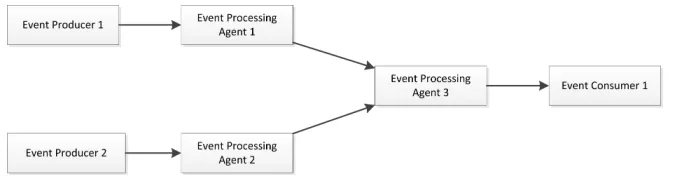
[image:10.612.165.503.320.411.2]In EPAs, three types of entities interact with each other forming an Event Processing Network[7], an example of which is shown in Figure 2.1.
Figure 2.1: Event Processing Network
The first of the three components is the event producer [7], which is re-sponsible for the generating and publishing of events. Events can be produced by both hardware and software. For example, a sensor can be used to measure certain values, such as temperature, in the real world. Every newly measured value can be regarded as an event allowing hardware to produce events. At the software level, various kinds of state changes may be regarded a events. Examples are: occurrence of exceptions, invocation of methods, construction of objects, access to I/O, etc.
When an event is produced, a reaction can take place which is the responsibility of theevent consumer[7]. The reactions that take place can, for example, be logging or storing of data, checking and reacting to received data, altering the event producer, and so on. Depending on the content, event consumers are also able to become event producers. At this point an event can be produced which will be consumed by another, or perhaps the same, consumer.
consume and produce events. They may perform various operations on the events. For example, filtering, routing, modifying and creating new events etc. The produced events can then be sent to either the consumer, or other event processing agents. Unlike the producer and consumer, the event processing agent can only be expressed in software entities.
The processing performed by the agents can be stateless or stateful. With stateless agents, the action which is performed is independent of the previously published events. With stateful agents, previous events influence the action which is performed with new events. An example of stateful agents is a filter which only lets an event pass when a certain amount of events have been pub-lished before it.
Using the processing agents to connect the consumers and producers removes a direct coupling between the entities, and the producers have no knowledge of which consumers will react to the event.
2.2
Case Study
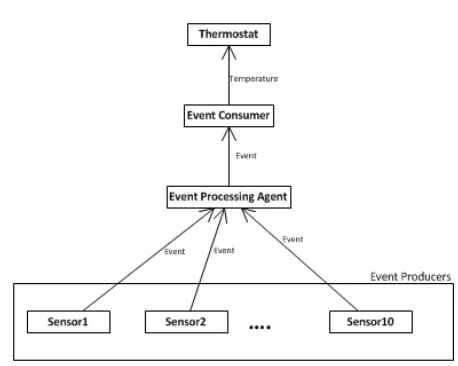
Throughout this thesis, a thermostat system is as an illustrative example. In this system, 10 sensors are located outside a house and measure a temperature every 10 minutes. The sensors are event producers and generate an event every time the sensor performs measures a new value.
There are software components used as consumers, which will publish the mea-sured temperature to the weather station. An event processing agent is used between the producer and consumer, filtering for the specific events produced by the outside temperature sensors. This allows other types of sensors to pro-duce events without these events being consumed by the existing consumers. Figure 2.2 shows the basic architecture of the system with the sensors produc-ing events, which are filtered by the event processproduc-ing agent. When an event is produced by this agent, the event consumer takes the temperature from the event and sends it to the thermostat.
2.3
Implementation Languages for Event
Pro-cessing Applications
Figure 2.2: Case Study
2.3.1
Stream-Processing Languages
Esper [8] is one of the event stream processing languages currently available. There are multiple implementations for Esper for Java and .Net. This section only focusses on the Java implementation. In Esper, events can be created using a Plain Old Java Objects (POJO). In the configuration of the Complex Event Processing(CEP) engine, the event needs to be added. Events can be instantiated in the base code and can be sent to the engine. Esper offers a dedicated language, similar to SQL, to filter the event stream and performing various actions on the events.
1 s e l e c t ∗ from EventName . win :l e n g t h( 2 )
Listing 2.1: Esper EPL Statement
1 p u b l i c c l a s s e x a m p l e L i s t e n e r i m p l e m e n t s U p d a t e L i s t e n e r {
2 p u b l i c v o i d u p d a t e ( EventBean [ ] newEvents , EventBean [ ] o l d E v e n t s ) {
3 EventBean e v e n t = newEvents [ 0 ] ;
4 System . o u t . p r i n t l n (” Event F i l t e r e d ”) ) ;
5 }
6 }
Listing 2.2: Esper Listener
2.3.2
Object Oriented Programming
In Object Oriented(OO) programming, objects are a means to modularize the concern of interest; e.g. event producers, event processing agents. This allows a program to be designed by creating objects for every real world object, creat-ing a more readable and reusable program. Variables and methods are defined within an object, which can be accessed and executed by other objects.
A possible implementation of EPAs can be achieved using the Observer de-sign pattern [9]. Using the Observer pattern, event producers are asde-signed the role of subject, and event processing agents and/or event consumers the role of observer. Observers are able to register with subjects, allowing them to be notified of changes when the subject invoke theirnotifymethod. The invocation of this method is regarded as an event being produced. The arguments set in the invocation are used as the attributes of the event.
Another possibility would be to use the event-delegate mechanism [9]. In this mechanism, event type can be defined using a special type of class. Events can be created by instantiating the correct event type. In order to bind producers and consumers, a delegate is used. A method which matches the signature of a delegate can be assigned to it, allowing multiple event consumers to be bound to a producer. Event can be published by invoking the delegate corresponding to the event.
2.3.3
Aspect Oriented Programming
Aspect Oriented (AO) programming [10] introduces the notion of aspects to modularize crosscutting concerns in software. The languages offer dedicated constructs to implements aspect elements.
Join points: Join points represent a state change of interest in the execu-tion of a program. Join points are not explicitly handled in many systems, yet it is an important element that needs to be discussed. The created join points make up the join point model which can be used by the other AO elements. This element can be roughly translated to an event. A join point describes the parts of the program which must publish an event with a specification of the information which the event contains. The join points model can be point in time or region-in-time [11]. The point-in-time model selects a specific point in the execution of the base program, while the region-in-time model select an interval in the execution. The latter can, for instance, be a method execution at which the join point will include the entire execution of this method.
Pointcuts: A pointcut is a means to select a set of join points of interest. The selection is usually expressed using a query language. Pointcuts can be more complex by making them history based [12], where a pointcuts is acti-vated based on the previous actions and pointcuts.
In implementing EPAs in AO languages, pointcuts can be adopted to implement the event filtering functionality. This, however depends on the expressive power of pointcuts designators. If it is not expressive enough, one has to also define the event filtering functionality using advice code.
Advice: The advice is a piece of code that is bound to one or more point-cuts and is executed when these are activated. Depending on how the concerns of EPA are separated, an advice can be used to implement the functionality of event processing agents and/or event consumers.
One of the currently best known AO languages is AspectJ [13, 14, 15], which is an extension to the Java language. Join points in AspectJ are static and consist of things like method calls, method executions, object instantiations, constructor executions, field references and handler executions [14, 16]. Inside a mainaspect component a user can define a pointcut by selecting the specific join points.
1 p u b l i c a s p e c t ExampleAspect{ 2
3 p r i v a t e p o i n t c u t m e t h o d C a l l ( ) : t h i s( S e n s o r ) && 4 c a l l(v o i d doSomething ( S t r i n g ) ) ;
5
6 b e f o r e( ) : m e t h o d C a l l ( ){ 7 // p e r f o r m a c t i o n
8 }
9 }
Listing 2.3: Example Aspect
aspect, it is defined that, whenever the method doSomething with the String parameter is called from aSensor object, the pointcutmethodCall is activated. The advice, which has been specified to be executed before the pointcut, will perform the required actions.
At compile time, the Java program is compiled to Java byte code. The byte code is examined by the AspectJ compiler to find every point in the flow which matches the defined pointcuts. For each matching point in the byte code, a call to the advice code is weaved in automatically.
2.4
Advantages of EPAs
One of the main reason EPAs are used is that it is supposed to facilitates loose-coupling between the event producers and consumers, or a separation of concerns [17]. Both these concerns can be implemented without requiring any knowledge of the function and implementation of the other. Using the events communication is possible between the two. Events consumers can also be implemented without knowing about each other. The loose coupling between the concerns should mean that consumers and producers can be added and removed without having any effect on the other producers and consumers. However, as this thesis shall show, the loose coupling is highly dependant on the core abstractions that are offered by the various languages which are used to program EPAs.
2.5
Summary
CHAPTER
3
Evaluation of Event Processing
Languages
EPAs, like any other type of application, can implement complex functionalities which may be subject to changes during, or after development. To support this, linguistic mechanisms need to be provided to increase reusability and evolvabil-ity. To evaluate whether or not the existing languages and framework fulfill these requirements, this chapter defines three criteria, and evaluates a set of representative languages.
In section 3.1, the three criteria are described. In section 3.2, a representative set of languages is evaluated. In section 3.3, evolution scenarios are applied to the case study to show the shortcomings in existing languages and frameworks. In section 3.4, the results are summarized and a solution is explained.
3.1
Evaluation Criteria
In this section, we define three evaluation criteria: language extensibility, mod-ularity and composability. This is done by examining how the criteria can be improved, and what advantages this provides.
3.1.1
Language Extensibility
The most obvious choice to implement EPAs is the adoption of General Purpose Languages (GPL), which are Turing complete languages.
application domains. A DSL is usually not Turing complete and contains a lim-ited set of features. Examples of DSLs are HTML, used for the creation of web pages, and SQL, for querying relational databases. Using the DSLs allows for a more readable functionality and makes the code more maintainable for people without a lot of programming knowledge.
When designing a framework a choice usually needs to be made which language is used to define the functionalities. Since the number of existing languages is too large to expect each and every one to be implemented in the framework, the focus lies on whether or not new languages, either DSL or GPL, could be added to a framework and used to implement a functionality.
With an increased language extensibility, a user is able to add new languages necessary for a specific domain. This would increase the understandability and maintainability of the different event consumers and event processing agents.
3.1.2
Modularity
In an EPA various event processing agents and event consumers may be used. To be able to cope with the complexity and to increase usability, a language must provide means to modularize these concerns. This allows them to be imple-mented without the knowledge of other elements [18]. The module abstraction must provide well-defined input and output interface and an implementation part which encapsulates the functionality [19]. To support referencing the mod-ules they must provide a unique identity.
3.1.3
Composability
To compose the modularized concerns with each other, a language must pro-vide mechanisms to support composing modules at interface level and defining modularized constraints in their language. The composition configuration can occur on three different levels:
• Instance level, where specific instances of modules have a specific config-uration.
• Module level composition, where every instance of a module is configured identically.
• Language level composition, where every module written in the same lan-guage has the same configuration.
Binding is possible in two different ways:
• Heterogeneously, to compose two concerns of a different type.
3.2
Evaluation
In this section, the shortcomings of existing Object Oriented, Aspect Oriented and Event Processing languages are explained with respect the defined criteria by using the representative languages and frameworks.
3.2.1
Language Extensibility
3.2.1.1 Aspect Oriented Programming
AspectJ, like other AO languages, offers a join point model which include all the events that can be produced. In the case of AspectJ it is a fixed model, meaning join points not included in this model can not easily be used in the definition of a pointcut and workarounds are required to make this possible, increasing the complexity and decreasing the modularity.
The language used to define the pointcut and advice is fixed in AspectJ. To extend the language extensibility in AO language, composition frameworks are provided allowing multiple DSLs to be used to implement concerns. There are currently various frameworks offering varying types of functionalities. The following list explains the mechanism behind a few of those frameworks and shows a few of their limitations.
• Awesomeallows users to construct a multi weaver by composing the sep-arate weavers constructed by the user [20]. Components are supplied by the framework which implement the basic functionality of AspectJ like weavers. New weavers can be created by implementing it in these compo-nents.
Awesome supports the AspectJ join point model restricting it to the same problems stated earlier.
Configuration of compositions in Awesome happens at language level, which results in a lack of precision, because not every module can be configured separately. Composition between the modules happens using a set of pre-defined constraints.
• Reflex is a versatile kernel for the composition of aspects [22]. These aspects can be defined in varying languages. Plug-ins can be created which translate aspects, written in the desired language, to basic operations understandable by the kernel and meta objects. A limited set of join points is provided.
composition between aspects is possible using the fixed set of composition instructions. Using these instructions, constraints can be created for a more advance configuration.
3.2.1.2 Object Oriented Programming
Events in the observer pattern are fixed resulting in a tight coupling between the producer and the consumer, because the producer is limited to the specific events of the consumer. New types of events would also require new observers, which makes projects with a large number of event types difficult to manage. The language used to define event consumers and event processing agents is fixed by the OO language used to implement the pattern.
The event delegate mechanism allows new types to be specified, but limits them to types published within a program. Languages used for event consumers and event processing agents are fixed.
3.2.1.3 Stream Processing Languages
Events in Esper can be defined in various ways including Java objects and XML. The language used to implement event consumers and event processing agents is fixed to Java and SQL respectively.
3.2.2
Modularity
3.2.2.1 Aspect Oriented Programming
AspectJ offers aspects in the form of modules containing pointcut designators to select events. When the expressiveness of the pointcut language is not good enough, not all required event selection can be implemented, meaning the ad-vice needs to contain code to implement it. This results in tangling between the pointcut and the advice.
Singleton instances experience difficulties when implementing stateful event pro-cessing where states need to be maintained for a specific group of event produc-ers, requiring workarounds to make this possible.
The advice code can be used to implement stateful event processing. There are other languages which allow history based event selection to be defined in the pointcut [12], yet these are very dependent on the expression power of the pointcuts.
3.2.2.2 Object Oriented Programming
Using the observer pattern results in fixed interfaces with only one type of event being used. For more advanced event processing this could offer some difficul-ties.
When implementing stateful event processing, other observers need to be used to gather events used to reason.
When implementing complex event consumers and event processing agents, mul-tiple observer are required, each implementing part of the processing. This re-sults in some tight coupling between the observers.
The event-delegate mechanism can also be used to implement the EPA. using this mechanism, event types are defined within their own module and these can be instantiated and published by the base program as events. The event con-sumer and event processing agents can be defined within their own module by defining a method whose signature matches the delegate. When implementing complex functionalities, the same problems arise as in the observer pattern.
3.2.2.3 Stream Processing Languages
Esper offers primitive statements used as queries for event processing, yet they are not represented as modules, meaning no modularity is supported.
3.2.3
Composability
3.2.3.1 Aspect Oriented Programming
join points to the method invocations or executions but would tangle the advice activating the join point and the advice reacting to it.
3.2.3.2 Object Oriented Programming
For observers to process the produced events streams they need to be explicitly bound to the subjects producing them. This create a tight coupling between the concerns and changing the number of subjects or observers the binding need to be redefined.
When observer objects produce events, the object needs to be designated the role of subject. For each target of the event a new implementation of observer pattern can be required, increasing the complexity.
When the amount of observers is changed, a redefinition may be required. Specifically when the order needs to be defined. The Mediator pattern may be used to implement this, but would require a redefinition of the observers. When subjects provide multiple event streams to be used by an observer, this ob-server needs to be invoked in all the subjects, creating a tight coupling between the subject and observer, and scattering the invocation across multiple subjects.
The composability of the event-delegate mechanism is very similar to the ob-server pattern, where there is a tight coupling between the producer and con-sumer.
3.2.3.3 Stream Processing Languages
Because modularization is not supported interface level composition can also not be supported. The composition of queries is possible using the SQL queries.
3.3
Illustration of Shortcomings in AspectJ
To show the shortcomings this sections uses the case study from section 2.2 to which evolutions are applied. To do this, a set of evaluation criteria and evolution scenarios are defined which are implemented and evaluated to identify areas of improvement.
3.3.1
Evaluation Criteria
In AspectJ, event selection is done by pointcut designators. AspectJ facilitates defining pointcuts in separate aspect modules. Advice is a means to define event reaction. Advice is bound to pointcut, the binding is defined as part of advice. The advice and pointcut will be considered modules in this section, which should be an advantage for AspectJ, and will make comparison easier.
The choice of evolution scenarios, which are used, were selected based on the types of software evolution described in [23]. The types most relevant to this sit-uation are those defined in the business rules, which areadaptive enhancive, and
corrective. This is, because the other evolution scenarios won’t create changes which can be used to evaluate the modularity and/or composability. For com-plete analysis, the main features of modularity have been defined as input, output, functionality and instantiation. These four features have been crosscut with the required types of software evolutions giving 12(4x3) types to be exam-ined, many of which can be combined.
To examine a framework, a set of criteria needs to be defined. When selecting the criteria we specifically want to look at how much existing code needs to be redefined and/or changed to implement these scenarios.
To examine modularity, the evolutions are checked for adding, removing, re-defining of modules. In the case of the composability, AspectJ’s composition happens within existing modules meaning the redefining of modules should cover that. Some frameworks cover composition in a separate section, requiring a metric which counts changes in composition code. In this case a change in the composition code is more desirable than a change in a module because of the requirement of reducing the amount of redefinition of the modules.
AspectJ can increase the modularity by adding external functionalities defined in classes which can be reused in multiple modules. This is more desirable than duplicate code, but still requires an extra metric.
Finally modularity offers the possibility to loosely couple elements. To examine this, a metric is added counting the amount of strongly coupled concerns. These requirements lead to the following list of metrics. Since different lan-guages have different sections modularized, this list assumes a module to be one of the EPA concerns. This way, it is possible to properly compare the languages and frameworks.
Added Modules: Number of event consumer and event processing agents added to perform the desired action. In the case of AspectJ, the pointcut and advice aspectmodules are counted and the overall aspect is ignored.
Removed Modules: Amount of modules removed from the implementation. When binding this to a pointcut which is never activated, it will also count as removed.
Redefined Modules: The number of modules where the code is changed. This can either be functionality or AspectJ binding which is changed.
modules in a separate script. This metric counts the amount of changes in this script. This type of change is more favourable than a redefined module, since it supports an increase modularity.
Non-modular functionalities added: Number of modules functionalities added not directly defined in a module. E.g. classes which are called from within a module.
# Strongly coupled concerns: Counts the number of concerns strongly cou-pled within one module. For AspectJ, the coupling between the advice and pointcut is ignored.
3.3.2
Evolution Scenarios
With the criteria defined the scenarios could be created. In the following sec-tion, six evolution scenarios are defined, using the case study from section 2.2 as a base, which will focus on one or more of the selected types defined in the previous section. These scenarios can be mapped in the following way:
Input
Functionality
Output
Instantiation
Enhancive
6
1, 2
6
1, 2
Corrective
3
3, 4
3
4
Reductive
6
5
6
5
3.3.2.1 Scenario 1
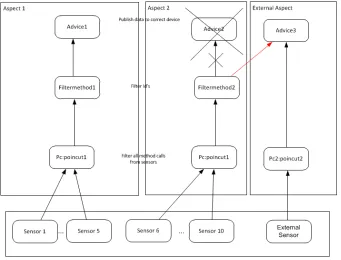
As an evolution, half of the sensors are moved from the outside to the inside. The indoor temperature was deemed useless for the weather station, yet would be useful for a thermostat to regulate indoor temperature. The values measured by the sensors must be split up to perform different actions. The values of the indoor sensors must be sent to the thermostat, while the outdoor sensors’ values must be sent to the weather station. The identifier of the sensors is used to differentiate between the two, where 1 to 5 is used for indoor sensors and 6 to 10 is used for outdoor sensors. This evolution scenario will be used to evaluate the frameworks on their ability of creating more complex event processing agents based on existing agents and the parameterization of instances.
3.3.2.2 Scenario 2
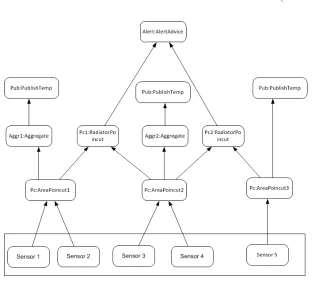
average of the last two values, and publish this to the user.
Secondly, the sensors must be used to measure radiator malfunctions, which needs to be fixed as soon as possible. The radiators are located between the areas, and when 10 continuous values greater than the allowed values (set at 30) is measured in one of the areas near the radiator the maintenance crew needs to be informed. This evolution scenario is useful to test the ability of a framework to have an instance of a module for a specific group of objects. Secondly, it tests the possibility of two aspects performing actions on the both the same and different instances of a functionality.
3.3.2.3 Scenario 3
For the third scenario, it is assumed that a new sensor has been added from an external project. This external project also has an event processing agent and an event consumer responsible for the transmitting of the data to a different weather station.
For the evolution, the old weather station needs to be removed and the outside temperatures must be sent to the new weather station. The reaction, responsi-ble for sending the data to new weather station, only requires the temperature as a value.
This evolution scenario will be used to examine the ability to correct functional-ities in existing event consumers and event processing agents. Secondly, it takes a look at correcting input and output of modules.
3.3.2.4 Scenario 4
For some reason the previous programmer switched the IDs in the event pro-cessing agents responsible for filtering between inside and outside, meaning the inside temperatures are sent to the weather stations and the outside are sent to the thermostat. In order to fix this, the event processing need to be corrected. This scenario will examine the possibility of correcting functionality and the instantiation of modules.
3.3.2.5 Scenario 5
The following scenario uses the resulting program of evolution scenario 2 as a base.
Because one of the three areas only contains one sensor, the publishing of the aggregate of the last two values has been deemed useless. To solve this, the choice has been made to remove the calculation of the aggregate and publish the temperature of the sensor directly to the user.
modules from the flow of a program.
3.3.2.6 Scenario 6
The following scenario contains 4 evolutions but to avoid repetition they are combined in one scenario.
This scenario looks at the event processing agents and event consumer of the inside sensors and more specifically the output of the former, the input of the latter, and the binding between the two. For the evolution, variables from both the input and output are added and removed resulting in the 4 (2x2) evolutions.
3.3.3
Implementation of Evolution Scenarios
After defining the criteria and the scenarios, they were implemented in AspectJ and the evaluation criteria are evaluated. Furthermore the results when using both the Observer pattern and Esper are discussed.
3.3.3.1 Base Scenario
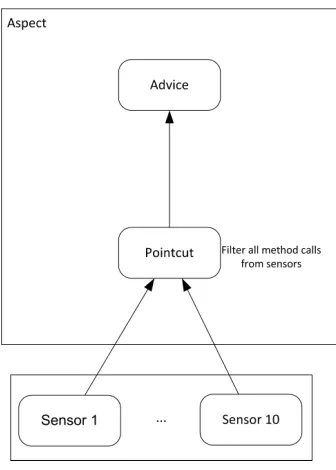
Implementing the base scenario in AspectJ an aspect needs to be defined in which joinpoints are selected where sensors store the measured temperature after which the advice is executed.
This results in the AspectJ code shown in Listing 3.1.
1 p r i v a t e p o i n t c u t f i l t e r ( T e m p e r a t u r e S e n s o r s e n s o r ) : t h i s( s e n s o r ) &&
c a l l(v o i d s t o r e ( S t r i n g , d o u b l e, i n t) ) ;
2
3 b e f o r e( T e m p e r a t u r e S e n s o r s e n s o r ) : f i l t e r ( s e n s o r ){ 4 // p e r f o r m a c t i o n
5 }
Listing 3.1: AspectJ Base Scenario Implementation
The advice is not fully implemented since it is not relevant for the evolution scenarios.
In Java, the Observer Pattern can be used where the observers can be cre-ated which will react when the sensors notify them that a value is published.
Figure 3.1: Base Project
3.3.3.2 Scenario 1
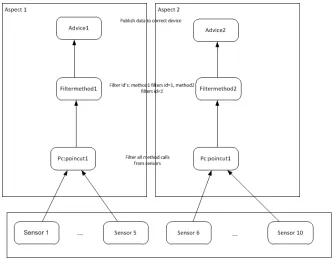
In this scenario, the original pointcut needs to be extended to filter on both the inside, where the ID is between 1 and 5, and the outside, where the ID is between 6 and 10. For both the filters, a reaction is required resulting in the structure seen in Figure 3.2.
To implement this in AspectJ the original aspect was altered to ensure it would be extensible in other aspects. This is done, by making the original aspect ab-stract and the pointcut protected. Listing 3.2 shows the resulting AspectJ code.
1 p u b l i c a b s t r a c t a s p e c t T e m p e r a t u r e F i l t e r {
2 p r o t e c t e d p o i n t c u t s e n s o r P o i n t c u t ( T e m p e r a t u r e S e n s o r s e n s o r ) : t h i s
( s e n s o r ) && c a l l(v o i d s t o r e ( S t r i n g , d o u b l e) ) ;
3 }
Listing 3.2: Abstract Temperature Aspect
Figure 3.2: Evolution Scenario 1
1 p u b l i c a s p e c t I n s i d e T e m p e r a t u r e F i l t e r e x t e n d s T e m p e r a t u r e F i l t e r { 2 p r i v a t e p o i n t c u t i n s i d e P o i n t c u t ( T e m p e r a t u r e S e n s o r s e n s o r ) :
s e n s o r P o i n t c u t ( s e n s o r ) && i f( s e n s o r . g e t I d ( ) >0 && s e n s o r . g e t I d ( )<6) ;
3
4 b e f o r e( T e m p e r a t u r e S e n s o r s e n s o r ) : i n s i d e P o i n t c u t ( s e n s o r ){
5 System . o u t . p r i n t l n (” p u b l i s h e d To t h e r m o s t a t : ”+s e n s o r . getName ( )
+” w i t h v a l u e : ”+ s e n s o r . g e t V a l u e ( ) ) ;
6 // p e r f o r m a c t i o n
7 }
8 }
1 p u b l i c a s p e c t O u t s i d e T e m p e r a t u r e F i l t e r e x t e n d s T e m p e r a t u r e F i l t e r { 2
3 p r i v a t e p o i n t c u t o u t s i d e P o i n t c u t ( T e m p e r a t u r e S e n s o r s e n s o r ) :
s e n s o r P o i n t c u t ( s e n s o r ) && i f( s e n s o r . g e t I d ( ) >5 && s e n s o r . g e t I d ( )<11) ;
4
5 b e f o r e( T e m p e r a t u r e S e n s o r s e n s o r ) : o u t s i d e P o i n t c u t ( s e n s o r ){ 6 System . o u t . p r i n t l n (” p u b l i s h e d To w e a t h e r s t a t i o n : ”+s e n s o r .
getName ( )+” w i t h v a l u e : ”+ s e n s o r . g e t V a l u e ( ) ) ;
7 // p e r f o r m a c t i o n
8 }
9 }
Listing 3.4: Outside Sensor Filter Aspect
The aspect responsible for the outside sensors needs the advice code from the original aspect, responsible for the publishing to the weather station. This can be copied from the aspect, after which the pointcut needs to be replaced with the pointcut specifically for the outside sensors.
Added Modules Removed Modules Redefined Modules Altered Bindings Non-modular Funct. Added #Strongly couple concerns
AspectJ 3 0 2 0 0 0
The amount of added modules seems logical since two new filters are required and one new reaction, but the filters perform the same action, but on a dif-ferent ID, meaning this number could be reduced. The redefined modules are not desired. Because of the strong coupling between the filter and the reaction, changing the binding between them requires a redefinition of one of the modules.
To allow this in Java, two new modules need to be created which utilize the orig-inal filter. The origorig-inal filter will need to be removed as an observer. Because of the binding between the filter and the reaction, the original filter will need to be redefined, removing the call to the reaction, which needs to be moved to a new filter. This means, even more changes are required for the Java implementation.
In Esper, the amount of new modules can not be reduced since instantiation or parameterization is not possible in the statements. The binding between the filter and reaction is specified in the filter, just like in Java, and therefore does not have the same problems as AspectJ. The problem with Esper is that the first filter, used to select the right events cannot be bound to other filters. This means the code from the primary filter needs to be moved to both the new filters introducing duplicate code.
3.3.3.3 Scenario 2
and instantiated and composed with the correct filters resulting in the structure seen in Figure 3.3.
Figure 3.3: Evolution Scenario 2
To reduce the amount of duplicate code for AspectJ, two classes were created to perform aggregate calculation, and temperature measurement. These classes were:
Aggregate: which maintains and returns the average temperature.
RadiatorSensor: Counts the amount of continues values above 30, when it reaches 10 values it will return ’true’.
To allow different areas to perform an action on the same instance all pointcuts and advices will have be defined within the same aspect. Otherwise instances of a specific type needs to be made public so other aspects can reference it. This would also create a strong coupling between the aspects, which we want to avoid. In the inside aspect, three Aggregate instances and two RadiatorSensor instances are defined, as shown in Listing 3.5.
1 A g g r e g a t e agg1 = new A g g r e g a t e ( ) ; 2 A g g r e g a t e agg2 = new A g g r e g a t e ( ) ; 3 A g g r e g a t e agg3 = new A g g r e g a t e ( ) ;
4 R a d i a t o r S e n s o r radMon1 = new R a d i a t o r S e n s o r ( ) ; 5 R a d i a t o r S e n s o r radMon2 = new R a d i a t o r S e n s o r ( ) ;
Listing 3.5: External Class Instantiation
For every area, a pointcut is defined, as shown in Listing 3.6.
1 p r i v a t e p o i n t c u t a r e a 1 ( T e m p e r a t u r e S e n s o r s e n s o r ) : s e n s o r P o i n t c u t (
s e n s o r ) && i f( s e n s o r . g e t I d ( )==1 | | s e n s o r . g e t I d ( ) ==2) ;
2 p r i v a t e p o i n t c u t a r e a 2 ( T e m p e r a t u r e S e n s o r s e n s o r ) : s e n s o r P o i n t c u t (
s e n s o r ) && i f( s e n s o r . g e t I d ( )==3 | | s e n s o r . g e t I d ( ) ==4) ;
3 p r i v a t e p o i n t c u t a r e a 3 ( T e m p e r a t u r e S e n s o r s e n s o r ) : s e n s o r P o i n t c u t (
s e n s o r ) && i f( s e n s o r . g e t I d ( ) ==5) ;
Listing 3.6: Area Pointcut Definition
After this, two options exist: Either handle all the advices per area, which is shown in Listing 3.7.
1 b e f o r e( T e m p e r a t u r e S e n s o r s e n s o r ) : a r e a 1 ( s e n s o r ){ 2 agg1 . addValue ( s e n s o r . g e t V a l u e ( ) ) ;
3 // p u b l i s h v a l u e
4 i f( radMon2 . addValue ( s e n s o r . g e t V a l u e ( ) ) ){ 5 // a l e r t m a i n t e n a n c e
6 }
7 } 8
9 b e f o r e( T e m p e r a t u r e S e n s o r s e n s o r ) : a r e a 2 ( s e n s o r ){ 10 agg2 . addValue ( s e n s o r . g e t V a l u e ( ) ) ;
11 // p u b l i s h v a l u e
12 i f( radMon1 . addValue ( s e n s o r . g e t V a l u e ( ) ) | | radMon2 . addValue ( s e n s o r
. g e t V a l u e ( ) ) ){ 13 // a l e r t m a i n t e n a n c e
14 }
15 } 16
17 b e f o r e( T e m p e r a t u r e S e n s o r s e n s o r ) : a r e a 3 ( s e n s o r ){ 18 agg3 . addValue ( s e n s o r . g e t V a l u e ( ) ) ;
19 // p u b l i s h v a l u e
20 i f( radMon1 . addValue ( s e n s o r . g e t V a l u e ( ) ) ){ 21 // a l e r t m a i n t e n a n c e
22 }
23 }
Or handle the radiator monitors as a pointcut, as shown in Listing3.8.
1 @P oin tcut (” ( a r e a 1 ( s e n s o r ) | | a r e a 2 ( s e n s o r ) ) && i f ( ) ”) 2 p r i v a t e b o o l e a n r a d i a t o r M o n i t o r 1 ( T e m p e r a t u r e S e n s o r s e n s o r ){ 3 r e t u r n radMon1 . addValue ( s e n s o r . g e t V a l u e ( ) ) ;
4 } 5
6 @P oin tcut (” ( a r e a 2 ( s e n s o r ) | | a r e a 3 ( s e n s o r ) ) && i f ( ) ”) 7 p r i v a t e b o o l e a n r a d i a t o r M o n i t o r 2 ( T e m p e r a t u r e S e n s o r s e n s o r ){ 8 r e t u r n radMon2 . addValue ( s e n s o r . g e t V a l u e ( ) ) ;
9 } 10
11 b e f o r e( T e m p e r a t u r e S e n s o r s e n s o r ) : a r e a 1 ( s e n s o r ){ 12 d o u b l e a g g r e g a t e = agg1 . addValue ( s e n s o r . g e t V a l u e ( ) ) ; 13 // p u b l i s h v a l u e
14 } 15
16 b e f o r e( T e m p e r a t u r e S e n s o r s e n s o r ) : a r e a 2 ( s e n s o r ){ 17 d o u b l e a g g r e g a t e = agg2 . addValue ( s e n s o r . g e t V a l u e ( ) ) ; 18 // p u b l i s h v a l u e
19 } 20
21 b e f o r e( T e m p e r a t u r e S e n s o r s e n s o r ) : a r e a 3 ( s e n s o r ){ 22 d o u b l e a g g r e g a t e = agg3 . addValue ( s e n s o r . g e t V a l u e ( ) ) ; 23 // p u b l i s h v a l u e
24 } 25
26 b e f o r e( T e m p e r a t u r e S e n s o r s e n s o r ) : r a d i a t o r M o n i t o r 1 ( s e n s o r ) | |
r a d i a t o r M o n i t o r 2 ( s e n s o r ){ 27 // a l e r t m a i n t e n a n c e
28 }
Listing 3.8: Separated Pointcut and Advice
The former reduces the amount of modules but increases the redundancy and does not separate the concerns of pointcut and advice. Both options will be examined to see which one is the best.
Added Modules Removed Modules Redefined Modules Altered Bindings Non-modular Funct. Added #Strongly couple concerns
AspectJ per area 6 0 0 0 2 12
AspectJ monitor as pointcut 9 0 0 0 2 3
The problem in AspectJ is that advices are unnamed modules. Composing mul-tiple advices together where the output of one is the input of another would require them to be defined within the same module, or requires utilization of global variable which becomes very dependant on the execution of AspectJ.
In Java, a similar coupling is required, where the reactions must call each other in order to perform multiple reactions after each other.
3.3.3.4 Scenario 3
[image:33.612.110.451.186.446.2]For this evolution scenario, the filter for the outside sensor needs to be composed with the reaction from the external project, as shown in Figure 3.4. The external
Figure 3.4: Evolution Scenario 3
aspect is shown in Listing 3.9.
1 p r i v a t e p o i n t c u t e x t e r n a l F i l t e r (d o u b l e v a l u e ) : t h i s(
T e m p e r a t u r e S e n s o r 2 ) && a r g s( S t r i n g , v a l u e , i n t) && c a l l(v o i d
s t o r e ( S t r i n g , d o u b l e, i n t) ) ;
2
3 b e f o r e(d o u b l e v a l u e ) : e x t e r n a l F i l t e r ( v a l u e ) { 4 // Perform e x t e r n a l a c t i o n
5 }
Listing 3.9: External Aspect
The problem in AspectJ is that the poincut and filter of the outside sensors and the advice from the external sensor need to be connected, as can be seen in the Figure 3.4. To make this happen some problems arise.
produce the same types as output.
To solve this, the outside filter can be changed by adding the value of the sensor to the pointcut. Now the external and the outside pointcut can be composed by ignoring the sensor in the new pointcut, as shown in Listing 3.10.
1 p u b l i c p o i n t c u t o u t s i d e P o i n t c u t ( T e m p e r a t u r e S e n s o r s e n s o r , d o u b l e
v a l u e ) : s e n s o r P o i n t c u t ( s e n s o r ) && a r g s( S t r i n g , v a l u e ) && i f( s e n s o r . g e t I d ( ) >5 && s e n s o r . g e t I d ( )<11) ;
Listing 3.10: Outside Sensor Filter with Added Output
This pointcut can be used in the external advice by composing the external and outside pointcut into one pointcut which can be done in the advice, as shown in Listing 3.11.
1 b e f o r e(d o u b l e v a l u e ) : e x t e r n a l F i l t e r ( v a l u e ) | |
O u t s i d e T e m p e r a t u r e F i l t e r . o u t s i d e P o i n t c u t ( T e m p e r a t u r e S e n s o r , v a l u e ) {
2 // Perform e x t e r n a l a c t i o n
3 System . o u t . p r i n t l n (” E x t e r n a l v a l u e p u b l i s h e d : ”+ v a l u e ) ; 4 }
Listing 3.11: Pointcut Composition
This does however require another change in the outside pointcut, because it needs to be made public for the external aspect to use it. This can however be avoided by having it public from the start.
If the outside pointcut was also being used by other advices, changing the out-put becomes a more difficult task since that change will ripple to all modules referencing it. To avoid this, a new pointcut can be created extending the out-side pointcut by adding the temperature to the output. Then, the new pointcut can be used for the external aspect while the other modules can keep using the original pointcut. Because the outside pointcut is not, and will not, be used by other modules, this alternative is ignored.
Another solution would be to copy the advice of the external filter and reuse it with the outside filter, as shown in Listing 3.12.
1 b e f o r e( T e m p e r a t u r e S e n s o r s e n s o r ) : O u t s i d e T e m p e r a t u r e F i l t e r .
o u t s i d e F i l t e r ( s e n s o r ) {
2 // Perform e x t e r n a l a c t i o n ( a g a i n ) 3 }
Listing 3.12: Duplicated External Reaction
temperature defined within the sensor provided by the outside filter. It also creates redundancy because the same code is defined twice. The outside filter will also still need to be made public so it can be referenced by the external aspect.
Another way to handle this is to create a superclass for both sensors. At this point both pointcuts can return that superclass as output and the advice can receive that type as input. This would, however, require a change in the base program and the external pointcut and advice, or the luck or knowledge that all the sensors are already subtypes of one generic superclass. At that point, only the external pointcut and advice need to be changed to alter the input and output, and the way the temperature is retrieved in the advice.
It would also be possible to use the joinpoint as output for the pointcuts and retrieve the class responsible for the activation of the pointcut, e.g. the sensors. This would still require a change in both the outside and the external pointcut to make sure that they output the joinpoint and a change in the advice to retrieve the sensor from the joinpoint. Secondly, because this situation doesn’t assume the previously mentioned superclass, the advice has to differentiate between the two different types of sensors to perform the action, increasing the amount of code.
All these different alternatives will be examined for completeness.
Added Modules Removed Modules Redefined Modules Altered Bindings Non-modular Funct. Added #Strongly couple concerns
AspectJ add temperature 0 1 2 0 0 0
AspectJ copied advice 0 1 1 0 0 0
AspectJ sensor superclass 0 1 2 0 1 0
AspectJ joinpoint 0 1 3 0 0 0
In all of the cases in this scenario, AspectJ requires changes to modules to cope with the strong coupling between the modules. The second implementation has a reduced amount of module redefinition but introduces duplicate code.
In Java, less, though still some, redefinition is required, because the filter used for the outside sensors can call the newly added advice and remove the call to the original advice, meaning Java is actually more preferable in this scenario.
3.3.3.5 Scenario 4
The fourth scenario requires the advice to be performed after a different point-cut is activated.
In AspectJ, this scenario is solvable in two ways. The first is to change the im-plementation of the pointcuts to make the filters correct again, as in Listing 3.13.
1 p r i v a t e p o i n t c u t i n s i d e P o i n t c u t ( T e m p e r a t u r e S e n s o r s e n s o r ) :
s e n s o r P o i n t c u t ( s e n s o r ) && i f( s e n s o r . g e t I d ( ) >5 && s e n s o r . g e t I d ( )<11) ;
2
3 p r i v a t e p o i n t c u t o u t s i d e P o i n t c u t ( T e m p e r a t u r e S e n s o r s e n s o r ) :
s e n s o r P o i n t c u t ( s e n s o r ) && i f( s e n s o r . g e t I d ( ) >0 && s e n s o r . g e t I d ( )<6) ;
Listing 3.13: Pointcuts with Switched Functionality
The second method is to change the bindings of the pointcuts in the advices to make the outside reaction use the inside filter and vice versa. This does however create the problem that the pointcuts need to be changed to allow them to be referenced in the other aspects.
Added Modules Removed Modules Redefined Modules Altered Bindings Non-modular Funct. Added #Strongly couple concerns
AspectJ change pointcut 0 0 2 0 0 0
AspectJ change advice 0 0 4 0 0 0
This scenario reiterates the point made earlier where instantiation and param-eterization can reduce the amount of modules, and when requiring changes like this would reduce the amount of redefined modules.
In Java and Esper, the same situation applies, where both the inside and the outside filter need to be changed.
3.3.3.6 Scenario 5
In this scenario, the functionality aggregating the values for one specific area needs to be removed, composing the filter for the outside sensors to the external reaction as seen in Figure 3.5.
Figure 3.5: Evolution Scenario 5
1 b e f o r e( T e m p e r a t u r e S e n s o r s e n s o r ) : a r e a 3 ( s e n s o r ){ 2 d o u b l e a g g r e g a t e = s e n s o r . g e t V a l u e ( ) ;
3 publAggr . p u b l i s h ( a g g r e g a t e ) ; 4 }
Listing 3.14: Advice with Removed Funtionality
As mentioned in scenario 2, there were two options of publishing the data, where the call to publishing could be incorporated in the aggregate calculation. This option was not chosen because that would reduce modularity and that would truly be shown in this scenario, where one instance of the aggregate-publishing advice would have to be changed. If the two advices would be implemented in one advice module, this scenario would require them to be separated and removed for the third area.
Added Modules
Removed Modules
Redefined Modules
Altered Bindings
Non-modular Funct. Added
#Strongly couple concerns
AspectJ 0 0 2 0 0 0
In this scenario, the strong coupling between filters and reaction is shown. Be-cause the two reactions are strongly coupled, removing one will result in a change for the other.
In Java, the same coupling problem exists, because the concerns specifies how to continue the flow of ˙Removing the reactions between the filter and another reactions requires the removal of the reaction and changing the filter to execute a different reaction.
In Esper, the reactions are bound in the same way as in Java, meaning the same actions are required.
3.3.3.7 Scenario 6
For this scenario, both the input of the reaction and the output filter will be changed by adding and removing one of the values.
In AspectJ, the removing a parameter from the input will still allow the same pointcut to be used. It will only require the binding defined in the reaction to be changed to ignore the output from the pointcut by adding the type instead of the name which used to match the input of the advice, as shown in Listing 3.15.
1 b e f o r e( ) : o r i g i n a l P o i n t c u t 1 ( ) | | i n s i d e P o i n t c u t ( T e m p e r a t u r e S e n s o r ){ 2 // do s o m e t h i n g
3 }
Listing 3.15: Ignored Pointcut Output
A more difficult situation arises when adding an extra input. Because that value will become unbound in the pointcut, an error will be given. For this to work, the pointcut needs to be changed to include the added input as an output value. After this, the input can be matched with the input, as can be seen in Listing 3.16.
1 p r i v a t e p o i n t c u t a d d e d I n s i d e O u t p u t ( T e m p e r a t u r e S e n s o r s e n s o r , S t r i n g
s t r i n g ) : i n s i d e P o i n t c u t ( s e n s o r ) && a r g s( s t r i n g , d o u b l e) ;
Listing 3.16: Pointcut with Added Output
1 b e f o r e( T e m p e r a t u r e S e n s o r s e n s o r , S t r i n g s t r i n g ) : o r i g i n a l P o i n t c u t 2 (
s e n s o r , s t r i n g ) | | a d d e d I n s i d e O u t p u t ( s e n s o r , s t r i n g ){ 2 // do s o m e t h i n g
3 }
Listing 3.17: Bound Pointcut and Advice with Added Input
In the case of removing of output, the same situation arises as the adding of input, which requires a change in the advice module. When adding output to the pointcut, the same situation is used as the removal of input requiring only a change in the binding code in the advice.
Added Modules Removed Modules Redefined Modules Altered Bindings Non-modular Funct. Added #Strongly couple concerns
Adding Input 0 0 2 0 0 0
Removing Input 0 0 1 0 0 0
Adding output 0 0 1 0 0 0
Removing output 0 0 1 0 0 0
AspectJ is fairly strict when it comes to input and output of the filter and re-action. Most prominently when adding an input to the reaction the filter both modules require changes. Secondly, the binding of input and output happens within the modules itself, meaning any change immediately means the modules need to be redefined which is not desirable.
In Java, the mapping of input and output is just as strict as AspectJ, since they are simple method call, and happens within the modules, resulting in the same situation as AspectJ.
In Esper, the input in modules is fixed, where the statement and the reaction only receives events, limiting the possibilities.
3.4
Summary
In the previous sections, a set of languages and frameworks were evaluated and shortcomings in fulfilling the criteria from section 3.1 were identified. When looking at the evaluation, some shortcomings which are fairly evident. When evaluating the language extensibility, the more established languages such as AspectJ offer no direct support for language extensibility, and even the plug-in mechanism XAspect does offers language extensibility, but with some limita-tions. Reflex and Awesome offer a greater language extensibility, but fall short when it comes to the modularity and composability.
The modularity and composability in AspectJ, though possible to some ex-tent, could be improved.
within one of the module. When a change is required in a filter, or when an-other filter needs to be used, the modules which are bound to it require a change themselves. Languages which offer a separate section in which the composition can be defined, preserves the separation of concerns and ensures the modules have no knowledge of each other, which is important in modularity.
Advices in AspectJ are unnamed modules and cannot be referenced in other modules. This leads to the problem that when multiple reactions need to take place they either needs to be defined in separate advices or all defined in one. When the output of one reaction is required as the input of another, they will need to be defined in the same advice, or require a construct where multiple advices use the same global variable.
In some scenarios, nearly identical modules were required, or two modules which needed to maintain a separate states. In the existing frameworks little to none direct support is offered for this, increasing duplicate code and .
The scenarios lead to the following list of shortcomings is identified.
• Strong coupling between filters and reactions, requiring lots of redefining of modules when small changes are needed.
• Strict binding of input and output, requiring all values to be mapped.
• Advices are unnamed and cannot be composed outside of the module.
• Duplicate code is increased due to lack of instantiation and parameteriza-tion.
With the concerns evaluated, the conclusion can be drawn that no existing framework is able to facilitate the modularity, composability and language ex-tensibility to a full extend. To solve this problem, a new framework is proposed which should be able to allow a bigger support these concerns to a greater degree. This new framework would have the following requirements:
• All filters and reactions are defined within their own, named, module.
• Modules can be instantiated and parameterized at will.
• Modules do not require any knowledge about each other.
• Free composition between filters and reactions.
• Composition between the modules is handles in a separate section.
• New DSLs and GPLs can be added to define the functionalities.
CHAPTER
4
EventReactor2.0
In the previous chapter, the shortcomings of various languages and frameworks to fulfill the modularity, composability and language extensibility criteria were discussed. To avoid these shortcomings a set of requirements are defined for a framework to implement EPAs. In this chapter the EventReactor2.0 framework is discussed.
In section 4.1, the compilation phase of the framework is explained. In sec-tion 4.2, the runtime behaviour of the framework is explained. In secsec-tion 4.3, the improvements of EventReactor2.0 over EventReactor are explained. In sec-tion 4.4, the results are summarized.
4.1
Compile time
Figure 4.1 shows the compiler of EventReactor2.0. To implement and EPA, an application developer has to defined Specification of Event Types and Specifi-cation of Events. These are used to define types of events and a set of events supported by the EPA respectively. Specification of Event Types is provided to the componentEvent Type Checkerwhich verifies if the event types are specified using the correct syntax and if language constraints, such as unique names, are adhered to. After verification, the specification is provided to the component
Event Type Compiler, which compiles the specifications to oneEvent Type Java Class for each defined event type. This class is stored on the file system. For
Specification of Events, the same type of actions are performed. It is provided to the component Event Checker to verify the syntax and the language con-straints. After that, the component Event Compiler creates one Event Java Class for each event, which is stored on the file system. In the applicationBase Program, which is created by the application developer, a generated Event Java Class can be instantiated and published to indicate a state change.
Figure
4.1:
Ov
erall
Arc
hitecture
of
Ev
en
[image:42.612.189.489.144.651.2]processing agents and event consumers in an extensible list of GPLs and DSLs. The specification is provided to the component Event Module Checker, which verifies whether or not the syntax is correct and the language constraints are adhered to. After verification, the specification is provided to the component
Event Module Compiler, which is responsible for translating it to one Event Module Java Class per specified event module. To do this, the repository Lan-guage Specific Compilers is used to select the correct compiler based on the language used to define Specification of Event Modules. A new Specification of Language Compiler can be defined by the application developer and added to the repository Language Specific Compilers so new languages to be used to defineSpecification of Event Modules. AfterEvent Module Java Class is gener-ated, it is stored inEvent Module Repository for later use.
The application developer provides Specification of Composition. This is in-put to the componentComposition Checker to verify the syntax and language constraints. After this, the component Composition Interpreter splits it up in three sections: Specification of Ordering, Specification of Instantiation, and
Specification of Binding.
Specification of Ordering, in which the order of execution of the modules in-stances is defined, is directly stored in the repository Ordering Specifications.
Specification of Instantiations describes how many instances of each event mod-ule is required and how they’re named. This is provided to the component
Instance Manager which also retrieves the event modules from Event Module Repository. Both components are used to create instances ofEvent Module Java Class as specified, to produce a list ofInstantiated Event Modules. The compo-nentBinding Manager is providedBinding Specifications, in which is described how the event module instances are bound together. Instantiated Event Mod-ules are retrieved by Binding Manager to create a list of unbound modules, to be stored in the repository Unbound Event Modules. This repository contains module instances, which do not have their output bound to the input of another module. These instances are the consumers or event processing agents which are at the start of the event processing network.
The component Binding Manager also sets all values in the instances as speci-fied in Specification of Bindings as static bindings. All instances are stored in the repository Event Module Instance Repository.
Figure 4.2: Abstract Runtime Architecture
4.2
Runtime
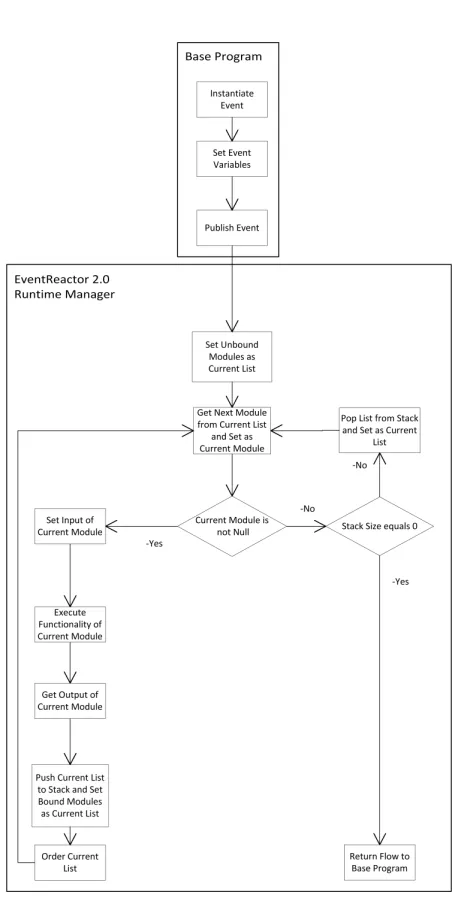
interest in the program. After this, the application developer must Set Event Variables, which can for instance be the temperature measured by the sensor. When all values are set the application developer can Publish Event, to notify the EventReactor2.0 framework of the state change.
In the framework, the component RuntimeManager is responsible for receiv-ing and processreceiv-ing the published event. After RuntimeManager receives the event, the repositoryUnbound Event Modules is used toSet Unbound Modules as Current List. Thecurrent list is the list containing event modules which are currently being traversed to be executed.
From the current list, the framework canGet Next Module from Current List and Set as Current Module. The Current Module is the event module to be executed next. This way, the current list is traversed.
Before execution, it is checked whether or notCurrent Module is Not Null. This verifies if there was still an event module in the current list.
If it is not Null, the framework canSet Input of Current Module. This sets all the input variables based onBinding Specifications.
After the correct values have been set RuntimeManager can Execute Func-tionality of Current Module. This functionality, expressed in the event module using a GPL or DSL, performs the event processing.
After the functionality is executed, the frameworkGet Output of Current Mod-ule. These are the values which are produces by the event module and can be used to bind to the input of other modules using the binding specification. Using Binding Specification the names of the module instances, bound to the current module, are retrieved. Using the repository Event Module Instance Repository, the module instances can be retrieved based on their name, result-ing in a list of event module instances which should be executed next. The framework can then Push Current List to Stack and Set Bound Modules as Current List. Thestack is filled with lists containing the event modules which still need to be executed, yet are not processed at this moment. By adding the current list to thestack and using the bound modules first the execution is performed depth first. Using the repositoryOrdering Specifications, the frame-work canOrder Current List to set the order of execution of the created event module list.
4.3
Extensions to EventReactor
Since the framework uses EventReactor as a basis, it is possible to examine the improvements offered by this new architecture. The following list explains the advantages offered by EventReactor2.0:
• With respect to the criteria language extensibility; EventReactor only DSLs are provided to implement the specific concerns. EventReactor2.0 allows an extensible list of DSLs and GPLs to be used to implement the concerns. New language specific compilers can be plugged into the frame-work allowing more readable event modules to be defined for specific con-cerns.
• With respect to the criteria modularity: The Prolog expressions in Even-tReactor can not be modularized, while the different consumer and event processing agent concerns can be modularized using the event module. In these event modules the functionalities can be defined without any knowl-edge required about other modules.
• with respect to thecomposability concern; module instantiation in Even-tReactor happens based on the attributes of the events, while EventReac-tor2.0 support explicit instantiation of the modules, and explicit binding of modules at instance level.
4.4
Summary
CHAPTER
5
Specification of Events
The first step in programming EPAs is to define the events which can be pub-lished. EventReactor2.0 assumes that events are typed entities, and provides dedicated linguistic abstractions to define event types and events. In section 5.1, the choices made when designing event types and events are explained includ-ing the resultinclud-ing languages. Section 5.2 describes how the two concerns are compiled and how the compiled modules can be used in the base program. Sec-tion 5.3 explains some shortcomings currently still existing in the language and how they can be improved. Section 5.4 summarizes the achieved results.
5.1
Design
5.1.1
Event types
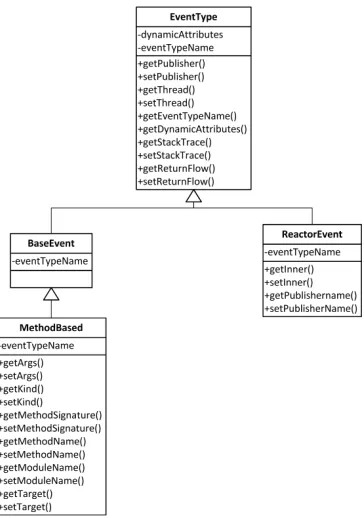
Event types are described as a specification for a set of event objects that have the same semantic intent and same structure [7]. Events can be seen as in-stances of event types.
In the following section, it is described how the language extensibility, modu-larity and composability requirements are fulfilled in the specification of event types.
To fulfill the requirementlanguage extensibility, the framework offers a dedicated language to define event types of interest as a data structure encapsulating a set of attributes. This provided the user with the possibility to use an extensible set of event types.
To fulfill the modularity requirement, all event types are defined in a sepa-rate module. Providing modularized event types facilitates defining a library or reusable event types. The modules have unique names and encapsulate the specification of attributes.