
Does monetary reward enhance motor sequence learning?
26
0
0
Full text
(2) 2. Abstract Learning new motor skills is quite time-consuming. Since recent studies found that reward has a positive influence on performance in simple cognitive and motor task we wanted to investigate if this effect can also be observed in the learning of a more complex motor task. Therefore, we examined if we can speed up the learning of a motor sequence through monetary reward. To investigate this issue we instructed participants to execute two sequences of each six key presses as fast and accurate as possible. One sequence was presented three times as often as the other. Participants in the experimental condition could earn €10 at maximum if they improved their performance during practice. A control group received no reward. We expected rewarded participants to execute the key sequences faster and more accurate compared to the non-rewarded group. Learning was measured as a decrease in RTs and erroneous responses in an initial practice phase. In the following test phase the difference in RTs and erroneous responses of the two familiar and two unfamiliar sequences were compared. Our hypothesis was only weakly supported by the data. Reward seemed to have positively influenced the amount of erroneous responses in the briefly practiced sequence. Although RTs of rewarded participants were shorter than those of nonrewarded participants during practice this difference was not significant. Additionally, we found that the familiar sequences were executed faster than unfamiliar ones in the test phase. RTs of the rewarded and non-rewarded group did not differ. Possible reasons for the absence of a positive effect of reward are discussed. An unexpected high motivation among all participants probably diminished the incentive effect of the reward. In future research it should carefully be accounted for such interfering factors..
(3) 3. Contents Abstract ...................................................................................................................................... 2 Introduction ................................................................................................................................ 4 The Dual Processor Model and the Role of Pactice ............................................................... 4 The Influence of Reward on Performance .............................................................................. 6 Dopamine and Its Relation to Reward and Motor Learning .................................................. 7 The Present Study ................................................................................................................... 9 Method ..................................................................................................................................... 10 Participants ........................................................................................................................... 10 Apparatus .............................................................................................................................. 11 Task and Procedure .............................................................................................................. 11 Results ...................................................................................................................................... 13 Practice Phase ....................................................................................................................... 13 Reaction Time. .................................................................................................................. 13 Test Phase ............................................................................................................................. 16 Reaction Time. .................................................................................................................. 16 Accuracy. .......................................................................................................................... 17 Explicit knowledge. .............................................................................................................. 18 Discussion ................................................................................................................................ 19 References ................................................................................................................................ 24.
(4) 4. Introduction Movements are the basis of our everyday behaviour. In the beginning we execute movement patterns slowly and carefully, but with practice we are able to perform them more fluently and become faster. Consider for example the first time someone tries to play the piano. In the beginning she is pretty slow because she has to actively search each corresponding key for each note. With practice, this process becomes more and more effortless and in the end it is not necessary anymore to think about where the keys are. This example illustrates that that the process from initial learning to a more automatic execution of a movement sequence takes quite some time. Therefore, the aim of this study is to examine whether this slow learning process can be enhanced through reward. In the following paragraph the dual processor model (Verwey, 2001) is introduced which describes the mechanisms underlying the learning of motor sequences. Then, different theories concerning reward and learning are introduced and the corresponding role of the neurotransmitter dopamine is discussed. To investigate motor sequence learning we used the discrete sequence production (DSP) task (e.g. Verwey, 1999; Abrahamse, Ruitenberg, De Kleine & Verwey, 2013) which will also be described in detail below. The Dual Processor Model and the Role of Pactice Verwey (2001) proposed the dual processor model (DPM) to describe the acquisition of skill in motor sequence learning. According to this model, a cognitive processor and a motor processor are involved in performing discrete movement sequences. The cognitive processor translates externally presented information into associated responses. It plans the execution of a movement and loads a so called motor buffer with information. Then, the motor processor reads the information from this buffer and carries out the action. In early practice the cognitive processor may translate each individual stimulus into a single response which then is executed by the motor processor. Verwey (2003) refers to this as the reaction.
(5) 5. mode. When the same sequence of key presses is performed again and again associations between succeeding movements are formed. This execution mode is referred to as the associative mode (Verwey, Abrahamse & De Kleine, 2010; Verwey & Abrahamse, 2012; Verwey, 2003) is reached and successive movements are primed by previous responses. For actual execution, however, this mode still relies on external guidance. The need for external stimulus information diminishes in the chunking mode. In this mode so called motor chunks evolve which represent a limited number of responses in just one memory unit (Verwey, 1999). The cognitive processor loads motor chunks into the motor buffer. This buffer can be understood as part of the working memory with only limited capacity (e.g. Verwey, 1999). The motor processor then reads the information from the motor buffer and carries out the action. Due to the emergence of motor chunks, processing load on the cognitive processor is reduced and movement sequences can be carried out faster (Verwey, 2001). As mentioned before this process of skill acquisition naturally takes quite some time. To investigate if the transition from reaction to chunking mode can be enhanced by reward the present study involves two different sequence conditions. The amount of practice will be extensive in one sequence and relatively brief in the other. We expect the extensively practiced sequence to depend on motor chunks and the briefly practiced condition to be rather executed in the reaction mode (e.g. Verwey, 1999). A task that is well suited to study motor sequence learning is the discrete sequence production (DSP) task (e.g. Verwey, 1999, 2001; Abrahamse et. al 2013). In this task respondents have to reproduce a sequence of six key presses. The sequence is shown on a computer screen with four squares representing four corresponding keys on a computer keyboard. The participants are instructed to press the corresponding key when a square lights up. After the first key press is successfully executed, the following square will light up and so.
(6) 6. on. Learning is measured as a decrease of reaction time and erroneous responses in a practice phase and the difference between RTs of familiar and unfamiliar sequences in a test phase. The Influence of Reward on Performance There is a great deal of evidence supporting the hypothesis that especially monetary rewards have a positive influence on performance (e.g. Dambacher, Hübner & Schlösser, 2011; Hübner & Schlösser, 2010; Savine & Braver, 2010). Hübner and Schlösser (2010) examined the influence of financial incentive cues in an Eriksen flanker task (Eriksen & Eriksen, 1974). This task is commonly used in cognitive psychology to investigate selective visual attention. A target stimulus has to be classified during the presence of responseincompatible or neutral flankers. They found that financial incentive cues increased attention effort. This led to an improved quality of sensory coding and therefore improved accuracy. Dambacher et al. (2011) investigated this issue further and examined the influence of payoff schemes on performance in a flanker task (Eriksen & Eriksen, 1974). They found that performance improved for monetary over symbolic rewards and that the incentives had most influence when penalties were higher for slow responses than for errors, or when neither slow responses nor errors were punished. Another study showed that reward incentives enhanced behavioural performance by facilitating the encoding and utilization of task related information (Savine et al., 2010). In this study participants had to judge a face’s gender or the amount of a word’s syllables while both stimuli were presented superimposed. All in all, these results demonstrate the effectiveness of reward as a motivational manipulation to enhance cognitive performance. Moreover, this positive effect on performance was also found to be evident in motor tasks. Wächter, Lungu, Liu, Willingham and Ashe (2009) examined the differential effect of reward and punishment on procedural learning using a serial reaction time (SRT) task. Like in the DSP task participants in the SRT task are instructed to respond repeatedly to the location of a stimulus. But due to the much longer sequence length the.
(7) 7. participants in a SRT task are unaware of the fact that stimulus presentation is sequential. Therefore, motor learning is assumed to be implicit in this task (Abrahamse, Jiménez, Verwey & Clegg, 2010). Wächter et al. (2009) found that only the reward group but not the control group displayed improved performance in motor sequence learning and that reward and punishment might even operate through different motivational neuronal systems. Palminteri et al. (2011) examined this issue further using a simple key press task including ten different sequences, each consisting of just three key presses. They found that participants increased RTs only when they were rewarded with a significant reinforcement compared to a symbolic one (€10 compared to 1 Eurocent). They considered the triplets of key presses as representing just one single motor action (or motor chunk) and learning to be implicit. In contrast, the sequences used in the present study are longer (consisting of six key presses each) and assumed to consist of more than one motor chunk (Verwey & Eikelboom, 2003). Therefore, the present study aims to investigate if the positive influence of reward on performance can also be observed in the learning of a more complex movement sequence. In line with the above discussed findings, we expect monetary reward to increase motivation and therefore enhance performance in the learning of sequential motor skill. Dopamine and Its Relation to Reward and Motor Learning Interestingly, the neurotransmitter dopamine has been found to play an important role in both the acquisition of motor skills (e.g. Badgaiyan, Fischman, & Alpert, 2007; Hikosaka, Nakamura, Sakai, & Nakahara, 2002; Molina-Luna et al., 2009) and in the coding of reward related memories in the brain (e.g. Bayer & Glimcher, 2005; Dambacher et al., 2011; Suri & Schultz, 1998; Zaghloul et al., 2009; Zald et al., 2004). It seems that the basal ganglia (BG) and neuronal mechanisms involving dopamine modulating synaptic plasticity in the striatum are of special importance for both processes (Badgaiyan et al., 2007; Garraux, Peigneux,.
(8) 8. Carson, & Hallett, 2007; Doyon et al., 2009; Hikosaka et al. 2002). Special support for dopamine’s mediating role in motor skill learning and reward coding comes from studies of patients with neuronal diseases such as Gilles de la Tourette syndrome or Parkinson’s disease (Molina-Luna et al., 2009; Palminteri et al., 2011; Wickens, 1989). In both diseases the dopamine balance in the BG is impaired. Gilles de la Tourette syndrome is a neurobehavioral disorder which is characterized by involuntary repetitive movements (motor tics) and utterances (phonic tics). It is suggested that abnormalities in the BG and corresponding hyperactivity of dopaminergic transmission are among others accountable for these behaviors (Albin & Mink, 2006). A common treatment for patients with Gilles de la Tourette syndrome is neuroleptics which restrict dopaminergic transmission. Palminteri et al. (2011) found that healthy controls and unmedicated patients with Gilles de la Tourette syndrome improved in motor skill learning after being rewarded, but not medicated patients. This indicates that the restriction of dopamine transmission reduced participant’s sensitivity for reinforcement in motor learning. Parkinson’s disease, in contrast, is characterized by the death of dopaminergic neurons which results in a deficiency of dopaminergic activity. This leads to movementrelated impairments and later on also to cognitive and behavioral problems (Davie, 2008; Jankovic, 2008). Among others, these cognitive problems include impaired responses to anticipated reward (Rowe et al., 2008). Furthermore, it seems that patients with Parkinson’s disease have difficulties in procedural learning (Frank, Seeberger & O’Reilly, 2004; Muslimovic, Post, Speelman, & Schmand, 2007) and especially the acquisition of motor sequences (Muslimovic et al., 2007). Frank et al. (2004) found that the reduced levels of dopamine in Parkinson’s patients impaired procedural learning from positive feedback, but improved learning from negative feedback. In their study patients had to choose from three different stimulus pairs and learn to make correct choices by trial-and-error. This indicates that dopamine levels can influence the sensitivity to reward when used as positive feedback..
(9) 9. To sum up, dopamine seems to be important for both, reward and motor learning. This raises the question if motor learning is especially delicate for reinforcement. The Present Study Based on the previous findings from the literature discussed above, we hypothesize that the learning of a motor sequence can be enhanced by monetary reward. Thus, we expect rewarded participants to show better learning performance in a sequential motor task compared to non-rewarded participants. The improvement should be evident in a decreased need for practice, shorter reaction times and less erroneous responses in sequences that are performed in the DSP task. To investigate if the need of practice is reduced an extensively practiced sequence is compared to a briefly practiced one. The effect of reward should especially be evident in the briefly practiced sequence condition, as we expect the development of motor chunks to occur only in the rewarded group. Finally, the effect of reward and practice should be evident in shorter reaction times and less erroneous responses when the familiar (learned) sequences are compared to unfamiliar sequences. Dambacher et al. (2011) found that rewarded participants only showed increased performance when speed was emphasized over accuracy. This phenomenon is probably due to a speed-accuracy trade off as respondents react slower to avoid “costly” errors. Moreover, it seems that monetary reinforcement only works as such if the reward is perceived as sufficient (Palminteri et al., 2011). So in accordance with these findings we informed the participants in the reward group that they could receive a financial reward of maximal €10 if they performed well in the task and respond as quickly as possible. We emphasized that they would receive the monetary reward only if their reaction time decreased over practice trials. They could earn money for each practice block in which their performance improved, but did not gain additional money if performance did not improve. As punishment seems to have no positive.
(10) 10. effect on the learning of motor sequences (Dambacher et al., 2011; Wächter et al., 2009) we decided not to punish (e.g. trough deducting money) the respondents if they did not succeed. As mentioned above we decided to use the DSP task to examine our hypothesis. In the present study there are two phases of the experiment, the practice and the test phase. In the initial practice phase the participants have to repeatedly execute two sequences of key presses during 11 practice blocks. To examine if the amount of practice influences performance one sequence is presented three times as often as the other one (extensive vs. brief practice). In the subsequent test phase the two previously practiced sequences and two new sequences are presented (familiar vs. unfamiliar) to measure to which extent learning has occurred. We expect the rewarded participants to show a smaller difference in reaction time between the extensive and brief practice condition as reward decreased the amount of time needed to develop motor chunks. Method Participants Participants in this study were 32 students (21 male, 11 female) from the University of Twente, aged 19 to 30 years (M = 23,16; SD = 2,3). According to Annett’s Handedness Inventory (1970) 27 of the participants were right-handed, two were left-handed and three were ambidexter. All had normal or corrected-to-normal vision and were either Dutch or German native speakers (12 Dutch, 20 German). The study was approved by the ethics committee of the Faculty of Behavioral Sciences of the University of Twente and all participants provided written informed consent before participation. As compensation they received either course credits (control group) or course credits and a monetary reward (experimental group). The monetary reward was dependent on performance with a maximum of €10 per participant..
(11) 11. Apparatus Stimulus presentation and response registration were controlled by E-Prime 2.0 software on an Intel Core i7-3770 (4*3.400 MHz) personal computer with 8GB RAM running on Windows 7. Stimuli were presented on a 22 inch LG Flatron E2210 display. The distance between the participant and the screen was approximately 50 cm, but this was not strictly controlled. A standard computer keyboard served as response device. Task and Procedure Upon entering the lab, participants first signed an informed consent form and answered some questions about their demographics and hand preference (Annett’s Handedness Inventory, 1970). Then, the experimenter started the experiment. The display showed four horizontally aligned squares that functioned as placeholders for the stimuli. These squares represented the stimuli corresponding to the keys C, V, B and N on the computer keyboard (see fig. 1). The squares. Figure 1: Illustration of the DSP task. were shown on a black screen and had a white outline. At the beginning of a sequence a square was filled yellow. This signalled the participant to press the corresponding key on the keyboard (see fig. 1). The four response keys had the same alignment on the keyboard as the four stimulus squares on the display. The participants were instructed to use their left middle finger for the C, their left index finger for the V, the right index finger for the B and the right middle finger for the N. They were also instructed to respond as quickly and accurately as possible to the stimuli. After the participant successfully executed the first key press, the following square was filled yellow until the respondent pressed the corresponding key and so on. A sequence consisted of six successive key presses. If a participant pressed a wrong key an error message (“fout”) appeared on a black screen and the same square was filled again.
(12) 12. until the correct response was given. After execution of a whole sequence, the four squares were filled black for a time interval of 1.000ms before the first stimulus of the next sequence was presented. In the present study four of eight keying sequences were used per participant: CVNCBV, VBCVNB, BNVBCN, NCBNVC which are characterized by the structure 124132 and CBVNBC, VNBCNV, BCNVCB, NBCNV which are characterized by the structure 132431. In order to prevent finger-specific effects, the sequences were counterbalanced between subjects, with the restriction that the four sequences did not start with the same key press. As mentioned before this experiment involved two distinct phases, a practice and a test phase. In the practice phase one sequence of each structure was presented to the participants (so two sequences in total). Executing one sequence was referred to as a trial. During the practice phase the stimuli were arranged in 11 blocks of 40 trials each. Throughout a block one sequence was presented 10 times and the other one 30 times in a random order resulting in a total of 110 repetitions for the extensively practiced and 330 repetition for the briefly practiced sequence. After each block the participants received feedback on their performance (mean RT and amount of errors). The first block was used to compute an individual baseline (RT) for each participant. In the following 10 blocks the participants in the reward condition received reward-related information in addition to the performance feedback. If they performed well and executed the sequences 5% faster than in the previous block they received the message: “$$ Goed gedaan! Je hebt geld verdiend. $$” ( “Well done you earned money”). If they did not perform better than the last time the massage: “Je hebt helaas geen geld verdiend.” (“Unfortunately you did not earn any money”) appeared. We decided to use this 5% deadline instead of a fixed deadline (e.g., 750ms) to take individual differences in reaction speed into account. After each block the experimenter came into the room, noted the mean RT of the participant and started the new block..
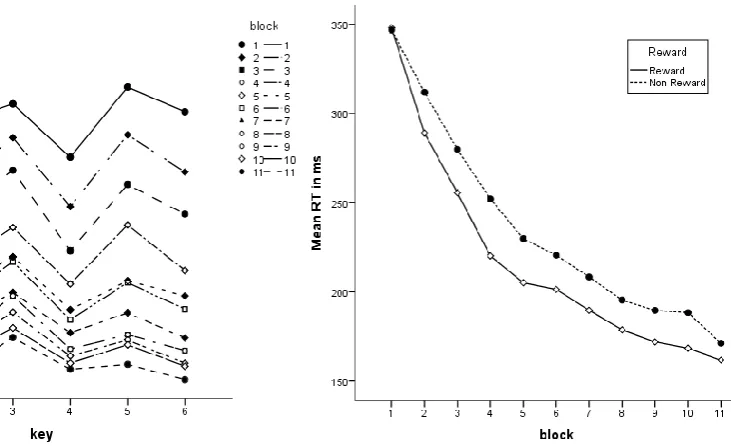
(13) 13. The test phase consisted of two blocks with 30 trials each per sequence (i.e., 60 trials per block). In the familiar test block, participants executed sequences that they performed during the practice phase. In the unfamiliar test block, they executed two new sequences. The test blocks were counterbalanced across participants. After the final block the participants filled out a questionnaire measuring their explicit knowledge of the practiced sequences. They were asked to recall their two practiced sequences from memory by writing down the correct order of response keys, and to recognize their two sequences from a list of 12 alternatives. At the end of the experiment the participants in the reward group received money for their performance. As mentioned before they were told that they could earn €10 at most. Accordingly they could earn €1 in each of the latter 10 practice blocks. The highest reward that a participant earned was €8 and the lowest €5. Results Practice Phase Reaction Time. An ANOVA on RT with repeated measures on the within subject variables key (6), block (11) and sequence (2; briefly practiced vs. extensively practiced) and the between subjects variable reward condition (2; reward vs. no reward) was performed. Results showed that the mean RT decreased over practice blocks (block 1 M = 369.19ms, SD = 11.53ms to block 11 M = 193.48ms, SD = 11.81ms), F(10,300) = 202.77, p < .05 (cf. figures 2 and 3). As figure 2 shows, some key presses were executed faster than others, F(5,150) = 84.29, p < .05 and in addition a block × key interaction was found F(50, 1500) = 14.94, p < .05. This indicates that several key presses improved more than others through blocks (fig. 2). This is probably due to the fact that the initial key press is usually executed much slower than the subsequent key presses and is not greatly influenced by practice. It is assumed that this.
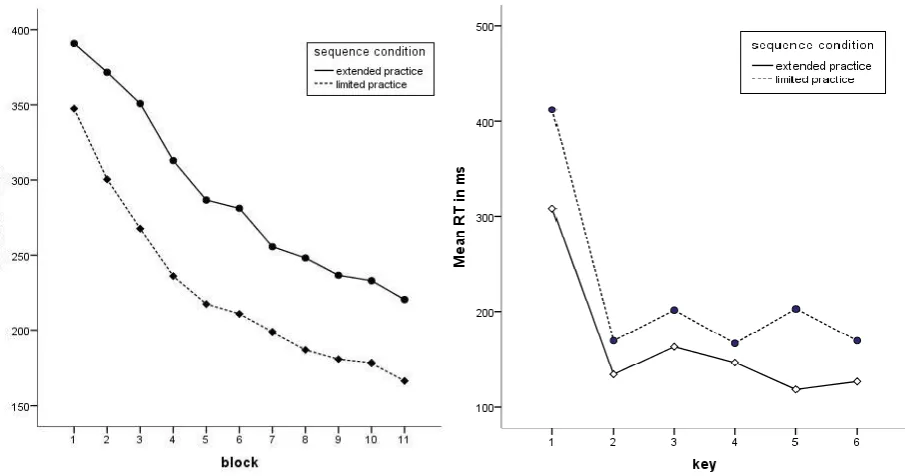
(14) 14. Fig. 2 Mean RT across the two sequences in the 11 practice blocks as a function of key position within the sequence. Fig. 3 Mean RT across the two sequences in the two reward conditions as a function of the 11 practice blocks. delay is caused by the selection and preparation of a sequence (e.g. Verwey, 1999; Abrahamse et. al 2013). It was also observed that the reward condition had no significant impact on RT performance F(1,30) = .56, p = .46 (see fig. 3). Moreover, there were no interaction effects observed between reward condition and any of the other variables, all p > .42. Furthermore, the data revealed, as expected, that RT decreased with sequence practice (briefly practiced M=289,85ms, SD=64,45ms; extensively practiced M=209,53ms, SD=82,16ms), F(1,30)= 94.07, p < .001, and that the effect of sequence practice was stronger in some blocks than in others, F (10, 300)= 3.49, p = .011 (fig. 4). There was also a key x sequence interaction effect found which means that sequence condition (briefly practiced vs. extensively practiced) had more influence on the reaction time decrease of some key presses than of others. This effect is probably due to the afore-mentioned slower first key press (see fig. 2). The two sequence conditions differed in the last practice block (fig. 5). The extensively practiced sequence was executed faster than the briefly practiced sequence which indicates that the former was learned better..
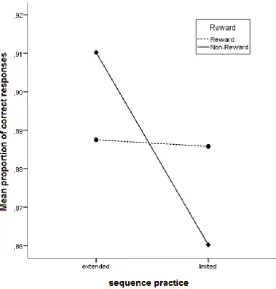
(15) 15. Fig. 4 Mean RT across the two sequences conditions in the two practice conditions as a function of the 11 practice blocks. Fig. 5 Mean RT across the two sequences conditions as a function of the 6 key presses in block 11. Accuracy. We also analysed participants’ performance in terms of accuracy (i.e., the mean proportion of correct responses). A repeated measure ANOVA on accuracy with the within subject variables block (11) and sequence condition (2) and the between subject variable reward condition (2) was performed. It showed that the amount of sequence practice had a significant influence on accuracy (extensively M = .90, SD = .05; briefly M = .87, SD = .06), F(1, 30) = 6.18, p < .05. Furthermore a practice × reward interaction was evident (fig. 6), F(1,30) = 5.39, p < .05. To investigate this interaction further, repeated measure ANOVAs on accuracy with the within subject variables block (11) and sequence condition (2) were executed for each reward condition. They showed that sequence condition significantly influenced the accuracy of non-rewarded participants, F(1,15) = 10.13, p < .05. The accuracy of rewarded participants, in contrast, did not differ significantly in the two sequence conditions, F(1,15) = .02, p = .90. Another interaction effect was found between block and practice F(6, 31) = 2.45, p < .05. This indicates that the impact of practice differed across blocks..
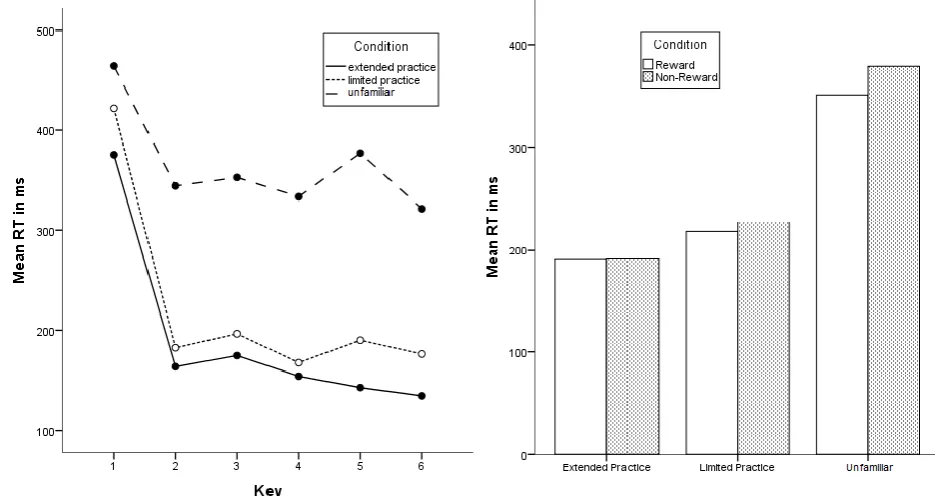
(16) 16. Fig. 6 Mean proportions of correct responses across the reward conditions as a function of sequence practice. Test Phase Reaction Time. An ANOVA on RTs with repeated measures on key (6) and sequence condition (3; briefly practiced vs. extensively practiced vs. unfamiliar) and the between subjects variable reward condition (2) was performed. (The two unfamiliar sequences were merged into one single variable and are referred to one condition in the following.) Results showed that participants executed some key presses faster than others, F(5, 150) = 146.17, p < .05, which is as mentioned before probably due to the longer RT on key press 1 compared to other keys (see also fig. 7). As expected, participants responded faster in the familiar sequences (extensive practice M = 190.78ms , SD = 66.99ms and brief practice M = 222.41ms , SD = 74.76ms) than in the unfamiliar (M = 365ms , SD = 70.14), F(2, 60 ) = 326.86 , p < .05 (see fig. 7). Furthermore, a key x sequence interaction was observed, F(10, 300 ) = 13.82 , p < .05, indicating that sequence condition (briefly practiced vs. extensively practiced vs. unfamiliar) influenced the reaction time on some key presses more than others (fig. 7). An ANOVA on.
(17) 17. RT with repeated measures on key (6) and sequence condition (2; extensive vs. brief) revealed that this interaction is due to differences between familiar and unfamiliar sequences as the interaction was not evident when only comparing the two familiar sequences, F(5, 155 ) = 2.17, p = .08. This reveals a different execution pattern in the familiar and unfamiliar sequences (see fig. 7). Reward did not seem to have a significant impact on the RTs, F(10, 30) = .29, p = .59, and did also not interact with the practice conditions, all ps > .45 (fig. 8).. Fig. 7 Mean RT across the six key presses in the sequence conditions. Fig. 8 Mean RT across the two sequences in the reward conditions for the three practice conditions. Accuracy. The proportion of correct responses was analysed for each condition to examine the participant’s accuracy. Rewarded participants performed on average 86.87% of their responses in the extensively practiced sequence correctly, 86.88% in the briefly practiced sequence and 77.81% in the unfamiliar sequences. Non-rewarded participants performed on average 90.63% of their responses in the extensively practiced sequence correctly, 86.88% in the briefly practiced sequence and 76.77% in the unfamiliar sequences. A repeated measure ANOVA on sequence condition (3) and the between subjects variable reward condition (2).
(18) 18. showed, as expected, that participants made less errors in the extensively practiced sequence than in the briefly or not practiced ones, F(2, 60) = 20.93, p < .001 (again, the two unfamiliar sequences were merged into one single variable and are referred to as “no practice” condition). No main or interaction effects of Reward were observed, all ps > .42. Explicit knowledge. At the end of the experiment explicit knowledge was measured as a function of the number of correct recalled and recognized sequences (0, 1 or 2). Of the 32 participants, 15 (49.9%) were not able to recall even one of the sequences correctly, 11 were able to recall one sequence correctly (34.4%) and 6 (18.7%) could recall both sequences correctly. With regard to recognition, 4 participants (12.5%) did not recognize any sequence, 12 (37.5%) recognized one sequence and 16 (18.8%) recognized both sequences correctly. A Pearson Chi-Square test revealed that recall and recognition did not differ between the rewarded and non-rewarded group, respectively ²(2) = .824, p = .66 and ²(2) = 2.33, p = .31. Furthermore, explicit knowledge was assessed as the number of correctly recalled key presses (0 – 6) for each sequence. To investigate the relation between explicit knowledge (06) and learning in the practice phase a correlation analysis for each reward condition was performed. Learning was measured as the difference between mean RT in block 1 and block 11. Results showed no correlation between the RT and explicit knowledge in the reward, ps > .54, or non-reward condition, ps > .14. To investigate if explicit knowledge correlated with learning in the test phase another analysis was performed. Learning was measured as the difference in RT between the two familiar (briefly practice and extensively practice) and the unfamiliar sequences, respectively. Results showed that there is a positive correlation between explicit knowledge and learning of the extensively practiced sequence when participants were rewarded, r=.56, p < .05. This means that rewarded participants with more explicit knowledge.
(19) 19. were faster at executing the extensively practiced sequence. No further correlations were evident, all ps > .14. Discussion The present study examined the effects of monetary reward on learning and performing a movement sequence. We expected rewarded participants to show shorter RTs and less erroneous responses in a DSP task compared to non-rewarded participants. In addition, we hypothesized that only rewarded participants would execute a briefly practiced sequence in the chunking mode whereas non rewarded participants would execute this sequence still in a slower execution mode. Below, our findings, potential limitations and suggestions for future research are discussed. The present results could not entirely support the hypothesis that reward enhances the learning of motor sequences. Although RTs differed between the two reward conditions in the practice phase (see fig. 3) this difference was not significant. The only significant impact of reward was found in an interaction with sequence practice (brief practice vs. extensive practice) on accuracy in the practice phase (see fig. 6). Rewarded participants made approximately the same amount of errors in the extensively and briefly practiced sequence. Non-rewarded participants in contrast made more errors in the briefly practiced sequence than in the extensively practiced sequence. This suggests that reward enhanced accuracy of the briefly practiced sequence and consequently the effect of practice diminished. Rand et al. (2000) argue that in early motor learning, improvement depends mainly on memory mechanisms responsible for correct selection of movements. Memory mechanisms which enhance performance speed become more important in later learning phases. This is in line with the idea that movements are first executed in an initial (slow) reaction mode which develops with practice into an association mode and finally into a (fast) chunking mode.
(20) 20. (Verwey, 2003). In contrast to the non-rewarded participants, the rewarded participants executed the briefly practiced sequence as accurately as the extensively practiced sequence. Therefore, it could be the case that the processing of accuracy related memory in early learning was enhanced in rewarded participants. This outcome supports at least partly our hypothesis that learning was enhanced through reward – although this was not evident in a decrease of RT. Another hypothesis was that motor chunks will only develop in the extensively practiced sequence and potentially in the briefly practiced sequence when participants are rewarded. In contrast to this hypothesis the data shows that the briefly practiced sequence was executed in the same manner (RT pattern) as the extensively practiced sequence (see fig. 7) regardless of the reward condition. This indicates that both conditions were executed in the chunking mode. We aimed to manipulate the transition from the reaction mode to the chunking mode through reward. This transition apparently took place independently from reward but due to practice. To prevent this effect in future research, the briefly practiced sequence should be practiced even less to maintain its execution in a slow execution mode. Another possibility would be to use a more complex sequence. It naturally would take more time to learn this sequence and the execution would therefore remain longer in the reaction mode. There is a great deal of literature supporting the fact that performance can be increased by monetary incentives (e.g. Dambacher et al., 2011; Hübner & Schlösser, 2010; Savine & Braver, 2010). In contrast to our outcome Palmenteri et al. (2011) found that reward only enhanced RT (and not error rates) in a motor sequence task. As described in the introduction we expected primarily to observe a decrease in RT in rewarded participants. Although past studies found that reward does not always enhance performance and sometimes even impairs it (cf. Bonner & Sprinkle, 2002) this is only the case for more complex cognitive tasks as for.
(21) 21. example problem solving. The data for simple tasks is quite consistent in the finding that performance will be enhanced through reward (e.g. Dambacher et al., 2011; Palminteri et al., 2011). So, the question at hand is why the rewarded participants in our study did not outperform the non-rewarded ones. In the following I will discuss three possible explanations for the absence of a positive effect of reward on RT. The first thing that should be discussed is if the operationalization of reward was successful. Money has proven to be a good choice to motivate humans in many experiments (e.g. Dambacher et al., 2011; Palminteri et al., 2011; Bonner & Sprinkle, 2002) and of course also in many real life situations. So through offering a monetary reward we wanted to positively influence motivation and therefore enhance performance. In the present study the participants could earn a reward of €10 at maximum and therefore €1 per trial. It is possible that this monetary incentive was perceived as not high enough by the participants. If this was the case, we failed to enhance the participant’s motivation and therefore the reward had no impact. Gneezy and Rustichini (2000) argue that a too small amount of money (representing an extrinsic incentive) can impair performance by reducing intrinsic motivation. Therefore, an appropriate amount of reward is required to compensate for the decrease of motivation. If this is not the case, performance will be impaired. Although this might be a possible explanation, we think that this is unlikely to be the case. We consider a payment of €5 to €8 as an appropriate incentive for students for participating in an experiment (they normally would not earn any money because their participation in several experiments is an obligatory part of their study). Moreover, Dambacher et al. (2011) found effects of reward although their participants could only earn an amount of €5 at most. Accordingly, we do not believe that the reward in the present study was to small to influence participants motivation. Secondly, motivation itself is an important mediator of performance (Bonner & Sprinkle, 2002; Seifert et al., 2003; Stanne, Johnson, & Johnson, 1999). Therefore, another.
(22) 22. possible explanation for the absence of a positive effect of reward is that the non-rewarded group was highly motivated as well and consequently undermined the effect of reward on motivation. The non rewarded participants got numerical feedback on their screen but could not earn a monetary reward. We know from experience that participants usually perceive the DSP task as quite boring. During the experiment many participants asked for the best times during the study and wanted to beat them. Hence, it seemed that they wanted to make a competition out of the task to make it more interesting for them. Participants in both groups (reward and non-reward) seemed to be highly motivated to beat their own scores and the scores of others during the experiment (evident trough repeatedly asking the experimenter for the best times). Competition can have a positive influence on performance (Stanne et al., 1999). Accordingly, it is possible that competition enhanced motivation of both groups and undermined the predicted impact of reward. To avoid this competitive effect in future research one could simply omit the numerical feedback on the participants screen. It would be sufficient to show the participants if they have improved or not without giving exact RTs or error rates. Finally, some participants in the reward condition stated at the end of the experiment that they did not really expected to get paid. Most of the participants were psychology students who have to participate in some experiments as part of their study. As they are familiar with psychological experiments and manipulations, some of them apparently thought that the chance of being rewarded should just be an illusionary incentive. The fact that they did not take the reward seriously could have impacted the reward’s efficacy. Moreover, the participants were only rewarded if they performed at least 5% better than in the previous trial. In some cases participants enhanced their RTs but did not reach the threshold for being rewarded. Anyway, they saw the numerical feedback on the screen and were disappointed that they did not earn money although they had improved. So, additionally to the fact that.
(23) 23. participants may have perceived €1 per trial as not highly motivating their motivation could be undermined by not being rewarded although a reward was expected. Some participants actually expressed that they were upset about not getting paid despite being faster. So all in all, it is likely that reward did not work the way we predicted it to, and therefore did not have the predicted influence on performance. As already mentioned a possible way to avoid this effect in future research would be to exclude numerical feedback on the participants screen. Giving participants information about their performance without exact RTs or error rates would be sufficient. All in all, our study only found weak support for the notion that motor sequence learning can be enhanced by monetary reward. RTs did not differ significantly between rewarded and non-rewarded participants. This might be due to the fact that the power of monetary incentives was undermined by other motivational factors. Future research should take motivational factors into account that could influence participant’s performance..
(24) 24. References. Abrahamse, E. L., Jiménez, L., Verwey, W. B., & Clegg, B. a. (2010). Representing serial action and perception. Psychonomic bulletin & review, 17(5), 603–23. doi:10.3758/PBR.17.5.603 Abrahamse, E. L., Jiménez, L., Verwey, W. B., & Clegg, B. (2010). Representing serial action and perception. Psychonomic bulletin & review, 17(5), 603–623. doi:10.3758/PBR.17.5.603 Badgaiyan, R. D., Fischman, A. J., & Alpert, N. M. (2007). Striatal dopamine release in sequential learning. NeuroImage, 38(3), 549–556. doi:10.1016/j.neuroimage.2007.07.052 Bayer, H. M., & Glimcher, P. W. (2005). Midbrain dopamine neurons encode a quantitative reward prediction error signal. Neuron, 47(1), 129–141. doi:10.1016/j.neuron.2005.05.020 Bonner, S. E., & Sprinkle, G. B. (2002). The effects of monetary incentives on effort and task performance: theories, evidence, and a framework for research. Accounting, Organizations and Society, 27(4-5), 303–345. doi:10.1016/S0361-3682(01)00052-6 Dambacher, M., Hübner, R., & Schlösser, J. (2011). Monetary incentives in speeded perceptual decision: effects of penalizing errors versus slow responses. Frontiers in psychology, 2(September), 248. doi:10.3389/fpsyg.2011.00248 Davie, C. (2008). A review of Parkinson’s disease. British medical bulletin, 86, 109–127. doi:10.1093/bmb/ldn013 Doyon, J., Bellec, P., Amsel, R., Penhune, V., Monchi, O., Carrier, J., Lehéricy, S., & Benali, H. (2009). Contributions of the basal ganglia and functionally related brain structures to motor learning. Behavioural brain research, 199(1), 61–75. doi:10.1016/j.bbr.2008.11.012 Garraux, G., Peigneux, P., Carson, R. E., & Hallett, M. (2007). Task-related interaction between basal ganglia and cortical dopamine release. The Journal of neuroscience : the official journal of the Society for Neuroscience, 27(52), 14434–14441. doi:10.1523/JNEUROSCI.1595-07.2007 Hikosaka, O., Nakamura, K., Sakai, K., & Nakahara, H. (2002). Central mechanisms of motor skill learning. Current opinion in neurobiology, 12(2), 217–222. Retrieved from http://www.ncbi.nlm.nih.gov/pubmed/12015240 Hübner, R., & Schlösser, J. (2010). Monetary reward increases attentional effort in the flanker task. Psychonomic bulletin & review, 17(6), 821–826. doi:10.3758/PBR.17.6.821 Jankovic, J. (2008). Parkinson’s disease: clinical features and diagnosis. Journal of neurology, neurosurgery, and psychiatry, 79(4), 368–376. doi:10.1136/jnnp.2007.131045.
(25) 25. Molina-Luna, K., Pekanovic, A., Röhrich, S., Hertler, B., Schubring-Giese, M., RioultPedotti, M.-S., & Luft, A. R. (2009). Dopamine in motor cortex is necessary for skill learning and synaptic plasticity. PloS one, 4(9), 1-10. doi:10.1371/journal.pone.0007082 Muslimovic, D., Post, B., Speelman, J. D., & Schmand, B. (2007). Motor procedural learning in Parkinson’s disease. Brain : a journal of neurology, 130(11), 2887–97. doi:10.1093/brain/awm211 Palminteri, S., Lebreton, M., Worbe, Y., Hartmann, A., Lehéricy, S., Vidailhet, M., Grabli, D., et al. (2011). Dopamine-dependent reinforcement of motor skill learning: evidence from Gilles de la Tourette syndrome. Brain : a journal of neurology, 134(8), 2287–301. doi:10.1093/brain/awr147 Rand, M. K., Hikosaka, O., Miyachi, S., Lu, X., Nakamura, K., Kitaguchi, K., & Shimo, Y. (2000). Characteristics of sequential movements during early learning period in monkeys. Experimental brain research, 131(3), 293–304. Retrieved from http://www.ncbi.nlm.nih.gov/pubmed/10789945 Rustichini, U., & Gneezy, A. (2000). Pay enough or don’ t pay at all. The quarterly Journal of Economics, 115(3), 791–810. Savine, A. C., & Braver, T. S. (2010). Motivated cognitive control: reward incentives modulate preparatory neural activity during task-switching. Journal of Neuroscience, 30(31), 10294–10305. doi:10.1523/JNEUROSCI.2052-10.2010 Seifert, J., Naumann, E., Hewig, J., Hagemann, D., Bartussek, D., & Haus, A. S. (2006). Motivated executive attention - incentives and the noise compability effect. Biological Psychology, 71(1) 80-89. doi:10.1016/j.biopsycho.2005.03.001 Stanne, M. B., Johnson, D. W., & Johnson, R. T. (1999). Does competition enhance or inhibit motor performance: a meta-analysis. Psychological bulletin, 125(1), 133–154. Retrieved from http://www.ncbi.nlm.nih.gov/pubmed/9990847 Suri, R. E., & Schultz, W. (1998). Learning of sequential movements by neural network model with dopamine-like reinforcement signal. Experimental brain research, 121(3), 350–354. Retrieved from http://www.ncbi.nlm.nih.gov/pubmed/9746140 Verwey, W. B. (2003). Processing modes and parallel processors in producing familiar keying sequences. Psychological research, 67(2), 106–122. doi:10.1007/s00426-002-0120-7 Verwey, W. B. (1999). Evidence for a Multistage model of practice in a sequential movement task. Jourmal of Experimental Psychology: Human Perception and Performance, 25 (6), 1693-1708.doi: 10.1037/0096-1523.25.6.1693 Verwey, W. B. (2001). Concatenating familiar movement sequences: the versatile cognitive processor. Acta psychologica, 106(1-2), 69–95. doi: 10.1016/S0001-6918(00)00027-5 Verwey, W. B., & Abrahamse, E. L. (2012). Distinct modes of executing movement sequences: reacting, associating, and chunking. Acta psychologica, 140(3), 274–282. doi:10.1016/j.actpsy.2012.05.007.
(26) 26. Verwey, W. B, Abrahamse, E. L., & De Kleine, E. (2010). Cognitive Processing in new and practiced discrete keying sequences. Frontiers in psychology, 1:23. doi:10.3389/fpsyg.2010.00032 Verwey, W. B., & Eikelboom, T. (2003). Evidence for lasting sequence segmentation in the discrete sequence-production task. Journal of motor behavior, 35(2), 171–181. doi:10.1080/00222890309602131 Wächter, T., Lungu, O. V, Liu, T., Willingham, D. T., & Ashe, J. (2009). Differential effect of reward and punishment on procedural learning. The Journal of neuroscience, 29(2), 436–443. doi:10.1523/JNEUROSCI.4132-08.2009 Wickens, J. (1990). Striatal dopamine in motor activation and reward-mediated learning: steps towards a unifying model. Journal of Neural Transmission, 80, 9–31. doi:10.1007/BF01245020 Zaghloul, K., Blanco, J., Weidemann, C. T., McGill, K., Jaggi, J. L., Baltuch, G. H., & Kahana, M. J. (2009). Human substantia nigra neurons encode unexpected financial rewards. Science, 323(5920), 1496–1499. doi:10.1126/science.1167342 Zald, D. H., Boileau, I., El-Dearedy, W., Gunn, R., McGlone, F., Dichter, G. S., & Dagher, A. (2004). Dopamine transmission in the human striatum during monetary reward tasks. The Journal of neuroscience, 24(17), 4105–4112. doi:10.1523/JNEUROSCI.464303.2004.
(27)
Figure
Related documents
Apesar do sistema de fachada ventilada possuir como desvantagens seu alto custo para execução, ainda permanece sendo uma solução construtiva promissora para as
• If the forgotten tablet or tablets occurred in the first week of yellow active tablets from your pack, and you had intercourse in any of the seven days preceding that week, you
Oscillometry, which is the most widely used technique for automatic NIBP measurement, is based on the analysis of the cardiac induced air-pressure oscillations in the pres-
An alternate extracellular signal- regulated kinase (ERK) activation pathway observed in epithelial endometrial cells and the possibility of differential expression of the
elegans type IV collagen (Sibley et al. 2008), these suppressor alleles do not cause detectable phenotypes as single mutants, and suppress the lethality of pxn-2 null and of spon-1
The most common instance of muscle entrapment occurs when the inferior rectus muscle becomes entrapped in a trapdoor fracture of the orbital floor (Figure 8) (Helveston,
Any financial institution – be it a securities firm, an insurance company, a hedge fund, a private equity firm, or a bank holding company – which is not now subject to the
We index a document based upon words, URIs, and triples that can be extracted from the document and give the user a light-weight query language to retrieve documents based upon
