History and Development of Genetics Research
in India: Three case studies
DP Kasbekar*
(Received 12 October 2014; revised 18 May 2016)
Abstract
The paper discusses three major contributions in genetics research from India; Genetic and cytogenetic studies on sugarcane undertaken at the Sugarcane Breeding Institute in Coimbatore during 1912- 1938 by C. A. Barber, T. S. Venkatraman, and E. K. Janaki Ammal, the publication of D. D. Kosambi’s mapping function (1944), and the discovery of the Bombay blood group in KEM Hospital, Mumbai by Y.M. Bhende and co-workers in 1952. Most current research on these topics is now done outside India, possibly because India never developed the critical mass of researchers to sustain the early leads of these pioneers.
Key words: Consanguinity, DNA profiling, Mapping function, Sugarcane interspecific and intergeneric hybrids, Sugarcane cytogenetics
*Haldane Chair, Centre for DNA Fingerprinting and Diagnostics (CDFD), Hyderabad 500 001 Email: [email protected]
1. INTRODUCTION
Professionally, I am a Neurospora geneticist, not a historian of Genetics. Therefore, an article on the history and development of genetics research in India by me carries less authoritative heft than (I imagine) do my articles in Neurospora genetics. Nevertheless, I took up the challenge to write this paper for three reasons; (1) I could bring in a different viewpoint than a professional historian, (2) it might goad others more competent than me to study this otherwise neglected topic, and (3) it gave me the opportunity to share the thrill of reading a 95 year old research paper published from Coimbatore (see Barber, 1920 in supplementary material 1).
This article touches upon three major early research contributions in genetics from India: (1) interspecific and intergeneric hybridization in sugarcane; (2) D. D. Kosambi’s map function; and (3) the discovery of the Bombay blood group. Given that the locus of current research in all these areas has indisputably shifted out of India, the
question why India has not been able to sustain its early leads into the present time has more than mere passing interest.
2. SUGARCANE: EARLY GENETIC AND CYTOGENETIC STUDIES
Sugarcane (Saccharum officinarum) was domesticated about 3000 years ago in Papua New Guinea. Domesticated cane is derived from the wild species Saccharum robustum (basic chromosome number x = 10, 2n = 80), with some admixture from the related grasses Erianthus
arundinaceus and Miscanthus sinensis.
in South and South-East Asia, and in ancient times it too was independently domesticated in India and led to the development of technology to extract sugarcane juice and make jaggery and sugar. The Indian canes, however, had much lower sugar content than the “noble” canes of Indonesia and Papua New Guinea.
Although sugarcane varieties are vegetatively propagated, sugarcane can flower naturally in some regions. However, the same varieties might not flower or may do so only rarely in other regions. Sugarcane seed is called fuzz, and is used only in breeding programs. Flowering behavior is affected by many factors including day length, temperature, and moisture. In equatorial regions sugarcane can flower throughout the year, but the flowers are sterile and preclude breeding activities. Flowering period becomes restricted as one moves north or south from the equator, but the fertility of the flowers increases. Fertility levels are maximal around latitudes 11o N and S, and
these latitudes are ideal for sugarcane breeding. Coimbatore is one such place, and has additional advantages for flowering and seed set with regard to rainfall, temperature, humidity and winds. In 1912, the Sugarcane Breeding Institute (SBI) was established in Coimbatore, with C. A. Barber as its first “Head of Station & Government Sugarcane Expert” and it undertook the breeding of improved sugarcane varieties. The SBI website (www.sugarcane.res.in) “knowledge bank” page is very informative on the early research on sugarcane.
Barber, assisted by T. S. Venkatraman, performed the first interspecies crosses using the noble Saccharum officinarum canes as females and the hardier, less sweet, Indian S. spontaneum
as males. The hybrid progeny had the high sugar content of the former and the increased hardiness to abiotic and biotic stress of the latter. Crossing of S. spontaneum males to S. officinarum females is called as “nobilization” of S. spontaneum. Barber and Venkatraman’s interspecies crosses
worked brilliantly because 1n pollen of S. spontaneum fertilized 2n eggs of S. officinarum
and produced n + 2n zygotes that retained the full chromosome complement of S. officinarum. However, the zygotes from the reciprocal cross, were n + n type, as they were in the self-crosses within the parental types. Backcross of the hybrid male to S. officinarum female again showed n + 2n transmission, although in further backcrosses the production of 2n eggs depended on the specific
S. officinarum clone used. The n + 2n transmission allowed the S. officinarum 2n genome to be retained and allowed the elimination of unwanted
S. spontaneum chromosomes and retention of only the desirable ones (the n-bearing segregants) (Bhat and Gill, 1985).
The Coimbatore breeds (“Co-canes”) transformed worldwide sugarcane production. Co 205, the first interspecies commercial variety was released in 1918, and in the first year itself it increased sugarcane production in Punjab by 50%. By 1927, Co 205 was being planted in Cuba and Florida. In 1928 Co 312 was released and for the next 30 years it was the most popular variety in sub-tropical India, until even superior varieties were bred.
Indian scientists also did first-rate cytogenetics studies in the 1930s. To give just two examples, K. Ramiah and colleagues had identified the second instance of triploidy in rice (Ramiah et al., 1933), only a year after the first instance was reported by Nakamori and colleagues from Japan. E. K. Janaki Ammal (1939) found that the species S. spontaneum is a polyploid series with 2n = 48, 56, 64, 72, and 80 in India, and 2n = 80, 96, 112 in further India and South-East Asia (Burma through Indonesia). Based on this finding she inferred that the species originated in India and that its basic chromosome number is 8. Further, presence of odd multiples of 8 (56, 72) was expected to lead to univalents or multivalents in meiosis, but instead she found 28 and 36 bivalents. This led Janaki Ammal to suggest that these clones arose from hybridization between ancestral x = 10 and x = 6 forms (eg., 28 = 3x6+10; 36 = 3x10+6).
3. KOSAMBI’S MAPPING FUNCTION.
The first paragraph from D. D. Kosambi’s 1944 paper (written when he taught at Fergusson College, Poona) succinctly defines the problem he wanted to address, and so I reproduce it here in its entirety. “Suppose three consecutive loci a, b,
c of the same linkage group to have the recombination fractions (percentage divided by 100) (a, b) = y1, (b, c) = y2, (a, c) = y12. Then it is
known that for small values of y1 and y2, y12 = y1
+ y2 approximately. For slightly larger values, we have a better approximation given by y12 = y1 +
y2- y1 y2; for still larger values, the approximation
has again to be replaced by y12 = y1 + y2- 2y1 y2. It
is desired to obtain one single formula that will cover the entire range 0-1/2 of y-values in a reasonably satisfactory manner. This must also correspond to a single-valued, monotonically increasing, continuous function x of y in such a way that the corresponding identity becomes x12 = x1 + x2. The variable x will then be called the
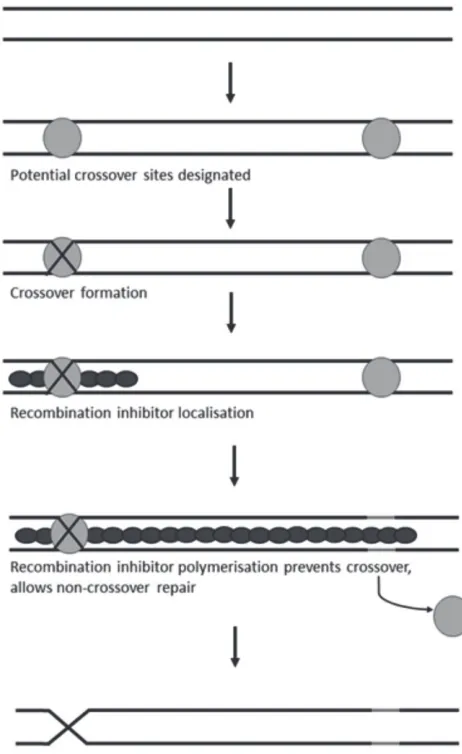
map distance corresponding to the given y.” Vinod (2011) has done a fine job describing Kosambi’s method to estimate map distances from recombination values for the calculus-challenged reader, and compared it with the methods of Morgan and Bridges (1916) and Haldane (1919). A genetic map plots the relative positions of different genes on a chromosome. The distance between two genes is proportional to the fraction of progeny that show a crossover between them. However, if the distance is sufficiently large then the progeny derived from an even numbers of crossovers would be added to the non-crossover type, and map distance would be underestimated. On the other hand, in many eucaryotes, the occurrence of one crossover suppresses a second crossover from happening nearby (“nearby” can be of the order of mega-basepairs). This is called crossover interference. The mechanistic basis of crossover interference is still not understood, indeed, Hillers (2004) suggests that interference might be only an incidental consequence of some other aspect of meiosis. [Interestingly, Siddiqi and Putrament (1963), reported a brilliant study showing polarized negative interference in the
interference, and Kosambi’s mapping function is best suited under conditions of incomplete interference (Vinod, 2011). Briefly, Haldane had recommended d = 1/2ln(1-2r), whereas Kosambi suggested d = ¼ln[(1+2r)/(1-2r)], where d is the map distance, and r is the recombination fraction. Although in organisms with sequenced genomes the genome sequence has now supplanted genetic maps, in organisms whose genomes have not yet been sequenced genetic
maps remain important. Sugarcane is one such organism. Its 10 Gb genome is not easy to sequence with current technology. Al-Janabi et al. (1993), who developed a genetic linkage map for
S. spontaneum, had used Kosambi’s mapping function to convert recombination percentages into map units. They also cited Janaki Ammal’s 1939 Current Science paper and another 1936 paper by her in the Indian Journal of Agricultural Sciences. That Kosambi and Janaki Ammal were cited 50 or more years post-publication, gives us a measure of the long shadows cast by the two giants. Indeed, I would go as far as to compare D. D. Kosambi with the great Cambridge mathematician G. H. Hardy, of Hardy-Weinberg Equilibrium fame. Both mathematicians made a single foray apiece into Genetics, and each managed to galvanize the subject in his own way. The cytogenetics of grasses by Janaki Ammal, brings to mind comparison with Barbara McClintock, the iconic maize geneticist.
4. BOMBAY BLOOD GROUP
[image:4.612.62.293.114.491.2]“Kahaani”, the 2012 Bollywood thriller (starring the talented Vidya Balan in the lead role), probably introduced the Bombay blood group to more Indians than any article on the history of Indian genetics research can hope to match. The film’s main antagonist had this rare blood group, and the protagonists track down the doctor who sourced the blood required for his transfusion. Bombay blood type was discovered in KEM Hospital, Mumbai by Bhende et al. (1952). Two patients (X was a railway accident victim, and Y had suffered a stab wound) were seen within a span of a few weeks. Both needed blood transfusion and both were apparently of blood group O. Surprisingly, their serum agglutinated the red blood cells of all the common ABO blood groups, thus showing that it contained A, anti-B, and anti-H (i.e. anti-O) antibodies. Therefore the patients were transfused with plasma and not blood. The researchers then made a systematic Fig. 1. A mechanism proposed for crossover interference.
examination of blood from 160 donors and found a first time male donor, Z, as the third case of Bombay type blood. Only the red blood cells of these three men themselves was not agglutinated by their own sera, or by anti-A, anti-B, or anti-H sera. Serum of all three men contained A, anti-B, and anti-H antibody. Absorption of their serum by group O red cells removed the anti-H, leaving the anti-A and anti-B unchanged, whereas absorption of the serum by red cells of Z left all the antibodies unchanged. The antibody that agglutinated O cells was inhibited by saliva from “secretors” regardless of their blood-group, but not by saliva of non-secretors (see below for an explanation). The degree of inhibition was comparable with the degree of inhibition of an eel anti-H serum caused by the same saliva. Thus the three men appeared to possess a new alleleomorph of the ABO locus, and they could receive blood transfusion of only Bombay type blood. The parents of patient X were first cousins, although the parents of the other two patients were not related to each other or to patient X. No such blood had been noted in Europe or the US although millions of appropriate tests must have been made. Ludwik Hirszfeld (1952), however, recalled seeing a patient during the Second World War (1941), in the kitchen of his provisional home in the Warsaw ghetto. The patient exhibited unagglutinable erythrocytes and strong anti-O agglutinins in her serum. Hirszfeld published his findings after the war (1946) in the Polish Medical Journal, although by then Roza Amsel, who had assisted him these studies, was murdered in 1943 “during the extermination of all Jews in Warsaw” (Hirszfeld 1952).
The ABO blood group was the first genetic polymorphism found in humans. We now know the ABO blood group antigens are sugars. The H locus on chromosome 19 encodes a fucosyltransferase that catalyses the last step in the production of H antigen on the red blood cells, which is the common precursor of all the ABO
blood types. The homologous Se (secretor) locus also is on chromosome 19, about 35 kb away from the H locus, and encodes another fucosyltransferase that produces a soluble form of the H antigen found in saliva and other body fluids. Secretors have the Se/Se or Se/se genotype, whereas non-secretors are se/se individuals. This explains why the anti-O antibody in the serum of the Bombay patients was inhibited by saliva from secretors but not of non-secretors. The H and Se loci are also referred to as FUT1 and FUT2 to underscore the fact they are paralogous loci, that arose from the duplication of a common ancestral gene. The ABO locus on chromosome 9 encodes a glycosyltransferase that can catalyse addition of another sugar moiety to the H antigen. The A allele encodes a glycosyltransferase that attaches N-acetylgalactosamine to the D-galactose end of the H antigen to produce A antigen, and the resulting blood group is called A. The B allele encodes a glycosyltransferase that attaches D-galatose to the D-galactose end of the H antigen to produce B antigen, and the resulting blood group is called B. If both enzymes are present, as in an AB individual, then both A and B antigens are produced and the blood group is called AB. If both enzymes are absent, the antigen remains as H and the blood group is called O. An individual of Bombay blood type is homozygous for the non-functional h allele of the H locus and fails to make H antigen. Therefore A, B, AB and O which are all different manifestations of H are all absent from the red cells. The Bombay Blood Group is termed as ‘Oh’, which means absence of ‘H’. Previous to this discovery, the detection of O was on the basis of absence of both A and B antigens. The authors hoped that their discovery would encourage transfusion services to test the serum of all blood donors against group O red cells.
5. CONSANGUINITY AND ENDOGAMY AMONG INDIANS
Discovery of the Bombay blood type reflects the high level of endogamy and consanguinity in the Indian sub-continent. Consanguinity is mating between two related individuals. The closest consanguineous matings are between first-degree relatives, such as parent-child and brother-sister. In most cultures such matings (called “incest”) are taboo. An example of father-daughter incest uncovered in the Centre for DNA Fingerprinting and Diagnostics is shown in Supplementary Material 2A. One can easily work out a “coefficient of inbreeding (F)” for a child born out of any consanguineous mating. The coefficient of inbreeding is the probability that an allele is homozygous because both the father and mother carry the same allele and pass it on to their child. F also identifies the fraction of the genome that is homozygous by descent. In a child from a first-degree (incestuous) mating F = 0.25; in a child born out of an uncle-niece mating F = 0.125; and in a child born from a first cousin mating F = 0.0625. Since the fraction of the genome homozygous due to consanguinity is F, the genome fraction that cannot be ascribed to consanguinity has to be (1 – F). If a recessive disease-causing allele is present in the population with frequency q, then in an individual with the disease the probability that the allele is homozygous because of consanguinity is Fq, and the probability it is homozygous independent of consanguinity is (1 – F)q2. Thus, for any affected individual, the
probability that consanguinity is the underlying cause is α = Fq/[Fq + (1 –F)q2]. If F is large relative
to q, α approaches 1. In other words, homozygosity of a very rare recessive genetic condition is almost always due to consanguinity. Endogamy is the practice of marrying within a specific group. If the group is small, then endogamy increases the chance of consanguinity. Endogamy is common among migrants in new countries who attempt to make roots and resist
complete integration (Darr and Modell, 1988). Sanghvi (1966) reported the coefficient of inbreeding in rural Andhra Pradesh was as high as 0.048.
dropout, and instead reflects the effect of endogamy in the population.
6. CONCLUSIONS
The buzz of current research in sugarcane genetics, linkage map construction, and blood group research has indisputably shifted out of India (eg. see Aitken et al., 2014; Ségurel et al., 2012), and leads us back to the question posed in the introduction: why has India not sustained its early leads in these areas into the present time? The answer in my opinion is quite prosaic – India just did not have the critical mass of researchers to take the baton from the pioneers. We hope the recent sprouting of many new universities and research institutes will enable scientific research in India to attain “criticality” in the near future and enable the best research to become self-sustaining.
ACKNOWLEDGEMENTS
I thank S. P. R. Prasad (CDFD) for providing the DNA profiles presented as Supplementary material 2A and 2B, Parmit Singh (NIH) for help in obtaining several articles, Vidyanand Nanjundiah (CHG) and Mandar V. Deshmukh (CCMB) for suggestions to improve the article, and D. Balasubramanian (LVPEI) for encouraging me to take up the challenge to write it in the first place. I am supported by the Haldane Chair in the Centre for DNA Fingerprinting and Diagnostics.
Supplementary material 1: Barber, C.A. 1920. The origin of the sugar cane. The International Sugar Journal 22: 249-251.
Supplementary material 2A: DNA profiles establish that the source of exhibit B (baby of victim) is the daughter born from an incestuous mating of the source of exhibit C (alleged father) with his daughter, source of exhibit A (victim). Each “exhibit” is a blood sample from that individual that was subjected to DNA profiling
using standard protocols. At each locus, two alleles are amplified, one paternally-derived and the other maternally-derived.
Supplementary material 2B: DNA profiles of the source of exhibit B (baby girl) shows her to have the same allele at nine of 15 loci examined. The homozygous alleles are highlighted in each profile. The girl’s mother was homozygous at three loci and the alleged father was homozygous at five. The alleged father, however, is not the real father, because the alleles of the baby marked in red could not have come from him. This was a case of disputed paternity. In the profiles shown in Supplementary material 2A, individuals A, B, C, and D were homozygous at, respectively, three, four, four, and four loci.
BIBLIOGRAPHY
Aitken, K. S.; McNeil, M. D.; Berkman, P. J.; Hermann, S.; Kilian, A.; Bundock, P. C.; and Li, J. Comparative mapping in the Poaceae family reveals translocations in the complex polyploidy genome of sugarcane. BMC Plant Biol. 14(2014):190.
Al-Janabi, S. M.; Honeycutt, R. J.; McClelland, M. and Sobral, B. W. S. A genetic linkage map of Saccharum spontaneum L. ‘SES 208’. Genetics 134(1993):1294-1260.
Barber, C.A. The origin of the sugar cane. The International Sugar Journal, 22 (1920): 249-251.
Bhat, S. R. and Gill, S. S. The implications of 2n egg gametes in nobilization and breeding of sugarcane. Euphytica, 34 (1985):377-384.
Bhende, Y. M.; Deshpande, C. K.; Bhatia, H. M.; Ranger, R.; Race, R. R.; Morgan, W. T. J. and Watkins, W. T. A “new” blood-group character related to the ABO system. Lancet 1(May 3 issue) (1952): 903-904 Darr, A., and Modell, B. The frequency of consanguineous
marriage among British Pakistanis. J. Med. Genet. 25(1988): 186-190
Haldane, J. B. S. The combination of linkage values, and the calculation of distance between linked factors. J. Genet.8(1919):299-309.
Hillers, K. J. Crossover interference. Curr. Biol. 14(2004): R1036-R1037.
Click here to open
Click here to open
Hirszfeld, L A “new” blood-group character related to the ABO system. Lancet 1(Oct 25 issue). (1952):826-827 Janaki Ammal E. K. Triplo-polyploidy in Saccharum
spontaneum. Current Science 8(1939):74-77. Janaki Ammal E. K. Chromosome numbers in Sugarcane x
Bamboo hybrids. Nature 141(1938): 925.
Kosambi, D. D. The estimation of map distance from recombination values, Ann. Eugenics 12(1944):172– 175.
Morgan, T. H. and Bridges, C. B. Sex linked inheritance in Drosophila. Carnegie Institution of Washington, 1916 p.88.
Ramiah, K.; Parthasarathi, N.; Ramanujam, S. A triploid plant in rice (Oryza sativa) Current Science
2(1933):170-171
Sanghvi L. D. Inbreeding in India. Eugenics Quarterly
13(1966):291-301.
Siddiqi, O. H. and Putrament, A. Polarized negative interference in the paba1 region of Aspergillus nidulans. Genet. Res. 4(1963): 12-20.
Ségurel, L.; Thompson, E. E.; Flutre, T.; Lovstad, J.; Venkat, A.; Margulis, S. W.; Moyse, J.; Ross, S.; Gamble, K.; Sella, G.; Ober, C. and Przeworski, M. The ABO blood group is a trans-species polymorphism in primates
Proc. Natl. Acad. Sci. USA109(2012): 18493-18498. Vinod, K. K. Kosambi and the genetic mapping function.
Resonance 16(2011):540-550.