TECHNICAL UNIVERSITY OF CLUJ-NAPOCA
ACTA TECHNICA NAPOCENSIS
Series: Applied Mathematics, Mechanics, and Engineering Vol. 61, Issue IV, November, 2018
DEVELOPMENT OF ICT EDUCATION IN DIGITALIZING
BUSINESS ENVIRONMENT
Joni KUKKAMÄKI, Vesa SALMINEN, Heikki RUOHOMAA
Abstract: We are moving towards fourth industrial revolution through the development of digitalization. Globalization, shortage on resource, change on purchase behavior, urbanization e.g. influences on new competitive situation in every domain. This causes both remarkable pressure for change and opportunities for most of the industry. The development of competitiveness of the education is attractive. Continuous maintenance requires co-operation between companies, smart clusters and R&D; how to continuously and systematically develop co-operation in digitalizing business environment. This article introduces created development process and framework for developing and organizing ICT education to support the competitiveness of universities, but also to support the transition towards digitalization and innovation based on the regional “Smart Specialization” strategy. It introduces model to renew ICT based higher education so that it will support continuous development of personnel competence. It also offers for the enterprises opportunity to involve in business co-evolution and initialization of new technologies and skills. Model also provides possibility to test products and services in transdisciplinary value networks.
Keywords:Industry 4.0, Value Network, Digitalization, Transdisciplinary, Co-Evolution
1. INTRODUCTION
Rapid increase of the digitalization has created new culmination point to our society that affects all levels. Enterprises have to play in new field of competition, where new players bring new products and services to markets, taking everything out of the new possibilities. That will require from existing companies faster and more efficient development and release processes. For organizations, skills and knowledge in how to handle new technology isn´t the only critical part. To create new products and services they have to be able to create new business models and value chains, improve capability of personnel and handle innovation processes and methods. At the same time, Universities think how to implement new digital technology and tools to education and how to improve their research activities to answer modern needs. This will also need more resources and competence to start these activities.
Co-evolvement between all different actors, companies, cities, and universities bring one
solution to tackle these certain issues. By doing development and research together, it is possible to learn from each other, use best resources available and to do all this fast enough and resource-wise way. This all will need open and committed co-operation and platforms to work together
2. THEORETICAL FRAMEWORK
Virtual services and products are merging to our physical world. We are connected to many systems via our smart phones and computers 24/7. This phenomenon is also happening in industry. Industrial Internet or Internet of Things (IoT) develops towards Internet of Everything (IoE). This spreading of digital communication and connectivity is linking virtual and physical world seamlessly together. This makes our environment more and more Smart. [1]
growth in usage of technology, mostly in field of Internet of Things, which will also set new challenges for education and research. Also, infrastructure like connectivity solutions need to develop quickly to answer these requirements. To increase smartness, it needs connections and collaboration. Internet of Things, new services, amount and usage of data and people need platforms to collaborate and connect everything to use. This also needs redesign of processes and habits. Industry 4.0 has started from industry, but it is spreading to whole society like in commercial business and education. [2]
Different institutions that do applied research together with customers have to have capability to answer for this rapid development. They must have expertise for processes but also to work collaborative way in different kind of teams together with different actors. This kind of management of networks and ecosystems need own kind of skillset. [3]
Multi-sectoral systems face strategic challenges of optimal development due to the complexity of interacting perspectives, interests, and preferences of decision-makers and stakeholders. In coping with these challenges, integrated approaches in strategic planning and decision support promise to generate more efficient and effective results than sectoral approaches. Cognitive skills are required of the stakeholders and experts involved in mutual and joint learning processes (transdisciplinarity). [4] Transdisciplinary is learning and solving problems together with different stakeholders. It gathers knowledge and skills of many parties like academic, business and research. Sum of this is greater than just combination of skillsets of each individual organization. Development is practice oriented and related to concrete real world problems. Important is that every partner has something to give for joint development and they are willing to do it. Development environment shouldn´t be closed, instead it should call different actors to participate. [5]
3. RESEARCH QUESTIONS
Digitalization will bring new business opportunities, and increasing competition. Companies are forced to renew their processes and activities and at the same time restructure
their business models. As well, universities and educators have forced to plan and redesign again their attractiveness for new and existing education in their business/technology environments. In order to see the development needs for attractiveness and change, but also to use the development resources best possible way. The key research questions are:
1. How competences can be updated to respond the need of new competition in exponentially growing digital environment
2. How to ensure learning for change and innovations process in organizations.
3. How to define the roles of actors in learning and innovation process
4. How to ensure the continuous development and co- evolvement
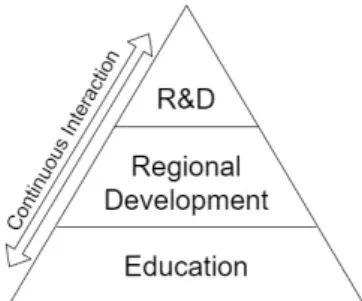
Research Unit for Smart Services at Häme University of Applied Sciences supports industry, commerce and the society in digitalization and service development needs. The task of the Research Unit is to create and execute, together with co-operation network, well-addressed R&D activities for the region and its’ enterprises. The Smart Services research center supports the utilization of digital technologies and service business development across sectors: similar solutions can be adapted in various lines of business. It also supports region's public and private sector partners on the creation and co-evolution on the business and co-evolution of education programs. (Figure 1)
Fig. 1. Regional development as the backbone on continuous co-evolvement
4. HOLISTIC DEVELOPMENT OF SMART REGION IN FRAMEWORK OF INDUSTRY 4.0
When building up cumulative competence in a creation of solutions for regional development by taking advantage of digitalization, the co-operation between government, enterprise and universities are essential to success. Also, it is essential to have a clear and commonly understood vision to direct the local operations and funding, in a rapidly changing operational environment. Otherwise, if the activities do not form parts of the whole vision, can it splinter as small pieces.
Industry 4.0 development will be seen as a smart utilization of digitalization, which has European level comparability to European development in all key clusters. The vision and approach are based on the need of regional clusters and the strengths of a region (eg. logistic, university, natural resources etc.).
There have to been good understanding about future needs, so that contents of education and training will be designed so that content will respond requirements.
Learning and development will take place in “real world” environments (field labs), which gives better fundament for development activities and implementation. This is the way how to ensure the birth of new innovations and the renewing the businesses and organizations. In universities, engineering students among others should be prepared to meet the demands of Industry 4.0 in order to be able to operate in future employment domains [6].
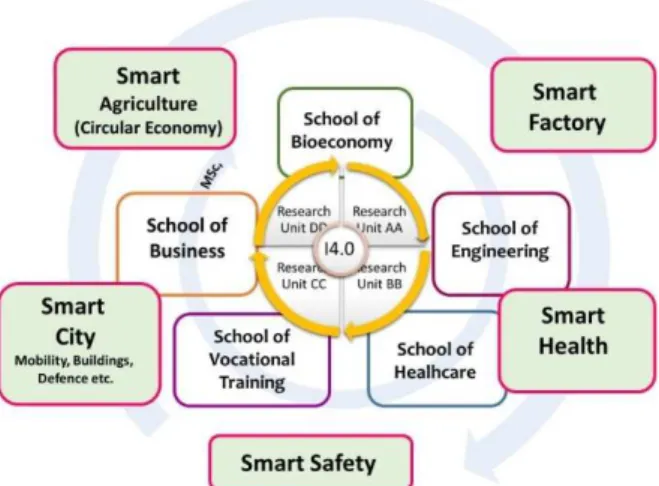
Region is implementing its new strategy “Smart Häme” to respond the challenges of digitalization and to be the part of Digital Single Market (DSM). Based on that, the focus is to increase the knowhow to digitalization on Häme region. After a Smart Specialization analysis, five key ecosystems (clusters) were found. These were seen to be the most critical for the development and attractiveness of Häme region (see Figure 4). The Smarts in the region and the ecosystemic choice to develop them are based on the region’s own choices and intent. The evaluation criteria, which were used to select the ecosystems in order to prioritize the development activities and resource allocation
were size, knowhow, importance, and versatility of the identified ecosystems.
These are the ecosystems, which also should have special attention and resource allocation, in development: “Smart Agriculture”, “Smart City”, “Smart Factory”, “Smart Wellbeing”, and “Smart Safety”.
Fig. 2. Integrating Häme regional Clusters/ “Smarts” and university structure.
Key element for universities is to support enterprises by applied research and creation of research and learning environments for continuous piloting of new technologies and preparation of new business models on Industry 4.0. It is not often the case or self-evident that representatives of government, enterprise, and universities collaborate with each other. While building up competence through common projects and development activities, it would be beneficial to support regional development. Digitalization provides a large variety of opportunities. The question remains that are we competent and fast enough to utilize these opportunities. A close co-operation makes it possible to build a common understanding and a shared vision, which guides the further development work. This is important so that all the existing and available development resources could be aligned.
enterprise-university partnerships, the interaction should take place on all levels. Being able to help the other partner to achieve their goals is beneficial for all. Longer-term development projects require high quality and in-depth roadmaps that should be developed collaboratively. This increases trust and commitment for long-term co-operation. Concrete co-operation project could emerge on various research projects, thesis work on both undergraduate and graduate studies and so on. Different kinds of experiments and measurements related to them could be started. It is important to succeed in benefiting multidisciplinary competence and sharing information sharing openly.
5. RELATED WORK & CASE STUDY
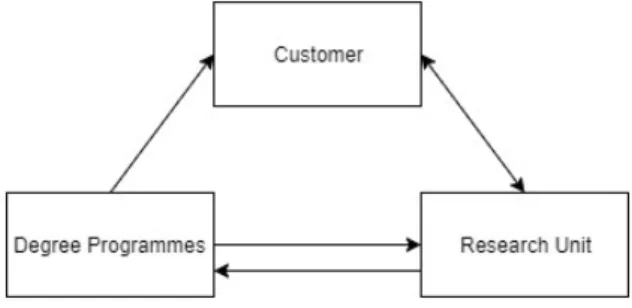
In Häme University of Applied Sciences and in its Research Unit for Smart Services has been done a lot in past few years to improve the model how Education, Research and Customers interract and work in development projects together. The most traditional model for Higher educational Institute is described in Figure 3. There are three actors and between them, there is different kind of relations and actions.
Fig. 3. Traditional model of Interaction between Customers, Education and Research
Degree programmes are the actors for education. Those interact with Customers mostly related to internships and theses that students do for Customers. Customers, which include cities, municipalities, companies and other private and public organizations mostly order theses work based for one single development need, or in worst case just to fill lack of personnel. Teachers will provide only guidance and interaction with student and customer might be in low level.
Usually this relation between education and customers is one-way. If everything goes well, Customer might recruit student after graduation. Degree programmes also produce student work in form of theses and internships for research needs similar way as they do for customers. Personnel of research unit might also participate in teaching in degree programmes. However, the teaching that they do is not always related to their research and they just lecture about subjects/topics they have competence in.
Traditional research in higher education means that research unit makes single projects with customers. Research unit apply for funding, find customers to participate and then execute the project the way that it was planned in application phase. There might be also other educational institutes participating but normally they just execute their own part of project in their own area and with own customers.
This traditional model is starting to be history in higher education. Different universities have generated their own, more modern models, which is recommendable because the traditional model has several major challenges:
• Actions are carried out only between two actors
• Teaching personnel isn´t involved anything else but teaching
• Actions are based only in single assignment and it won´t lead to cumulation of competence or to trusty relations and continuous co-operation.
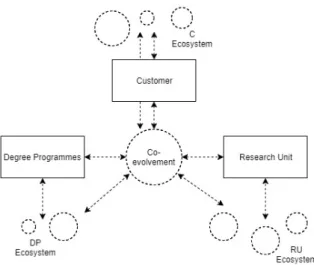
During the past years Research Unit for Smart Services of Häme UAS has develop relations to degree programmes and customers to generate one kind of a modern model to create a co-operational environment. Model is represented in Figure 4. The aim is to generate not only relations but also real environment, which is available for all actors:
• For Customers it is a development environment
• For Degree Programmes it is a learning environment
• For Research Unit it is a research environment
these actors to participate in co-evolvement. Also, it is important to understand that this model doesn´t require always all the actors to participate, it just generates prerequisites for it.
Fig. 4. Model for co-evolvement
This model has several major benefits. First, it makes possible for different actors to get all the best skills and knowledge for use. It also improves communications and joint operations so different actors won´t simultaneously work with similar challenges without knowing about each other. Model also makes possible to continuously and in an interative way to develop and learn around different topics and themes, while in traditional model, projects delivered are single actions, and won´t lead to cumulation of competence and co-operations.
It is also noticeable that co-evolvement “bubble” in the middle is dynamic and floats between
iterations. It might be that project starts as a thesis work ordered by company, where research unit only has a role in giving guidance to student. Based on published thesis, company might then start a fast POC (Proof Of Concept) project, where bubble moves more towards research when researchers have role of coordinate and deliver the solution while students have still remarkable role in practice. That can lead to major development project where research unit has even more significant role and ecosystems are participating. It also offers possibilities to teaching personnel to join project in role of an expert. After these iterations, based on new knowledge and competence, it is possible to renew the education and start new development and research projects in same field of study. The aim of all this is to do innovative partnership and strategic development together between different actors. When done correctly, it provides win-win situations, where also students have more challenging learning environment to improve their skills and teachers can also participate in role of an expert rather than just in guiding. Customers and research can gain more skills and knowledge to reach the goals and that way become more capable to deliver challenging and advanced development projects in future. Main keys are open communication, trust and real co-operations. Usually these have to be build up from bottom with time. Different levels of partnership are described in Figure 5.
5.1. Case study: Tavastia Events
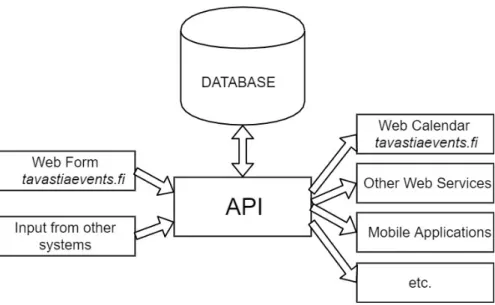
Tavastia Events is an open event API (Application Programming Interface) which is developed as a pilot of OpenHäme (AvoinHäme) project which is coordinated by Smart Services Research Unit. Goal of OpenHäme project is to create prerequisites of usage of Open Data in businesses. Project is funded by Häme Regional Council from European Regional Development Fund. Also three Cities from Häme region, Hämeenlinna, Riihimäki and Forssa are providing funding for the project.
Project has started in May 2017, but already during 2015-2016 key actors of region consisting cities, municipalities and companies have worked together to improve Open data development in region. Based on this co-operation, Research Unit for Smart Services decided to apply for funding for this theme. During application phase, workshops were held for all interested parties, also educational, to offer a possibility to participate and influence to determining work packages, themes and pilots for project. This was the first iteration of the co-operation.
Event API was determined in co-operation to be the main pilot of the project. When project got funded, first step to launch development of Event API pilot was a thesis made by Business Information Technology student. From the same degree programme, there was also a student project to make the first installation of API, which is based on open source code. This was the second iteration, where students had major role to provide needed basic knowledge and experiences.
After this background work, main development phase was started. As a launch for that, project held workshops for different actors and customers. Main goal was to collect opinions and requirements from wide audience representing different roles. Results of this workshop generated backbone and framework for development work.
Development was done during January – May 2018. During development project team tested and approved new features and functionalities with a guidance group, which was specially gathered for this purpose. Group consisted
people from cities, municipalities, companies and other organizations. Their insights were asked weekly to support the work of developers. Project has two technical developers. Backend software developer is employee of Research Unit, but frontend web development was done totally by a trainee in guidance of project personnel. Project benefit a lot from this skilled student but the student got also a possibility to learn a lot about the topic, which he is interested in real world environment and development project. This kind of challenging learning situations can´t normally be offered by normal education for skilled and motivated students. During development phase, there was also co-operation with another region that was doing the same kind of development at the same time. While product owners discussed openly about features, issues and future development, programmers in both region had a channel to share experiences and ask for help if needed. This development iteration really showed benefits of co-evolvement while there was research, developers, student, customers and ecosystem of regions working together in open co-operation to achieve as good results as possible. It also provides framework for future co-operation in even deeper level and that kind of work has already been started related to other APIs.
Fig. 6. Structure of Tavastia Events API developed in OpenHäme Project
OpenHäme project has delivered many other activities too, not only this one pilot. One of those is guest lectures that personnel of the project has given for various degree programmes in HAMK UAS. This is the way to renew content of teaching easily, without changing whole curricula. Through these lectures, it has been possible to bring all the latest results and knowledge about Open Data and its possibilities to students. In academic year 2017-2018, project personnel gave total of 7 lectures for bachelor and master level students. These lectures also acted as an open call for students to participate the project.
6. DISCUSSION AND CONCLUSIONS
Any complex methods or systems won’t be necessary needed to really achieve co-evolvement. Most important thing is that people in different units and organizations share same goals and insights, and are willing to work together in open way. That is the start of the journey towards strategic partnerships and co-evolvement. During that journey competence and trust will increase and it will become easier to make partnership contracts etc. when those are based in concrete and meaningful long-term co-operations. It is sure that this way it is possible to gain many kinds of advantages: More knowledge to use, resource-wise efficient way to
work and cumulative development of different themes together.
Further studies are needed both in theoretical and practical level. This article only introduces theb model and way to co-operate and Smart Services -research units experiences about topic. Needed studies are related to requirements of physical and virtual platforms and enviroments for co-evolvement. Also contracts, trust, ownerships and openness of development and learning are critical to research. This article excluded role of funders from model, but it is also important to research change of that role and new possibilities to fund activities efficiently and in a smart way.
7. REFERENCES
[1] Deloitte. (2014) Industry 4.0. Challenges and solutions for the digital transformation and use of exponential technologies. Available from:https://www2.deloitte.com /content/dam/Deloitte/ch/Documents/manu facturing/ch-en-manufacturing-industry-4-0-24102014.pdf
[2] PWC. (2016) 4.0 Industry: Building the digital enterprise. Global Industry Survey. Available from: https://www.pwc.com
[3] Salminen, V., Kantola, J., Vanharanta, H. (2015) Competence portfolio assessment of research and development center for regional development. 6th International Conference on Applied Human Factors and Ergonomics (AHFE 2015), Las Vegas, USA July 26-30, 2015
[4]Wiek, A., Walter, A. (2009) A transdisciplinary approach for formalized integrated planning and decision-making in complex systems. European Journal of Operational Research 197 (2009) pp. 360– 370
[5] Häberli, R., Bill, A., Grossenbacher-Mansuy, W., Thompson Klein, J., Scholz, R.W., Wetli,
M. (2001). Synthesis in: J.Thompson Klein, W. Grossenbacher- Mansuy, R. Häberli, A. Bill, R.W. Scholz, M. Welti (Eds.), Transdisciplinarity: Joint Problem Solving among Science, Technology and Society, Birkhäuser, Basel, 2001, pp. 6–12.
[6] Schuster K, Groß K, Vossen R, Richert A, Jeschke S. Preparing for Industry 4.0— Collaborative virtual learning environments in engineering education. In: Automation, Communication and Cybernetics in Science and Engineering 2015/2016. Cham: Springer International; 2016. pp. 417-427
DEZVOLTAREA EDUCAȚIEI ITC ÎN DIGITALIZAREA MEDIULUI DE AFACERI
Rezumat: Ne îndreptăm spre a patra revoluție industrială prin dezvoltarea digitalizării. Globalizarea, lipsa resursei,
schimbarea comportamentului de cumpărare, urbanizarea, influențează asupra noii situații competitive în fiecare
domeniu. Aceasta determină atât presiuni remarcabile pentru schimbare, cât și oportunități pentru majoritatea industriei
Dezvoltarea competitivității educației este atractivă. Întreținerea continuă necesită cooperarea între companii, clustere
inteligente și cercetare și dezvoltare; cum să dezvolte continuu și sistematic cooperarea în domeniul digitalizării mediului
de afaceri. Acest articol introduce procesul de creare și cadrul de dezvoltare creat pentru dezvoltarea și organizarea
educației în domeniul TIC pentru a sprijini competitivitatea universităților, dar și pentru a sprijini tranziția către
digitalizare și inovare bazată pe strategia regională "Specializare inteligentă". Acesta introduce un model de reînnoire a
învățământului superior bazat pe TIC astfel încât să sprijine dezvoltarea continuă a competenței personalului. De
asemenea, oferă întreprinderilor posibilitatea de a se implica în co-evoluția afacerilor și inițierea de noi tehnologii și
abilități. Modelul oferă, de asemenea, posibilitatea de a testa produsele și serviciile în rețelele de valoare transdisciplinară. Joni KUKKAMÄKI, Research Unit for Smart Services, Häme University of Applied Sciences,
Visamäentie 35A, Hämeenlinna, Finland, [email protected]
Vesa SALMINEN, Research Unit for Smart Services, Häme University of Applied Sciences, Visamäentie 35A, Hämeenlinna, Finland, [email protected]