TECHNICAL UNIVERSITY OF CLUJ-NAPOCA
ACTA TECHNICA NAPOCENSIS
Series: Applied Mathematics, Mechanics, and Engineering Vol. 62, Issue II, June, 2019
RESEARCH ON THE LOAD BEARING FORCE IN NARROW SLIDING
RADIAL BEARINGS (L < 0,7 D) OPERATING IN SHOCK CONDITIONS
Ioan Marius ALEXANDRESCU, Radu Iacob COTEȚIU, Simion HARAGÂȘ
Abstract: It was highlighted how to carry out the load bearing force of the narrow sliding bearings operating under shock and vibration, in the case of movement to close the surfaces of the spindle and the coupling, by the expulsion effect of the lubricant from the interstices ("squeeze film"). Taking into account the minimal lubricant thickness determined in static load conditions, the variations of the instantaneous load force were determined, depending on the adimensional thickness of the lubricant film for the three launching heights of weight (5 cm, 20 cm, 40 cm) and the variation of the instant bearing force of the bearing in dimensional form (Ai, Bi, Ci – in N) is based on the minimum thickness of lubricant hi, respectively, depending on the time of the shock (ci (sec)).
Key words: Radial bearing, lubricant, hydrodynamic regime, squeeze film, instant load bearing force.
1. INTRODUCTION
The study of the behavior of radial bearings, with hydrodynamic lubrication, operating in conditions of shock and vibration, is made from a tribological point of view, following the appearance of friction and lubrication, the lubricant film, through which, the shock is amortized.
The objective of this work is the analysis of the situations occurring in the operation of the radial bearings with sliding, due to large loads (shocks), by modifying one or more important parameters of the operation of the radial bearings, with effects on the pressure in the lubricant film. Theoretical studies are carried out that attempt to elucidate the phenomena that occur in the lubrication of the radial bearings with heavy shocks, and, some contributions are made regarding the modeling of the spindle contact in the case of the HD radial bearings conditions of shock and vibration [5].
It was highlighted how to carry out the bearing of the bearings operating under shock and vibration, in the case of movement to close the surfaces of the spindle and the coupling, by the expulsion effect of the lubricant from the interstices ("squeeze film").
2. MATHEMATICAL MODELING ON INSTANT LOAD BEARING FORCE OF HD RADIAL BEARINGS OPERATING UNDER SHOCKS
uniformly distributed force on the length (rectangular footprint)
Notations used:
L- length of bearing (m); η- viscosity of lubricant (Ns/m2); θ is the angular coordinate; G-
static loading (N); p-pressure (Pa); F- dynamically loading (N); h- fluid film thickness (m); D- bearing shaft diameter (m); Fs_ad - instantaneous squeeze force; Ai, Bi, Ci – instant load bearing force in
dimensional form (N); H - weight launching height (m); ci – time of shock (sec.); ɛ - the
relative eccentricity ; ψ - the relative clearance; V - bushing surfaces velocity immediately before impact; V0 – velocity immediately after
impact; v – the shaft peripheral speed; n – the rotational speed.
The equation of pressure in the lubricant film, the classic form of the Reynolds equation for the laminar flow of the incompressive fluid,
x h V z p h z x p h x ∂ ∂ = ∂ ∂ ∂ ∂ + ∂ ∂ ∂ ∂ 6 3 3 η
η . (1)
The useful solution in engineering applications is the approach, "isotherme", considering the equation of energy in a global form, which allows the determination of a constant average temperature in the interstitium, which leads to the thought and constant viscosity in the interstices [8]. Thus, the corresponding Reynolds equation form
x h V z p h z x p h x ∂ ∂ = ∂ ∂ ∂ ∂ + ∂ ∂ ∂ ∂ η 6 3
3 . (2)
The Reynolds equation has an analytical solution only if the hypothesis of the narrow bearing theory is admitted, in which, due to the fact that the width of the L bearing is relatively small in relation to its circumference πD, the gradient of the pressure may be neglected in circumference direction compared to the gradient of the pressure in the axial direction
0 = ∂ ∂ ∂ ∂ << ∂ ∂ x p z p x p
. (3)
Approximation is acceptable for L < 0.7 D values provided that the eccentricity is not very high (ε < 0.9).
Due to this simplified hypothesis, the final form of the distribution of the pressure can be
(
)
− + = 2 2 3 2 4 cos 1 sin 24 z L J n p θ ε θ ε ηπ . (4)
The load bearing force generated by the lubricant film shall be determined by integrating the pressure field defined by the equation (4).
The following simplificative assumptions shall be deemed acceptable:
• • lubricant is an incompressive Newtonian fluid, the lubrication of the bearing in the laminar flow regime; The flow regime is considered laminar if the relationship is satisfied
5 , 1 2 6 , 26 ψ ν ⋅ ≤ D
n , (5)
• all components of the system are continuous environments;
• there is no sliding between the fluid and the walls;
• the inertial forces in the fluid are negligible; • the pressure in the film is constant on the thickness of the film;
• properties of component materials: densities, specific heat, conductivity, are constant in the field of temperatures in which the bearings work; temperature variation in axial direction is negligible;
• the zone and the coupling have cylindrical, smooth and rigid surfaces with parallel axes.
The neglect of the pressure solution in Reynolds ' equation is the effect of approaching surfaces (squeeze) can give a distorted image of the phenomenon. The modelling of the expulsion effect of the lubricant (squeeze) starts all from Reynold’s equation, but in which the terms containing the speed of proximity of two surfaces should be considered (
t h V =−∂ ∂ ).
In the case of movement to close the surfaces of the spindle and the coupling to the hydrodynamic bearings operating with variable load, the expulsion effect ("squeeze film") is determined by the resistance of the fluid to the expulsion from the interstices, which Lead to the creation of the self-supporting lubricant film (figure 1) [9].
Fig. 1 Expulsion effect (squeeze)
Fig. 2 Expulsion effect in case of proximity of parallel plane plates
The first analytical treatment of the squeeze effect occurring near two planparallel boards, loaded with constant load, was carried out by M. Ten Bosch in the 1941 edition of Vorlesungen uber Maschinenelemente [3], figure 2.
F. P. Bowden and D. Tabor [4] studied the pressure developed in the fluid film at the collision of two planparallel surfaces. The maximum pressure developed in the center of the circular surface grows rapidly with a maximum, after which it tends to zero, the initial thickness of the film is 0.05 cm, the viscosity 25 centipoise, the surface radius approaching 1 cm, the M mass and the V speed-figure 3:
The thickness of the lubricant film, h
Fig. 3 Maximum pressures in the centre of planparallel tiles at the time of shock
Moore determined the maximum impact pressure in the center of the tiles, which increases with the decrease in the thickness of the film, H, up to a maximum value determined by the size and weight of the plates, and the viscosity of the expelled lubricant, figure 4 [5].
Thickness h, (mm)
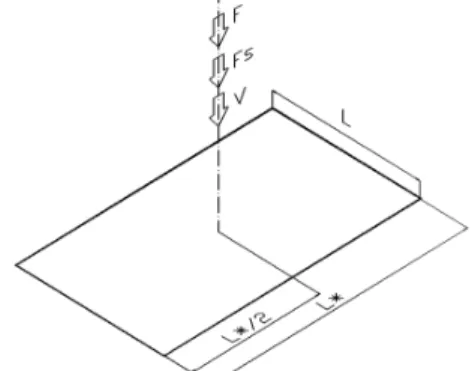
Fig. 4 Maximum impact pressure – parallel plane plates To highlight the particular aspects that interfere with the determination of the bearing of the radial bearings subjected to strong shocks will be considered the expulsion effect of the lubricant film under shock, addressing the particular single-dimensional case of the flat plate of infinite length L * > > L (L represents the width of the rectangular plate), subjected to a shock load F of a weight having a speed prior to impact V0 – Figure 5. The weight is
released from a specified height, H, which in subsequent dynamic calculations has a value ranging from 5 to 40 cm.
modeling of the expulsion effect in the case of the rectangular plate of infinite length has as its starting point the loss of kinetic energy of the plate with the mechanical work spent on defeating the viscosity forces
(
)
[
− −]
=− ⋅ ⋅
20 2 2 * 2 L pdz L h V V V g
F δ δ
(6)
The distribution of pressure may be deducted from the conservation of the deployed flow [6].
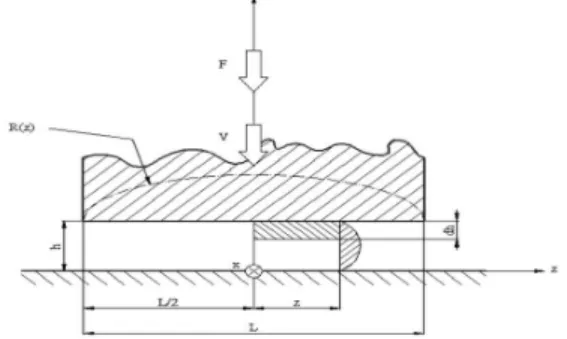
Graphically, it is represented by the equal areas of the shaded in Figure 6, taking into account the xOy symmetry plan.
Fig. 6 Squeeze pressure distribution in the case of the plane plate of infinite length
Thus, starting from the fundamental balance equation of the portable fluid films, considering the case of the Poiseuille type of flow (Couette flow is null because there is no tangential relative movement), it can be written
dy d dz dp τ
= . (7)
For a Newtonian fluid
dz du
η
τ
= . (8)Results dz dp dy u d
η
1 2 2= , (9)
(
h y)
y dz dp
u = − −
η
2 1
. (10)
For y=h/2, dz dp h u
η
8 2max=− , (11)
dz dp h u um
η
12 3 2 2max =−
= . (12)
Results dz dp h u h
qz m
η
12 3 − = ⋅= . (13)
Customizing the Reynolds equation for the case of constant thickness film can be written
3 2 2 12 h V dz p d η −
= . (14)
Integrated successively twice, and putting conditions at the limit taking into account the condition of admission of the symmetry plan xOy (z = ± L/2, p=0 and z=0, dp/dz=0) [6], results the parabolic distribution of pressure in the interstices:
(
2 2)
3 4 2 3 z L h V
p=
η
− , (15)and 3 2 max 2 3 h VL
p = η . (16)
Substituting the relationship (15) in the relationship (6), and taking into account the
0 2 ≈ V
δ , it obtain:
V h L L t V g F 3 3 *
η
δ
δ
=− ⋅ , (17)( )
= 3 3
* h h L L V g
F δ η δ
;
δ
h=−Vδ
t, (18)C h L L g FV + −
= 3 2
2 1 *
η . (19)
Putting the condition at the limit of initialization: the h=h0 (initial thickness of the
lubricant film); V=V0, it obtain
C h L L g FV + − = 2 0 3 0 2 1 *
η
. (20)Follows the speed of the plate
− − = 2 0 2 3 0 1 1 2 * h h F g L L V
V
η
. (21)In the vast majority of cases, V→0, and h0
>>h, so that if the approval of the V≈0, it obtain:
0 3 2 * FV g L L
h≅ η , (22)
and represents the minimum lubricant thickness between the surfaces of the plates, in dynamic regime.
distribution taking into account its symmetrical character [1]. So
(
L z)
dz h V L pdz L F L Ls = ⋅
=
−2 0 2 2 2 0 3 4 2 3 * 2 *
2 η (23)
It obtain such
3 3 * h L VL
Fs =η . (24)
By numerically solving the expression (24), it is obtained for the initial thickness h0 =10,175 µm and dynamic charging F=3332,5 N, graphical representation of the instantaneous squeeze force function of the instantaneous thickness of the lubricant film hs (µm)
depending on the time ts (sec) while the shock
lasts – figure 7.
Fig. 7 Instant load bearing force for a shock charge F=3332.5 N
The lubricant film has a variable thickness over time, so the problem of maintaining the film between the surfaces, under the conditions of the proximity movement, has a temporal connotation.
From the relationship (24), you can write
3 3 *L L h F V s
η
= , (25)
which, introduced in the expression (21) gives
− − = 2 0 2 3 0 3 3 1 1 2 *
* F h h
g L L V L L h
Fs
η
η
. (26)In an adimensional form, you can write:
0 3 3 0 *LV L
h F
F s
s =
η
, (27)h h H = 0
, (28)
0 3 3 0 *LV L
Fh F
η
= , (29)
0 0 0
gh V
V = . (30)
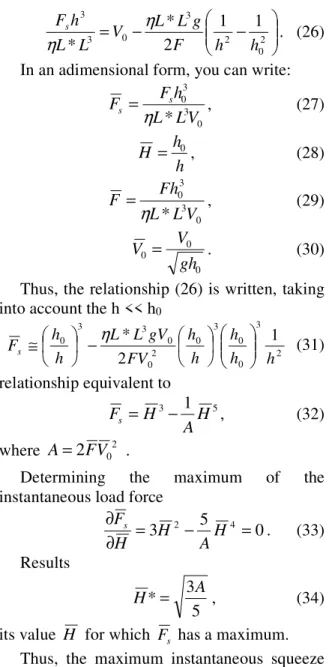
Thus, the relationship (26) is written, taking into account the h << h0
2 3 0 0 3 0 2 0 0 3 3 0 1 2 * h h h h h FV gV L L h h
Fs
−
≅ η (31)
relationship equivalent to
5
3 1
H A H
Fs = − , (32)
where A=2FV02 .
Determining the maximum of the instantaneous load force
0 5
3 2− 4 =
= ∂ ∂ H A H H Fs
. (33)
Results
5 3
* A
H = , (34)
its value H for which Fs has a maximum. Thus, the maximum instantaneous squeeze force has the expression [2]
5 3 25 6 max A A
Fs = . (35)
Without the hypothesis h << h0 Get the more
accurate solution for the instant squeeze force. Thus, the equation (26), using the same adimensionalization for the instantaneous squeeze force Fs, the thickness of the lubricant
film H and shock load F, becomes
2 0 0 2 0 2 0 0 3 0 2 1 2 1 1 V gh F h h V gh F h h
Fs +
− =
, (36)
relationship equivalent to
Π + Π − = F H H F H Fs 4 4
1 5 3
3
or
(
)
[
3 5]
4 1 4
1
H F H
F
Fs + Π −
Π
= . (38)
With notations: V0 = 2gH ,
h h H = 0
,
0 h H
=
Π and A=4FΠ, where H represents the
height from which the weight is launched that dynamically loads the system, and Π is the parameter of expulsion the lubricant film, the expression (38) becomes [4]
(
)
[
3 5]
1 1
s s
s H A H
A
F = + − . (39)
Its value Hs for which Fs has a maximum is
(
)
5 1 3
* A
H = + . (40)
Thus, the maximum instantaneous squeeze force has the expression
(
) (
)
5 1 3 25 1
6 2
max
A A
A
Fs = + + . (41)
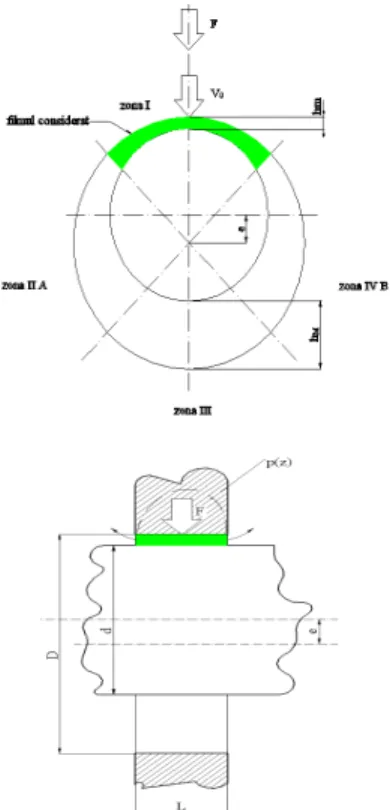
In the case of the narrow sliding radial bearing (L/D ≤ 0,7), due to the very short time of loading, the order of 0.5 – 1 ms, is considered only the approach between the spindle and the coupling on the direction of the centre line, without rotating movement of the expulsion effect of the lubricant is predominant in the completion of the self-supporting film. Simplified modeling of the lubricant film thickness and the portance in the conditions of the nearby movement of the spindle surfaces and the coupling for the narrow radial camp subjected to shocks modeled in 4 regions (figure 8), has as the starting point the following assumptions: Area I is the only area that truly opposes the movement of proximity; The geometry of the lubricant film will be approximated the coating with a constant thickness surface, equal to the minimum thickness of the lubricant film from static load conditions, based on the pattern of the rectangular plate of infinite length; In zones II A and IV B the section remains ,,roughly” constant and therefore the pressure remains constant; In zone III the movement is the removal of surfaces, the pressure decreases, and can be considered constant in the conditions of the occurrence of cavitation.
Fig. 8 Modeling the thickness of the lubricant film For geometric considerations you can write:
4
* D
L =
π
, (42)(
−ε
)
= − =
= 1
2 2
J e J h
h m , (43)
gH
V0 = 2 , (44) 0
≈
V . (45) where H represents the height from which the weight that dynamically loads the bearing is released.
Thus, the relationship (21) becomes
−
≅ 2
0 2 3 0
1 1 '
8F hm hm g
DL
V
ηπ
. (46)It ignores the taking into account and other moving masses in addition to considering the dynamic load F, so that equality can be considered F = F'. Appropriate instant load bearing force taking into account the approximating hm << hm0 is
5
3 1
s s
s H
A H
F = − , (47)
m m s
h h
H = 0 . (48)
The variations of the instantaneous load bearing force were determined, depending on the adimensional thickness of the lubricant film for the three weight release heights, Hs.
Fig. 9 Instant load bearing force function of the adimensional thickness of the lubricant film
(G=2250 N, n=370 rot/min, pin=0,5 bar)
Fig. 10 Instant load bearing force function of the adimensional thickness of the lubricant film
(G=2250 N, n=600 rot/min, pin=1,5 bar)
Fig. 11 Instant load bearing force function of the adimensional thickness of the lubricant film
(G=2250 N, n=960 rot/min, pin=8 bar)
The more accurate solution, if no consideration is given to the hm << hm0, for the
instant bearing force has the expression
(
)
[
3 5]
1 1
s s
s H A H
A
F = + − , (49)
where A=4FΠ, and the parameter of expulsion the lubricant film Π has the expression
0 m h
H
=
Π . (50)
The variations of the instant bearing force were determined, depending on the adimensional thickness of the lubricant film according to H (the case without hm << hm0):
Fig. 12 Instant load bearing force function of the adimensional thickness of the lubricant film
(G=2250 N, n=370 rot/min, pin=0,5 bar)
Fig. 13 Instant load bearing force function of the adimensional thickness of the lubricant film
(G=2250 N, n=600 rot/min, pin=1,5 bar)
Fig. 14 Instant load bearing force function of the adimensional thickness of the lubricant film
(G=2250 N, n=960 rot/min, pin=8 bar)
Using the previous computing relationships, a resolution in the Mathcad 2001i program was determined the variation load bearing force in the dimensional form (Ai, Bi, Ci – in N) depending on the minimum thickness of lubricant hi, respectively, depending on the time
the shock lasts (ci(sec)).
H=40 cm
H=20 cm H=5 cm
H=40 cm
H=20 cm H=5 cm
H=40 cm
H=20 cm H=5 cm
H=40 cm
H=20 cm H=5 cm
H=20 cm H=5 cm
H=20 cm H=5 cm
H=40 cm
Fig. 15 Instant load bearing force(n=370 rot/min, pin=0,5 bar, G=2250 N, hm0=10,175 μm)
Fig. 16 Instant load bearing force (n=370 rot/min, pin=0,5 bar, G=4500 N, hm0=6,723 μm)
Fig. 17 Instant load bearing force (n=600 rot/min, pin=1,5 bar, G=2250 N, hm0=12,554 μm)
Fig. 18 Instant load bearing force (n=600 rot/min, pin=1,5 bar, G=4500 N, hm0=8,493 μm)
H=40 cm
H=40 cm H=40 cm
H=40 cm H=40 cm
H=40 cm
H=40 cm H=40 cm
H=20 cm
H=20 cm H=20 cm
H=20 cm
H=20 cm H=20 cm
H=20 cm H=20 cm
H=5 cm
H=5 cm
H=5 cm H=5 cm
H=5 cm H=5 cm
Fig. 19 Instant load bearing force (n=960 rot/min, pin=8 bar, G=2250 N, hm0=15,159 μm)
Fig. 20 Instant load bearing force (n=960 rot/min, pin=8 bar, G=4500 N, hm0=10,506 μm)
3. CONCLUSIONS
The following is noted:
• The instant load bearing force, under the same static and dynamic load conditions, is theoretically higher by about 20% if the exact
solution is considered, without the hypothesis hm
<< hm0, than in the case of the simplified
hypothesis (the error introduced being high, in mathematical modelling of the radial bearing subjected to shocks and vibrations, the case will be considered without the simplification hypothesis);
• The instant load bearing force increases in both situations with increased dynamic load, respectively with the increase of the spindle speed;
• The existence of an optimum from the point of view of the load bearing force; any modification of the functional parameters of the bearing leads to the removal of the optimum value from the point of view of the port;
• The ratio of the film thicknesses, Hs_ad,
significantly influences the load bearing force; Once the maximum area is exceeded, the load bearing force decreases rapidly.
• The increase of the load bearing force of the narrow sliding bearings is noted with the increase in relative eccentricity (decrease δ) respectively, the increase of the load bearing with the increase of the L/D ratio, for the same value of the relative thickness of the lubricant film
• The instantaneous squeeze force (lubricant expulsion resistance) at the time of the shock increases with the increase dynamic load; The increase is achieved with the decrease in the thickness of the film, until a maximum is reached after which the bearing force decreases sharply; In time the phenomenon has a similar variation, the bearing force increases with the increase of time, reaches a maximum after which the bearing force decreases sharply (figure 15 – figure 20);
• The lubricant supply pressure, at the same speed and static bearing load, does not significantly influence the bearing load subjected to large loads (graph allure, phenomenon duration and squeeze force size do not undergo any changes significant);
• When increasing the spindle speed and implicitly the minimum lubricant thickness, a slight increase in the expulsion resistance of the lubricant film is noted; at the same speed and power pressure, with the increase in static load, a significant increase in the bearing H=40 cm
H=40 cm
H=40 cm
H=40 cm H=20 cm
H=20 cm H=20 cm H=20 cm
H=5 cm
(approximately 30%) is observed in the same dynamic load;
• The allure of the load force graphs function of the minimum instantaneous thickness of the lubricant film is identical to the shape of the graphs presented by F. P. Bowden and D. Tabor in [4] – Figure 3, respectively by D. F. Moore in [5] – Figure 4.
4. REFERENCES
[1] Alexandrescu, I. M., Pay, E., Pascovici, M. D., The effect of lubricant film expulsion under shock in the case of the narrow sliding radial bearing (L/D < 0,6). Scientific Bulletin, Serie C, Vol. XIX. Fascicle: Mechanics, Tribology, Machine Manufacturing Technology. Part I. International Multidisciplinary Conference, 6-th Edition, North University of Baia Mare, 2005, pp. 1-6, ISSN 1224-3264, ISBN 973-87237-1-X
[2] Alexandrescu I. M., Cotețiu R., Darabă D., Correlations of the instantaneous carrying force and pressure distribution in the case of the narrow sliding radial bearing under hard shocks. Published under licence by IOP Publishing Ltd. IOP Conference Series: Materials Science and Engineering, Vol. 174
[3] Bosch, M. Ten, Vorlesungen uber Maschinenelemente. Berlin, Verlag von Julius
Springer, 1941, pp. 272-273
[4] Bowden, F. P., Tabor, D., The Friction and Lubrication of Solids. Oxford at the Claderendon Press, 1950, pp. 259-283
[5] Moore, D. F., Viscoelastic Machine Elements. Elastomers and lubricants in machine system. Oxford, Butterworth-Heinemann Ltd., 1993, pp. 139-163
[6]Negrean I., New Formulations in Analytical Dynamics of Systems, published in Acta Technica Napocensis, Series: Applied Mathematics, Mechanics and Engineering, Vol. 60, Issue I, 2017, ISSN 1221-5872, pp. 49-56
[7]Negrean I., Mass Distribution in Analytical Dynamics of Systems, published in Acta Technica Napocensis, Series: Applied Mathematics, Mechanics and Engineering, Vol. 60, Issue II, 2017, ISSN 1221-5872, pp. 175-184
[8]Negrean I., Generalized Forces in Analytical Dynamics of Systems, published in Acta Technica Napocensis, Series: Applied Mathematics, Mechanics and Engineering, Vol. 60, Issue III, 2017, ISSN 1221-5872, pp. 357-368
[9]Negrean I., Advanced Equations in Analytical Dynamics of Systems, published in Acta Technica Napocensis, Series: Applied Mathematics, Mechanics and Engineering, Vol. 60, Issue IV, 2017, ISSN 1221-5872, pp. 503-514
[10] Pascovici, M. D., Cicone, T., Elemente de tribologie. Bucureşti, Editura Tehnică, 2000
CERCETĂRI PRIVIND PORTANȚA LAGĂRELOR RADIALE CU ALUNECARE
ÎNGUSTE (L < 0,7 D) SUPUSE LA ȘOCURI
Rezumat: S-a evidenţiat modalitatea de realizare a portanţei lagărelor ce funcţionează în regim de şocuri şi vibraţii, în cazul mişcării de apropiere a suprafeţelor fusului şi cuzinetului, prin efectul de expulzare a lubrifiantului din interstiţiu (,,squeeze film’’). Ţinând cont de grosimile minime de lubrifiant determinate teoretic în condiţii de încărcare statică, s-au determinat variaţiile forţei portante instantanee, funcţie de grosimea adimensională a filmului de lubrifiant pentru cele trei înălţimi de lansare a greutăţii (5 cm, 20 cm, 40 cm) și s-a determinat variaţia portanţei în formă dimensională (Ai, Bi, Ci – în N) funcţie de grosimea minimă de lubrifiant hi, respectiv funcţie de timpul cât dureazăşocul (ci[sec]).
Ioan Marius ALEXANDRESCU Lecturer Ph.D. Eng., Technical University of Cluj-Napoca, North University Center of Baia Mare, Faculty of Engineering, Department of Engineering and and Technology Management, 62A Victor Babes St., RO-430083, Baia Mare, ROMANIA, E-mail: [email protected], Tel. 0264-202975.
Radu Iacob COTETIU Professor Ph.D. Eng., Technical University of Cluj-Napoca, North University Center of Baia Mare, Faculty of Engineering, Department of Engineering and and Technology Management, 62A Victor Babes St., RO-430083, Baia Mare, ROMANIA, E-mail: [email protected], Tel. 0264-202975.