Refereed paper
Are we setting about improving the safety
of computerised prescribing in the right
way? A workshop report
Arash Vaziri
Medical Student, St George’s, University of London, UK
Eric Connor BSc (Econ) MSc DIC CITP
Head of Technology Strategy, Royal Pharmaceutical Society of Great Britain, London, UK
Ian Shepherd BSc (Pharmacy) MRPharmS FBCS CITP
Chair of the British Computer Society Primary Health Care Specialist Group, London, UK
Robert Treharne Jones LMSSA MRCS
Independent Consultant, London, UK
Tom Chan RGN RMN MSc PhD
Honorary Senior Lecturer in Informatics, St George’s, University of London, UK
Simon de Lusignan MBBS MSc MD (Res) FBCS FRCGP
Reader in General Practice and Biomedical Informatics, St George’s, University of London, UK
ABSTRACT
Background Prescribing errors are common and costly. Technology should enable safer prescribing. The two main current methods of doing so are computer initiated clinical support software (CDSS) and the user initiated information retrieval (IR) systems. However, despite the near universal avail-ability of computerised prescribing support in the UK, errors continue.
Objective To evaluate the experience of UK pri-mary health care professionals using CDSS and to consolidate current technical opinion and literature in this area with the aim of creating useful hypoth-eses for guiding future academic investigation and industrial development.
Study design The study was a synthesis, drawing together a literature review and views from experts in the field to explore from a qualitative perspective where and how CDSS and IR could be used to improve prescribing safety in primary care. We conducted a literature review, held a workshop to explore issues in practice and had a follow-up expert panel meeting to confirm the findings. The workshop was recorded, transcribed verbatim and analysed thematically.
Participants and setting The study involved pri-mary care practitioners, system developers, infor-mation suppliers and academics.
Outcomes Although CDSS is incorporated into primary care electronic patient record systems there does not appear to be an associated marked reduc-tion in prescribing errors. Clinicians are frustrated with current systems, and are concerned these may have a negative impact on patients. There is an un-helpful signal–noise ratio with too many clinically irrelevant alerts and insufficient recognition of the potential downsides of over alerting – possibly making compliance less likely, having a negative impact on the doctor–patient relationship and overloading clin-icians. A preferred way forward would be alerts based on quantitative risk assessment of interaction at the level of the preparations being prescribed, rather than theoretical possibilities of interactions between classes of drugs.
Conclusion Prescribing errors remain a major source of unnecessary morbidity and mortality and cur-rent systems do not appear to have significantly reduced this problem; nor has the extensive literature about how to reduce unnecessary alerts been taken into account. We need a new and more rational basis for the selection and presentation of alerts that would help, not hinder, the clinician’s performance.
Introduction
Medical errors occurring at the hands of clinicians unfortunately come about regularly and are costly in both financial terms and in terms of patients’ health.1 At a fundamental level, practising medicine with incomplete information regarding the patient or rel-evant to the management of the patient is thought to be a major contributory factor in the aetiology of these errors.1A retrospective analysis2of clinical records in the UK revealed that 10.8% of patients had experi-enced an adverse event on medication. Half of these were thought to be preventable by ordinary standards of care. One third of the events resulted in moderate to severe disability or death. In a separate study, 72.6% of iatrogenic adverse drug reactions were found to be due to a fundamental lack of knowledge regarding the drug therapy, the nomenclature, or patient factors affecting the use of the therapy.3The aim of prescrib-ing support software or e-prescribprescrib-ing software includ-ing CDSS and IR is to facilitate the provision of this information at the point of care for the patient4(see Box 1 for definitions of these key terms). There is international evidence that some applications of e-prescribing software have successfully improved patient safety through this mechanism.5–9However, despite this optimism the range of areas where benefit has been realised are limited and prescribing safety problems remain a substantial issue.10
Primary care in the UK, along with many other countries that run personal registration systems, is almost universally computerised.11 One of the few areas where computer use saves time is in prescrib-ing.12,13Primary care electronic patient record (EPR) systems enable electronic prescribing to be linked to CDSS and IR. The most widespread prescribing sup-port software in UK primary care practices is the prescribing alert system, warning of potential drug interactions and of a previous record of allergy.14These systems are included as a standard part of primary care EPR systems. Although rolled out relatively slowly, the
most common use of CDSS is to support anticoagu-lation prescribing in primary care, usually in nurse run clinics.15
We carried out this study to evaluate the experience of UK primary healthcare professionals using CDSS and to consolidate current technical opinion and literature in this area, with the aim of creating useful hypotheses to guide future academic investigation and industrial development.
Method
We carried out a literature review to gain an under-standing of the key terms, concepts and recent devel-opments in using computers to improve prescribing safety. This included a Medline database search of the terms ‘e-prescribing’, ‘clinical decision support sys-tem’ and ‘information retrieval’. The internet search engine ‘Google’18was also used to find links to NHS websites on e-prescribing software. We included only findings which might be applicable in primary care.
A workshop was organised by SdeL, RTJ, IS and EC and held on behalf of the Primary Health Care Spe-cialist Group of the British Computer Society as part of the HC2008 healthcare computing conference. Over 30 delegates attended the workshop. The primary aim was to describe current best practice, and to explore the role of and best practice in the use of prescribing support software. The attendants included a range of informaticians, academic clinicians, pharmacists, clin-icians with an IT (information technology) interest, human factor/user experience consultants and medi-cal and non-medimedi-cal commercial IT vendors, as well as members of the National Health Service (NHS) national programme for IT development team.
The workshop was a series of four talks given by academics and industry leaders in the subject, fol-lowed by a discussion. The talks given outlined the scale of the safety problem with prescribing and the
Box 1 Key definitions
Prescribing support software/e-prescribing: The utilisation of electronic systems to facilitate and enhance the communication of a prescription, aiding the choice, administration or supply of a medicine through decision support and providing a robust audit trail for the entire medicines use process.16This includes IR and CDSS.
Clinical decision support software (CDSS):‘active knowledge systems which use two or more items of patient data to generate case-specific advice.’16
rationale for the development of IT solutions. Some of the methods for developing software to improve prescribing safety were mentioned, as well as the characteristics that such software should include to make it optimally functional. An anticoagulation clinical decision support programme was used as a worked example. The discussion that followed was semi-structured. The delegates were asked the question ‘Are we addressing the right issues to improve prescribing safety?’, and consequent ideas and themes were devel-oped during the discussion. SdeL acted as chair to ensure that all delegate views were represented.
The workshop was tape recorded, and transcribed verbatim. Delegates used a hand-held microphone and the panel desk microphones. The transcript was produced by an experienced transcriber and was subsequently checked and annotated. The tapes were listened to for any additional context which might further explain meaning. The transcript data was subsequently analysed and interpreted with the assist-ance of the computer program NVivo 2.0. The transcribed data was disintegrated into segments and reintegrated into themes in the analysis.
The analysis results and conclusions were sub-sequently fed back to SdeL, EC, IS, RTJ (who are expert panellists in the CDSS and prescribing alert fields) and discussed. The major themes were devel-oped and a consensus-building process was conducted through communications over the following several months, until conclusions were reached.
Results
Our findings from the literature were that preventable prescribing errors are common and that these often result in patient harm. However, although there may be improved reporting with electronic prescribing there still appears to be an ongoing high rate of avoidable patient harm due to prescribing errors.
End-users (principally general practitioners (GPs)) at the workshop reported that prescribing alerts were more often a source of frustration more than of help. This topic took up most of the discussion. Delegates also reported concerns about the current prescribing support prompts, primarily the low specificity of the pop-ups, which were too numerous, often unhelpful and therefore ignored. Low specificity prompts may frustrate a clinician:
‘...if in my practice system I have an elderly person who might be on a diuretic, I give them a tiny bit of one half percent steroid cream, my system throws up this warning that says ‘‘Steroids may result in fluid retention’’, and it’s terribly undermining of confidence with the patient.’ (Academic GP)
There was agreement that excessive numbers of low specificity pop-ups result in low utility:
‘Alerts that pop up all the time that annoy people, which has been alluded to several times. I mean, if an alert comes up once in a while people notice it, if they come up all the time they don’t.’ (Software developer)
Clinicians want high specificity information that will help them provide the best care in the practical clinical scenario:
‘I only want to know what’s relevant at that point of the process.’ (GP)
Clinicians felt that the dual prescribing alert system was unwelcome. The disruption caused by needing to read excessive and non-contextual prompts impinged on the work flow within the consultation. The current practice of having the vendor’s prescribing alert systems as well as additional alerts mandated by the National Patient Safety Agency (NPSA) may add to the infor-mation overload. This may not be a practical model for continued development.
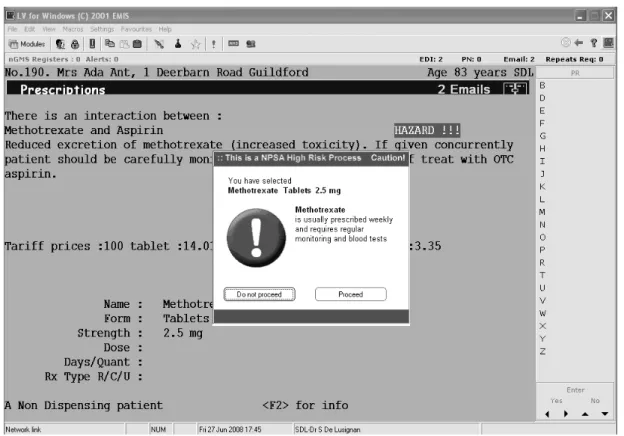
‘It’s alright when there’s one or two or three, on methotrexate we’ve had some bad events so we’ve got to do this, then we’ve had some bad events with this so we’ve got to do that, and that, and that, and that, and that, and that ... And I’m afraid – and I don’t know if there’s anybody here from NPSA ... that really the approach is not a hammer to crack a nut I suppose. That’ll work for the first one, two, three or four, but it won’t work for 200.’ (GP)
Alerts may suggest that the clinician has made an error and may provoke patient anxiety, compromising ad-herence to treatment.
Some clinicians felt that their authority with the patient was undermined by the visual (e.g. the red exclamatory error – see Figure 1) and auditory disrup-tion caused by prescribing alerts. GPs felt that patients might perceive that an alert from the computer system informing the doctor of an error was being ignored. It was thought that this might create unfounded worries for patients and might impact on the adherence of the patient to the medication.
GPs also felt undermined with patients by these systems:
‘....anti-rheumatoid drugs ... And you’ve got a patient that you’re encouraging to take, you know, horrible medicine, ‘‘You really, really want to take them,’’ and then you’ve got this, ‘‘donk’’, for methotrexate or, you know, that comes up that you’ve actually physically got to cancel. My computer goes ‘‘donk’’ when it does it’ (GP)
Prescribing alerts may also cause worry for patients:
‘...because I do sit there and the patient’s sort of doubts ... ‘‘You mean it’s terribly dangerous, doctor?’’’ (GP)
Information overload may have a negative impact on cognitive performance. Some workshop participants were concerned that the information overload from low specificity alerts combined with a cumbersome user interface could lead to the clinician being distracted and pressurised. This could compromise his or her cognitive performance and therefore jeopardise the quality of care provided and potentially increase the risk to the patient.
‘I think if they’ve got to jump through so many hoops putting their prescription into the system, they’re not focusing on the task or they’re not focusing on the patient and the medicine they’re trying to prescribe for the patient’s condition, they’re focusing on the screen. And they’re trying to think, well do I have to type that in, do I have to pick that drop-down, do I have to move my mouse over there?’ (Software developer)
Proposed methods of resolving
problems with CDSS
A proposed solution to the problem of low specificity alerts was to make a change in the process that generates
the alerts. The use of substantive quantitative methods using hazard and likelihood criteria from adverse drug events would allow an evidence-based calculation of the risk associated with each drug to be made. Current sources of quantitative data on adverse drug reactions include the Medicines and Healthcare Products Regu-latory Agency’s Yellow Card scheme19and the results of data analysis from drug trials. The potential benefit of a prescribing alert to this risk could then be balanced against the potential ‘costs’ of each alert. The costs include the detrimental effects of information overload on clin-ical performance, patient anxiety and medication com-pliance, for which evidence should also be collected.
The NHS should require risk-based assessment of prescribing alerts, so they flag real rather than hypothesised risk:
‘One of the things the NHS should move towards is risk-based assessment, because obviously you could have something that was highly specific and highly sensitive but actually it going wrong was of no consequence or of such minimal consequence that it wasn’t important’ (Academic GP)
There was support for the use of quantitative methods to be implemented to perform risk assessments:
‘...industrial strength risk management with lots of quan-titative methods’ (Informatician)
However, some were more cautious, as there was not as yet any evidence base for this approach. Prescribing software needs to be validated like any other part of clinical care:
‘...like any other part of clinical care that you’re doing ... it needs to be validated’ (Clinician)
There was an interest in developing the more ad-vanced forms of decision support by increasing the complexity of clinical coding behind the software. Advanced decision support is capable of picking up a broader range of safety hazards and could further improve prescribing safety. The linking of the pre-scribing support software to the patient’s demographic details and diagnostic codes might be needed to sub-stantially improve specificity and sensitivity. Diagnostic coding quality has been much improved as a conse-quence of the change to a financially incentivised quality based contract and the widespread use of computer links with laboratories. Advanced CDSS applied in this way could also improve specificity or context relevancy of alerts as only advice relevant to the patient would be included. The software would, however, have to be quite intelligent in order to discern which of the many coded clinical factors are relevant at that specific point of the care plan.
‘An extension of prescribing support to include linkage to key Read codes or SNOMED codes within GP systems to make it more intelligent, because that coding is there and linkage to certain specific recodes would make warning more specific.’ (Informatics consultant)
Discussion
Principal findings
There was dissonance between the literature, which reported that prescribing errors were common, and the delegates’ irritation with current systems. Some reported positive effects from the use of prescribing support applications, but many reported end users are highly critical of the prescribing alerts used. The conclusion of the workshop was that the current system of prescribing alerts is experienced as prob-lematic by some end users, it is often unhelpful and it disrupts some clinical consultations (Figure 2). How-ever, attendees appeared unaware of the evidence base and the range of approaches used in other health systems for reducing low-yield prompts.
Implications for practice
Despite the shared will for decision support software to progress in order to improve prescribing safety, the implications of these findings are different for clin-icians, software developers, academics and accrediting organisations.
General practitioners working in the front lines of medical practice feel they should have more involve-ment in software developinvolve-ment. There needs to be a wider use of technologies which can better describe where difficulties lie and can enable developers, academics and accrediting bodies to gain a clearer understanding
What is known on this topic What this paper adds
1 Prescribing errors are a major source of unnecessary morbidity and mortality
1 Clinicians still report being frustrated by numerous unnecessary alerts and these are frequently cancelled before being read
2 Prescribing alerts have the potential to improve the quality and safety of clinical practice
2 Prescribing alerts may displace other important information clinicians are processing during a consultation
3 The literature has persistently reported that many alerts are frequently cancelled and ignored
3 The benefit–harm ratio of alerts needs further investigation
4 Methods of identifying prompts which are of low value have been identified, but not widely implemented
4 Quantitative clinical risk assessment could provide a better method of balancing possible degree of harm and its likelihood. This could help select which alerts are most likely to improve quality and safety (greatest benefit) and should be displayed
in order to take corrective measures. Counts of alert override rates may be a pragmatic first step in provid-ing feedback.In vivoobservation of real consultations is needed, perhaps starting with simple counts of the number of times that the alerts are overridden, poss-ibly followed by use of techniques such as the multi-channel video to provide a greater understanding of where these alerts improve safety.20
Software designers should continue to work closely with users and modify software to suit the practical requirements of healthcare professionals during the clinical consultation. The ‘costs’ of the prescribing alerts, including the effect on the clinician’s cognitive performance, should be taken into account during the design process.
There is scope to improve communication between software developers and end users. However, this relationship also needs to include knowledge devel-opers and address any liability concerns.21,22
Comparisons with literature
The low specificity and low utility of the prescribing alert systems being used in primary care practice is a widely reported and long-standing problem. Payne
et al reported that 11% of medical prescription resulted in alerts for drug–drug, drug–allergy or other hazards and that clinicians prescribed the medicine and ignored the advice for 88% of even ‘critical’ drug– drug interaction warnings; though work by Paterno
et al, suggests tiering of alerts is needed to improve compliance.23,24Subsequent reports have shown little difference: clinicians felt that eight out of nine of all prescribing alerts are unhelpful,25and a review of 17 reports on prescribing alerts in 2006 found that between 49% to 96% of all prescribing alerts are overridden by clinicians.26The same review found multiple reasons for this, including low specificity, low sensitivity, unclear information content, unnecessary workflow disrup-tions and unsafe and inefficient handling. A recent study has shown that important and serious alerts are being ignored in the wake of unhelpful ones.24‘Miller’s magical number’ is a psychological concept that was first described in the 1950s; the number 7 (+/–2) is hypothesised to be the number of concepts or items that an individual can retain in their short term memory.27Miller demonstrated that most people can only retain this number of items and that if you add an additional item something else has to be dropped. There is a risk that an important item of information might be displaced by an unnecessary alert.
Alternative approaches to improving the specificity of prescribing alert systems have included the use of clinician’s opinions to analyse the alerts produced in their system. Data on how specific interactions and other medical issues actually harmed patients were
synthesised and clinical opinion was used to develop a set of alerts identified as low yield. The alerts were then removed from the system. This process improved the number of ‘accepted’ alerts to over 67%.28 Other approaches to improving alert compliance also in-clude the tiered presentation of alerts according to drug–drug interaction severity. In one recent study tiered presentation received a compliance rate of 29%, compared with non-tiered presentation at 10%.25
Other safety critical industries have powerful in-spectorates who carefully analyse fatal and non-fatal errors. Perhaps the closest medical model is the confidential enquiry into maternal and child health.29 Inspectorates in the air transport30and railway trans-port industries31raised safety standards on the basis of actual errors. In all these industries detailed retrospec-tive analysis is conducted after a critical incident and corrective and preventative measures are introduced. The National Patient Safety Agency has only recently applied this model to prescribing errors made in primary care with methotrexate. Following analysis, a mandatory requirement was made of primary care computer systems to include a specific alert when methotrexate is prescribed.32
Adherence or concordance with prescribed therapy is a major issue in health care. Only a minority of patients take their medicine as prescribed. Whilst patients should be fully informed, they may have their confidence unnecessarily undermined by low speci-ficity alerts which may not apply in their individual context. Unnecessary alerts can also distract the doc-tor and result in the patient feeling unattended to. This perception has been reported to have a negative impact on patient compliance with medication.
Limitations of the method
This research may be subject to bias, even though its findings are unexpected. Participants were conference delegates and inevitably self selected; they also represented only a tiny fraction of practising GPs. The workshop subject selection, the presentations and facilitation were all done by the co-authors, who share a strong interest in informatics. We originally set out to elicit where CDSS might be used most effectively in primary care, and might have prepared differently had we set out to investigate the negative effects of pre-scribing alerts.
Calls for further research
This research should include assessing the potential harm of prescribing alert systems, including:
1 measuring the influence of additional prescribing alerts on clinician’s behaviour and decision making; 2 recording how prescribing alerts influence patients both at the time of the consultation and later on in terms of treatment compliance.
Research is also needed to enable better evaluation of the effectiveness of the alerts that are presented, and to better designate which alerts are important and which are not, as well as to develop a greater under-standing of why known approaches are not being adopted.33
Conclusion
Prescribing errors are a major source of unnecessary morbidity and mortality and prescribing alerts have the potential to improve the quality and safety of clinical practice. However, the literature has persist-ently reported that many alerts are frequpersist-ently can-celled and ignored. Clinicians are frustrated by what they feel are unnecessary alerts that may displace other important information they may be processing at the time. They also find the alerts disruptive to the con-sultation and often cancel them before reading them. We conclude that the benefit–harm ratio of alerts needs further investigation. We believe quantitative clinical risk assessment could provide an accurate method of deciding which alerts are most likely to improve quality and safety, i.e. would have the greatest benefit. This would allow the selective presentation of alerts that would help and not hinder the clinician’s per-formance.
ACKNOWLEDGEMENTS
This work was carried out by AV principally during a Student Special Study Module on the MBBS course at St George’s, University of London. Academic support was provided by SdeL and TC. The workshop, recording and transcribing was supported by the British Com-puter Society’s Health Informatics Forum and its Primary Health Care Specialist Group (PHCSG) who set aside half a day of their HC2008 Conference. A further meeting was held as part of PHCSG conference to triangulate the findings of the study. IS is chair of the PHCSG. EC and RTJ are members of the executive team. SdeL has an ex-officer role as editor of the
Informatics in Primary Carejournal.
REFERENCES
1 Kohn LT, Corrigan JM and Donaldson MS (eds).To Err is Human: building a safer health system.Washington, DC: National Academy Press, 1999.
2 Vincent C, Neale G and Woloshynowych M. Adverse events in British hospitals: preliminary retrospective record review.British Medical Journal2001;322:517–19. 3 Lesar TS, Briceland L and Stein DS. Factors related to errors in medication prescribing.Journal of the American Medical Association1997;277:312–17.
4 Committee on Quality Health Care in America, Institute of Medicine.Crossing the Quality Chasm: a new health system for the 21st century. Washington, DC: National Academy Press, 2001.
5 Mahoney CD, Berard-Collins CM, Coleman R, Amaral JF and Cotter CM. Effects of an integrated clinical information system on medication safety in a multi-hospital setting. American Journal of Health–System Pharmacy2007;64:1969–77.
6 Vardi A, Efrati O, Levin Iet al. Prevention of potential errors in resuscitation medications orders by means of a computerised physician order entry in paediatric critical care.Resuscitation2007;73:400–6.
7 Samore MH, Bateman K, Alder SCet al. Clinical deci-sion support and appropriateness of antimicrobial pre-scribing: a randomized trial. Journal of the American Medical Association2005;294:2305–14.
8 Bates DW, Teich JM, Lee J et al. The impact of computerized physician order entry on medication error prevention.Journal of the American Medical Informatics Association1999;6:313–21.
9 Purves IN. PRODIGY: implementing clinical guidance using computers. British Journal of General Practice 1998;48:1552–3.
10 Schedlbauer A, Prasad V, Mulvaney C et al. What evidence supports the use of computerized alerts and prompts to improve clinicians’ prescribing behavior? Journal of the American Medical Informatics Association April 2009. (Epub ahead of print.)
11 de Lusignan S and Teasdale S. Achieving benefit for patients in primary care informatics: the report of an international consensus workshop at Medinfo 2007. Informatics in Primary Care2007;15:255–61.
12 Mitchell E and Sullivan F. A descriptive feast but an evaluative famine: systematic review of published articles on primary care computing during 1980–97. British Medical Journal2001;322:279–82.
13 Pizziferri L, Kittler AF, Volk LA et al. Primary care physician time utilization before and after implemen-tation of an electronic health record: a time-motion study.Journal of Biomedical Informatics2005;38:176–88. 14 de Lusignan S and Chan T. The development of primary care information technology in the UK. Journal of Ambulatory Care Management2008;31:201–10. 15 de Lusignan S, Singleton A and Wells S. Lessons from the
implementation of a near patient anticoagulant moni-toring service in primary care.Informatics in Primary Care2004;12:27–33.
eprescribing/baselinefunctspec.pdf (accessed 28 July 2008).
17 Information Retrieval Specialist Group (IRGS), British Computer Society. About the IRGS. Available from: irsg.bcs.org/about.php
18 Google UK. Available from: www.google.co.uk 19 Medicines and Healthcare Products Regulatory Agency.
Yellow Card Data. Available from: www.mhra.gov.uk/ Safetyinformation/
Howwemonitorthesafetyofproducts/Medicines/ TheYellowCardScheme/YellowCarddata/index.htm 20 de Lusignan S, Kumarapeli P, Chan Tet al. The Activity
Log Files Aggregation (ALFA) toolkit: a method for precise observation of the consultation.Journal of Medi-cal Internet Research2008;10:e27.
21 Klein SR and Jones JW. Clinical decision support programs can be risky business.Journal of Healthcare Information Management2007;21:15–17.
22 Rollins G. The prompt, the alert, and the legal record: documenting clinical decision support systems.Journal of the American Health Information Management Associ-ation2005;76:24–8.
23 Payne TH, Nichol WP, Hoey P and Savarino J. Charac-teristics and override order checks in a practitioner order entry system.Proc Amia Symp20.
24 Paterno MD, Maviglia SM, Gorman PNet al. Tiering drug–drug interaction alerts by severity increases com-pliance rates.Journal of the American Medical Inform-atics Association2009;16:40–6.
25 Weingart SN, Toth M, Sands DZ, Aronson MD, Davis RB and Phillips RS. Physicians’ decisions to override computerized drug alerts in primary care.Archives of Internal Medicine2003;163:2625–31.
26 van der Sijs H, Aarts J, Vulto A and Berg M. Overriding of drug safety alerts in computerized physician order entry.Journal of the American Medical Informatics Asso-ciation2006;13:138–47.
27 Miller GA. The magical number seven, plus or minus two: some limits on our capacity for processing infor-mation.Psychological Review1956;63:81–97.
28 Shah NR, Seger AC, Seger DLet al. Improving accept-ance of computerized prescribing alerts in ambulatory
care.Journal of the American Medical Informatics Associ-ation2006; 13:5–11.
29 Confidential Enquiry into Maternal and Child Health. About us. Available from: www.cemach.org.uk/About Us.aspx
30 Health and Safety Executive.By example: real issues in the air transport industry. Available from: www.hse. gov.uk/ airtransport/example.htm
31 Office of Rail Regulation.Accident and incident investi-gation. Available from: www.rail-reg.gov.uk/server/ show/nav.1077
32 National Patient Safety Agency.Improving compliance with oral methotrexate guidelines. Available from: www. npsa.nhs.uk/EasySiteWeb/
GatewayLink.aspx?alId=5325
33 van Roon EN, Flikweert S, le Comte Met al. Clinical relevance of drug–drug interactions: a structured assess-ment procedure.Drug Safety2005;28:1131–9.
CONFLICTS OF INTEREST
None.
ADDRESS FOR CORRESPONDENCE
Simon de Lusignan
General Practice and Primary Care Division of Community Health Sciences St George’s
University of London London SW17 0RE UK
Tel: +44 (0) 20 8725 5661 Fax: +44 (0) 20 8725 3584 Email: [email protected]