1
Formative Research, Capacity Building, and Strategic Planning To Advance Smoke-Free Multi-Unit Housing in North Carolina
Brenda Buescher, Amy Reid, Anna Stein, Patrick Tang, Clayton Velicer
Capstone partner organization: Tobacco Prevention and Control Branch Capstone community partner: Sally Herndon, MPH
Capstone faculty adviser: Susan Ennett, PhD
3
Acknowledgements
4 Abstract
Background: The Surgeon General has determined that there is no safe level of exposure to secondhand smoke (HHS, 2006). In apartments and condominiums, also known as multi-unit housing (MUH),
secondhand smoke can travel through hallways, air ducts, and small spaces between units (HHS, 2009). There is evidence that low-income persons are disproportionately impacted by exposure to secondhand smoke in MUH (King, et al., 2009). We partnered with the Tobacco Control and Prevention Branch of the North Carolina Division of Public Health (TPCB) to promote the passage of smoke-free policies in multi-unit housing in North Carolina, particularly in affordable housing. Methods: We engaged the
5
is still much work to be done educating them on the issue and providing tools they can use to
implement smoke-free policies. It will be particularly important to bring together owners and managers who have successfully implemented smoke-free policies with those who want to learn more. A positive outcome is that the housing owner we worked with in Greensboro may be interested in implementing smoke-free policies in some of his properties as a result of the findings of the survey of his tenants. The online toolkit will be a valuable resource to TPCB as it works to share information with MUH owners, managers, and tenants across the state.
Deliverables
1) Housing Industry Survey Summary Results;
2) Multi-Unit Housing Tenant Survey Summary Results;
3) Memorandum to TPCB Summarizing Recommendations for Measuring Changes in Prevalence of Smoke-Free Housing in North Carolina;
6
Table of Contents
Introduction 8
Background
Public Health Burden of Secondhand Smoke 9
Secondhand Smoke Exposure in Multi-Unit Housing 10
Impact of Smoke-Free Policies 11
Smoke-Free Policies in Multi-Unit Housing 12
Perceived Barriers to Smoke-Free Policies and Opportunities for Intervention 13 Methods
Project Logic Model 16
Planning for Sustainability 17
Importance of Engagement 18
Engagement and Assessment Activities 19
Collective Purpose of Deliverables 20
Results
Summary of Deliverables 21
Engagement and Assessment Results 23
Impact and Lessons Learned in Community Engagement 26
Sustainability Findings 27
Discussion
Limitations and Strengths of Engagement and Assessment Activities 31
Potential Impact and Benefits 34
Overall Lessons Learned and Challenges 36
Considerations for Sustainability 37
Conclusion and Recommended Next Steps 37
7
List of Commonly Used Acronyms
AHM Affordable Housing Management
HUD Housing and Urban Development, U.S. Department of MUH Multi-Unit Housing
NCAHC North Carolina Affordable Housing Conference PHA Public Housing Authority
8 Introduction
During the 2011-2012 academic year, we partnered with the Tobacco Prevention and Control Branch of the North Carolina Division of Public Health (TPCB) to complete this Capstone project. Capstone is a group-based, mentored, evaluated service-learning opportunity that partially fulfills the requirements for the MPH degree in the Department of Health Behavior at the University of North Carolina Gillings School of Global Public Health. The ultimate goal of our Capstone project was to increase the availability of smoke-free multi-unit housing (MUH) in North Carolina.
TPCB protects the health of North Carolina residents by promoting smoke-free environments and tobacco-free lifestyles (TPCB, 2012). TPCB has four major goals: 1) preventing initiation of smoking by young people; 2) eliminating exposure to secondhand smoke; 3) promoting smoking cessation among adults and youth; and 4) identifying and eliminating tobacco-related disparities among populations (TPCB, 2012). As we explain below, increasing the number of MUH complexes with smoke-free policies will help reach all four of TPCB’s goals.
According to the U.S. Department of Health and Human Services (HHS; 2006; 2010), there is no risk-free level of exposure to secondhand smoke. Non-smoking tenants are often exposed to
secondhand smoke in MUH, and TPCB has received complaints from tenants who are bothered by smoke exposure. Children and elderly persons make up more than half of the tenants in public housing, and these groups are especially sensitive to the negative effects of secondhand smoke (HUD, 2009). In North Carolina and other states, some MUH managers have implemented smoke-free policies to attract non-smoking tenants, to reduce operating costs, and to prevent fires and property damage. Although the exact proportion is unknown, there are many MUH complexes in North Carolina that continue to allow smoking in units.
9
with a literature review to describe the public health burden of secondhand smoke exposure in MUH, the demonstrated benefits of smoke-free policies, and the strategies and procedures that the housing industry has used to implement smoke-free policies. Next, we describe our community engagement strategies and results and our plan to sustain our work beyond this academic year. We describe each of our major deliverables:
A summary of the results of a survey conducted to assess housing industry knowledge and attitudes about smoke-free housing policies;
A summary of the results of a survey to assess tenants’ attitudes towards smoke-free housing policies, conducted at 13 properties owned by Affordable Housing Management, Inc. (AHM); A memorandum listing recommendations for TPCB to implement a baseline survey of MUH
providers to identify the proportion of housing units with smoke-free policies in North Carolina; An online toolkit with resources for MUH owners and managers to learn about smoke-free
policies, and to prepare, implement, and enforce these policies;
A strategic plan for TPCB with the recommended next steps to advance smoke-free MUH in North Carolina.
We conclude by discussing the potential impact and benefits of our work, our key findings, and lessons learned.
Background Public Health Burden of Secondhand Smoke
10
no safe level of exposure (HHS, 2006). In children, second hand smoke exposure leads to respiratory problems, including asthma and lower respiratory infections (HHS, 2006). In non-smoking adults, secondhand smoke is known to cause cancer and heart disease (HHS, 2006; Kaur et al., 2004). Secondhand smoke has immediate negative effects on the cardiovascular system, and brief exposure can have harmful effects, particularly on elderly people and children (HHS, 2006). Furthermore, pregnant women exposed to secondhand smoke have an increased risk of a stillbirth or a child with a congenital malformation (Leonardi-Bee, 2011).
Secondhand Smoke Exposure in Multi-Unit Housing
For most Americans who are exposed to secondhand smoke, the home is the primary place of exposure (HHS, 2009). In MUH, secondhand smoke moves through hallways, air ducts, and small spaces between units (HHS, 2009). Secondhand smoke exposure can be measured in two ways: 1) by
measuring indoor concentrations of airborne smoke, or 2) by measuring individual blood levels of cotinine, a biological method of assessing tobacco exposure (Kraev, 2009; Wilson et al., 2011). By measuring air samples, researchers have demonstrated that smoke traveling from smoking units causes tobacco contamination in non-smoking units and common areas (Kraev, 2009; King, 2010). In a
nationally representative sample of children from non-smoking households, Wilson and colleagues (2011) examined blood cotinine levels and found that children living in apartments have higher levels of secondhand smoke exposure than children living in detached family homes.
11
more than half of the tenants in public housing, and these groups are especially sensitive to the negative effects of secondhand smoke (HUD, 2009). In addition, groups of lower socioeconomic status tend to have poorer health, measured across many different indicators, than groups of higher status (Berkman & Kawachi, 2000). Smoking is one of the many factors that contribute to this disparity, as children and adolescents from low-income households are more likely to initiate smoking, and adults with lower income are less likely to quit smoking than those with higher incomes (Gilman, 2003). As Winickoff and colleagues argue, “A permissive smoking policy [in public housing] perpetuates such disparities and also increases the tobacco-smoke exposure of non-smokers in public housing, a group that has few
alternative housing options available” (2010).
Impact of Smoke-Free Policies
According to a 2006 report by the Surgeon General, the only way to fully protect non-smokers from secondhand smoke is to eliminate smoking in indoor spaces (HHS, 2006). Air filtration and ventilation do not eliminate the health risks of secondhand smoke exposure in a MUH complex (HHS, 2006). They may improve air quality slightly, but they do not remove enough of the tobacco
contamination from the air to make it safe to breathe (Sandel et al., 2010). Smoke-free housing policies are likely to produce substantial public health benefits, just as clean indoor air policies in bars,
12
outcomes. Several studies have measured statistically significant decreases in hospitalizations for acute myocardial infarctions (i.e. heart attacks) and acute asthma attacks following the implementation of clean indoor air laws in U.S. communities (Hahn, 2010; Sargent et al., 2004). Smoke-free policies also increase cessation rates among smokers. Workers are up to two times as likely to stop smoking if their workplace adopts a non-smoking policy (Bauer et al., 2005; Hopkins et al., 2010).
Smoke-Free Policies in Multi-Unit Housing
In recent years, government entities and public health advocates have begun to develop new initiatives to promote smoke-free MUH. In 2009 and 2010, HUD strongly urged Public Housing
Authorities (PHAs) and managers of affordable housing units to implement smoke-free policies at their properties. Between January 2005 and February 2010, the number of PHAs with smoke-free policies in some or all of their buildings increased eight-fold, from 17 to 141 (Schoenmarklin, 2010). California, Oregon, and Minnesota, in particular, have been state leaders in this movement towards smoke-free housing.
13
Perceived Barriers to Smoke-Free Policies and Opportunities for Intervention
Despite the advantages, many properties do not have smoke-free policies. Some managers may not have considered transitioning to smoke-free living, and some managers face barriers to policy change. There have been no nationwide surveys of property managers’ attitudes towards smoke-free policies, but surveys have been completed at the city or county level in Massachusetts, Oregon, Washington, and New York (Hewett, 2007; King et al., 2010; Pizacani et al., 2011). These regional surveys of property managers have found that for those who do not have smoke-free policies, the primary barriers to implementing smoking policies are concerns about increased vacancy, decreased market share, and the legality of smoke-free policies (Hewett, 2007; King et al., 2010; Pizacani et al., 2011). Property managers who have implemented smoke-free policies are motivated by high demand for smoke-free units, happier tenants and less turnover, and lower insurance rates (King et al., 2010). These surveys offer promising guidance to those hoping to design an intervention for property managers, as many of the perceived barriers can be removed or reduced.
Manager concerns about the legality of smoke-free policies are often based on misinformation. It is important that property managers understand the legal issues surrounding smoking policies in private homes, from the federal and the state level. At the federal level, the courts have consistently upheld the view that smoking is not protected under the constitutional right to privacy, and smokers are not a protected class of citizens under the equal protection clause (Public Health Institute, 2004;
Winickoff et al., 2010). Consequently, property owners have the legal backing to implement smoke-free policies in order to protect public health and the environment.
However, at the state level, there are questions as to whether PHAs may regulate smoking in public housing units (Elleveve Donahue, personal communication, 2011). In 2009, North Carolina became the first state in the southeastern region to pass a law prohibiting smoking in bars and
14
local governments may not enact policies that restrict smoking in private residences (NC Gen. Stat. 130A-498(b1)(1), 2012). Since PHAs in North Carolina are considered local government entities, it is possible that PHAs would face legal challenges if they restricted or prohibited smoking in public housing units in the state. However, because PHAs were not specifically included in the law by the legislature, they may be exempt from the provision about regulating smoking in private residences. While clarifying this issue is an important policy problem for tobacco control advocates to confront in the future, our Capstone team chose to focus on market-based housing and affordable housing, not public housing, for this project. Individual owners of private housing properties, including those who accept state or federal funding for affordable housing programs, can legally create a smoke-free policy in some or all of their units.
Besides legal concerns, another major issue for property owners is the possibility that implementing smoke-free policies will alienate residents, create negative publicity, and limit market share (Hewett et al, 2007; King et al, 2009). Surveying residents in the local area can produce an
15
Finally, managers have expressed concern about the enforcement of smoke-free policies (Hewett et al, 2007). At this point, there is no peer-reviewed literature about best practices in
enforcement of smoke-free housing policies, but there are industry-recommended strategies (Laughter, 2011; Smoke-Free Housing Coalition of Maine, 2007). Trade organizations and experienced industry leaders recommend marketing smoke-free living aggressively in all advertising materials, adding clear language about the smoking policy to the lease agreement, posting smoke-free signage on the property, and responding promptly to resident complaints about non-compliance. If a resident is violating the smoking policy, mangers may handle the situation as they would any other lease violation. This may include an informal discussion with the resident and one or more written warnings. Eviction, a time-consuming and costly process, is a last resort. (Laughter, 2011; Smoke-Free Housing Coalition of Maine, 2007)
16 Methods Project Logic Model
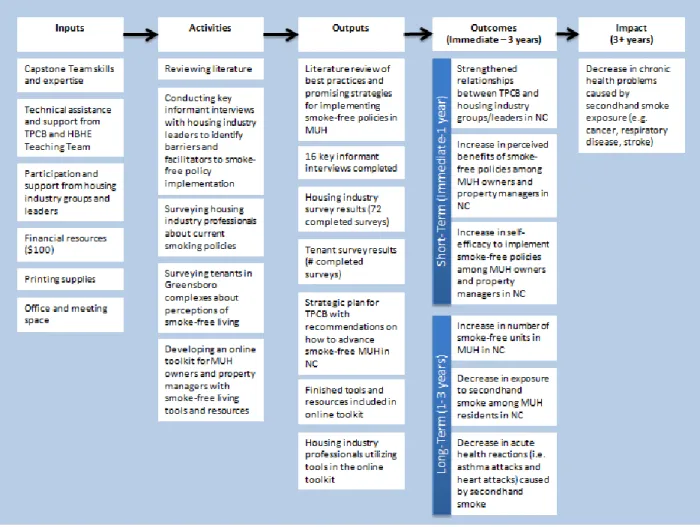
A logic model is a tool used to illustrate how a public health intervention works. According to the W. K. Kellogg Foundation (2004, p.3), “A program logic model links outcomes (both short- and long-term) with program activities/processes and the theoretical assumptions/principles of the program.” It explicitly shows the logic behind the program design. Creating a logic model is an important step in program planning, implementation, and evaluation (W.K. Kellogg Foundation, 2004). Our program logic model is depicted in Figure 1.
Figure 1. TPCB Capstone Project Logic Model
17
including reviewing literature, surveying and interviewing tenants and managers, and creating an online toolkit. Our outputs were the immediate products of these activities: the interviews conducted, the surveys completed, the tools created, the reports written. These outputs lead to the program’s intended outcomes and impact. In the short-term, our program activities were designed to strengthen
relationships between the housing industry and tobacco control advocates in the state, increase
perceived benefits of smoke-free policies among housing industry leaders, and increase the self-efficacy of housing industry leaders to implement these policies, in other words, their perception that they can succeed. As a result, there will be more MUH complexes in the state that adopt smoke-free policies and less secondhand smoke exposure among North Carolina residents in MUH. Reduced exposure offers immediate public health benefits, including fewer asthma attacks and fewer heart attacks and long-term declines in tobacco-attributable chronic diseases, such as lung cancer, cardiovascular disease, and respiratory illnesses (Hahn, 2010; HHS, 2006; Sargent et al., 2004).
Planning for Sustainability
While developing our program logic model and choosing our intervention strategies, we planned for program sustainability. Sustainability has been defined as the extent to which an evidence-based intervention can be maintained and deliver its intended benefits over an extended period of time after the termination of external support (Rabin et al., 2008). Planning for sustainability in the initial stages of program development and monitoring sustainability over time enhance the long-term impact of an intervention. Ensuring sustainability is important to our Capstone work because as demand for smoke-free housing increases, there will be a continuing need for smoke-smoke-free housing resources and
community engagement activities.
18
institutionalization of a program within an organization, and 3) measures of capacity building in the recipient community. In our project, we conceptualized sustainability as the degree to which our smoke-free housing initiative will be institutionalized within TPCB and the degree to which we helped build the capacity of the housing industry to enact smoke-free policies.
In the planning process, we determined that developing an online toolkit for smoke-free MUH would be a cost-effective way to disseminate resources to stakeholders. Smoke-free housing initiatives in other states have used websites to facilitate communications with the housing industry, tenants, and condo owners. These toolkits often include educational materials, resource directories, and clear instructions on transitioning properties to smoke-free. Resources for tenants include strategies for working with property managers to promote policy change and a housing directory for renters searching for smoke-free properties. The toolkit fills a gap in TPCB’s program activities and requires minimal staff time and maintenance costs after the initial development phase. We worked closely with the TPCB staff to ensure that TPCB has the resources to handle the basic upkeep of the website after our project has concluded.
Importance of Engagement
19
program (Staley as cited in McCloskey et al., 2011). In this portion of the report, we describe our engagement and assessment activities, the results of these activities, and how these activities have shaped our project agenda, data collection tools, and dissemination plans.
Engagement and Assessment Activities
With the ultimate goal of increasing smoke-free MUH in North Carolina, the stakeholders in our community included affordable housing managers and property owners, as well as residents in
affordable housing. We took a three-pronged approach to our community assessment activities: key informant interviews with managers and property owners, a survey of managers and property owners, and a resident survey. Additionally, and most importantly, our community engagement involved consistent communication with our housing industry partner, the owner of Affordable Housing Management Inc. (AHM), and a revision of goals based on his needs.
Our initial efforts focused on identifying a manager or property owner willing to be our partner in transitioning his or her property to smoke-free living. We followed up on leads gathered by TPCB at a housing conference in May 2011, but difficulties garnering interest in our project indicated a need to conduct formative research with the stakeholders in our community to understand more about the barriers, facilitators and motivation to implement smoke-free policies. Thus, we used in-depth qualitative interviews (n=15) and a survey (n=72) to understand the views of property managers and owners in North Carolina.
At the North Carolina Affordable Housing Conference (NCAHC), which took place on November 1 and 2, 2011, we surveyed property managers and owners attending the conference (n=72) about smoking policies at their properties. We asked managers who had implemented smoke-free policies (n=40) what motivated smoke-free policy implementation and what facilitated the transition
20
implementation, and what resources would be helpful if they chose to move towards a smoke-free environment. The second purpose of the survey was to collect contact information of managers and property owners who were interested in receiving smoke-free living resources. In summary, the in-depth interviews, coupled with the survey at the NCAHC, allowed us to have a greater understanding of the barriers, facilitators, needs and assets of property managers and owners.
In addition to our survey and interview activities with the community of manager and property owners, we assessed the community of residents who live at the thirteen AHM properties. As part of a community assessment of AHM properties, we surveyed all AHM residents by mail to assess their attitudes towards smoke-free policies. We pre-tested the survey with a focus group (n=1) of 13
residents, mailed the survey to residents in all 13 properties (n=339) in March, and followed up with two reminder flyers. The assessment of residents has informed the owner and managers about resident readiness to move to smoke-free living. These results will help determine how, where, and to what extent smoke-free living is implemented at AHM’s properties. We will share the results of the surveys with residents by presenting their community’s general views on smoke-free living.
Lastly, throughout the year, we spoke with a variety of influential leaders in the housing industry to make connections and increase their awareness of smoke-free housing in North Carolina. These partners included the NC Housing Finance Agency, the Southeast Affordable Housing Management Association, the NC Housing Coalition, and the Apartment Association of NC.
Collective Purpose of Deliverables
21
goals, particularly limiting exposure to secondhand smoke among North Carolinians. Our Capstone team brought qualitative and quantitative research experience, as well as community assessment techniques, writing skills, and social marketing experience to the project. When we began our work, we chose deliverables that used our strengths to promote smoke-free MUH by encouraging voluntary policy change in the private housing market.
Results Summary of Deliverables
Table 1. Description of deliverables and key findings
Deliverable 1: Housing Industry Survey Summary Results
Purpose: To gain knowledge about the housing industry, identify motivators and barriers to implementing smoke-free policies, and collect success stories from professionals with experience implementing smoke-free policies.
Timing: September 2011-January 2012
Methods Key Findings
We administered a 12-item survey to a convenience sample (n = 72) of housing industry professionals who attended the NC Affordable Housing
Conference in Raleigh in November. The survey was informed by in-depth interviews with housing industry members and asked respondents about current smoking policies at their properties, intentions to implement smoke-free policies in the future, perceived tenant attitudes towards smoke-free policies, barriers and motivations to
implementing smoke-free policies.
Among smoke-free properties, the top reasons for implementing the smoke-free policy were fire risk, tenant health, and turnover costs. For those without policies, the major barriers to implementing a policy were concerns about enforcing smoke-free policies and reducing consumer demand. However, 84% of those with smoke-free policies said the policies had been received positively or neutrally, and only 12.5% said that enforcing the smoke-free policy was difficult. This indicates an opportunity to educate concerned owners and managers about the success stories of others in their industry.
Deliverable 2: Multi-Unit Housing Tenant Survey Summary Results
22 Timing: October 2011-April 2012
Methods Key Findings
In March 2012, we administered a mailed survey to 320 tenants of the 13 properties owned by
Affordable Housing Management, Inc. (AMH) in Greensboro, North Carolina. The 10-item survey measures tenants’ attitudes toward SHS, current smoking behavior, and attitudes toward smoke-free policies in MUH.
The large majority of survey respondents said they do not smoke at all. Almost half of respondents reported a medical condition worsened by SHS. Importantly, the majority of respondents preferred smoke free living, including some smokers.
Deliverable 3: Memo to TPCB Summarizing Recommendations
for Measuring Changes in Prevalence of Smoke-free Housing in North Carolina
Purpose: To conduct formative research that will inform an implementation plan for a baseline survey that will allow TPCB to measure the changes in prevalence of smoke-free policies in affordable housing over time and evaluate its efforts.
Timing: October 2011-March 2012
Methods Key Findings
We researched methods that have been used across the country to quantify prevalence of smoke-free policies in MUH, using a search of the literature and direct communications with tobacco advocates in other states. We also determined the existence of multiple sampling frames of affordable MUH properties in NC.
The most feasible method of determining the prevalence of smoke-free policies will be to conduct establishment surveys by phone of property managers, using property lists from HUD, the NC Housing Finance Agency, and the US Department of Agriculture.
Deliverable 4: Smoke-free Housing Online Toolkit for Housing Industry Professionals and Tenants
Purpose: To develop a directory of resources (including electronic brochures, sample leases, cost-benefit analyses, posters, etc.) that will educate stakeholders and aid MUH owners in the transition to smoke-free housing.
Timing: November 2011-March 2012
Methods Key Findings
We collected tools and resources from tobacco control advocates nationwide. We developed a website with resources (including electronic brochures, sample leases, cost-benefit analyses,
23 posters, etc.) to educate stakeholders and aid MUH owners in the transition to smoke-free housing.
sections include: 1) “Read Success Stories” 2) “Learn about Smoke-Free Policies” 3) “Prepare for a Change” 4) “Implement the Policy” 5) “Enforce the Policy” and 6) “Market Your Smoke-Free Property.”
Deliverable 5: Strategic Plan for Advancing Smoke-free Multi-Unit Housing in North Carolina
Purpose: To offer recommendations for future steps TPCB can take to advance smoke-free MUH in North Carolina.
Timing: February 2012-April 2012
Methods Key Findings
The Strategic Plan lists our recommendations for next steps that the TPCB can take to continue to promote smoke-free MUH in North Carolina. The Strategic Plan was informed by the activities completed by the Capstone team, and it
incorporates the results of the surveys, focus groups, and interviews conducted in the fall and spring semesters.
The Strategic Plan includes three main strategic goals: 1) increase awareness about the benefits of smoke-free policies in MUH among the key decision-makers in the NC housing industry; 2) facilitate implementation of smoke-free policies in MUH; 3) increase recognition and visibility of North Carolina’s smoke-free housing properties.
Engagement and Assessment Results
Our engagement and assessment activities illustrated the diversity of strengths and resources, as well as weaknesses and challenges, experienced by managers and property owners (Table 2). By engaging with managers and property owners, we learned about their perceptions of barriers to smoke-free policy implementation. First, we learned that managers fear smoke-smoke-free policies will be
24
We also spoke with housing managers who have successfully transitioned their properties to smoke-free living, and they shared a number of facilitators and motivators with us. Two major motivators for prohibiting smoking were preventing fires caused by cigarettes and reducing turnover costs from preparing a smoker’s apartment for the next resident. Supportive residents, access to sample language for lease addendums, and sample tenant letters helped facilitate the transition. The results of these in depth interviews informed response options for our survey of housing managers and property owners at the NCAHC in November, as well as the contents of the online toolkit we created.
From our survey of affordable housing property managers and owners (n=72) at the NCAHC, we learned about knowledge, attitudes, beliefs and behaviors regarding smoke-free housing. Nearly half of the respondents were unaware or unsure of the HUD recommendation encouraging smoke-free
housing. However, 56% had implemented a smoke-free policy in at least part of their properties and only 12.5% of them said that enforcing the policy was difficult. For those who had not implemented a smoke-free policy, 38% were concerned about policy enforcement, and 25% were concerned about reduced consumer demand. An information packet with smoke-free policy resources was the most requested item to help people move forward.
These data point to two pressing needs. First, managers and owners who have successfully enforced smoke-free policies can be informative resources for those who see enforcement as a barrier, and we see a benefit in TPCB facilitating occasions for them to meet in the future. Second, managers and owners who have not implemented smoke-free policies want to be connected with resources on this issue. Therefore, one of the goals of this project is to promote this exchange of information. In conclusion, this assessment will ensure that the contents of our online toolkit are relevant to the needs of the community, and it will inform recommendations we make to TPCB.
25
possible responses at the time of analysis for a response rate of 37%. The results suggest that smoking rates may be much lower in these complexes than anticipated by property managers, with 72.5% of respondents reporting they smoked cigarettes “not at all.” Prior to the survey, we received an estimate from one manager of a smoking rate of 80%.
Furthermore, our survey identifies residents in affordable housing as particularly vulnerable to SHS. Importantly, 47.03% of tenants report they or someone living in their home has a medical condition made worse by SHS. Considering that over half of non-smokers reported smelling smoke that came from outside their units at least one day in a typical week, each week there is potential for negative effects on those with medical conditions affected by SHS.
26
Table 2. Strengths and weaknesses of manager/property owner community
Strengths - Established
communication channels with tenants
- Authority to implement a new policy
- Close network of managers and property owners
Resources
-Documents, advice from managers who have already implemented smoke-free policies
- Financial resources to incentivize tenant response to surveys
- Success and lessons learned from smoke-free bars/restaurants
Weaknesses
- Manager/owner lack of information about smoke-free housing and HUD recommendations
- Divided teams: property owners who are on board and managers who are not
Challenges
- Negative views towards smoke-free policies
- Legal and policy ambiguities
- Concern about smoke-free policy enforcement
Impact and Lessons Learned in Community Engagement
Our community engagement activities led us to shift key aspects of our project plan. Originally, we attempted to identify a partner who was ready to implement a smoke-free housing policy. As we began speaking with managers, we realized that we needed to better understand managers’ concerns and motivators before we could assist a property in implementing a smoke-free policy. Once we identified a partner, instead of setting the agenda to move his properties to smoke-free living, we listened to his goals for the partnership and incorporated them into our work plan.
As we moved forward with our partners, we remained mindful of their level of
participation. Arnstein (1969) identifies different levels of community engagement that range from manipulation to citizen control and reflect varying degrees of citizen power in the research
27
partnership in which our partner was able to negotiate the outcomes with us, we were able to move the project forward, out of non-participation and into the partnership characteristic of citizen power.
There were challenges incorporating our partner’s goals into our program planning and design. First, it was difficult to balance the varying desires and needs of property owners, managers, and tenants with what is known to be healthy: limiting SHS exposure. Second, determining the scale of our engagement efforts proved difficult. Due to our limited time and resources, we decided to focus on affordable housing, specifically, on AHM’s 13 properties in Greensboro.
Despite these challenges and lessons learned, our community engagement with tenants will have an impact on smoking policies and dialogue about the issue of smoking in MUH. We created the tenant survey to determine the level of tenant support to help the AHM Inc owner decide whether to implement a smoke-free policy. Our tenant survey results have been provided in a summary report to the owner. We will take special care in providing these results to note the 37% response rate and that the results may not be representative of the views of all residents. However, we are satisfied that the residents will have a voice in policy change in their community. In addition, by sharing these results with all AHM Inc residents, we hope to stimulate dialogue about the issue.
Sustainability Findings
28 Sustainability: Project Design and Implementation Factors
The key factors to consider in our project design and implementation are the project negotiation process, project effectiveness, project duration, and project financing (Shediak-Riskallah and Bone, 1998).
Through our community engagement efforts, we identified a partner with an interest in exploring smoke free policies. In the project negotiation process, we made an effort to ascertain and cater to the needs of our housing industry partner. Our work with this partner was driven by his priorities and needs, which should increase the likelihood that the final result will be acceptable to all parties. Additionally, the housing industry survey responses that we collected during the NC Affordable Housing Conference informed our program design, including the need for a resource directory.
The perceived effectiveness of implementing smoke-free policies was affected by managers’ concerns over low tenant demand for smoke-free units, tenant resistance to policy change, and difficulty of policy enforcement. These concerns are particularly salient in the context of affordable housing, as data show that smoking rates are inversely related to income level (Gilman, 2003). We worked with an affordable housing property owner to survey his tenants regarding their smoking habits and their desire to live in smoke-free housing. By developing a survey and demonstrating the feasibility and low cost of its implementation, we created a template for other owners to conduct similar surveys among their own tenants. Evidence about the effectiveness of smoke-free policies was also included in our online toolkit.
29
program planning purposes. Finally, the strategic plan will assist TPCB in determining next steps in the smoke-free housing initiative, building on the progress achieved during this Capstone project.
Sustainability: Factors within the Organizational Setting
Our Capstone team is fortunate to have an established community partner in TPCB and a well-respected organizational champion in the head of TPCB, Sally Herndon. An organizational champion is a transformational leader that has the ability to clearly articulate a vision, attach meaning to an
innovation, influence changes in others, and span the boundaries between various stakeholders (Hendy and Barlow, 2011; Howell and Higgins, 1990). TPCB is stable and well-funded, providing a strong
organizational base for our Capstone project. Our smoke-free MUH project aligns with the TPCB’s organizational goals and builds on past initiatives related to tobacco cessation, secondhand smoke, and smoke-free bars and restaurants. Sally Herndon has been the Branch Head of Tobacco Prevention and Control since 1991, giving her over twenty years of experience in tobacco policy and planning. With a strong organizational structure and a program champion in the leadership position, efforts to promote smoke-free MUH are expected to receive continued organizational support within TPCB in the future.
30
managers using the information on smoke-free housing and the toolkit developed as part of this Capstone project.
Sustainability: Factors within the Broader Community Environment
There are regular housing conferences in North Carolina that TPCB can attend to promote smoke-free MUH and continue the work started in this Capstone project. These forums provide periodic opportunities to recruit participants for data collection, locate allies, and identify sites for project collaboration, as well as to disseminate findings and marketing materials.
Our Capstone team worked to identify champions within the housing industry that would be able to promote our message and connect interested parties to our resources. For example, we identified a market-rate housing manager who had transitioned her properties smoke-free and was willing to be profiled as an example of a success story. Housing industry champions will play an important role in changing social norms around smoke-free housing by advocating for and modeling implementation of smoke-free policies within the professional housing associations. In addition, these champions can provide TPCB with industry insights and help TPCB build relationships with other industry stakeholders.
31
Health, 2011). As a result of this law, social norms have changed as patrons in restaurants and bars have come to expect a smoke-free environment. Additionally, studies have shown that restaurant profits are not harmed by smoking bans, which corrects the misconception that such policies are bad for business (Glantz, 1999; Klein et al., 2010).
The arguments made on behalf of the smoking ban in restaurants and bars represent the latest attempt by tobacco control advocates to re-frame the issue of environmental tobacco smoke from the right to smoke to the right to breathe clean air. We believe that this shift will motivate non-smokers living in MUH to advocate for clean air in their homes, and landlords to be more sympathetic to their tenants' complaints about being bothered by smoke from a neighboring unit. By planning for
sustainability throughout the Capstone project, our team is confident that this initiative will continue to grow after our work concludes in April 2012.
Discussion Limitations and Strengths of Engagement and Assessment Activities
The team faced a few limitations that impacted our ability to use our findings to help TPCB move affordable housing complexes towards smoke-free policies. Our main limitation may be our inability to generalize our findings to a larger group beyond the affordable housing owners and tenants we have already engaged. Although all of our engagement activities were considered formative research, these limitations are worth discussing. First, we used a convenience sample of housing industry professionals at the NCAHC as our respondents. The attendees at this conference may not have been representative of affordable housing owners and managers statewide, and their answers may have differed
systematically in some way from those of the target population we were trying to assess.
32
different conference sessions with audience members representing a wide variety of professions within the housing industry, including tax specialists, insurance specialists, general complex staff and other occupations that did not relate to managing or owning an apartment complex. Thus, while we could count the number of people in attendance at each session and the number of surveys turned in, we did not know how many of the attendants had declined to fill out the survey because they were not owners or managers and thus were not eligible, versus how many were eligible but had simply chosen not to respond. The sponsors of the conference estimated that the sessions we surveyed had a total of 500 attendees, but there was overlap of attendees between the seven sessions we attended. We received 72 completed surveys. This relatively low number raises concerns about whether our results reflect the attitudes of the owners and managers at the conference or merely those who had stronger feelings on the issue and were more likely to take the time to complete the survey. Additionally, although our survey was based on an extensive literature review and allowed space for open response, the choices we provided on the survey did not include all potential barriers or concerns for owners of affordable complexes going smoke-free in North Carolina.
Despite the limitations with respect to sampling and representativeness, our community engagement strategy had several strengths. For example, the open discussion in the tenant focus group allowed residents to mention ideas we had not read in the literature. For example, some respondents emphatically believed that cigarette smoke could not escape a bathroom and could not travel out of the unit if a fan was on. These ideas revealed to us an unexpected lack of knowledge about secondhand smoke among some tenants. Additionally, the focus group gave us a chance to attach faces and names to our project, and hear, first hand, the impact in people’s lives. Hearing a first-hand account of how the smoke negatively impacted one resident was more powerful than reading statistics in an article.
33
their contact information will be notified when our toolkit is available online, and some have provided us with additional information on their complexes. We advise TPCB to keep up these relationships in order to move smoke-free MUH forward in North Carolina.
We learned several lessons from our community engagement activities. Importantly, we learned about the structure and atmosphere of the large housing conferences that are held in the state. With people having very different roles and agendas and rushing from session to session, we learned the importance of making TPCB’s efforts stand out from other events occurring at the conference. Many of the companies and organizations with tables at the event offered small incentives to get participants’ attention, such as pens, water bottles or key chains. Although TPCB may not be able to secure funding for such items, exploring this option or other ways of having appeal may increase the success of future TPCB attempts to engage with conference attendees.
We also learned to reduce the time lag between collecting participant information and contacting them. Although a number of respondents to our November NCAHC survey indicated they would be willing to talk to us for a follow-up, as a result of the timing with the holidays and semester break, we did not attempt to contact them until January and February. Due to this delay, people may have been less eager to talk with us and we may have lost some momentum in our efforts to gain success stories and further engage owners.
34
that certain subgroups were more likely to respond to the survey. For example, non-smokers and tenants with medical conditions may have been more likely to respond because they viewed this as an opportunity to change something that really bothered them. Also, it is possible that some people did not disclose that they were smokers due to social desirability pressures; however, we believe this scenario was unlikely as respondents were informed that their responses were confidential. Conversely, it is possible smokers responded at a higher rate because they viewed this survey as a threat to existing policy that allows them to smoke in their homes.
Potential Impact & Benefits
Our work has three distinct groups of direct beneficiaries: the owner and property managers at AHM, current and future tenants at AHM properties, and TPCB. First, the managers at AHM benefit from understanding their tenants’ views on smoke-free policies. Ideally, the surveys will identify which complexes are ready for an immediate transition to smoke-free living. Such a transition will have financial benefits for the owners of AHM properties, as it will reduce the risk of fire, decrease cleaning costs and reduce overall operating costs (Ong, 2011; Winickoff et al., 2010). Even if this initial round of surveys of AHM tenants does not identify specific buildings that are ready for an immediate transition to smoke-free housing, they will identify existing barriers that can be addressed and possibly make the transition easier in the future.
35
For TPCB, there will be several benefits from our work this year. Our formative research at the housing conference, focus group with AHM tenants, and interviews with property managers and owners strongly influenced the development of our toolkit. This online toolkit will allow TPCB to serve as a powerful resource for property managers and owners throughout the state who are interested in transitioning to smoke-free living. The success stories published as part of our toolkit, as well as the ability of owners to connect with each other, will convince owners of affordable housing complexes without smoking policies that they too can go smoke-free. The resources provided on overcoming barriers will also serve owners once their decision is made. As more complexes implement smoke-free policies, cessation rates among residents and workers should increase (Bauer et al., 2005; Hopkins et al., 2010), aiding TPCB to achieve its goal of improving the health of North Carolinians.
36 Overall Lessons Learned & Challenges
We experienced a number of challenges throughout the project, but we viewed these challenges as learning opportunities. The delay in finding a partner willing to move to smoke-free housing taught us the significance of being flexible and persistent when things are not going as initially planned. In this same vein, our work plan changed over the course of the academic year, as it became apparent that some plans would not be feasible and as other opportunities presented themselves. For example, we added the unexpected activity of conducting a survey at the NCAHC. This experience reinforced the importance of our maintaining high, yet flexible, expectations over the course of the project.
We also learned negotiation skills in working with our community partner. In this Capstone project, the housing owner initially resisted the idea of including an upfront $1 cash incentive with the survey to tenants for participating in the survey. Research shows that an upfront cash incentive would be most likely to improve response rates in this situation, rather than giving respondents a gift card upon receipt of the survey (Dillman, Smyth, & Christian, 2008). Team members presented the case for an upfront incentive, which was accepted by the partner. Thus, while in the end there was no
contention over how to implement the survey, we learned that sometimes the perspectives of
community partners differ from the perspectives of academic researchers, and parties must be prepared to negotiate details of the project according to their values.
Our lessons learned also stem from successes we experienced. We found strong allies in the community, including housing owners who were happy to share their stories and government
37 Considerations for Sustainability
Some of the Capstone project components should be maintained to promote the sustainability and growth of the smoke-free MUH initiative in NC. First, we encourage property managers to
implement tenant surveys in order to assess their tenants’ attitudes toward smoke-free housing. This survey is available through the online toolkit, which also provides detailed instructions on how to administer the survey. Second, after the online toolkit is released to the public, TPCB staff should continue to work with MarketSmart, the website designers, to monitor website traffic and usage. Periodic monitoring will provide valuable information on how to improve the toolkit and to assess how well the toolkit is being promoted. Furthermore, this website will need to be updated if there are significant legal or social developments around smoke-free MUH in NC. Third, the housing manager survey should be conducted periodically to assess changes in attitudes, gather contact information for outreach purposes, and collect success stories to share with the community. Lastly, we helped TPCB develop a Capstone team project for the next academic year, which will build on our current progress. The next Capstone team will create a social marketing campaign, promote and evaluate the online toolkit, and implement surveys as needed.
The Capstone project also produced two documents that provide recommendations for TPCB; the memo to TPCB summarizing recommendations for measuring changes in prevalence of smoke-free housing in North Carolina and the strategic plan for advancing smoke-free MUH. We recommend using these documents in the planning of future TPCB activities to build on the work our Capstone team has completed this year.
Conclusion and Recommended Next Steps
38
community assessment and engagement activities in the affordable housing setting, and we created an online toolkit to share resources with MUH owners, managers, and tenants across the state in both affordable and market-rate housing.
We have a number of recommendations for future directions TPCB can take to promote smoke-free MUH in NC. First, we recommend increasing the awareness of the benefits of smoke-smoke-free policies among key decision-makers in the NC housing industry. It will be important for TPCB to continue
outreach to housing industry leaders by attending housing conferences, making presentations to groups, and initiating one-on-one meetings.
Second, we see the need for TPCB to facilitate the implementation of smoke-free policies in MUH in NC. TPCB can plan forums that allow owners and managers to share stories about how to implement smoke-free policies, since we learned from our community engagement that they would prefer to learn from each other rather than from an institution of public health. TPCB can also aid implementation by ensuring that the online toolkit is posted, maintained, and well publicized. A future Capstone team will provide a valuable service by evaluating the usefulness of the toolkit and
disseminating information about it to appropriate audiences.
Third, our team recommends increasing the recognition and visibility of the state’s smoke-free MUH properties in order to facilitate demand for them. TPCB may want to develop a database of its own or to link to other housing databases. It may also consider reaching out to commercial databases to encourage them to prominently list properties’ smoke-free status.
39 References
Arnstein, S. R., (1969). A ladder of citizen participation. JAIP. 35(4), 216-224.
Bauer, J.E., Hyland, A., Li, Q., Steger, C., Cummings, K.M. (2005). A longitudinal assessment of the impact of smoke-free worksite policies on tobacco use. American Journal of Public Health 95 (6): 1024-1029.
Berkman, L. F., & Kawachi, I. (Eds.). (2003). Social epidemiology. New York: Oxford University Press.
Bolger, G. (2012). Memorandum on Statewide Survey Tobacco Prevention Program Funding. Retrieved, 2012, from
http://www.ncallianceforhealth.org/Media/Poll%20Results%20MEMO%20Prevention%20Funding %202-17-12.pdf.
Drach, L. L., Pizacani, B. A., Rohde, K. L., & Schubert, S. (2010). The acceptability of comprehensive smoke-free policies to low-income tenants in subsidized housing. Preventing Chronic Disease, 7(3), A66.
Dillman, D.A., Smyth, J.D., & Christain, L.M. (2008). Internet, Mail, and Mixed-Mode Surveys: The Tailored Design Method, 3rd Edition. Location: John Wiley & Sons, Inc.
Gilman, S. S. E. (2003). Socioeconomic status over the life course and stages of cigarette use: Initiation, regular use, and cessation. Journal of Epidemiology and Community Health (1979), 57(10), 802-808. Glantz, S. (1999). Smoke-Free restaurant ordinances do not affect restaurant business. Period., Journal
Of Public Health Management and Practice 5(1).
Hahn, E. J. (2010). Smokefree legislation: A review of health and economic outcomes research. American Journal of Preventive Medicine, 39(6 Suppl 1), S66-76. doi:10.1016/j.amepre.2010.08.013
Hendy, J., & Barlow, J. (2011). The role of the organizational champion in achieving health system change. Social Science & Medicine, 74(3), 348-355.
Hennrikus, D., Pentel, P. R., & Sandell, S. D. (2003). Preferences and practices among renters regarding smoking restrictions in apartment buildings. Tobacco Control, 12(2), 189-194.
40
Hopkins, D. P., Razi, S., Leeks, K. D., Priya Kalra, G., Chattopadhyay, S. K., Soler, R. E., & Task Force on Community Preventive Services. (2010). Smokefree policies to reduce tobacco use. A systematic review. American Journal of Preventive Medicine, 38(2 Suppl), S275-89.
Howell, J. M., & Higgins, C. A. (1990). Champions of technological innovation. Administrative Science Quarterly, 35, 317-341.
Kaur, S., Cohen, A., Dolor, R., Coffman, C. J., & Bastian, L. A. (2004). The impact of environmental tobacco smoke on women's risk of dying from heart disease: A meta-analysis. Journal of Women's Health (2002), 13(8), 888-897. doi:10.1089/jwh.2004.13.888
Klein, E.G., Forster, J.L., Collins, N.M, Erickson, D.J., and Toomey, T.L. (2010). Employment Change for Bars and Restaurants Following a Statewide Clean Indoor Air Policy. American Journal of Preventive Medicine, 39(6), Supp.1, S16-S22.
King, B. B. A. (2010). Prevalence and predictors of smoke-free policy implementation and support among owners and managers of multiunit housing. Nicotine & Tobacco Research, 12(2), 159-163. King, B. A., Mahoney, M. C., Cummings, K. M., & Hyland, A. J. (2011). Intervention to promote
smoke-free policies among multiunit housing operators. Journal of Public Health Management and Practice : JPHMP, 17(3), E1-8. doi:10.1097/PHH.0b013e3181ffd8e3
King, B. A., Travers, M. J., Cummings, K. M., Mahoney, M. C., & Hyland, A. J. (2010). Secondhand smoke transfer in multiunit housing. Nicotine & Tobacco Research : Official Journal of the Society for Research on Nicotine and Tobacco, 12(11), 1133-1141. doi:10.1093/ntr/ntq162
Kraev, T. A., Adamkiewicz, G., Hammond, S. K., & Spengler, J. D. (2009). Indoor concentrations of nicotine in low-income, multi-unit housing: Associations with smoking behaviours and housing characteristics. Tobacco Control, 18(6), 438-444. doi:10.1136/tc.2009.029728
Laughter, D. (2011). Smokefree housing enforcement. Retrieved, 2011, from http://www.smokefreehousinginfo.com/pages/Landlord%20tools.index.html
Leonardi-Bee, J., Britton, J., & Venn, A. (2011). Secondhand smoke and adverse fetal outcomes in nonsmoking pregnant women: A meta-analysis. Pediatrics, 127(4), 734-741.
doi:10.1542/peds.2010-3041
41
North Carolina Alliance for Health. (2011). Legislative Update April 7, 2011. Retrieved, 2012, from
http://www.ncallianceforhealth.org/Media/Tobacco/Leg%20Update%205%204-7-11.pdf
Ong, M. K., Diamant, A. L., Zhou, Q., Park, H., & Kaplan, R. M. (2011). Estimates of smoking related property costs in california multiunit housing. American Journal of Public Health, , e3.
Pickett, M. S., Schober, S. E., Brody, D. J., Curtin, L. R., & Giovino, G. A. (2006). Smoke-free laws and secondhand smoke exposure in US non-smoking adults, 1999-2002. Tobacco Control, 15, 302.
Pizacani, B. A., Laughter, D., Menagh, K., Stark, M., Drach, L., & Hermann-Franzen, C. (2011). Moving multiunit housing providers toward adoption of smoke-free policies. Preventing Chronic Disease, 8(1), 1.
Public Health Institute. (2004). There is no constitutional right to smoke. Oakland, CA: Technical Legal Assistance Center.
Sandel, M., Baeder, A., Bradman, A., Hughes, J., Mitchell, C., Shaughnessy, R., . . . Jacobs, D. E. (2010). Housing interventions and control of health-related chemical agents: A review of the evidence. Journal of Public Health Management and Practice : JPHMP, 16(5 Suppl), S24-33.
Sargent, R. P., Shepard, R. M., & Glantz, S. A. (2004). Reduced incidence of admissions for myocardial infarction associated with public smoking ban: Before and after study. BMJ, 328, 977.
Schoenmarklin, S. (2010). Secondhand smoke seepage into multi-unit affordable housing. Saint Paul, MN: Tobacco Control Legal Consortium.
Smoke-Free Housing Coalition of Maine. (20). Tips for enforcement. Retrieved, 2011, from http://www.smokefreeforme.org/landlord.php?page=Tips+for+Enforcement
U.S. Department of Health and Human Services. (2006). The health consequences of involuntary exposure to tobacco smoke: A report of the surgeon general. Atlanta, GA: Centers for Disease Control and Prevention.
U.S. Department of Health and Human Services. (2009). The surgeon general’s call to action to promote healthy homes. Atlanta, GA: Centers for Disease Control and Prevention.
U.S. Department of Housing and Urban Development. (2009). Notice PIH 2009-21: Non-smoking policies in public housing. Washington, DC: Office of Public Housing Management and Occupancy Division.
42
W.K. Kellogg Foundation. (2004). Using Logic Models to Bring Together Planning, Evaluation, and Action: Logic Model Development Guide. Battle Creek, MI: W.K. Kellogg Foundation.
Wilson, K. K. M. (2011). Tobacco-smoke exposure in children who live in multiunit housing. Pediatrics (Evanston), 127(1), 85-92.
43 Appendix A: Final Work Plan
Tobacco Prevention & Control Branch
Draft Capstone Work Plan
Updated 3.14.2012
A.
Capstone Team Members
Sally Herndon, MPH Community Partner
Branch Head
Tobacco Prevention & Control Branch Division of Public Health
1932 Mail Service Center Raleigh, NC 27699
Phone: 919-707-5401 (office); 919-270-0525 (cell) Fax: 919-870-4844
E-mail: [email protected] Susan Ennett, PhD
Faculty Adviser
Professor
UNC-School of Public Health Health Behavior
CB# 7440
Chapel Hill, NC 27599-7440 Phone: 919-966-9207 Fax: (919) 966-2921
E-mail: [email protected] Brenda Buescher Student Phone: 612-353-7979 E-mail: [email protected] Amy Reid Student Phone: 703-946-4543 E-mail: [email protected] Anna Stein Student
Phone: 919-834-1152 (home); 919-622-1403 (cell) E-mail: [email protected] Patrick Tang Student Phone: 504-994-5167 E-mail: [email protected] Clayton Velicer Student Phone: 401-523-4391 E-mail: [email protected]
B.
Working Title
44
C.
Capstone Project Description
According to the U.S. Department of Health and Human Services (HHS, 2006; 2010), there is no risk-free level of exposure to second-hand smoke (SHS). Children, pregnant women, older adults and individuals with heart or respiratory problems are especially at risk. Separating smokers from others and/or providing separate ventilation does not protect against the health risks of SHS. Many North Carolina residents complain to the Tobacco Prevention and Control Branch (TPCB) and to the media about secondhand smoke in multi-unit apartments and lack of support from managers/owner to find a valid solution to eliminate smoking. The U.S. Department of Housing and Urban Development (HUD, 2009) strongly encourages public housing authorities to adopt smoke-free policies to protect the health of residents. Private multi-unit housing managers in NC are interested in making units smoke-free as a marketing edge to the majority who are non-smokers and as a way to cut turnover and cleaning costs. The Capstone team will help conduct community assessments and lay the groundwork for incremental change toward smoke-free policies in private and affordable housing in North Carolina.
D.
Deliverables & Activities
1Deliverable I: Housing Industry Survey Summary Results
Purpose: To gain knowledge about the housing industry, identify motivators and barriers to implementing smoke-free policies, and collect success stories from professionals with experience implementing smoke-free policies.
Description: In the fall semester of 2011, we conducted 12 key informant interviews with property managers and owners and leaders of housing industry professional organizations. In spring 2012, we continued to conduct key informant interviews with housing managers who submitted contact
information at the November Southeast Affordable Housing Conference (n = 30). From managers who own smoke-free properties, we gathered qualitative data about the transition process, motivations, and tenant reactions. From managers who do not have smoke-free policies, we learned about barriers to smoke-free living and desired resources or assistance. We also administered a 12-item survey to a convenience sample (n = 72) of housing industry professionals who attended the Southeast Affordable Housing Conference in Raleigh in November. The survey asked respondents about current smoking policies at their properties, intentions to implement smoke-free policies in the future, perceived tenant attitudes towards smoke-free policies, barriers and motivations to implementing smoke-free policies. A short summary of the survey results was presented to the TPCB.
ACTIVITIES DATE COMPLETED
1.0 Developed interview guide for key informant interviews September 14, 2011
Updated iteratively, as needed 1.1 Conduct key informant interviews with housing
professionals
September 2011 – January 31, 2012
45
1.2 Create survey instrument for housing professionals October 25, 2011 1.1. 1.3 Write and submit IRB application for survey October 25, 2011 1.2. 1.4 Conduct survey of housing professionals at NC Housing
Conference in November
November 2, 2011 1.5 Communicate survey results to TPCB January 6, 2012
Deliverable II: Multi-Unit Housing Tenant Survey Summary Results
Purpose: To assess tenant knowledge and attitudes about SHS exposure in multi-unit housing and the desirability and feasibility of transitioning to smoke-free housing.
Description: In March 2012, we administered a mailed survey to 339 tenants of the 13 properties owned by Affordable Housing Management, Inc. (AMHI) in Greensboro, North Carolina. The 10-item survey measured tenants’ knowledge and attitudes about SHS, current smoking behavior, and attitudes about smoke-free policies in multi-unit housing. In November 2011, we pre-tested the survey with a focus group of residents (n = 13) at Windhill Apartments in Greensboro, one of the properties managed by AHMI. We developed a detailed implementation plan for the survey (including distribution, packaging, incentives, and return procedures) in January 2012 and received IRB approval. Surveys were mailed to residents on March 3.
ACTIVITIES DATE COMPLETED
2.0 Identify pilot site and recruit management partner October 25, 2011 a. 2.1 Draft tenant survey instrument November 18, 2011 b. 2.2 Conduct focus group with tenants to pre-test survey November 21, 2011 c. 2.3 Revise and finalize survey instrument January 25, 2012 d. 2.4 Develop implementation plan for survey February 3, 2012 e. 2.4 Write and submit IRB application for tenant survey February 8, 2012 f. 2.5 Conduct survey of tenants at Affordable Housing
Management, Inc. properties (13 properties)
March 3, 2012 g. 2.6 Analyze data from tenant survey March-April 2012 h. 2.7 Distribute survey results and recommendations to
community partners and teaching team
April 9, 2012
Deliverable III: Memo to TPCB Summarizing Recommendations for Measuring Changes in the Prevalence of Smoke-free Multi-Unit Housing in North Carolina
Purpose: To conduct formative research that will inform an implementation plan for a baseline survey that will allow TPCB to measure the changes in prevalence of smoke-free policies in affordable housing over time.
46
data, so that TPCB can quantify changes over time in this industry as a result of the efforts of TPCB and others to promote smoke-free policies.
ACTIVITIES DATE COMPLETED
3.0 Contact housing associations and organizations about using membership lists for sampling frame
December 2011
3.1 Consult with Mike Bowling about sampling strategies Multiple meetings, Fall 2011
3.2 Report recommendations to TPCB March 6, 2012
Deliverable IV: Smoke-Free Housing Online Toolkit for Housing Industry Professionals and Tenants Purpose: To develop a directory of resources (including electronic brochures, sample leases,
cost-benefit analyses, posters, etc.) that will educate stakeholders and aid multi-unit housing owners in the transition to smoke-free housing.
Description: In the fall of 2011, we began collecting resources from key informants in North Carolina and tobacco control advocates in other states. In partnership with TPCB and Warren Ortland of the Public Health Law Center, we created an outline for our toolkit and began organizing our resources in an online document sharing system. In spring 2012, we finalized our toolkit materials, presented our design recommendations to TPCB and their marketing firm. The website with our materials will be completed by June 2012.
ACTIVITIES DATE COMPLETED
4.0 Create a system for sharing resources (Dropbox) November 10, 2011 4.1 Develop outline of online toolkit materials January 18, 2012 4.2 Meet with TPCB staff to discuss website design January 20, 2012 4.3 Compile all toolkit resources and adapt for NC February 29, 2012 i. 4.4 Meet with website developer to submit final toolkit
materials
March 2, 2012
Deliverable V: Strategic Plan for Advancing Smoke-Free Multi-Unit Housing in North Carolina
Purpose: To offer recommendations for future steps the TPCB can take to advance smoke-free multi-unit housing in North Carolina.
Description: The Strategic Plan will be informed by the activities completed by the Capstone team, and it will incorporate the results of the surveys, focus groups, and interviews conducted in the fall and spring semesters. The Plan will include our recommendations for next steps that the TPCB can take to
continue to promote smoke-free multi-unit housing in North Carolina. We will specifically include recommendations for activities that could be completed by a future Capstone team from the
Department of Health Behavior. The Strategic Plan, which includes recommended goals, objectives, and action steps for the future, is separate from Deliverable VI (Capstone Summary Report) which
47
ACTIVITIES DATE COMPLETED
5.0 Assist TPCB to draft 2012-2013 Capstone proposal February 3, 2012 5.1 Review results of surveys and interviews and compile
results
March-April 2012 j. 5.2 Develop objectives for future TPCB efforts March 2, 2012