Genomics Education for Public Health: A Resource Guide for Curriculum Development
by
Linda J. Dawson April 10, 2005
A Master's paper submitted to the faculty of the University of North Carolina at Chapel Hill in partial fulfillment of the requirements for the degree of Master of Public Health in the School of Public Health, Public Health Leadership Program.
Approved by:
-J
Genomics Education for Pnblic Health: A Resource Guide for Curriculum Development
by
Linda J. D~wypn
April I 0, 2005
A Master's paper submitted to the faculty of the University of North Carolina at Chapel Hill in partial fulfillment of the requirements for the degree of Master of Public Health in the School of Public Health, Public Health Leadership Program.
Abstract: Genomics has been identified by the Institute of Medicine (I OM) as one of eight new emerging areas critically important to building public health infrastructure and capacity in workforce development initiatives. The completion of the human genome map in 2003, creates new possibilities for the public health workforce to respond to these new scientific advances. A number of genomic competencies have been developed with dialogue among interdisciplinary teams representing various organizations. These competencies were developed in an effort to ensure a basic level of needed competence in genomics in practice and training of the public health workforce. With appropriate training, the role of genomic influences may be woven into existing knowledge of environmental, behavioral and lifestyle factors and applied to an improved understanding of the risks of disease predisposition and acquisition. Many of the top ten causes of death in the United States are potentially preventable, with nine having a known genetic component. One of the challenges for the public health educational system as discussed herein is to train new students as well as the existing
workforce in the applications of genomics to population health in order to achieve its remit of improving health and preventing disease. The uptake of genomics into public health practice will take place in the context of a variety of potential impact factors which will be considered along with acknowledgement of
Project described here is one such initiative to make use of these existing electronic resources and match them with competencies and associated learning objectives customized for public health personnel with no background in genetics. This Resource Guide is primarily intended to be used to aid in curriculum
development but is not limited to that purpose as anyone with an interest in genetics can benefit from the competencies, learning objectives and resources described.
Background: Genetics has traditionally been relegated to the domain of highly specialized practitioners because single gene and chromosomal disorders such as Huntington's disease, Down's syndrome, various newborn disorders and others were uncommon, affected relatively few individuals and no real prevention or treatment interventions existed. These disorders did not significantly attract the attention of the broader medical community and even less so for the public health community whose remit is primarily disease prevention with a population health focus. However, the epidemiologic transition has occurred and chronic disease is increasingly the culprit for the major causes of mortality and disability as the population continues to age. With the mapping of the human genome completed ahead of schedule in April2003, the single gene disorders have given rise to new possibilities for unraveling the complexities involved with multiple gene and environmental influences on disease predisposition and acquisition.
medical care community. The mapping of the human genome represents a starting point to begin to reveal a more relevant understanding of the genetic influence of disease and the multitude of potential interacting variables.
With nine of the top ten causes of mortality in the United States having a significant known genetic component, an opportunity exists for public health to begin to integrate genomic advances into prevention strategies in which
environmental, behavioral and lifestyle factors are increasingly playing key contributory roles. A combination of environmental factors and individual behaviors has been estimated to account for 70% of all premature deaths.1 Both of these factors clearly fall within the domain of public health practice and responsibility. Integrating knowledge of gene-environment interactions with genetic predisposition to certain behaviors and disease susceptibility could provide new insights into counseling and health behavior/health education practices. A new kind of interdisciplinary dialogue is needed among scientists, geneticists, ethicists, lawyers, clinicians, the public, policymakers and the public health community. New roles and partnerships must be forged to inform decision-making using genomics to improve health and prevent disease. However, like many other technological advances, they take time to transition from bench to bedside, and they can either be used for the good of or to the detriment of society. The checks and balances of interdisciplinary teams are more important now than ever before.
l
L
I
!
T-The ecological or health field model put forth by Evans and Stoddart2 and endorsed by public health leadership, is key within which to fit the discussion about a number of influences of genomics on public health workforce
development. Some of these influences include the directives put forward by the Institute of Medicine (IOM), a description of the public health workforce and functions, educational initiatives undertaken by schools of public health, health policy issues, the genomics information explosion and the influence and reach of the internet and the media. Finally, no discussion is complete without
consideration of budgets and resources necessary to adequately carry out public health activities. Each of these influences will be discussed to provide a context within which to discuss genomics and public health practice.
The Ecological Model in Public Health Practice
Public health has traditionally focused on prevention and risk reduction strategies to improve health and prevent disease with a population focus, while the medical system has primarily focused on identification, diagnosis, treatment and/or amelioration of existing disease focusing on the individual patient. The
knowledge of genomics adds more specific information to the armamentarium of tools to help influence behavioral and lifestyle modifications and their impact on disease risk and acquisition. Appendix 1 depicts a visual model of the
determinants of health from a public health perspective3 and Appendix 2 visually depicts these determinants in a manner in which the consumer may readily
. 4 recognize.
L
i
Historically the debate revolving around disease causation has been nature vs. nurture, but a transformation has evolved that places the multiple determinants of health not in an adversarial "either or" role, but in a larger context in which complementary influences such as genetic predisposition, environment and lifestyle factors all contribute to the risk of disease acquisition. Although public health cannot influence individual genetic makeup, knowledge of the prevailing principles and applications of genomics can serve as the initial step in applying strategies and developing programs and policy options that address the assurance function of public health. A more complete understanding of the impact and magnitude of interactions between genetics, environmental and lifestyle factors on disease acquisition is necessary to ensure that the development of prevention strategies on health outcomes are targeted and sustainable.
The traditional ecological model is a pervasive influence in many aspects of public health practice. Figure 1 represents the author's perspective of an adapted ecological model and focuses on some key factors that can influence the uptake and utilization of genomics in public health practice. Each of these influences will be discussed consecutively in a clockwise manner beginning with the IOM Reports.
t
r
r-Figure 1: An Adapted Ecological Model: Impact Factors Influencing the Uptake of Geuomics in Public Health Practice
Public Health Practice
!
c
'
Institute of Medicine Reports, Recommendations & Call to Action
Since the 1988 landmark report on the state of public health published by the
Institute of Medicine (IOM)5 several follow-up and companion reports have been
released emphasizing the need to improve and reform public health infrastructure
d d . 678 an e ucat10n. · ·
A national agenda for public health workforce development has been put forward
that includes genomics as one of eight new emerging areas.6 Although genomics
is only one of these new areas highlighted by the IOM, this knowledge area
transcends the other emerging areas in multiple ways. By focusing on genomics
as an educational initiative, other areas can also be addressed in this context such
as medical informatics, communication, policy, cultural competence, global
health and others.
In addition, a companion report issued by the IOM in 2003 described the
educational goals for public health professionals for the 21 '1 century. 8 The call to
action includes emphasizing the central role of the ecological model of health
which considers multiple influences on health such as social, economic, cultural,
environmental, lifestyle, individual genetics and biology of health and disease.8
The IOM reports also emphasize the roles of schools of public health in educating
the educators, serving as a central point for transdisciplinary research and
teaching especially with medical and nursing schools, improving health literacy,
contributing to health policy, collaborating with other professional schools,
L
i-!
engaging the community and assuring access to lifelong learning for the public health workforce. Recommendations for the roles of federal, state and local public health agencies are also outlined in the IOM reports. Key roles include:
• Assessment of public health workforce developmental needs
• Assurance that appropriate personnel, with MPH level education are filling governmental pubic health leadership and management roles • Providing increased funding for curriculum development
• Academic/practice partnerships
• Increase participation of public health professionals in educational activities of schools of public health
Genornics is one of the continually evolving areas in which all of these
recommendations can be integrated to help educate the public health workforce.
It represents a new lens through which public health practitioners can view the multiple determinants of disease and apply this knowledge to population health.
In response to this national call to action, the Office of Workforce Policy and Planning at the Centers for Disease Control and Prevention (CDC) has undertaken several key initiatives and has assumed a key organizational role in public health workforce development initiatives9 The mission of the Office of Workforce Policy and Planning is "to improve the ability of public health workers, nation-wide, to perform the essential services of public health and to prepare the workforce to respond to current and emerging health threats. The Office of Workforce Policy and Planning enhances the ability of the workforce to perform essential public health services through programs such as: Workforce
Development Strategic Plan, Leadership Development, Academic Partnerships, Center for Public Health Preparedness, and Public Health Ready." A strategic
·--plan for workforce development which arose from this initiative, has focused on six major strategies to accomplish their goae
I. Monitor Workforce Composition
2. IdentifY Competencies/Develop Curriculum 3. Design Integrated Learning Systems
4. Use Incentives to Assure Competency 5. Conduct Evaluation and Research 6. Assure Financial Support
In support of these strategies, the CDC website has compiled a workforce development library covering the past decade of training, planning and policy initiatives as well as competencies developed by consensus for specific areas of public health practice. These areas include: medical informatics, maternal and child health, environmental health, law, genomics and many others.
I
The Public Health WorkforceA public health professional is defined as a person educated in public health or a related discipline employed to improve health through a population focus. The public health "workforce" or practitioners include all those involved in the practice of public health. However, many of those considered public health practitioners have no formal training in public health. 8 In fact, the Office of Workforce Planning and Policy at the CDC reports the following disturbing
. • 10
statistics.
• Only 44% of the public health workforce has formal public health education.
• Only 22% oflocal public health officials have graduate degrees in public health.
• Only 40% of public health nurses-( the largest professional discipline in public health) have training in community based practice.
I
'!
!
l
• Few public health workers have knowledge about the essential public health services and related competencies.
Efforts aimed at identifYing, analyzing and enumerating the "public health
workforce" has also been the subject of much debate and controversy over at least the past decade and many reports of these shortcomings in enumerating and categorizing the workforce have been generated.11• 12•13 The lack of any type of
credentialing, certification, continuing education requirements or licensure is a major roadblock to enumerating those who are considered the public health workforce. In addition, public health provides a wide range of services in various employment settings including: clinics, federal, state, and local government. The functions, responsibilities, differing job titles and location of practice also
influence appropriate enumeration and categorization. Several types of personnel categorized as public health workers can be captured due to other professional licensure requirements such as physicians, nurses, nutritionists, pharmacists, dental professionals, social workers and attorneys.
The last official comprehensive effort at enumerating the public health workforce was conducted in 2000 and 448,254 individuals were categorized as functioning in a public health capacity.11 This represents one public health practitioner for every 635 people. (A decrease since the 1970's in which the ratio was better- one public health practitioner for every 457 people). The public health workforce capacity has thus been eroding over time.
[
'
i
f
l
'
L
I
!
1
!
- -::-.::>.
This is the best estimate of the size of the public health workforce, despite limitations such as over and undercounting certain job categories, and 25% of those counted not assigned to a specific worker type category.
Public health professionals consisted of 45% of the workforce and other public health workers accounted for 55%. In addition, there were 2,864,825 volunteers. Of the 45% consisting of public health professionals:
• 25% public health nurses,
• 10% environmental professionals • 7% public health laboratory worker
• 3% each; public health physician, public health nutritionist • I% each; public health educator, dental worker and social worker • 0.5% epidemiologists
• 49% "all other professionals" (those that could not be identified by title or other titles)
Of the 55% consisting of public health workers: • 12% administrative support
• 9% technicians
• 4% each; paraprofessionals, officials, administrators • 1% service/maintenance
• 0.3% each; skilled craft, protective service • 25% unreported category
Along with the problems in enumerating the overall public health workforce, two surveys of state public health agencies were conducted in 2002 and 2003 by the Association of State and Territorial Health Officials (ASTHO), Council of State Governments (CST) and the National Association of State Personnel Executives (NASPE).14 The ensuing report predicted a looming shortage of public health employees in the coming years. Key findings included:
• A rapidly aging workforce whose average age is 46.6 years • Public health retirement rates as high as 45% over the next 5 years • Current vacancy rates of up to 20% in some states
Nurses, laboratory professionals, epidemiologists and environmental health specialists are the disciplines in which a shortfall in number of workers is projected. Of the thirty seven states that formed the basis for the survey, two of the most frequently cited strategies for retaining the current workforce included educational opportunities and higher pay and benefits.
Who will conduct the genomic training needed by the public health workforce? The clinical specialty with training in both genetics, counseling and family health are genetic counselors. However, there are only 1933 board certified genetic counselors, those uniquely equipped to provide key training to public health, and only 120-130 students graduate each year from the 26 genetic counseling
programs.15, 16 Today, there is only one genetic counselor for every 200,000 people.17 Both matriculated students of public health in the academic community and the 500,000 public health practitioners and workers need training. With so few genetic counselors and so many in public health practice, the internet, a rich source of information in genomics, may serve as a bridge between trainers and trainees but learned intermediaries are needed to develop curricula and training programs.
I
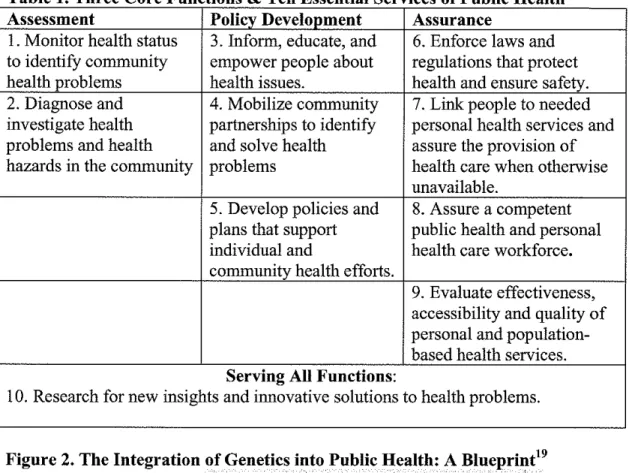
Public Health Functions and ServicesTable 1 briefly describes the three core functions and the ten essential services of public health.12•18 The ten essential services were originally developed through
consensus from a group of public health organizations through the Public Health
L
l
l
,..
l_ 1
Functions Steering Committee in 1994. A visual depiction is provided in Figure
2 within a genetics framework.
Table 1
.
Three Core Functions & Ten Essential Services of Public HealthAssessment Policv Develonment Assurance
1. Monitor health status 3. Inform, educate, and 6. Enforce laws and to identify community empower people about regulations that protect health problems health issues. health and ensure safety. 2. Diagnose and 4. Mobilize community 7. Link people to needed investigate health partnerships to identify personal health services and problems and health and solve health assure the provision of hazards in the community problems health care when otherwise
unavailable.
5. Develop policies and 8. Assure a competent plans that support public health and personal individual and health care workforce. community health efforts.
9. Evaluate effectiveness, accessibility and quality of personal and population-based health services. Serving All Functions:
10. Research for new insights and innovative solutions to health problems.
Figure 2. The Integration of Genetics into Public Health: A Blueprint19
The Integration of Genetics into
Public Health: A Blueprint
T
II
&
'
~
~
'a.
+
The Future of
Public Health
(10M)
The majority of the essential services called for by the public health community can be linked to a potential genomic application. For example:
• Essential Service #3- Consumer education in genetics/genomics will be required to adequately inform the community as a result of media attention to genomics and the influence of
genes/environment/behavior for focused prevention interventions and to promote health literacy among communities.
• Essential Service #4- Partnerships can be sought with genetic counselors and other health professionals with genetics training to help apply appropriate prevention strategies.
• Essential Service #5- Elevate the influence of genetics and
behavioral/environmental influences to policymakers that illustrate how disease can potentially be mitigated by effective prevention strategies.
• Essential Service #6- Public health input on policy initiatives will need to be addressed to effect legislation relating to privacy, insurance, discrimination, legal, social and ethical issues that genomic technology has spawned.
~ __ o=-.
•
Essential Service # 8-Training in genomics as a step towards assuring integration of new scientific advances into public health practice.•
Essential Service #9-The use of genetic testing for predisposition testing, carrier screening, requires oversight and adherence to standards of accuracy, analytic and clinical validity, utility, reliability and ethical, legal and social issues relating to such testing. Counseling will need to be provided to recipients of genetic tests for impact, meaning and appropriate context, especially with the advent of direct-to-consumer advertising of genetic tests over the internet.•
Essential Service #1 0-Health problems can be traced back to genetic susceptibility and certainly new research in genomics can be applied to the top ten causes of death.Although many of the essential services can be linked to a genomics perspective, the focus will be on the Assurance Function, and particularly essential service #8. Without a public health workforce adequately trained in genomics, few of the other potential applications will be realized. Of note, is that two schools of public health in the United States have taken a leadership role in the development of formalized curricula within existing public health programs to address the emerging field of public health genetics- the University of Washington and the University of Michigan. 20 University of Pittsburgh has a longstanding program in
'
~
~
!
l
f
t
l
~
~
F
human genetics and genetic counseling available through the school of public health.
I
Top Ten Causes of Death in the United StatesPublic health has long been concerned with mortality rates, disease risk and most notably those potentially preventable causes of death and disability (Table 2). Many of the top ten causes of death in the United States, are potentially preventable because their acquisition is influenced by behavioral, lifestyle and enviromnental factors (smoking, nutrition, obesity, physical inactivity). While genetic variation also plays a role, it is not deterministic but rather contributes to the overall risk and timing of disease acquisition. One of the emerging roles of public health, therefore, is to embrace and understand the influence of genetic variation on disease risk, morbidity and mortality.
T bl 2 T a e op en auses o fD th. th U "t d St t 2003T C ea m e me a es 21*
Cause of Death Death Rate Number of Deaths
(per 100,000 population' (Absolute numbers)
Diseases of the heart 235.4 684,462
Malignant neoplasms 190.7 554,643
Cerebrovascular disease 54.3 157,803
Chronic lower respiratory 43.4 126,128
diseases
Accidents 36.3 105,695
(Unintentional injuries)
Diabetes mellitus 25.4 73,695
Influenza and pneumonia 22.3 64,847
Alzheimer's disease 21.8 63,343
Nephritis/nephritic syndrome 14.6 42,536
& nephrosis.
Septicemia 11.8 34,243
*
Preliminary data for 2003-based on 93% of death certificates.L
I
Schools of Public Health-Directive and ActionsSchools of public health have been given the national directive that eight new "critical" areas should be addressed in educating public health professionals. These areas include medical informatics, genomics, communication, cultural competence; community based participatory research, global health, policy and law, and public health ethics.8 A survey of schools of public health published in October, 2004 revealed that although many schools of public health are making strides towards including content areas recommended by the IOM, genomics remains one of four areas that still require increased attention to content.22 Of the percentage of schools offering core content in particular areas, the lowest was genomics at 15%. The authors did note that with the continuing advances in both genomics and information technology, these two areas are "likely to have a profound effect on public health practice and the health delivery system at large.22
I
Public Health FundingFor fiscal year 2006, the President's budget proposal for the Department of Health and Human Services (DHHS) and its associated agencies is $642 billion
representing an increase of$58 billion compared to 2005.23 However, a number of funding cuts to particular agencies have been quite marked. Budget cuts have occurred in Health Resources Service Administration (HRSA) CDC, substance abuse and mental health services. The CDC, the premiere public health arm of the federal government, has a proposed budget of$7.5 billion which represents a net decrease of $491 million below 2005 funding levels. Of this, $60 million has been
L
cut from the chronic disease prevention and health promotion program, another $60 million cut in public health improvement and leadership and an additional $60 million cut from public health research. In addition the internal structure of the CDC had undergone major changes (The Future's Initiative)24 and is
reorganizing the majority of its programs under four coordinating centers and three coordinating offices. This includes Infectious Diseases, Health Promotion, Public Health and Information Services, Environmental Health and Injury, Terrorism, Global Health and Workforce and Career Development. A lifestage approach is one key strategy with five categories oflifestages from newborn to elderly, each with measurable objectives and performance indicators for health protection.24 It is not known where the Office of Genomics and Disease Prevention will fall under the new structure and budget reallocation.
I
Health Policy IssuesFour key issue areas in genomics have been identified that are of "universal importance" to health policy and society including: genetic privacy, regulation and standardization of genetic tests gene patenting and education.25 The role of local departments of public health cannot be overstated in conducting educational outreach efforts in the community for a variety of health issues including
genomics. However, first public health practitioners must be trained. Barriers to incorporating genetic services among health care/public health practitioners include lack of knowledge, lack of referral guidelines, lack of clinical utility, lack of updated or detailed family history, competing time demands, fear of
·· d f · · h un2s
unant1c1pate consequences o genet1c testmg among ot ers. , , However,
!
t
[
L
--'--""'.
one of the oldest applications of genetics is in newborn screening for genetic disorders for which public health has been the leading champion. Collection of family history is also a function most health providers perform though quality of the collection varies; this too is considered "genetics." The Surgeon General,29 along with other health organizations such as NCHPEG,30 AMA/1 AAFP,32 CDC33 and NSGC34 have been promoting health care provider education in collecting accurate family medical histories.
I
The Genomic Information ExplosionThe genomic resources available on the internet have grown exponentially in recent years and can truly be considered an explosion. Searches of the internet using two popular search engines (Google and Yahoo) were performed to identify the quantity of information. In addition, a search of the medical literature from the National Library of Medicine (PubMed) was conducted using a keyword search strategy. The keywords included were: gene, genetics, genomics, pharmacogenetics, pharmacogenomics and the phrase "genetics of disease." Literally, millions ofwebsites were identified representing the myriad of information both reliable and otherwise a health professional or consumer could locate using a general search engine or PubMed to locate these terms. Although approximately 63% of American adults have internet access, about one-third does not have access for a variety of reasons. 35 Many libraries, universities and other public institutions provide freely available workstations with internet access for those who wish to utilize these resources. Tables 3 and 4 tabulates the findings
l
t
L
from two internet search engines and the medical literature related to keywords in genormcs.
T bl 3 I a e . n erne t tS earc hE ng~ne R e neva s t . I b K ~Y eywor : d M arc h5 2005
'
Terms Search Engine/Date #Hits
Gene Google, 3/5/05 30,100,000
Gene Yahoo, 3/5/05 35,100,000
Genetics Google, 3/5/05 15,900,000
Genetics Yahoo, 3/5/05 12,800,000
Genomics Google, 3/5/05 4,740,000
Genomics Yahoo, 3/5/05 2,169,000
Pharmacogenetics Google, 3/5/05 262,000
Pharmacogenetics Yahoo, 3/5/05 120,000
Pharmacogenomics Google, 3/5/05 300,000
Pharmacogenomics Yahoo, 3/5/05 198,000
Genetics of disease Google, 3/5/05 4690 Genetics of disease Yahoo, 3/5/05 1,280
T a e bl 4 M d" : e 1ca I L"t 1 era ure Rt" t e neva s JY e ec e l b S l t d T erm, M arc h 5 2005
' '
Terms Source/Date #Hits
Gene PubMed/3/5/05 761,098
Genetics PubMed/3/5/05 1,359,120
Genomics PubMed/3/5/05 9,849
Pharmacogenetics PubMed/3/5/05 2,839
Pharmacogenomics PubMed/3/5/05 2,711
Genetics of Disease PnbMed/3/5/05 155,194
I
The Internet and the MediaThe use of the internet has blossomed over the past decade. Originally developed for government defense use, it has permeated mainstream society with
approximately 63% of US adults (128 million) and 81% of teenagers as regular users?5 The Pew Internet & American Life Project (PIP) funded by the Pew Charitable Trusts conducts ongoing surveys of uses of the internet by the public. Approximately 94 million Americans have used the internet for health or medical purposes. Of those that go online, 85% women seek health information vs. 75% of men. Based on age, ofthose online, 70% of middle age users (ages 30-64)
1 !
l
t
L
L
f
seek health and medical information vs. 57% of younger and older internet users.35 In a 2002 survey, 38% of internet users say the internet has improved the way they take care of their health. 35 Of 1 00 million internet users belonging to an online "community," 28% belong to a support group for a medical condition or personal health problem.
Of the close to 94 million Americans using the internet for health-related matters, the majority look for information about a specific disease or condition. Table 5 outlines the types of information online health seekers access. 35
T bl 5 T a e . type o flfi norma Ion
s
oug1 ht b y nme eao r
H Iths
ee ers k 35Type of Information Percent of Users
Specific disease 63%
Treatments/Procedures 47%
Diet/Nutrition 44%
Exercise/Fitness 36%
Medicines 34%
Alternative medicines 28%
Health insurance 25%
Mental illness 21%
Particular physicians/hospitals 21%
Experimental Treatments 18%
Environmental health hazards 17%
Vaccinations 13%
Sexual health 10%
Medicare/Medicaid 9%
Substance Abuse 8%
Smoking cessation 6%
Denved from Pew Internet & Amencan Life ProJect, December 2002, survey of 94 million Americans using the internet for health related matters.
Searching governmental websites is a regular practice of 97 million Americans of which 36 million have sought health and safety information?5 Of interest is that consnmers say their health use of the internet is important due to convenience, (93%), they get more health information than they do from other sources (83%),
I
r
and they can get the information anonymously (80%). Surveys report that people feel more in control of their own health care when actively seeking information. However, most just began searching on their own (86%) vs. asking for advice about relevant health websites from others (14%).36
Once people locate information they are seeking, one in three bring it to a physician for verification and a quality check, two in five check the source and many health seekers reject sites that appear to have commercial messages. 36 However, most people still get most of their health information from their physician. Consumers not only look for health information for themselves and others on the internet, but 73% who look for information for themselves say the material they locate affect decisions about treatments and care, whether to visit a physician and whether to ask questions and get a second opinion. Half say the information influenced their nutrition and exercise habits. 36 The report also found that 11 million Americans who helped a loved one deal with an illness in the past two years said their use of the internet played a crucial or important role in their helping others and more than 4 million said the internet helped them cope with th . eu own maJor . 1 "11 ness. 36
The transition to information age healthcare with various inputs into patient decision making has begun according to Lee Rainie, investigator in the Pew Internet & American Life Project and is depicted in Figure 3.
r
L
!
Figure 3. Information Age Medicine
(Source: Rainie, L. Pew Internet &American Life Project. Presented at Internet Librarian Conference November 3, 2003, Monterey, CA)
t
L
f
i
The popular media is also a source to raise issues related to genetics and genomics. Popular movies such as Gattica, The Island of Dr. Moreau, Jurassic Park, Blade Runner, Lorenzo's Oil are a few examples of popular films that depict genetics in a deterministic and invariably evil way. Other sources of perspective and information include newspaper articles, radio talk shows and magazines for the public such as Scientific American and Time have covered genetic-related issues over the past several years. Time magazine has sported several thought-provoking articles related to the ethical, legal, social and scientific issues of genomics. Selected examples of Time magazine covers are included in Appendix3.
Quality health information is available, but so too lurks misinformation and commercialism. The public health community will surely be approached by consumers and patients with questions about various genetic issues relating to disease, genetic tests advertised over the internet and other issues relating to media headlines about health, illness and disease genes. Patients have already approached their personal physicians with information found on the internet. Thus, the use of the internet as a resource for genomics education may provide a cost-effective means for educating the public health workforce.
I
Competency Based TrainingA competency is defined as the knowledge, skills and abilities necessary to achieve a standard level of worker performance. Competencies are actions which are observable in the execution of ones work in the application of skills and knowledge.37
L
l
;
~.
The January 2000 Strategic Plan for Public Health Workforce Development calls
for all workforce development efforts to be competency-based and facilitated by
ready access to life-long learning. 38 However, surveys of various healthcare
professionals have generally revealed that confidence in genetics knowledge is
low and additional training is desirable. Lapham et a!. conducted a random
sample mail survey of 6 health professional organizations as part of the human
genome education model (HuG EM) initiative.39 An overall response rate of 57%
was obtained from 3600 health professionals (approximately 600 from each
association). The groups surveyed included: American Dietetic Association,
American Occupational Therapy Association, American Physical Therapy
Association, American Psychological Association, American
Speech-Language-Hearing Association and the National Association of Social Workers. Almost
two-thirds of those surveyed said they would be interested in attending continuing
education workshops in genetics at their conferences. Over one-third of those
surveyed were interested in receiving training to provide education on genetic
issues to colleagues, patients and students. The topics of most interest included:
role of genetics in common diseases such as stroke, heart disease and cancers,
overview of human genetics, identifying genetic resources for clients, helping
clients cope with a new genetic diagnosis, genetic information and racial/ethnic
concerns, new treatments for genetic disorders including gene therapy, privacy
and confidentiality issues in releasing genetic information to others such as health
insurers, schools and employers, and communicating genetic information to
clients.
L
l
A comprehensive document has been developed to aid in developing curricula for the public health workforce from sets of competencies. The document, entitled
Competency-to-Curriculum Toolkit: Developing Curricula for Public Health Workers was a collaborative effort from many organizations and developed by the Center for Health Policy at Columbia University School ofNursing and the Association of Teachers of Preventive Medicine?7
I
ConclusionThe convergence of a number of related factors has opened a window of
opportunity for assuring the public health workforce has the necessary genomics background and competencies needed to maintain effectiveness in the 21st century. Opportunities for lifelong learning abound, if public health leadership is committed to adequately and appropriately preparing and training the workforce to operate in an environment experiencing rapid change, ongoing discovery and cutting edge science.
The Genomic Competencies/Resource Project referred to herein combined with guidance from the Competency-to-Curriculum Toolkit may serve as the basis for health educators, curriculum developers and others with a role in public health workforce development to begin converting the competencies and resources into curricula and training programs in genomics for the public health workforce.
I
Existing Genomic CompetenciesTable 6 represents a compilation of competencies, policies, position statements, and curricula as related to genetics/ genomics for health professionals. University of Washington and University of Michigan have specific curricula in public
f
health genetics. Two key competency sets; one from the National Coalition for Health Professional Education in Genetics (NCHPEG) and the Centers for Disease Control and Prevention (CDC) are the most comprehensive and developed with dialogue among a broad cross section of stakeholders.
NCHPEG is a consortium of 120 member organizations including health
professional organizations, consumer and voluntary groups, government agencies, private industry, managed care organizations and professional genetics societies. The group was established in 1996 by the American Medial Association, the American Nurses Association and the National Human Genome Research Institute in order to promote health professional education and access to information about advances in human genetics. A set of core competencies in genetics relevant to all health professionals including medicine, nursing, allied health, public health, pharmacy, dentistry, psychology, social work and others was developed by a taskforce ofNCHPEG members and made available on their website in 2001 (Table 6). These competencies represent the minimum
knowledge, skills and attitudes necessary to incorporate an awareness of genetics in patient care. A detailed history of the process involved in the development of the NCHPEG core competencies was published in 2001.40
CDC convened working groups to develop competencies in genomics specific for the public health workforce in 2000.41 The intention was to incorporate genomics into the framework of the three core functions and ten essential services of public health (Table 1, Figure 2). The working groups were composed of fifty state and
l
r
'
I
I'
'
;
i 1
local public health officials, as well as representatives from the academic and
private sector spanning multiple specialties. The competencies thus developed
were intended to provide the basis for planning, prioritizing and developing
curricula and training to shape formal educational programs and ongoing training
projects in addition to the development of performance standards.
The competencies have been categorized by job function and include all public
health workforce, all public health professionals, clinicians, epidemiologists,
laboratorians, environmental health professionals, leaders/administrators and
health educators. These competencies were also made available in 200 I at the
CDC website (Table 6).
T bl 6 E . . a e XIS(Illl: C ompetency ets m S . G enom1cs
cnc•"
NCHPEG"'
AAFP44
ASHG"0
ASTH040
Centers for Disease Control and Prevention
Competencies for public health professionals (included are subsets of competencies for all public health workforce, all public health
professionals, laboratorians, clinicians, environmental health personnel, leaders/administrators, epidemiologists, and health educators).
h!!Q :/ /www. cdc. gov/ genomics/training/ comnetencies/ comns.htm
N a tiona! Coalition for Health Professional Education in Genetics
Genomic competencies for all health professionals
h!!Q://www.nchneg.org/nchneg.html?h!!Q://www.nchneg.org/eduresources/ core/core.asn (Also available in Spanish).
American Academy of Family Physicians
Competencies for Family Practice Physicians h!!Q :/ /www.aafu.org/x 1654 7 .xml
American Society of Human Genetics
Policy guideline-Competencies For Physicians
httQ :/I genetics. faseb .org/ genetics/ ashg/nolicy/ren-0 l.htrn
Association of State and Territorial Health Officials
Policy guideline-Public Health Genetics
h!!Q://www.astho.orgillubs/consolidatednolicy.html#PHG-I PubHealthGenetics
L
f
b
,-I
1-ASTCDD41 Association of State and Territorial Chronic Disease Directors
Working Group Report
httJl://www.chronicdisease.org/Genomics Summit ReQort.Qdf
UMI SPH4' University of Michigan, School ofPnblic Health
Educational program in public health genetics. httn://www.snh.umich.edu/Qeneticsed!
UWA University of Washington, School ofPnblic Health SPH49 Public Health Genetics degree/core courses/curriculum
httQ://dej:1ts.washington.edu/j:1hgeu/DegreeTracks/j:1hd.html
httJl://dej:1ts.washington.edu/j:1hgeu/DegreeTracks/comj:1etencies.html httJl://dej:1ts.washington.edu/j:1hgen/Curriculum/CoreCourses/PHG.html
UPitt, University of Pittsburgh School of Public Health
SPH50 httJl://www.hgen.Qitt.edu/academics/mj:1h.html httJl://www.hgen.Qitt.edu/academics/index.J:1hl1
ABGC'1 American Board of Genetic Counseling
httJl://www.abgc.net/genetics/abgc/accred/acc-03/2004 Reguired AC Criteria.l)df
The Genomics Competency/Resource Project
Description: The Genomics Competency/Resource Project was conceived and
undertaken as a practicum initiative in January 2004. A practicum is a required
component ofthe curriculum at the University of North Carolina, School of
Public Health for the masters of public health (MPH) degree. The practicum was
conducted under the auspices of the North Carolina Center for Genomics and
Public Health (NCCGPH), one of three nationwide centers funded over a 3-year
period through mid 2005 by the Centers for Disease Control and Prevention
(CDC). The mission of the NCCGPH is to prepare the public health workforce to
respond to advances in genetic technology and to incorporate genomics into the
everyday language and practice of public health. Objectives include knowledge
base development, technical assistance and training. 52
t
L
Impetus: The impetus for the project revolved around the recognition that genomic competencies existed in one world (paper/publications) and genomic educational and resource materials existed in another (world of the web). The overarching goal and source of excitement in undertaking this project was to serve as an intermediary for merging and customizing the genomic competencies with reliable sources of information and resources freely available on the internet.
Objective: The primary objective of The Genomics Competency/Resource
Project was to address essential public health service #8: "Assure a competent
public health and personal health care workforce" in the area of genomics. The competencies, objectives and resources provided herein can be used as a tool to provide health educators and public health faculty with resources to help guide curriculum development in genomics. The content component of the project with competencies and resources will be shared with the University of North Carolina, School of Public Health and the North Carolina Task Force on Genomics and Public Health. The Task Force was developed in the Office ofGenomics under the Chronic Disease and Injury Section of the Division of Public Health in the North Carolina Department of Health and Human Services (NCDHHS). The mission of the office of genomics is to ensure that North Carolina monitors new genomic knowledge in terms of science, technology, ethics, law and policy. The task force was convened in order to ensure the benefit of genomic advances for all North Carolina citizens and to monitor discoveries in genomics and help to
channel them into more effective disease detection, prevention and treatment initiatives that will improve public health. The content will be adapted for
i.
inclusion in a subsection of the state of North Carolina website (Genomics and Public Health Task Force) which is currently in the developmental phases.
Target Audience: The target audience for the competencies and resources include public heath practitioners with limited background and no formal training in genetics/genomics. Many of the website links contain information for a variety of professional medical audiences. Some sites are geared towards public health practitioners, others to certain categories of health care providers and clinicians in general and others towards patients. All websites have been reviewed and
represent sources of learning and competency development for a broad health care provider audience.
Process: Review of Existing Genomic Competencies and Selection/Revision Genomic competency sets (Table 6) were identified utilizing several methods including use of a literature search using PUBMED (a freely accessible search engine that covers the medical literature). In addition, internet searches were conducted using: Google and Yahoo, two popular internet search engines. Terms and phrases for the search included genetics, genomics, competencies, education, health professional education, public health, public health education, public health workforce development and health professional in a variety of combinations. Various organizations and university websites were also perused individually for genomic competencies. After reviewing the medical literature, numerous
governmental, university and professional websites, I 0 major sets of
competencies were identified as relevant to genomics education for public health practitioners (Table 6).
l
f
The genomic competencies and related materials such as policy and position statements and curriculum descriptions were analyzed for similarities and differences according to depth, audience, scope and degree of detail. The most notable differences included the specific wording of the competencies and depth of knowledge which appeared to depend upon the intended audience and source (university course/degree track, vs. public health practitioners vs. all healthcare practitioners).
After reviewing the existing competency sets in detail, ten, genomic "topics" were identified as most relevant to initial training endeavors for the public health workforce. These competencies were ranked from# l-#10 based on what appeared to be a natural learning progression. The CDC and NCHPEG competencies contained the most overlap and formed the key elements for competency topic selection.
Specific learning objectives were developed to coincide with each competency topic based on relevance to a broad group of public health practitioners,
practicality, and applicability to various public health services. The competency topics and objectives were subsequently reviewed by a core group of three
these competencies/objectives to be a reasonable starting point for education in genomics for a self-starting public health practitioner, health educator, or faculty member to use in the development of appropriate training materials and curricula.
Review and Selection Process for Internet Resources
Research was conducted via the web for relevant and appropriate genomic resources. Each search engine hit led to numerous other sites with deeper knowledge, more individual resources, and even more lists of resources. The amount of high quality information that was freely available was overwhelming. Hundreds of sites were evaluated, and a selection process ensued based on the focus of the site, meeting the objectives for the specified competencies, relevance and reliability of information, free availability and appeal to a general audience of public health practitioners. Criteria for reliable medical information on the web were used in assessing the sites. All of the web resources represent reliable sources of information from government agencies, academia, health departments, professional societies, hospitals and industry. Many sites have the HONcode symbol on their website for Health Information on the Net (HON). The HONcode subscribes to 8 ethical principles/criteria for quality web-based information. These criteria include: authority of the information provided, data confidentiality and privacy, proper attribution of sources, transparency of financial sponsorship and the importance of clearly separating advertising from editorial content. The HONcode seal of approval is given to websites who meet all eight criteria and approximately 3600 websites currently have the seal of approval. 53 Health information can be searched through HON directly, or a
l
[L
i-!
•
L
r
i
•
l
!I
symbol will appear on a website if the web-developer has subscribed to the code of conduct and applied for the seal of approval.
Figure 4. Health on the Net Code (HONCode)
The National Library of Medicine (NLM) has an online document entitled: MedLine Plus Guide to Healthy Web Surfing. 54 This document is intended to
provide guidance to consumers on how to evaluate medical information on the internet. In addition, the NLM also contains links to a variety of other resources that provide information on how to evaluate health information. 55
The National Coalition for Health Professional Education in Genetics (NCHPEG) launched a website in 2004 called GROW (Genetics Resources on the Web).56 The mission of GROW is to "optimize the use of the web to provide health professionals and the public with high quality information related to human genetics, with a particular focus on genetic medicine and health." Each genetic site is evaluated and must meet strict criteria to be listed. This resource was developed due to the volume of genetic related websites with questionable information. Basic and advanced search capabilities allow the user to search for topics in a particular area of interest.
Multiple competency areas
Many of the links contain information which address several competency areas. In those cases, links were placed with the competency which appeared to be the
t
l
fI
focus of the information in the website. Every effort was made to link directly to the specific site of interest.
Requirements for viewing some content on the websites
Requirements for viewing some of the websites or portions of sites may require various plug-ins and computer capabilities for streaming video and audio. Macromedia FlashPlayer, Shockwave, Real-Player, MP3, PowerPoint, Adobe Acrobat Reader or other programs may be required to view some of the sites, however, most are available for free download from the specific sites that use these plug ins.
As ofMarch 27,2005, all of the websites referred to herein were accessed and in working order. Due to the dynamic nature of the internet, some sites may have undergone revisions, updates or other changes that may make them inaccessible at times. Each website is a direct link to the relevant learning materials rather than a general homepage.
Cultural competence
Multilingual materials are available on many of the websites to address the
information needs of practitioners and their clients who are multilingual. The sites with information in other languages have been denoted as such. Many materials are available in Spanish and some have also been translated into other languages. Some direct links may not be available in multiple languages, but the source homepage may have links to relevant multilingual educational materials. In addition, some sites provide a translation functionality in which all of the materials on the site can be translated into different languages.
L
i-'
L
'
'
Linking to Websites
Linking to particular websites may require permission from the administrator of the homepage on specific sites. Most govermnental websites do not have specific link -related requirements but may require that appropriate credits be provided in a particular way when linking to their site. Some sites may also have copyright instructions/restrictions for copying, printing, reproducing and distributing materials found on their site. Some of the materials may be subject to different rules which may be applicable to selected uses of the information such as educational or commercial uses. Any necessary permissions and copyright fees required should be determined prior to using the materials.
Availability
The majority of websites cited for competency development are available free of charge, however, some may require a one time (free) user registration. Some sites have been listed which are links to training programs and courses which may charge a fee to obtain continuing education credits associated with their programs. Those sites which may require a fee for accessing certain materials or portions of their sites or for CE credit are marked with a dollar sign ($) where relevant.
W ebsites not included
Over the course of a year, internet searches were conducted to locate reliable and relevant sources of electronically available information on genomics specifically suited to public health practitioners. Many of the sites visited had a plethora of information and additional links, resources, games, teacher training materials,
L
case studies and specific disease information on many hundreds of disorders. Because of the overwhelming nature of information related to genomics content on the web, distillation was a necessary process in order to focus on the
competency areas with a reasonable number ofwebsites. The non-inclusion of any particular website does not necessarily imply non-endorsement. It is clear from Table 3 that millions ofwebsites exist of which only a small fraction was selected. Many other high quality websites exist, however, due to sheer volume, they were not included here.
Competency 1: Background and History of Genetics
The participant should be able to:
• Explain the major historical milestones and timeline of
genetic discoveries contributing to the current
understanding of genetics/genomics.
• Develop a basic understanding of the history of
genetics research including the role of key scientists
and their contributions: from Gregor Mendel with his
experiments with peas in the mid 1800s to the present
with Francis Collins and Craig Venter announcing the
completion of the map of the human genome.
• Understand the history and role of the Human Genome
Project (HGP).
• Describe the Eugenics movement and its implications
Milestones/Timelines/Key Scientists
From Cold Spring Harbor Laboratory (CSHL) and Dolan DNA Learning Center (DDNALC) (funded by HHMI) DNA Interactive (DNAi) An interactive history of the discovery of DNA and modem genetics. A great Timeline of Genetic
Discoveries with many key scientists interviewed (audio/video-clips and pop-up
biographical sketches) mentioned in the process of discovery of DNA. Visit each decade from the pre-1920s to the present and see a parallel time line of the events going on in the rest ofthe world at the same time. 57
http://www.dnai.org/timeline/index.html
From National Institutes of Health (NIH), an online exhibit from the Museum of Medical Research entitled: Deciphering the Genetic Code, explores the history of genetics research in the 1950's and 1960's and the importance of the work done by Marshall Nirenberg who won the Nobel Prize in 1968 for "breaking the
genetic code." Contains biographies of many scientists instrumental in solving the mysteries of the genetic code. 58
http:/ /history .nih. gov I exhibits/nirenberg/index.htm
From Discovery Channel, Discovery Health. A historical summary of genetics entitled: The History of Modern Genetics Describes the age of Gregor Mendel to the modem era of genetics to the age of genornics, to human genetics. 59
http:/ lhealth.discovery.cornlminisites/dna/ zw history.html
(Notes: includes a section with suggested readings; some of which have full text links).
Human Genome Project/Activities
From the National Human Genome Research Institute (NHGRl): Several webcasts, learning resources and activities from the first National DNA Day in April, 2003. Includes a placeholder for celebrating the upcoming anniversary of DNA day on April25, 2005.60
http:/ /www.genome.gov/1 0506367
From the Kaiser Network Health-casts: A web-cast conducted April 2003 entitled:
Bringing the Genome to You: Human Genome Project to Society. 61
www .kaisemetwork.orglhealthcast/nhgri/ 15apr2003/ (Notes: requires RealPlayer).
From the National Human Genome Research Institute (NHGRl): 50 years of DNA: from double helix to health. A variety oflinks to webcasts, educational materials and curricula concerning the human genome. Activities conducted in April2003.62
http://www.genome.gov/10005139
i
f
t
From the US Department of Energy (DOE) and the Human Genome Project (HGP): An online guide entitled: Genomics and its Impact on Science and Society: The Human Genome Project and Beyond, A 2003 Primer. This primer
covers basic genetics, the Human Genome Project, ELSI, medicine and the new genetics, benefits of genetic research, future scientific challenges, and more. 63 http://www .ornl. gov I sci/techresources/Human Genome/publicat/primer200 1/inde x.shtml
(Notes: Available in html, adobe. Requires powerpoint for slide viewing and adobe acrobat reader if you choose to view PDF. Power Point slides accompany the primer).
Eugenics
From the Dolan DNA Learning Center (DDNALC), Cold Spring Harbor Laboratories. Eugenics- Image Archive on the American Eugenics Movement.
This is a library of images and information from the eugenics era and contains a searchable database of images and information.64
http://www.eugenicsarchive.org/eugenics/
Competency 2: Genetics/Genomics Terminology
The participant should be able to:
• Understand the basic language of genetics/genomics by
becoming familiar with the most common genetic
terminology/vocabulary, abbreviations and
pronunciation as related to general terms, terms related
to chromosomal structure and function, clinical and
medical genetics, laboratory testing, and the
biotechnology industry.
• Acquire the ability to briefly define and correctly
pronounce genomics related terms, explain a term or
abbreviation to a patient in layman's language or to
another healthcare provider.
• Continually update knowledge and familiarity with
terms related to genomics and to locate and navigate
l r
r
L
resources for identifYing new terms related to genetics
and genomics.
• IdentifY the difference between genetics and genomics.
From the National Human Genome Research Institute (NHGRI): This is a "talking" glossary of genetic terms which includes phonetic spellings and audio clips for correct pronunciation. 65
http://www.genome.gov/10002096 (English version) http://www.genome.gov/sglossarv.cfm (Spanish version)
(Notes: includes a search function, multilingual, requires Rea!Player).
From the Human Genome Project (HGP): A glossary of genetic terms in an A-Z index. You can also browse the whole glossary. There is a wealth of information other than the glossary.66
http:/ /www.ornl.gov/sci/techresources/Human Genome/ glossary/
From the Genetics Home Reference (GHR): a service of the U.S. National Library of Medicine (NLM). This site is an A-Z glossary of genetics terms of which you can browse the whole glossary or select a specific term. 67
http:/ I ghr .nlm.nih. gov/ ghr/ glossary/G lossary;j sessionid= FD02D I BEF A 70709B6 D9E24B04996C6F7
From Gene Tests funded by National Institutes of Health (NIH): An illustrated glossary of genetic/genomics terms with definitions, descriptions, illustrations and case examples. 68
http://www.genetests.org/servlet/access?gry=ALLTERMS&db=genestar&fcn=ter m>report2=true&id= 17563&key=i3UZrab5qem Yo
From Access Excellence at the National Health Museum funded by Department of Health and Human Services (DHHS)- Glossary of terms relating to the structure ofDNA.69
http://www.accessexcellence.org/AE/AEC/CC/DNA glossary.html
From the Virtual Children's Hospital at the University oflowa-Glossary of genetic abbreviations. 70
http://www. vh.org/pediatric/provider/pediatrics/Clinical Genetics/ AppendixB/ App enBGlossofAbbrev .html
f
'
I
c
l
Competency 3: Ethical, Legal and Social Issues with
Genomics (ELSI)
The participant should be able to:
• Develop an understanding of the various issues and viewpoints
that arise about ethical, legal and social issues surrounding
genomics, including topics relating to disclosure of information
on genetic risk and disease predisposition to family members,
implications of an individuals own genetic test results on family
members, medical privacy, insurance, employment and,
discrimination.
• Develop an awareness of the policy issues and debate
surrounding human cloning, stem cell collection and research,
pre-implantation genetic diagnosis and embryo selection,
genetic testing of minors and the implications of genetic testing
in the workplace.
• Develop the ability to identifY various uses of genomics
including, data collection of genetic information for Bio-banks,
use of stored specimens, legal rights regarding specimen
handling and privacy, privacy of medical records including
genetic diagnoses, informed consent process in clinical trials
and issues of patient access to the benefits of genomic
advances.
From the National Human Genome Research Institute (NHGRI): Policy and
Legislation Database: a searchable database of policy and legislative documents relating to privacy of genetic information/confidentiality; informed consent; insurance and employment discrimination; genetic testing and counseling; and commercialization and patenting.71
http :I /www. genome. gov /Policy Ethics/Le gDatabase/pubsearch.cfin (Notes: search by state, content, topic or source).
From the US Department of Energy (DOE), Human Genome Project (HGP)
Genetics and Patenting:. a brief introduction to commercialization and patenting of genes. Provides links to other goverrnnent projects related to ELSI issues and publications of interest.72
From North Carolina Center for Genomics and Public Health (NCCGPH) -A collaborative effort through the Universities of Washington, Michigan and North Carolina schools of public health. This is a video narrated by Wylie Burke of University of Washington, Seattle, entitled: Policy Issues in Genetic Testing from The Genomics Revolution and Public Health Series. 73
http://www.sph.unc.edu/nccgph/phgenetics/video.htm (Notes: requires Rea!Player and audio/video capabilities).
From Action Bioscience: A review entitled: Primer on Ethics and Human
Cloning.74
http://www.actionbioscience.org/biotech/mcgee.html
From the American Academy of Pediatrics (AAP), Section on Bioethics entitled:
Ethical Issues with Genetic Testing in Pediatrics. 75
http:/ /aappolicy.aappublications.org/cgi/reprint/pediatrics; I 07 /6/1451.pdf
(Notes: requires adobe acrobat reader, PDF of article from Pediatrics June, 2001 ). From the National Human Genome Research Institute (NHGRI): Sununary from a Direct to Consumer Advertising Workshop (March 23, 2004) entitled: Direct to
Consumer Marketing of Genetic Tests76 http://www.genome.gov/12010659 (Notes: includes link to workshop held in March, 2004 and participant perspectives).
From the Centers for Disease Control and Prevention (CDC): A resource to links about ethical, legal and social issues in genetics from a variety of sources. 77 http://www.cdc.gov/genomicsllinks/ethical.htm
Competency 4: Population Genetics
The participant should be able to:
• Describe the newborn screening process and the tests
that are performed on newborns and how they vary by
state.
• Describe genetic predisposition to certain diseases and
screening initiatives among various ethnic groups for
certain genetic diseases.
• Develop an awareness of chronic disease epidemiology
and the relative contributions of genetics, environment
i t