Not Immune: A Research Plan for Better Understanding the Lived Experiences ofHN-Positive Women Age 50 and Older
By
Melinda G. Abemethy-Smith
A Master's Paper submitted to the faculty of the University of North Carolina at Chapel Hill in partial fulfillment of the requirements for the degree of Master of Public Health in the
Public Health Leadership Program.
Abstract
Background:
This paper describes a literature review of peer-reviewed articles
researching specific stressors, coping strategies and self perceived quality of life among HIV positive women age 50 and older. Following the literature review, a research plan for a qualitative study aiming to investigate these issues is
explained, including preliminary data. Methods of Research Project:
Qualitative in-depth interviews are being conducted among HIV -positive women age 50 and older who are current patients in the UNC Infectious Diseases Clinic. Interviews are tape-recorded, transcribed and coded by the primary investigator. Analysis for emergent themes is conducted following a grounded theory research approach.
Results:
Analyses on the first five interviews highlight important considerations for the remainder of the study. Issues regarding HIV status disclosure, the perceived lack of public acknowledgement regarding risks among older women, and the importance of individual faith as a coping strategy are common themes in the interviews.
Conclusion:
Introduction
As the "baby-boomer" population in the United States continues to age, requiring a focused response on behalf of medical and service providers, specific knowledge regarding the needs of HIV -positive women age 50 and older is an important consideration. Historically, this population has not been involved in research or targeted prevention/education endeavors and, as such, little is known regarding the specific social stressors and coping strategies encountered by these women. Without this knowledge, it is impossible to evaluate how current models of assistance (community case workers, financial assistance organizations, support groups, etc.) appropriately respond to and serve their needs.
I preformed a literature review of relevant studies addressing these issues as well as programs aimed at developing more appropriate models for prevention, education and care. In collaboration with an Infectious Diseases attending
focused prevention messages and care/support frameworks appropriate for this specific population. This paper reflects the work -to-date, including background research, a review of the literature, the research project plan and preliminary results from the first five interviews.
Women and HIV
In 2004, women accounted for 30% of the reported HIV incidence and 27% of newly diagnosed AIDS cases in the United States, an increase of
approximately 20% since 1985 1• 2 Unlike trends observed early in the epidemic,
in which most HIV cases in women occurred among users of injection drugs in the urban Northeast3, a large percentage of transmission to women now occurs via heterosexual exposure. Data from the 2004 CDC surveillance study reported that at least 4 5% of women contracting the virus that year acknowledged a
heterosexual exposure to an individual at risk for HIV 1. However, this number is likely underestimated, as it may not have included women exposed though heterosexual contact with an individual of unknown, or presumed non-existent, risk. In North Carolina, specifically, 28% of new HIV/AIDS cases in 2004 were among women. Furthermore, the associated infection rate was 14 times higher among African-American women compared to Caucasian women, a disparity that merits specific attention 4• 5.
younger populations of women. Substantiated by data reflecting that between 26% and 50% of all heterosexually acquired cases of HIV are among teenagers and young adults ( < 24 years of age), such targeting is valid and necessary 6. Additionally, as early advances in the prevention of mother-to-child transmission and the subsequent dramatic effects associated with targeting women in pre-natal clinics became evident, further attention has been granted to women of child-bearing potential. While these focused interests are appropriate, they
unfortunately neglect the specific needs of, and potential areas of prevention for, the sub-population of women age fifty and older.
HIV among older adults in the United States Epidemiology
Each year, adults 50 years of age and older comprise approximately II% of all reported AIDS cases in the United States 1, and as of 2000, has become the fastest growing population of individuals affected by HIV/AIDS 7• This number is secondary to the increasing survival of individuals with HIV in addition to
African-American women, accounting for 50% and 65% of cases in older women, respectively 7, and the majority of cases resulted from sexual transmission9
Overlooked Risk Factors
Despite these statistics, research has been slow to acknowledge the effects of HIV on this population or to include older women in targeted study
populations, primarily under the belief that such women do not engage in sexual activity outside exclusively monogamous relationships and do not engage in the use of injection drugs10. However, even as early as 1992, one study among non-infected women from 40 to 7 5 years of age, found that 8% of participants had at least one risk factor for HIV11. According to 2000 census data, this would translate to approximately 4.3 million American women who are at risk for contracting HIV9 The high number of older women at risk is most likely secondary to two factors: 1. sexually active older women consider themselves to be at little risk for acquiring HIV, and may participate in high risk activities without concern for potential repercussions 7; and 2. prevention/educational efforts are not specifically targeted to this population.
Condom Use among Women over 50
to have never used a condom before HIV diagnosis (63% vs 37%)14.
Post-menopausal women may be physiologically more susceptible to infection due to
atrophic changes in the vaginal mucosa, posing further risks when coupled with
lack of regular condom use. Yet, a woman's motivation to use barrier
contraception may be diminished by the absence of concern for potential
pregnancies 14 Even if women wish to use condoms, their partners may disagree
with their arguments or perspectives. In many retirement communities and social
centers frequented by older adults, women generally outnumber men. Women in
such settings, where the increasing gender gap limits their selectivity with regard
to sexual partnerships, may fear offending a potential male companion and forego
any discussion of condom use15• 16
Risk Perceptions: Where are We Going Wrong?
The Knowledge Deficit
Compounding women's self-perception of risk is the lack of prevention
and education methods specifically designed to target older women, leading to a
substantial deficit in HIV knowledge within this population. Numerous studies
have demonstrated that older adults generally possess less knowledge with regard
HIV . . d . d 9 17-19
to transm1sswn an preventwn compare to younger counterparts ' ,
with older African-American and Latino women scoring the lowest on knowledge
assessments20 This deficit undoubtedly contributes to a lack of awareness
regarding personal risks for HIV, protection strategies and delayed access to
. d. I 21
Hesitancy in Diagnosis
Delay of induction into appropriate HIV -related care among older
individuals has also been linked to the hesitancy of heath care providers to elicit
sexual histories and/or recommend serologic testing for HIV, attributing early
symptoms of HIV to "normal" changes in the geriatric population 15. Even after
appropriate diagnosis and care referral, older women are at increased risk for
non-compliance with appointments and medications, primarily due to the unique roles
women serve in society, as well as the association between activities evoking a
"high-risk" status and lived situations involving poverty, violence and/or
inadequate social support structures22 Whether such experiences and perceptions
directly contribute to decreased quality of care and access to antiretroviral
medications is an important aspect of consideration.
Initial Steps
Targeted education, screening and intervention strategies can be more
appropriately developed if we acquire a better understanding of how women age
50 and older respond to and experience living with HIV.
Review of Current Literature
I initiated a review of the literature to better understand the lived
experiences- including stressors, coping strategies, and influences on
Subsequent to the paucity of studies specifically dealing with older women and HIV, the literature review was extended to examine these factors among all HIV-positive women.
Literature Search
Internal Validity of Reviewed Literature
I assigned quality ratings for each of the eight articles, based on scores (poor, fair, good, excellent) for categories appropriate to the research design. Specific criteria for the ranking process, based on research methodology, are included in the following sections and final categorical scores are included in Table 1.
Quantitative Ratings
The quantitative studies were reviewed for appropriateness of sampling strategy, measurement methodologies, statistical analysis and clinical relevance of results. Evaluation of the sampling strategy was based on the inclusion of a clear description of an appropriate source population, and the selection of a study population that was adequately representative of that source population. Methods of data measurement were based on reliability and validity of specific tools used and statistical analysis was evaluated for awareness and control for potential confounding and appropriate use of analysis strategies. A checklist for ranking categories is included in Appendix A. The final grade for each quantitative study was based on the frequency of sub-group rankings.
Qualitative Ratings
in the current literature. these criteria are generally regarded as valid descriptors of
methodological rigor30"35. However, I wished to attempt a relative comparison
between the studies with hopes that such an analysis would assist in the
development of our own research methodology. Avoiding quality rankings, I
opted instead for a descriptive analysis of each study based on criteria generally
regarded as valid descriptors of methodological rigor30"35.
The three qualitative studies were assessed on the basis of a short question
set (Appendix B) adopted from the work ofBarbour30, Greenhalgh and Taylor32,
and Mays and Pope33 for: appropriateness of methodology and study population,
data collection and analysis methodologies, and clinical relevance of results
(Table 1). The researchers' decision to use a qualitative design was evaluated for
appropriateness based on the prescribed aim to, "study things in their natural
setting, attempting to make sense of, or interpret, phenomena in terms of the
meanings people bring to them"34. The study population was evaluated for the
level of definition and justification for sampling methods. Quality of data
collection and analysis was based on the degree of explanation for the protocol's
evolution, the reliability and verifiability of data collection tools, and the
appropriateness of analysis techniques and quality control measures. In particular
the use of grounded theory, reflexivity, multiple coding, triangulated results,
methodological congruence and respondent validations are a few of the particular
methods for validating qualitative research. I further describe these techniques,
Explanations of Techniques to Improve Rigor in Qualitative Research
I. Grounded Theory
Grounded theory is a qualitative technique in which all results, explanations and theoretical development are derived from the data itse!f30• 34• 36• 37 It is an "iterative process by which the analyst becomes more and more 'grounded' in the data and develops increasingly richer concepts and models of how the phenomenon being studied really works" 37
. Opposed to traditional quantitative research, in which the study is engaged to analyze a hypothesis generated a priori, the grounded theory approach is used in attempt to reduce the impact of researcher bias and influence. However, even with use of the technique, many have argued that the methodology does not prevent this from occurring30• 36 Critics of grounded theory argue for the need of a constructivist approach, in which the data is recognized as organized by the researcher and the conferred meaning is framed by the influence of both researcher and subject33· 36. Determination of credibility calls for a step by step explanation of how the data coding, analysis and final conclusive insights were formed.
2. Reflexivity
To follow a constructivist approach to grounded theory, reflexivity, or "the process of reflecting critically on the self as researcher," is
researcher is aware of a certain degree of observer bias present in qualitative research, and responds with a reflexive presentation of their own experience, influences and a priori assumptions in reaction to the research agenda, data collection and analysis32-34• 38
3. Multiple Coding
Coding of the texts by more than one individual allows for a better understanding of themes as identified by independent readers, therefore limiting the influence of bias that a single coder may create30• 37
Alternatively, this can be accomplished to a less rigorous degree of reliability with a single reader, analyzing the texts at two different points . . 30
m
time .4. Triangulation of Results
Triangulation refers to the comparison of results from studies addressing the same research question through varied methods of data collection30• 33. The method is often used to validate results by
5. Methodological Congruence
Congruence of qualitative research is described as involving four
components: rigor in documentation, rigor in procedures, rigor in ethical
approach, and confirmabilitl1. Broadly speaking, this involves an
analysis of how well researchers documented integral steps in the study
process. The first step is an accurate identification of the research question
and support for the research design's ability to adequately address the
problem and significantly contribute to the existing body ofknowledge31.
Following the study's initiation, methodological congruence necessitates
appropriate and ethical methods of informed consent, data collection and
results analysis, including an accurate description of all procedures31.
6. Respondent Validation
With the growing impact of participatory action research,
respondent validation of research results is becoming a more popular
means though which qualitative data is validated. While it is a useful tool
to refine meanings and correct epistemological errors in terms of those
who initially presented the data upon which the meanings are conferred, it
must also be approached as a source of potentially new data in itself and
Studies and Data: Results of the Literature Review
Each included study is presented in the following sections, divided into subgroups based on the aim of the study's research question(s).
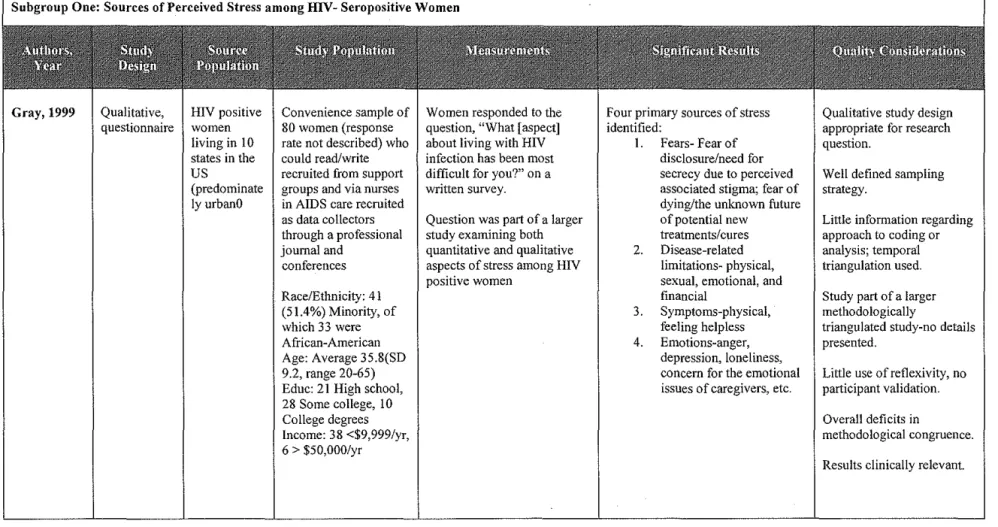
Subgroup One: Sources of Perceived Stress among HIV-Seropositive Women
triangulated research project; however, results from other studies were not
available. Participant validation, as well, was not employed.
Gray determined four primary sources of stress for the interviewed
women: fear, limitations, symptoms and emotions. In particular, her finding that
the women's expressed fears were not only of their unknown future and potential
mortality but also of disclosure and perceived stigma was particularly interesting.
While the study was limited by the above issues in methodology as well as the use
of a written tool to aid in verbal data collection, the results point to important
areas of consideration for future research as well as provision of support services.
Stigma was also found to be a common theme of perceived stress in the
study by Ingram and Hutchinson with 18 volunteering HIV -positive mothers in
Georgia24. The small qualitative study was used to initially explore the
experiences of being a HIV -positive mother. Findings were presented as a
description of Goffman's theory of stigma in which the negative consequences of
stigmatization involves a loss of perceived norma!cl4. This "emergent fit"
analysis was used to assist the researcher in "expand[ing] personal work by
exploring in depth ... a small part of a larger phenomenon," and was validated
among both participants and colleagues24 However, little detail is presented regarding the steps through which researchers developed the association between
their data and the associated theory.
Women expressed a similar fear to those in the study by Gray. In
particular, participants feared disclosure and the associated stigma it would entail;
"abnormality24." Furthermore, the authors conclude the paper with suggestions to HIV providers on means to decrease stigma, such as closed clinic doors and discrete labeling; as well as to improve sensitivity to the diverse needs expressed by HIV positive women.
Among the quantitative studies, the case series published by Kirkham and Lobb found that significant stressors among the 110 participating women were: financial difficulties (60.9% of respondents), lack of intimacy (53.6%), fear of rejection or discrimination (51.8%) and own health/medical problems (40.9%i5• The study was conducted via a mailed survey developed in consultation with medical experts, an epidemiologist, a statistician, community AIDS educators, and HIV-positive women; and was pre-tested among a small group ofHIV-positive women with subsequent integrated feedback. While the survey distribution was initially large, information on the source population demographics or precise percentage of respondents is not presented due to
limitations in identifying HIV -positive women through anonymous testing. Based on a statistical back-calculation, the authors estimate that 15-25% of the HIV-positive women in the province completed the survey.
psychosocial stressors. While such data may have been helpful if significant, the identification of specific concerns among these women is instrumental in
providing direction for future research.
Subgroup Two: The Utilization of Various Coping Methods
The case series conducted by Simoni and Cooperman explored sources of stresses and strengths among a non-probability group of HIV -positive women living in New York City27. The included women were predominately African-American (44%) or Hispanic (42%), and of low economic status (85% reported an income of< $1 ,000/month). While not as important for their research
methodology, the source population was poorly described as were the recruitment strategies used to establish the convenience sample, leading to the common concern for selection bias in case series analyses. The participant group (n=373), however, was sufficiently large with demographics generally representative of the HIV positive population of women in the United States. Through face-to-face interviews, the researchers accessed perceived stressors, strengths, and psychological as well as physical wellbeing, using pre-validated scales.
controlling for mastery drastically attenuated the association between spirituality and depression, suggesting the role of mastery as a mediator for the effects of spirituality. Additionally, Simoni and Cooperman determined a correlation between higher levels of reported satisfaction with social support and better psychological and physical adaptation (p<O.OOl and p<O.Ol, respectively)27.
While the potential for social desirability bias secondary to the face-to-face interviews exists in their study, Simoni and Cooperman succeed in highlighting two potential areas for interventions for HIV positive women: the reliance upon spirituality for bolstering self-strength, and the need for adequate support systems to maintain psychological and physical wellbeing.
Following this initial study, Simoni (with Martone and Kerwin) conducted a cross-sectional analysis on the role of spirituality as a coping mechanism among a similar group of women in 200i8 After controlling for demographics, social support indices and drug use in a multivariate model, the researchers found that spirituality and spiritually based coping significantly correlated with less drug use, increased social support, and improved psychological adaptation (p-values all < 0.05). Data for the analysis was collected using modified pre-validated scales administered through highly structured face-to-face interviews conducted by women previously trained as part of a larger investigation. The interviewers included health care consumers from the seropositive women's community. While selection bias (lack of information on establishment of study population),
and the lack of causal directionality in cross-sectional studies all limit the study's findings, the authors point to an important area of potential assistance to similar HIV-positive women.
In a qualitative manuscript, Malone, a social worker, reported the voiced concerns, opinions and beliefs of the five regular members of her support group for women over the age of 50. While the group served an important role in the lives of the author and the participants, and was based on the establishment of a long-term relationship between those involved, it is difficult to qualifY the study as a classic participant observation project as it was structured with Malone in the role of director/moderator41. Neither was the study a focus-group as it lacked the
necessary procedural structure42. However, following the post-structural
movement of researchers in the social sciences away from the difficult nuances of participant observation, it could be argued that Malone succeeds in writing a brief ethnography in which she posits herself in the midst of the support group's
interactions, subjectively presenting the women's voices within its specific context41
Subgroup Three: Self-perceived Quality of Life
The case series report by Kirksey eta!. of a group ofHIV-positive women attending a university-based AIDS clinic in Houston, Texas (n=61) found that perceived quality of life and social support were related to overall perception of health with borderline significance (p=0.019, p= 0.031, respectivelyi6. The study included a convenience sample of women, reported as adequately representing the overall clinic population. Surveys were comprised of pre-validated questionnaires that were self-administered. Their analyses involved multiple regression model controlling for the potential confounders of ethnicity and self-efficacy. As with similar studies, the potential influence of unanticipated and unidentified
confounders, the role of selection bias within a convenience sample and the measurement bias associated with self-reported data all limit the validity of he study's findings.
In a similar study, Sowell eta!. addressed the relative importance of social and psychological factors as predictors of self-perceived quality of life among a group of HIV -positive women receiving care at one of eight public clinics in Georgia. The researchers found that disclosure to a greater number of individuals, presence of intrusive thoughts and increased age were significant positive
Women who were married or living with a partner reported greater levels of
general anxiety and HIV symptoms.
Data for the analysis was collected using predominately pre-validated
scales through highly structured face-to-face interviews with trained, female
research assistants as well as clinic chart reviews. Scales were modified based on
findings from an initial focus-group session during the formative phase of the
study. While the study is limited by selection bias (lack of information on
establishment of study population), measurement bias (use of self-reported data),
potential influence of unknown confounders and the lack of causal directionality
in cross-sectional studies, the presented findings point to potential factors
influencing the quality of life among HIV -positive women.
External Validity of Results from Literature Review
Quality ratings for external validity were not assigned to particular studies.
In general, however, all but one study8 enrolled women of all ages and were
predominately comprised of women with a mean age of35-40.
Other issues, as well, limit the applicability of study findings to diverse
populations of women. In particular, the studies by Gray and Kirksey relied upon
the use of a written tool for data collection23· 26. While an appropriate step to
regulate data collection techniques, it limits the transferability of results to
populations of illiterate or non-English speaking women as well as those for
whom varied levels of education and cultural differences may have limited their
conducted in British Columbia among predominately Canadian (76.4%) and Caucasian (80.9%) women is also limited in its applicability to diverse populations, notably those within the United States where women may have access to different levels of community and financial support than do their Canadian counterparts25 .
All of the studies included in the literature review include women who are established with service providers either through provider clinics or social service organizations. Subsequently, an unknown number of women who have not presented for care or services are not represented in these populations. It may be that these women, including those age 50 and older in particular, have different experiences living as an HIV positive individual. They may encounter different stressors and coping strategies than women who are in care, and may require different methods of intervention and support as a population.
Furthermore, as illustrated in the above review, only one study specifically included only HIV-positive women age 50 and older8. With data primarily from populations of younger women, it is incorrect to assume that the conclusions found within this literature review involving aspects of social stressors, coping mechanisms and perceptions of quality of life appropriately represent women above the age of 49.
Important Considerations from Excluded Studies
including both women and men above the age of 50 was excluded from the formal literature review, two studies within this category offered important
considerations for our research.
A qualitative study conducted in New York City among HIV positive individuals age 50- 68 revealed a variety of potentially relevant themes of both advantages and disadvantages of older age when dealing with HIV. Advantages included: developed wisdom, enhanced problem-solving skills, greater
cautiousness and sense of emotional moderation, patience, sense of illness and physical decline as expected aspects of advancing age, and pre-illness
achievement oflife goals. Disadvantages included: communication issues with providers, sense of self-depravation with regard to care, stigma, and having more "vulnerable bodies"43•
The second study highlighted difficulties in the measurement of quality of life among older populations ofHIV -positive individuals44 Avis and Smith concluded that secondary to common co-morbidities as well as differences in perceptions of what constitutes quality of life, current methods of evaluating this variable among an older population may not adequately assess the true
perceptions or needs.
In summary, the literature review finds that research specifically targeted to HIV -positive women age 50 and older is needed to better understand and respond to the social, emotional and physical needs of this growing population.
Methods
The following sections include our research project's methodology at this point in the study process. As the nature of qualitative research provides for continuous reflection on results and data obtainment/analysis, minor modifications of the methods throughout the project are expected.
Approach to methodology
The project involves qualitative methods and analytical modeling to explore particular social experiences of women age 50 and older currently living with a diagnosis ofHIV. The use ofin-depth qualitative analysis is a well-founded approach to "exploring unknown or understudied phenomenon and to promote the development of conceptual and theoretical frameworks"45. Such frameworks can then be utilized to generate hypotheses for further qualitative and quantitative research. Investigating our research question initially through a qualitative model provides an opportunity to uncover previously unrecognized variables within the women's lives as well as the ways in which those variables are influenced by particular situations. In other words, the qualitative design allows us as researchers to explore the "haws of people's lives (the constructive
work involved in producing order in everyday life) as well as the traditional whats
and the interviewee (the research participant) in a space that allows for candid
expression through narrative experience, and appropriate reflexivity in data
obtainment and analysis. Defined as "a performance that positions the author in
relationship to the field, the act of research, writing and the production of
knowledge more generally"47, the interview itself requires a continual
appreciation of the idiosyncratic experiences and attitudes brought into context by
both interviewer and interviewee.
Recruitment
I am currently identifying eligible women consecutively in the UNC
Infectious Diseases Clinic (UNC ID Clinic) and approaching them for emollment
in the clinic either while they are waiting to be seen by their provider or after
completion of their clinic visit. Inclusion in this convenience sample is limited to
HIV positive women who are age 50 or above, are current patients of the UNC ID
Clinic, and who have demonstrated willingness to be approached for research
study participation (as documented by previous written informed consent to
participate in the UNC Center for AIDS Research Database). The only exclusion
criteria are an inability to provide written informed consent and/or inability to
speak English. The initial encounter script is included as Appendix C. If a woman
agrees to participate in the study, consent is obtained (Appendix D) and
interviews are scheduled to be held in a private and confidential location at a time
convenient to the participant. To date, all completed interviews have been
physician visit in a private clinic room. Permission to audio tape the interviews is requested; however, individual women are able to refuse audio taping and still participate in the research study. No participants have refused audio taping at this time. At the completion of the first five interviews, six women declined to
participate in the study. For the six women, the stated reason for refusal involved difficulty with the time commitment. Four women could not rearrange their transportation and two women had pressing engagements or responsibilities.
Interviews
I conduct each semi-structured interview with women who give written informed consent to participate in the study. The interviews follow a framework based on a grounded theory research approach in which the interviewer begins with a broad open-ended question and then follows-up with more focused questions or probes36 This approach allows for an awareness of"emic points of view, or insider meanings, that are attached to social phenomena" (emphasis in original)48 The interview guide (Appendix E) is designed to elicit information from the women on psychosocial aspects of their lives, as well as perceived similarities or differences between their experiences and those of younger women with HIV. Additionally, these interviews provide participating women with an opportunity to elucidate examples of the various situations, knowledge
social support. A UNC Infectious Diseases Attending Physician (Kristine Patterson, MD) is available by pager if any issues arise during the interview process. Each interview lasts approximately one hour and women are reimbursed $15 for their participation. During the course of each interview, I refer back to trends and concepts demonstrated in previous interviews in order to inform the questions and associated probes in progress, thus incorporating a continuous comparative analysis between interviews.
Analyses
Following an understanding of interviews as "a form of discourse between two or more speakers or as a linguistic event in which the meanings of questions and responses are contextually grounded and jointly constructed by interviewer and respondent" 49,the research team will not attempt to "lift the results of [the] interviews out of the context in which they were gathered and claim them as objective data with no strings attached46 Instead, we will approach the texts as negotiated presentations of individuals' lived experiences though conversations held with a researcher who embodies dissimilar demographic characteristics.
Transcription
I transcribe each interview within 48 hours of completion. As the
awareness of who the women are in context of the interview process. Through this reflective interaction, I will allow for an intermediate step to contemplate the manner through which our transcription process is reflecting and representing the words and ideas of each research participant. The development of and
justifications for this intermediate step as described in a study by Oliver et al.48 are included in the following section.
An Intermediate Step in Transcription: The Oliver eta/. Study
The intermediate step in transcription reflects the methodology employed by Oliver eta!. in their qualitative research project among HIV positive men in Ohio 48. During the study, investigators realized that their research question warranted neither a completely naturalized approach to transcription (in which every utterance, pause and speech overlap is noted to fully analyze the
conversation) nor a completely denaturalized approach (in which idiosyncratic elements of language are excluded in an effort to focus on embedded meanings and perceptions). They felt it was difficult to accurately portray the interviewees' words verbatim in a way that adequately demonstrated their broader significance to a wider audience.
Despite their use of grounded theory techniques, which normally rely upon a denaturalized transcription style, the researchers felt that this method neglected important aspects of how particular meanings and perceptions were
objectively allow the interviewees to speak for themselves, ignored the social and ideological influences of the transcriptionist as he/she proceeds to translate that communication and creates a hegemonic ideal of"standard speech"48. To allow for the spoken words of their participants while preventing the attachment of prejudiced assumptions to their analysis, Oliver eta!. adopted an intermediate step in the transcription process to reflect upon how particularly conveyed
pronunciations, use of slang, geo-ethnic accents, diction, involuntary vocalizations, and nonverbal vocalizations were a) necessary to completely convey meanings and interpretations and b) affected the interviewee's
presentation with risk of stereotypical influence. This step allowed the researchers to work with the interviewers' words, approaching them as data sources while simultaneously appreciating how their portrayal of those words affected the subsequent analysis.
Transcription: Implications for Current Research Project
were shared. Granting ownership of their words to the individual women is an
important aspect of our research agenda.
Coding
Following transcription, the interviews are each then entered into a
qualitative research software program, Atlas t.i, vol. 5.1. As there exist current
debates regarding the validity of computer based qualitative analysis, I will utilize
the program for organizational ease, but will also review hard copies of the
transcribed interviews for a analysis "by hand 5°." Using this dual method, I will
iteratively review interviews to identify themes, and assign codes. To insure
credibility and authenticity, the interview field notes and transcripts will then be
independently reviewed by two study co-investigators. These will then be
compared and themes will be characterized and modified based on consensus.
Throughout the study process, an audit trail of written documentation illustrating
the process of developing themes will be maintained. This will allow for precise
demonstration of the framework in which the interviews were approached,
analyzed and understood. In part this information will be used to inform
additional interviews, and in part to determine when theme saturation has
occurred as well as to enhance validity. Once theme saturation has occurred we
will close enrollment. Based on prior work among HIV -infected women using
Results to Date
At the time of this report, five interviews have been completed,
transcribed and coded. All women interviewed were African-American and
between the ages of 50 and 79. Four of the five women were between 50 and 54
years of age. Two of the women were divorced, two were widowed and one was
married. All believed they contracted HIV from a heterosexual contact; four felt
that they contracted the virus from their concurrent husband. Previous alcohol
and/or drug dependence was common, with two of the women reporting a positive
history and one who discussed currently struggling with her addiction. At the time
of the interview, she reported a week of sobriety. Trends apparent from these
interviews include: the importance of faith in God, a need for selective disclosure
ofHIV status, and dissatisfaction with available education and prevention efforts.
Strength from Faith
Each of the five women interviewed specifically addressed the importance
of God and their personal faith as a vital source of strength. While they each
stated that faith and spirituality had always played a role in their lives, most of the
women felt that the strength they derived through their faith increased following
their diagnosis and helped them handle the implications of living with HIV. In the
words of three women:
I talk to Jesus a lot. It makes you grow closer to God, I think.
If it wasn't for me believing that God was helping me and taking care of me, I don't know whether I
would be here or not.
Two participants did not feel that her faith had changed since being diagnosed, but believed that their previously established relationships with God assisted them in facing the new challenge of an HIV diagnosis. One woman stated:
I've always been [faithful]. My mom took me to church when I was little, so ... I've always been in the church. I guess it has just never changed. I know
that you have challenges that you have to go through and you have to face them. And, like I
said-it could be worse than said-it is, so said-it's not. So, I am grateful for that too.
Another woman felt that her faith was always important, but increased when God assisted with her decision to become clean from drugs and alcohol. In her words:
No, it's always been real important, because God didn't leave me. I left him when I was using. The
minute I decided that I didn't want to do that anymore, he was a big part of my life. Cause I know
that he spoke to me. That's just for me; I can't say for anybody else. But, I know that's how things happened. He said, "Stop, or you are going to die."
So, I decided to live, with him.
Following the description ofHIV as an acceptable challenge to be faced, two of the women expressed beliefs that their diagnosis was specifically
implemented by God in order to facilitate a growth in spiritual strength. One woman's words illustrated this belief:
give me this mountain and give me the strength to climb. When you give it to me Lord, give me the
strength to climb.
One woman, currently battling an ongoing addiction to crack cocaine,
described how she believed God orchestrated her life: "I can't control the HIV
anyway, only God can. You know, he has already written my life." For another
woman, God served as a confidant, providing an outlet for self-reflection. She
stated:
It [faith] is very important. I am not sure that I would have made it through the initial shock and acclimation to it all without my faith. There have been many times when I didn't have anyone to talk
to, and I had to talk to God.
For all of the women interviewed so far, their faith provided an important
tool with which they were able to accept their diagnosis, and face the day-to-day
challenges ofliving with HIV. Of the five, four brought up an aspect of their faith
or spirituality before I specifically probed on the topic.
Interestingly, only two of the women interviewed discussed the
importance of attending church, or having a church community. Both women
elaborated on the difficulties faced when deciding to whom they would tell their
status, and stated that church members were not appropriate for this sort of
disclosure. Such acknowledgement leads into the next commonly encountered
theme: that of living in two worlds- one in which their HIV status is known by
A Lived Duality
For most of the women interviewed, the decision to disclose their positive
statns to others was one that involved serious considerations of implications.
These included: an awareness of the potential effects such knowledge would have
on those individuals being told; the potential for negative reactions and stigma;
and, the likelihood that these individuals would tell others, making their status
publicly known in a community. One woman did not tell her children initially as
her diagnosis followed closely behind her divorce from their father. She felt that,
"it would be too much for them at the time." Years later, she had still not told
them, stating that:
Now tbat so much time has passed, I don't really know how. Sometimes I wonder how they will react
when they do find out.
For her, the concern regarding disclosure to her immediate family was
based more on how the knowledge might disturb their lives than on the impact it
would have on her own experiences.
Others believed that through self-disclosure they could increase awareness
among others and potentially contribute towards increased education and
prevention strategies. The level of openness to achieve this, however, required a
great deal of courage not easily employed by the women. In the words of one
woman:
And I want to tell them so bad, what difference does it make? You know, you can't get it like that, just by talking to them or being around them. You just
don't know how. I'm kind-of like, I don't really want them to know that I have HIV. I don't know what to do. Sometimes I think about it, that I just need to get up there and tell it. And then I think about it and think, 'no, no, I better not do that.' So, I
don't know. Tell my story ... I feel scared. So, I don't know. I think it would help other people. I haven't even told my own daughter. I should tell her, but I haven't. I don't know why. It's just
tough."
Another woman was contemplating whether or not she wanted to
participate in a panel educating teenagers in other town. She realized the potential
contribution she could make, and felt more comfortable with the panel not being
in her hometown:
I don't think that it would be harmful for me to do it in [town x]. I wouldn't want to do it in [my hometown]. Nah.lt'sjust something I wouldn't
want to do there.
For these women, disclosure involved a self-negotiation in which they
balanced potential benefits to others with potential harms to themselves. For
others, disclosure to any one individual could result in many others knowing
about their diagnosis. To prevent public awareness of their diagnosis, they used
careful discretion in choosing those individuals to whom they would disclose.
One woman stated:
You know, it's just- that is a fine line right there. If I decide to have somebody else [know], are they going to conceal? I mean, tell my private things or
whatever. So, I don't do that.
The common fear associated with disclosure related to a perceived risk of
I don't tell everybody, but there are certain peoples that I do talk to like my case worker. Sometimes it's
not good to tell your church members ... My cousin does [know about my status]. I don't tell nobody
else. I tell only the one that I know won't talk because people treat you bad ... The only think I had to do was to keep my mouth shut and not to talk my business to everybody. The people are not good to you if they find out. They are scared of you. They think that if they drink some water behind you then they will get it. But, that's not the way that you get
it.
I feel like I just can't be honest with people anymore now that I have HIV. Just as far as people
are concerned, I just try to stay my distance ... I don't want someone saying that I gave it to them, or
I caused them to get it. I know that I couldn't, you know, just by cooking or whatever, but people don't
always know these things. I kind-of just stay in the back you know. I can't control what everybody thinks or believes and I don't want them making me
feel worse about everything, you know. People tend to treat you a little different, kind-of standoffish. I attend church, but no friends there. No, no. I don't trust nobody but my family with this
stuff.
Much of the fear expressed by these women related to the lack of accurate knowledge regarding HIV in their community. Because of misconceptions and myths, they were concerned about potential blame for any subsequent diagnoses among others. Appropriate education was deemed vitally important by all of the women interviewed.
Needed Improvements in Education and Prevention
individuals as well as for providers treating such populations. One woman in
particular held resentment for her previous primary care physician who never
tested her for HIV even after she became quite ill. She described how her
diagnosis was finally made when she attempted to apply for life insurance:
I had been sick for a while. Feeling horrible, losing weight, extreme fatigue, my lymph nodes were swollen up like golf balls- I was convinced that I
was going to die. I went to my regular doctor numerous times, and he performed every test in the book. I was tested for everything, except HIV. They
assume that because I am successful, because I am not a crack addict, because I am educated-that I
couldn't possibly have HIV. So, I went along, completely convinced that I was dying from some unknown illness, a malignancy that they could not find. I was worried about my children. This was almost three years ago and at that time I still had two kids in college. So, I decided to try to get life insurance, to cover my children. I was completely convinced that I was going to die. I applied and they
denied me on the basis of a "severe blood abnormality." That, of course, was HIV. To think that I went along for so long, not knowing what I
had, not taking medication that I needed ...
Other women, as well, discussed the need for providers to talk with older
women about potential risks and strategies for prevention. As two women stated:
But, if a doctor would just talk to people about it more, I think that we would get a better
understanding too.
Doctors need to tell those women to think, think about what you don't have and if you don't want it,
then be smart about it. Just think.
These women believed that many providers did not see older women as
and screening. Explaining a potential cause of increased risk among older women, one woman stated:
But I think for many women who find themselves in mid-life and single, either divorced or widowed, that dating is a very difficult thing. It is probably difficult to tbink about condom negotiation when you are afraid of 'scaring off' the one man you managed to find what was not married or interested in other men. Now, that's a prevention message that needs to be put out there. That needs to be talked
about.
After her diagnosis, this same woman felt that available educational materials for HIV -positive individuals were not applicable to her life experiences. In her words:
As for being an older woman with HIV, you quickly realize that absolutely none of the educational materials mean anything to you. You sit out here in the waiting room and all of the pamphlets are about alcohol and drug abuse, about 'how to tell a partner
that you are HIV positive,' 'how to start dating again.' These issues are not of concern to me. I am
not a drug or alcohol abuser, I am not planning to date. The reading material is just not for me.
Several women offered suggestions for targeting populations of both infected and non-infected older women. Common vehicles for education discussed were advertisements and human interest stories in magazines commonly read by older women, as well as a reinvigorated focus on popular television talk shows. As discussed by three ofthe women:
And, well, they do. Educators are missing a very powerful venue to make a difference. Actually, now
that I think about it, talk shows don't talk about it either. .. if only we could get Oprah to bring it up on
her show. Awareness is out there for gay men and even for young women, but among my age, there is
nothing. Magazines are the way to go; magazines with real life stories about real life women who have experienced HIV in some way. That, and lets get Oprah focused on some topics that really matter
to us at home.
And then, through magazines. A lot of women order those magazines. That's a good way too.
I think that the TV would be more. People watch stuff, they watch documentaries and stuff like that
on TV. I think that there would be a whole lot of interest for stufflike that on TV. And talk -show hosts, if they would do more on it. Well, like Oprah,
of course.
Only one of the women interviewed felt that the education and prevention
messages currently used were adequate if"you are paying attention". She did
debate whether or not she felt they were targeted to women her age:
Discussion
I think that they are targeted to younger people, kind-of. At that age ... What age do you have to be?
Anybody can get it. It doesn't matter, right? So, I don't know. I'll have to think about that a little more, to see if it is targeted for women like me or if
it really matters as long as the message is out there. I don't know.
While the results presented above are preliminary and based on only five
completed interviews, they highlight important considerations for the remainder
they may have experienced varied levels of openness with their diagnosis, each
woman expressed a need for boundaries. Within certain circles of individuals,
they felt comfortable acknowledging their HIV status. Beyond these circles,
however, fear of public knowledge and negative reactions prevented full
disclosure.
It seems possible that a perceived lack of public acknowledgment regarding the risk ofHIV among older women, and the prevalence of inaccurate
knowledge of transmission could contribute to the fear of disclosure reported by
the interviewed women. They view themselves as members of a population
believed to be at no risk for HIV due to stereotypes that women above the age or
50 are either in stable and monogamous relationships or are abstinent. Disclosure,
then, could marginalize them not only as HIV -positive individuals, but also as
HIV -positive individuals who should not be infected. If this association remains
valid, many of the ideas for increased dissemination of educational messages may
be important targets for public health efforts.
The importance offaith highlights a potential vehicle for agendas aimed to
benefit older HIV -positive women. Support groups, held at churches and
involving spiritually-based counseling programs, could be useful in assisting these
women with HIV associated challenges as well as providing a protected
environment for self-expression and growth. However, the difficulty some of the
women expressed concerning disclosure to church members must also be
than the participant's home congregation. Further interviews may help to
elucidate the feasibility and desirability of such initiatives.
Methodological Limitations
The findings from the completed study will be unavoidably subject to
limitations in methodology. The sampling method is non-random, resulting in a
potentially inadequate representation of the clinic population and a subsequent
difficulty in generalizing findings to the source population. The five initial
interviews included mostly women between the ages of 50 and 53, likely
overlooking important differences in the lived experiences of older sub-groups.
Further limiting the study is self-reported data in a face-to-face setting that
risks the influences of social desirability, reporting and interpretation biases.
Finally, the lack of an HIV -negative comparison group, and the cross-sectional
methodology preclude any assumptions regarding the directionality of
associations proposed by the research findings.
Impact of My Role in Study Processes
Important to note, as well, is my own role in the research project as the
principle investigator, interviewer, transcriptionist and primary coder/analyst. As
a Caucasian, 28-year old, medical/public health student I enter the interview
setting with unavoidable pre-conceived ideas regarding the women's lived
experiences. I do not live in poverty; I have not experienced drug abuse or
mother or a grandmother; I am not African-American; I do not know what it is
like to live with HIV. I can not fully comprehend the lives of women who have
any number of the above lived experiences different from our own. Yet, such
differences are inevitably brought into the interview setting. It is immediately obvious to the participating interviewees that I am not like them, if for no other
apparent reason than the fact that I am younger than 50. Furthermore, because of
the setting in which the study occurs, the UNC Infectious Diseases Clinic, there is
an aspect of provider/patient dichotomy at play during the interaction. I am
entering into a territory in which they are defined by their seropositive status,
offering participation in a study primarily for that reason.
These potential differences are not discussed, but we are both aware of
them to some degree. Without awareness, they have the potential to
subconsciously impact the probes I employ and the tone of voice or body
language with which I react to particular answers; as well as the truths the
participant decides to share and the manner through which those truths are
communicated. It is vital, as I continue the interviews, transcriptions, coding and analysis, that I remain conscious of these potential effects and approach the data
through a continually reflexive process.
Previous studies have demonstrated that the level of information revealed
by a respondent is positively correlated with the degree of privacy employed
during the interview52. This has both potentially negative and positive
implications for the research study. First, I am not a regular provider for the
While the unfamiliarity may limit the degree of comfort the women feel when
expressing opinions and emotions, it may also provides an opportunity to talk and
share perspectives within a confidential setting with someone who is not directly
linked to their regular care and without the time constraint of a regular clinic
appointment.
Implications for Future Research
Despite these limitations, the role of our research project with be
formative to the future of research targeting HIV -positive women age 50 and
older. Results obtained from this study can be used to generate hypotheses for
more systematic, quantitative research as well as larger, more in-depth qualitative
studies. The use of an initial qualitative study design may point to previously
unestablished means by which to approach and provide for this particular
population ofHIV-positive individuals, potentially aiding in the development of
more appropriately targeted prevention strategies and improved guidelines for
screening, education and service provision.
Acknowledgements
I would like to thank Kristine Patterson and Sonia Napravnik for the
opportunity to conduct this study and for guidance in its process and
implementation. Additionally, I thank Merry-K Moos for her expertise and
assistance through the analytical and writing process as well as for her role of
Reid with assistance during the initial stages of writing and editing, and my new
husband, Kevin Smith, for making this the most magical year of my life.
References
1. CDC. Cases ofHIV Infection and AIDS in the United States, 2004. HIV/AIDS Surveillance Report. Vol. 16. US Department of Health and Human Services, Public Health Service, Centers for Disease Control and Prevention. 2004.
2. Kates J. The Hemy J. Kaiser Family Foundation HIV/AIDS Policy Fact Sheet: The HIV/AIDS Epidemic in the United States. 2005.
3. Guinan M, Hardy A. Epidemiology of AIDS in women in the United States 1981 through 1986. JAMA. 1987;257:2039-2042.
4. DHHS N. North Carolina HIV/STD Quarterly Surveillance Report: Vol. 2005, No.3. North Carolina Department of Health & Human Services: HIV /STD Prevention and Care Branch- Epidemiology & Special Studies Unit. 2005.
5. Leone P, Adimora A, Foust E, a!. e. HIV Transmission Among Black Women- North Carolina, 2004. MMWR Morbitity and Mortality Weekly Report-Centers for Disease Control and Prevention. 2005.
6. Hader S, Smith D, Moore J, Holmberg S. HIV Infection in Women in the United States: Status at the Millennium. JAMA. 2001;285:1186-1192. 7. Winningham A, Corwin S, Moore C, Richter D, Sargent R, Gore-Felton
C. The changing age ofHIV: sexual risk among older African American women living in rural communities. Preventative Medicine. 2004;39:809-814.
8. Malone MA. HIV -positive women over fifty: how they cope. AIDS Patient Care and STDs. 1998;12(8):639-643.
9. Henderson S, Bernstein L, St. George D, Doyle J, Paranjape A, Corbie-Smith G. Older Women and HIV: How much do they know and where are they getting their information. Journal of the American Geriatrics Society. 2004;52: 1549-1553.
10. Riley M. AIDS and older people: The overlooked segment of the population. In: Riley M, Ory M, Zablotsky D, eds. AIDS in an aging society: what we need to know. New York: Springer Publishing Co.; 1989:3-57.
11. Binson D, Pollack L, Catania J. AIDS- related risk behaviors and safer sex practices of women in midlife and older in the United States: 1990-1992. Health Care of Women International. 1997;18:343-354.
12. Feldman M. Sex, AIDS and the elderly. Archives of Internal Medicine. 1994; 154:19-20.
14. Schable B, Chu SY, Diaz T. Characteristics of women 50 years of age or older with heterosexually acquired AIDS. American Journal of Public
Health. 1996;86(11):1616-!618.
15. Lieberman R. HIV in older Americans: an epidemiological perspective.
Journal of Midwifery & Women's Health. 2000;45(2):176-182.
16. Agate LL, Mullins JM, Prudent ES, Liberti TM. Strategies for reaching retirement communities and aging social networks: HIVIAIDS prevention activities among seniors in South Florida. Journal of Acquired Immune
Deficiency Syndromes. 2003;33(Suppl. 2):S238-S242.
17. Altschuler J, Katz A, Tynan M. Developing and implementing an HIV I AIDS educational curriculum for older adults. The Geronologist. 2004;44(1 ): 121-126.
18. McCaig L, Hardy A, Winn D. Knowledge about AIDS and HIV in the US adult population: Influence of the local incidence of AIDS. American
Journal of Public Health. 1991;81:1591-1595.
19. Schoenborn C, Marsh S, Hardy A. AIDS knowledge and attitudes for 1992. Data from the National Health Interview Survey. 1994;243: 1-16. 20. Cunningham W, Davidson P, Nakazono T, Andersen R. Do black and
white adults use the same sources of information about AIDS prevention?
Health Education & Behavior. 1999;26(5):703-713.
21. Whetten K, Reif S, Lowe K, Eldred L. Gender differences in knowledge and perceptions of HIV resources among individuals living with HIV in the southeast. Southern Medical Journal. 2004;97(4):342-349.
22. Linsk N, Fowler J, Klein S. HIVIAIDS prevention and care services and services for the aging: Bridging the gap between service systems to assist older people. Journal of Acquired Immune Deficiency Syndromes.
2003;33(Suppl. 2):S243-S250.
23. Gray JJ. The difficulties of women living with HIV infection. Journal of
Psychosocial Nursing and Mental Health Services. 1999;37(5):39-43.
24. Ingram D, Hutchinson SA. HIV-positive mothers and stigma. Health Care
of Women International. 1999;20:93-103.
25. Kirkham CM, Lobb DJ. The British Columbia positive women's survey: a detailed profile of II 0 HIV -infected women. Canadian Medical
Association Journall998;!58(3):3!7-323.
26. Kirksey KM, Hamilton MJ, Holt-Ashley M. Correlates of perceived health in women diagnosed with HIV disease. The Internet Journal of Advanced
Nursing Practice. 2003;5(2).
27. Simoni JM, Cooperman NA. Stressors and strengths among women living with HIVIAIDS in New York City. AIDS Care. 2000;12(3):291-297. 28. Simoni JM, Marone MG, Kerwin JF. Spirituality and psychological
adaption among women with HIV I AIDS: implications for counseling.
Journal of Counseling Psychology. 2002;49(2):139-147.
29. Sowell RL, Seals BF, Money ham L, Demi A, Cohen L, BrakeS. Quality of life in HIV -infected women in the south-eastern United States. AIDS
30. Barbour RS. Checklists for improving rigour in qualitative research: a case of the tail wagging the dog? BMJ 2001;322: 115-117.
31. Cesario S, Morin K, Santa-Donato A. Evaluating the level of evidence of qualitiative research. JOGNN 2001;31(6):708-714.
32. Greenhalgh T, Taylor R. How to read a paper: papers that go beyond numbers (qualitative research). BMJ 1997;315:740-743.
33. Mays N, Pope C. Assessing quality in qualitative research. BMJ 2000;320:50-52.
34. Denzin N, Lincoln Y. Introduction: The disclipline and practice of qualitative research. In: Denzin N, Lincoln Y, eds. The Landscape of
Qualitative Research: Theories and Issues. Vol I. 2nd ed. Thousand Oaks, California: Sage Publications, Inc. ; 2003:1-46.
35. Rolfe G. Validity, trustworthiness and rigour: quality and the idea of qualitative research. Journal of Advanced Nursing. 2006;53(3):304-310. 36. Charmaz K. Grounded theory: objectivist and constructivist methods. In:
Denzin N, Lincoln Y, eds. Strategies of qualitative inquiry. Vol 2. 2nd ed. Thousand Oaks, California: Sage Publications, Inc.; 2003:249-291.
37. Ryan GW, Bernard HR. Data management and analysis methods. In: Denzin N, Lincoln Y, eds. Collecting and Intrepreting Qualitative
Research. Vol 3. 2nd ed. Thousand Oaks, California: Sage Publishing,
Inc.; 2003:259-309.
38. Lincoln Y, Guba E. Paradigmatic controversies, contradictions, and emerging confluences. In: Denzin N, Lincoln Y, eds. The Landscape of
Qualitative Research: Theories and Issues. Vol 1. Thousand Oaks,
California: Sage Publications; 2003:253-291.
39. Richardson L. Writing: a method of inquiry. In: Denzin N, Lincoln Y, eds.
Collecting and Interpreting Qualitative Materials. Vol3. 2nd. ed.
Thousand Oaks, California: Sage Publications; 2003:499-541.
40. Glaser B, Strauss A. The discovery of grounded theory. Chicago: Aldine 1967.
41. Tedlock B. Ethnography and Ethnographic Representation. In: Denzin N,
Lincoln Y, eds. Strategies of Qualitative Inquiry. Vol 2. 2nd ed. Thousand Oaks, California: Sage Publications; 2003:165-213.
42. Madriz E. Focus groups in feminist research. In: Denzin N, Lincoln Y, eds. Collecting and Intrepreting Qualitative Materials. Vol 3. 2nd ed. Thousand Oaks, California: Sage Publications; 2003:363-388.
43. Siegel K, Raveis V, Karns D. Perceived advantages and disadvantages of age among older HIV -infected adults. Research on Aging.
1998;20(6):686-711.
44. Avis NE, Smith K. Quality of life in older adults with HIV disease.
Research on Aging. 1998;20(6):822-845.
45. Waldrop D, Kramer B, Skretny J, Milch R, Finn W. Final transitions: Family care giving at the end of life. Journal of Palliative Medicine. 2005 ;8(3 ):623-63 8.
Qualitative Materials. Vol 3. 2nd ed. Thousand Oaks, California: Sage Publishing, Inc.; 2003:61-106.
47. Haggerty K. Review essay: ruminations on reflexivity. Current Sociology. 2003;51 (2): 153-162.
48. Oliver DG, Serovich JM, Mason TL. Constraints and Opportunities with Interview Transcription: Towards Reflection in Qualitative Research.
Social Forces. 2005;84(2):1273-1289.
49. Schwandt T. Qualitative inquiry: A dictionary of terms. Thousand Oaks, California: Sage Publishing, Inc.; 1997.
50. Weitzman EA. Software and qualitative research. In: Denzin N, Lincoln Y, eds. Collecting and intrepreting qualitative research. Vol3. 2nd ed. Thousand Oaks, California: Sage Publishing, Inc.; 2003:310-339. 51. Napravnik S, Royce R, Walter E, Lim W. HIV-1 infected women and
prenatal care utlization: barriers and facilitators. AIDS Patient Care STDS. 2000; 14(8):411-420.
52. Newman JC, DesJarlais DC, Turner CF, Gribble J, Cooley P, Paone D. The differential effects of face-to-face and computer interview modes.
Table 1. Studies Included in Literature Review
Subgroup One: Sources of Perceived Stress among HIV- Seropositive Women
Gray, 1999 Qualitative, questionnaire
HIV positive women living in 10 states in the
us
{predominate ly urbanO
Convenience sample of 80 women (response rate not described) who could read/write recruited from support groups and via nurses in AIDS care recruited as data collectors through a professional journal and
conferences
Race/Ethnicity: 41 (51.4%) Minority, of which 33 were African-American Age: Average 35.8(SD 9.2, range 20-65) Educ: 21 High school, 28 Some college, 10 College degrees Income: 38 <$9,999/yr, 6 > $50,000/yr
Women responded to the question, "What [aspect] about living with HIV infection has been most difficult for you?" on a written survey.
Question was part of a larger study examining both quantitative and qualitative aspects of stress among HIV positive women
Four primary sources of stress identified:
1. Fears- Fear of disclosure/need for secrecy due to perceived associated stigma; fear of dying/the unknown future of potential new
treatments/cures 2. Disease-related
limitations- physical, sexual, emotional, and financial
3. Symptoms-physical, feeling helpless 4. Emotions-anger,
depression, loneliness, concern for the emotional issues of caregivers, etc.
Qualitative study design appropriate for research question.
Well defined sampling strategy.
Little information regarding approach to coding or analysis; temporal triangulation used.
Study part of a larger methodologically
triangulated study-no details presented.
Little use of reflexivity, no participant validation.
Overall deficits in
methodological congruence.