ABSTRACT
ROBERT H. GILBERTSEN. Application of contaminant fate and
transport models in saturated soil (Under the direction of
CASS T. MILLER.)
Systems that remediate an aquifer by purging
contaminated water often operate for prolonged periods
because contamination stubbornly lingers. This is the
tailing phenonmenon. For nondegradable, nonionic organics in
ground water, sorption is the prominent reaction. Sorption
is crucial to the tailing phenomenon.
Types of sorption rate expressions include (1) local
equilibrium, (2) Langmuir second order, (3) equilibrium/
first order, and (4) dual resistance sorption. Types of
equilibrium isotherms include (1) linear, (2) Freundlich, or
(3) Langmuir equilibrium.
This work improves four existing contaminant transport
simulator models; each model incorporates one sorption rate
assumption.
Based on modeling of the ground water contaminant nitro¬
benzene on Ann Arbor granular aquifer material in laboratory
librium models display the tailing phenomenon. The linear
TABLE OF CONTENTS
Page
LIST OF FIGURES... vi
LIST OF TABLES ... viii
ACKNOWLEDGEMENTS ... ix
I. INTRODUCTION ... 1
A. Ground water contamination, the general
problem ... 1
B. Contaminant tailing, the specific problem ... 2
C. Improved contaminant transport models, the
focus of this report ... 6
II. THEORETICAL BACKGROUND AND LITERATURE REVIEW --- 8
A. The advective-dispersive equation ... 9
B. The sorption expression ... 11
C. Related research ... 23
III. EXPERIMENTAL METHODS ... 25
A. Description of laboratory studies ... 25
B. Improvement of numerical models ... 26
C. Studies with the numerical models ... 36
IV. EXPERIMENTAL RESULTS AND DISCUSSION ... 39
A. Laboratory-scale analysis ... 39
V. CONCLUSIONS AND RECOMMENDATION ... 89
A. Conclusions ... 89
B. Recommendations ... 90
NOTATION...___ 91
REFERENCES ... 95
LIST OF FIGURES
Number
I-l
IV-1
IV-2
IV-3
IV-4
IV-5
IV-6
IV-7
IV-8
IV-9
IV-10
IV-11
IV-12
IV-13
IV-14
IV-15
IV-16
IV-17
IV-18
IV-19
IV-20
Page
The Tailing Phenomenon ... 5
LED Validation: Analytic Solution ... 40
LED Validation: Numerical Prediction ... 41
LSO Validation: Analytic Solution ... 42
LSO Validation: Numerical Prediction ... 43
FED Validation: Analytic Solution ... 44
FED Validation: Numerical Prediction ... 45
DUAL Validation: Analytic Solution ... 46
DUAL Validation: Numerical Prediction ... 47
Tracer Test 15-1 Fit with 21 Nodes ... 50
Tracer Test 16-1 Fit with 21 Nodes ... 51
Tracer Test 16-2 Fit with 21 Nodes ... 52
15-1, Linear LED, 1 Parameter Fit... 60
15-1, Freundlich LED, 1 Parameter Fit ... 61
15-1, LSO, 1 Parameter Fit ... 62
15-1, FED, 1 Parameter Fit... 63
15-1, DUAL, 1 Parameter Fit... 64
15-1, Linear LED, DH Sensitivity ... 68
15-1, Freundlich LED, DH Sensitivity ... 69
15-1, LSO, SOK Sensitivity ... 70
15-1, FED, Fast/Slow Sensitivity ... 71
IV-21 15-1, DUAL, FilltiK Sensitivity ... 72
IV-22 16-1, LSO, Predictive Mode ... 77
IV-23 16-1, FEL, Predictive Mode ... 78
IV-24 16-1, DUAL, Predictive Mode ... 79
IV-25 16-2, LSO, Predictive Mode ... 80
IV-26 16-2, FED, Predictive Mode ... 81
IV-27 16-2, DUAL, Predictive Mode ... 82
IV-28 Field Scale Simulation ... 88
LIST OF TABLES
Number Pacre
III-l Benchmark Testing in Various Computer
Environments ... 3 3
IV-1 Fitted Hydrodynamic Parameters ... 53
IV-2 Laboratory Column Parameters Known at Start
of Sorption Study ... 55
IV-3 Findings of Sorption Calibration Procedure ... 57
IV-4 Input Parameters for Models of Column 15-1,
the Calibration Run... 59
IV-5 Variance of Fitted Models of Column 15-1 ... 66
IV-6 Input Parameters for Models of Column 16-1,
A Predictive Run ... 75
IV-7 Input Parameters for Models of Column 16-2,
A Predictive Run ... 76
IV-8 Variance of Predictive Models of Column 16-1 . 83
IV-9 Variance of Predictive Models of Column 16-2 . 83
IV-10 Input Parameters for Field-Scale
Investigations ... 87
I would like to thank the citizens of North Carolina for
supporting my research through the Water Resources Research
Institute. Their grant titled "Modeling Organic Contaminant
Sorption Impacts on Aquifer Restoration" funded this
research.
I. INTRODUCTION
A. Ground water contamination, the general problem
Millions of Americans depend on ground water. At least
73 million people in the United States drink ground water
(JAWWA, 1986), or about one-third of the U.S. population.
This figure is not constant from state to state. Florida,
for instance, provides 90 percent of its residents with
drinking water from ground water (Tschinkel, 1986).
Because Americans depend so much on ground water, we
wish it were always safe and pure. Unfortunately this is
not the case. A great deal of ground water is contaminated.
A commonly quoted estimate of ground water contamination is
2 percent of the contents of U.S. aquifers, but even this
figure may underestimate the magnitude of the problem. The
National Research Council recently reviewed estimates of the
nation's ground water contamination. They dismissed earlier
claims that 2 percent of America's ground water is
contaminated as a "rough estimate based on oversimplified
assumptions." The Council believes that the actual level is
probably higher. Even if the percentage appears small, the
tendency for contamination to exist near population centers
contamination is the number of Superfund sites on the
National Priorities List. That number is now approaching
1000 and is expected to at least double (GWMR, 1985; SN,
1986; Grisham, et al., 1986). Presently there are 703
formal Superfund sites and 248 under consideration (USWN,
1987). EPA has no data on the volume of ground water
contaminated by these sites, but estimates that 75 percent
of the sites have produced observed ground water
contamination (ENR, 1986b).
Whatever the estimate of current contamination may be,
it is probably an underestimate. That is because a long lag
typically occurs between a contamination incident and the
eventual discovery of contamination. In ground water these
lags often stretch for decades. Even if people begin using
only safe waste disposal practices now, an increasing rate
of contaminant discovery will almost certainly continue
(Roberts et al.. 1982).
B. Contaminant tailing, the specific problem
After someone discovers that an aquifer is contaminated,
the land owner or the government often begins a cleanup
effort. Although a variety of cleanup options is available,
the most widely used option is the purge well method (Canter
and Knox, 1986). The concept of purge wells is simple. The
engineer deliberately places one or more withdrawal wells in
progresses over a period of time, the flow of water carries
away the contaminated water. The soil in the aquifer poses
a special problem because some contaminant sticks or "sorbs"
to the soil. This contaminated soil can continue to cause
problems by releasing sorbed contaminants even after wells
remove the the original contaminated water. In the purge
well method pure water does eventually wash even the
contaminated soil of the aquifer clean. Several
possibilities exist for disposing the withdrawn contaminated
water. Treatment and discharge to a surface water,
treatment and recharge to the ground water, and direct
discharge to sewers are typical disposal options.
Such cleanup operations can cost a great deal. The
average cost of cleaning up a Superfund site by whatever
method is about $8 million, but due to the great range of
aquifer and contaminant situations possible, that cost may
range from $200,000 to $2 billion (Kavanaugh, 1986). For
the specific case of well recovery systems, the single
greatest cost may be the energy cost of maintaining the
pumping for the years required to cleanse an aquifer (Canter
and Knox, 1986).
Given the high cost of cleaning contaminated aquifers in
general, and given the high energy cost of purge well
systems in particular, accurate prediction of contaminant
movement is crucial. Only by accurately understanding the
movement of a ground water contaminant plume can a ground
particular, accurate forecasts of cleanup time are vital to
economical design.
One drawback of many models currently in use, models
that couple the most commonly applied physical modeling
assumptions with the most commonly applied chemical modeling
assumptions, is the so-called "tailing" phenomenon (Roberts
et__al., 1982). In the field and even in the lab researchers
find that breakthrough response extends for considerably
longer than expected. It appears that the contaminant
sorbed to the soil takes longer to release than the
conventional model would predict. Figure I-l is an
illustrative example of what tailing might look like for a
purge well system. As the figure shows, at the start of
pumping the ground water is contaminated, but as pumping
progresses over time the ground water withdrawn becomes
FIGURE 1-1
THE TAILING PHENOMENON
z
O
I—
z UJ
o z
o
o
TS
D MEASURED VALUES
TIME
misleading forecast would incorporate grossly unrealistic
operation and maintenance costs. Since cleanup costs are
typically so large, this imprecision is important to
examine.
C. Improved contaminant transport models, the focus of
this report.
This work explores the hypothesis that the tailing
phenomenon results from a number of subtleties of
contaminant sorption. These subtleties are easily
understood, and mathematical modeling can anticipate them. A
discussion of two areas of concern follows.
First, most current ground water contaminant transport
models depend on the notion of instantaneous equilibration
of contaminant levels between the ground water and nearby
soil. This notion is generally based on batch reactor
experiments in which a small quantity of soil is stirred in
a solution of water containing a contaminant of interest.
The change in fluid phase contaminant concentration versus
contact time is customarily plotted in a graph. When this
measured change drops below experimental error, the system
is assumed to be at equilibrium. This approach is less than
rigorous, and may considerably underestimate the true time
required for attainment of equilibrium. That is because the
solid phase available for sorption comprises a nearly
activity may still occur in the solid without a noticeable
effect on the fluid phase. The conventional approach may
indicate that the system attains equilibrium within a few
hours when in fact, the equilibration process may continue
indefinitely (Coates and Elzerman, 1986).
Second, most current ground water contaminant transport
models hypothesize that the soil-water equilibrium isotherm
is linear. Recent work using low-organic soils over wide
ranges of contaminant concentration suggests that various
nonlinear isotherm models better define the equilibrium
condition (Miller and Weber, 1986).
This paper, then, is devoted to the improved modeling of
contaminant fate and transport by taking rate-controlled
kinetics, intraparticle diffusion, and nonlinear sorption
equilibrium into account. The technical report explores the
effect of rate-controlled kinetics, intraparticle diffusion,
and nonlinear sorption equilibrium on simulations of
laboratory soil columns and on simulations of a simple
field-scale application. Improvements of existing simulator
A. The advective-dispersive equation
The mathematical specification of physical and chemical
phenomena related to contaminant fate and transport makes
development of computerized, mathematical, ground-water
models possible. Such development begins here with the
fundamental physical processes — hydrodynamics — and then
adds the relevant chemical process — sorption.
Consider first an elemental volume. Within this unit
volume, conservation of mass dictates
Amass = area* (flux in) - area* (flux out) (H-l)
+(source or sink) + (reaction)
where
Amass = the net rate of change of contaminant mass within
the elemental volume (MT~ );
2
area = area of element face normal to velocity of flow (L );
— 2 —1
flux m = mass transfer into the elemental volume (ML T );
-2 -1
flux out = mass transfer from the elemental volume (ML T );
source or sink = contaminant mass added or removed (MT" );
The physical forces responsible for flux into and out of
the element are advection, mechanical dispersion, and
molecular diffusion. Most engineers assume Pick's law
governs mechanical dispersion and molecular diffusion. In
three dimensions, detailed consideration of mass balance
yields the advective-dispersive equation:
6C ^
— = - V • grade + div(Dj^gradC) (II-2)
5C ^b 6q
ͣ
^ (^-T^rxn -^ ^(C) + T (fit )srp
where
— 3
C = solution-phase solute concentration (ML );
t = time (T);
V = pore velocity vector (LT );
. . 2 —1
D, = second-rank hydrodynamic dispersion tensor (L T );
— 3 —1
V(C) = fluid-phase solute source (ML T );
—3
P, = bulk density of the soil phase (ML ) ;
6 = volume void fraction in the medium (dimensionless);
q = volume-average soil-phase mass normalized by the mass of
the solid phase (MM~ );
rxn = subscript denoting a general chemical or mass-transfer
reaction (dimensionless);
srp = subscript denoting sorption reaction (dimensionless).
This research considers the one-dimensional case. The
reduces to a simpler form in one-dimensional systems. In
one dimension without sources or sinks and without reactions
other than sorption, the mass-balance approach yields a
simpler equation. Physical chemists working with
chromatographic columns discovered this equation almost four
decades ago (adapted from Lapidus and Amundson, 1952):
6C 6C 6^C Pb (5g
^ = -^2 6^ + °h ^ - T ^^ ^srp (^^-3)
where
D, = longitudinal hydrodynamic dispersion coefficient
(L^t"^);
v_ = pore velocity in the longitudinal direction (LT~ );
2 = longitudinal distance variable (L).
Lapidus and Amundson performed their pioneering work in
ion exchange and chromatographic columns, but the basic
principles also apply to one-dimensional ground water flow
and ultimately to higher-dimensional, ground-water systems.
Interestingly, the chemists' early work examined the
relative applicability of rate and equilibrium controlled
sorption modeling, which is a central focus of this
technical report.
Although some researchers (van Genuchten, et al.. 1984;
11
Parker and Valocchi, 1986) argue that the
advective-dispersive equation presented here can oversimplify ground
water hydrodynamics, this research uses it for two reasons.
First, it is by far the most common means of analyzing
ground water fate and transport. Secondly, laboratory
tracer tests using a nonreactive, nonsorbing tracer suggest
that for the laboratory systems studied in this report the
advective-dispersive equation reasonably approximates the
hydrodynamics.
B. The sorption expression
Once system hydrodynamics are assumed, the only
remaining task in modeling the fate and transport of a
nondegradable contaminant is to specify the nature of the
sorption phenomenon. Because of the huge surface area over
which ground water and soil contact each other, accurate
characterization of sorption is indispensable to the
construction of a realistic ground-water
contaminant-transport model. Sorption is a general term used to
describe the uptake of a contaminant by soil without
specific reference to any particular mechanism. Sorption
encompasses both surface adsorption of a contaminant onto
the exterior of soil particles and also the partitioning of
a contaminant between water and the interior of soil
particles (Chiou, in press).
Considerable disagreement surrounds the sorption
equilibrium isotherm plots and the rate of equilibrium
attainment. The question of equilibrium isotherm shape
centers on whether increasing fluid-phase contaminant
concentration in the ground water causes a linear increase
in solid-phase contaminant concentration. The question of
rate centers on whether the contaminant in ground water
rapidly equilibrates with the contaminant sorbed in the soil
particles.
The next few pages detail the development of four
fundamentally different ways of looking at the sorption
expression. These formulations form the basis of the
computer programs revised for this research.
The local equilibrium approach
This approach (Freeze and Cherry, 1979) assumes that
interphase mass transfer occurs so rapidly that the solid
phase — the particles that compose the aquifer — and the
fluid phase — the ground water — are always in local
equilibrium.
Focusing specifically on the sorption term of equation
(II-3) and invoking the chain rule,
6q _ 6q 6C ^ (II-4)
&t 6C 6t
Equation (II-4) creates a need to define the relation
between the solid-phase concentration and the fluid-phase
13
equilibrium, the sorption isotherm provides the needed
information. One possible isotherm is the Freundlich
isotherm.
qe = Ve"" (^^-5)
where
q = equilibrium volume-average soil-phase mass normalized
by the solid-phase mass (MM~ );
rz Freundlich isotherm sorption-capacity constant
((lV^)");
K
C = equilibrium solution-phase concentration (ML~ );
n = Freundlich isotherm sorption-energy constant
(dimensionless).
Assuming local equilibrium, any solid-phase
concentration and fluid-phase concentration combination that
satisfies the equation is an equilibrium solution. This
permits differentiation of (II-5).
dq 5C
d3 = 6t "V • (^^-S)
Putting this new information to work, equation (II-4)
6q 6C n-1
6t = ^ "V • (^^-^)
Some researchers (Chiou, in press; Chiou, et_al., 1979;
Chiou, et al.. 1983) maintain that the Freundlich
coefficient equals unity for nonionic polar organics, the
class of contaminants of interest in this report. These
researchers suggest that nonionic polar organics sorb by
means of partitioning to the organic matter in aquifer
materials. In other words they believe that the sorption
isotherm is linear. This is also the conventional wisdom
among practicing engineers. Other researchers (Saltzman et
al.. 1972; Mingelgrin and Gerstl, 1983; and Miller and
Weber, 1986) claim that the Freundlich form with n not equal
to unity is more likely to be true, particularly in
low-organic aquifer materials over wide contaminant
concentration ranges. Such an extreme situation, they
maintain, is common in ground water, but rare in sorption
studies.
Regardless of whether the linear or nonlinear isotherm
is true, the derivative of the general Freundlich isotherm,
equation (II-7), may enter the advective dispersive
equation, equation (II-3) to yield
6C 6^C 6C ^b _ , 6C
15
Rearrangement yields
gC 6^C SC
where
Pb
,n-l
R^ = 1 + -g- nK-C /
R- = retardation factor.
The term Rf is the retardation factor. It has an
interesting property: If the Freundlich coefficient equals
unity the retardation factor is a constant. The constant
provides the ratio of the average ground water velocity to
the average contaminant velocity. This is a compelling
reason why engineers may wish to assume linear equilibrium,
quite apart from the question of whether the assumption of
linearity is rigorously true.
The Lanqmuir second-order approach
This model — which Hiester and Vermeulen (1952)
pioneered in packed-bed adsorbers — carries two
assumptions: (1) Sorption is a function of the product of
the fluid-phase concentration and the difference between the
sorption capacity and the contaminant concentration on the
solid phase. (2) Desorption is simply a function of the
Specifically, the solid-phase governing equation is
65 o ^
Tt = kg[C(Q° - q) - ^] (11-10)
where
Q° = Langinuir isotherm sorption-capacity constant (MM~ ) ;
3 —1 —1
k = second-order Langmuir model rate constant (L M T );
3 —1
b = Langmuir isotherm sorption-energy constant (L M ).
As conditions approach steady state, the above equation
yields the Langmuir isotherm.
*3e = 1 + bC • (11-11)
As before, this development is for a nondegradable,
nonreactive contaminant.
Substituting equation (11-10), the solid-phase governing
equation, into equation (II-3), the advective-dispersive
equation, yields
6C "S^c 6C
-^ = Dj^ -2 - V^ - (11-12)
'b q
17
Simultaneous solution of equation (11-12) and equation
(II- 10) links the solid-phase and fluid-phase solutions.
The first-order rate controlled with parallel ecfuilibrium
approach
Cameron and Klute (1977) were among the first to propose
this approach. It assumes that there are two types of sites
on the aquifer material where sorption may occur. The first
group of sites allows fast sorption. The model assumes
sorption there occurs so quickly that the fast sites locally
equilibrate with nearby ground water. At the second group
of sites sorption is slower. Sorption there proceeds
according to both rate and equilibrium expressions.
In equation form,
6q fi'^f ^%
where
q^ = volume-average soil-phase mass normalized by the mass
of the solid phase for the rapid sorption rate
component of the equilibrium/first-order model (MM~ );
q = volume-average soil-phase mass normalized by the mass
of the soild phase for the slow sorption rate component
of the equilibrium/first-order model (MM~ ).
Equation 11-14 is the solid-phase governing equation.
It is ready to substitute into equation (II-3), the
advective-dispersive equation. This yields
SC 6^0 6C ^b ^% gC 6'^s
5t = ^h —2 - ^z 5^ - r ^~C 6t + TT) • (^^-^5)
o z
Assuming that the Freundlich equilibrium model governs
the fast sites, equation (11-15) develops just as the
Freundlich local-equilibrium model did to produce
^F,f^fPb n--l 6C
(1 + —^---- ^ ) it (II-l^)
6^0 6c ^b ^%
" °h ^^2 " ^z 6^ -" "e" ~5t
where
Kp ^ = Freundlich isotherm sorption-capacity constant for
the rapid rate component of the
equilibrium/first-3 -1 &#equilibrium/first-34;f
order rate model ((L M ) );
n^ = Freundlich isotherm sorption-energy constant for the
rapid rate component of the equilibrium/first-order
rate model (dimensionless).
The addition of a first-order expression for the
19
6C S^C 5C '^b n
^f,f ^ = °h -2 - ^z 6^ - T "(^F,s C - ^s) (^^-17)
0 zwhere
a = equilibrium/first-order mass-transfer coefficient (T~ );
R^ ^ = retardation factor for the rapidly sorbing fraction
in the equilibrium/first-order model (dimensionless);
K-, = Freundlich isotherm sorption-capacity constant for
r , s
the slow rate component of the
equilibrium/first-3 -1 &#equilibrium/first-34;s
order rate model ((L M ) );
n = Freundlich isotherm sorption-energy constant for the
Slow rate component of the equilibrium/first-order
model (dimensionless).
The slow-sorption solid-phase equation is
'^^ "s
"it = <^(^F,s'= - ^s) • (^^-IS)
simultaneous solution links equations (11-17) and (Il¬
ls).
The dual-resistance approach
Crittenden and Weber (1978) were among those who
performed early work with the dual-resistance model in
two-step process. For a molecule of contaminant to sorb to
the soil it must first pass through a film layer which
surrounds each soil particle and then diffuse into the soil
particle proper. Even though aquifer soil is mostly
impenetrable mineral, this does not detract from the model's
applicability. The diffusion process simply shifts to the
patches of organic matter which dot the exterior of the soil
particles, so the porous adsorbant model also applies to
sand grains as long as there is some organic matter on the
grains' exterior.
If the concentration of contaminant on a soil particle
composed of spherical shells equals the integral of
contaminant mass on each shell over the particle radius
divided by the particle volume, then
^ R 2
g = -^ ( .-^ r^g dr) (11-19)
R-^ •'o ^
where
R = radius of soil particle (L);
r = radial distance variable for dual-resistance model (L);
q = solid-phase solute mass normalized by the mass of the
solid phase as a function of radial position (MM~ ),
21
t - „3 6t ( /_ ^ '^rdr) . (11-20)
6^ R-' '^^
ͣ
ͣ
'o
By applying a mass balance to mass transfer among
adjacent shells and assuming Fickian diffusion, the solid
phase governing equation is
2
6 Qj. 2 * "^r <5 ^s
°s (-2- + r T7) = Tt (1^-21)
gr
where
D = intraparticle surface-diffusion coefficient for
dual-2 -1
resistance model (L T ).
The solid phase governing equation has two boundary
conditions. The first follows from radial symmetry at the
particle center.
(S r r=o
= 0 . (11-22)
The second combines Fickian diffusion at the films's
exterior with flux through the boundary-layer film.
a^r. I ^
f
where
kj = film mass transfer coefficient for the DUAL model
(LT"^);
C = fluid-phase, equilibrium-isotherm concentration
corresponding to the soil-phase concentration at the
—3
particle boundary (ML );
—3
p = density of the soil particle (ML ).
Although equation (11-20) defines the change of
solid-phase concentration with respect to time, a more practical
definition to substitute into the fluid-phase governing
equation comes from examination of flux.
^ = MASS FLUX * SURFACE AREA * particLE MASS ' ^^^'^^^
Substituting mathematical terms.
^ = kf(C - C3)*4TrR2* 4----3— . (11-25)
3 - ^ P
Simplification yields the change in the solid-phase
concentration with respect to time to plug into the
advective-dispersive equation.
6q 2^f(^ - ^s)
23
Now the advective-dispersive equation, equation (II-3)
becomes
6C 52^ 3 k^ (1 - e )
^ = °h 77---Ri---- (C - ^s) ' (1^-27)
which serves as the fluid-phase governing equation.
Simultaneous solution links the fluid-phase governing
equation, equation (11-27) with the solid-phase governing
equation, equation (11-21).
C. Related research
Valocchi (1985) examined the relative performance of
rate-controlled versus local-equilibrium-controlled sorption
in simulated one-dimensional ground water column
experiments. The study included not only chemical
nonequilibrium but also physical nonequilibrium models.
Valocchi did not examine the importance of isotherm shape
because he used the method of time moments, an analytical
analysis method that requires use of linear isotherms.
Chiou (in press) has conducted numerous batch laboratory
experiments to determine equilibrium sorption isotherm
shapes for a variety of nonionic organic solvents. His
studies have encompassed a range of organic matter content,
Miller (1984) studied and modeled sorption in batch
reactor laboratory systems and in laboratory soil column
reactors. His work included the contaminants lindane and
nitrobenzene, but focused on lindane. He demonstrated that
lindane exhibits nonlinear, rate-controlled sorption on
several granular aquifer materials.
This technical report is closely allied with the
original work of Miller. The chief distinctions of this
technical report are refinements of the numerical model
simulator programs and the modeling of the contaminant
III. EXPERIMENTAL METHODS
A. Description of laboratory studies
This technical report is an offshoot of the dissertation
of Miller (1984). All laboratory work and many programs
used in this technical report come from the work of Miller.
Clearly, a basic understanding of that work is a
prerequisite to understanding this work. This first section
of Chapter II provides a framework for such a basic
understanding. A reader interested in details should refer
to the original dissertation.
The original study is titled Modeling of Sorption and
Desorption Phenomena for Hydrophobic Organic Contaminants in
Saturated Soil Environments. The work consists of three
major parts: bottle-point equilibrium studies, completely
mixed batch reactor (CMBR) studies, and soil-column reactor
studies. It focuses on the sorption of two hydrophobic
organic contaminants taken one at a time on a variety of
glacially deposited Wisconsin Age sands.
Of particular pertinence to the present technical report
is the work on the contaminant nitrobenzene on Ann Arbor
soil. Miller's modeling thoroughly covers only bottle point
and CMBR reactors. The dissertation does not detail the
contaminant-soil combination even though a complete set of
laboratory data, rate parameters, and equilibrium parameters
is at hand.
Nitrobenzene (CgH_NO_), the contaminant used in the
experiments of interest, is also known as oil of mirbane.
It is a product of the organic chemical industry. Solvent
recovery plants use it, as do manufacturers of dyestuffs.
It is a solvent used in TNT production. It is also a
constituent in shoe polish. It has the odor of bitter
almonds. Miller studied it because of its common occurrence
in the environment, its moderately nonvolatile nature, its
resistance to degradation, and its partitioning properties.
The Ann Arbor soil had a median grain diameter of 0.232
mm, a grain size uniformity coefficient (dgQ/d^,.) of 2.616,
—3
a hydraulic conductivity of 4.15x10 cm/sec, a total
organic carbon content of 1.14 percent, and a cation
exchange capacity of 6.9 meq/lOOgr. Miller studied Ann
Arbor soil because of its sandy character, a character
shared my many aquifers tapped for potable water supplies.
This remainder of this chapter details how the student
used the infomnation from Miller's original studies,
modified and wrote computer programs, and then modeled
nitrobenzene on Ann Arbor soil in soil columns.
B. Improvement of numerical models
Computer model improvement represents by far the largest
27
At the start of this study, this research inherited four
FORTRAN computer programs which contained the basic
algorithms for finite difference solution of the four types
of sorption models presented in the previous chapter. The
programs were descendants of the programs Miller used in his
dissertation. These programs were named local equilibrium
with dispersion (LED); Langmuir second order sorption (LSO);
equilibrium / first-order sorption (FED); and
dual-resistance (DUAL).
The finite difference models are, of course, numerical
models, not analytical solutions. The nonlinearity of the
problems and the desire to have flexible control over
boundary conditions force the use of numerical models.
This paper often refers to five, not four models. That
is because the model LED does double duty. Depending on
whether the input data deck specifies linear isotherm
equilibrium or or Freundlich isotherm equilibrium, the model
operates under the name linear local equilibrium with
dispersion (L-LED) or Freundlich local equilibrium with
dispersion (F-LED).
The heart of each model is a set of governing finite
difference equations. These are spatially centered finite
difference approximations of the differential equations
presented in the previous chapter. The equations that
appear here are not the direct finite difference analogies
to the governing equations, but instead the "sorted"
dependent variable at like nodes appear together. DGEAR, an
IMSL subroutine, handles the time-stepping tasks. DGEAR is
a pre-packaged FORTRAN subroutine that solves differential
equations using Gear's method.
For LED the governing equation (II-8) becomes
^^i 1 ^h ^z 2 Dj^
f,l Az Az
Dh_ ^
ͣ
*" ^ ~2 " 2AZ ^ ^i+l^
Az
where
P
Rf^. = 1 + y nKp C."-l ,
i = column node index.
For each of the other models there are two governing
equations, a solid-phase and a fluid-phase equation. The
29
dC. D. V, 2D-
1 h z h
dt " ^,2 "^ 2Az ^ ^i-1 "^ ^" .2 ^ ^i (III-2)
Az^ ^^
ͣ
"
ͣ
" Az
°h
"^ ^,,2 2Az^ *-^i+l
AZ
^b _ ^i
sO
0
k3[(Q- - qi) C. -3]
The LSO solid phase equation (11-10) becomes
dq. q.
dt^ = k^[(Q° - qi) Ci - ~] . (III-3)
The FED fluid-phase equation (11-17) becomes
1 1 h z 1 h
~dt " r7T~ ^772 "^ 2A^^ ^i-1 "*" RTTT ^" 772^^i
f, f, 1 iiZ f, f, 1 Az
^f,f,i ^Az2 " 2Az) ^i+l
Pj3 ^
The FED solid phase equation (11-18) becomes
^^s,i
-dt-= «(Kf,s ^i ' %,i^ ' (I^^-5)
The DUAL fluid-phase equation (11-27) becomes
dC ^h ^z ^°h 3k£(l-0)
dt " ^~[^ "^ TKi^ ^i-1 "^ ^~ ~^ " ^ ^ ^i
Dh ^z 3kf(l-e)
ͣ
•" ^"^ " 2Ai^ ^i+1 "^ ^ Re ^^s,i . (III-6)
The DUAL solid phase equation (11-21) becomes
D - ^ D
Ar, s D„ D„ s_^^
dq - s s +
^^ = ^ArAr_ " rAr^ *^r,l-l ^ ^" ArAr_ " ArAr^^ ^r,:
D^ D„
___^ __^
ͣ
•" ^ ArAr^ "^ rAr^ '3r,l+l (III-7)
where
31
Ar^ + Ar_
Ar =
---=---Ar =
Ar, =
^1 " ^1+1
^1+1 - ^1
+ 2
The changes to the existing programs follow.
1. Commenting of programs
The first change made to the four existing programs was
the addition of comment lines. These comment lines did not,
of course, affect the operation of the programs, but they
did improve the clarity of the programs. The task also
familiarized the student with the programs.
2. Transportability of programs
The second change was the conversion of the programs
from personal computer programs to a form that could easily
operate in either a mainframe or2 microcomputer environment.
The increased solution speed was a welcome improvement,
particularly for models such as DUAL which required many
hours to execute, even on a PC-AT. The needed changes
included restructuring of the program common blocks and
development of easily redirectable input and output units.
Several mainframe versions also ran on the Triangle
speed using the standard FORTRAN code developed for the
mainframe and microcomputer. Improved FPS-164 performance
would have required code specifically designed to take
advantage of the FPS-optimized library subroutines. Program
transportability took precedence over speed so further
programming efforts stayed in the mainframe and
microcomputer environments.
An early task performed to learn about the relative
usefulness of the various computer environments was
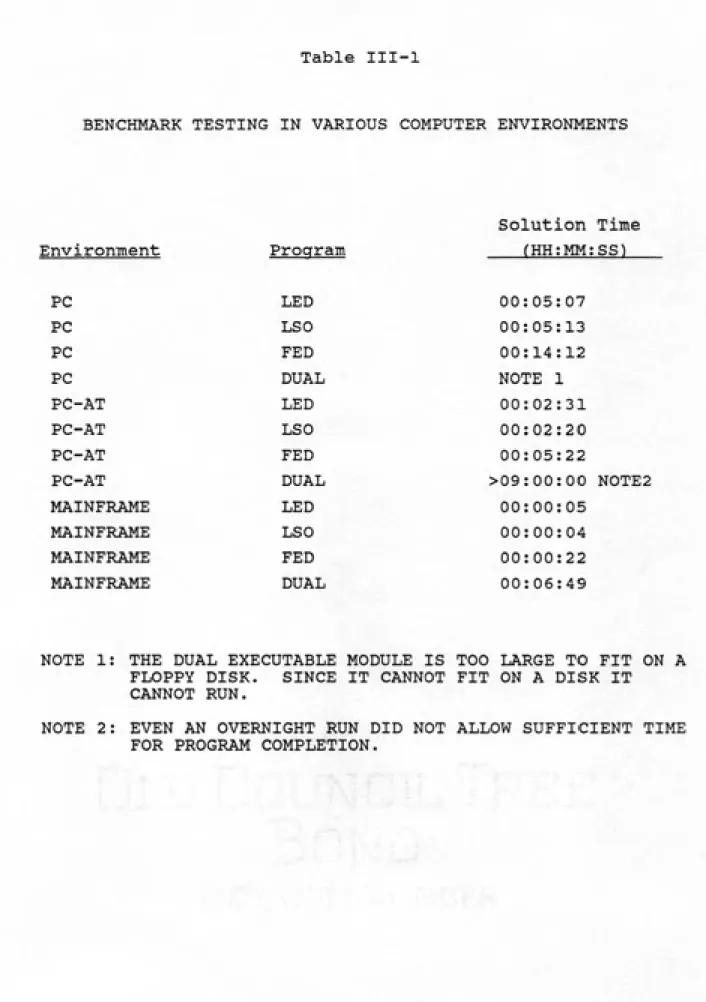
benchmark testing. Table III-l presents the performance of
a benchmark run in three different environments: the PC-AT,
an ordinary PC with a math coprocessor, and the mainframe.
The comparison attempted to isolate CPU time from
input/output time in order to report just the time spent
33
Table III-l
BENCHMARK TESTING IN VARIOUS COMPUTER ENVIRONMENTS
Environment
Procfram
Solution Time
fHH;MM;SS^
PC
PC
PC
PC
PC-AT
PC-AT
PC-AT
PC-AT
MAINFRAME
MAINFRAME
MAINFRAME
MAINFRAME
LED
LSO
FED
DUAL
LED
LSO
FED
DUAL
LED
LSO
FED
DUAL
00:05:07
00:05:13
00:14:12
NOTE 1
00:02:31
00:02:20
00:05:22
>09:00:00 N0TE2
00:00:05
00:00:04
00:00:22
00:06:49
NOTE 1: THE DUAL EXECUTABLE MODULE IS TOO LARGE TO FIT ON A
FLOPPY DISK. SINCE IT CANNOT FIT ON A DISK IT
CANNOT RUN.
NOTE 2: EVEN AN OVERNIGHT RUN DID NOT ALLOW SUFFICIENT TIME
3. Variation of influent
As the present research began, the computer simulation
models assumed constant soil column influent concentration.
The third change and the first major alteration of the
codes was the addition of variable influent concentration
capability. The modifications to the code allowed the
programs to accept both minor fluctuations in influent
concentration and drastic changes in influent concentration.
The user could now specify a constant influent concentration
or precisely steer the influent concentration. The
effluent boundary condition, the partial of concentration
with respect to location equals zero, remained unchanged.
The ability to control precisely the upstream boundary
condition was convenient when reproducing small experimental
fluctuations in the influent concentration. The control was
indispensable when studying sorption/desorption systems
where an elutriation phase follows a period of contaminant
feed.
A companion modification to the variable influent
provision was to add subroutines, INFOl and INF02, that
provide a detailed report of simulation status. As program
complexity increased the likelihood of blunders increased
dramatically. INFOl and INF02 helped to counteract this
natural tendency by displaying such relevant factors as
influent concentrations and the derivative of influent
35
programs were functioning properly, and to aid in
troubleshooting if they were not.
4. Variation of velocity
The fourth change was to accommodate a single update in
the soil column flow velocity at the time of contaminant
shutoff, should one occur. This was required because of a
peculiarity in the laboratory experimental design which
resulted in a change in contaminant velocity when
contaminant flow stopped and elutriation began.
5. Calculation of mass balance
The fifth and final change was the addition of an
automatic mass balance check. Numerical models, even ones
that are technically validated, always threaten an
unexpected numerical breakdown. These breakdowns were a
constant source of worry for the program operator since they
were not always obvious. Subroutines MASSl and MASS2
provided relief. The subroutines kept track of the
contaminant mass in the influent, contaminant mass in the
effluent, contaminant left in the soil, and contaminant left
in the fluid. By computing the ratio of input to accounted
mass at the end of each soil column simulation, these
subroutines assured the program operator that the
C. Studies with the numerical models
A six-step protocol for model development and
application drew ideas about the modeling process from a
paper by Thomann (1982).
MODEL DEVELOPMENT PROTOCOL
1. Formulate a model — a set of governing differential
equations plus boundary conditions — from consideration
of fundamental principles. Recast the model in terms of
a numerical scheme for solution.
2. Check the numerical model in an analytically tractable
scenario against an analytic solution. If it checks, the
model is technically validated.
3. Isolate and identify as many parameters as possible
through independent parameter determination.
4. Use an experimentally derived data set and force a fit
using parameters that could not be independently
established. Check that the parameters are plausible.
If the parameters are plausible and the prediction fits,
the model is calibrated, and operationally validated.
5. Take at least one more data set from a different set of
conditions and make a predictive run. If the prediction
fits the new data, the model is dynamically validated.
6. After every run perform a mass balance. This affords yet
another partial technical validation each time the model
37
Upon completion of the full set of activities from the
model development protocol at the lab scale, the research
returned to the original question of purge well analysis by
preparing an illustrative field-scale example.
Unfortunately, the lack of actual field-scale data prevented
application of the entire modeling process. The model was,
however, well suited to demonstrate the effect of the scale
of the problem on the prediction of the model.
The application of these modeling activities to Miller's
soil-column laboratory experiments and the illustrative
field scale model compose the subject matter of the next
A. Laboratory-scale analysis
This section details the results of the model
development protocol for the laboratory-scale analysis.
Technical validation precedes actual model use. One way
to make this validation is to compare predictions of the
numerical models against predictions of existing analytical
simulators from Miller (1984). When the predictions match,
it demonstrates that the central components of the numerical
models function correctly. Because this research uses
existing programs, the use of the technical validation is a
conservative approach.
The breakthrough curves produced in simplified,
analytically tractable situations follow in Figures IV-1
through IV-8. The curves appear in matched pairs that
present a numerical prediction and the corresponding
analytic prediction. The LED and FED predictions depict a
situation of contamination followed by elutriation. The LSO
FIGURE IV-1
0,9
0.8
z
o
1-
0,7
<
oc
t-z
0.6
LU
o z
o
o
0.5
a
u
M
0,4
-J
i
0,3
0.2
0,1
111 IIII mi mi in a
LED VALIDATION: ANALYTIC SOLUTION
wB)iiiiimi|HiiiniiiiiniiiiuiHiM«it
8
10
12
BED VOLUMES
2
O
1-<
ft: H 2
Ui
o
2
O o o
b!
-J
ft:
O
2
1
LEO VAUDATION:
NUMERICAL PREDICTION
r\ a
j^ 1 y-^
rv a
\
\
\
[3
\
1
[\
I
\
1
\
n 1 _
J
\
U. 1
0 -
ͣ aaDacjDoe^
/
\
^Qe*
3aDDaq3
8
10
12
z
o
I-z
Ul
o z
o o o
u
N
IT
O
z
1
0.9
0,8
0.7
0.6
0,5
0,4
0.3
0,2
0,1
FIGURE IV-3
LSO VALIDATION: ANALYTIC SOLUTION
.^^
.e--n
^
J^
y"
f^
^
ja
20
40
60
BED VOLUMES
LSO VALIDATION: NUMERICAL PREDICTION
<
I-z
o
O o
Q
Ui
M
o
z
0,9
0.8
0.7
0.6
0.5
0.4
0.3
0.2
0.1
r-r&
.^
^
ja13^
r
.y
^
3
-O0
y^
^^
ͣ
t-T
20
40
60
0,9
0.8
z
o
1—
0.7
<
a:
t-z
0.6
o z
o
o
0.5
o
u
N
0.4
—11
fX.
0.3
0.2
0.1
FIGURE IV~5
FED VALIDATION: ANALYTIC SOLUTION
i
^
\
/
\
/
\
/
\
L J J
/
/
/
iiHiiiiiiinffIr'
/
Vb,
8
BED VOLUMES
o
I-<
o z
o
o
o
u
O
i _,
FED VAUDATION-
NUMERICAL PREDICTION
-. 1—It—» 1—1 !^-i f—ti—1#-^»—• •—I r—i •"*»-«—.
1
^^BO^ 1 p^
\
\
1
n "7
\
\
[ 3
\
I
t 3t
\
1
\
J
\
U. 1
r-i r—if*nr-i r
/
N
'^^^^'^^ti
iDDaDct
0 —]
8
10
12
BED VOLUMES
FIGURE IV~7
DUAL VALIDATION: ANALYTIC SOLUTION
0.9
0.8
z
o
p
0.7
<
q:
1-2
0,6
o
2
o
o
0.5
a
Ul
M
0,4
~j
1
o
0.3
2
0.2
0,1
„«ee^
5&&°
^^^^l"~
^
^
/
V
^
/
y
20
40
60
DUAL VALIDATION: NUMERICAL PREDICTION
0,9
0.8
2 .
o
1-
0.7
<
CC
t-z
0.6
o z
o
o
0.5
N
O
0.4
0.3
0.2
0.1
^^^ 1
„o-^
^^^
^
,^^
1
^
X
^
/
^
/^
/
\y
0
20
40
60
BED VOLUMES
ͣ
48
The analytic and numerical models match almost
perfectly; the models are technically validated.
The next step — isolation and independent estimation of
as many parameters as possible — begins with
characterization of system hydrodynamics. The system is a
suite of three soil column reactors packed with Ann Arbor
granular aquifer material. The operational names of these
columns are column 15-1, column 16-1, and column 16-2.
Miller's laboratory tracer tests conducted with the
chloride ion provide the means to characterize each column's
hydrodynamics. An automatic nonlinear parameter estimator
program attached to the front end of one of the improved
simulator programs (LED) drives the simulator. The
parameter estimator program uses the IMSL subroutine ZXSSQ.
ZXSSQ uses the Levenberg-Marquardt algorithm for nonlinear
optimization. The estimator drives the simulator, varying
only hydrodynamic dispersion until the sum of the squares of
the residuals of the model prediction with respect to the
observed data reach a minimum.
Limitations on the size of the DUAL program restrict
analysis to models with 21 column nodes, although for ideal
numerical model operation theoretical considerations would
call for as many as 3 6 column nodes. A comparison with a
theoretically more favorable situation not presented here
demonstrates that the consequences of the 21-node limitation
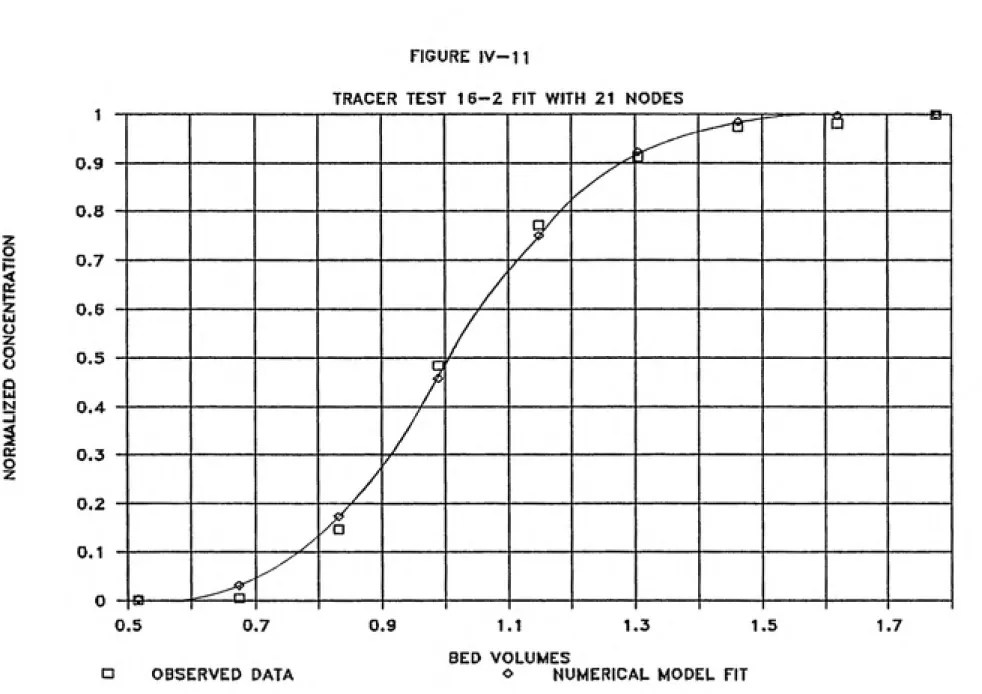
are minimal. Figures IV-9 through IV-ll illustrate the
Table IV-1 presents the optimal hydrodynamic dispersion
coefficient and dispersivity for each column as determined
by this research.
°h
a =where
a = longitudinal dispersivity (cm)
Dispersivity measures the tendency of the aquifer
material to cause dispersion and is independent of ground
FIGURE IV-g
z
o
o 2:
o
o
o
u N
tr
O
z
1
TRACER
TEST
15-1
FIT WITH 21
NODES
1
a
d
9
0 1
lJ,Tf
/
n "7 0, /
/
'
U.O
/
yjtA- —
/
rv 0
/
/
/
b
0.10 -
^
0.6
0.8
1,2
1.4
1.6
1.8
ͤ
OBSERVED DATA
BED VOLUMES
o NUMERICAL MODEL FIT
TRACER TEST 16-1 FIT WITH 21 NODES
0,9
0.8
z
o
1-
0.7
<
tc
V-z
0.6
Ulo
z
o
o
0.5
o
u
N
0.4
-J
1
ct
0.3
o
z
0.2
0,1
^
^^
—e-
---gI---1 n I---1
/
/
ͤA
/
J
D/
•t
/
/
/
ͣ
p -
.---E
^ei_
^^
0.1 0.3 0.5
ͤ
OBSERVED DATA
0.7
0.9
1.1
1.3
1.5
1.7
1,9
2.1
BED VOLUMES
FIGURE IV-11
TRACER TEST 16-2 FIT WITH 21 NODES
0,9
0.8
2
o
1—
0.7
<
ct H
2
0.6
LU o
2 .•,
o
o
0.5
o
u
N
0.4
Ui
i
a.
0.3
^
0.2
0.1
.^-^
^^^-j""" ͣ'
ͣ
a---
,---B-]
/
/
V
/
y
A
-La---.
^-^"D
0.5
0.7
0.9
1.1
1.3
1.5
1.7
ͤ
OBSERVED DATA
BED VOLUMES
Table IV-1
Fitted Hydrodynamic Parameters
The table lists optimal hydrodynamic parameters for
columns modeled with 21 nodes.
Hydrodynamic
Dispersion Longitudinal
Column Coefficient Dispersitivity
Number (cm /hr) _____(cm)_____
15-1 2.22 0.453
16-1 1.86 0.587
54
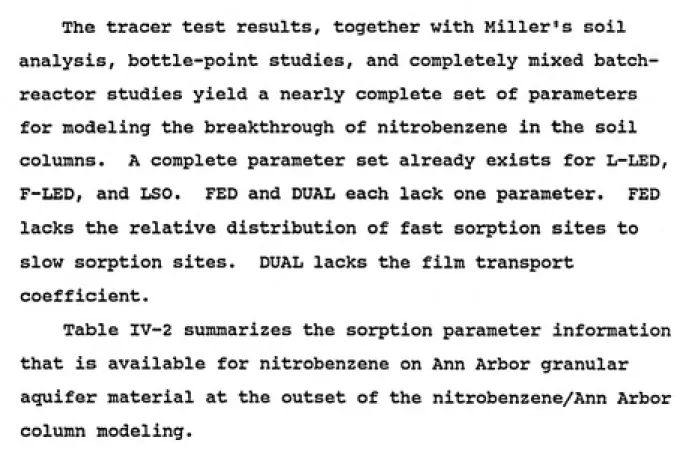
The tracer test results, together with Miller's soil
analysis, bottle-point studies, and completely mixed
batch-reactor studies yield a nearly complete set of parameters
for modeling the breakthrough of nitrobenzene in the soil
columns. A complete parameter set already exists for L-LED,
F-LED, and LSO. FED and DUAL each lack one parameter. FED
lacks the relative distribution of fast sorption sites to
slow sorption sites. DUAL lacks the film transport
coefficient.
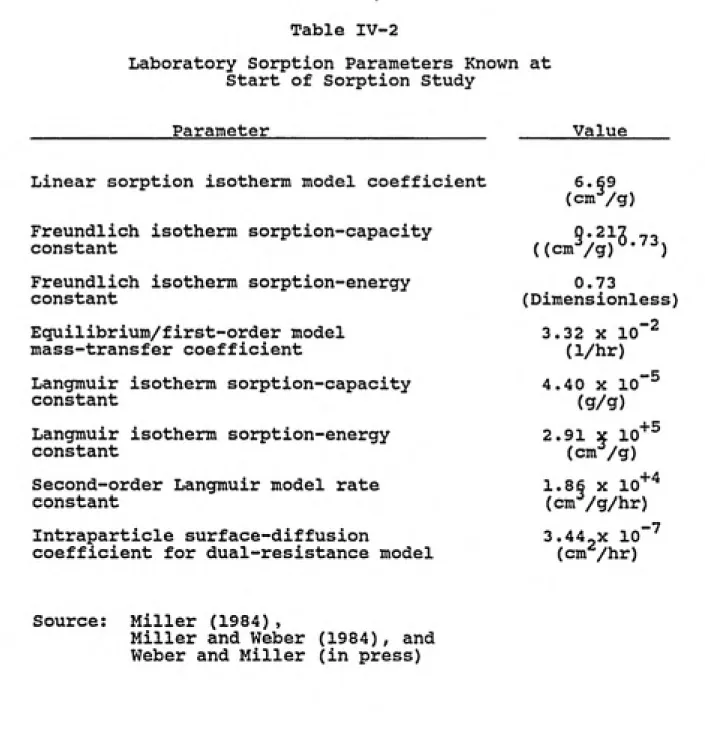
Table IV-2 summarizes the sorption parameter information
that is available for nitrobenzene on Ann Arbor granular
aquifer material at the outset of the nitrobenzene/Ann Arbor
Table IV-2
Laboratory Sorption Parameters Known at
Start of Sorption Study
Parameter
Value
Linear sorption isotherm model coefficient
Freundlich isotherm sorption-capacity
constant
Freundlich isotherm sorption-energy
constant
Equilibrium/first-order model
mass-transfer coefficient
Langmuir isotherm sorption-capacity
constant
Langmuir isotherm sorption-energy
constant
Second-order Langmuir model rate
constant
Intraparticle surface-diffusion
coefficient for dual-resistance model
6.69
(cm-^/g)
§•213 73
((cmVg)°-^^)
0.73
(Dimensionless)
.-2
32 X 10
(1/hr)
40 X 10
(g/g)
,91 X 10
(cmVg)
-5
+5
1.86 X 10"^'*
(cm /g/hr)
3.44-X 10"^
(cm'^/hr)
Source: Miller (1984),
56
Model calibration to determine the values of the
remaining parameters for nitrobenzene modeling follows
independent parameter estimation. In order to preserve a
fair comparison among the models, the runs treat one
parameter from each model as an unknown. This allows L-LED,
F-LED, and LSO to share the improved prediction capability
afforded by calibration. The runs treat hydrodynamic
dispersion as unknown for L-LED and F-LED, and treat the
second-order rate constant as unknown for LSO.
Calibration begins with the first nitrobenzene / Ann
Arbor data set, number 15-1. Calibration fits the one
missing parameter for each model. The objective function is
to minimize the sum of squares of model residuals. The IMSL
automatic estimator ZXSSQ encounters operational
difficulties for LSO and FED models so progressively finer
grid searches find the best fit. A grid search on k^ also
finds the best fit for the DUAL model because an automatic
parameter estimation would require an unacceptably large
amount of computer time — something in the range of
several CPU-hours for a single run.
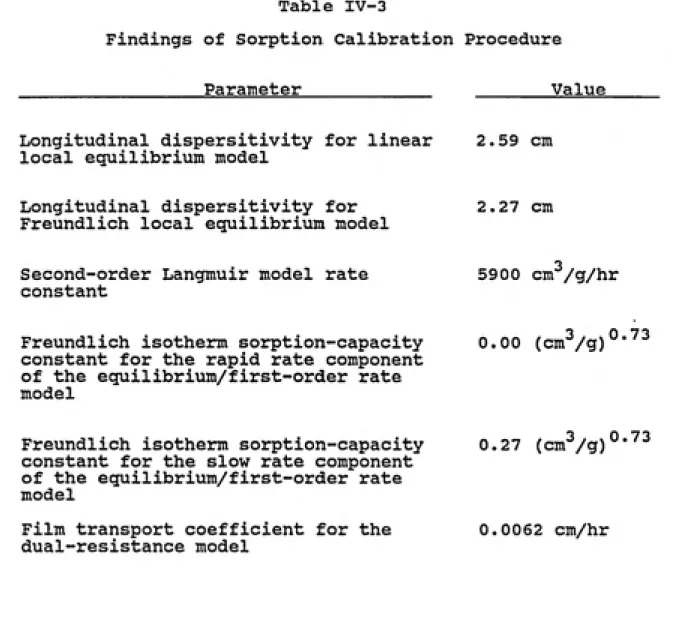
Table IV-3 presents the findings of the calibration
Table IV-3
Findings of Sorption Calibration Procedure
Parameter
Value
Longitudinal dispersitivity for linear 2.59 cm
local equilibrium model
Longitudinal dispersitivity for
Freundlich local equilibrium model
2.27 cm
Second-order Langmuir model rate
constant
5900 cm /g/hr
Freundlich isotherm sorption-capacity
constant for the rapid rate component
of the equilibrium/first-order rate
model
0.00 (cm^/g)°''^^
Freundlich isotherm sorption-capacity
constant for the slow rate component
of the equilibrium/first-order rate
model
Film transport coefficient for the
dual-resistance model
0.27 (cmVg)°'^"^
58
Comparison of Table IV-2 with Table IV-3 provides
favorable information: For the three models where parameter
estimation is not absolutely necessary, the parameter values
do not shift dramatically.
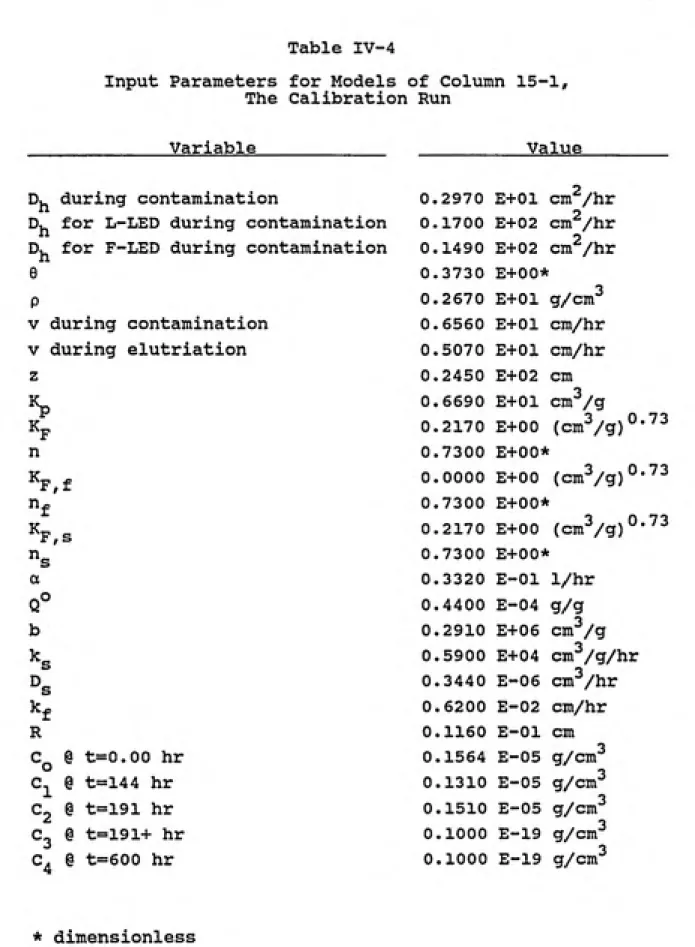
Plotting the model predictions for column 15-1 along
with the experimental breakthrough measurements provides
means to assess whether the calibrations are successful.
Table IV-4 presents the input parameters for each model.
Table IV-4
Input Parameters for Models of Column 15-1,
The Calibration Run
Variable
Value
Dv^ during contamination
Dy^ for L-LED during contamination
D, for F-LED during contamination
e
V during contamination
V during elutriation
n
K.
K
a
b
k
F,f
F,s
s
R
C,
@ t=0.00 hr
@ t=144 hr
@ t=191 hr
@ t=191+ hr
@ t=600 hr
0.2970 E+01 cm /hr
0.1700 E+02 cm^/hr
0.1490 E+02 cm^/hr
0.3730 E+00*
0.2 670 E+01 g/cm^
0.6560 E+01 cm/hr
0.5070 E+01 cm/hr
0.2450 E+02 cm
0.6690 E+01 cm-^/g
0.2170 E+00 (cm-^/g)°"'^^
0.7300 E+00*
0.0000 E+00 (cm-^/g)°*^-^
0.7300 E+00*
0.2170 E+00 (cm-^/g)^''^-^
0.7300 E+00*
0.3320 E-01 1/hr
0.4400 E-04 g/g
0.2910 E+06 cm^^/g
0.5900 E+04 cm-^/g/hr
0.3440 E-06 cm-^/hr
0.6200 E-02 cm/hr
0.1160 E-01 cm
0.1564 E-05 g/cm"^
0.1310 E-05 <3/ctP
0.1510 E-05 g/cm^^
0.1000 E-19 g/cm'^
0.1000 E-19 g/cm-^
FIGURE IV~12
15-1, LINEAR LED, 1 PARAMETER FIT
z
o
I-2
Ui
o z
o
o
a
u
N
o
z
20
40
60
80
100
120
ͤ
OBSERVED DATA
BED VOLUMES
o NUMERICAL MODEL FIT
15-1, FREUNDLICH LED, 1 PARAMETER FIT
0.9
0.8
2:
F
0.7
<
oc
Y-z
0.6
Ul
0
z
0
0
0.5
0
u
N
0.4
-Jt
fX.
0.3
0
z