ACKNOWLEDGMENTS
I would like to acknowledge the assistance and guidance from Shu Wen Ng, PhD, my master’s paper advisor at UNC who helped guide me through this entire process. Additionally, thanks to my academic advisor Janice Sommers who helped shape my two years of graduate school. My graduate school experience would have been entirely different had it not been for her support and advice.
EXECUTIVE SUMMARY
Chronic diseases are increasing in the American population, leading to skyrocketing healthcare costs, often paid by taxpayer dollars and burdening employer-sponsored insurance plans. Lifestyle
modification can greatly reduce the incidence and severity of these diseases, leading many worksites to consider wellness initiatives. Hospitals are a natural environment to implement employee wellness policies which, unlike wellness programs, do not necessarily require ongoing funding, and can provide passive benefits to hospital employees, patients and visitors. Hospitals almost always have a mission statement related to health improvement and are one of the largest employers in many American communities.
NC Prevention Partners (NCPP) is a non-profit organization working to reduce illness and death attributed to tobacco, poor nutrition and physical inactivity in North Carolina. NCPP focuses on comprehensive wellness assessments for worksites, including hospitals, and has been successful in improving the ‘healthy food environments’ in many hospitals throughout the state of North Carolina, now expanding in future states, including South Carolina.
Using both qualitative and quantitative research, this paper will describe, examine, and compare the implementation of hospital nutrition wellness policies and environments in the ‘Red Apple Project’ in North Carolina and ‘Working Well’ in South Carolina by providing key differences and lessons learned for future expansion of NCPP’s work.
Key informant interviews were conducted with staff members from NCPP and SCHA who were or are heavily involved with these healthy hospital initiatives. Additionally, reports were obtained from NCPP and SCHA, providing data regarding numbers and dates of hospitals earning Red or Gold Apples, criteria used to qualify hospitals for such awards, and data about the types of hospitals.
The reach and rates of uptake differed between the two states’ campaigns; however they both reached similar types of hospitals. In NC, only two out of 95 hospitals were unable to maintain Red Apple status, showing that sustainability is not at risk, despite evolving higher standards required by NCPP.
EMPLOYEE WELLNESS POLICIES IN HOSPITALS
The leading causes of death and disability in our nation are directly impacted by modifiable lifestyle choices. Such chronic diseases, including obesity, diabetes and cardiovascular disease, have led to significant increases in healthcare costs, much of which is paid for by taxpayer-funded Medicare and Medicaid1. Worksite wellness initiatives have received much attention in recent years, as a potential way to improve employee health and productivity, and reduce healthcare and absenteeism-related costs.
However, there is mixed evidence on the success of worksite wellness programs in obesity and
cardiovascular disease reduction as it relates to cost, return on investment and sustainability2. Programs that include group classes, individual counseling, and employee challenges, for example, may be
expensive to implement and not attract the employees who could most greatly benefit from chronic disease risk reduction. Worksite wellness policies, on the other hand, can circumvent these concerns. They do not necessarily require ongoing funding like a program would, and can provide passive benefits to hospital employees, patients and visitors.
Hospitals are a natural environment to implement employee wellness policies. Not only do they have missions focused on improving community health, hospitals are also one of the largest employing sectors in the nation, with nearly 5.5 million employees3. Any change made at the institutional or environmental level within a hospital can have an impact on not only employees, but patients and visitors as well. Additionally, many hospitals have the resources needed to successfully implement comprehensive wellness strategies, such as on-site nutrition and health professionals to provide education and care. For self-insured hospitals, the ability to decrease healthcare claim costs for
employees is a large source of motivation, in addition to improving employee morale, recruitment, and limiting turnover.
It is important to note that the wellness policies discussed in this paper are organizational policies rather than governmental. They are created by hospital administration, often with the support of the
State hospital associations, which represent member hospitals, work to promote access to, delivery and quality of health care within their respective states. In terms of worksite wellness, hospital associations are critical in promoting and networking among hospitals for technical support and resources, reducing the workload for member hospitals who want to achieve improvements in their wellness policies and environments.
The recent federal legislation regarding health care reform also impacts worksite wellness policies, whether directly or indirectly. For example, the 2010 Affordable Care Act (ACA) will require worksites to accommodate employees with reasonable space and time for breastfeeding or pumping4. Recognizing the cost-savings of many wellness initiatives focusing on prevention, the ACA will also provide grants to small businesses enabling them to create and implement worksite wellness programs, adherent to specific guidelines. While not directly related to worksite wellness, the ACA also mandated menu labeling for chain restaurants with more than 20 locations. This could lead to changes in cultural norms and education around calorie labeling, perhaps increasing comprehension and support for menu labeling within worksite cafeterias. Many of these federal ACA changes will not take effect until 2014, but still represent a shifting focus to good public health and prevention.
In 2010, the National Center for Chronic Disease Prevention and Health Promotion, as part of the Centers for Disease Control and Prevention (CDC), convened an expert panel on nutrition, physical activity, tobacco and breastfeeding-related policies and environments in hospitals. Following this two-day meeting, the panel’s recommendations and approaches were summarized in a publication entitled “Healthy Hospital Choices”5. Fifteen recommendations were provided among five sessions. Session 1 is most relevant to this policy brief. Entitled “Food and Beverage Environments”, the panel’s
recommendations were as follows:
1. Hospitals and public health practitioners can collaborate to establish healthy food/beverage standards and measures addressing employee, community and environmental health for hospital venues.
2. Hospitals can support food and beverage environmental change strategies (e.g., access, pricing, product placement, and menu labeling strategies).
These recommendations were partially informed by the work of a public health nonprofit organization in North Carolina, NC Prevention Partners (NCPP), as well as other hospital success stories, and are now used to inform the hospital industry at large about the importance of healthy hospital policies and environments.
ROLE OF NC PREVENTION PARTNERS
NC Prevention Partners (NCPP) was created in 1998 as a statewide non-profit organization with the goal of reducing illness and death attributed to tobacco, poor nutrition and physical inactivity6. NCPP’s ‘Healthy NC Hospitals’ initiative began in 2006, when the Duke Endowment provided funding for NCPP to partner with the North Carolina Hospital Association (NCHA) and work towards tobacco-free policies and campuses. Nutrition was the next focus with additional funding in 2008 for the statewide ‘Red Apple Project’.
Figure 1: Timeline of Key NCPP Accomplishments
In 2013, NCPP now has a comprehensive wellness assessment for worksites, including hospitals,
available evidence. At the completion of each module, the organization’s score is presented as a letter grade, “A+” through “F”. In addition to the baseline assessment, NCPP follows-up with each organization for site visits and technical assistance, and requires annual reassessments to ensure long-term,
sustainable wellness solutions. Currently, NCPP recognizes the following awards for eligible hospitals: Gold Apple – Nutrition
Gold Star – Tobacco
Gold Medal – Physical Activity
Gold Heart – Patient Tobacco Cessation
Through these assessments and tailored recommendations, NCPP aims to assist organizations in establishing effective wellness policies, benefits and environments that will improve the health of all employees. Although completely voluntary, NCPP’s hospital initiatives have had a high level of participation, partly due to industry competitiveness, promotion from the North Carolina Hospital Association, and annual awards and recognition for high-achieving hospitals. Demonstrating its outstanding reach, NCPP has engaged all acute-care hospitals within North Carolina, and has also had the opportunity to expand to hospitals and other worksite organizations in South Carolina and New York, with plans for future expansion in additional states.
NC PREVENTION PARTNERS’ INITIATIVES IN HOSPITALS ACROSS NORTH AND SOUTH CAROLINA This paper will describe, examine, and compare the implementation of hospital nutrition wellness policies and environments in the ‘Red Apple Project’ in North Carolina and ‘Working Well’ in South Carolina, providing key differences and lessons learned for future expansion of NCPP’s work.
The process of data collection for this paper’s examination and comparison required both qualitative and quantitative research. Key informant interviews were conducted with staff members from NCPP and SCHA who were or are heavily involved with these healthy hospital initiatives. Additionally, reports were obtained from NCPP and SCHA, providing data regarding:
The number of NC and SC hospitals achieving Red or Gold Apple status and respective award dates;
Database report on every WorkHealthy AmericaSM assessment taken online from NC and SC hospitals since 2009.
‘RED APPLE PROJECT’ IN NORTH CAROLINA
The ‘Red Apple Project’ was a statewide initiative conducted by NCPP in partnership with the North Carolina Hospital Association (NCHA) from 2008-2010 that aimed to help hospitals achieve a healthy food environment. This campaign was the precursor to the current Gold Apple awards and WorkHealthy America℠ wellness assessment, and focused on implementing a healthy food environment in each NC hospital. The 5 core principles of a healthy food environment, as defined by NCPP’s Red Apple Project, are very similar to the recommendations laid out by the CDC in Healthy Hospitals Choices, and are as follows7:
NCPP’s Principles of a Healthy Food Environment
1 Provide access to healthy foods at all times using standard nutrition criteria 2 Promote healthy items with pricing incentives
3 Use marketing techniques, including nutrition labeling, to educate and encourage healthy items 4 Provide preventive benefits and wellness incentives to encourage long-term behavior change 5 Implement education campaigns to promote healthy foods to staff and visitors
Table 1: Principles of a Healthy Food Environment
By 2011, NCPP had engaged all North Carolina acute-care hospitals and had led over 90 to Red Apple status. Today, the standard has been set even higher and is now re-named the Gold Apple, challenging worksites to continue new wellness initiatives and improvements. Achieving a grade A in the
WorkHealthy AmericaSM nutrition module is the central requirement to achieve this standard, in
addition to verification documentation and telephone or on-site review. The standards set by NCPP also evolve as the evidence behind nutritional science, policy and worksite wellness develops. In fact, a new and updated nutrition module will be released in the summer of 2013, reflecting updated science for which nutrition policies and interventions have the highest level of evidence.
Lessons learned from Red Apple Project in NC
engagement at the hospital level … and peer-to-peer support / benchmarking”8. NCPP developed case studies, best practice sharing and ‘Centers of Excellence’ to promote hospitals’ success and share with others. NCHA was also an active partner with NCPP to engage their member hospitals and enhance communication within the industry.
Thornhill also noted three key stakeholder groups within the hospital setting that needed to be supportive of nutrition policy and environmental change. These groups include hospital executives (Chief Executive Officer, Financial Officer, Operations Officer, Human Resources, etc.), the food service director and staff (whether self-managed or through a contract food service management company) and the wellness team. Earning trust and support from each stakeholder group was critical, even though their motives, concerns and priorities were not the same. For example, executives “tended to care about risk of revenue loss, employee satisfaction and community relationships”, Thornhill learned8. Revenue generation was also a concern for food service, in addition to customer service. Wellness teams, on the other hand, were focused on “employee engagement, cross-promotion of existing [wellness] initiatives, and often distracted by issue fatigue”8. In order to appeal to these diverse groups, NCPP developed messaging for each group, tailored to their individual concerns.
Stakeholder Group Priorities
Executives Revenue, Employee Satisfaction, Community Relationships Food Service Department Revenue, Customer Service
Wellness Team Employee Engagement, Existing Wellness Initiatives Table 2: Red Apple Project – Stakeholders and Priorities
assessment for their evolving, evidence-based standards. A challenge for many hospitals in this re-assessment is maintaining changes in the foodservice department, due to changes in contracts and management personnel. For this reason, comprehensive policy change is recommended by NCPP to avoid the conflicts of waning enthusiasm or competing priorities and challenges.
During the course of the ‘Red Apple Project’, there were 95 Red Apples awarded to hospitals throughout the state, with a wide geographical distribution7.
EXPANSION INTO SOUTH CAROLINA: THE ‘WORKING WELL’ CAMPAIGN
The Working Well campaign, a collaboration between NCPP and the South Carolina Hospital Association (SCHA), began in 2011 with a 3-year funding agreement. As opposed to the Red Apple Project, which was funded specifically to focus on hospitals’ healthy food environments only (the nutrition component of worksite wellness), Working Well brought the entire WorkHealthy AmericaSM wellness assessment to hospitals, thus requesting action in all four areas of worksite wellness (nutrition, physical activity, tobacco, culture of wellness)9. Therefore, SC hospitals were eligible to work towards multiple types of awards, such as the Gold Apple, Gold Star, Gold Medal and/or Gold Heart. This paper, however, is only focused on hospitals earning the Gold Apple award (nutrition component).
According to the South Carolina Hospital Association, the key features of Working Well include9:
1. Focus on policy, environment and systems level 2. Enhance, align and sustain current wellness initiatives 3. Recognize the cost of doing nothing
4. Create a culture of wellness
5. Make the healthy choice the easy choice
6. Take care of your most valuable asset – your employees
SCHA hired a full time manager, Jen Wright, who assisted with campaign activities such as hospital recruitment, site visits, webinars and communication. 2011 celebrated not only the kick-off for Working Well, but also the first Gold Apple awards. In 2013, SCHA continues to recruit and engage new hospitals throughout the state, with 51 hospitals already engaged and having completed the WorkHealthy AmericaSM assessment.
areas, especially our quality initiatives, so when Working Well was introduced the way it was, it was viewed in the same way” noted Wright10. SCHA also led by example, completing the WorkHealthy AmericaSM modules for their own organization and including employee wellness in their strategic plan. During the two years of Working Well’s existence, there has been success at a variety of hospitals. Additionally, Working Well has also been identified as a best practice strategy in 2012 for South Carolina’s Community Transformation Grant, and is now included for communities to select as their worksite wellness strategy.
Wright shared that there is not a clear advantage for large versus small hospitals, rural versus urban, community or academic. However, she does believe there to be a difference in whether a hospital self-manages their food service operations or uses a contract management company. Currently, 80% of the South Carolina hospitals who have been awarded Gold Apples use contract food service management companies, including the first three Gold Apple award recipients10. Wright noted “that the self-managed [hospitals] have a more difficult time [meeting the nutrition standard] since they are creating the infrastructure... contract companies already have the infrastructure that meets the standard”10. NCPP, as part of the WorkHealthy AmericaSM program, does not in itself provide any of this infrastructure or programming to hospitals, but can link hospitals to organizations, resources or companies that can meet their needs. This echoes the same ‘advantage’ that NCPP found in NC
COMPARING THE RED APPLE PROJECT IN NC TO WORKING WELL IN SC
Differences in requirements due to timing of initiatives
The Red Apple Project, in 2008, was NCPP’s first initiative related to healthy food environments in hospitals. During those initial years, the only requirements needed by NC hospitals to earn the Red Apple project were implementing all five principles of a healthy food environment (see Table 1). In 2011, when WorkHealthy AmericaSM (WHA) was released, hospitals now had to meet the ‘standard’ by earning an “A” in the Nutrition module of WHA. In addition to the principles of a healthy food environment, the WHA nutrition module also introduced important policy level requirements for individual hospitals like:
Implementing a Healthy Food Policy
Including Medical Nutrition Therapy as an insurance benefit for all employees
Due to the progression and expansion of the Red Apple Project to become Gold Apple awards in multiple states (including North Carolina), there is a slight difference in the requirements met by ‘early’ NC Red Apple winners to current Gold Apple winners. Despite these differences, hospitals are asked to continue to meet the higher standard, as annual re-assessments are required to maintain their Gold Apple status. Therefore, early Red Apple winners who are now Gold Apple winners have had to meet the ever-raising bar in WHA. Figure 2, below, graphically displays the requirements, contrasting those from the original Red Apple Project to the current Gold Apple awards in both states.
Rates of Uptake
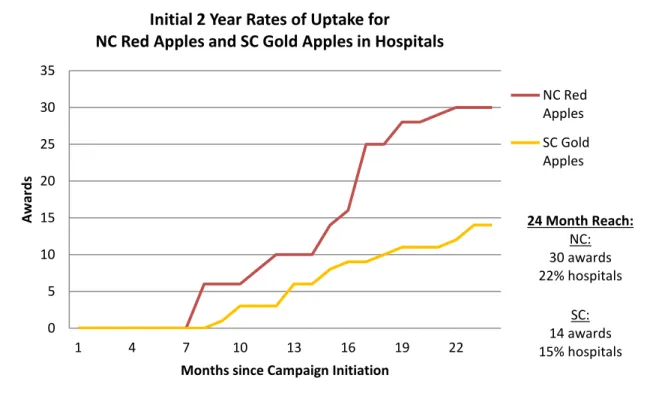
The rate of uptake is an important quantitative measure of the performance of these initiatives. Figure 3 shows the rates of uptake for the two campaigns: The Red Apple Project in North Carolina, and Working Well in South Carolina, and measures the number of awards given for the initial two years. In both states’ campaigns, there was a 6-8 month time period before any awards were earned, likely the time during which hospitals were working to make changes to their food environments and policies. After that time period, there is a steady growth from both states, although slower in SC. This could possibly be attributed to the fact that the Working Well campaign charged hospitals with achieving standards in nutrition, physical activity, tobacco and culture of wellness, whereas the Red Apple Project in NC targeted nutrition alone. This means that while NC hospitals were only working towards the Red Apple, SC hospitals were focusing efforts in a wide variety of wellness targets to work towards the Gold Apple, Gold Star, Gold Medal or Gold Heart (representing achievements in nutrition, tobacco, physical activity or patient tobacco cessation, respectively). Another contributing factor to a slower rate of uptake in SC is that the Gold Apple is a higher standard, so arguably more time-consuming to reach than the Red Apple.
Figure 3: Comparing initial 2 year rates of uptake between NC and SC Hospitals 0 5 10 15 20 25 30 35
1 4 7 10 13 16 19 22
A
war
d
s
Months since Campaign Initiation
Initial 2 Year Rates of Uptake for
NC Red Apples and SC Gold Apples in Hospitals
NC Red Apples
SC Gold Apples
24 Month Reach:
It is also important to note that there are 50% more hospitals in NC than in SC (137 and 91 members of their respective state hospital association, respectively); therefore you would expect a higher number of NC hospitals to achieve the award by the end of the 24 month period. Looking at this uptake data by percentage of member hospitals, the Red Apple Project awarded 22% of NCHA member hospitals within the first 24 months, while Working Well awarded the Gold Apple to 15% of SCHA member hospitals. This represents a slightly lower reach in SC, but again this paper is not including other awards that the hospitals might have achieved in other non-nutrition areas.
Regarding the rate of uptake, it is interesting to note that these campaigns tended to have months where many more awards were given, rather than a consistent slope month to month. Sharp increases in awards often correlate to deadlines for recognition, such as NCPP’s annual meeting each June which explains the large jump in NC Red Apples earned in month 17 on the graph.
Hospital Characteristics
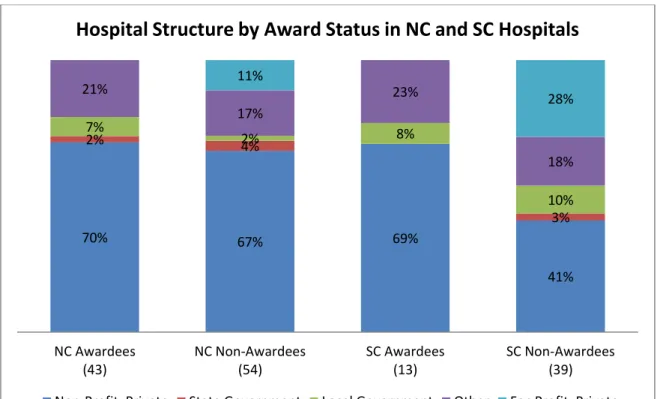
The following data describe hospitals in both NC and SC who have been awarded either the Red Apple or Gold Apple, and were taken from NCPP’s database of WorkHealthy AmericaSM (WHA) assessments. To date, there have been 95 NC hospitals and 14 SC hospitals which have been given these awards. Due to the nature of this data collection, this data may not reflect hospitals who won their awards prior to WHA. However, those hospitals, assuming compliance with annual reassessments, should still be included in WHA assessments from following years.
Figure 4: Hospital Structure by Award Status
Figure 5: Employee Count by Award Status
70% 67% 69%
41%
2% 4%
3% 7%
2% 8%
10% 21% 17% 23% 18% 11% 28% NC Awardees (43) NC Non-Awardees (54) SC Awardees (13) SC Non-Awardees (39)
Hospital Structure by Award Status in NC and SC Hospitals
Non-Profit, Private State Government Local Government Other For-Profit, Private
14% 19%
8% 28% 33% 35% 38% 28%
23% 19% 23%
23%
7% 2%
5%
9% 9%
15%
13%
14% 17% 15%
3% NC Awardees (43) NC Non-Awardees (54) SC Awardees (13) SC Non-Awardees (39)
Employee Count by Award Status in NC and SC Hospitals
Regarding employee count, there is a fairly similar number of large and small hospitals receiving these awards, although more small hospitals (<500 employees) are in the non-awarded group in each state (14% vs. 19% in NC, 8% vs. 28% in SC). This may indicate that smaller hospitals have limited resources and require more assistance and time in order to achieve various nutrition wellness standards, an important consideration for future expansion of NCPP’s work.
Sustainability
As mentioned previously in this paper, the Red and Gold Apple initiatives by NCPP were always intended to produce long-term, sustainable wellness solutions for hospitals. For this reason, annual
reassessments are a critical component to ensuring that actions taken by hospitals are maintained, as well as new actions taken. Anne Thornhill mentioned that this is especially important in the foodservice management and operations of hospitals, as health and wellness-focused initiatives often come and go, as well as foodservice directors, each with his or her own priorities. Using the data provided for this paper, there seem to be only two NC hospitals which achieved an “A” grade on the WHA nutrition module, only to lose this status in following years. One such hospital was a medium-sized, non-profit hospital who earned an “A” in 2010, but only a “B” in 2013. A second hospital earned the Red Apple award during the initial campaign, but was unable to earn an “A” in the nutrition module when WHA was released in 2011. However, compared to 93 other hospitals that have been able to earn and
maintain their status, it is clear that NCPP is successful at creating sustainable nutrition wellness policies and environments, through tailored support and resources.
SUMMARY OF FINDINGS AND RECOMMENDATIONS FOR FUTURE STATE EXPANSION EFFORTS This paper has described, examined and compared the implementation of hospital nutrition wellness policies environments in NC and SC via NCPP’s initiatives. While the reach and rate of uptake differed between the two states (see Figure 3), these hospital initiatives reached similar types of hospitals (see Figures 4 and 5). A slower rate of uptake in SC may be related to the broad focus of multiple wellness components simultaneously (nutrition, tobacco, physical activity) as compared to NC’s Red Apple Project which had a nutrition-only focus. Therefore, for future states, it may prove beneficial to guide hospitals to focus on one area at a time, enabling success (award) sooner, which will in turn garner support and motivation for future wellness-related policy or environmental changes.
Working with state hospital associations proved to be a critical strategy, due to these organizations’ respect within the industry, resources and communication channels. Additionally, both the NC and SC campaigns recognized that hospitals with contract foodservice systems seemed better equipped to make the necessary food environmental changes needed for Red or Gold Apple status. Therefore, it is recommended that NCPP promote resources for those hospitals without contract foodservice
management.
‘Gradually raising the bar’
The WorkHealthy America assessment modules were released in 2011, and graded worksites’ wellness environments and policies based on the latest available scientific evidence. Due to the evolving fields of worksite wellness and public health nutrition, evidence-based recommendations have changed. For this reason, a newly updated nutrition module for WHA will be released in summer 2013, reflecting the most accurate evidence behind nutrition recommendations for worksite wellness. This includes new
Recommendations
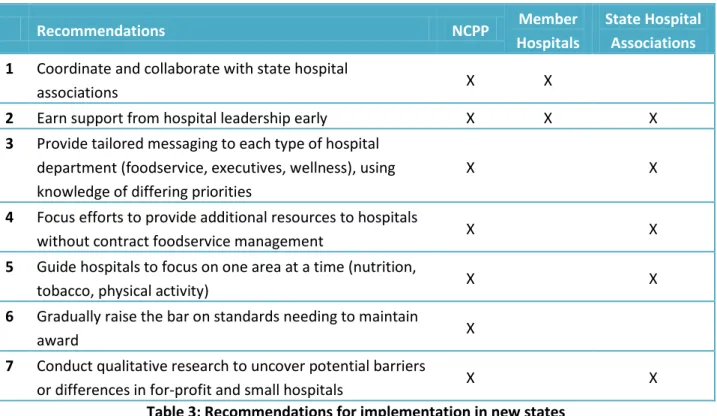
NCPP has already been in communication with additional states for expanding WHA, including New York, Virginia and Oklahoma. With a small staff centralized in Chapel Hill, NC, changes will be required in order to provide the same level of tailored support and resources to states in other parts of the country. Thus, collaboration with key partners, such as state hospital associations, will be even more important to ensure the viability of these programs. Table 3, below, summarizes some key recommendations for future state campaigns to consider in the implementation of nutrition wellness policies and
environments in hospitals.
Recommendations NCPP Member
Hospitals
State Hospital Associations 1 Coordinate and collaborate with state hospital
associations X X
2 Earn support from hospital leadership early X X X
3 Provide tailored messaging to each type of hospital department (foodservice, executives, wellness), using knowledge of differing priorities
X X
4 Focus efforts to provide additional resources to hospitals
without contract foodservice management X X
5 Guide hospitals to focus on one area at a time (nutrition,
tobacco, physical activity) X X
6 Gradually raise the bar on standards needing to maintain
award X
7 Conduct qualitative research to uncover potential barriers
or differences in for-profit and small hospitals X X Table 3: Recommendations for implementation in new states
REFERENCES
1. Finkelstein EA, Trogdon JG, Cohen JW and Dietz W. Annual medical spending attributable to obesity: Payer-and-service-specific estimates. Health Affairs. 2009;28(5):w822-w831
2. Thorndike, AN. Workplace interventions to reduce obesity and cardiometabolic risk. Curr Cardiovasc RiskRep. 2011;5(1):79-85.
3. American Hospital Association. The Economic Contribution of Hospitals.
http://www.aha.org/research/reports/13econimpact.shtml. Accessed February 26, 2013.
4. United States Department of Labor. Fact Sheet #73: Break Time for Nursing Mothers under the FLSA. http://www.dol.gov/whd/regs/compliance/whdfs73.htm. Revised December 2010. Accessed March 5, 2013.
5. National Center for Chronic Disease Prevention and Health Promotion. Division of Nutrition, Physical Activity, and Obesity. Healthy Hospital Choices: Promoting Healthy Hospital Food, Physical Activity, Breastfeeding and Lactation Support and Tobacco-free Choices: Recommendations and Approaches from an Expert Panel. http://www.cdc.gov/nccdphp/dnpao/hwi/docs/HealthyHospBkWeb.pdf. Accessed November 30, 2012.
6. NC Prevention Partners: Making Healthy Choices Easier for North Carolina.
http://www.ncpreventionpartners.org/dnn/AboutUs/HistoryMission/tabid/99/Default.aspx. Accessed January 4, 2013.
7. NC Prevention Partners. Healthy NC Hospitals: Red Apple Project.
http://www.ncpreventionpartners.org/dnn/WhatWeDo/Programs/HealthyNCHospitals/RedApplePr oject/tabid/306/Default.aspx. Accessed January 4, 2013.
8. Thornhill, Anne. Personal interview. February 20, 2013.
9. South Carolina Hospital Association. Working Well. http://www.scha.org/working-well. Accessed February 10, 2013.
10. Wright, Jennifer. Personal interview. March 6, 2013.
11. Aramark Healthcare. http://www.aramark.com/Industries/Healthcare/. Accessed March 11, 2013. 12. Morrison Healthcare Overview. http://www.iammorrison.com/Healthcare_Overview.aspx. Accessed
13. Partnership for a Healthier America. PHA Announces New Partners: Morrison, Varsity Brands and Leading EHR Vendors. http://ahealthieramerica.org/media/news-releases/#2981,news. Published March 7, 2013. Accessed March 11, 2013.
14. Loewenstein G, Brennan T, and Volpp KG. Asymmetric paternalism to improve health behaviors.
JAMA. 2007;28(20):2415-7