EFFECTS OF 8 WEEKS CORE STRENGTH TRAINING ON CORE
MUSCLE STRENGTH AMONG YOUNG MALE CYCLISTS
Stephanie Chok
Sport Science, Faculty of Psychology and Education, Universiti Malaysia Sabah, Malaysia
Email: [email protected]
(Received 13 March 2019; accepted 19 August 2019; published online 30 July 2020)
To cite this article: Chok, S. (2020). Effects of 8 weeks core strength training on core muscle strength among young male cyclists. Malaysian Journal of Movement, Health & Exercise, 9(2),
9-16. https://doi.org/10.15282/mohe.v9i2.383 Link to this article:https://doi.org/10.15282/mohe.v9i2.383
Abstract
This study aimed to determine whether 8 weeks of a core strength training program with three sessions weekly can improve cyclists’ core muscle strength. Six healthy male junior cyclists (age 15.8 ± 1 years, mass 62 ± 4 kg, height 170.2 ± 6 cm) volunteered for the study. Participants were instructed to perform five types of core exercises per session for a total of 24 sessions. For every session, each movement was performed in 20 repetitions for three sets. Comparison of pre- and post-test data revealed significantly greater (p < 0.05) gains in this case study. These results suggest that it is important for coaches to incorporate core strengthening exercises in their training routines.
Keywords: Core strength, core exercise, core muscle, cycling, training
Introduction
Muscle strength contributes to performing many activities unique to sports and greatly affects athletic performance. Furthermore, the core muscles are one of the most important components of these muscle activations. According to Kocahan and Akınoğlu (2018), the core muscles consist of the diaphragm at the upper section, abdominal and oblique muscles at the front and lateral sections, paraspinal and gluteal muscles at the back, and pelvic floor and hip junction at the lower section.
Additionally, focusing on core strength can help athletes stabilize other weak areas to reduce the risk of injury (Tinto, Campanella, & Fasano, 2017). Esser (2017) state that back pain is a frequent problem for swimmers, especially for master swimmers, which the cause seems to be insufficient core strength. It is important for coaches to incorporate core strengthening exercises in their training routine.
Lee and McGill (2017) have shown that core exercise is a basic part of many physical training regimens with goals ranging from rehabilitation of spine to improving athletic performance and influence performance and injury resilience for a brief period. His study also confirms that short-term isometric core training increases performance for both experienced and inexperienced athletes.
Core training programs can be incorporated safely in regular training to improve core muscle strength, which can eventually lead to better performance (Bashir, Nuhmani, Dhall, & Muaidi, 2018). Traditional sit-up exercise is a simple method to strengthen core muscles (Bae et al., 2018).
For cycling, as well as in everyday life, core strength is very important. Cyclists obviously need strong legs, but these are stronger if they are accompanied by a strong core to drive powerful pedal strokes (Agur, 2014). Whether tackling a long climb, powering down for a burst of speed, leaning hard into a turn or just cruising along, your core is important for balance, power, agility and control. When your core muscles are weak, you restrict the full capacity of your lungs.
The aim of this study was to examine whether 8 weeks of core strength training could improve core muscle strength among young cyclists. It was hypothesized that the core strength training would lead to increased core muscle strength.
Subjects and Methods
Six healthy male junior cyclists (age 15.8 ± 1 years; mass 62 ± 4 kg; height 170.2 ± 6 cm) volunteered for the study. Participants descriptive data are presented in Table 1. All participants were informed of testing procedures and possible risks involved and provided written consent. Ethical approval was obtained from the university research ethics committee and none of the participants reported injury or surgery within 6 months prior to the initial testing.
Table 1: Participants descriptive characteristic.
Variables n = 6
mean SD Minimum Maximum
Age (years) 15.83 0.98 15 17
Height (cm) 170.17 6.01 160 178
Weight (kg) 62.00 4.00 57 69
Experience in cycling (years) 2.50 1.38 1 4
Procedures
All participant were tested to assess core strength before (pre-test) and after 8 weeks training period (post-test). This is a case study; hence, the participants performed an 8 weeks core strengthening program three times a week along with their normal routine cycling training.
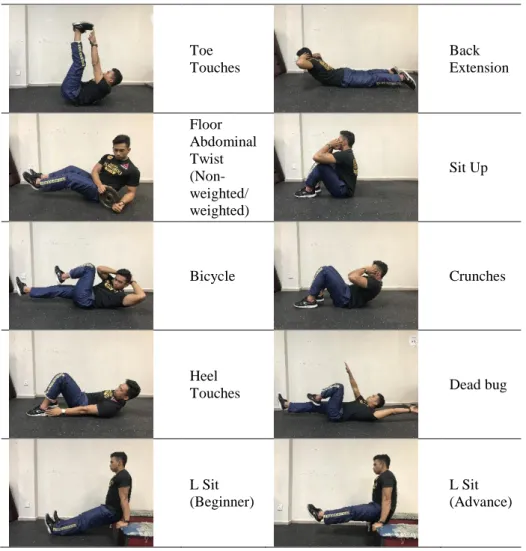
All participants completed standardized isometric, eccentric and concentric strength training for core musculature in a pre-test/post-test experimental design consisting of fifteen exercises: bird dog, low plank, hip bridge, high plank, superman, side plank, toe touches, back extension, floor abdominal twist, sit up, bicycle, crunches, heel touches, dead bug and L sit. The core strengthening exercises are presented in Figure 1.
Participants were instructed to perform five types of core exercises per session for a total of 24 sessions. For every session, each movement was performed 20 repetitions for 3 sets (Ozmen & Aydogmus, 2015) to improve core strength and endurance. The program included exercises of progressively increasing difficulty, focusing on strengthening the abdominal, lower back and pelvic-muscles.
Movement Exercise Movement Exercise
Bird Dog Low
Plank
Hip Bridge High
Plank
Toe Touches
Back Extension
Floor Abdominal Twist (Non-weighted/ weighted)
Sit Up
Bicycle Crunches
Heel
Touches Dead bug
L Sit (Beginner)
L Sit (Advance)
Figure 1: Core strengthening exercises.
The participants core muscle strength was evaluated using the low plank isometric test, which measures the control and endurance of the back and core stabilizing muscles. Two investigators acted as supervisors to monitor the participants’ body posture during the pre-test/post-test experimental design low plank testing.
The participants were evaluated with t-test for low plank test. Data were analysed using SPSS (Version 23.0; SPSS Inc., Chicago, IL, USA). Descriptive statistic (mean ± SD) were calculated for all variables. Statistical significance was accepted at p ≤ 0.05.
Results
All participants completed 8 weeks of core strength training (24 sessions). Descriptive statistics for pre and post-test values for this study are indicated in Table 2. There were significant increases (p = 0.042) in this case study when comparing the pre and post-test result (p < 0.05). After the intervention, the mean for post test results increased by 1.59 minute as compare to the pre intervention. Statistical analysis indicated that the scores in the pre-test (mean = 3.43 minute) were significantly lower than in the post-test (mean = 5.42 minute), t (5) = -2.72, p<.05.
Table 2: Descriptive statistics pre and post-test for core strength training.
Mean SD
Pre 3.43 1.98
Post 5.42 3.17
Independent sample t-tests demonstrated significant differences between the pre-and post-test data. The paired sample test data are summarized in Table 3. The overall improvement in the group was greater at the follow up-interviews. All participants reported less back pain during their normal cycling activity, especially involving the Time Trial event, which requires the body to stabilize motion and maintain a rigid position for a certain duration. This study shows that an 8-week training program can lead to obvious improvements in performance and a long-lasting decrease in back pain.
Table 3: Paired samples test for core strength training.
Mean Std. Deviation t df Sig. (2-tailed)
Pre - Post -1.98 1.78483 -2.722 5 .042
Discussion
To this researcher’s knowledge, numerous studies have been conducted on core strength training among sedentary people and athletes. This study has been specifically conducted with cyclists to investigate the effects of 8 weeks of core strength training involving isometric, eccentric and concentric exercise on core muscle strength.
as rotating, extending and twisting. It has also been shown to improve posture and movement, thus reducing the chance of pain or injury (Slocum, 2018).
In the current study, six healthy subjects were able to improve the low plank test by an average of 1.59 minutes. Possibly due to the consistency of training to work on the core muscle, whereby the area they neglect to train the most. This result seems to be supported by previous studies. Agur (2014) reported that a strong core is vital to a strong pedal stroke as it is the platform that one pushes from. If the core is not strong and stable, it will fatigue and one will waste a lot of energy compensating. Using smaller muscles, the body will move up, down and sideways instead of putting that energy into the pedals. Arthurs-Brennan (2019) indicated that having a stronger core allows one to transfer more power through the legs, as well as reducing the instance of injury and improving posture.
While the legs are a major source of power in the sport of cycling, the muscles that make up the core are the foundation. This is where all movement begins, including the circular motion of pedalling. Additional information was collected during the tests and a follow-up interview six months later. All participants reported less back pain during their normal cycling activity, especially involving the Time Trial event, which requires the body to stabilize in motion and maintain a rigid position for a certain duration. This study shows that the 8-week training program can lead to an obvious improvement in performance and a long-lasting decrease in back pain.
For further study, it may also be helpful to bring participants to the lab for a couple of weeks to investigate their physiological data and cycling performance changes incorporate with the core strength training program. This study is also applicable for a different level of athlete, such as the state and national athletes; these groups may benefit more than a younger group in regard to sport performance. Since this is a case study, it would also be interesting to investigate whether a control group of young athletes would demonstrate the same results. Finally, this study should be repeated with a large sample size which would make a normal distribution of subjects more likely.
Conclusion
Acknowledgement
The research was supported by Universiti Malaysia Sabah, Malaysia and conducted in October 2018. The authors particularly thank the participants who participated in the study and Dr. Dayang Maryama A. Daud for being a mentor to this study. Thanks also go to Kenson Rubanjar and Viearl Jivel for their assistance. There has been NO prior presentation of this material at any conference. There have been no similar articles or abstracts published by the author with similar information.
Conflict of interest
The author have no personal or financial relationships that may have influenced this work.
References
Agur, L. (2014) Why Is Core Strength Important for Cyclists? I Love bicycling. Website. https://www.ilovebicycling.com/why-is-core-strength-important-for-cyclists/, Accessed 3/6/2019.
Arthurs-Brennan, M. (2019) How to build a core strength programme for cycling. Cycling Weekly. Website. https://www.cyclingweekly.com/fitness/training/top-ten-core-drills-31170, Accessed 3/12/2019.
Bae, C. R., Jin, Y., Yoon, B. C., Kim, N. H., Park, K. W., & Lee, S. H. (2018). Effects of assisted sit-up exercise compared to core stabilization exercise on patients with non-specific low back pain: A randomized controlled trial. Journal of Back and
Musculoskeletal Rehabilitation, 31(5), 871-880.
https://doi.org/10.3233/BMR-170997
Bashir, S. F., Nuhmani, S., Dhall, R., & Muaidi, Q. I. (2018). Effect of core training on dynamic balance and agility among Indian junior tennins players. Journal of Back
and Musculoskeletal Rehabilitation, 32(2), 245-252.
https://doi.org/10.3233/BMR-170853
Esser, M. (2017). Effects of core stability training on masters swimmers. Sportverletz
Sportschaden. 31(2), 93-102. https://doi.org/10.1055/s-0043-101973
Lee, B., & McGill, S. (2017). The effect of short-term isometric training on core/torso stiffness. Journal of Sports Sciences, 35(17), 1724-1733. https://doi.org/10.1080/02640414.2016.1235791
Ozmen, T., & Aydogmus, M. (2015). Effect of core strength training on dynamic balance and agility in adolescent badminton players. Journal of Bodywork and Movement
Therapies, 20(3), 565-570. https://doi.org/10.1016/j.jbmt.2015.12.006
Sisson, M. (2010). How-To: Proper Plank Technique. Mark’s Daily Apple.
Slocum, C. (2018). Why Core Strength is Key to Athletic Performance? Athlete Training Health. Website. https://athletetrainingandhealth.com/blog/core-strength-key-athletic-performance/, Accessed 3/12/2019.
Tinto, A., Campanella, M., & Fasano, M. (2017). Core strengthening and synchronized swimming: TRX® suspension training in young female athletes. Journal of Sports
Medicine and Physical Fitness, 57(6), 744-751.
DOI:10.23736/S0022-4707.16.06338.