92
EVALUATION OF THE QUALITY AND AVAILABILITY FOR IRRIGATION
OF WATER FROM DIFFERENT SOURCES FROM SOUTHERN OLTENIA
DRĂGHICI RETA, CROITORU MIHAELA, DRĂGHICI IULIAN, DIACONU AURELIA, CONSTANTINESCU MIRCEA, STOICA MARIA MILIOARA, DIMA MILICA
Keywords: fixed mineral residue, pH, nitrates, ammonium, water
ABSTRACT
The researches were carried out under the conditions of 2019 and aimed at assessing the quality and availability for irrigation of groundwater and surface water from different sources located on the territory of Dabuleni Research Development Station for Plant Culture on Sands (Dabuleni RDSPCS). The results regarding the quality of the water showed different values according to the source and climatic conditions. The average values regarding the fixed mineral residue, pH, nitrate content and ammonium ions, determined in 9 working points, show that the analyzed sources cannot be used as drinking water, but can be used for irrigation of agricultural crops. The obtained results showed the following water quality indicators: mineral residue = 475 -1350 mg / dm3; pH = 7.05 - 8.43; nitrates = 10.23 - 28.08 mg / dm3, ammonium (NH4 +) = 1.73 - 8.82 mg/dm3.
INTRODUCTION
Due to the unfavorable pedoclimatic conditions, irrigation is required as a mandatory measure intended to cover the water deficit in order to increase the average yield of the crops. The researches have revealed high values of evapotranspiration, determined by the high temperatures, dry winds and reduced atmospheric humidity during the active period of the plants (Marinică Gh. Et al. 2003). In these studies it is shown that for the water consumption of the different species of agricultural plants, the sandy soils provide between 4 - 9% of their own reserve, and the rest of the necessary consumption is ensured from irrigation 29 - 60% and from the precipitation 34 - 62% . The quality of irrigated water can largely influence crop production, and the use of inadequate irrigation water, with high salinity and electrical conductivity, can significantly reduce its production and quality (Nicolescu C. et al., 2011, Ayers R.S. and Westcot D.W., 1994). Irrigation of crops, with water from the groundwater, has led to an increase in production by approx.
93
mineralization of the water, but also the chemical composition of her after the anions and cations of the mineral salts (Sandu Maria et al., 2018). Therefore, greater attention should be paid to the presence and critical values of sodium, magnesium, and alkaline salts. Considering the importance of irrigation for the area of sandy soils, as a measure of soil improvement and to maximize the productive potential of plants, in 1979 the Sadova-Corabia irrigation system was put into operation, having as source of water the Danube river, which has provided irrigation of over 80000 ha, of which 36000 sandy soils. At present, the Sadova-Corabia irrigation system is no longer functioning, and in this context, new possibilities are being sought to ensure the water needed for plant consumption.
MATERIAL AND METHOD
The researches were carried out under the conditions of 2019 and aimed at assessing the quality and availability for irrigation of groundwater and surface water, from different sources located on the territory of Dabuleni Research Development Station for Plant Culture on Sands (Dabuleni RDSPCS). Water samples were collected from 9 sampling points, possible sources of irrigation for crops during the current period. The quality of water was carried out in dynamic, four dates (May 29th, July 2, July 29, August 30), from 6 water wells drilled placed on the 3rd and 4th Danube terraces, the spring underground from the area called "ASCUNSA", from the plankton basin and from the drainage channel. The water wells on the third terrace were located, as follows: water well no. 1 near a farm building, water well no 2 in a pea crop and water well no 3 in a potato crop. The water wells on the 4th terrace were located as follows: water well no. 1 inside a sheep farm, water wells 2 and 3 near farm buildings. The following chemical properties were performed: pH by potentiometric method,
fixed mineral residue by gravimetric method, nitrates (NO3) and ammonium (NH4+), by Bremner method.
RESULTS AND DISCUSSIONS
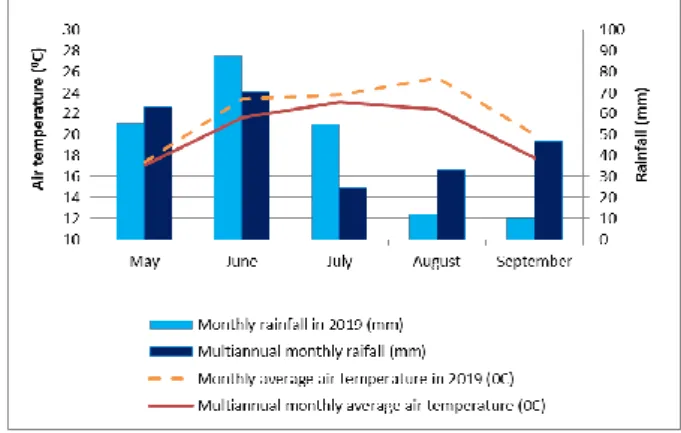
Analyzing the climatic conditions during April-September, during which the vegetation phenophases of most plants grown on sandy soils are carried out, we notice the increase of the drought phenomenon (figure 1). Compared to the multiannual average, the rainfall recorded in the area of sandy soils showed lower values in 2019, which, combined with the higher temperatures in the air, led to the creation of poor conditions for the emergence of spring and autumn crops, being necessary applying irrigation work.
Figure 1. The climatic conditions recorded in the area of sandy soils in
southern Oltenia
94
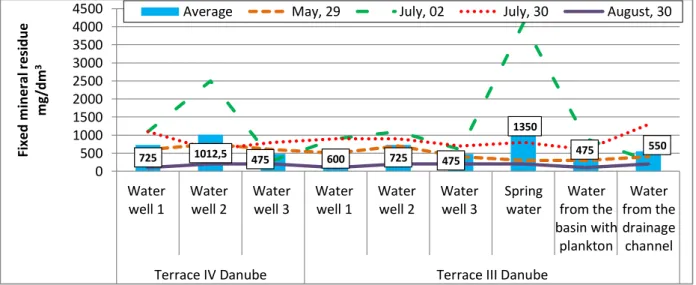
oligomineral or poorly mineralized, and samples with values greater than 500 mg / dm³ are characterized as being highly mineralized (Figure 2). The highest values were determined in water well 2 on the 4th Danube terrace and in spring water (2500-4100 mg / dm³), at the beginning of July, against the background of higher amounts of rainfall, recorded on during the month of June and which brought a greater quantity of particles from the groundwater. The average fixed mineral residue was between the limits of
475-1350 mg / dm3, framing the water in the territory of Dabuleni RDSPCS within normal limits for irrigation. Research conducted over time on sandy soils, regarding the fixed mineral residue from different water sources, revealed values between 400 and 4515 mg / dm³ (Grumeza N., et al., 1990, Șoimu T., 1995, Mihaela Croitoru, 2000). The results obtained at the end of August highlight the minimum values of the fixed mineral residue, which are positively correlated with the precipitation regime.
725 1012,5 475 600 725 475
1350
475 550
0 500 1000 1500 2000 2500 3000 3500 4000 4500
Water well 1
Water well 2
Water well 3
Water well 1
Water well 2
Water well 3
Spring water
Water from the basin with
plankton
Water from the drainage channel
Terrace IV Danube Terrace III Danube
Fi
xed
m
in
er
a
l r
esid
u
e
m
g/
d
m
3
Average May, 29 July, 02 July, 30 August, 30
Figure 2 - Dynamics of the fixed mineral residue from the water sources used for irrigation in the territory of Dabuleni RDSPCS
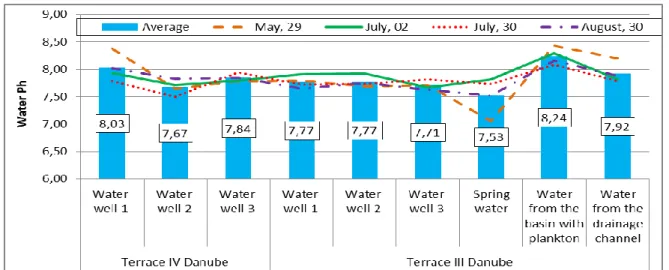
The pH level of the irrigation water is very important, because it directly influences the solubility of the fertilizers. In addition, it may cause fertilizer to precipitate, in irrigation systems, leading to blockage of drips, causing additional problems. The analyzes regarding the pH of the water from the sources taken in the study, revealed values between 7.05, in spring water and 8.43, in the water sample from the plankton basin, values showing a weak alkaline reaction (figure 3). In general, the pH of the water in the groundwater has alkaline values. The research carried out by Mihaela Croitoru, 2000, on water samples from different sources, classified the water in the 2nd category of quality, with values from neutral to weak alkaline (6.86-7.50). In
95
Figure 3 - pH dynamics of the water sources used for irrigation in the territory of Dabuleni RDSPCS
Another element of major importance in establishing the quality of water is nitrates from the soil (NO3), which come both from the fixation of atmospheric nitrogen by numerous plant species (legumes) and from nitrogen fertilization, the latter being a major source of their. Nitrates from groundwater come from the washing by rainwater of nitrates, naturally occurring in the surface soil (thus reaching the
groundwater), or may have as a source the fertilizer used for fertilization. The natural concentration of nitrates in groundwater is normally less than 10 mg / l. The analysis of the water samples showed a low nitrate content, being 2.10 mg / dm3 at the water well no. 3 and 61.2 mg / dm3, at water well no. 1 from the sheep microfarm, both being on the fourth terrace of the Danube (figure 4).
22,28
10,23 14,14 14,79
28,09
18,84
11,88 10,39 14,30
0,00 10,00 20,00 30,00 40,00 50,00 60,00 70,00
Water well 1
Water well 2
Water well 3
Water well 1
Water well 2
Water well 3
Spring water
Water from the basin with
plankton Water from the drainage channel
Terrace IV Danube Terrace III Danube
N
it
ra
te
s
(N
O3 -)
(
m
g/
dm
3)
Average May, 29 July, 02 July, 30 August, 30
Figure 4. Dynamics of the nitrate content from the water sources used for irrigation in the territory of Dabuleni RDSPCS
Research conducted by Mihaela Croitoru, 2000, showed values of much higher nitrate
content (49.79 and 397.75 mg / dm3), in
some water sources similar to those in this experiment. The amount of nitrates is variable during one year, being influenced by the climatic conditions and the amount of nitrogen fertilizers applied to different crops.
96
G.F. et al., 1981). Higher levels of nitrate content in drinking water, which in the
European Union is 50 mg / l nitrate-NO3, can
be dangerous for the population, therefore it is necessary to respect some principles in agriculture, including the rational use of fertilizers and irrigation with a water that falls within normal limits from a physico-chemical point of view (Ștefan Babuțiu, 2016). This
explains the value of 61.2 mg / dm3,
determined in the water well no. 1 from the fourth terrace of the Danube, located in a sheep farm. The average nitrate content of
10.23-28.09 mg / dm3 is within normal limits,
outlined in the literature on the irrigation water.
Ammonia (NH3), present in water as a soluble
gas with a pungent taste and pungent odor, is naturally converted to the ionic form of
ammonium (NH4+). The presence of
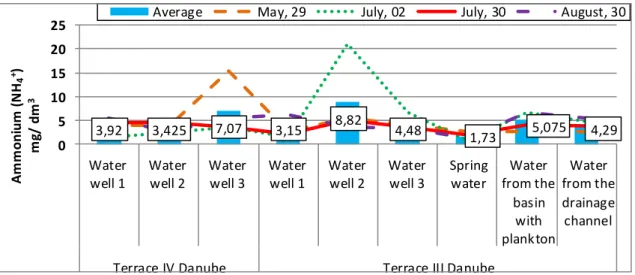
ammonium ion in the groundwater and surface waters is due solely to chemical pollution. This explains the value of 21 mg /
dm3 NH
4+, determined in the water well no. 2
from terrace of the 3rd Danube, which was placed in the pea culture, as a result of the nitrogen leaching resulting from fertilization (Figure 5).
3,92 3,425 7,07 3,15 8,82 4,48 1,73 5,075 4,29
0 5 10 15 20 25
Water well 1
Water well 2
Water well 3
Water well 1
Water well 2
Water well 3
Spring water
Water from the
basin with plankton
Water from the drainage channel
Terrace IV Danube Terrace III Danube
A
m
m
on
ium
(N
H4 +)
m
g/
dm
3
Average May, 29 July, 02 July, 30 August, 30
Figure 5. Dynamics of the ammonium content from the water sources used for irrigation in the territory of Dabuleni RDSPCS
The application of large quantities of fertilizers and the improper management often leads to environmental pollution. Leaching fertilizers, especially those with nitrogen, it is a potential source of contamination of groundwater and surface water with nitrates and ammonium (Myung K. et al., 2014, Rose S.C. and Carter H.S., 2003, Jimoh O.D. et al., 2003). The obtained results reveal ammonium ion values between 0.84-21 mg / dm3 NH
4+, with a maximum determined in the water well no. 2 on the 3rd Danube terrace, located in pea culture, mainly due to the nitrogen leaching resulting from fertilization. The analysis of the average values of ammonia from different water sources, underlines values between 1.73-8.82 mg /
dm3 NH4 +, above the limit allowed in drinking water of 0.5 mg / dm3 NH
4+, according to the law no. 311 of June 28, 2004.
CONCLUSIONS
1. The results regarding the quality of the water showed different values according to the source and climatic conditions. 2. The fixed mineral residue showed average values of 475-1350 mg / dm3, framing the water within normal limits for irrigation.
97
indicating good water for irrigating agricultural crop.
4. The average nitrate content (10.23-28.09 mg / dm3) was within normal limits for drinking water and implicitly for irrigation.
5. All sources of water analyzed from the point of view of the content of ammonium (NH4+), presented values above the permissible limits, of 0.5 mg / dm3, in drinking water and of 1.5 mg / dm3, in irrigated water.
ACKNOWLEDGEMENT
This work was supported by a grant of the Romanian Ministery of Research and Innovation CCDI - UEFISCDI, Project INNOVATIVE TECHNOLOGIES FOR IRRIGATION OF AGRICULTURAL CROPS IN ARID, SEMIARID AND
SUBHUMID-DRY CLIMATE, project
number
PN-III-P1-1.2-PCCDI-2017-0254, Contract no. 27PCCDI /
2018, within PNCDI III.
BIBLIOGRAPHY
1. Ayers R.S., Westcot D.W., Water
quality for agriculture. Irrigation and
drainage. Paper 29, rev. 1. FAO.
Reprinted 1989, 1994.
2. Craun G.F., Greathouse D.G.,
Gunderson D.H., 1981. Methaemoglobin
levels in young children consuming high
nitrate well water in the United States. Int.
Journal Epidemiol, 191; 10(4):309-17.
3. Croitoru Mihaela, 2000.
Researches on the quality of irrigation
water and groundwater from the Sadova
Corabia perimeter. Proceed. of the 5th
Nat. Conf. for Environ. Prot. by Biolog. and Biotech.al Meth. and Means, Brașov, May 26-27.
4. Grumeza N, Kleps C., Tușa C.,
1990. Evolution of the level and the chemistry of groundwater from irrigation management in the interrelations with the
environment. Bucharest,
Technical-agricultural propaganda editorial.
5. Jimoh, O.D., Ayodeji, M.A.,
Mohammed, B., 2003. Effects of
agrochemicals on surface waters and
groundwaters in the Tunga-Kawo
(Nigeria) irrigation scheme. Hydrol. Sci.
J., 48, 1013–1023.
6. Marinică Gh., Gheorghe D.,
Ploae P. et all., 2003. Research on the agricultural system for sands and sandy
soils. RDSPCS Scientific Works
Dăbuleni, vol. XV, SITECH Publishing, Craiova, ISBN 973-657-514-4, p. 17-27.
7. Nicolescu C., Şovăială Gh.,
Popescu Alina Iolanda, Matache
Gabriela, 2011. Aspects of water quality as an important issue for irrigation
National multidisciplinary conference - with international participation "Professor Dorin Pavel - the founder of Romanian hydropower". Sebeş, 2011, pp. 483-488. 8. Nolan, J.& Weber, K.A., 2015,
Natural Uranium Contamination in Major
U.S. Aquifers Linked to Nitrate. Environ.
Sci. Technol. Lett, 2, 215–220.
9. Rose, S.C.&Carter, A.D., 2003,
Agrochemical leaching and water
contamination. In Conservation
Agriculture; Springer: Dordrecht, The Netherlands, pp. 417–424.
10. Sandu Maria, Tărîţă Anatol,
Lozan Raisa, Ţurcan Sergiu, 2018.
Water quality for irrigation. Bulletin of the
Academy of Sciences of Moldova, Life Sciences, no. 1, p. 173.
11. Sanjay Mahato, Asmita Mahato,
Pankaj Kumar Karna&Nisha Balmiki, 2018. Investigating aquifer contamination and groundwater quality in eastern Terai
region of Nepal, Res Notes (20187)
11:321 https://doi.org/10.1186/s13104-018-3445-z.
12. Șoimu T., 1995. Some aspects
regarding the pollution of groundwater with nitrates in the area of sandy lands in
the south of Oltenia, Works of the VI -
National Arad Ecology Conference.
13. Ștefan Babutiu, 2016. Nitrates
and nitrites in drinking water.
https://www.academia.edu/36249656/
14. xxx. Law no. 311 of June 28,