Component-Based Software
Engineering — New Challenges
in Software Development
Ivica Crnkovi´c
M¨alardalen University, Department of Computer Engineering, V¨asteras, Sweden˚
The primary role of component-based software engi-neering is to address the development of systems as an assembly of parts (components), the development of parts as reusable entities, and the maintenance and upgrading of systems by customising and replacing such parts. This requires established methodologies and tool support covering the entire component and system life-cycle including technological, organisational, marketing, legal, and other aspects. The traditional disciplines from software engineering need new methodologies to support component-based development.
Keywords: software components, software engineering,
software architecture, COTS, component-based develop-ment, component-based software engineering.
1. Software Development Challenges
We are witnessing an enormous expansion in the use of software in business, industry, ad-ministration and research. Software is no longer marginal in technical systems but has now be-come a central factor in many fields. Sys-tem features based on software functionality, rather than other characteristics, are becoming the most important factor in competing on the market, for example in car industry, the service sector and in schools. Increasing numbers of software users are non-experts. These trends place new demands on software. Usability, ro-bustness, simple installation and integration be-come the most important features of software. As a consequence of the wider area of software utilisation, the demand for the integration of different areas has increased. We distinguish between vertical integration in which data and processes at different levels are integrated, and horizontal integration in which similar types of
data and processes from different domains are integrated.
For example, in industrial process automation, at the lowest levels of management(Field Man-agement), the data collected from the process and controlled directly, is integrated on the plant level (Process Management), then is further processed for analysis and combination with the data provided from the market and finally published on the Web(Business Management). A consequence of all this is that software is be-coming increasingly large and complex. Tradi-tionally, software development addressed chal-lenges of increasing complexity and dependence on external software by focusing on one system at a time and on delivery deadlines and budgets, while ignoring the evolutionary needs of the system. This has led to a number of problems: failure of the majority of projects to meet their deadline, budget, and quality requirements and the continued increase in the costs associated with software maintenance.
degree of consistency, and wider range of us-ability1].
However, there are several disadvantages and risks in using CBD which can jeopardize its success.
—Time and effort required for the development of components. Among the factors which can discourage the development of reusable components are the increased time and effort required, the building of a reusable unit re-quires three to five times the effort required to develop a unit for one specific purpose.
(B. Spencer, Microsoft, Presentation at 22nd ICSE, 1999 is also an interesting observa-tion about efficient reuse of real-time com-ponents, made by engineers at Siemens 2] that, as a rule of thumb, the overhead cost of developing a reusable component, includ-ing design plus documentation, is recovered after the fifth reuse. Similar experience at ABB 3] shows that reusable components are exposed to changes more often than non-reusable parts of software at the beginning of their lives, until they reach a stable state.) —Unclear and ambiguous requirements. In general, requirements management is an im-portant part of the development process, its main objective being to define consistent and complete component requirements. Reusable components are, by definition, to be used in different applications, some of which may yet be unknown and the requirements of which cannot be predicted. This applies to both functional and non-functional require-ments.
—Conflict between usability and reusability. To be widely reusable, a component must be sufficiently general, scalable and adaptable and therefore more complex(and thus more complicated to use), and more demanding of computing resources(and thus more expen-sive to use). A requirement for reusability may lead to another development approach, for example building a new, more abstract level which gives less flexibility and fine tuning, but achieves better simplicity3]4]. —Component maintenance costs. While appli-cation maintenance costs can decrease, com-ponent maintenance costs can be very high since the component must respond to the dif-ferent requirements of difdif-ferent applications running in different environments, with dif-ferent reliability requirements and perhaps
requiring a different level of maintenance support.
—Reliability and sensitivity to changes. As components and applications have separate lifecycles and different kinds of requirements, there is some risk that a component will not completely satisfy the application require-ments or that it may include concealed char-acteristics not known to application devel-opers. When introducing changes on the ap-plication level(changes such as updating of operating system, updating of other compo-nents, changes in the application, etc.), there is a risk that the change introduced will cause system failure.
To enjoy the advantages and avoid the prob-lems and risks, we need a systematic approach to component-based development at the process and technology levels.
2. Component-Based Software Engineering
The concept of building software from compo-nents is not new. A “classical” design of com-plex software systems always begins with the identification of system parts, designated sub-systems or blocks, and on a lower level modules, classes, procedures and so on. The reuse ap-proach to software development has been used for many years. However, the recent emergence of new technologies has significantly increased the possibilities of building systems and appli-cations from reusable components. Both cus-tomers and suppliers have had great expecta-tions from CBD, but their expectaexpecta-tions have not always been satisfied. Experience has shown that component-based development requires a systematic approach to and focus on the compo-nent aspects of software development3]. Tra-ditional software engineering disciplines must be adjusted to the new approach, and new pro-cedures must be developed. Component-based Software Engineering(CBSE)has become rec-ognized as a new sub-discipline of Software En-gineering.
of components for different systems require es-tablished methodologies and processes not only in relation to the development/maintenance as-pects, but also to the entire component and sys-tem lifecycle including organisational, market-ing, legal, and other aspects. In addition to specific CBSE objectives such as component specification or composition and technologies, there are a number of software engineering dis-ciplines and processes which require specific methodologies for application in component-based development. Many of these methodolo-gies are not yet established in practice, some are not even developed. The progress of soft-ware development in the near future will depend very much on the successful establishment of CBSE and this is recognized by both industry and academia. All major software engineer-ing conferences now include sessions related to CBSE and CBSE workshops are held fre-quently6]7]8]9]10]. According to the Gart-ner Group11]“By 2002, 70 percent of all new applications will be deployed using component-based application building blocks.”
Overviews of certain CBSE disciplines and some of the relevant trends and challenges in the near future are presented below.
3. Component Specification
For a common understanding of component-based development, the starting point is an agree-ment of what a component is and what it is not. As a generic term the concept is pretty clear — a component is a part of something — but this is too vague to be useful. The definition of a component has been widely discussed13]14]. However, we shall adopt Szyperski’s definition
4], which is the most frequently used today:
A software component is a unit of composition with contractually specified interface and ex-plicit context dependencies only. A software component can be deployed independently and is subject to composition by third parts.
The most important feature of a component is the separation of its interface from its imple-mentation. This separation is different from those which we can find in many program-ming languages (such as ADA or Modula-2), in which declaration is separated from imple-mentation, or those in object-oriented program-ming languages in which class definitions are
separated from class implementations. We re-quire that the integration of a component into an application should be independent of the component development lifecycle and that there should be no need to recompile or re-link the application when updating with a new compo-nent. Another important characteristic of the separation is that the component implementa-tion is only visible through its interface. This is especially significant for components deliv-ered by a third party. An implication of this is the requirement for a complete specifica-tion of a component including its funcspecifica-tional interface, non-functional characteristics ( per-formance, resources required, etc.), use cases, tests, etc. While current component-based tech-nologies successfully manage functional inter-faces, there is no satisfactory support for man-aging other parts of a component specification. The component definition adopted above is fo-cused on the use of components. It says little about how to design, implement and specify a component. There are, however, other defini-tions which point to other aspects of component-based development. For example there is a strong relation between object-oriented program-ming (OOP) and components. Component models (also called component standards) COM/DCOM 15]16], .NET17], Enterprise Java Beans (EJB)18]19], and CORBA Com-ponent Model (CCM) 20] relate Component Interface to Class Interface. Components adopt object principles of unification of functions and data encapsulation. Cheesman and Daniels21] consider that a component can exist in several forms during its lifecycle: Component Specifi -cation (component characteristics, component function), Component Interface (a part of its specification, a definition of a component’s be-haviour),Component Implementation(A reali-sation of a Component Specification),Installed
Component(deployed instance of a Component Implementation)andComponent Object(an in-stance of Installed Object). Not all researchers agree that components are extensions of OOP. On the contrary, they think that the difference between components and objects lies in the fact that an object has state and is a unit of instan-tiation, while a component is stateless and is a unit of deployment4].
functional and non-functional features), indus-try sees components as parts of a system which can be reused, but are not necessarily well de-fined with explicit interfaces and with slight or no conformance with component models. A component can be an amorphous part of a sys-tem, the adaptation of which may require much effort. Such components(or rather reusable en-tities)are of extreme importance, as the larger the components, the greater the productivity which can be achieved by their reuse.
Component specification remains a topic of re-search. Component standards are mostly con-centrated on the interface definition, while non-functional properties are specified(if specified at all) informally in separate documentation. Some improvements in that direction, by gath-ering both functional characteristics and design characteristics, have been made in the new Mi-crosoft Component Model .NET.
4. Component-Based System Development Lifecycle
CBSE addresses the requirements, challenges and problems similar to others encountered else-where in software engineering. Many of the methods, tools and principles of software engi-neering can be used in the same or similar way as in other types of applications or systems, but there is one distinction: CBSE covers both com-ponent development and system development with components. There is a slight difference in the requirements and business ideas in the two cases, therefore different approaches are
necessary. Of course, when developing com-ponents, other components can be (and often must be) incorporated, but the main emphasis is on reusability: Components are built to be used and reused in many applications, some not yet existing. A component must be well spec-ified, easy to understand, sufficiently general, easy to adapt, easy to deliver and deploy and easy to replace. The component interface must be as simple as possible and strictly separated
(both physically and logically)from its imple-mentation. Marketing factors play an important role as development costs must be compensated from future earnings, this being especially true for COTS. However, the main problem in de-veloping components is in the acquisition and elicitation of requirements in combination with COTS selection 23] because the process in-cludes multi-criteria decisions. If the process begins with requirements selection, it is highly probable that a COTS meeting all the require-ments will not be found. If components are selected too early in the process, the system ob-tained may not meet all the requirements. Development with components is focused on the identification of reusable entities and rela-tions between them, starting from the system re-quirements. The early design process includes two essential steps: Firstly, specification of a system architecture in terms of functional com-ponents and their interaction, this giving a log-ical view of the systems and secondly, speci-fication of a system architecture consisting of physical components.
Different lifecycle models, established in soft-ware engineering, can be used in CBD. These
Requirements Design Implementation Test Release Maintenance
1Find 2 Select 4 Adapt
3 Create
5 Deploy 6 Replace 4 Test
Requirements
Requirements DesignDesign ImplementationImplementation TestTest ReleaseRelease Maintenance
1Find 2 Select 4 Adapt
3 Create
5 Deploy 6 Replace 4 Test
1Find 2 Select 4 Adapt
3 Create
5 Deploy 6 Replace 4 Test
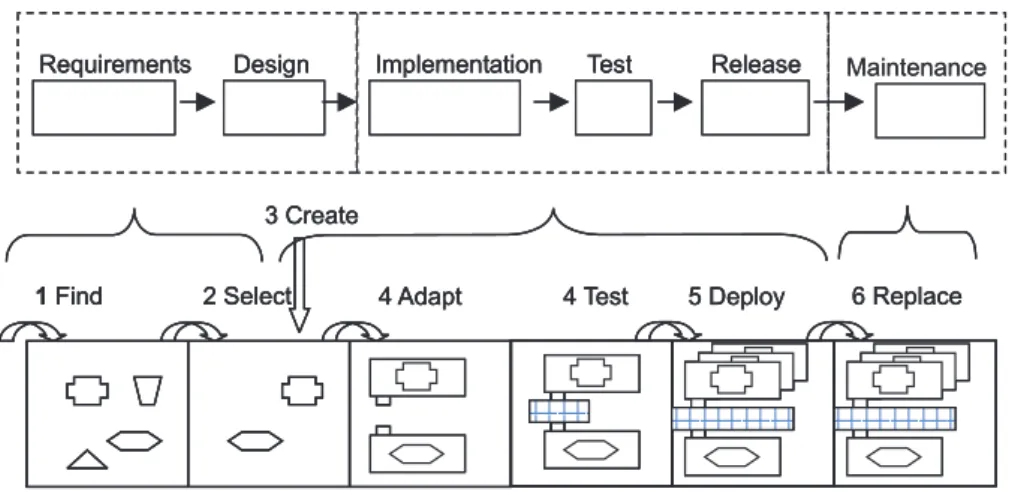
models will be modified to emphasise compo-nent-centric activities. Let us consider, for ex-ample, the waterfall model using an extreme component-based approach. Fig. 1 shows the waterfall model and the meaning of the phases. Identifying requirements and a design in the waterfall process is combined with finding and selecting components. The design includes the system architecture design and component iden-tification/selection.
The different steps in the component-based sys-tems development process are:
—Find components which may be used in the system. All possible components are listed here for further investigation. To success-fully perform this procedure, a vast number of possible candidates must be available as well as the tools for finding them. This is-sue relates not only to technology, but also to business.
—Select the components which meet the re-quirements of the system. Often the require-ments cannot be fulfilled completely and a trade-off analysis is needed to adjust the system architecture and to reformulate the requirements to enable use of the existing components.
—Alternatively, create a proprietary compo-nent to be used in the system. In a component-based development process this procedure is less attractive as it requires more efforts and lead-time. However, the components that include core-functionality of the prod-uct are likely to be developed internally as they should provide the competitive advan-tage of the product.
—Adapt the selected components so that they suit the existing component model or
speci-fication of requirements. Some components would be possible to directly integrated in to the system, some would be modified through parameterisation process, some would need wrapping code for adaptation, etc.
—Compose and deploy the components using a framework for components. Typically com-ponent models would provide that function-ality.
—Replace earlier with later versions of com-ponents. This corresponds with system main-tenance. Bugs may have been eliminated or new functionality added.
There are many other aspects of CBD which re-quire specific methods, technologies and man-agement. For example, development environ-ment tools24]25], component models and sup-port for their use, software configuration man-agement 26], testing, software metrics, legal issues, project management, development pro-cess, standardisation and certification issues, etc. Discussion of these is beyond the scope of this article. The relation between software architecture and CBD is discussed in the fol-lowing.
5. Software Architecture and
Component-Based Development
Software architecture and components are clo-sely related to each other. All software systems have an architecture which can be viewed in terms of the decomposition of the system into components and their relations. A commonly used definition of Software architecture is28]:
“The software architecture of a program or computing system is the structure or structures of the system, which comprise software compo-nents, the externally visible properties of those components and the relationships among them.”
Traditionally, software architecture is at the fo-cus in the early design phase when the overall structure of the system is designed to satisfy functional and non-functional requirements. In monolithic applications, the architecture spec-ified in the design process is concealed at ex-ecution time in one block of executable code. Component technologies focus on composition and deployment, closer to or at execution time. In a component-based system, the architecture remains recognizable during the application or system execution, the system still consisting of clearly separated components. The system architecture thus remains an important factor during the execution phase. Component-based software engineering embraces the total lifecy-cles of components and component-based sys-tems and all the procedures involved in such lifecycles.
ar-chitecture is evaluated with respect to the driv-ing quality requirements. Once the software architecture has been defined, the components which are to constitute the system must be de-veloped or selected. We can distinguish dif-ferent categories of components in relation to the requirements of the system: special pur-pose components, developed specifically for the system, reused components, internally devel-oped for multiple usage, and final commercial components(COTS). Pre-existing components typically need to be integrated into the system using glue code or a modification of the com-ponents themselves. This top-down approach ensures fulfilment of the requirements, or at least a better control thereof. However, this approach does not encourage the reuse of pre-existing components, especially not commer-cial components, since there is a high degree of probability that the pre-existing components do not exactly fit into the system. Another proach, a mix of bottom-up and top-down ap-proaches, begins with the system requirements and the analysis of possible candidate compo-nents. The component specification and selec-tion have impact on final requirements and the system architecture. In this case, software ar-chitecting is primarily concerned with identify-ing means of optimisidentify-ing interactions between the given components. Since components and their composition are basic artefacts for both software architecture and component technolo-gies, it is natural that they will merge, i.e. use common techniques, methods and tools. Archi-tectural definition languages (ADLs), for ex-ample ACME 29], can be used for designing component-based-systems and implemented for the existing component models.
Software architecture is often related to a pro-cess of tradeoff analysis. Experience has shown that the many attributes of large software sys-tems live principally in the system’s software architecture. In such systems the achievement of quality attributes depends more on the overall software architecture than on code-level prac-tices such as language choice, detailed design, algorithms, data structures, testing, and so on. There are several methods for such analysis, for example SAAM (Software Architecture Anal-ysis Method) 30] and ATAM (Architecture Tradeoff Analysis Method)31]. Both ATAM and SAAM are scenario-based methods. How-ever, unlike the SAAM, the ATAM focuses on multiple quality attributes(modifiability, avail-ability, security, and performance)and is aimed
at locating and analysing tradeoffs in a soft-ware architecture. For component-based sys-tems a modified approach in these analyses is required. The components have pre-determined attributes, some of them immanent only to the component, but some of them emerging in com-position with other components. A tradeoff analysis helps in selecting the proper nents and in predicting the attributes of compo-nent compositions. At the same time inclusion of the pre-existing components sets the bound-aries in which the analysis can be performed. For example one characteristic of a candidate component can be high reusability but poor per-formance, while of the other candidate a better performance but a lower reusability. Architec-tural analysis will help in making decision in component selection.
Software architecture and CBD are successfully used in the development of software product lines 22]27] from which many variants of a product are delivered. Typical product variants contain a set of core-components and a num-ber of additional components. The component-based approach and architectural design play important role in product configuration man-agement.
6. UML and Component-Based Systems Modelling
<<subsystem>> Account <<interface>> IAccount +getAccount() Canonical Form <<subsystem>>
Account Elided Form IAccount <<subsystem>> Account <<subsystem>> Account <<interface>> IAccount +getAccount() <<interface>> IAccount +getAccount() Canonical Form <<subsystem>> Account <<subsystem>>
Account Elided Form IAccount
Fig. 2.UML component.
designing component-based systems covering all these aspects1],5]. Interfaces are presented as multiple subsystems(multiple interfaces may also be realised by a subsystem), which indicate the possibility of changing the implementation without replacing the interface. An interface can be presented in two ways(see Fig. 2), the second alternative being the more common pre-sentation.
Fig. 3 shows the three aspects of system archi-tecture. The conceptual architecture is a
re-sult of a top-down system analysis and design and, in at least the first step, is not different from a “non-component-based” design. In the conceptual part, the components are expressed by UML packages with the <<subsystems>> stereotype. In the implementation architecture part, the physical components are represented by UML components and the <<imp>> stereo-type. Note that the implementation part is not necessary only the refinement of the conceptual level, but that also the structure can be changed. For example, different packages can include the same physical components. It may also happen that the component selection requires modifica-tions of the conceptual architecture.
However, UML is not specialised for CBD and certain extensions to standard UML(such as naming convention, or stereotypes) are re-quired. The component interfaces cannot be described by UML at such a detailed level that they can be used directly. For this reason there are extensions to UML, for example Catalysis
33]. Further work on UML related to CBSE is expected. The next major version of UML
<<imp>> ComA IComA :ComB :SysX :ComC <<subsystem>> ComA
IComA IComB <<subsystem>>ComB
<<subsystem>> ComC IComA Conceptual Architecture <<imp>> ComB IComB <<imp>> ComC IComC <<imp>> SysX
ISysX IComY <<imp>>ComY
Implementation Architecture :ComA Deployment Architecture :ComB Server DataServer <<imp>> ComA IComA <<imp>> ComA IComA :ComB :SysX :ComC <<subsystem>> ComA
IComA IComB <<subsystem>>ComB
<<subsystem>> ComC IComA Conceptual Architecture <<imp>> ComB IComB <<imp>> ComC IComC <<imp>> SysX
ISysX IComY <<imp>>ComY
Implementation Architecture :ComA Deployment Architecture :ComB Server DataServer :ComB :ComB :SysX
:SysX :ComC:ComC
<<subsystem>> ComA IComA <<subsystem>>ComA
<<subsystem>> ComA
IComA IComB <<subsystem>><<subsystem>>ComBComB <<subsystem>>
ComB IComB
<<subsystem>> ComC IComA <<subsystem>>ComC
<<subsystem>> ComC IComA Conceptual Architecture <<imp>> ComB IComB <<imp>> ComB IComB <<imp>> ComC IComC <<imp>>ComC IComC
<<imp>> SysX ISysX <<imp>>SysX
ISysX IComYIComY <<imp>><<imp>>ComYComY
Implementation Architecture :ComA :ComA Deployment Architecture :ComB :ComB Server DataServer
(UML 2.0) 34] proposes extensions for de-scribing Enterprise Java Beans, data modelling entities, real-time components, XML compo-nents, etc. Many of these are related directly or indirectly to CBSE.
7. Future of Component-Based Software Engineering
It is obvious that CBD and CBSE are in the very first phase of their lives. CBD is recog-nized as a new, powerful approach that will, if not revolutionise, at least significantly change the development of software and software use in general. We can expect that components and component-based services will be widely used by non-programmers for building their applica-tions. Tools for building such applications by component assembly will be developed. Au-tomatic component update over the Internet, already present in many applications, will be a standard means of application improvement. Another trend we can see is the standardisa-tion of domaspecific components on the in-terface level. This will make it possible to build applications and the system from components purchased from different vendors. Standardis-ation of domain-specific components requires standardisation of domain-specific processes. Widespread work on standardisation in differ-ent domains is already in progress, (a typical example is OPC Foundation 35], working on a standard interface to enable interoperability between automation/control applications, field systems/devices and business/office applica-tions). Support to the exchange of information between components, applications and systems distributed over the Internet will be further de-veloped. Works related to XML 36] will be further expanded.
Today CBSE is facing many challenges, some of which are summarised in the following. —Trusted components— Because the trend is
to deliver components in binary form and the component development process is outside the control of component users, questions re-lated to component trustworthiness become very important. The meaning of “trust-worthiness” is, however, not precisely de-fined. Although there are formal definitions of many attributes associated with the con-cept “trustworthiness” (reliability and ro-bustness, for example), there is no formal
definition or understanding of “trustworthy” and no standardised measurement or trust-worthiness . What are the effects of dif-ferent degrees of trustworthiness on system attributes is not known.
—Component certification— One way of clas-sifying components is to certificate them. In spite of the common belief that certifica-tion means absolute trustworthiness, it in fact only gives the results of tests performed and a description of the environment in which the tests were performed. While certification is a standard procedure in many domains, it is not yet established in software in general and especially not for software components
37]38].
—Composition predictability— Even if we as-sume that we can specify all the relevant at-tributes of components, it is not known how these attributes determine the corresponding attributes of the systems of which they are composed. The ideal approach, to derive system attributes from component attributes is still a subject of research. A question remains — “Is such derivation at all pos-sible? Or shouldn’t we concentrate on the measurement of the attributes of component composites?” 39].
requirements. As there are still many uncer-tainties in the process of component selec-tion, suitable strategies are needed for risk management selection of components and the evolution process40],5].
—Long-term management of component-based systems— As component-based systems clude sub-systems and components with in-dependent lifecycles, the problem of system evolution becomes significantly more com-plex. There are many questions of differ-ent types: technical issues(can a system be updated technically by replacing the com-ponents?), administrative and organisational issues (which components can be updated, which components should be or must be up-dated?), legal issues(who is responsible for a system failure, the producer of the sys-tem or the producer of the component?), etc. CBSE is a new approach and there is little experience as yet of the maintainability of such systems. There is a risk that many such systems will be troublesome to maintain. —Development models — Although existing
development models demonstrate powerful technologies, they have many ambiguous characteristics, they are incomplete and dif-ficult to use.
—Component configurations— Complex sys-tems may include many components which, in turn, include other components. In many cases compositions of components will be treated as components. As soon as we be-gin to work with complex structures, the problems involved with structure configu-ration emerge. For example, two composi-tions may include the same component. Will these components be treated as two different entities or will they be assumed to be one identical entity? What happens if these com-ponents are of different versions, which ver-sion will be selected? What happens if these versions are not compatible? The problems of dynamic updating of components are al-ready known, but their solutions are still the subject of research41].
—Dependable systems and CBSE — The use of CBD in safety-critical domains, real-time systems, and different process-control sys-tems in which the reliability requirements are more rigorous, is particularly challeng-ing. A major problem with CBD is the lim-ited possibility of ensuring the quality and
other non-functional attributes of the com-ponents and thus our inability to guarantee specific system attributes.
—Tool support — The purpose of Software Engineering is to provide practical solutions to practical problems, and the existence of appropriate tools is essential for success-ful CBSE performance. Development tools, such as Visual Basic, have proved to be ex-tremely successful, but many other tools are yet to appear — component selection and evaluation tools, component repositories and tools for managing the repositories, com-ponent test tools, comcom-ponent-based design tools, run-time system analysis tools, com-ponent configuration tools, etc. The objec-tive of CBSE is to build systems from com-ponents simply and efficiently, and this can only be achieved with extensive tool support. These are some of the many challenges facing CBSE today. The goal of CBSE is to stan-dardise and formalise all disciplines supporting activities related to CBD. Success of the CBD approach depends directly on further research and the implementation of CBSE.
References
1] BROWN, A.,Large-Scale Component-Based
Devel-opment, Prentice Hall, 2000.
2] MRVA, M., Reuse Factors in Embedded Systems
Design, High-Level Design Techniques Dept. at
Siemens AG, Munich, Germany, 1997.
3] CRNKOVIC´, I.AND LARSSON, M. A., Case Study: Demands on Component-Based Development, Pro-ceedings 22nd International Conference on
Soft-ware Engineering, ACM Press, 2000.
4] SZYPERSKIC.,Component Software-Beyond Object
-Oriented Programming, Addison-Wesley, 1998.
5] HEINEMAN, G. AND COUNCILL, W.,
Component-Based Software Engineering, Putting the Pieces
Together, Addison Wesley, 2001.
6] ICSE 2000, Workshop on Component-Based
Soft-ware Engineering(CBSE 3),http://www.sei.
cmu.edu/cbs/cbse2000/CFP2000.html, Access date 2001-07-14.
7] ICSE 2001, Workshop on Component-Based
Soft-ware Engineering(CBSE 4),http://www.sei.
cmu.edu/pacc/CBSE4-Proceedings.html, Access date 2001-07-14.
8] ECOOP 2000, Workshop on
9] Euromicro 2001, Workshop on Component-Based Software Engineering, http://www.idt.mdh. se/ecbse/, Access date 2001-07-14.
10] Workshop on CBSE — ABB Corporate Research Centre, Switzerland, 2000, http://icawww2. epfl.ch/ opreiss/CBSE Conference2000/, Access date 2001-07-14.
11] GARTNER GROUP, http://www.gartner.com,
Access date 2001-07-14.
12] BROWN, A.ANDWALLNAU, K., The current state of CBSE,IEEE Software, 1998.
13] SZYIPERSKI, C. AND PFISTER, C., Workshop on Component-Oriented Programming, Summary. In M¨uhlh¨auser M. (ed.) Special Issues in
Object-Oriented Programming — ECOOP96 Workshop Reader, Springer 1997.
14] ICSE 1999, Workshop on Component-Based
Soft-ware Engineering (CBSE 2), http://www.sei.
cmu.edu/cbs/icse99/cbsewkshp.html, Access date 2001-07-14.
15] BOX, D.,Essential COM, Addison-Wesley, 1998.
16] Microsoft Component Object Model, http://
www.microsoft.com/com/, Access date 2001-07-14.
17] Microsoft. NET Component Model,http://www.
microsoft.com/net, Access date 2001-07-14.
18] Enterprise Javabeans technology, http://java.
sun.com/products/ejb/, Access date 2001-07-14.
19] MATENA, V.ANDSTEARNS, B.,Applying Enterprise
JavaBeans(TM): Component-Based Development
for the J2EE(TM) Platform, Addison-Wesley, 2000.
20] OMG, CORBA, http://www.omg.org/
tech-nology/documents/spec catalog.htm, Access date 2001-07-14.
21] CHEESMAN, J.ANDDANIELS, J.UML Components –
a Simple Process for Specifying Component-Based
Software, Addison-Wesley, 2001.
22] BOSCHJ.Design & Use of Software Architecture, Addison Wesley, 2000.
23] MAIDEN, N.AND NCUBE, C., Acquiring Require-ments for Commercial Off-The Shelf Package Se-lection,IEEE Software, Vol. 15, No. 2, Mar., 1998.
24] Microsoft Visual Studio,
http://msdn.microsoft.com/vstudio/, Access date 2001-07-14.
25] Development tools — Forte
TMtools,http://www. sun.com/forte/, Access date 2001-07-14.
26] LARSSON, M.ANDCRNKOVIC´, I., New challenges for configuration Management,Proceedings of9th
Symposium on System Configuration Management,
Lecture Notes in Computer Science, Springer, 1999.
27] BOSCHJ., Software Product Lines: Organisational alternatives, ICSE 2000 Proceedings, ACM Press, 2001, pp. 91–100.
28] L. BASS, P. CLEMENTS, R. KAZMAN, Software
Ar-chitecture In Practice, Addison Wesley, 1998.
29] ACME architecture definition language,
http://www.cs.cmu.edu/ acme/, Access date 2001-07-14.
30] KAZMAN, R., ABOWD, G., BASS, L., CLEMENTS, P., “Scenario-Based Analysis of Software Architec-ture”,IEEE Software, Nov. 1996, pp. 47–55.
31] RICK KAZMAN, MARIO BARBACCI, MARK KLEIN, S. JEROMYCARRICRE, Experience with Performing
Architecture Tradeoff Analysis, ICSE 1999
Pro-ceedings, ACM Press, 1999, pp. 54–63.
32] BOOCH G., JACOBSON I AND RUMBAUGH J., The
Unified Modeling Language User Guide,
Addison-Wesley, 1998.
33] D’SOUZAD.ANDWILLSA.,Objects, Components,
and Frameworks With UML : The Catalysis
Ap-proach, Addison-Wesley, 1998.
34] OMG UML,http://www.omg.org/technology
/uml, Access date 2001-07-14.
35] OPC Foundation,http://www.opcfoundation.
org/, Access date 2001-07-14.
36] Extensible Markup Language (XML), http:
//www.w3.org/XML, Access date 2001-07-14.
37] VOASJ.ANDPAYNEJ., Dependability Certification of Software Components, Journal of Systems and
Software, No. 52, 2000, pp. 165–172.
38] MORRISJ., LEEG., PARKERK., BUNDELLG., PENG LAMC., “Software Component Certification”,IEEE
Computer, 2001, September.
39] WALLNAUK.ANDSTAFFORDJ., Ensembles: Ab-stractions for a New Class of Design Problem, 27th
Euromicro Conference 2001 Proceedings, IEEE
Computer Society, 2001, pp. 48–55.
40] KOTONYAG.ANDRASHIDA., A strategy for Man-aging Risks in Component-Based Software Devel-opment, 27thEuromicro Conference 2001
Proceed-ings,IEEE Computer Society, 2001, pp. 12–21.
41] CRNKOVIC´ I., LARSSON M., K¨USTERFILIPE J. K., LAUK.,Databases and Information Systems, Fourth
International Baltic Workshop, Baltic DB&IS, Se-lected papers, Kluwer Academic Publishers 2001, pp. 237–252.
Received:June, 2003
Accepted:September, 2003
Contact address:
Ivica Crnkovi´c M¨alardalen University Department of Computer Engineering V¨aster˚as, Sweden Phone:+46 21 10 31 83
Fax:+46 21 10 41 60
e-mail:[email protected]
IVICACRNKOVIC´ is a professor of industrial software engineering at
M¨alardalen University where he is the administrative leader of the software engineering laboratory and the scientific leader of the in-dustrial software engineering research. His research interests include component-based software engineering, software configuration man-agement, software development environments and tools, as well as software engineering in general. Professor Crnkovi´c is the author of more than 40 refereed articles and papers on software engineering top-ics and a co-autor and co-editor of two books: Builiding Releiable Component-Based Systems, and Implementing and Integrating Prod-uct Data Management and Software Configuration Management. He has co-organized several workshops and conferences related to soft-ware engineering(in particularly component-based software
engineer-ing)and participated in Program Committees of software configuration