Semantic Search in Tabular Structures
Aleksander Pivk1, Matjaž Gams1and Mitja Luštrek1,2
1Department of Intelligent Systems, Jozef Stefan Institute,
Jamova 39, SI-1000 Ljubljana, Slovenia
2Department of Computer Science, University of Alberta,
Edmonton, Alberta, Canada T6G 2E8
E-mail:{aleksander.pivk, matjaz.gams, mitja.lustrek}@ijs.si
Keywords:tabular structures, ontology learning, semantic web, query answering
Received:November 18, 2005
The Semantic Web search aims to overcome the bottleneck of finding relevant information using formal knowledge models, e.g. ontologies. The focus of this paper is to extend a typical search engine with semantic search over tabular structures. We categorize HTML documents into topics and genres. Using the TARTAR system, tabular structures in the documents are then automatically transformed into ontologies and annotated to build a knowledge base. When posting queries, users receive responses not just as lists of links and description extracts, but also enhanced with replies in the form of detailed structured data. Povzetek: Razvili smo metode semantiˇcnega spleta za iskanje informacij v tabelah.
1 Introduction
The World Wide Web has in the years of its exponential growth become a universal repository of human knowledge and culture, thus enabling an exchange of ideas and infor-mation on a global level. The tremendous success of the In-ternet is based on its usage simplicity, efficiency, and enor-mous market potential [4].
The success of the World Wide Web is countervailed by efforts needed to search and find relevant information. The search of interesting information turned out to be a diffi-cult, time-consuming task, especially due to the size, poor structure and lack of organization of the Internet [3, 7, 31]. A number of approaches appeared in the last decade with a common objective to improve searching and gathering of information found on the Web.
One of the first solutions to cope with the information overload was search engines. In order for a search engine to function properly and to return relevant and satisfactory an-swers to user queries, it must conduct two important tasks in advance. The first task is to crawl the Web and gather, following the hyperlinks, as many documents as possible. The second task deals with document indexing [12, 35], hy-perlink analysis, document relevance ranking [20, 23] and high dimensional similarity searches [13, 19].
Once these tasks are completed, a user may post queries to gain answers. User queries, unless they include highly selective keywords, tend to match a large number of doc-uments, because they do not contain enough information to pinpoint most highly relevant resources [28]. They may sometimes even miss the most relevant responses, because
of no direct keyword matches, but the most common dis-advantage of this approach is that an engine might return thousands of potentially interesting links for a user to man-ually explore. The study described in [17] showed that the number of keywords in queries is typically smaller than three, which clearly cannot sufficiently narrow down the search space. In principle, this can be seen as the prob-lem of users of search engines themselves. Reducing the ambiguity of search requests can be achieved by adding semantics, i.e. by making computers better ’understand’ both the content of the web pages and the users’ intentions, which can help to improve search results even with a re-quest of a very limited size. In addition, search engines favor largest information providers due to name-branding and time optimization. To overcome this bottleneck, the Semantic Web search, where information is structured in a machine interpretable way, is a natural step forward, as originally envisioned by Tim Berners-Lee [4].
<dl>stand for different list types. A simple example of a table, found in a Web document, is represented in Fig-ure 1.
Figure 1: A simple table example belonging to a tourism domain.
Understanding of their content is crucial when it comes to finding and providing explicit answers to user queries. The table understanding task demands efficient handling of tabular structures and automatic transformation of struc-tures into explicit semantics, which enables further reason-ing about the data within tables. But both, a table structure comprehension task and a semantic interpretation task ex-ceed in complexity the corresponding linguistic task [16].
The paper is structured as follows. In Section 2 we first introduce a simplified view of the ALVIS search engine fol-lowed by a detailed description and an algorithm of our extensions. Section 3 describes the current state of our approach and its evaluations. After presenting the related work in Section 4 we give concluding remarks in Section 6.
2 ALVIS - Semantic search engine
extensions
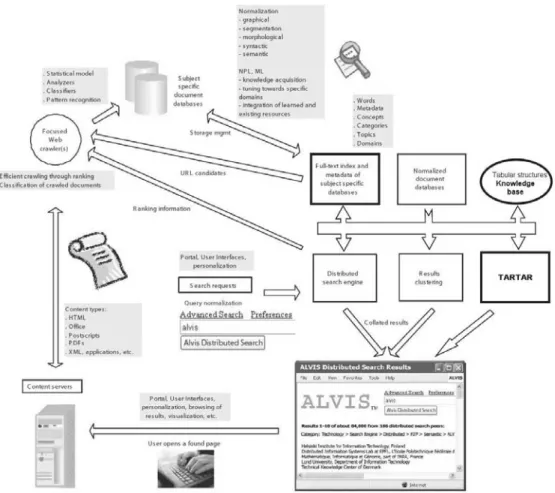
The basic idea for attaining a semantic search engine is to automatically enrich the indexed web pages with seman-tics, in our case in the form of ontologies. This is the key subject of the EU IST-project ALVIS (Superpeer Semantic Search Engine, IST-1-002068-STP), which represents the framework for our contribution. The general architecture of ALVIS is presented in Figure 2. Our major contribution is represented as two bold boxes on the right-hand side of the figure.
The ALVIS project (www.alvis.info/alvis) con-ducts research in the design, use and interoperability of
just ontologies) to distribute queries and merge results. Be-cause semantic expressivity and interoperability are com-peting goals, developing a system that is both distributed and semantic-based is the key challenge: research involves both the statistical and linguistic format of semantic inter-nals, and determining the extent to which the semantic in-ternals are exposed at the interface.
The problems that were identified and served as a mo-tivation factor while developing the system and methodol-ogy are: (a) tabular structures present a general schema for data presentation due to their good visual comprehension, hence a great deal of data is hidden within them, (b) multi-ple table representations for the same content/data are very likely, (c) manual annotation does not scale in general, (e) tables and lists, due to their richer structure, support the discovery of interdependent information, whilst a typical keyword or link-analysis based search usually fails in this area [27], and (f) ontology learning from arbitrary text has so far had limited success [6, 9].
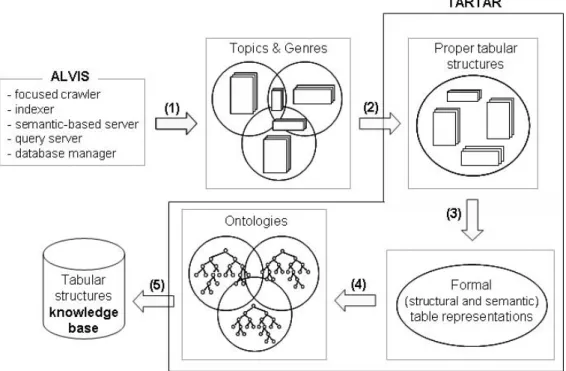
The whole process of semantic search over tabular struc-tures consists of two subprocess: (a) transformation of tab-ular structures found on the Web into the knowledge base, described in subsection 2.1 and shown in Figure 3, and (b) user query processing, described in subsection 2.2 and shown in Figure 6.
2.1 Tabular structures transformation
The overall analysis, transformation, and formalization of tabular structures can be graphically observed in Figure 3. It roughly corresponds to the bold boxes in Figure 2 and di-rectly to Figure 4. Here we will shortly present each of the five major steps with the obtained results given in section 3:
(1) Categorization of Web documents (a) into Topics
(b) into Genres
(2) Filtering of proper tabular structures from documents
(3) Transformation of arbitrary tabular structures into formal representations (4) Automatic ontology generation from
formalized tabular structures (5) Knowledge base construction
Figure 2: Performance architecture of ALVIS search engine.
1) Categorization of Web documents
Clustering is a technique for classification of Web docu-ments into groups within which interdocument similarity is large compared to the similarity between documents cho-sen from different groups, and enables taxonomy design, e.g. topic hierarchy construction. The technique assists fast similarity search, while groups of similar documents significantly narrow the search space.
1.a) Topics
Work on topic classification has been utilized by our col-leagues Mladeni´c et al. [22]. They used machine learn-ing techniques on a document collection gathered from Ya-hoo to reconstruct YaYa-hoo’s manually built topic taxonomy. Documents are represented as feature-vectors that include word sequences, where the learning approach depends on feature subset selection and results in a combination of a set of independent classifiers. The whole categorization process belongs to the bold box (Full-text index...) in Fig-ure 2.
1.b) Genres
Another type of categorization that we propose is cate-gorization into genres. According to Merriam-Webster
On-line Dictionary, a genre is a category of artistic, musical, or literary composition characterized by a particular style, form, or content. Editorial and poem, for example, are gen-res characterized by style and form, while science fiction is a genre characterized by content. For our purpose, we will concentrate on the first kind of genres, because the second kind are already in large part covered by topical catego-rization. In information retrieval, genres should ideally be orthogonal to topics, because this best divides the search space and reduces the number of search hits. Traditional genres often do not satisfy this requirement, but in the se-lection of genres we use and in the preparation of training data for the genre classifier, we tried to be as close to the ideal as possible.
We chose 20 genres one can expect to find on the World Wide Web: some of them Web-specific, such as FAQ and community, others traditional, such as journalistic and po-etry. The next step was the preparation of the training data for the genre classifier. We gathered Web pages returned by the most popular queries according to Google, random Web pages and Web pages specifically sought to belong to the less common genres. Each Web page was manually categorized by two annotators and in case of disagreement checked by the authors.
Figure 3: The transformation of tabular structures found on the Web into the knowledge base.
features from the Web pages. Due to the complexity and irregularity of HTML found on the Web, this is a time-consuming and error-prone procedure that can compromise the robustness of the classifier. Therefore we chose pre-diction by partial matching (PPM) classification algorithm, which can accept raw HTML as the input. This algorithm is derived from data compression techniques and essentially learns the way to most efficiently compress the Web pages belonging to each genre. An uncategorized page is then compressed with each genre-specific compressor in turn and categorized into the genre associated with the most ef-fective compressor. Initial tests have been performed by Bratko and colleagues [5], proving successful in a related problem setting.
2) Filtering of proper tabular structures
Tabular structures appear in Web documents within spe-cific tags, thus enabling their easy discovery. Unfortu-nately, it has been shown that at least 70% of such struc-tures are not used for presentation of data but for better vi-sual and layout purposes [8]. To solve this problem, we adopted a solution developed by Wang et al. [34]. It is based on machine learning techniques, in particular deci-sion trees and support vector machines. In the learning process, several types of features are used, such as struc-tural, content, and word/text features.
3) Formalization of tabular structures
This essential part concentrates on the analysis of tab-ular structures aiming to exploit their partial structure and cognitive modeling habits of humans. Understanding of ta-ble contents requires tata-ble-structure comprehension and
se-mantic interpretation. The outcome of applying the method is a knowledge frame encoded in an F-Logic representation language [18].
The most comprehensive and complete model for the analysis and transformation of tables found in literature is Hurst’s [15], which is also adopted here. The model an-alyzes tables along graphical, physical, structural, func-tional, and semantic dimensions. Our approach stepwise instantiates the last four dimensions.
In the first step, corresponding to the physical dimension, a table is extracted, cleaned, canonicalized and transformed into a regular matrix form.
In the second step, the goal is to detect the table struc-ture. This is a very complex task, since there is a huge num-ber of table layout variations. The three most important sub-tasks are: (a) to determine table reading orientation(s), which is discovered by measuring the distance/similarity among cells and hence among rows and columns (features given at the end of the paragraph); (b) to dismember a table into logical units and further into individual regions, in a way that regions consist of only attribute cells, e.g. ’Lo-cation’ in Figure 1, or instance cells, e.g. ’Rogla’; (c) to resolve the table type, which must belong to the one of five pre-defined types (one- or two-dimensional, or three types of complex tables). For these purposes several heuristics, i.e. token type hierarchy, and measures are used, i.e. value similarity (regression), value features (character/numeric ratio, mean, variance, standard deviation), data frames (e.g. regular expressions for recognizing dates), and string pat-terns.
an access path for each individual cell. After finalizing the FTM construction, its recapitulation is carried out with a goal to minimize the model.
Finally, in the fourth step we deal with the discovery of semantic labels for table regions, where WordNet [11] lex-ical ontology and GoogleSets service are employed. These semantic labels serve as annotations of FTM nodes and are later also used within outgoing formal structures as can be observed in Figure 5.
A very detailed description of this particular part can be found in [30].
4) Automatic ontology generation
Tables with different structures that are categorized into the same topic/genre clusters and had been individually transformed into knowledge frames, could now be merged into a single cluster ontology. In this way, a generalized representation that semantically and structurally describes captured tables within each cluster would be created.
Our approach to frame matching and merging is multi-faceted, which means that we use all evidence at our dis-posal to determine how to match concepts. In using this evidence we look not only for direct matches as is com-mon in most schema matching techniques, but also indirect matches. The most relevant matching techniques are the following: (a) label matching which depends on WordNet features and string distance metrics; (b) value similarity, where matching is based on value characteristics; (c) ex-pected values by using constant value recognizers in data frames; (d) constraints that include keys of the table, func-tional relationships, one-to-one correspondences, and sub-set/superset relationships; and (e) structural context, where features such as proximity, node importance measured by in/out-degree, and neighbor similarity help match object sets.
Once the mappings among frames have been discovered, the actual merging is executed. Sometimes two frames are directly fused by simply merging corresponding nodes and edges. Often, however, merging induces conflicts that must be resolved, where several different approaches for con-flict resolution are used. Concon-flict resolution will not be discussed in this paper due to length limits. Finally, af-ter all frames of a particular topic/genre clusaf-ter are incor-porated, the outcome reflects an appropriate domain ontol-ogy, where the concepts are arranged into a directed acyclic graph, where the arcs represent the relations among con-cepts and are labeled with relation type.
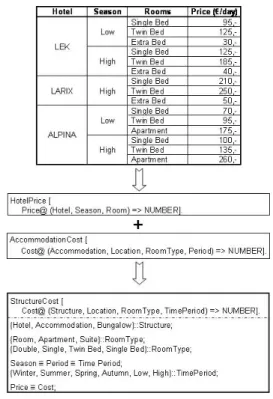
Figure 5 illustrates a simple example of the ontology cre-ation process by merging two same-cluster tables; the sec-ond table is shown in Figure 1. Both tables deal with ho-tel price information, but the naming convention and con-tents are different. The matching of the frame concepts and object sets are based on several techniques: Label Match-ing and Structure help determine the concept matchMatch-ing, while Value Similarity and Expected Values apply to price, room type, and period. The domain ontology is presented as a frame, but its concepts are further classified and the
Figure 5: A simple example of the ontology creation pro-cess.
classification encoded in F-Logic notation. For example, concepts ’Hotel’ and ’Accommodation’, according to the WordNet, share a common hypernym ’Structure’; values ’Double/Single Room’, ’Apartment’, and ’Suite’ become concepts and are hierarchically organized under a ’Room-Type’ concept; the same thing happens to season periods. Also note that concepts ’Price’ and ’Cost’ share the same synset in WordNet, which is in the ontology described by an equivalent operator (≡) among them. In this way a com-mon ontology covering both frames is generated, which en-ables annotation and query answering, the later through the knowledge base.
We have explored issues of frame matching for ontology generation in [29], where further information can be found.
5) Knowledge base construction
By constructing multiple domain ontologies, where each one corresponds to a particular topic/genre cluster, the final step of our algorithm is evident in a construction of a knowledge base. The knowledge base is created by formalizing the table contents according to the newly generated formal structures. Together with the inference engine it will be used for providing replies to user queries.
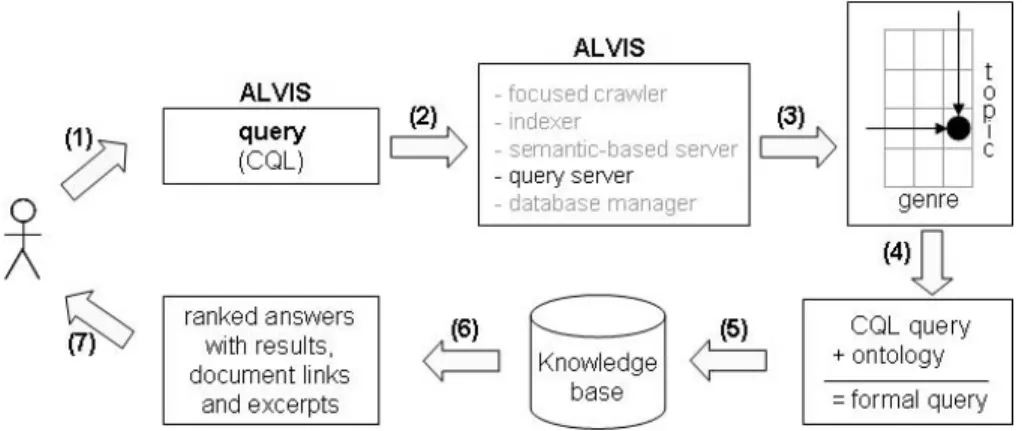
Figure 6: A seven-step user query processing schema.
ijs.si/sandi/work/tartar/.
Each of these algorithmic steps is important in the over-all process and benefits search in terms of accuracy and reduced complexity.
2.2 Tabular structures querying
Many search systems permit the query to contain single words, phrases, and word inclusions and exclusions. In-stead of exclusion, a safer way is to rate each document for how likely it is to satisfy the user’s information need, to sort in decreasing order of this score, and present the results in the ranked list. Search engines differ in how they perform vector-space ranking.
Our motivation is to extend the ALVIS search engine with our tabular structure handling approach, where for-mal knowledge models and semantics decrease ambiguity and hence better determine similarity among a query and a document. In addition, they provide semantically relevant replies to user queries.
The execution of a user query is performed along the following seven steps, as shown in Figure 6 (note the cor-responding numbers):
1. Querying: users provide queries using CQL [1] (Com-mon Query Language). CQL is a formal language for representing queries to information retrieval sys-tems such as Web indexes, bibliographic catalogs and museum collection information and has been adopted in ALVIS. The CQL design objective is that queries be human readable and human writable, and that the language be intuitive while maintaining the expres-siveness of more complex languages such as SQL. Simplicity and intuitiveness of expression is achieved by combining with the richness of Z39.50’s type-1 query [32]. This process corresponds to the ’Query requests’ box in Figure 2.
2. Resolution: the ALVIS query server resolves the CQL query and extracts its key terms. This step corre-sponds to the ’Distributed search engine’ box in Fig-ure 2.
3. Categorization: extracted key terms are used to de-termine potentially interesting categories, topics and genres in particular, where detailed search should be executed. Categorization is perform as described in subsection 2.1 1) and is utilized by Mladeni´c and col-leagues [22] and Bratko and colcol-leagues [5]. The pur-pose of searching only within certain topics and gen-res is to significantly narrow the search space and con-sequently speed up the whole replying process, which is of particular importance when querying the knowl-edge base of tabular structures. This corresponds to the left-upper bold box (Full test index ...) in Figure 2.
4. Mapping: as described in subsection 2.1 (4), each cluster possesses its own automatically generated on-tology. The ontology concepts and relations are used together with the extracted key terms in order to refor-mulate posted CQL queries into new, formal queries. These queries are encoded in the F-Logic formal lan-guage, same as the knowledge base. This corresponds to the TARTAR component in Figure 2.
5. Inference: The new formal queries, obtained in a pre-vious step, are posted against the knowledge base us-ing an appropriate inference engine, which returns plausible results. This part has been presented in the paper by Pivk and colleagues [30].
6. Ranking: ALVIS ranking component ranks, according to its ranking function, the results obtained from the knowledge base with the set of documents that match the CQL query. The ranked results are sent to the out-put creation module.
7. Results: ranked results and document excerpts are gathered and incorporated into a document, which is returned to the user. Note that this document in-volves also the results inferred from the knowledge base, which represent semantically aware answers to a posted query.
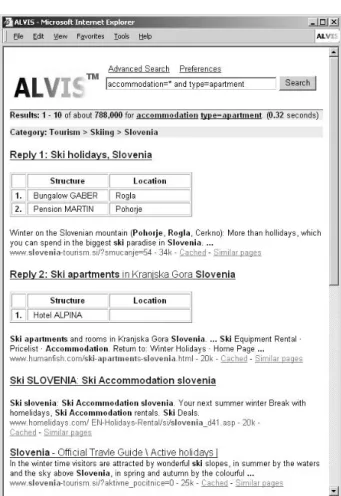
Figure 1 and 5. For simplicity, we will first present a query in a natural language, followed by individual step descriptions. Natural language interface is also being developed, but not directly as part of the ALVIS system. The two demonstrating examples are:
A) SHOW THE ACCOMMODATIONS THAT OFFER APART -MENTS.
1. Q="accommodation=* and type=apartment";
2. Key terms of Q, such as accommodation, type, and apartment would determine possible categories, i.e. "tourism:skiing:slovenia", and a genre, such as "com-mercial/shopping".
3. An example of an F-logic query where for mapping purposes the ontology shown in Figure 5 is used:
FORALL S,L <- EXISTS A,T,P A:StructureCost[Cost@(S,L, apartment,T)->P].
4. The query Q posted against the knowledge base re-turns the following three results gained from the table examples:
- S=Bungalow GABER, L=Rogla; - S=Pension MARTIN, L=Pohorje; - S=Hotel ALPINA, L=?;
5. - 7. The results are ranked and returned to the user as a Web document, as shown in Figure 7. Some re-sults are upgraded with tables, where a table consists of all semantically relevant facts found in the partic-ular document. These results are in the output doc-ument marked as ’Reply #’ link, where # represents the relevance number of a document introducing the facts. Such examples can be observed from the first two results in Figure 7.
B) SHOW ALL PRICES OF DOUBLE ROOMS IN HOTELS ON POHORJE, SLOVENIA.
1. Q="price=* and accommodation=hotel and hotel=* and place=pohorje and type=’double room’";
2. Holds a similar description as in the previous exam-ple;
3. FORALL S,T,P <- EXISTS A
A:StructureCost[Cost@(S,pohorje, double room,T)->P and
isa_(S,hotel)].
and
FORALL S,T,P <- EXISTS A
A:StructureCost[Cost@(S,pohorje, twin bed,T)->P and isa_(S,hotel)].
4. - S=Hotel AREH, T=Winter, P=840; - S=Hotel AREH, T=Rest, P=690;
5. - 7. Similar as in the previous example.
Figure 7: A simulated graphical representation of ranked results, requested in example A).
3 Current state and evaluations
Here we will shortly present the individual state-of-the-art of the described system components and some evaluations. More detailed descriptions are given in the referenced pa-pers.
• Topic categorizationis based on a hierarchical topic structure. For each topic, a naive Bayesian classi-fier is built. For an uncategorized document, each of the classifiers estimates the probability of it belong-ing to a given topic. Experimental evaluation on real world data shows that the proposed approach gives good results. The best performance was achieved with features selected based on a feature scoring measure known from information retrieval called Odds ratio using relatively small number of features [22].
• Formalization of tabular structures: The empirical evaluation is performed from efficiency and applica-bility perspectives, where the dataset consisted of over 700 test tables, belonging to two different domains, tourist and geopolitical. First, the efficiency E of the approach is measured according to the portion of correctly transformed tables into knowledge frames reaching 84.52% (E= 1
2(Et+Eg) = 21(289369+313345)).
The more detailed results description is omitted due to its complexity and the lack of space but can be found in [26, 25]. Second, the applicability is shown by querying the content of tables encoded in the knowl-edge base, where it is shown that returned answers are true and complete in 100% of cases [30].
• Automatic ontology generation: Initial tests of the on-tology generation process have been shown in [29], indicating that the process is feasible but pointing out that the conflict resolution still needs some improve-ments. Further tests are still in progress.
• Knowledge base construction: This step cannot be evaluated separately since it depends on the results of previous two tasks and merely formalizes the data found within tables. Anyway, the study in [30] showed that by querying the content of tables encoded in the knowledge base, the returned answers are true and complete in all cases.
The system consisting of the described parts is not yet fully implemented. While individual parts have already been tested and achieved the expected performance, the functionality of the integrated system is yet to be verified.
4 Related work
In this paper we have covered several important topics of modern information handling, which can be basically split into three main areas: document categorization, on-tology learning, and analysis of tabular structures. We will not present each of these areas thoroughly, since these are given in respective papers, but will rather show their main achievements.
An important portion of information retrieval [3, 31] is focused to the document categorization tasks, where several different techniques and methods have been used, ranging from machine learning techniques such as Bayesian learning, SVM, or (hierarchial) clustering, to nat-ural language processing, graph theory, and combination of these approaches.
is shown by Peng et al. [24] reaching 86% when classi-fying documents into 10 different genres. Prediction by partial matching (PPM), the method which we are going to employ, also belongs to this group. Finally, there are vi-sual methods, but these are typically used on scanned doc-uments represented as bitmaps and are not well suited for use in a search engine.
A very recent systematic overview of related work on table recognition, transformation, and inferences can be found in [36]. Most of the work in this area has been done on table detection and recognition addressing sev-eral types of document encodings, mostly plain text files, images, and HTML documents. Work performed on tex-tual tables and images was mainly oriented towards table detection, row labeling, and cell classification [36]. Work on HTML tables was extended to indexing relation detec-tion, cell/row/table merging or splitting, classification [34], and other approaches aiming at the deep understanding of table structure [36]. Table extraction methods have also been applied in the context of question answering and on-tology learning. A similar proposal to ours was introduced by Tijerino et al. [33]. They presented only a vision for a system that would be able to generate ontologies from arbi-trary tables or table-equivalents. Their approach consists of a four-step methodology which includes table recognition and decomposition, construction of mini ontologies, dis-covery of inter-ontology mappings, and merging of mini-ontologies. For the purpose of semantics discovery the ap-proach is multifaceted, meaning they use all evidence at their disposal (i.e. Wordnet, data frames, named entities, etc.). Since the paper, unlike ours, presents only a vision, no evaluation is provided.
5 Conclusion and Future Work
ALVIS represents a major attempt to create a semantic search engine. For this purpose, it introduces several novel approaches and mechanisms. Our approach is novel in the sense that it is the first to address the whole process of se-mantically aware information discovery and query answer-ing by analyzanswer-ing information presented in tabular struc-tures. By putting together the components, such as two-aspect document categorization, detection, filtering, trans-formation and formalization of tabular structures, a search engine gets enhanced with new capabilities in a scalable way.
will also benefit in terms of scalability and speed, but can-not show or discuss that in details since it has can-not been fully implemented and tested yet.
Regarding success rate of HTML input tabular transfor-mations into formal semantic descriptions, the proposed approach reaches nearly 85%. Besides the transformation the approach also enables annotation of the original re-sources with generated formal descriptions.
Although tabular semantic approach by itself may not be the ultimate research goal, and although its success relies on specific properties of tables, i.e. implicit relationships, it might give some indications regarding semantic search from plain text. We are aware that our approach and the ontology learning text processing approaches tackle and cope with different problems, thus making direct compari-son nearly impossible, we still assume that our results show great potential for wide acceptance.
Future research in the tabular structure analysis area is aiming into two main directions. Firstly, the focus will be to incorporate some machine learning techniques, in partic-ular for: (a) the classification of tabpartic-ular structures into the (predefined) table type classes, and (b) the improved and more scalable discovery and division of tables into logical units and regions. This will enable better grounds for the ongoing transformation process. Secondly, our method-ology is domain and document type independent, but has been implemented to cover HTML tables only. Therefore two important extensions need to be provided in the fu-ture: (a) the extensions to cover other document types, i.e. PDF, excel, etc., and (b) to enable a framework for a simple inclusion of the other domain-dependent knowledge mod-els. With these extensions comprehended, we anticipate that the approach will be used to semantically enrich a va-riety of legacy data and will support the conversion of the existing Web into a Semantic Web.
Acknowledgement
This work has been supported by the EU IST-projects ALVIS (Superpeer Semantic Search Engine, IST-1-002068-STP) and SEKT (Semantically Enabled Knowl-edge Technologies, IST-2004-506826). The research was also supported by Slovenian Ministry of Education, Sci-ence and Sport, and by Marie Curie Fellowship of the Eu-ropean Community program ’Host Training Sites’, medi-ated by FZI and AIFB at University of Karlsruhe, Germany. Thanks to all our colleagues for participating in the evalu-ation of the system as well as to the reviewers for useful comments on the paper.
References
[1] Z39.50 International Maintenance Agency. CQL -Common Query Language, 2004. http://www. loc.gov/z3950/agency/zing/cql/.
[2] A. Antonacopoulos and J. Hu.Web Document Analy-sis: Challenges and Opportunities. World Scientific, 2004.
[3] R. Baeza-Yates and B. Ribeiro-Neto. Modern Infor-mation Retrieval. Addison Wesley, 1999.
[4] T. Berners-Lee, J. Hendler, and O. Lassila. The se-mantic web.Scientific American, 2001(5), 2001.
[5] A. Bratko and B. Filipic. Exploiting structural infor-mation for semi-structured document categorization.
Information Processing & Management, 42(3):679– 694, 2006.
[6] P. Buitelaar, P. Cimiano, and B. Magnini, editors. On-tology Learning from Text: Methods, Applications and Evaluation, volume Frontiers in Artificial Intel-ligence and Applications. IOS Press, 2005.
[7] S. Chakrabarti.Mining the Web: Discovering Knowl-edge from Hypertext Data. Morgan-Kauffman, 2002.
[8] H. Chen, S. Tsai, and J. Tsai. Mining tables from large scale HTML texts. InProceedings of the 18th International Conference on Computational Linguis-tics (COLING), pages 166–172, 2000.
[9] P. Cimiano, L. Schmidt-Thieme, A. Pivk, and S. Staab. Learning taxonomic relations from hetero-geneous evidence. In P. Buitelaar, P. Cimiano, and B. Magnini, editors, Ontology Learning from Text: Methods, Applications and Evaluation, pages 56–71. IOS Press, 2005.
[10] John G. Cleary and Ian H. Witten. A comparison of enumerative and adaptive codes. IEEE Transactions on Information Theory, 30(2):306–315, 1984.
[11] C. Fellbaum. WordNet, an electronic lexical database. MIT Press, 1998.
[12] W.B. Frakes and R. Baeza-Yates. Information Re-trieval: Data Structures and Algorithms. Prentice Hall, 1992.
[13] A. Gionis, P. Indyk, and R. Motwani. Similarity Search in High Dimensions via Hashing. InVLDB, pages 518–529, 1999.
[14] J. Hu, R. Kashi, D. Lopresti, G. Nagy, and G. Wil-fong. Why table ground-truthing is hard? In Proceed-ings of the 6th International Conference on Document Analysis and Recognition, pages 129–133, 2001.
[15] M. Hurst. Layout and language: Beyond simple text for information interaction - modelling the table. In
a large sample of excite searchers. InProceedings of the World Conference on the WWW, Internet and Intranet (WebNet-98), pages 913–928. AACE Press, 1998.
[18] M. Kifer, G. Lausen, and J. Wu. Logical foundations of object-oriented and frame-based languages. Jour-nal of the ACM, 42:741–843, 1995.
[19] J.M. Kleinberg. Two Algorithms for Nearest-neighbor Search in High Dimension. InACM Sympo-sium on Theory of Computing, pages 599–608, 1997.
[20] J.M. Kleinberg. Authoritative Sources in a Hyper-linked Environment.Journal of the ACM, 46(5):604– 632, 1999.
[21] A. Maedche. Ontology Learning for the Semantic Web. Kluwer Academic Publishers, 2002.
[22] D. Mladeniˇc and M. Grobelnik. Feature Selection on Hierarchy of Web Documents.Decision Support Sys-tems, 35:45–87, 2003.
[23] L. Page, S. Brin, R. Motwani, and T. Wino-grad. The PageRank Citation Ranking: Bring-ing Order to the Web. Technical report, Stan-ford Digital Library Technologies Project, 1998. http://www-db.stanford.edu/ ~backrub/pageranksub.ps.
[24] F. Peng, S. Dale, and W. Shaojun. Language and Task Independent Text Categorization with Simple Lan-guage Models. InProceedings of the Human Lan-guage Technology Conference of the ACL, pages 189– 196, Edmonton, Canada, 2003.
[25] A. Pivk. Automatic Generation of Ontologies from Web Tabular Structures. PhD Thesis (in Slovene), University of Maribor, Slovenia, 2005.
[26] A. Pivk. Automatic Ontology Generation from Web Tabular Structures.AI Communications, 19(1):83–85, 2006.
[27] A. Pivk, P. Cimiano, and Y. Sure. From Tables to Frames. Web Semantics: Science, Services and Agents on the World Wide Web, 3(2–3):132–146, 2005.
[28] A. Pivk and M. Gams. Domain-dependant informa-tion gathering agent. Expert Systems with Applica-tions, 23:207–218, 2002.
Logical Form with TARTAR.Data & Knowledge En-gineering, accepted, 2006.
[31] F. Sebastiani, editor. Advances in Information Re-trieval, Proceedings of the 25th European Conference on IR Research (ECIR 2003), Lecture Notes in Com-puter Science, Vol. 2633, Pisa, Italy, April 14-16, 2003. Springer.
[32] M. Taylor and M. Cromme. Searching very large bod-ies of data using a transparent peer-to-peer proxy. In
Proceedings of DEXA 2005 Workshop, pages 1049– 1053. IEEE Computer Society, 2005.
[33] Y.A. Tijerino, D.W. Embley, D.W. Lonsdale, and G. Nagy. Ontology generation from tables. In
Proceedings of 4th International Conference on Web Information Systems Engineering (WISE’03), pages 242–249, 2003.
[34] Y. Wang and J. Hu. A machine learning based ap-proach for table detection on the web. InProceedings of the 11th International Conference on World Wide Web, pages 242–250. ACM Press, 2002.
[35] I.H. Witten, A. Moffat, and T.C. Bell. Managing Gi-gabytes: Compression and Indexing Documents and Images. Multimedia Information and Systems. Mor-gan Kaufmann, 1999.