ORIGINAL RESEARCH ARTICLE
Impact of an Antenatal Counseling on Use of Modern Family
Planning Methods in the Postpartum in Rural Guinea
DOI: 10.29063/ajrh2018/v22i4.2
Bienvenu S.
Camara1*, Alexandre Delamou
1,2, Sidikiba Sidibé
1,2, Abdoul H. Béavogui
1, Patrice
Bouedouno
1, Malick M. Sylla
1, Onadja Yentema
3and Seni Kouanda
4,5Maferinyah National Centre for Training and Research in Rural Health, Forécariah, Guinea1; Public Health Department, Faculty of Health Sciences and Techniques, Gamal Abdel Nasser University of Conakry, Conakry, Guinea2; High Institute for Population Science, Ouagadougou, Burkina Faso3; African Institute of Public Health, Ouagadougou, Burkina Faso4; Research Institute in Health Science, Ouagadougou, Burkina Faso5
*For Correspondence: Email: [email protected]; Phone: +224 622 32 32 33
Abstract
In Guinea, family planning (FP) uptake remains low. The objective of this study was to compare the impact of two types of antenatal counseling on modern FP uptake in the postpartum in rural Guinea. This was a two-group non-equivalent study comparing the impact of a reinforced antenatal counseling (intervention) to the routine antenatal counseling (control). The study included 404 pregnant women at five rural health centres in Forécariah district, Western Guinea. Each woman was followed up until the ninth month postpartum. The study was conducted from October 12, 2013 to December 30, 2014. Findings showed that at the ninth month postpartum, use of modern FP was significantly higher in the intervention group than in the control group (5.7% and 1.1%, respectively; p=0.024). However, 67.6% and 65.7% of women in the intervention group and the control group, respectively, abstained from sexual intercourse at the sixth month postpartum and had the intention to do so until the child walks. At the ninth month postpartum such women represented 70.5% and 59.5%, respectively. Therefore, a longer study period is recommended to assess the effect of antenatal counseling on use of modern FP in the postpartum in Guinea. (Afr J Reprod Health 2018; 22[4]: 16-25).
Keywords: Antenatal counseling; Family planning; Postpartum; Rural; Guinea
Résumé
En Guinée, l'utilisation de la planification familiale (PF) reste faible malgré l'objectif du développement durable qui vise à accroître l'utilisation de la PF d'ici 2030. L'objectif de cette étude était de comparer l'impact de deux types de conseil prénatal sur la prise en charge moderne de la PF au post-partum en Guinée rurale. Il s'agissait d'une étude non équivalente à deux groupes comparant l'impact d'un conseil prénatal renforcé (intervention) au conseil prénatal de routine (contrôle). L'étude comprenait 404 femmes enceintes qui assistent à des consultations prénatales dans cinq centres de santé ruraux du district sanitaire de Forécariah, en Guinée de l‘ouest. Chaque femme a été suivie jusqu'au neuvième mois du post-partum. L'étude a été menée du 12 octobre 2013 au 30 décembre 2014. Les conclusions de l'étude ont montré qu'au sixième mois après l'accouchement, l'utilisation de la PF moderne dans le groupe d'intervention n'était pas statistiquement différente de celle du groupe témoin (4,6% et 3,2%, respectivement) p = 0,893. Au neuvième mois du post-partum, l'utilisation de la PF moderne était significativement plus élevée dans le groupe d'intervention que dans le groupe témoin (5,7% et 1,1%, respectivement; p = 0,024). Cependant, 67,6% et 65,7% des femmes du groupe d'intervention et le groupe témoin, respectivement, se sont abstenues des relations sexuelles au sixième mois du post-partum et avaient l'intention de le faire jusqu'à ce que l'enfant se promène. Au neuvième mois du post-partum, ces femmes représentaient respectivement 70,5% et 59,5%. Par conséquent, une période d'étude plus longue est recommandée pour évaluer l'effet du conseil prénatal sur l'utilisation de la PF moderne après l'accouchement dans le contexte guinéen. (Afr J Reprod Health 2018; 22[4]: 16-25).
Introduction
Family planning (FP) is part of target 3.7 of the Sustainable Development Goals (SDGs) by 20301. FP use is known as an important means to reduce maternal and child mortality, especially in low income countries where unwanted pregnancies and unsafe abortions are common2–4.
Yet, in Africa, FP uptake remains low, particularly in West Africa where contraceptive prevalence among married women was estimated to 9% in 2010, compared to 25% in East Africa5. Between 1991 and 2004, FP use increased by 0.6 percentages per year in West Africa, compared to more than double (1.4 percentages) in East African countries6. In West Africa, unmet FP needs have been reported as key obstacle to FP uptake5. In Burkina Faso, a population-based survey conducted between October 2013 and March 2014 showed 18% of unmet FP needs7. Survey data in previous years from Benin (2006), Burkina Faso (2003) and Mali (2001) showed a proportion of women‘s unmet needs for FP ranging 41% to 49%8. Guinea belongs to the Ouagadougou Initiative for FP in West Africa. In 2011, this initiative gathered eight French-speaking West African countries to identify concrete solutions to meet FP needs in the sub region5. The country also adopted a new national FP repositioning plan in 2013 to improve FP indicators9. This plan recommends the promotion of postpartum contraception to meet women‘s needs for FP and reduce maternal morbidity and deaths9. However, despite the high proportion of woman having heard about FP (91%) and the integration of FP to routine health services in the country, only 7.8% of married women used a modern FP method in 2016 (2.9% for lactational amenorrhea method (LAM), 2.2% for injectable methods, and 1.7% for pills)10 . In rural areas, use of modern FP was lower (6.7%) than in urban areas (9.6%). Women with unmet needs for FP represented 27.6% 10. FP uptake in the postpartum is poorly documented in Guinea; however, this should be low since the global contraceptive prevalence is low.
Given the high fertility rate (4.8 children per woman) and the high maternal and infant mortality (550 deaths per 100,000 births and 44
deaths per 1,000 live births, respectively)10 in the country, additional interventions are required to meet the SDG for FP by 2030. One strategy for improving these indicators is to improve uptake of FP in the postpartum.
Studies assessing the influence of antenatal counseling on FP use in the postpartum have reported different findings in the African context11–
13
. In Nigeria, repeated one-to-one antenatal contraceptive counseling to clients led to increased use of postpartum FP method (57%) compared to clients attending a single routine one-to-one postpartum contraceptive counseling (35%;
P=0.002)14. Also in Ghana, a study in 2015 found that discussing FP during antenatal care was associated with FP use in the postpartum [Adjusted Risk Ratio: 1.12; 95% Confidence Interval (CI): 1.07-1.53]15. However, in Tanzania, an intervention offering contraceptive counseling to antenatal clients was reported to have no influence on FP use in the postpartum, compared to clients receiving routine antenatal counseling 16. Likewise, in Uganda, another intervention committing Village Health Team members to provide prenatal contraceptive advice to clients through home visits showed no evidence of influence on FP use in the postpartum, compared to clients attending routine antenatal counseling17.
With regards to these contrasting findings and the limited number of studies on the topic in West Africa, further research is needed to inform strategies improving FP uptake in the postpartum, especially in countries with low contraceptive prevalence like Guinea. Cleland et al in their review in 2015, noticed major gap in knowledge concerning demand for, and means of promoting immediate postpartum FP services in African countries18. The aim of this study was to assess the impact of a specific (reinforced) antenatal counseling on use of modern FP in the postpartum in rural Guinea.
Methods
Setting
rural health districts. The study was conducted in the rural health district of Forécariah (western Guinea), precisely at the health centers of Maferinyah, Farmoriah, Kaback, Moussayah and Sikhourou. Forécariah was randomly selected among the districts with lowest facility-based proportions of FP uptake (3.7%)23. As for 2012, the district had 403 575 inhabitants, with 94 437 women of childbearing age and 16 143 deliveries expected22. The district of Forécariah totalizes 10 health centres. During the study period, the following FP methods were available in the selected health centres: pills, injectable methods, implant, intrauterine device (IUD), male and female condoms.
Study design
This was a two-group non-equivalent study composed of health centres providing reinforced antenatal counseling and health centres providing routine antenatal counseling.
The reinforced antenatal counseling (intervention) consisted of providing, in addition to routine counseling, a specific counseling, that is one session of face-to-face individual counseling with the provider. The specific counseling focused on postpartum FP methods (modern and traditional methods). The session was scheduled to last 15 to 20 minutes and used contraceptive samples and a toolbox to guide the counseling session. It took place in the antenatal care (ANC) unit by the ANC provider who was trained on the study protocol.
Counseling in the control group consisted of routine antenatal counseling provided at health centres in Guinea. It consisted of collective information sessions (regardless woman‘s age or the age of pregnancy), held at every ANC visit, in the waiting room of the health centre. Each session covered different topics including nutrition, childbirth preparedness, immunization and family planning. The counseling in the control health centres were not directed by the research team.
Study population and sampling
The study population included pregnant women attending ANC visits in one of the five selected health centres. These health centres were randomly
selected from the list of health centres in Forécariah health district and were randomly assigned to the two study groups (two intervention centres and three control centres). The intervention zones (catchment areas of the health centres) and the control zones were separated by two neutral zones.
Sample size: Basing on the number of women attending at least one ANC visit in Forécariah health district in 2012 (n = 12705) 22, a 95% confidence level and a 5% error margin, at least 373 women were needed for the study, half of them expected to come from each group.
Inclusion in the study: the study included only women who had at least six months of pregnancy and agreed to participate in the study and stay at their current residence during the study period.
Follow-up on participants: each woman included in the study was followed up until the ninth month postpartum. Women were met in the health centres or in the community for the follow-up interviews at the sixth month postpartum and at the ninth month postpartum.
Outcomes of interest
The primary outcome of interest of the study was the proportions of women using a modern FP method at the sixth month and the ninth month postpartum. The intervention was considered beneficial if a statistically significant increase in use of modern FP was observed in the intervention group compared to the control group.
The secondary outcomes of interest included i) the proportion of women in each group using any FP method (either modern or traditional), ii) the proportion of women with the intention to use FP in the postpartum , and iii) women‘s knowledge on FP.
Data collection and study variables
education level, religion, occupation, marital status, spouse's education level, number of children alive, number of children desired, if the woman has ever heard about FP, if the woman has ever used an FP method, if the woman wanted the current pregnancy, if the woman was using an FP method during the period she got the current pregnancy), woman's intention to use FP in the postpartum, and FP use in the postpartum. Unmet need for FP was referred to as when a pregnant woman did not want the current pregnancy, however, was not using FP24. Data on the intention to use FP were collected just after the counseling session at the time of inclusion in the study, at the sixth month postpartum and at the ninth month postpartum. Data on FP use in the postpartum were collected at the sixth month and at the ninth month postpartum. FP methods were categorized into two groups: modern methods (pills, injectable, LAM, IUD, implant, and condom) and traditional methods (periodic abstinence, withdrawal method, traditional herbs/strings). ANC providers in the target health centres and two trained physicians collected the data.
A written informed consent was obtained from each study participant prior to the inclusion. The study protocol was approved by the National Ethics Committee for Health Research, Guinea.
Statistical analysis
The study variables were presented as proportions or means [standard deviations (SD)]. The proportions of women using FP as well as the other key variables were compared between the intervention and the control groups using Pearson‘s Chi square, Fischer or Student t tests with a significance level set at 5%.
Data were entered using Epi Data software version 3.1 (Epi Data Association, Odense, Denmark) and analyzed using STATA software version 13 (STATA Corporation, College Station, TX, USA).
Results
Of the 422 pregnant women contacted, 404 were included in the study and 381 were considered for analysis (Figure 1). Among those included in the
analysis, 194 women received the reinforced counseling and 187, the routine counseling. There was no difference in the baseline characteristics of women excluded from the study and those included in the analysis.
Baseline characteristics of the sample
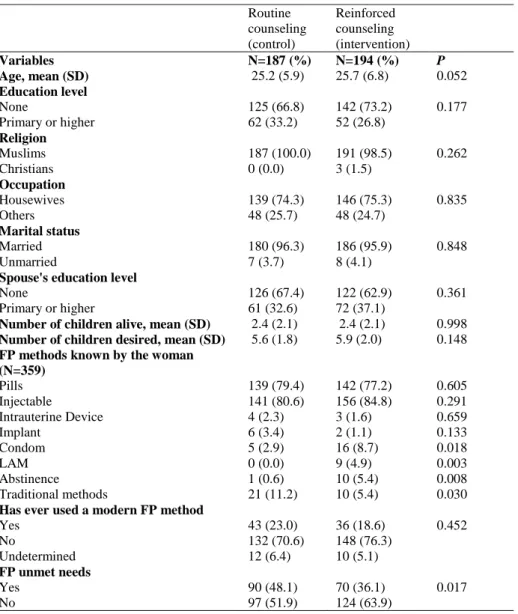
Women‘s socio-demographic characteristics were similar across the intervention and the control groups (Table 1). They had a mean age of 25.7 (SD: 6.8) years in the intervention group and 25.2 (SD: 5.9) years in the control group. They had in majority no education level, were housewives, Muslims and married. Women desired on average 5.9 (SD: 2) children in the intervention group and 5.6 (SD: 1.8) children in the control group. However, there was a statistically significant difference in their levels of knowledge on FP. More women in the intervention group had heard about condoms, lactational and amenorrhea method (LAM) and abstinence than in the control group; however, fewer women in the intervention group had heard about other traditional methods than in the control group. Both groups were similar in terms of previous FP use (19.6% in the intervention group and 23% in the control group). There were more unmet needs for FP in the intervention group (63.9%) than in the control group (51.9%, P <0.05).
Use of a modern family planning method in
the postpartum
422 women contacted
404 included in the study
387 came back for the 6th
month postpartum visit
382 came back for the 9th
month postpartum visit
381 included in the analysis
18 excluded
• Did not consent: 10
• Husband refused: 6
• Non residents: 2
17 loss-to-follow up
• Death: 1
• Not met again: 6
5 loss-to-follow up
• Death: 1
• Not met again: 4
1 excluded from the analysis
• Type of counselling
unknown
Figure 1: Flow chart of women‘s inclusion in the study, October 2013-December 2014, Forécariah, Guinea
did not want it, their desire for another child, and the side effects of modern method FP.
At the ninth month postpartum, use of modern FP was significantly higher in the intervention group (5.7%; n=10) than in the control group (1.1%; n=2; P=0.024) (Table 3). The injectable methods represented the main methods used. The primary reason for the non-use of modern FP method was women‘s preference to abstain from sexual intercourse till their child walks; however, this proportion was significantly higher in the intervention group (70.5%) than in the control group (59.5%; P=0.027). Another
reason was the fact that the husband did not want them to use a modern FP method (8.2% in the
intervention group and 4.3% in the control group).
Use of any family planning method in the
postpartum
At the sixth month postpartum, there was no statistically significant difference between the proportions of women using any FP method in the two groups (5.7% in the intervention group and 4.8% in the control group) (Table 2). At the ninth month postpartum, an increase in FP uptake in the intervention group (6.7%) was observed, whereas this decreased in the control group (2.7%);
however, no statistically significant difference was seen between both groups in terms
Table 1: Baseline characteristics of women receiving two types of antenatal counseling in five rural health centres, Forécariah health district in Guinea, October 2013-December 2014 (N = 381)
SD: Standard déviation LAM: Lactational and Amenorrhea Method
Intention to use an FP method in the
postpartum
Women with postpartum FP intention were more represented in the intervention group at the sixth month postpartum (88%) than in the control group (69%; P<0.01), as well as at the ninth month postpartum (78% and 54%, respectively, P<0.001). However, these proportions were similar
at the time of inclusion just after the counseling session (Figure 2).
Knowledge on family planning at end line
At the ninth month postpartum, women cited more FP methods in the intervention than in the routine group (Table 3). Pills, intra-uterine device, implant and traditional methods were the methods more cited.
Routine counseling (control)
Reinforced counseling (intervention)
Variables N=187 (%) N=194 (%) P
Age, mean (SD) 25.2 (5.9) 25.7 (6.8) 0.052
Education level
None 125 (66.8) 142 (73.2) 0.177
Primary or higher 62 (33.2) 52 (26.8)
Religion
Muslims 187 (100.0) 191 (98.5) 0.262
Christians 0 (0.0) 3 (1.5)
Occupation
Housewives 139 (74.3) 146 (75.3) 0.835
Others 48 (25.7) 48 (24.7)
Marital status
Married 180 (96.3) 186 (95.9) 0.848
Unmarried 7 (3.7) 8 (4.1)
Spouse's education level
None 126 (67.4) 122 (62.9) 0.361
Primary or higher 61 (32.6) 72 (37.1)
Number of children alive, mean (SD) 2.4 (2.1) 2.4 (2.1) 0.998
Number of children desired, mean (SD) 5.6 (1.8) 5.9 (2.0) 0.148
FP methods known by the woman (N=359)
Pills 139 (79.4) 142 (77.2) 0.605
Injectable 141 (80.6) 156 (84.8) 0.291
Intrauterine Device 4 (2.3) 3 (1.6) 0.659
Implant 6 (3.4) 2 (1.1) 0.133
Condom 5 (2.9) 16 (8.7) 0.018
LAM 0 (0.0) 9 (4.9) 0.003
Abstinence 1 (0.6) 10 (5.4) 0.008
Traditional methods 21 (11.2) 10 (5.4) 0.030
Has ever used a modern FP method
Yes 43 (23.0) 36 (18.6) 0.452
No 132 (70.6) 148 (76.3)
Undetermined 12 (6.4) 10 (5.1)
FP unmet needs
Yes 90 (48.1) 70 (36.1) 0.017
Table 2: Use of family planning method at the sixth month postpartum among women receiving two types of antenatal counseling in five rural health centres, Forécariah health district in Guinea, October 2013-December 2014 (N = 381)
*Data missing for lactational amenorrhea method (LAM)
Figure 2: Intention to use an FP method among women receiving two types of antenatal counseling in five rural health centres, Forécariah health district in Guinea, October 2013-December 2014 (N = 381)
100%
88%
78% 99%
69%
54%
0% 20% 40% 60% 80% 100%
Just after the counseling
At the 6th month postpartum
At the 9th month postpartum
P=0.972 P<0.01 P<0.001
Pr
o
p
o
rtion
o
f wo
m
e
n
Follow up time
Reinforced counselling (intervention)
Routine counselling (control) Routine counseling
(control)
Reinforced counseling (intervention)
Variables N=187 (%) N=194 (%) P
Use of any FP method * 0.708
Yes 9 (4.8) 11 (5.7)
No 178 (95.2) 183 (94.3)
Use of a modern FP method * 0,473
Yes 6 (3.2) 9 (4.6)
No 181 (96.8) 185 (95.4)
Methods used by woman 0.282
Condom 4 (2.1) 4 (2.1)
Pills 0 (0.0) 4 (2.1)
Intrauterine Device 1 (0.0) 1 (0.0)
Injectable 1 (0.0) 0 (0.0)
Traditional Methods 3 (1.6) 2 (1.0)
Reasons for the non-use of modern FP method at the 6th month postpartum (N=366)
Prefer to abstain from sexual intercourse till the child walks
119 (65.7) 125 (67.6) 0.712
The desired FP method not available 2 (1.1) 42 (22.7) <0.001
Husband does not want 6 (3.3) 8 (4.3) 0.615
Desire for another child 7 (3.9) 3 (1.6) 0.319
Because of the side effects 2 (1.1) 5 (2.7) 0.467
Table 3: Knowledge about and use of family planning method at the ninth month postpartum among women receiving two types of antenatal counseling in five rural health centres, Forécariah health district in Guinea, October 2013-December 2014 (N = 381)
LAM: Lactational amenorrhea method
Discussion
The objective of this study was to assess the impact of a specific (reinforced) antenatal counseling on use of modern FP in the postpartum in rural Guinea. The reinforced antenatal counseling intervention would be considered beneficial if a statistically significant increase in use of modern FP was observed in the intervention group (women who received the reinforced antenatal counseling) compared to the control group (women who received the routine antenatal counseling).
The findings showed that use of modern FP was low at the sixth month and the ninth month postpartum. At the ninth month postpartum, a statistically significant increase (4.6 percentage
points difference; P=0.024) in use of modern FP methods was observed among women who received the reinforced antenatal counseling compared to those who received the routine antenatal counseling. However, it is important to note that most women were not sexually active at the sixth month postpartum (67.6% in the intervention group and 65.7% in the control group) and at the ninth month postpartum (70.5% and 59.5%, respectively) since they abstained from sexual intercourse till the child walks. Thus, these women were not in need of modern FP methods. Therefore, it becomes difficult to discern at these stages whether the intervention influenced use of modern FP methods. Nevertheless, we observed that the intervention had improved women‘s knowledge on FP and increased their postpartum Routine counseling
(control)
Reinforced counseling (intervention)
Variables N=187 (%) N=194 (%) P
FP methods known by the woman
Pills 161 (86.1) 181 (93.3) 0.020
Injectable 156 (83.4) 168 (86.6) 0.385
Intra-uterine device 2 (1.1) 40 (20.6) <0.001
Implant 5 (2.7) 27 (13.9) <0.001
Condom 18 (9.6) 11 (5.7) 0.146
LAM 14 (7.5) 15 (7.7) 0.929
Traditional methods 22 (11.8) 37 (19.1) 0.049
Use of any FP method 0,064
Yes 5 (2.7) 13 (6.7)
No 182 (97.3) 181 (93.3)
Use of a modern FP method 0,024
Yes 2 (1.1) 11 (5.7)
No 185 (98.9) 183 (94.3)
FP method used by the woman 0,058
Pills 0 (0.0) 1 (0.5)
Injectable 1 (0.5) 10 (5.2)
Implant 1 (0.5) 0 (0.0)
Traditional method 3 (1.6) 2 (1.0)
Reasons for the non-use of a modern FP method at the ninth month post-partum (N=368)
Prefer to abstain from sexual intercourse till the child walks
110 (59.5) 129 (70.5) 0.027
Because of the side effects 0 (0.0) 4 (2.2) NA
The desired FP method not available 0 (0.0) 6 (3.3) NA
Husband does not want 8 (4.3) 15 (8.2) 0.126
FP intention. This implies that the intervention could influence use of modern FP method on the long run, that is, if women were followed up until they resume sexual intercourse. However, in Tanzania, Keogh et al found that antenatal counseling had an effect on postpartum FP intentions, but not on use16. Findings from the present study therefore recommend longer study period, that is, at least two years for postpartum follow up, to assess the effect of antenatal counseling on use of modern FP in the postpartum in the Guinean context.
More FP unmet needs were reported at the time of the inclusion in the study, among women in the intervention group than the control group. The reinforced antenatal counseling might have contributed to overcome some barriers to FP use among women with FP unmet needs. In addition, the relatively high proportion of FP unmet needs (more than one-third of pregnant women) in our study sample shows that FP use can be improved in rural Guinea if more appropriate approaches are locally identified.
This study has several limitations. First, the estimation of use of modern FP at the sixth month postpartum did not take into account use of lactational and amenorrhea method (LAM), due to lack of verification of the LAM criteria26 during data collection. Second, the timeline for measuring FP use in the postpartum period was short to demonstrate the utility of the intervention. Third, we could not collect data on the number of ANC visits attended by women to adjust the intervention effect for. This might have affected the influence of the intervention on FP use in the postpartum. Finally, the study context, with the emergence of the Ebola outbreak in Guinea and in the study setting, was marked by the dysfunction of many health structures leading to the decline of the use of health services including for family planning 27.
Conclusion
Providing specific individual antenatal counseling to women in rural Guinea with a focus on FP can improve their knowledge on FP and increase postpartum FP intention. This study could not demonstrate the utility of specific antenatal counseling on use of modern FP in the postpartum,
given the relatively short follow up period. It therefore recommends longer study period, that is, at least two years for postpartum follow up to assess the effect of antenatal counseling on use of modern FP in the postpartum in the Guinean context.
Conflict of interest
None
Contribution of Authors
BSC, AD and SS were involved with conception and design of the protocol. BSC, AD, PB and MMS were involved with acquisition of data. BSC, AD and SS did the data analysis and all authors were involved with interpretation. All authors have given approval for the final version to be published and are accountable. All authors read and approved the final version.
References
1. United Nations. Sustainable Development Goals [Internet]. 2015 [cited 2016 Oct 14]. Available from: https://sustainabledevelopment.un.org/sdg3
2. Bongaarts J, Charles FW. The Potential Role of
Contraception in Reducing Abortion. 2000;31(3):193–202.
3. Guttmacher Institute. Induced Abortion Worldwide. 2016;6736(May):1–2. Available from: papers3://publication/uuid/E73D169E-5FAD-4D15-904A-EEAFE8D81683
4. WHO. Family planning/Contraception. Fact sheet. [Internet]. 2017 [cited 2017 Oct 6]. Available from: http://www.who.int/mediacentre/factsheets/fs351/en /
5. Family Planning Ouagadougou Partnership. Family Planning: Francophone West Africa on the Move. A Call to Action. 2012;1–28. Available from:
http://www.prb.org/pdf12/ouagadougou-partnership_en.pdf
6. Cleland JG, Ndugwa RP and Zulu EM. Family planning in sub-Saharan Africa: progress or stagnation?TP. Bull World Health Organ [Internet]. 2011;89(2):137–43. Available from: http://www.who.int/bulletin/volumes/89/2/10-077925.pdf
8. Pearson E and Becker S. Couples‘ Unmet Need for Family Planning in Three West African Countries. Stud Fam Plann. 2014;45(3):339–59.
9. MSHP Guinee. Plan stratégique national de
repositionnement de la Planification Familiale 2012-2018. 2013.
10. Institut National de la Statistique. Rapport des résultats clés: Suivi de la situation des enfants et des femmes.MICS 2016. [Key Results Report: Monitoring the situation of children and women. MICS 2016]. 2017.
11. Hernandez LE, Sappenfield WM, Goodman D and Pooler J. Is effective contraceptive use conceived prenatally in Florida? The association between prenatal contraceptive counseling and postpartum contraceptive use. Matern Child Heal J. 2012;16(2):423–9.
12. Lee JK, Parisi SM, Akers AY, Borrerro S and Schwarz EB. The Impact of contraceptive counseling in primary care on contraceptive use. J Gen Intern Med. 2011;26(7):731–6.
13. Barber SL. Family planning advice and postpartum contraceptive use among low-income women in Mexico. Int Fam Plan Perspect. 2007;33(1):6–12. 14. Adanikin AI, Onwudiegwu U and Loto OM. Influence of
multiple antenatal counselling sessions on modern contraceptive uptake in Nigeria. Eur J Contracept Reprod Heal Care. 2013;18(5):381–7.
15. Wuni C, Turpin CA and Dassah ET. Determinants of contraceptive use and future contraceptive intentions of women attending child welfare clinics in urban Ghana. BMC Public Health. 2017;18(1):1–8. 16. Keogh SC, Urassa M, Kumogola Y, Kalongoji S, Kimaro
D and Zaba B. Postpartum Contraception in
Northern Tanzania: Patterns of Use, Relationship to Antenatal Intentions, and Impact of Antenatal Counseling. Stud Fam Plann. 2015;46(4):405–22. 17. Ayiasi RM, Muhumuza C, Bukenya J and Orach CG. The
effect of prenatal counselling on postpartum family planning use among early postpartum women in Masindi and Kiryandongo districts, Uganda. Pan Afr Med J. 2015;21:1–7.
18. Cleland J, Shah IH and Daniele M. Interventions to Improve Postpartum Family Planning in Low‐ and Middle‐Income Countries: Program Implications and Research Priorities. Stud Fam Plann. 2015;46(4):423–41.
19. Institute of Statistics. Guinea Demographic and Health and Multiple Indicators Survey 2012. 2013. 20. Ministère de la Santé de Guinée. Annuaire des
statistiques sanitaires nationales 2012. [National health statistics yearbook 2012]. Conakry; 2015. 21. MSHP Guinee. Annuaire des statistiques sanitaires
nationales 2012. Conakry; 2015.
22. DHS. Révision des besoins non satisfaits : En bref Résumé de l ‘ analyse de MEASURE DHS. 2012. 23. Contraceptive Technology and Reproductive Health
Series. Lactational Amenorrhea Method (LAM) [Internet]. 2017 [cited 2018 Jan 7]. Available from: https://www.fhi360.org/sites/default/files/webpages/ Modules/LAM/s1pg4.htm