A N N O T A T E D B IB L IO G R A P H Y F O R G A M E
S T U D IE S : M O D E L IN G S C H O L A R L Y
R E S E A R C H IN A P O P U L A R C U L T U R E
F IE L D
Cathlena Martin, University of Montevallo
INTRODUCTORY ESSAY
The University of Montevallo, Alabama’s only public liberal arts university, created a Game Studies and Design (GSD) minor three years ago. This interdisciplinary, undergraduate minor is meant to complement any major on campus. In the GSD core classes, students explore the historical and cultural impact of different genres of games including video games, board games, card games, role-‐playing games (RPGs), and other such varieties. Game Studies courses analyze a range of games, both traditional and digital, and Game Design courses uniquely specialize in creating non-‐digital games while exploring the fundamentals of game design that apply to any medium. The minor consists of twenty-‐one credit hours comprised of five required three-‐credit-‐ hour courses and two elective courses. Required courses include History of Games, Survey of Modern Games, Game Design Workshop I & II, and Mathematics of Games. Elective possibilities include special topic courses like Sociology and Games, Mathematics of Chess, Tabletop RPGs, Children’s Literature and Games, and Aesthetics and Ethics in Games.
GSD 225: Survey of Modern Games focuses on the study of electronic games, particularly the history of video games and games significant to the development of the medium. This course attracts students from a wide range of majors (art, mathematics, English, theatre, psychology business, and so forth), most of whom have a strong passion for video games. The course is divided into three units of study—past, present, and future—which consist of the following questions:
• What is the historical foundation for electronic games? • What is the current moment in games?
• Where are we headed in game design and scholarship?
Given computer games’ mass appeal, I find it imperative to ground the Survey of Modern Games course in current scholarship in order to instill an academic tone from the start of this popular culture topic course; thus, the very first assignment I give is an annotated bibliographic entry of an article from journals such as Game Studies: The International Journal of Computer Game Research. Coming from a humanities background, this traditional assignment helps frame the games course around scholarly discourse. What follows is a verbatim copy of the
assignment.
THE ASSIGNMENT
Select one article from the recommended list of articles from online academic game journals like Game Studies (http://gamestudies.org) and Eludamos (http://www.eludamos.org). Then, within the next two weeks, post a summary and evaluation/commentary of the article with a Works Cited under the discussion board in Blackboard. These posts will help us build a repository of information regarding academic analysis and discussions of games and will provide a springboard for discussion regarding the qualities of an academic investigation of games. A maximum of two students may write about the same article, so read through previous posts to make sure two other students have not already chosen the article you selected.
Once you select an article, write a one-‐paragraph summary of the article’s content and a one-‐ paragraph commentary/evaluation on it.
Your entry should include the following: • Summary
This section should be a one-‐paragraph minimum summary of the article in your own words. Do not plagiarize the article's abstract. Read the article, possibly several times, and summarize its key points in your own words. If this summary is from an online journal with no page numbers, only the author's name should be in the parenthetical citation if you quote; however, since this is a summary paragraph the use of quotes should be very limited. Make sure you are giving agency to the author: for example, use “According to Aarseth” or “Aarseth argues.” And try to select an article on a topic or game you like!
• Commentary/Evaluation
This section should be a one paragraph minimum commentary/evaluation of the article. Why is it useful? What was interesting about this article? What new insight did it
provide? This paragraph is your opinion regarding the article.
[You may know this assignment as an annotated bibliography.] Post your entry under the discussion board on Blackboard. Your entry is worth 10% of your overall grade in the class, so please do your best work.
ASSESSMENT AND CONCLUSION
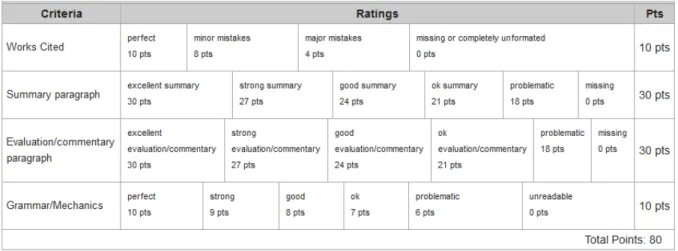
The following rubric is used to assess this assignment. On the rubric, there is space to add written comments to the students.
FIGURE 1: ASSESSMENT RUBRIC.
Students performed quite well on this assignment and showed a high level of mastery. The grades were distributed as follows:
Grade Distribu-on
A
B
C
D
Over half the class (53%) earned an ‘A’ and most others earned (37%) earned a ‘B’. Students with little exposure to scholarly writing have—through this assignment— taken a significant concrete step towards developing this expertise. The mean was 88.6% and the median was 92.5%.
High scores on this assignment could be related to a variety of causes. This is the first major written assignment of the class, when students have the most energy of the semester and are trying to establish themselves to the professor. This assignment is also posted for all class members to see in the discussion forum of our learning management system, thus creating a social or peer expectation. Whatever the reason for the final grades, the assignment
subjectively seems to benefit my students and provide a scholarly foundation for the rest of the term to build on. Students that populate this interdisciplinary undergraduate class have spent countless hours playing video games and have typically read scores of game reviews, but they generally come into my course with a lack of understanding of what defines a scholarly approach to analyzing and discussing the medium. By having them read, summarize, and evaluate a scholarly article, they begin to distinguish between game reviews and game
scholarship, elements we then discuss further in class discussion. This provides basic scaffolding that we can build upon as the class progresses. By asking them to process scholarly articles, I familiarize them with examples of formal academic analysis that their later class essay assignments should be modeled after.
This assignment also gives students guidance and practice of how to construct an MLA works cited entry for an online journal and reinforces good writing habits like in-‐text citations and making the distinction between authorial voice and outside research ideas. The MLA Handbook for Writers of Research Papers does not, as of the seventh edition, codify a method for citing video games; therefore, this assignment also allows me to establish a class standard. Students post their assignments in our learning management system (Blackboard) and also share their work in class. This affords students multiple entryways into discussing games like The Sims (Maxis, 2000) or Halo (Bungie, 2001) that they may have never before viewed through a scholarly lens.
Anecdotally, I see higher levels of engagement with scholarly research when students in this class are asked to write a research essay at the end of the semester than I do with my History of Games class, which has not previously included this assignment. In the 200-‐level Survey of Modern Games course, students seem more information-‐literate; they are able to select and incorporate scholarly articles into their own essays after completing this assignment. Because of this, I will begin incorporating the assignment, with different journal articles, into my History of Games class too.