and Management Studies
ISSN: 2313-7401 Vol. 3, No. 1, 47-55, 2016
http://www.asianonlinejournals.com/index.php/AJSSMS
Exploring the Effects of Training and Development
Practices on Organization Performance: A Case Study of
Pakistan Telecommunication Authority
Muhammad Waqas Chughtai
1*--- Zulfiqar Ali Nadeem
21
Assistant Professor, NTI School of Management Sciences
2
Research Scholar, NTI School of Management Sciences
Abstract
Contents
1. Introduction ... 48
2. Literature Review ... 48
3. Research Methodology ... 49
4. Results & Discussion ... 49
5. Conclusion ... 54
6. Suggestions ... 55
References ... 55
Citation | Muhammad Waqas Chughtai; Zulfiqar Ali Nadeem (2016). Exploring the Effects of Training and Development Practices on Organization Performance: A Case Study of Pakistan Telecommunication Authority. Asian Journal of Social Sciences and Management Studies, 3(1): 47-55.
DOI: 10.20448/journal.500/2016.3.1/500.1.47.55
ISSN(E) : 2313-7401
ISSN(P) : 2518-0096
Licensed:
Author(s) Contribution:
This work is licensed under a Creative Commons Attribution 3.0 License All authors contributed to the conception and design of the study.
Funding: This study received no specific financial support.
Competing Interests: The authors declare that they have no conflict of interests.
Transparency: The authors confirm that the manuscript is an honest, accurate, and transparent account of the study was reported; that no vital features of the study have been omitted; and that any discrepancies from the study as planned have been explained.
Ethical: This study follows all ethical practices during writing.
History: Received: 31 August 2015/ Revised: 29 September 2015/ Accepted: 14 October 2015/ Published: 20 October 2015
Publisher: Asian Online Journal Publishing Group
Training and development (T&D) is important for survival of every organization. It plays a strategic role to achieve the current as well as future goals of the organization. The core objective of the research was to explore the impact of training and development on organizational effectiveness. The research was based on a case study of Pakistan Telecommunication Authority. The study consists of the data gathered through a structured questionnaire from the employees and management of Pakistan Telecommunication Authority in Islamabad and Rawalpindi region. The results have disclosed the importance of training and development practices and its impact on individuals as well as on organization. Furthermore, it is suggested that T&D programs should be carefully assessed, designed, implemented and evaluated in order to fill the gap between existing and required skills, abilities and knowledge of the employees; in addition to enhance the organizational effectiveness.
1. Introduction
Human resource is considered as an important asset of organization. Every organization needs to sustain adequate numbers of human capital. This is the age of competition and every organization has to face its rivals and market challenges. An organization cannot compete in the market without having skilled and competent employees. Training and development program is an important activity in the organization because it enhances employee’s skills and competences and helps the organization to get competitive advantage (Batool and Batool, 2012). The managers should focus staff training and development according to organization needs because an effective team can perform well to achieve the desired objectives. Training and development program needed to be a continual exercise in organization for its growth and competitiveness. Well trained staff perform efficiently and effectively to achieve the intended milestones of organization. Productive organization provides more benefits for its employees, that enhance the level of job satisfaction and consequently employee’s turnover reduces and retain for a long time (Jehanzeb and Bashir, 2013).
Human resource management is about recruiting, hiring and managing employees. However, an effective human resource system entails many more aspects of the organization, including organizational culture and ensuring health and safety. With an understanding of these components of an HR management system, business owners and managers can effectively structure their business processes. Training and development programs are essential for every organization for its long term planning and strategy. These programs help organization to achieve its objectives in time and enhance the skills and competencies of workforce (Khan et al., 2012). Several organizations think that staff training simply increases the cost of organization, because the organization has to allocate staff training budget every year. But this concept has been changed now, because of cost of non training is always higher than the cost of training. Training and development programs enable the employees to get necessary skills to use new technologies
(Imran et al., 2014). Effective employees training minimize the gap between actual required skill to do the job and existing skills in new employees (Simons and Richardson, 2012). Proactive, motivated and well trained staff makes the organization productive and prosperous. Training and development enhances the organization towards its strategic goals and objectives (Niazi, 2011).
Human resource is a source like any other natural resource. The management can get and use the skill, knowledge, ability, etc. through the development of skills, tapping and utilizing them again and again. Human resource is that part of the process of management which manages and develops the human beings of an enterprise. It is not only the administration of skills, abilities but also the attitudes and aspirations of people. When individuals join an organization, they come with not only technical skills, knowledge, experience etc. but also with their personal feelings, perception, desires, motives, attitude, values etc. An important part of human resource management is the ‘humane approach’ while managing people. This approach assists a manager to consider his people as an important resource. It is a benevolent approach to develop and effectively utilize the manpower not only for the benefit of the organization but for the growth, development and self satisfaction of the concerned people. Thus, human resource management is a system that focuses on human resource development, on the one hand, and effective management of people on the other. HRM approach is a fundamental change in the philosophy and perspective stemmed from reckoning with the resourcefulness of the people at work, which can be developed by appropriate programs. It emphasizes the human aspect of individual workers and their aspirations and needs.
1.1. Objectives of the Research
1. To explore the effects of training and development on organizational effectiveness.
2. To give fruitful suggestions for the improvement of employees training and development techniques in the organizations.
2. Literature Review
Ahmed et al. (2014) examined the impact of training and development on employee performance while focusing a case study from different banking sector of north Punjab. The results disclosed that all the three factors namely training and development, on the job training and its delivery style has positive impact on employee’s performance. They further concluded that employee’s training need assessment should be conducted in every organization in order to make the employees more productive after delivering necessary training to them.Al-Kassem (2014) concluded that training must be designed to fill gap between actual performance and what was needed. New employees were not usually aware with the environment of the new organization. Initially new employees had to understand the organizational culture and working environment, for the purpose they needed basic training to accommodate them in new organization. Training helped the organization to reduce that gap; however it could not be completely eliminated. Effective training reduced the employee’s turnovers and enhanced the employee’s commitment in the organization.
Raza (2014) elaborated training and development impact on organizational performance while collecting evidence from oil and gas sector of Pakistan. The study analyzed learning organization and its strategic training and development alignment, training need analysis and line manager’s involvements in training and developments programs and training formalization including implementation and its evaluation. The findings showed that organizational performance has been enhanced by the strategic training and development alignment, manager’s active participation as well as due to effective design, implementation and evaluation of training and development programs. AlYahya et al. (2013) stated that human resource development was required by every organization to meet the challenges. Therefore effective training and development programs were needed by the organization to ensure well trained workforce in the organization. Training intervention has been an important function to increase the effectiveness of human resource development in organization. The training outcome would be more productive and effective when the numbers of participation of workforce would be attentive and present regularly.
Amin et al. (2013) explored the impact of employees training on the job performance in education sector of Pakistan. Training and development improved current and future performance of employees in organization. Training need assessment was essential process to identify training need, to improve behavior of employees and to gain organizational goals. Jehanzeb and Bashir (2013) explained that employee job satisfaction should be vital in the organization. Workforce always switched the organization whenever their level of satisfaction was lower than expected or required to meet their basic needs. Satisfied employees always showed loyalty to the organization and focused the job assignments.
Shaheen et al. (2013) concluded the relationship between training and employees, for this purpose school teacher of Kotli Azad Jamun Kashmir has brought in the study. It is indicated that employee performance played as mediating role between employees training and organizational performance. Effective training produced positive outcome in the organization. The performance and methodology of the teachers improved due to proper training.
Batool and Batool (2012) concluded that organization could get competitive advantage by staff training and development. Training and development of employees was the basic requirement of the organization. Without having efficient and trained workforce in the organization, it would be difficult for organization to meet market challenges.
Singh and Mohanty (2012) emphasized that the organizations should expand in training of its employees, because training enhanced the employee productivity as a result the revenue of organization increased. Without training the performance of employees went down and de-motivated. Productive employee could better contribute for achievement of the organization objectives.
3. Research Methodology
This research is based on primary data that have been collected from selected respondents of Pakistan Telecommunication Authority Islamabad Head office; a well structured questionnaire has been designed to gather the relevant information from respondents by using convenient sampling technique. A simple descriptive statistics has been applied to interpret the data.
4. Results & Discussion
Table-1.Frequency of Training in PTA
Category Respondents Percentage
Monthly 14 8 %
Quarterly 86 50%
Annually 56 33%
Training Once 10 6%
No Training 6 3%
Total 172 100 %
The Table No.1 shows the frequency of training practices in PTA. When the frequency of training in the
organization was investigated, 8% of the total respondents mentioned that they are offered training on monthly basis. They said their department heads lecture them every month and let them know about the monthly targets. They are given proper instruction to achieve these targets in time.
While 50% of the total respondents indicated that they are provided training quarterly either by their department head or by any expert to accomplish their goals. Their performances are evaluated after four months and it helps them to overcome their deficiencies. Likewise 33% of the total respondents answered that they are provided training annually in the organization. An annual review is conducted and the employees are provided opportunity for further training to achieve next year goals.
The employees are either given training in organization or send them to other professional institutions to learn new things. And 6% of the total respondents believe that they have given only one time training when they joined the organization. Most of such employees are new inductees in the organization. Rests of the 3% of the total respondents believe that they have been offered no any training by the organization.
4.1. Impact and Significance of Training and Development on Employees
Table-2.Impact and Significance of training and development to the Employees
Impact and Significance of T&D to the Employees
Category Strongly
Agree
Agree Disagree Strongly Disagree
No Comments
Total
% % % % %
T&D is Beneficial for Motivation 87 51% 80 47% 2 1% 2 1% 1 1% 172
Training is helpful for promotion 57 33% 104 60% 4 2% 1 1% 6 3% 172
labor laws are taught during training 48 28% 96 56% 13 8% 10 6% 5 3% 172
Organization Conducts Orientation 41 24% 102 59% 13 8% 9 5% 7 4% 172
New Employees gets formal training 54 31% 111 65% 3 2% 2 1% 2 1% 172
Training enhances Encouragement &performance
67 39% 93 54% 5 3% 5 3% 2 1% 172
T&D enhance competencies 64 37% 87 51% 12 7% 4 2% 5 3% 172
T&D enhance Skills and knowledge 69 40% 97 56% 3 2% 3 2% 0 0% 172
Training Improves Communication Skills
58 34% 97 56% 9 5% 6 3% 2 1% 172
T&D impact on career development 50 29% 99 58% 11 6% 6 3% 6 3% 172
Performance Increases due to T&D 81 47% 87 51% 2 1% 1 1% 1 1% 172
T&D brings positive impact in attitude
48 28% 102 59% 9 5% 7 4% 6 3% 172
Awareness with Current job responsibilities
79 46% 88 51% 2 1% 3 2% 0 0% 172
T&D reduce work stress 45 26% 98 57% 13 8% 11 6% 5 3% 172
Skills employees perform more than unskilled
91 53% 74 43% 3 2% 2 1% 2 1% 172
The Table No. 2 indicates the impact and significance of training and development to the employees. Several
questions were asked to investigate the impact of training and development on employee performance. When the employees were asked about the benefits of training on development on employee’s motivation, 51% of total respondents strongly consider Training and development is beneficial for employee’s motivation whilst 47% also agree with it. They think that without proper training and development the employees cannot be motivated. Training and development enhances employees’ knowledge and skills, which provide them chances of career development in the organization. So level of motivation of such employees are more and they perform well in the organization. On the other hand 1% of the total respondents disagree similarly 1% strongly disagrees. They do not consider training and development as beneficial for employee motivation. They believe employee motivation level changes from time to time. Sometimes more training and development programs increase their stress level. Because of the training they are given more tasks to perform, which they usually could not complete, so more work cause de-motivation among the employees. The remaining 1 % of the total respondents set this query aside and given no any answer.
Training is helpful for promotion of the employees, when the participants were asked, 33 % of the total respondents strongly agree while 60% agree. They consider training is one of the key strategies for employee promotion, because training increases the employee’s skills, knowledge and competencies. Training enables the employees to perform their job easily and in professional manner. They think employee promotion is mostly associated with the employees training and learning. However 2% of the total respondents disagree and 1% strongly disagrees with it. They feel promotion needs strong references instead of training. They think, if you have strong references in the organization, you can get easy chances for promotion. However, 3 % of the total respondents were found silent to reply this question.
Usually employees are not aware about the labor laws and its implementation in the organization. They simply look only rules and regulation of the organization and unaware of local labor laws and policies. When this query was raised, 28% to the total respondents answered that they are taught about the labor laws during training programs in organization. And 56% to the total respondents have also shows agreement to this query and replied that they have been taught about the labor laws in their training programs. On the other hand 8 % of the total respondents disagree and 6 % strongly disagree. They believe that they are usually not told about the labor laws during their training programs. And they are not aware of the local labor laws and its proper implementation in the organization. However 3 % has given no reply.
It is important for every organization to conduct orientation for every newcomer in the organization, so that they could easily socialize and perform their duties. When this query was investigated in PTA, 24 % of the total respondents have shows their strong agreement and 59 % also agree. They think that orientation program is conducted for every new employee. They are introduced with their coworkers, subordinates, seniors as well as with the staff on other department. They are informed and helped to perform their job responsibilities. They are given all necessary assistance. However 8 % of total respondents disagree and 5% strongly disagree. They replied, they did not go through with any orientation programs when they joined the organization. The remaining 4% of the total respondents kept them aside and given no reply.
organization. They think that they were given no any kind of initial training when they were inducted in the organization. Rest of the 1% has given no any response. These results reveals that PTA is very much concerned with employees training, they provide initial training to maximum staff those are new hired. These new hired employees have given initial training to perform their job in effective way.
When it was investigated, whether training programs encourage employees for efficient performance, 39 % of the total respondents strongly agree and 54% of the total respondents has also shown their agreement. They think training and development programs are instrument to encourage employees towards better performance. When employees get more skills they are encouraged to perform difficult task. Ultimately they contribute exceptionally to achieve the overall organizational goal. However, 3 % of the total respondents disagree and 3% strongly disagree. They believe training do not encourage the employee to perform more task because more tasks are always treated as work burden by the employees. Remaining 1% of the total respondents provided no comment to this query.
As for as employees competences are concerned, 37% of the total respondents consider that training and development programs enhance employee’s work competences at a great extent, while 51% respondents have also agree that employees competences are directly associated with effective training. On the other hand 7% of total respondents disagree and 2% strongly disagree with it. However, 3% of the respondents have given no answer to the question.
Without skill and knowledge no any task can be performed. Both are essential for all employees of any organization. When the association of training and development with knowledge and skill were investigated at PTA, 40% of the total respondents strongly believe that training and development is the key factor to enhance employee’s knowledge and skill. While 56% of the total respondents also believe that without effective training programs employees knowledge and skills cannot be enhanced. They think that the employees can only be beneficial for the organization when they are more skillful and knowledgeable. Conversely 2% of the total respondents disagree and 2 % strongly disagree.
Better communication in an organization is as important as blood circulation is important in our body. Timely and effective communication helps to handle all tasks timely with proper understanding. When importance of communication with respect to training program was investigated, 34% of the total respondents strongly agree and 56 % agree and believe that training helps to boost the communication in organization. Training enhances the communication skill of employees and provides opportunity to complete their tasks with understanding and timely. However 5% disagree and 3 % strongly disagree, they think training is not essential to increase communication skills. They believe communication skill is improved by more socialization instead of formal training programs. Rest of the 1% of the total respondents has given no comment.
Career development is usually associated with employees training and development, because effective training enhances knowledge, skills and competences of employees that enable employees to accomplish their tasks timely and provide them opportunities for career development. When this fact was explored in PTA, 29% of the total respondents strongly agree and 58% also depicted their agreement. They consider training and development as important key for career development. On the other hand 6% of the total respondents disagree and 3% strongly disagree. They believe, for employee’s career development you should have strong association with your seniors. The remaining 3% of the total respondents have given no any reply.
Training and development increase employee performance, 47% of the total respondents believe at the great extent while 51% respondents also agree. They consider training and development important for employee performance, and due to training and development programs their performance adequately enhanced. On the contrary 1% of the respondents have shown their disagreement and 1 % has indicated strongly disagreement. They think performance required motivation, if you are motivated your performance will be high, usually training and development puts overburden so employees are not motivated. Rest of the 1 % has given no answer to this query.
Among the total respondents 28% strongly feel that training and development has put positively impact on their attitude while 59% of the total respondents also think as well. They consider training and development as one of the key factors in building personal behavior and attitude, which ultimately cause to enhance the organizational culture. Whilst 5% of the total respondents disagree and 4% strongly disagree, saying that attitude has no direct concern with training and development. They believe the organizational environment plays so much major role while affecting employee’s attitude instead of training and development. If the organization has pleasant and stress free environment then worker’s attitude will be affected positively otherwise it will be changed according to the situation. However 3% has given no reply to the question.
When the respondents were asked about the job responsibilities, the 46% of the total respondents strongly believe that training and development helped them to understand their job responsibilities at high extent and 51 % respondents also agree. They feel training and development has not only increased their knowledge and skills but also enhance awareness about their job responsibilities and importance of the tasks and assignments. Due to training and development; now they completely understand the importance of their job and always do their best to accomplish the tasks in scheduled time period. While 1% has shows disagreement and 2% strongly disagree. They think the candidates must already have knowledge of their job responsibilities, before inducting in the organization, so no any training is usually required to improve the job responsibilities.
When they respondents were asked about the performance difference of skilled and unskilled employees, 53% of respondents strongly believe that skilled employees are far better than unskilled. Skilled employee has the potential to do the job timely and with good understanding. Similarly, 43% of the total respondents also agree and they believe skilled employees are capable to manage their time, tasks, communication within department and accomplish their job in the required timeframe. Conversely 2% of the total respondents disagree and 1% strongly disagrees. These respondents were from lower ranked usually working as watchman and office boy. They believe there is no skill required to perform their job. However, 1% of the total respondents have passed no comments.
The findings reveal that training and development has significant impact on individual effectiveness. The respondents consider that training and development has enhanced their performance, skills, knowledge, competences and awareness about their job responsibilities. As the results indicates, maximum respondents believe that they are getting required training in the organization and they give credit to training programs for their career development and professional attitude.
4.2. Impact and Significance of Training and Development to the Organization
Table-3.Impact and Significance of training and development to the Organization
Impact and Significance of T&D to the Organization
Category Strongly
Agree
Agree Disagree Strongly Disagree
No Comments
Total
% % % % %
T&D is helpful for success of Organization 89 52% 76 44% 4 2% 2 1% 1 1% 172
Training increases the financial status of organization
79 46% 84 49% 5 3% 2 1% 2 1% 172
T&D programs are practices in PTA 69 40% 93 54% 3 2% 5 3% 2 1% 172
Training Develops morality of organizational culture
50 29% 102 59% 9 5% 7 4% 4 2% 172
Training increases the market share 70 41% 95 55% 3 2% 3 2% 1 1% 172
Training Enhance the retention of employees 65 38% 95 55% 5 3% 4 2% 3 2% 172
Training programs provided to employee are best fit with PTA Corporate Strategy
76 44% 86 50% 4 2% 3 2% 3 2% 172
T&D is an essential activity in PTA 70 41% 95 55% 4 2% 2 1% 1 1% 172
Table No. 3shows the responses of sample respondents against the several questions asked to know the impact
and significance of training and development to the organization. When the respondents were asked to find out the impact of training and development on organization success, 52 % of the total respondents state that training and development is helpful for organization success, because it enhances the employees relevant skills, knowledge and abilities, which ultimately increase their work efficiency that may lead the organization towards its growth. Similarly 44% of the total respondents replied that training and development is important for organizational growth because they believe training and development not only enhances employee’s skills, chances for career development but it also provide opportunities for organization to achieve its goals efficiently. However, 2% of the total respondents consider training and development is not helpful for organizational growth because it is waste of time and money. Similarly 1 % strongly disagrees, and remaining 1 % has given no comment to this inquiry.
When the respondents were asked to see impact of training and development on the financial status of the organization, 46% of the total respondents strongly agree while 49% of the total respondents agree that training and development has improved the financial status of the organization. They assume, training and development enhance skills and competences of the employees, which helped the organization to achieve its objectives timely. When the organization achieves its objective in the specified time it causes to increase its revenue. In return this benefits for organization as well as for the employee. They believe their salaries and other allowances have been increased as on adequate level due to their performance and due to better financial status of the organization. However 3% has shown disagreement while 1% strongly disagrees. They think training and development are time consuming activities which are cost for the organization. So training and development do not cause to increase the financial status of the organization. The remaining 1% of the total respondents has given no reply.
The respondents were asked about the frequency of the training and development programs in PTA, 40% of the total respondents strongly believe that training and development is a regular practice in their organization. They are given opportunity to participate in these training and development programs. These training programs are scheduled monthly, quarterly semi annually and annually as per their requirements. Likewise 54% of the respondents also agree that training and development programs are focused in the organization and almost every employees are provide opportunity to participate in these programs. They believe these programs are usually associated with the overall organizational strategy and objectives. On the other hand 2% of the total respondent disagrees and 3% strongly disagree. They replied that they have given no any opportunity to attend any kind of training in the organization. Other 1% of the respondents have given no any answer to the question asked.
Whenever the respondents were asked about the training and development impact on morality of the organizational culture, 29% of the total respondents agree at high extent. They think culture of the organization can be changed by effective training and development programs and 59% of the total respondents also agree with this statement. They believe organizational culture is always formed by the level of training in the organization. It can be improved by better training of the employees in the organization. However 5% disagree and 4% strongly disagree, they think organizational culture has no linked with the training of employees. Rest of the 2% has given no answer to the inquiry.
feel training and development enhance the market knowledge of the employees and the employees can implement better marketing strategies for the goods and services which could cause increase market share of the organization. On the other hand 2% of the total respondents have indicated their disagreement and similarly 2% has shown strongly disagreement. The remaining 1% has given no comment to this query.
Training helps the organization to retain its employees, 38% of total respondents strongly agree with it and 55% also agree. They think that training and development programs provide career development opportunity for employees because training increases their skills and knowledge. When the employees get chances for promotion usually they try to stay in the organization. However 3% of the total respondents disagree while 2% strongly disagree. They believe employees retention is directly associated with the benefits, when the salary and benefits of the employees are high, they stay in the organization. Because the organization has to bear huge training cost, therefore usually the salary and benefits are increased at minimum level. Other 2% of respondents have given no comment.
Training and development programs should be linked with overall corporate strategy. When the respondents were asked about this point 45% of the total respondents believe strongly that the training programs offered to them are best fit with organization corporate strategy. Likewise 50% also agree and they are confident that they are aware with the organizational strategy and they perform accordingly to complete their tasks. However 2% disagree and 2% strongly disagree. They replied they have given no any training to work as per corporate strategy of the organization. The remaining 2 % of the total respondents have not given any reply to this question.
Training and development is an essential activity in PTA; when this query was raised 41% of the total respondents reply at the level of high extent. The staff gets regularly training in the organization, as per schedules. Everyone gets chances to participate in these training and development programs. Similarly 55% of the respondents also agree and they believe that their organization is very focused for the training and development of the employees. But on the other hand 2% of the total respondents disagree and 1% strongly disagrees. They feel the organization is not so much concerned with the training and development of the employees. They replied that they have given no any chance to participate in training programs. While 1% has given no any answer to this inquiry.
The findings reveal that Pakistan Telecommunication Authority is very much concerned with training and development of its employees. These Training and development pogroms have not only enhanced the skills, knowledge and abilities of its employees but also put positive impact on the organizational effectiveness. Training and development has enabled the organization to improve its public image as well as morality of its culture. It has benefited the organization to improve its financial status and market share. Due to effective training and development programs the turnover of the employees is almost zero. Most of the respondents believe that their organization performs as market leader, so they enjoy working in this organization and they feel proud to be part its team member.
4.3. Methods of Employees Training in the Organization
Table-4.On the Job Training
On the Job Training
Category Strongly
Agree
Agree Disagree Strongly Disagree
No Comments
Total
% % % % %
Your organization follows apprenticeship style of Training
75 44% 88 51% 4 2% 3 2% 2 1% 172
Your organization follows job rotation style of Training
66 38% 93 54% 6 3% 4 2% 3 2% 172
Your organization follows coaching style of Training
72 42% 90 52% 4 2% 3 2% 3 2% 172
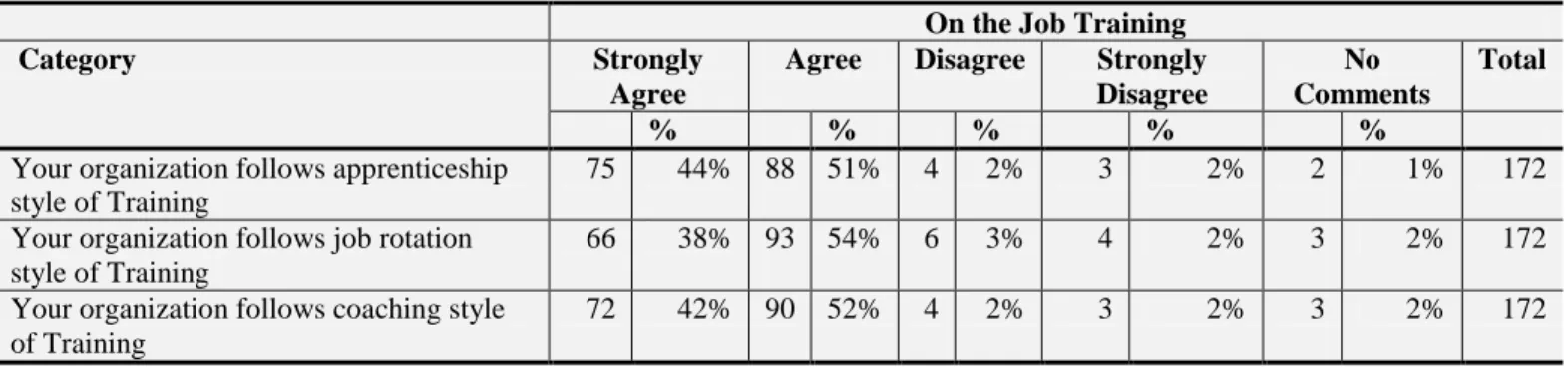
Table No. 4 shows the method of on the job training in PTA. On the job training should be regular practice in
every organization so that employees the job knowledge and skills of employees could be enhanced. And they could perform effectively. On the job training is cost effective and easy to arrange for the management. Few questions were asked about styles of on the job training in the organization and further investigated its effect on employees and on organization.
When apprenticeship style of training was explored, 44 % of the total respondents strongly agree that the organization provides this style of training. They believe that they have been given tasks to perform under the supervision of their seniors. They believe it is very effective, it minimize the chances of mistakes because the trainer recheck all the tasks performed by the trainee. Furthermore the trainee gets more chances to learn without any hesitation. Likewise 51% agree with this style of training. They replied their organization follows apprenticeship style of training. They believe that this kind of training has strengthened their confidence level and made them more effective to execute any task assigned to them. On the other hand 2% of the total respondents disagree similarly 2% strongly disagree. They noticed no any apprenticeship style of training has given to them in their department. The remaining 1% has given no any response to this inquiry.
Likewise when the respondents were questioned to know the coaching style of training, 42% of the total respondents strongly agree that they were trained by their supervisors and managers while coaching them about new things, job assignments and any change in the organizational strategies and 52% respondents also agree that they are usually coached by their manager. They think this kind of training has not only helped them to enhance their skills but also helped the organization to achieve its objectives timely. On the contrary 2% of the total respondents disagree and 2% strongly disagree. They believe that they have never been coached by their seniors. They think this kind of training has never been offered to them yet in the origination. Other 2% of the total respondents have given no comments.
The results indicate that Pakistan Telecommunication Authority regularly follows on the job training in the organization. The respondents believe that on the job training has enhanced their skills, knowledge, abilities, competences, and motivation level. They think the organization is very much concerned with the employees’ career development and job enrichment. The employees get chances for promotion and job rotation in the organization. Most of the respondents consider on the job training as effective tool for their success. It not only has significant impact while increasing effectiveness of the employees but also helps the organization to execute its strategy and to gain its long term goals.
Table-5. Off the Job Training
Off the Job Training
Category Strongly
Agree
Agree Disagree Strongly Disagree
No Comments
Total
% % % % %
Role playing Style of Training 67 39% 93 54% 5 3% 4 2% 3 2% 172
Simulation Style of Training 58 34% 97 56% 12 7% 3 2% 2 1% 172
Case Study Style of Training 76 44% 83 48% 6 3% 5 3% 2 1% 172
Video Tape/ Video Conferencing Style of Training
70 41% 87 51% 8 5% 4 2% 3 2% 172
Internet Base Training 80 47% 80 47% 5 3% 4 2% 3 2% 172
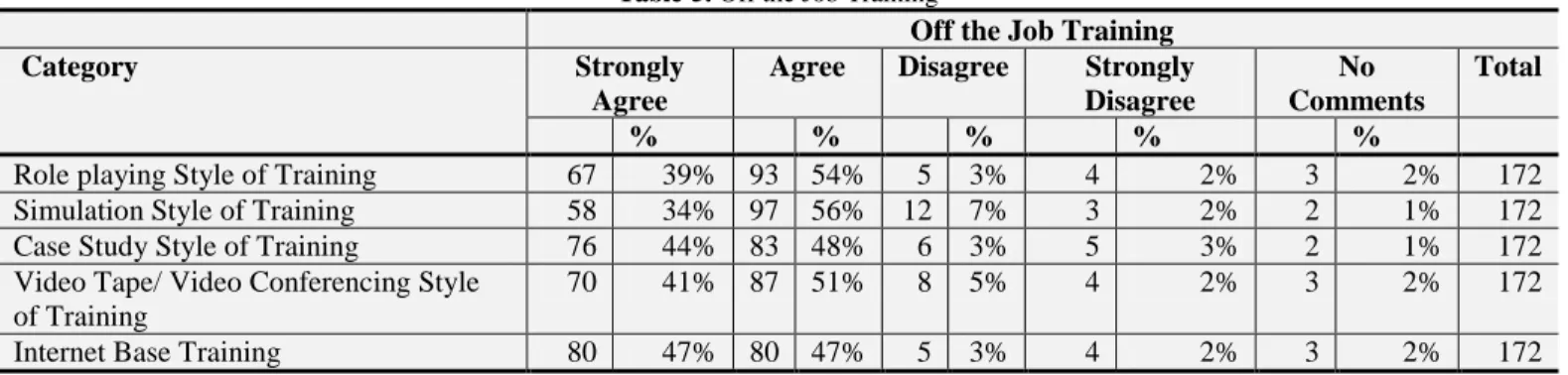
Table No. 5 indicates the styles of off the job training in PTA. Just like on the job training, off the job training is
also important for the employees. By conducting off the job training, the employees get new knowledge about the external environment, technologies and pattern of management. When the respondents were asked about the role playing style of training, there are 39 % of total respondents strongly agree whilst 54% agree that they have participated in such kind of training. However 3% of the total respondents disagree and 2% strongly disagree. They replied that they have never provided such environment of training by the organization. And 2% of the total respondents have given no comment. Similarly when the respondents were asked about the simulation style of training 34% strongly agree and 56% agree. They think that the organization follows simulation style of training. On the contrary 7% disagree while 2% strongly disagree. They feel that they are not given any kind of such training opportunity. Rest of the 1% of the total respondents has not given any answer.
Case study is an effective style of off the job training, the employees learn effectively while solving practice issues occur in organization in different situations. There are 44% of the total respondents who strongly agree and believe that the organization use this style of training. They are given case studies to resolve different problems. Likewise 48 % of total respondents also agree that they have been trained while following case study style of training. On the other hand 3% respondents disagree and similarly 3% strongly disagree. They believe that they have given no any case study for learning purpose. Other 1% of the respondents have provided no comment.
Video conferencing is one of the most effective medium of off the job training as 41% of the total respondents strongly agree while 51% agree. Video tape/ video conferencing style of training has been provided to the employees in PTA. They respondent consider it as one of the interactive and effective mean of training. On the other hand 5% disagree and 2% strongly disagree. They have given no such kind of training in the organization. The remaining 2% of the respondents have given no answer to this kind of training.
As far as internet based training is concerned, 47% of the respondents strongly agree similarly 47% agree that they are given internet based training. They knew how to use internet as a mean of training and how to get successfully their lesson. They feel internet base training as one of the time saving training style. But 3% of the respondents disagree while 2% strongly disagree. They feel internet is not available for every employee at home therefore they have got no any kind of such training. Rest of the 2% of the respondents has given no any comment.
The results disclose that off the job training opportunity is also given to the employees in PTA. Maximum staffs are satisfied with the training provided to them from professional organization. The finds showed that the respondents got more awareness about the new technology and technical skills due to off the job training offered to them by the organization. This kind of training not only increased skills of employees but also enhanced the effectiveness of the organization while achieving its objectives within targeted timeframe.
5. Conclusion
minor numbers of employees responded that they have given no any training from their appointment. Overall the study showed that Pakistan Telecommunication Authority is very much focused for training and development of its employees; which is healthy activity for both employees and for the organization. Most of the employees are motivated and experienced in this organization. Therefore the organization has gained exceptional public image.
6. Suggestions
Training need assessment is always important, so it should be carefully planned.
Training and development should be a regular practice in organization.
It is necessary for all employees for better understanding of the organizational policy and to improve its effectiveness.
Training should be conducted for both existing and new employees in order to meet external challenges and to gain the core objectives of the organization.
It should be executed in such a way that it should benefit for both individual and organization.
Training and development programs should be associated with the employee’s career development, so that the performance and motivation level of employees could be enhanced.
The training and development programs should be associated with organizational goals.
References
Ahmed, N., N. Iqbal, M.S. Mir, Z. Haider and N. Hamad, 2014. Impact of training and development of employees performance.( A Case Study from Different Banking Sector of North Punjab). Arabian Journal of Business and Management Review, 2(4): 19-24.
Al-Kassem, A.H., 2014. Determinants of employee’s overall satisfaction towards training and development program. International Journal for Economics, Finance and Management, 3(3): 129-135.
AlYahya, M.S., N.B. Mat and A.M. Awadh, 2013. Review of theory of human resource development training (Learning) participation. Journal of WEI Business and Economics, 2(1): 47-58.
Amin, A., S. Rashid, R.N. Lodhi, S. Mizna, A. Iqbal and R. Tehreem, 2013. The impact of employees training on the job performance in education sector of Pakistan. Middle-East Journal of Scientific Research, 17(9): 1273 - 1278.
Batool, A. and B. Batool, 2012. Effects of employees training on organizational competitive advantage: Empirical study of private sector of Islamabad, Pakistan. Far East Journal of Psychology and Business, 6(1): 59-72.
Imran, M., N. Maqbool and S. Shafique, 2014. Impact of technological advancement on employee performance in banking sector. International Journal for Human Resource Studies, 4(1): 57-70.
Jehanzeb, K. and N.A. Bashir, 2013. Training and development program and its benefits to employee and organization. (A Conceptual Study). European Journal of Business and Management, 5(2): 243-252.
Khan, T., N.A. Khan and K. Mehmood, 2012. An organizational concept of human resurce development – how human resource management scholars view ‘HRD’. University Journal of Management and Social Sciences, 2(5): 36-47.
Niazi, A.S., 2011. Training and development strategy and its role in organizational performance. Iqra University Islamabad Campus, Journal of Public Administration and Governance, 1(2): 42-57.
Obi-Anike, O. and M.C. Ekwe, 2014. Impact of training and development on organizational effectiveness: Evidence from selected public sector organizations in Nigeria. European Journal of Business and Management, 6(29): 66-75.
Raza, H., 2014. Training and development impact on organizational performance: Empirical evidence from oil and gas sector of Pakistan. Journal of Business and Management (ISOR-JBM), 16(1): 67-72.
Shaheen, A., S.M.H. Naqvi and M.A. Khan, 2013. Employees training and organizational: Mediation by employees performance. Interdisciplinary Journal of Contemporary Research Business, 5(4): 490-503.
Simons, N. and J. Richardson, 2012. New roles, new responsibilities: Examining needs of repository staff. Journal of Librarianship and Scholarly Communication, 1(2): 1051 -1060.
Singh, R. and M. Mohanty, 2012. Impact of training practices on employee productivity: A comparative study. Inter-Science Management Review, 2(2): 87-92.