International Journal of Research in Engineering & Applied Sciences
http://www.euroasiapub.org 61
TO DEVELOP A NEW CLASS OF NATURAL FIBER BASED POLYMER
COMPOSITES TO EXPLORE THE POTENTIAL OF COIR FIBER
Devendra Prasad Maurya*
BajiRav**
Bhuvenesh Sharma***
ABSTRACT
Fiber-reinforced polymer composites have played a dominant role for a long time in a variety of applications for their high specific strength and modulus.The fiber which serves as a reinforcement in reinforced plastics may be synthetic or natural. Glass and other synthetic fiber-reinforced plastics possess high specific strength; their fields of application are very limited because of their inherent higher cost of production. Natural fibers are not only strong and lightweight but also relatively very cheap. The present work describes the development and characterization of a new set of natural fiber based polymer composites consisting of coconut coir as reinforcement and experiments are carried out to study the effect of fiber length on mechanical behavior of these epoxy based polymer composites epoxy resin. In the present work, coir composites are developed and their mechanical properties are evaluated. Scanning electron micrographs obtained from fractured surfaces were used for a qualitative evaluation of the interfacial properties of coir/epoxy. These results indicate that coir can be used as a potential reinforcing material for many structural and non-structural applications. This work can be further extended to study other aspects of such composites like effect of fiber content, fiber orientation, loading pattern, fiber treatment on mechanical behavior of coconut coir based polymer composites.
*Assistant Professor, Satyam Engineering College & Technology Noida
**P.G Scholor, Noida institute of Engineering &Technology Greater Noida
International Journal of Research in Engineering & Applied Sciences
http://www.euroasiapub.org 62
INTRODUCTION
The advantage of composite materials over conventional materials stem largely from their higher
specific strength, stiffness and fatigue characteristics, which enables structural design to be more
versatile. Composites are materials that comprise strong load carrying material (known as reinforcement) imbedded in weaker material (known as matrix). Reinforcement provides strength and rigidity, helping to support structural load. The matrix or binder (organic or inorganic) maintains the position and orientation of the reinforcement. The reinforcement may be platelets, particles or fibers and are usually added to improve mechanical properties such as
stiffness, strength and toughness of the matrix material. Long fibers that are oriented in the
direction of loading offer the most efficient load transfer.
1.1 Composites: A definition, a composite material is made by combining two or more materials to give a unique combination of properties, one of which is made up of stiff, long fibers
and the other, a binder or 'matrix' which holds the fibers in place.
1.2 Composites Properties: Composites consist of one or more discrete phases embedded in a continuous phase to produce a multiphase material which possesses superior properties that are
not obtainable with any of the constituent materials acting alone. These constituents remain
bonded together but retain their identity and properties. The continuous phase which is present in
greater amount in composites is termed as matrix. The discrete phase is generally harder and
stronger than the continuous phase and is called the „reinforcement or „reinforcing material. The
geometry of the reinforced phase is one of the major parameter in determining the effectiveness
of the reinforcement. Properties of composites are strongly depend on the characteristics of their
constituent materials, their distribution and the interaction among them Further, the need of
composite for high strength to weight ratio, corrosion resistance, lighter construction materials
and more seismic resistant structures has placed high emphasis on the use of new and advanced
materials that not only decreases weight but also absorbs the shock & vibrations through tailored
microstructures.
1.3 Need of Composite
Over the last thirty years composite materials, plastics and ceramics have been the dominant
emerging materials. Modern composite materials constitute a significant proportion of the
International Journal of Research in Engineering & Applied Sciences
http://www.euroasiapub.org 63
The efforts to produce economically attractive composite components have resulted in several
innovative manufacturing techniques currently being used in the composites industry. It is
essential that there be an integrated effort in design, material, process, tooling, quality assurance,
manufacturing, and even program management for composites to become competitive with
metals. The composites industry has begun to recognize that the commercial applications of
composites promise to offer much larger business opportunities than the aerospace sector due to
the sheer size of transportation industry. Thus the shift of composite applications from aircraft to
other commercial uses has become prominent in recent years.
The increased volume has resulted in an expected reduction in costs. High performance FRP can
now be found in such diverse applications as composite armoring designed to resist explosive
impacts, fuel cylinders for natural gas vehicles, windmill blades, industrial drive shafts, support
beams of highway bridges and even paper making rollers. For certain applications, the use of
composites rather than metals has in fact resulted in savings of both cost and weight.
Further, the need of composite for lighter construction materials and more seismic resistant
structures has placed high emphasis on the use of new and advanced materials that not only
decreases dead weight but also absorbs the shock & vibration through tailored microstructures.
Composites are now extensively being used for rehabilitation/strengthening of pre-existing
structures that have to be retrofitted to make them seismic resistant, or to repair damage caused
by seismic activity. Unlike conventional materials (e.g., steel), the properties of the composite
material can be designed considering the structural aspects. The design of a structural component
using composites involves both material and structural design. The use of composites will be a
clear choice in many instances, material selection in others will depend on factors such as
working lifetime requirements, number of items to be produced (run length), complexity of
product shape, possible savings in assembly costs and on the experience & skills the designer in
tapping the optimum potential of composites. In some instances, best results may be achieved
through the use of composites in conjunction with traditional materials.
1.4 Composites Classification Composite materials can be classified in different ways.
The two broad classes of composites are:-
(1) Particulate composites and
(2) Fibrous composites.
International Journal of Research in Engineering & Applied Sciences
http://www.euroasiapub.org 64
A particulate composite is composed of particles suspended in a mixture. It may be spherical,
cubic, tetragonal, a platelet, or other shape, but it is approximately equal. Normally, particles that
are not very effective in improving fracture resistance; they increase the stiffness of the
composite to a limited extent. There are two subclasses of particulates, flake and filled/skeletal.
A flake composite is generally composed of flakes with large ratios of platform area to thickness,
suspended in a matrix material. A filled/skeletal composite is composed of a continuous matrix
filled. Particle fillers are widely used to improve the properties of matrix materials to modify the
thermal and electrical conductivities, improve performance at elevated temperatures, reduce
friction, increase wear and abrasion resistance, improve machinability, increase surface hardness
and reduce shrinkage.
1.4.2 Fibrous composites: A fiber is defined by its length which is much greater than its cross sectional dimensions. Fibers are very effective in improving the fracture resistance of the matrix
because reinforcement having a long dimension opposes the growth of cracks normal to the
reinforcement that might otherwise lead to failure, particularly with brittle matrices. Fibers,
because of their small cross- sectional dimensions, are not directly usable in engineering
applications. They are, therefore, embedded in matrix materials to form fibrous composites. The
matrix serves to bind the fibers together, transfer loads to the fibers and protect them against
environmental attack and damage due to handling. Fibrous composite can be subdivided into -
continuous fiber (large aspect ratio), discontinuous (short) fiber (low aspect ratio) and hybrid.
1.4.2.1 Continuous fibers: Continuous fiber composites can be either single layer or multilayered. The single layer continuous fiber composites can be either unidirectional or woven,
and multilayered composites are generally referred to as laminates. The material response of a
continuous fiber composite is generally orthotropic.
1.4.2.2 Discontinuous fibers: Material systems composed of discontinuous reinforcements are considered single layer composites. The discontinuities can produce a material response that is
anisotropic, but in many instances the random reinforcements produce nearly isotropic
composites.
International Journal of Research in Engineering & Applied Sciences
http://www.euroasiapub.org 65
For the sake of simplicity, however, composites can be grouped into categories based on the nature of the matrix each type possesses [7]. Methods of fabrication also vary according to physical and chemical properties of the matrices and reinforcing fibers.
(a) Métal Matrix Composites (MMC)
Metal matrix composites, as the name implies, have a metal matrix. Examples of matrices in such composites include aluminium, magnesium and titanium. The typical fiber includes carbon and silicon carbide. Metals are mainly reinforced to suit the needs of design. For example, the elastic stiffness and strength of metals can be increased, while large co-efficient of thermal expansion, and thermal and electrical conductivities of metals can be reduced by the addition of fibers such as silicon carbide.
(b) Ceramic Matrix Composites (CMCs)
Ceramic matrix composites have ceramic matrix such as alumina, calcium, alumina silicate reinforced by silicon carbide. The advantages of CMC include high strength, hardness, high service temperature limits for ceramics, chemical inertness and low density. Naturally resistant to high temperature, ceramic materials have a tendency to become brittle and to fracture. Composites successfully made with ceramic matrices are reinforced with silicon carbide fibers. These composites offer the same high temperature tolerance of super alloys but without such a high density. The brittle nature of ceramics makes composite fabrication difficult. Usually most CMC production procedures involve starting materials in powder form. There are four classes of ceramics matrices: glass (easy to fabricate because of low softening temperatures, include borosilicate and alumino silicates), conventional ceramics (silicon carbide, silicon nitride, aluminum oxide and zirconium oxide are fully crystalline), cement and concreted carbon components.
(c) Polymère Matrix Composites (PMCs)
The most common advanced composites are polymer matrix composites. These composites consist of a polymer thermoplastic or thermosetting reinforced by fiber (natural carbon or boron). These materials can be fashioned into a variety of shapes and sizes. They provide great strength and stiffness along with resistance to corrosion. The reason for these being most common is their low cost, high strength and simple manufacturing principles. Due to the low density of the constituents the polymer composites often show excellent specific properties.
International Journal of Research in Engineering & Applied Sciences
http://www.euroasiapub.org 66
The raw materials used in this work are:-
1. Coconut coir fiber
2. Epoxy resin
3. Hardener
Composite Specimen Preparation
Preparation of Coconut coir fiber
Coconut coir fiber is collected and cut in to a length of 20 mm approximately. These fibers are
washed in water and then dried with the help of hair drier.
Epoxy Resin and Hardener
Epoxy resins are relatively low molecular weight pre-polymers capable of being processed under
a variety of conditions. Two important advantages of these over unsaturated polyester resins are:
first, they can be partially cured and stored in that state, and second they exhibit low shrinkage
during cure. However, the viscosity of conventional epoxy resins is higher and they are more
expensive compared to polyester resins. The cured resins have high chemical, corrosion
resistance, good mechanical and thermal properties, outstanding adhesion to a variety of
substrates, and good and electrical properties. Approximately 45% of the total amount of epoxy
resins produced is used in protective coatings while the remaining is used in structural
applications such as laminates and composites, tooling, moulding, casting, construction,
adhesives, etc.
The type of epoxy resin used in the present investigation is Derakane 411-350 epoxy vinyl ester
resin which chemically belongs to epoxide family. Epoxy resins are characterized by the
presence of a three-member ring containing two carbons and an oxygen (epoxy group or epoxide
or oxirane ring). Epoxy is the first liquid reaction product of bisphenol-A with excess of
epichlorohidrin and this resin is known as Diglycidyl-Ether of Bisphenol-A (DGEBA). DGEBA
is used extensively in industry due to its high fluidity, processing ease, and good physical
properties of the cured of resin. Both the epoxy and hardener were supplied by Ashland
Polymers, USA.
Preparation of composite laminates
Two wooden molds of dimension (150x150x3.5) mm and (130x80x3) mm was used for casting
the composite sheet. First mold size is used for preparing the samples for tensile strength and
International Journal of Research in Engineering & Applied Sciences
http://www.euroasiapub.org 67
was manufactured with 5, 10, 20, 25 and 30 % volume fraction of fibers. Usual hand lay-up
technique was used for preparation of the samples. For different volume fraction of fibers, a
calculated amount of epoxy resin and hardener (ratio of 10:1 by weight) was thoroughly mixed
in a glass jar and placed in a vacuum chamber to remove air bubbles that got introduced. This
procedure was performed for 10 minutes initially. The mixture was re-stirred and the vacuum
procedure was performed again for 10 minutes for further removal of bubbles. Figure 3.1
illustrates the mold used to construct the composite. For quick and easy removal of composite
sheets, mold release sheet was put over the glass plate and a mold release spray was applied at
the inner surface of the mold. After keeping the mold on a glass sheet a thin layer (1mm mm
thickness) of the mixture was poured. Then the required amount of fibers was distributed on the
mixture. The remainder of the mixture was then poured into the mold. Care was taken to avoid
formation of air bubbles. Pressure was then applied from the top and the mold was allowed to
cure at room temperature for 72 hrs. During application of pressure some amount of mixture of
epoxy and hardener squeezes out. Care has been taken to consider this loss during manufacturing
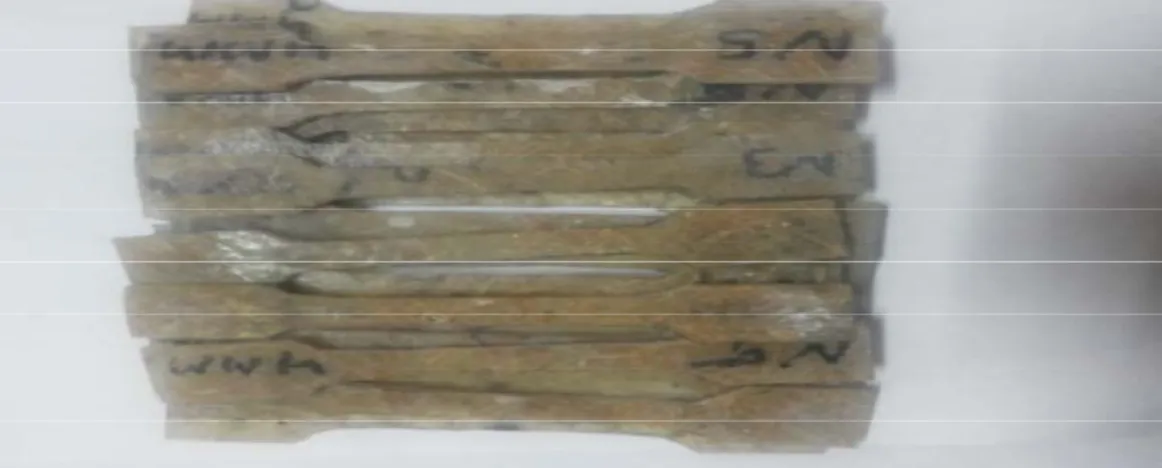
of composite sheets. After 72 hrs the samples were taken out of the mold. Figure 3.2 shows the
photograph of the composite and some of the specimen cut for further experimentation. After
cutting they were kept in airtight container. The samples for tensile test, flexural test, SEM and
hardness test are prepared in the following volume fractions.
Volume fractions of different samples
S.No Composites Composition
1. EBSF-1 Epoxy + Coconut coir fibre (0% Volume Fraction)
2. EBSF-2 Epoxy + Coconut coir fibre (5% Volume Fraction)
3. EBSF-3 Epoxy + Coconut coir fibre (10% Volume Fraction)
4. EBSF-4 Epoxy + Coconut coir fibre (20% Volume Fraction)
5. EBSF-5 Epoxy + Coconut coir fibre (25% Volume Fraction)
International Journal of Research in Engineering & Applied Sciences
http://www.euroasiapub.org 68
Figure 1: Mold Preparation for preparing the sample
International Journal of Research in Engineering & Applied Sciences
http://www.euroasiapub.org 69
Figure 3: Samples prepared for flexural testing
CHARACTERIZATION OF MECHANICAL PROPERTIES
Tensile and flexural tests were carried out on INSTRON 3382,100 kN Universal Testing
Machine at a temperature of 23±2˚C, and with relative humidity of 50±5%. Testing procedures
were carried out in ASTM D638 for tensile tests and ASTM D790 for flexural tests. Summary of
the entire test performed are shown in the Table 1
.
Testing Machine Used Working Variables
No of Specimen
Standard Used
Tensile INSTRON 3382
UTM
Load cell : 100
KN
Rate : 5 mm/min
6×5=30 ASTM D638
Flexural INSTRON 3382
UTM
Load cell : 100
KN
Rate : 1.32
mm/min
International Journal of Research in Engineering & Applied Sciences
http://www.euroasiapub.org 70
Table 3.2: Summary of tests
RESULT
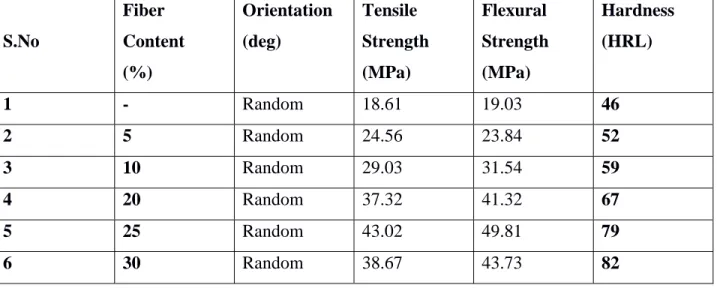
Table: Mechanical properties with varying % of coconut coir fiber
S.No
Fiber Content (%)
Orientation (deg)
Tensile Strength (MPa)
Flexural Strength (MPa)
Hardness (HRL)
1 - Random 18.61 19.03 46
2 5 Random 24.56 23.84 52
3 10 Random 29.03 31.54 59
4 20 Random 37.32 41.32 67
5 25 Random 43.02 49.81 79
6 30 Random 38.67 43.73 82
CONCLUSION
The results of the work shows that a useful composite with good properties could be successfully
developed using coconut coir fiber as reinforcing agent for the polymers matrix. From this,
several conclusions can be drawn regarding to mechanical properties of composite (tensile,
flexural and micro hardness) to the effect of content of the fiber.
As the fiber content in unsaturated polymer increased in term of volume %, the Tensile strength
increased slowly till 25 %. It is found that the tensile strength declined as the fiber concentration
in composite increased. The increase of fiber-to-fiber interaction and dispersion problem in
matrix has contributed to this phenomenon
Flexural strength and hardness also increases up to 25% and then starts decreasing.
Finally to summarize everything, coconut coir fiber has enhanced tensile properties, flexural as
well as impact properties of the unsaturated polymers. The study has demonstrated the optimum
for peak performance for tensile and flexural testing at 25 % of fiber content.
FUTURE WORKS
International Journal of Research in Engineering & Applied Sciences
http://www.euroasiapub.org 71
Determination of chemical constituents inside the local abundant coconut coir fiber to
the extent of chemical content and its effects to certain properties.
The work should be extended to study other properties such as creep, fatigue,
compressive, shear strength, chemical resistance and electrical properties.
The usage of different types of chemical promoters and coupling agents can be studied. Other epoxy-hardener polymeric matrix system can be studied.
Hybrid composite comprising other fiber (such as glass fiber) with coconut coir fiber can
be studied as this will definitely yield better performance of composite system.
The above results can be more precise by optimizing the above data.
Chemical treatment of fibers can be done. It can improve the mechanical properties of
the composite.
Different composites can be prepared with different length of fibers. Length can be a
factor in improving the mechanical properties of the composites.
Different composites can be prepared by placing the fibers at different angles. This can
affect the mechanical properties of the composites.
REFERENCES
[1] Mueller D.H and Krobjilowski A, “New Discovery in the Properties of Composites
Reinforced with Natural Fibers”, Journal of Industrial Textiles, 33(2), 2003, pp.111-129.
[2] Rai, A., Jha, C.N., Natural fiber composite and its potential as building material. BMTPC
Seminar.
[3] Mohanty K, Misra M and Drzal L. T, (2005) Natural Fibers, Biopolymers and Biocomposites, Boca Raton, FL, CRC Press, Taylor & Francis Group, 2005, pp. 875.
[4] Mahlberg R, Paajanen L, Nurmi A, Kivistö A, Koskela K and Rowell R.M, “Effect of
chemical modification of wood on the mechanical and adhesion properties of wood
fiber/polypropylene fiber and polypropylene/veneer composites”, Holz als Roh- und
Werkstoff, 59(5), 2000, pp. 319-326.
[5] Mohanty A. K, Khan M. A and Hinrichsen G, “Influence of chemical surface modification
on the properties of biodegradable jute fabrics-polyester amide composite”, Composites:
Part A, 31, 2000, pp. 143-150.
[6] Mohanty A. K, Khan M. A and Hinrichsen G, “Surface modification of jute and its
International Journal of Research in Engineering & Applied Sciences
http://www.euroasiapub.org 72
Science and Technology, 60, 2000, pp. 1115-1124.
[7] Iannace S, Nocilla G and Nicolais L, “Biocomposites based on sea algae fibers and
biodegradable thermoplastic matrices” Journal of Polymer Science, 73 (4), 1999, pp. 583-
592.
[8] Shibata M, Ozawa K, Teramoto N, Yosomiya R and Takeishi H, “Biocomposites made
from short abaca fiber and biodegradable polyester”, Macromolecular Materials and
Engineering, 288 (1), 2003, pp. 35-43.
[9] Luo S and Netravali A. N, “Interfacial and mechanical properties of environment-friendly
‘green’ composites made from pineapple fibers and poly(hydyoxybutyrate-co-valerate)
resin”, Journal of Materials Science, 34, 1999, pp. 3709-3719.
[10] Rout J, Misra M, Tripathy S. S, Nayak S. K and Mohanty A. K, “The influence of fiber
treatment on the performance of coir-polyester composites”, Composite Science and
Technology, 61, 2001, pp. 1303-1310.
[11] Gassan J and Bledzki A. K, “Possibilities for improving the mechanical properties of
jute/epoxy composites by alkali treatment of fibers”, Composite Science and Technology,
59 (9), 1999, pp. 1303-1309.
[12] Harisha S, Peter Michaelb D, Benselyb A, Mohan Lalb D, Rajaduraic A, “Mechanical
Property Evaluation Of Natural Fiber Coir Composite”, Materials Characterization, 60,
2009, pp. 44-49.
[13] Satyanarayana K.G, Pillai C. K. S, Sukumaran K, Pillai S. G. K, Rohatgi P. K and Kalyani
Vijayan, “Structure and properties of fibers from different parts of coconut tree”, Journal of
Materials Science, 17, 1982, pp. 2453-2472.
[14] Owolabi O, Czvikovszky T and Kovacs I, “Coconut fiber reinforced thermosetting plastics”,
Journal of Applied Polymer Science, 30, 1985, pp. 1827-1836.
[15] Varma D. S, Varma M, Varma I. K, “Coir Fibers II: Evaluation as a Reinforcement in
Unsaturated Polyester Resin Composites”, Journal of Reinforced Plastics and Composites, 4