Levitsky A. P., Egorov B. V., Lapinskaya A. P., Selivanskaya I. A. Inadequate fat diet. Journal of Education, Health and Sport. 2020;10(7):248-255. eISSN 2391-8306. DOI http://dx.doi.org/10.12775/JEHS.2020.10.07.029
https://apcz.umk.pl/czasopisma/index.php/JEHS/article/view/JEHS.2020.10.07.029
https://zenodo.org/record/3971081
The journal has had 5 points in Ministry of Science and Higher Education parametric evaluation. § 8. 2) and § 12. 1. 2) 22.02.2019. © The Authors 2020;
This article is published with open access at Licensee Open Journal Systems of Nicolaus Copernicus University in Torun, Poland
Open Access. This article is distributed under the terms of the Creative Commons Attribution Noncommercial License which permits any noncommercial use, distribution, and reproduction in any medium, provided the original author (s) and source are credited. This is an open access article licensed under the terms of the Crea tive Commons Attribution Non commercial license Share alike.
(http://creativecommons.org/licenses/by-nc-sa/4.0/) which permits unrestricted, non commercial use, distribution and reproduction in any medium, provided the work is properly cited. The authors declare that there is no conflict of interests regarding the publication of this paper.
Received: 19.06.2020. Revised: 09.07.2020. Accepted: 31.07.2020.
UDK 616.314:664.315
INADEQUATE FAT DIET
A. P. Levitsky1, B. V. Egorov1, A. P. Lapinskaya1, I. A. Selivanskaya2
1Odessa National Academy of Food Technologies 2Odessa National Medical University
Abstract
Aim. To determine the main factors of inadequate fat diet (IAFD) and indicate the ways of their change.
Methods. Analysis and generalization of existing scientific literature data and the results of our own research.
Results. The following factors of IAFD have been identified: 1) excess fat in the diet;
2) an excess of palmitic acid in dietary fats;
3) an excess of linoleic acid in dietary fats;
4) consumption of thermoperoxide fats;
5) deficiency of ω-3 polyunsaturated fatty acids (PUFA).
Conclusion. IAFD is a cause of metabolic and neuropsychiatric disorders underlying non-communicable diseases.
Fats (triglycerides) are one of the parts of a large and very diverse in structure and
functions class of organic compounds called lipids and united by only one common chemical
property - the presence of a fatty acid [1, 2].
Biological classification of fatty acids (FA) [3]:
1. Bioenergetic FA
1.1. Oleic (C18: 1)
1.2. Palmitic (C16: 0)
1.3. Stearic acid (C18: 0)
1.4. FA with C less than 16.
2. Irreplaceable structural PUFA (C18)
2.1. Linoleic acid (C18: 2, ω-6)
2.2. α-linolenic (C18: 3, ω-3) 2.3. γ-linolenic (C18: 3, ω-6).
3. Irreplaceable structural and regulatory PUFA (C20 and C22)
3.1. Arachidonic (C20: 4, ω-6)
3.2. Eicosapentaenoic acid (C20: 5, ω-3)
3.3. Docosapentaenoic acid (C22: 5, ω-3 and ω-6)
3.4. Docosahexaenoic acid (C22: 6, ω-3).
4. Anti-nutritional FA
4.1. Trans-isomers of FA
4.2. Oxygenated FA
4.3. High molecular weight FA
5. Toxic FA
5.1. Branched FA
5.2. Acetylene FA.
From a biological point of view, fats have two main functions: 1. Energy and 2.
Source of essential (indispensable) fatty acids.
The energy function of fats is due to their high calorie content (9.1 kcal / g), by which
they surpass all other nutrients by more than 2 times. The energy requirement of muscle tissue
and heart is 80-90% satisfied due to the oxidation of fatty acids in mitochondria [4].
Being insoluble in water, fats are easily deposited in the subcutaneous adipose tissue,
from where they enter the bloodstream in the form of non-esterified fatty acids during periods
As for the second function of fats as a source of essential fatty acids, here we mean the
need to enter the body for the synthesis of structural lipids (phospholipids, cholesterol esters,
sphingomyelins) and the formation of regulatory substances (eicosanoids and docosanoids).
For humans and animals, such essential fatty acids are polyunsaturated fatty acids
(PUFA), which include linoleic (C18: 2, ω-6), α-linolenic (C18: 3, ω-3), γ-linolenic (C 18: 3 , ω-6),
arachidonic (C 20: 4, ω-6), eicosapentaenoic (C 20: 5, ω-3), docosapentaenoic (C 22: 5, ω-3 and C
22: 5, ω-6) and docosahexaenoic (C 22 : 6, ω-3) acids [5, 6].
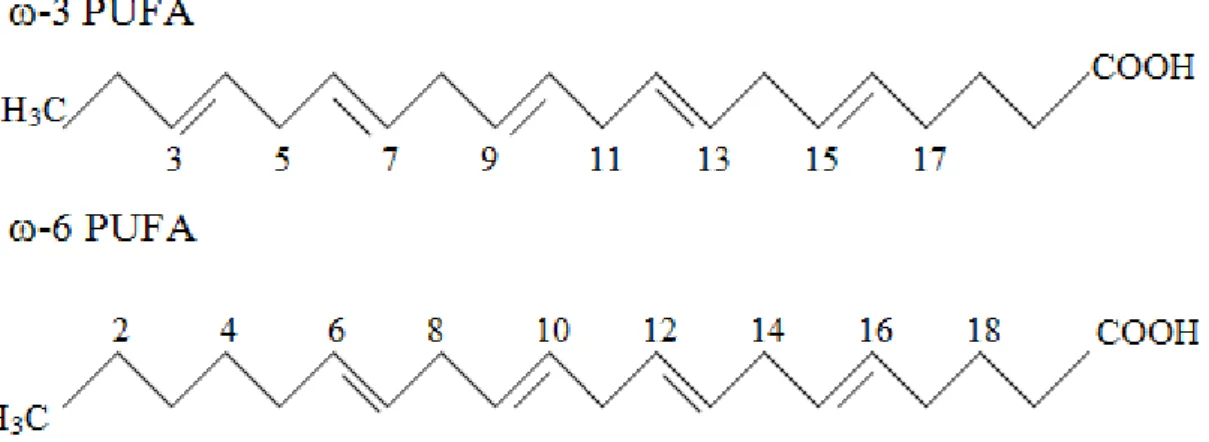
Fig. 1. The structure of ω-3 PUFA (eicosapentaenoic) and ω-6 PUFA (arachidonic)
From linoleic acid in humans and animals, γ-linolenic and arachidonic fatty acids are formed, and from α-linolenic - eicosapentaenoic, docosapentaenoic (ω-3) and
docosahexaenoic fatty acids [7].
Fig. 2. Scheme of
Fig. 2. Scheme of the conversion of C18 PUFA to C20 PUFA
Unfortunately, the process of conversion of α-linolenic acid into long-chain fatty acids С18:2 ω-6
linoleic
С18:2 ω-3
α-linolenic
С18:3 ω-6
γ-linolenic С18:4 ω-3
С20:3 ω-6
С20:4 ω-6
arachidonic
С20:5 ω-3
eicosapentaenoic
С20:4 ω-3
desaturase
elongaza
formation of structural lipids that are part of the cellular and intracellular membranes of all
tissues, especially in the composition of the nervous tissue [8]. This circumstance makes it
mandatory to introduce into the body with food fats with a high content of long-chain PUFA
(for example, fish oil) [9, 10]. Lack of long-chain PUFA (C20 and C22 ω-3 series) in food
leads to impaired neuropsychic activity (only in the USA, 27% of the population suffers from
neuropsychiatric disorders [11]) and weakened reproductive function (various forms of
infertility [12].
For various reasons, in recent decades, the consumption of fish oil and seafood from
northern latitudes, the richest in the content of long-chain PUFAs, has sharply decreased [9,
10]. Therefore, most of the Earth's population (except for residents of northern latitudes and
some other countries in which fish consumption has not decreased, for example, Japan) is in a
state of hypovitaminosis and often vitamin F deficiency with all the ensuing health
consequences [13].
Returning to the question of the energy function of fats, here, too, not everything is
clear. First, in civilized countries, most of the population has significantly reduced muscle
load as a result of the mechanization of almost all technology processes. However, the habit
of consuming fatty foods, remained, moreover, it even intensified due to taste preferences and
the expansion of the range of fat-containing foods. As a result of all this, the excess intake of
fat in the body of a modern person leads to an increase in its deposition, i.e., ultimately, to
obesity, which affects almost 20% of the world's population (almost 1.5 billion people) [14,
15]. And in this case, the record holder is the United States, in which almost 50% of the
population is overweight [16].
It should be noted that not only the consumption of fats has increased, but the set of
fats in the diet has also changed due to the wider use of animal fats and palm oil, rich in
saturated fatty acids (primarily palmitic acid) [17, 18]. At the recommended consumption rate
of palmitic acid (no more than 10% of the total fatty acids), animal fats contain 25-30% of
this acid, and palm oil up to 50% [1, 3]. The rate of oxidation of palmitic acid in mitochondria
is significantly lower than the rate of oxidation of other fatty acids (for example, linoleic and,
especially, oleic) [19]. Fats with a high content of palmitic acid contribute to the development
of atherosclerosis and other diseases of the cardiovascular system [20].
The ideal fats for the energy function of the body are fats with a high-oleic acid
content (olive oil, high oleic sunflower oil). Oleic acid is more readily oxidized than other
fatty acids in mitochondria [21]. It does not inhibit the formation of long-chain PUFA [22]
Excessive consumption of dietary fats with a high content of linoleic acid (C18:2, ω-6)
is also undesirable. These are, first of all, ordinary sunflower oil (linoleic acid content
55-60%), corn and soybean oils (50-55% linoleic acid). The need for linoleic acid is 5-6 g per
day [3]. An excess of linoleic acid leads to an increased formation of arachidonic acid (C20:4
ω-6), from which pro-inflammatory eicosanoids are formed [24]. As a result, a situation is
created in the body that is favorable for the development of systemic inflammation [25].
Another factor in inadequate fat nutrition is the consumption of thermoperoxide fats,
which are formed when using high-temperature fat cooking technologies [26]. At high
temperatures, PUFA (especially linoleic acid) undergo oxidation with the formation of lipid
peroxides, epoxy compounds, trans-fatty acids, aldehydes and ketones [27]. All these
compounds are toxic to the body [28].
Given the widespread use of high-temperature fat cooking methods, it is necessary to
take measures to reduce the formation of toxic products of thermal peroxidation (use of olive
or high oleic sunflower oil instead of sunflower oil, introduction of antioxidants into the oil
before heat treatment). Methods for preventing complications of the consumption of
thermoperoxide fats by taking preparations containing bioflavonoids are also effective [29].
Thus, to summarize all of the above, inadequate dietary fat is the following:
1. High-fat food (the fat content in the diet is more than 30% of calories).
High-fat nutrition causes the development of not only obesity, but is the cause of the
development of dysbiotic syndrome [25]. If it is not possible to reduce excessive consumption
of fats, then there are two recommendations: first - replace, if possible, dietary fats with a
high content of palmitic or linoleic acid for high oleic sunflower oil (for example, oil
"Olivka"); the second is to use antidisbiotic agents containing antioxidants and prebiotics (for
example, dietary supplements "Kvertulin", "Lekvin" or "Lysozyme-Forte") [22, 25, 29].
2. High content of palmitic acid in edible fats (over 10%). Recommendations in this
case: as with a high-fat diet.
3. High content of linoleic acid in edible fats. Here the recommendations are similar to
those indicated in paragraphs 1 and 2.
4. Deficiency of essential PUFA due to low consumption of fish oil and seafood with a
high content of ω-3 PUFA. The daily consumption rate of PUFA is: linoleic acid ‒ 5-6 g,
α-linolenic acid - 1-2 g, eicosapentaenoic acid ‒ 0.5-0.7 g, docosahexaenoic acid ‒ 0.4-0.6 g.
We have proposed a dietary supplement "Liposan-forte" (oil solution), which contains
5. Consumption of thermal peroxide fats of fat-containing products, which must be
limited by using fats that are more resistant to thermal peroxidation (for example, high oleic
sunflower oil) for high-temperature fat cooking. A method of preventing the undesirable
effect of thermoperoxide fats by taking bioflavonoid preparations (for example, "Kvertulin")
is recommended.
The transition from inadequate to adequate fatty nutrition will prevent the
development of a large number of diseases (atherosclerosis, obesity, type 2 diabetes mellitus,
neuropsychic and metabolic disorders), which are the main cause of high mortality in the
population.
REFERENCES
1. Titov VN, Lisitsyn DM. Fat acids. Physical chemistry, biology and medicine.
M.‒Tver, Triada, 2006: 672. (in Russian)
2. Titov VN. Fatty acids, lipids (transport forms of fatty acids) and apolipoproteins
(lipid-carrying macromolecules) are a single functional system. Clinical Laboratory
Diagnostics. 2007; 1: 3-10. (in Russian)
3. Levitsky AP. Olivka: the unique sunflower oil, the analogue to olive oil. Odessa,
KP OGT, 2016: 28. (in Russian)
4. Titov VN. Regulation of insulin fatty acid metabolism, and then glucose in the
implementation of the biological function of locomotion. Clinical laboratory diagnosis. 2012;
5: 3-12. (in Russian)
5. Shikh EV, Makhova AA. Long-chain polyunsaturated fatty acids of the ω-3 family
in the prevention of diseases in adults and children: a view of a clinical pharmacologist.
Nutrition Issues. 2019; 88(2): 91-100. (in Russian)
6. Levitsky AP. The role of polyunsaturated fatty acids (PUFA) in the formation of the
structure and functions of biomembranes. Journal of Education, Health and Sport. 2020;
10(6): 101-107.
7. WallR, Ross RP, Fitzgerald GF [and others]. Fatty acids from fish:
antiinflammatory potential of long-chain omega-3 fatty acids. Nutr. Rev. 2010; 68(2):
280-289.
8. Gladyshev MI. Essential polyunsaturated fatty acids and their sources for men.
9. Belyaeva LE., Pavlyukevich AN. Early programming of human diseases and the use
of nutraceuticals for preventive purposes: focus on fish oil. Literature review. Part 1. Bulletin
of the Vitebsk State Medical University. 2019; 18(4): 7-16. (in Russian)
10. Belyaeva LE., Pavlyukevich AN. Early programming of human diseases and the
use of nutraceuticals for preventive purposes: focus on fish oil. Literature review. Part 2.
Bulletin of Vitebsk State Medical University. 2019; 18(5): 12-25. (in Russian)
11. Ross BM. Omega-3 fatty acid deficiency in major depressive disorder is caused by
the interaction between diet and a genetically determined abnormality in phospholipid
metabolism. Med. Hypotheses. 2007; 68(3): 515-524.
12. WarensjöE, Risérus U, Vessby B. Fatty acid composition of serum lipids predicts
the development of the metabolic syndrome in men. Diabetologia. 2005; 48: 1999-2005.
13. Plourde M, Cunnane SC. Extremely limited synthesis of long chain
polyunsaturates in adults: implications for their dietary essentiality and use as supplements.
Appl.Physiol.Nutr.Metab. 2007; 32(4): 619-634.
14. Zohrabian A. Clinical and economic aspects of obesity treatment: a review of the
use of orlistat. International Endocrinological Journal. 2015; 6(70): 69-77. (in Russian)
15. Romancova TI. The obesity epidemic: truthful and veritable reasurs. Obesity and
metabolism. 2011; 1: 1-14. (in Russian)
16. Mokdad AH, Ford ES, Bowman BA [and others]. Prevalence of obesity, diabetes,
and obesity-related health risk factors, 2001. JAMA. 2003; 289(1): 76-79.
17. Titov VN, Rozhkova TA, Amelyushkina VA [and others]. Role of palmitic fatty
acid in initiation of hypertriglyceridemia, hypercholesterolemia, atherosclerosis and
atheromatosis. International medical journal. 2015; 21(2(82): 5-14. (in Russian)
18. Titov VN. Excess palmitic fatty acid in food is the main cause of lipidosis of
insulin-dependent cells: skeletal myocytes, cardiomyocytes, pediportal hepatocytes, Kupffer
macrophages and pancreatic β-cells. Clinical laboratory diagnosis. 2016; 61(2): 68-77. (in
Russian)
19. Sazhina NN, Evteeva NM, Titov VN. Rate constants of reactions of interaction of
ozone with palmitic, oleic and other fatty acids. The role of ozonolysis in fatty acid
metabolism. Clinical laboratory diagnosis. 2018; 63(8): 460-465. (in Russian)
20. Pérez-Jiménez F, López-Miranda J, Mata P. Protective effect of dietary
monounsaturated fat on arteriosclerosis: beyond cholesterol. Atherosclerosis. 2002; 163(2):
21. Titov VN, Lisitsyn DM. Regulation of peroxidation in vivo as a stage of
inflammation. Oleic acid, reactive oxygen species invaders and antioxidants. Clinical
laboratory diagnosis. 2005; 6: 3-12. (in Russian)
22. Levitsky AP. The pathophysiology of high-fat diet and ways to prevent its
complications. Bulletin of XVII readings named after V. V. Podvysotsky, May 24-25, Odessa,
2018: 120-124. (in Russian)
23. Levchenko YeM. Hepatoprotective and antidysbiotic effects of high oleic
sunflower oil (experimental investigation). Journal of Education, Health and Sport. 2015;
5(11): 735-744. (in Russian)
24. Kawashima H. Intake of arachidonic acid-containing lipids in adult humans:
dietary surveys and clinical trials. Lipids in Health and Disease. 2019; 18: 235.
25. Levitsky AP. Disbiotic syndrome: etiology, pathogenesis, clinic, prevention and
treatment. Dentistry Bulletin. 2019; 10: 14-20. (in Russian)
26. Ambreen G, Siddiq A, Hussain K. Association of long-term consumption of
repeatedly heated mix vegetable oils in different doses and hepatic toxicity through fat
accumulation. Lipids in Health and Disease. 2020; 19: 69.
27. Ju J, Zheng Z, Xu Y-j [and others]. Influence of total polar compounds on lipid
metabolism, oxidative stress and cytotoxicity in HepG2 cells. Lipids in Health and
Disease. 2019; 18: 37.
28. Sarkisian VA, Kochetkova AA, Bessonov VV [and others]. Toxicological
characteristics of the main products of lipid oxidation. Nutrition issues. 2016; 85(6): 80-85.
(in Russian)
29. Levitsky AP, Makarenko OA, Levchenko OM [and others]. Bioflavonoid
hepatoprotectors. Odessa: KP OGT, 2014: 86. (in Russian)
30. Levitsky AP, Khodakov IV, Lapinskaia AP [and others]. Vitamin F (essential
polyunsaturated fatty acids ω-6 and ω-3 PUFA. Odessa, FLP Tashchenko S. Iu., 2020: 65. (in