Background. The fourth Millennium Development Goal (MDG) aims at reducing childhood deaths in the developing world by 2015.
Objective. To examine the pattern of childhood deaths in a Nigerian tertiary hospital which served at least three states of the federation between 1996 and 2015.
Method. A retrospective study of paediatric deaths between January 1996 and December 2005. Subjects admitted in the pre-MDG period were compared with those admitted during the pre-MDG period.
Results. Of 10 451 paediatric patients admitted, 1 320 (12.6%) died but only 1 225 were studied. The male-to-female ratio was 1.4:1. Although the yearly mortality rate ranged from 10.7% to 14.9%, the overall mortality rate for the pre-MDG period was similar to that for the MDG period (p=0.135). Most deaths (69.1%) occurred within 48 hours of hospitalisation. Of the 1 225 patients who died, 57.3% were neonates. These neonatal deaths were commonly due to prematurity (34.6%), perinatal asphyxia (30.8%) and septicaemia (24.8%), while severe anaemia was the most common cause of death among infants (20.1%) and toddlers (25.1%). Severe malaria, severe anaemia, and tetanus formed 33.3% of all deaths among children older than 5 years. There was no significant difference in the role of prematurity (p=0.298) and measles (p=0.927) as causes of death before and during the MDG periods. HIV/AIDS (p=0.046) became more common as a result of the HIV pandemic, while severe malaria (p=0.041) became less common as a cause of death during the same period.
Conclusion. The childhood mortality rate remained high over the 10-year study period. The deaths were mostly caused by infectious and other preventable conditions. The utilisation of specific target-orientated interventions, such as integrated management of childhood illnesses (IMCI), and primary health care may reduce the number of childhood deaths before 2015.
Childhood mortality is a useful index for evaluation of the quality of health care available in a community.1 Childhood
deaths have been reported to be concentrated in poor resource settings such as Africa and Asia, where poverty, ignorance and social instability have provided a platform on which malnutrition and infection-related diseases have resulted in childhood deaths.2 Recent studies have suggested that the
burden of childhood death has only changed minimally in the last two decades in most parts of the developing world, especially as a result of persistently high neonatal mortality rates.3
These deaths have significant socio-economic implications on the development of nations, thus underscoring the need for improved health care to reduce childhood mortality. Towards this, interventions such as child survival strategies, the baby-friendly hospital initiative, control of diarrhoeal diseases and acute respiratory infections, and the integrated management of childhood illnesses (IMCI) were introduced. The inclusion of a reduction in childhood mortality in the Millennium Development Goals (MDGs) in 2000 appeared to crown it all.4 Among other related targets, the fourth MDG aims to
reduce childhood deaths in the developing world by
two-thirds by 2015. Therefore some new health interventions, such as rejuvenation of the primary health care system, improved school meals, nutritional supplementation, the Roll Back Malaria Initiative as well as provision of antiretroviral drugs for people living with HIV/AIDS, were put in place in most parts of the developing world, including Nigeria.
It is therefore imperative to appraise the prevailing situation of childhood deaths to make subsequent health planning and intervention more focused. This study was carried out to examine the pattern of childhood deaths at the Olabisi Onabanjo University Teaching Hospital, Sagamu, Nigeria over a 10-year period. This is the first such study done at our tertiary health facility. It also compared childhood mortality patterns before and after the introduction of the MDG targets to try to identify specific aspects of the health care delivery system that need to be addressed to achieve the fourth MDG.
Materials and methods
The Olabisi Onabanjo University Teaching Hospital, Sagamu, Ogun State, Nigeria provides both primary and tertiary health care, including specialist paediatric and neonatal care, to at
Bolanle Fetuga,
MB BS, FWACP
Tinuade Ogunlesi,
MB ChB, FWACP
Folasade Adekanmbi,
MB BS, FWACP
Durotoye Olanrewaju,
MB BS, FWACP
Adebiyi Olowu,
MB BS, FWACP
Department of Paediatrics, Olabisi Onabanjo University Teaching Hospital, Sagamu, Nigeria
Comparative analyses of childhood
deaths in Sagamu, Nigeria:
ARTICLE
least three states of the federation. The paediatric unit at the hospital comprises the children’s emergency ward, the main children’s ward with isolation facilities and the neonatal ward. The age limits for paediatric care in the hospital range from birth to 16 years.
This is a retrospective study of the recorded age, sex, clinical diagnoses and duration of hospitalisation of all children who died between January 1996 and December 2005. Other data obtained from the hospital records included the total number of admissions and deaths in the unit during the same period. Clinical diagnoses made by resident doctors with or without ancillary tests are usually reviewed and verified by at least one consultant paediatrician. Although laboratory and radiological facilities are available to complement clinical diagnoses, autopsies are not routinely done to confirm such diagnoses for reasons of cultural disapproval. These clinical diagnoses are critically discussed at the fortnightly morbidity and mortality review meetings in the unit.
Subjects who died before and during the MDG periods were compared with regard to their age distribution and their specific diseases. Statistical analyses of the data were done using the SPSS for Windows version 11.0 and PEPI statistical software. Statistical differences between groups were assessed using Student’s t-test for continuous variables and chi-square (χ2) tests for categorical variables. Statistical significance is
established when p≤0.05.
Results
During the 10-year study period 10 541 children were hospitalised. There were 1 320 deaths during this period but 95 of these were excluded from further analysis owing to incomplete data. The remaining 1 225 subjects comprised 707 males (57.7%) and 518 females (42.3%), giving a male-to-female ratio of 1.4:1.
Age distribution
The ages ranged from birth to 16 years. Table I shows the distribution of the subjects by age and sex. A total of 1 098 (89.6%) were aged 5 years, with neonates comprising 57.3%. Overall, neonatal deaths constituted 77.1% of infant deaths, while infant deaths formed 83.0% of under-5 deaths. Similarly, under-5 deaths constituted 89.6% of all childhood deaths.
Pattern and causes of mortality
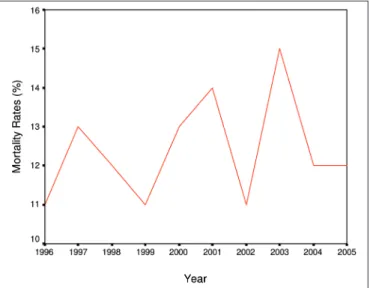
Out of 10 541 children 1 320 died, giving an overall mortality rate of 12.6%. Fig. 1 shows the yearly pattern of childhood mortality rates. The mortality rate was lowest (10.7%) in 1999 and highest (14.9%) in 2003. The decrease observed in 1999 and 2002 may be due to reduced hospital admissions during periods of industrial action in the health sector.
Although the overall mortality rate for the pre-MDG period was similar to that during the MDG period (492/4 127 (11.9%) v. 828/6 414 (12.9%); p=0.135), the overall neonatal mortality rate during the MDG period was significantly higher compared with the pre-MDG period (458/1 776 (25.8%) v. 244/1 192 (20.5%); p=0.0008) . However, the overall mortality rate for children in the post-neonatal group was insignificantly higher in the pre-MDG period compared with the MDG period (220/ 2 935 (7.5%) v. 303/4 638 (6.5%); p=0.107).
Eight hundred and forty-seven subjects (69.1%) died within 48 hours of hospitalisation – 57% and 76.2% in the pre- and post-MDG periods, respectively (p=0.0000).
Birth - 28 days
The ages ranged from birth to 28 days, with a mean of 3.09 (5.6) days. The male-to-female ratio was 1.3:1. The mean duration of hospitalisation was 3.26 (5.12) days (range: 0 - 30 days). Most of the neonatal deaths (67.2%) occurred within the first 48 hours of hospitalisation. Table II shows that the leading causes of death included prematurity (34.6%), perinatal asphyxia (30.8%), septicaemia (24.8%) and severe neonatal jaundice (15.4%). Other causes included neonatal tetanus, anaemia and congenital malformations.
>28 days - 12 months
The male-to-female ratio was 1.5:1. The mean age was 7.50 (3.9) months while the mean duration of hospitalisation was 2.41 (4.53) days. The majority of these patients (75.2%) died within 48 hours of hospitalisation. The leading causes of death, as shown in Table III, were severe anaemia (20.1%), pneumonia
TABLE I. AGE AND SEX DISTRIBUTION OF 1 225 DEATHS IN CHILDREN AGED BIRTH – 16 YEARS
Sex
Age Male (%) Female (%) Total deaths (N) Total deaths (%)
Birth - 28 days 398 (56.7) 304 (43.3) 702 57.3
>28 days - 12 months 125 (59.8) 84 (40.2) 209 17.1
>12 months - 5 years 106 (56.7) 81 (43.3) 187 15.2
>5 - 16 years 78 (61.4) 49 (38.6) 127 10.4
Total 707 (57.7) 518 (42.3) 1 225 100.0
Fig. 1. Yearly mortality rates in children hospitalised at the OOUTH, Sagamu, Nigeria.
(11.9%), septicaemia (11.0%) and protein-energy malnutrition (PEM) (10.0%). Other notable causes were meningitis, measles, severe malaria, gastroenteritis and HIV/AIDS.
>12 months - 5 years
The male-to-female ratio was 1.3:1. The mean age was 2.7 (1.2) years while the mean duration of hospitalisation was 2.1(3.6) days. The majority of deaths (76.4%) occurred within 48 hours of hospitalisation and over 50% of these occurred within 24 hours. The leading causes of death included severe anaemia (25.1%) and severe malaria (15.0%), while measles, PEM and septicaemia each accounted for 8.0% (Table IV).
>5 years - 16 years
The male-to-female ratio in this group was 1.6:1. The mean age was 10.3 (2.9) years. The mean duration of hospitalisation was 3.87 (6.12) days and most of the subjects (59.1%) died within 48 hours of admission. Acute illnesses, namely severe malaria, severe anaemia and tetanus, were responsible for 33.3% of the deaths. Chronic disorders such as renal failure, malignancies,
tuberculosis and sickle cell anaemia were responsible for 26.8% of the deaths (Table V).
Comparison of the occurrence of common causes of
death in the different age groups
Severe malaria was a significantly more common cause of death among infants than toddlers (11 (5.3%) v. 28 (15.0%);
p=0.001) and among toddlers compared with children older than 5 years (47 (25.1%) v. 14 (11.0%); p=0.002).
The occurrence of severe anaemia as a cause of death was similar among infants and toddlers (42 (20.1%) v. 47 (25.1%);
p=0.231) and among toddlers and children older than 5 years (28 (15.0%) v. 16 (12.6%); p=0.552).
TABLE II. CAUSES OF DEATH IN 702 NEONATES
Causes of death* Frequency %
Prematurity 243 34.6
Perinatal asphyxia 216 30.8
Septicaemia 174 24.8
Hyperbilirubinaemia 108 15.4
Tetanus 51 7.3
Anaemia 27 3.8
Multiple congenital malformations 17 2.4
Bleeding disorders 14 2.0
Meconium aspiration 9 1.3 Congenital heart diseases 9 1.3 Congenital pneumonia 8 1.1 Necrotising enterocolitis 4 0.6
* Some infants had multiple clinical diagnoses.
TABLE III. CAUSES OF DEATH IN 209 INFANTS AGED >28 DAYS - 12 MONTHS
Causes of death Frequency %
Severe anaemia 42 20.1
Pneumonia 25 11.9
Septicaemia 23 11.0
PEM 21 10.0
Meningitis 17 8.1
Measles 11 5.3
Severe malaria* 11 5.3 Gastroenteritis 10 4.8
HIV/AIDS 7 3.3
Aspiration pneumonitis 6 2.9 Sickle cell anaemia† 4 1.9
Malignancies 2 0.9 Tuberculosis 1 0.5 Febrile convulsions 1 0.5
Others‡ 28 13.9
Total 209 100.0
*Other manifestations of severe malaria except severe anaemia.
†Other manifestations of sickle cell anaemia except severe anaemia. ‡Others include upper airway infections and obstructions, chronic
liver disease, acute renal failure, congenital heart diseases, intestinal obstruction, poisoning and severe burn injury.
TABLE IV. CAUSES OF DEATH IN 187 CHILDREN AGED >12 MONTHS - 5 YEARS
Causes of death Frequency %
Severe anaemia 47 25.1 Severe malaria* 28 15.0
Measles 15 8.0
PEM 15 8.0
Septicaemia 15 8.0 Gastroenteritis 9 4.8 Meningitis 8 4.4
HIV/AIDS 7 3.7
Tuberculosis 6 3.2 Febrile convulsions 5 2.7
Tetanus 3 1.6
Malignancies 3 1.6
Pneumonia 3 1.6
Sickle cell anaemia† 1 0.6
Others‡ 22 11.7
Total 187 100.0
*Other manifestations of severe malaria except severe anaemia.
†Other manifestations of sickle cell anaemia except severe anaemia. ‡These include upper airway infections and obstructions, chronic liver
disease, acute renal failure, congenital heart diseases, encephalitis, acute abdomen and other surgical emergencies, poisoning and severe burn injury.
TABLE V. CAUSES OF DEATH IN 127 CHILDREN AGED >5 - 16 YEARS
Causes of death Frequency %
Severe malaria* 16 12.6
Severe anaemia 14 11.0
Tetanus 11 8.7
Renal failure 9 7.1
Malignancies† 9 7.1
Tuberculosis 8 6.3
Sickle cell anaemia‡ 8 6.3
Meningitis 7 5.5
Septicaemia 6 4.7
HIV/AIDS 5 3.9
Rabies 3 2.4
Encephalitis 1 0.8
Others§ 30 23.6
Total 127 100.0
*Other manifestations of severe malaria except severe anaemia.
†Malignancies including leukaemias.
‡Other manifestations of sickle cell anaemia except severe anaemia. §These include upper airway infections and obstructions, chronic liver
ARTICLE
Measles as a cause of death was similar among infants and toddlers (11 (5.3%) v. 15 (8.0%); p=0.269).
Comparison of common causes of death among
sub-jects admitted before and during the MDG
peri-ods
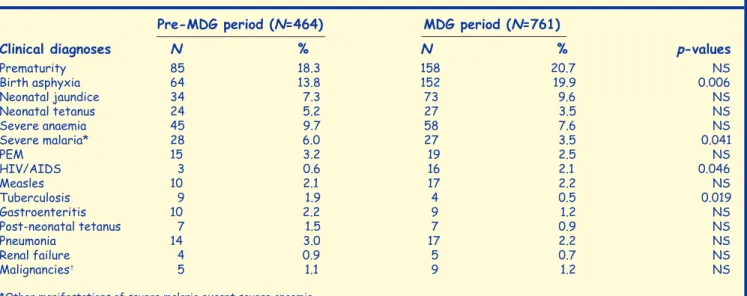
Table VI compares the relative occurrence of specific causes of death before and during the MDG periods. There was no statistically significant difference in the occurrence of prematurity (p=0.298), severe neonatal jaundice (p=0.173), neonatal tetanus (p=0.167), severe anaemia (p=0.204), PEM (p=0.447) and measles (p=0.927) as causes of death before and during the MDG periods. However, birth asphyxia (p=0.006) and HIV/AIDS (p=0.046) became significantly more common causes of death during the MDG period, while severe malaria (p=0.041) and tuberculosis (p=0.019) became less common causes of death during the same period.
Discussion
This study examined the pattern of childhood deaths over a period extending from the end of the 20th century to the beginning of the new millennium. The latter period is saddled with MDG targets, the fourth of which specifically aims to reduce childhood deaths by two-thirds of its present status by 2015.4 Although the target of the fourth MDG is still some
years away, early evaluation is desirable in order to have a step-wise and guided approach to meeting this target. The overall mortality of 12.6% obtained in this study was comparable with 14.6% reported in Ibadan, Nigeria5 between
1969 and 1973, and with 11.6% obtained in Ilorin, Nigeria6
between 1983 and 1984. However, it was higher than the 9.5% reported from a more recent Ibadan study.7 Interestingly, the
mortality rate obtained in this study was higher than the 8.2% and 7.8% reported from Kenya and South Africa, respectively.8,9
In the Kenyan study and in the present study all childhood deaths were included, but in the South African study only deaths in the under-5 group were included. Nevertheless, the yearly mortality rates remained high throughout the 10-year period, except for the decreases in 1999 and 2002. Those were
periods of low hospital admissions due to multiple industrial actions in the health sector. Hence, childhood mortality rates in the south-western part of Nigeria do not seem to have changed remarkably. This justifies the need to intervene in the form of MDGs.
The concentration of deaths within the first 48 hours of hospitalisation was similar to previous reports.5-8 This probably
suggests late presentation at the hospital, possibly due to poor accessibility especially in terms of cost. It is probable that some of these deaths could have been averted if the services at the hospital were free and patients were encouraged to present early in the course of their illness.
The role of severe PEM as a cause of childhood deaths appeared to have diminished compared with previous reports.5,6,10 The
exact reason is unknown as the socio-economic situation of most Nigerian families had not improved remarkably over the period studied.11 In contrast to earlier reports5,6,12,13 a decline in
the prevalence of fatal gastroenteritis as a cause of childhood death was observed in this study. Improved management of diarrhoeal diseases with oral rehydration therapy has been proposed as a likely reason for the decline in the occurrence of fatal cases of gastroenteritis and severe PEM, especially kwashiorkor, since the early 1990s when oral rehydration therapy was introduced.14
In this study the peak of childhood deaths occurred in the neonatal period. Neonatal deaths formed 57.3% of childhood deaths, which was higher than the 23.5 - 26.4% previously obtained in both Ibadan and Ilorin between the late 1960s and the 1980s.5,6,10 However, the dominance of neonatal deaths in this study was similar to the finding in a more recent Ibadan study.7 This change is difficult to explain. However, the higher neonatal mortality rate and the increased significance of perinatal asphyxia as a cause of neonatal death in the MDG period may reflect the increasingly poor utilisation of prenatal and delivery services for socio-economic reasons.15,16
Interestingly, the range of causes of neonatal deaths still also included prematurity, septicaemia, tetanus and jaundice – in agreement with previous reports.5-8,12,13,17 Therefore, the
provision of free, good-quality obstetric and immediate post-delivery neonatal care may increase neonatal survival.
TABLE VI. COMPARISON OF CAUSES OF DEATH IN THE PERIODS BEFORE AND DURING THE MDG
Pre-MDG period (N=464) MDG period (N=761)
Clinical diagnoses N % N % p-values
Prematurity 85 18.3 158 20.7 NS
Birth asphyxia 64 13.8 152 19.9 0.006
Neonatal jaundice 34 7.3 73 9.6 NS
Neonatal tetanus 24 5.2 27 3.5 NS
Severe anaemia 45 9.7 58 7.6 NS
Severe malaria* 28 6.0 27 3.5 0.041
PEM 15 3.2 19 2.5 NS
HIV/AIDS 3 0.6 16 2.1 0.046
Measles 10 2.1 17 2.2 NS
Tuberculosis 9 1.9 4 0.5 0.019
Gastroenteritis 10 2.2 9 1.2 NS
Post-neonatal tetanus 7 1.5 7 0.9 NS
Pneumonia 14 3.0 17 2.2 NS
Renal failure 4 0.9 5 0.7 NS
Malignancies† 5 1.1 9 1.2 NS
*Other manifestations of severe malaria except severe anaemia.
†Malignancies, including Burkitt’s lymphoma and acute leukaemias.
NS = not significant.
ARTICLE
While severe anaemia was not previously known to be a leading cause of childhood death,5,6,12 it was a very common cause of
death in children under 5 years of age in this study. It lost this prime position to severe malaria in children older than 5 years. Malaria had previously been shown to be a leading cause of childhood death.7
The leading role of severe malaria in children older than 5 years was unusual since such children were normally less prone to the severe forms of the disease. Is the epidemiology and pattern of immunity with regard to malaria changing? This needs to be examined in subsequent clinical and laboratory studies.
Although the detailed aetiologies of
anaemia were not examined in this study, the dominance of severe anaemia as a cause of death in children under 5 is difficult to explain. This dominance was contrary to a few reports5,6 in the preceding two decades but similar to
more recent reports from within and outside the country.13,18
Severe malaria is renowned to be a common cause of severe childhood anaemia in the tropical region.13,18 Although severe
malaria became a less common cause of death in this study in the MDG period, there was no difference in the role of severe anaemia as a cause of death in the pre-MDG and MDG periods. This suggests the increasing role of other aetiologies in severe anaemia. Extensive clinical research is required to elucidate this. The decline in the role of malaria as a cause of death in the MDG period is commendable as it may be a gain of the latest malaria control measure – the Roll Back Malaria Initiative. Measles was not a leading cause of childhood death in this study – contrary to reports obtained in the preceding two decades.5,6,10 However, the finding in this study agreed with
similar recent reports from Ibadan, Kenya, Bangladesh and Sagamu.7,8,17,19 This latest pattern may indicate partial success
of control measures instituted over the years. However, the similarity in the role of measles as a cause of death among both infants and toddlers may suggest that its epidemiology is changing, as pointed out in a Nigerian study.20 This change calls for the intensification of the present measles vaccination programme and the possible introduction of a booster measles vaccine at 2 years of age and at school entry.
Childhood HIV/AIDS has been widely associated with significant childhood mortalities.9,21,22 Although HIV/AIDS
was not a leading cause of childhood death during the two study periods, its occurrence increased significantly from the pre-MDG period to the MDG period. This was probably due to an increased awareness about the disease. Hospitalised children were not routinely screened for HIV at our centre; only those with clinical stigmata suggestive of HIV. It may be helpful to screen all critically ill children routinely as this would establish the exact role of HIV/AIDS in childhood deaths in this part of the world.
Conclusion
This study shows that childhood mortality remains high in Sagamu, south-west Nigeria. Most of these deaths occurred early during hospitalisation due to infectious and other preventable causes. Health intervention programmes such as IMCI and primary health care, which have been shown to reduce childhood deaths significantly, need to be intensified.23,24
methods, introduction of booster measles vaccine and provision of free health services may reduce these deaths further and help to achieve the fourth MDG by 2015.
References
1. Park K. Indicators of health. In: Park K, ed.
Park’s Textbook of Preventive and Social Medicine.
17th ed. Jabalpur, India: M/S Banarsidas Bhanot Publishers, 2002: 21-24.
2. Alma-Ata International Conference on Primary Health Care. WHOChronicle 1978; 32: 409-430.
3. Dawodu A. Neonatology in developing countries: problems and practices and prospects. Ann Trop Paediatr 1998; 18: S73-S79.
4. WHO. Health in the Millennium Development Goals. Available at: www.who.int/mdg/goals/en/ (last accessed 3 June 2005).
5. Adeyokunnu AA, Taiwo O, Antia AU. Childhood mortality among 22,255 consecutive admissions in the University College Hospital, Ibadan. Nig J Paediatr 1980; 7: 7-15.
6. Fagbule D, Joiner KT. Pattern of childhood mortality at the University of Ilorin Teaching Hospital. Nig J Paediatr 1987; 14: 1-5.
7. Ayoola OO, Orimadegun AE, Akinsola AK, Osinusi K. A five-year
review of childhood mortality at the UCH, Ibadan. West Afr J Med 2005; 24: 175-179.
8. Menge I, Esamai F, van Rekan D, Anabwani G. Paediatric morbidity and mortality at the Eldoret District Hospital, Kenya. East Afr Med J
1995; 72: 165-169.
9. Krug A, Patrick M, Pattinson RC, Stephen C. Childhood death auditing to improve paediatric care. Acta Paediatr 2006; 95: 1467-1473.
10. Bamgboye EA, Familusi JB. Mortality pattern at a Children’s Emergency Ward, University College Hospital, Ibadan, Nigeria. Afr J Med Med Sci
1990; 19: 127-132.
11. UNICEF. http://www.unicef.org (accessed 1 December 2006). 12. Ibrahim M, Udoma MG, Abdulwahab I. Infant mortality at Usmanu
Danfodiyo University Teaching Hospital, Sokoto. Nig J Paediatr 1993; 20: 17-20.
13. Ibeziako SN, Ibekwe RC. Pattern and outcome of admissions in the Children’s Emergency Room of the University of Nigeria Teaching Hospital, Enugu. Nig J Paediatr 2002; 29: 103-107.
14. Oyelami OA, Ogunlesi TA. Kwashiorkor – is it a dying disease? S Afr Med J 2007; 97: 65-68.
15. Ogunniyi SO, Faleyimu BL, Makinde ON, Adejuyigbe EA, Ogunniyi FA, Owolabi AT. Delivery care services utilization in an Urban Nigerian population. Nig J Med 2000; 9: 81-85.
16. Ogunlesi TA. The pattern of utilization of prenatal and delivery services in Ilesa, Nigeria. The Internet Journal of Epidemiology 2005; 2 (2). 17. Baqui AH, Sabir AA, Beguin N, Arifeen SE, Mitra SN, Black RE. Causes
of childhood death in Bangladesh: an update. Acta Paediatr 2001; 90: 682-690.
18. Commey JO, Dekyem P. Childhood deaths from anaemia in Accra, Ghana. West Afr J Med. 1995; 14: 70-71.
19. Fetuga MB, Njokanma OF, Ogunfowora OB, Runsewe-Abiodun TI. A ten-year study of measles admissions in a Nigerian Teaching Hospital.
Nig J Clin Pract 2007; 10: 41- 46.
20. Ojuawo A, Bello M. Measles in Ilorin. Nig J Med 2000; 9: 101-103. 21. Adejuyigbe EA, Oyelami O, Onayemi O, Durosinmi MA. Paediatric
HIV/AIDS in Ile-Ife, Nigeria. Cent Afr J Med 2003; 49: 74-78.
22. Grandin W, Westwood T, Lagerdein K, King MS. Deaths at Red Cross Children’s Hospital, Cape Town 1999 - 2003 – a study of death
notification forms. S Afr Med J 2006; 96: 964-968.
23. Lulseged S. Integrated management of childhood illnesses: a review of the Ethiopian experience and prospects for child health. Ethiop Med J
2002; 40: 187-201.
24. Afari EA, Nkrumah EK, Nakana T, Sakatoku H, Hori H, Binka F. Impact of primary health care on child morbidity and mortality in rural Ghana: the Gomoa experience. Cent Afr J Med 1995; 41: 148-153.