Synthesis and Preliminary Characterization of a New
Hexadentate Sequestrant in the
Ethylenediaminetetrapropionic Acid Class
Mihaela Cazacu*, Teodor Traşcă, Adrian Riviş, Corina Costescu, Ducu Ștef, Călin Jianu
Faculty of Food Processing Technology, Banat’s University of Agricultural Sciences and Veterinary Medicine “King Michael I of Romania” at Timișoara, Calea Aradului 119, RO-300645 Timișoara, Romania
Abstract
Ethylenediaminetetraacetic acid (EDTA) (E-385) as such and/or derivatized (salified) occupies a separate chapter, of wide interest in food sciences, because of its coordinating (sequestering) competences towards various organic and/or inorganic structures (especially metal cations) with small geometric dimensions. This paper aims to diversify the structural range of these hexadentate ligands, by accessing a synthetic protocol different from the classic one, the cyanoethylation of primary amine functional groups of ethylenediamine (ED). In this paper are considered the main dependences of the yields of nucleophilic addition of the amino groups to the activated double bond in acrylonitrile (AN) monomer, on the operating parameters (temperature, processing time, molar ratio of reactants), and finally the preliminary data on the coordinating (sequestering) competence of ethylenediaminetetrapropionic acid (EDTP). The conclusions drawn support further research to extend the area of hexadentate sequestering structures.
Keywords: hexadentate ligands, complexone II, ethylenediaminetetraacetic acid, Trilon B, N,N' -bis-(2-hydroxyethyl)-ethylenediamine-N,N'-diacetic acid.
1. Introduction
Metal chelates (m.c) are coordinative compounds which are characterized by the presence within their coordination sphere of ligands grafted to the metal ion through more than one donor atom, so that they form with it a “heterocycle” (chelate). These molecular architectures or ions are also known as chelating agents (chelators). The process of formation of a metal chelate is called by this term, having been proposed in 1920 by Morgan and Drew from the Greek χηλή, chēlē = “claw” (crawfish pincer) [1,2]. Chelators (chelating agents) are chemical compounds able to form stable cyclic structures (chelate rings). These structures of 5 or 6 ring atoms, less frequently of 4 or more than 6 carbon atoms, are also called
* Corresponding author: Cazacu Mihaela, Tel 0724316959, Email [email protected]
“internal complexes”, because both active groups that generate the ring belong to the same molecule. This cyclic architecture may be formed in two ways, by the coordination of a hydrogen atom bound to an electronegative element to an atom with lone-pair electrons or engaged in a multiple bond or in an “aromatic cloud”, or the coordination of the unshared electrons of an (electronegative) element to an electron-deficient metal (Al, Be, etc.) or one having vacant orbitals (Mn, Fe, Co, Ni, Cu, etc.). The number and variety of structures for which chelating competences have been confirmed has increased considerably. The most general criterion of their classification is denticity, which refers to the number of atoms through which the ligand can graft to a given metal ion. Based on this criterion, chelating agents can be classified into di-, tri-, tetra-, penta-, or hexadentate, respectively. At the formation of a metal chelate, a multidentate agent may not access all its donor atoms (a potentially
hexadentate agent can act as a pentadentate one, behavior observed for a large number of ligands of this type) [1,2]. In this work the authors have aimed to diversify the structural range of
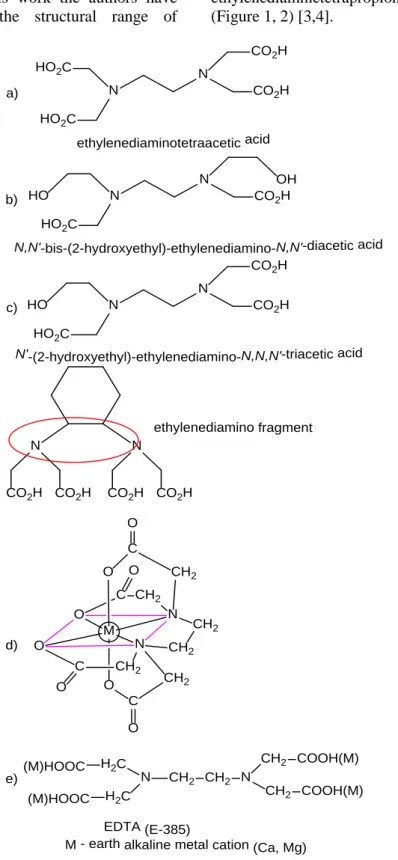
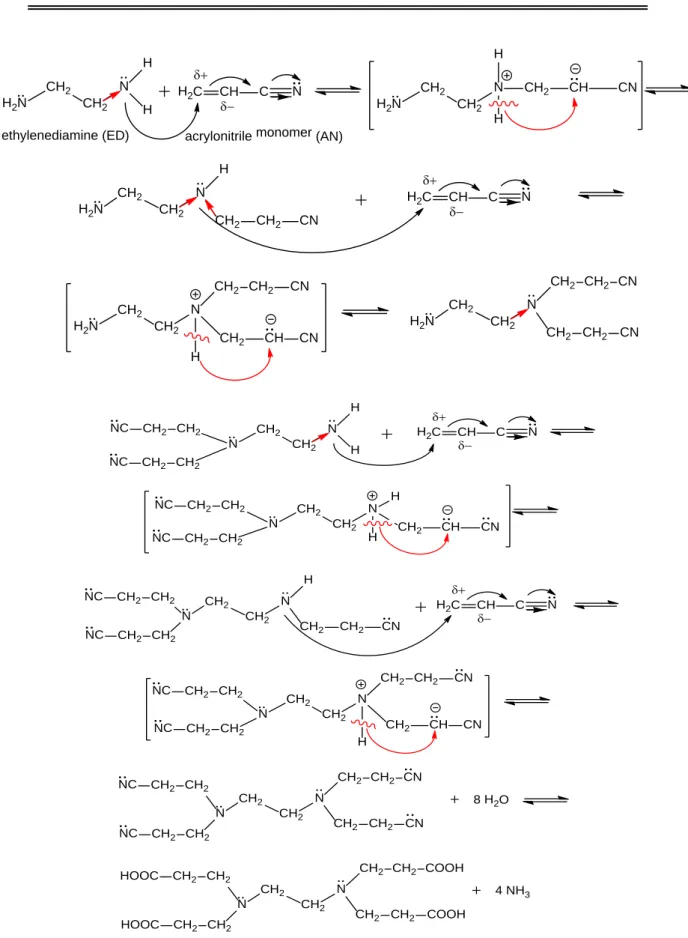
hexadentate ligands, by accessing a classical reaction scheme adapted to the synthesis of ethylenediaminetetrapropionic acid (EDTP) (Figure 1, 2) [3,4].
N
N
CO2H
CO2H HO2C
HO2C a)
ethylenediaminotetraacetic acid
N
N
CO2H HO2C
b)
N,N'-bis-(2-hydroxyethyl)-ethylenediamino-N,N'-diacetic acid HO
OH
N
N
CO2H
CO2H HO2C
c) HO
N'-(2-hydroxyethyl)-ethylenediamino-N,N,N'-triacetic acid
N N
CO2H CO2H CO2H CO2H
ethylenediamino fragment
C
O CH2
M
N O
O C
N
CH2
O O
O
C CH2
O
CH2 CH2 C
O CH2
d)
CH2 CH2 N N
CH2 CH2 H2C
H2C
COOH(M)
COOH(M) (M)HOOC
(M)HOOC
EDTA (E-385)
M - earth alkaline metal cation (Ca, Mg) e)
CH2
H2N CH2
N H
H ethylenediamine (ED)
H2C CH C N
d+
d−
acrylonitrile monomer (AN)
CH2
H2N CH2
N CH2 H
CH CN
CH2
H2N CH2
N H
CH2 CH2 CN
H2C CH C N
d+
d−
CH2
H2N CH2
N CH2 H
CH CN
CH2 CH2 CN
CH2
H2N CH2
N CH2
CH2 CH2 CN CH2 CN H
CH2
N CH2
N H
H
H2C CH C N
d+
d−
CH2
N CH2
N CH2
H CH CN
CH2
N CH2
N H
CH2 CH2 CN
H2C CH C N
d+
d−
CH2
N CH2
N
CH2
H
CH CN CH2 CH2 CN
CH2
N CH2
N CH2
CH2 CH2 CN
CH2 CN
NC CH2 CH2
NC CH2 CH2
NC CH2 CH2
NC CH2 CH2
H
NC CH2 CH2
NC CH2 CH2
NC CH2 CH2
NC CH2 CH2
NC CH2 CH2
NC CH2 CH2
8 H2O
CH2
N CH2
N CH2
CH2 CH2 COOH
CH2 COOH
HOOC CH2 CH2
HOOC CH2 CH2
4 NH3
ethylenediaminotetrapropionic acid (EDTP)
There are other ways for the classification of chelating agents, of which can be mentioned those based on the nature of the functional groups or on the structural features of the molecule. Ligands with two basic groups coordinate as neutral species. The chelate formed has the same charge as the metal ion. In that category of chelating agents should be mentioned primarily aliphatic diamines (ethylenediamine) or heterocyclic ones (dipyridyl and phenanthroline). Ethylenediamine is the most accessed chelating agent (Figure 1). Ethylenediaminetetraacetic acid (EDTA) (E-385) at doses of ca. 75mg/kg is well tolerated by the human consumer, sequesters primarily alkaline earth cations (Ca, Mg), generating a stable,
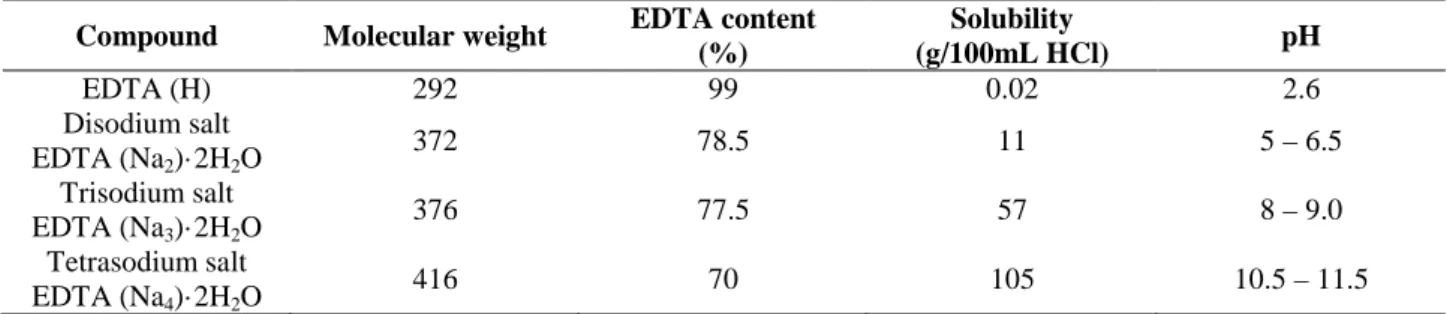
water-soluble complex, without any physiological role as such, only occasionally with the risk of decalcification (hypocalcemic tetany) over the long term. As such or salified (di-, tri-, tetrasodium salt), anhydrous or hydrated (Figure 1), it is commonly used in food processing as sequestering (complexing) agent of many metal cations (Table 1), to stabilize vitamins from fruit juices, wines, vinegar etc., to prevent the non-enzymatic browning of fruits and vegetables, in the processing of aquatic and marine fauna, of classic dairy and meat products (E-385). In the last decades the interest in these structures has also been steadily increasing in the food sciences [5-8].
Table 1.
Structure and physical characteristics of certain EDTA derivatives
Organisms able to accumulate high concentrations of heavy metals (with no noticeable symptoms) are often referred to in literature as metallophilic or hiperaccumulators [3,4]. The concept of heavy metal flora/fauna refers to species that normally grow in natural and anthropogenic environments enriched with heavy metals. Organisms have different capacities to store heavy metals [3]. The absorption intensity and “transport” of heavy metals does not depend solely on the type of metal cation, but also on its action, particularly in biochemical reactions. The mobility and distribution of the cations of heavy metals in plants depends mainly on their ability to form complexes, chelates with the xylem components [3,4].
2. Materials and Methods
• Ethylenediamine (Sigma Aldrich)
• Acrylonitrile (stabilized monomer) (Sigma Aldrich)
Methods [10-14]
Preparation of exhaustively cyanoethylated ethylenediamine
In a reaction vessel equipped with an effective cooling system, mechanical stirring, thermometer, dropping funnel, under inert atmosphere, at 20-30°C 0.1 moles ethylenediamine (ED) are introduced over 30-45 minutes and then 0.0025 moles finely divided anhydrous FeSO4 are added.
5.83 g (0.11 moles) acrylonitrile monomer (AN) are added cautiously, so that the temperature of the reaction mixture does not exceed the recommended range. If necessary the reaction vessel is cooled. It is allowed a further 2 hours under the same conditions to complete the reaction, and the precipitated salts are filtered hot. The yellowish-colored fluid residue is purified if necessary from traces of acrylonitrile oligomers by eluting on a silica gel column. Yields against ED are virtually quantitative.
Preparation of ethylenediaminetetrapropionic acid (EDTP)
The acids were obtained by total acid hydrolysis with hydrochloric acid of the propionitriles previously prepared. In a reaction vessel equipped
Compound Molecular weight EDTA content (%)
Solubility
(g/100mL HCl) pH
EDTA (H) 292 99 0.02 2.6
Disodium salt EDTA (Na2)·2H2O
372 78.5 11 5 – 6.5
Trisodium salt EDTA (Na3)·2H2O
376 77.5 57 8 – 9.0
Tetrasodium salt EDTA (Na4)·2H2O
with effective mechanical stirring, thermometer, reflux cooler and dropping funnel, 0.1 moles nitriles are introduced at 60-70°C to avoid abundant foaming or the reaction mass overflow, respectively, 0.4 moles (14.5g) hydrochloric acid (40-42 mL concentrated hydrochloric acid) are added over 30-45 minutes. The reaction is perfected at 90-100°C for another hour, then the mixture is neutralized with ca. 16 g divided NaOH (54 mL NaOH 30% aqueous solution). The precipitated inorganic salts are filtered and the water in the reaction product is removed under vacuum (10-20 mm Hg). The fluid residue obtained after concentration is then purified by repeated extractions in the ethyl ether/water system, followed by elution on a column packed with ion exchangers. The purity of EDTP is checked by thin-layer chromatographic separation. Yields against nitriles starting materials are between 95-98%.
Preparation of EDTP alkaline salts
In a reaction vessel equipped with effective mechanical stirring, thermometer and dropping funnel 0.1 moles EDTP are introduced, then the neutralizing agent is added cautiously at 60-70°C under continuous stirring, in a suitable form and amount. After ca. 1 hour the pH of the mixture is adjusted to a 7.5-8.5 value, the traces of water are removed under vacuum (10-20 mm Hg), and the residue is purified by repeated alcoholic extractions. Purity was determined by the titration method.
3. Results and discussion
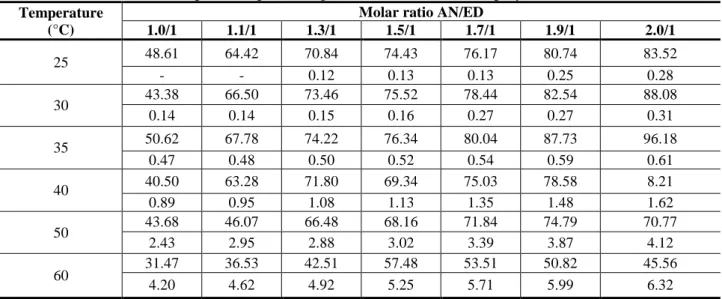
Preliminary tests of ethylenediamine cyanoethylation [3] have revealed that the oligomerization processes of the acrylic monomer, especially at temperatures above 30°C, have a significant relevance. The yields of nucleophilic addition decrease considerably, and the reaction tends to proceed vehemently, strongly exothermically, with the formation of aggregated reddish-brown resins, soluble in polar solvents (water, acetone, etc.) or dispersed yellow solid products soluble in solvents with medium, low polarity. Initially we worked without any oligomerization inhibitor of the acrylic monomer in order to follow the evolution of the cyanoethylation and oligomerization yields (Table 2).
Subsequently, under the conditions of the optimal parameters set, anhydrous FeSO4 was introduced
as oligomerization inhibitor. Under equimolar
conditions, by increasing the temperature in the range of 25-35°C, the yields decrease. Under considerable excess of acrylic monomer, the evolution of the yield follows a similar trend. In the 25-40°C range, the amount of oligomers formed is below 1%, independently of the excess of monomer used, while between 40-60°C it increases markedly [9].
Table 2. Dependence of the ethylenediamine cyanoethylation (ED)/oligomers yields (%) on the AN/ED molar ratio and temperature, processing time 60 minute, without polymerization inhibitor
Temperature (°C)
Molar ratio AN/ED
1.0/1 1.1/1 1.3/1 1.5/1 1.7/1 1.9/1 2.0/1
25 48.61 64.42 70.84 74.43 76.17 80.74 83.52
- - 0.12 0.13 0.13 0.25 0.28
30 43.38 66.50 73.46 75.52 78.44 82.54 88.08
0.14 0.14 0.15 0.16 0.27 0.27 0.31
35 50.62 67.78 74.22 76.34 80.04 87.73 96.18
0.47 0.48 0.50 0.52 0.54 0.59 0.61
40 40.50 63.28 71.80 69.34 75.03 78.58 8.21
0.89 0.95 1.08 1.13 1.35 1.48 1.62
50 43.68 46.07 66.48 68.16 71.84 74.79 70.77
2.43 2.95 2.88 3.02 3.39 3.87 4.12
60 31.47 36.53 42.51 57.48 53.51 50.82 45.56
4.20 4.62 4.92 5.25 5.71 5.99 6.32
At the same time the content of oligomers increases with temperature and excess monomer. These behaviors suggest that the cyanoethylation reaction of ED is reversible. In the process of ED cyanoethylation the reaction time favors the formation of propionitriles up to 180 minutes, and the oligomerization of the monomer over the entire duration of the process. After this period the cyanoethylation yields decrease, further suggesting the reversible character under prolonged contact between reactants. The maximum yield value is achieved at shorter
reaction times. On the whole process, increasing the reaction time up to ca. 180 minutes favors all the reaction processes, including the formation of AN oligomers. After approximately 180 minutes the content of propionitriles decreases due to prolonged contact with the basic environment of the reactants. In this work the formation of AN oligomers was avoided by the introduction of anhydrous ferrous sulfate (FeSO4) as
polymerization inhibitor of the acrylic monomer
(Table 3).
Table 3. Dependence of the ethylenediamine (ED) cyanoethylation yield on the polymerization inhibitor (anhydrous FeSO4) content, molar ratio AN/ED 1/1, temperature 30°C, processing time 2 hours
Crt. No. Polymerization inhibitor (%) Yield (%)
1 0.5 82.25
2 0.6 86.31
3 0.7 89.42
4 0.8 93.77
5 0.9 96.82
6 1.0 98.90
Liquid–liquId extraction
Vigorous stirring
Phase separation EDTP
(aqueous/organic sol. 0.02M)
deionized water
aqueous sol. MeSCN 0.1M
CH2Cl2
25oC, 10 min
Aqueous phase Organic phase (E1)
... ...
CH2Cl2
Repeated liquid-liquid extractions
Repeated liquid-liquid extractions deionized
water
Reunited aqueous R1-R5 phases
Reunited organic E1-E5 phases
Alkaline cation evaluation
Volhard method
Drying on anhydrous
Na2CO3
Vacuum evaporation
Metal cation evaluation colorimetry
gravimetry Figure 3. The block diagram of
The nature of the acid catalyst (HA) favorably influences the hydrolysis yields through the acid’s strength: if in the presence of concentrated sulfuric acid at low temperatures propionamides are mainly obtained, in the presence of hydrochloric acid above 80°C substituted propionic acids are formed. Increasing the temperature and the HA/nitrile molar ratio favors the total hydrolysis yields. The amount of acid selectively influences the hydrolysis to propionic acids, along with their esters, while an excess of n -dodecylbenzenesulfonic acid (catalyst) favors more the formation of propionamides and less that of propionic acids, without the formation of the corresponding esters. In all cases studied, above 80°C the propionitriles content decreases markedly regardless of the acid catalyst used, and the presence of propionic esters is observed. Above 110°C in the presence of hydrochloric acid increasing amounts of ED are noticed due to the cleavage of ether bridges. Increasing the reaction time favors the total acid hydrolysis. At higher temperatures (over 80°C) in the presence of hydrochloric acid, after ca. 60 minutes acrylonitrile disappears from the reaction mixture, and after 90 de minutes so does the propionamide formed intermediately. From the interpretation of the preliminary values of the distribution balance of the sequestrating matrix between the two phases, a convincing distribution of them is noticed (Figure 3).
4. Conclusions
From the analysis of the experimental data of the ethylenediamine cyanoethylation process, the reaction proceeds by a specific mechanism in which the rate-determining step is the proper nucleophilic addition. Its pre- and post-stages are protolytic equilibria (acid–base) in which the hydroxylic nucleophile characteristic to the substrate is formed, and the carbanionic structure resulting from the addition is stabilized, respectively. Because in the formation of the activated complex participate two polarized molecular species, the acrylic monomer and ethylenediamine, the reaction is strongly influenced by effects of solvation (coordination), due both to the polarity of the reaction medium and the nature of the cation. Increasing the ionic character of the nucleophile–cation bond favors
the coordination effects specific to the conformation of the processing intermediates. The distribution balance of metal cations between the two phases of the sequestration process is encouraging and suggests further research in the EDTP class.
Acknowledgements
The authors express their entire gratitude to Prof. Univ. Emeritus Ionel Jianu for the suggestions put forward during the development of this work.
References
1. C. Liteanu, E. Hopîrtean, Chimie analitice cantitativă. Volumetria, Ediția 6. Editura Didactică și Pedagogică București, 1972.
2. *** Enciclopedia de chimie, volumul 3. Editura Academiei, București, 1972.
3. Jianu C. Research concerning the of some metal ion complexing additives to improve food value in horticultural raw. PhD thesis. Banat's University of Agricultural Sciences and Veterinary Medicine, 2006,. Jianu I. Aminoethers surfaceactive agents. Cationic surfaceactive agents. PhD thesis. Polytehnic University, 1984.
4. G. Schwarzenbach, Die Komplexometrische Titration, II Anfl., Enke – Verlag, Stuttgart, 1985. 5. G. Marcu, Chimia compușilor coordinativi. Editura Academiei R.S. România, București, 1987.
6. C. Drăgulescu, E. Petrovici, Chimie structurală modernă. Chimia coordinației 8. Editura Academiei, București, 1977.
7. Haiduc, Chimia compușilor metaloorganici. Editura Științifică București, 1972.
transfer catalysis conditions (II). J Agroalim Proc Technol 2009, 15:79-87.
13. Jianu C. Synthesis of nonionic-anionic colloidal systems based on alkaline and ammonium beta-nonylphenol polyethyleneoxy (n=3-20) propionates/dodecylbenzenesulfonates with prospects
for food hygiene. Chemistry Central Journal 2012, 6:95, doi:10.1186/1752-153X-6-95.