VOLUME 15 ISSUE 4 (2017), Page 69 – 78
CHANGES AND THREATS IN THE PRESERVATION OF THE TRADITIONAL MALAY LANDSCAPE
Nor Zalina Harun1, Noor Aziah Mohd Ariffin2, & Fadzidah Abdullah3
1
Institute of Malay World and Civilization
UNIVERSITI KEBANGSAAN MALAYSIA 2, 3
Kulliyyah of Architecture and Environmental Design
INTERNATIONAL ISLAMIC UNIVERSITY MALAYSIA
Abstract
The cultural landscape is regarded as being of the most complex designs which involves interactions between man, nature, cultural values and the associated built environment. Issues relating to the degradation of the cultural landscape are often caused by rapid urbanisation and industrialisation. The traditional Malay Landscape exists through harmoniously balanced interactions between man, nature and culture together with the traditional house, and contains unique and interesting features that have to be preserved as one of the most important cultural heritage sites. However, the preservation of heritage in Malaysia tends to focus more on architectural buildings rather than adopting a holistic approach that includes the surrounding environment of where the building is located. The absence of such approach has contributed towards the loss of the traditional Malay Landscape. This study highlights the changes and threats in the preservation of the traditional Malay Landscape by focusing on the preservation of a traditional house compound. The research employs a qualitative approach which involves site visits, interviews, and document analysis concerning the research topic. The old Malay villages located in Tumpat, Kelantan and Alor Gajah, Melaka have been selected as case studies. The findings reveal that the changes and threats include four underlying aspects; Unsuitable and inappropriate uses, Ownership Problems, Inadequate fund and consultation and Current development trends. The study concludes that the traditional Malay Landscape is facing numerous changes and threats in terms of its physical characteristics, environmental aspects and cultural values. In addition, the study reveals that traditional Malay landscape is not seen here as an integrating, holistic concept.
Keywords: Traditional Malay landscape; changes; threats; heritage; preservation
Date Received: 18th July 2017
INTRODUCTION
Conservation is known as a process of looking after or managing changes. It also includes maintenance and may, according to circumstances, include preservation, restoration, reconstruction and adoption and often a combination of more than one of these philosophies. According to International Council on Monuments and Site or ICOMOS (2007), conservation is a process which leads to the prolongation of life of cultural property and for its utilization now and in the future, it is also to recapture a sense of the past and to conserve, as much as possible the existing fabric in its original condition or situation. It is also a process that seeks to promote the harmony of both private and community lives in the affected areas (Kottak, 1994; Samsudin, 2013). In addition, it is also referring to the encouragement of the preservation of those cultural properties that constitutes the memory of mankind.
The global society has started to recognise the importance of conservation in
early 20th century. Simultaneously, conservation works began to receive positive
reaction by all quarters of expert, especially in the field of historic building. In Malaysia, conservation initiatives only began to capture government attention during the 1970’s. This culminated in the Antiquity Act (Act 168) in 1976, and most recently, the National Heritage Act (2005).
It is evident that the preservation of heritage in Malaysia tends to focus more on architectural buildings rather than adopting a holistic approach that includes the surrounding environment of where the building is located (Abdul Razak, 2015; Aidatul, Nooridayu & Norajlin, 2012). As a result, the absence of such approach has contributed towards the loss of the traditional or cultural landscape. This paper aims to explore the current condition and challenges in achieving the holistic preservation effort by focusing on the Malay Landscape. The first objective is to identify the special attributes and components that form the Malaysian landscape. The second objective is to identify the various changes and threats concerning the preservation of the traditional Malay Landscape. The third objective is to study the method of protecting the heritage of the traditional Malay Landscape. The research employs a qualitative approach which involves site visits, interviews, and document analysis concerning the research topic. The old Malay villages located in Tumpat, Kelantan and Alor Gajah, Melaka have been selected as the case studies.
THE MALAY LANDSCAPE
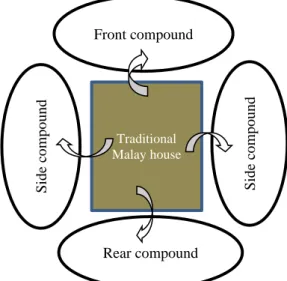
on the record of Abdullah Munsyi in his book "The Travels of Abdullah", the forbidden garden on the Malacca Sultanate era is the earliest garden in Malaysia (Osman & Yusoff, 1983). Munshi also described the beauty of a flower garden of the Kelantan sultanate in the 16th century called as the Tanah Serendah Sekebun Bangui. Moreover, it was also narrated of the Hunting Park and Central Melaka sultanate known as Ghairat Park and Kraton Park (Samsudin, 2014). In the traditional Malay garden, the house compound is divided into three different spaces based on functions. The plants and the components of the compound associate with the space itself. The composition of the Malay garden consists of the front compound, side compound and rear compound (Figure 1). The spaces create the identity of Malay garden and were derived from their culture, belief and religion.
Figure 1 The spatial composition of the traditional Malay garden
Front Compound
The front compound (laman hadapan), or the open lawn, is situated in front of
the house facing the main road. It is the wide space cleared of any obstruction giving ample space to conduct communal activity when required, such as wedding ceremony, feast, and space for children playing. Ismail, Utaberta and Ismail (2015) state that the open lawn being a main space that connect the front compound and side compound of the garden. In the eastern region of Peninsular Malaysia, this area is being used for drying fish, paddy winding as well as for drying clothes. The plants planted in front compound are usually ornamental, fragrant, colourful and small in size. This is to welcome the guests as well as to accentuate the appearance of the house (Zakaria, Salleh & Sabrizaa, 2012a).
Side c
ompou
nd
Front compound
Side c
ompou
nd
Rear compound
Side Compound
The side compounds (laman sisi) are located on the right and left side of
traditional Malay house. This space links with the front compound and rear compound. This compound is slightly narrow and elongated to the rear yard. The second entrance is located in this compound to link a house garden with the neighbour’s house compound. Moreover, this compound is a multipurpose area to accommodate the daily activities such as space for relaxing, leisure, gathering space for the family, and at the same time to entertain their neighbour and relatives. Hence, it helps to strengthen the relationship among the village society. Trees, such as fruit trees, are planted in this area and being the source of food. Hardscape elements like shelters, paddy store and hen coop are among many important elements that increase the functionality of the space (Zakaria, Salleh & Sabrizaa, 2012b).
Rear Compound
The rear compound (laman belakang) is related to the kitchen activities such as
cooking, bathing and washing as well as for orchard and farming. It is usually unturfed as the compound normally used for cooking, feeding the livestock and storage of kitchen utensils. This space is usually dominated by the women as they spend more time in the kitchen. This space also creates the sense of privacy due to the planting composition, whereby the trees and shrubs are planted close to one another. Trees with canopy are planted to make the backyard area as an isolated zone. Also, back yard has a high density of plants and scattered layout as its function to absorb the unpleasant smell from the remaining pool or water channel
called as parit and the livestock. This space is considered as kitchen garden or
edible garden as it provided the domestic raw food, fruit trees and herbs as medicinal purpose (Zakaria, Salleh & Sabrizaa, 2014b; Ismail, Utaberta & Ismail 2015).
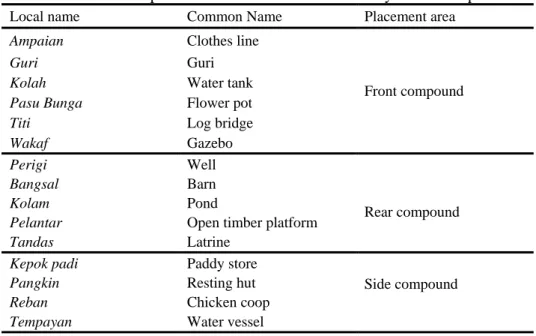
Hardscape Element
Table 1 Hardscape elements in the Traditional Malay house compound.
Local name Common Name Placement area
Ampaian Clothes line
Front compound
Guri Guri
Kolah Water tank Pasu Bunga Flower pot Titi Log bridge Wakaf Gazebo Perigi Well
Rear compound Bangsal Barn
Kolam Pond
Pelantar Open timber platform Tandas Latrine
Kepok padi Paddy store
Side compound Pangkin Resting hut
Reban Chicken coop Tempayan Water vessel
Softscape Elements
Softscape elements in traditional Malay house compound represent the nature related to their colloquial activities. It consists of varying types and species of plants. Softscape elements are usually used for ornamental and medicinal purposes. They also provide fresh ingredients for cooking as well as create shade. The type of plants may include climbing plants, orchid plants and exotic plants. Shrubs and ground cover are often planted in the front compound as ornamental, which can give benefits in terms of their shape, colour, smell, and size. In the rear compound is the kitchen garden where herbs and vegetables are planted for use
in cooking. Meanwhile, shady trees like beringin and ketapang are planted in the
side compound to provide shade. Fruit trees such as rambutan, mango,
mangosteen and durian tree are also sometimes planted in the compound of Malay traditional house.
METHODOLOGY
This study employed qualitative research method. Primary data were obtained through site visits, observation and interview. Meanwhile, secondary data were gathered through literature review of Malay culture and traditional Malay garden. Interviews with the house owners and tenants have revealed information regarding the changes or adverse effects on which the hardscape and softscape elements in the ten selected traditional Malay houses were affected or changed.
being preserved today. The preservation of the traditional Malay houses in
Melaka is monitored by Perbadanan Muzium Melaka (PERZIM). According to
PERZIM, more than 100 traditional Malay houses in villages in Melaka have been earmarked for preservation. Meanwhile, Shuaib and Enoch (2013) believe that the traditional Malay house in Kelantan has the most traditional aesthetic values. The selected site in Kelantan is Kampung Chenderong Batu located in the district of Wakaf Bharu and Tumpat, while in Melaka the sites are located in Kampung Padang Sebang, Kampung Tanjung Rimau Luar and Kampung Gadek, in the district of Alor Gajah.
In overall, ten traditional Malay houses were selected from the study areas. All of the houses were owner-occupied, except two in Alor Gajah, which were rented to local tenants. The houses displayed minimal deterioration. The houses’ compounds contained special structures of hardscape and softscape belonging to various historical periods (more than 100 years), which are worthy of preservation.
The very contextual and scope of the study will inevitably influence and limit the generality of the study findings. Besides the above, the major limitations of the study were that the study areas being limited to the locality of the historic buildings within two states. Thus findings may be of slight relevance and applicability to other part in the country. Finally, the study also assumed that the respondents interviewed have some level of knowledge in traditional Malay landscape and the need for their preservation.
FINDINGS
The study shows that the front compound of most of the houses in Kelantan and Melaka still maintain the composition of open free space often found in the front area of a traditional Malay house. Similarly, most of the houses also maintain the traditional combination of plants such as herbs, fragrance, fruit trees and brightly coloured flowering plants. For houses in Kelantan, the side and rear compound were planted with plants that are associated with food and daily necessities for the use in cosmetics and medicine. These imply that the plants were planted to create an aesthetic sense, provide habitat for wildlife as well as to provide shade and shelter. Thus, it can be said that traditional Malay landscape actually creates a balance ecological system. In addition, the use of various shapes and characters of the plants resulted in pleasant and soothing environment. In terms of cultural aspect, the landscape was created for social interaction among the community members suggesting a strong mutual relationship and understanding.
Use of Unsuitable Material
From observation, some of the compounds were cleared of the natural turfing and resurfaced with premix and other types of hard surfaces. This has changed the original setting of the compound. In some cases, softscape such as fruit trees and shrubs were removed for easy maintenance of the compounds. But this has led to increase heat during the day.
Some of the houses were inherited by the present owners who may not understand or appreciate the traditional landscape concept and design adopted by the original owner. As a result, present owners have redesigned the compounds according to their liking and, in the process, changed the original traditional setting of the compounds.
Lack of Maintenance
The problem of lack of maintenance can be attributed to several reasons. Firstly, to most residents of the houses, the maintenance of the houses was much more important than the compounds. Therefore, while the houses were repaired and maintained, the compounds were often not. This resulted in poorly maintained compounds of the houses being studied.
The issue of house ownership also contributed to lack of maintenance of the houses compounds. In the event of death of the original owner, the house, including the compounds, is often left unattended until the ownership of the house is legally transferred to an heir or a new owner. The situation was made worse when no heir or new owner was willing to stay in the house even after ownership has been transferred. This leaves the house and the compounds unattended and decayed.
This study also found that the traditional houses which were rented out also tend to have the problem of lack of compound maintenance. This was because tenants were unwilling to spend or cannot afford the cost of maintaining the compounds. As a result, the maintenance of the compounds was being neglected by the tenants.
Inadequate Fund and Consultation
Some of the traditional houses were given a one-off financial assistance by the local authorities for their conservation and maintenance work. However, the fund was mainly for works on the house building rather than the compounds. Thus, the amount of fund received was limited and insufficient to include maintenance and conservation works of the compounds.
Current Development Trend
Modern design of development has influenced owners of traditional houses to also upgrade their residence as well as the traditional landscaping in the house compounds. The compound traditional setting was altered to include contemporary landscape components with modern design and materials. This, if left unchecked, would endangered the conservation of traditional Malay landscape in the country.
CONCLUSION
The findings from the study reveal that traditional Malay houses in both states, Melaka and Kelantan, appear to share common landscape characteristics. The landscape is generally characterised by the three types of space, which are the front compound, the rear compound, and the side compounds. The compounds, on the other hand, provide space for social interaction between house owners/occupiers with the community.
The study also found that the traditional Malays landscape is under threat due to lack of, and poor, maintenance work. Issues in house ownership, insufficient funds, and lack of knowledge on traditional Malay landscape have been identified among the factors that threaten the conservation of traditional Malay landscape.
ACKNOWLEDGEMENTS
REFERENCES
Abdul Razak, D. (2015, December 24). Save our vanishing kampong. The New
Straits Times. Retrieved from
https://www.nst.com.my/news/2015/12/118833/save-our-vanishing-kampung
Aidatul, F. B., Nooridayu, A. Y., & Norajlin, J. (2012). Managing heritage assets:
Issues, challenges and the future of historic Bukit Jugra, Selangor. Procedia
- Social and Behavioral Sciences, 68(2012), 341-352.
ICOMOS. (2007). Heritage at risk: ICOMOS world report 2006/07 on
monuments and sites in danger.
Ismail, N. A, Utaberta, N., & Ismail, S. (2015). A cultural responsive landscape
study on Perak Malay garden: An expressional value. Advances in
Environmental Biology, 9(5), 485-490.
Kottak, C. P. (1994). Cultural anthropology (4th Edition). New York, Random
House.
Osman, M. T., & Yusoff, W. K. (1983). Kajian Budaya dan Masyarakat di
Malaysia. Kuala Lumpur: Dewan Bahasa dan Pustaka.
Samsudin, N. A. (2013). Influence of traditional Malay settlements physical design attribute on social characteristic: Johor, Malaysia. Retrieved from: http://www.academia.edu/5418878/Influence_of_Traditional_Malay_Settle ments_Physical_Design_Attribute_On_Social_Characteristic_Johor_Malay sia
Samsudin, N. A. (2014, August). The Physical Design Attributes of Traditional
Malay Kampong in Kampung Tanjung Bunut, Kuala Terengganu. 5th
International Graduate Conference on Engineering, Science & Humanity. August 19-21, 2014, Johor Bahru, Malaysia.
Shuaib, A. A., & Enoch, O. F. (2013). Integrating the Malay traditional design elements into contemporary design: An approach towards sustainable
innovation. Procedia - Social and Behavioral Sciences,129 (2014), 59-67.
Nasir, A. H., & Wan Teh, H. (1997). The traditional Malay house. Kuala Lumpur:
Institut Terjemahan Negara Malaysia.
Zakaria, A. Z., Salleh, I. H., & Sabrizaa, M. (2012a). Landscape furniture present in the ancient Malay garden according to old manuscripts and their effects on
the formation of Malay garden design concept model in Malaysia. Procedia
- Social and Behavioral Sciences, 91 (2013), 28-35.
Zakaria, A. Z., Salleh, I. H., & Sabrizaa, M. (2012b, December). Plants present in the ancient Malay garden according to old manuscripts and their effects on
the formation of a Malay garden design model in Malaysia. The 9th Regional
Symposium of the Malay Archipelago, SIMPORA 9:2012. December 11-12, 2012, Seri Iskandar, Perak, Malaysia.
Zakaria, A. Z., Salleh, I. H., & Sabrizaa, M. (2013). Malay landscape elements as
Zakaria, A. Z., Salleh, I. H., & Sabrizaa. (2014a). The Malay garden design
concept opportunity to be developed as the tourism product. Procedia-Social
Behavioral Sciences, 153, 298-307.
Zakaria, A. Z., Salleh, I. H., Harun, S. N., & Sabrizaa, M. (2014b). Preservation characteristics of Malay garden: A catalyst for sustainable cultural