Knowledge Management Curriculum
Development: Linking with Real Business Needs
Celina M. Olszak and Ewa Ziemba
Karol Adamiecki University of Economics, Katowice, Poland
Abstract
The aim of the article is to present the key assumptions related to the development of a new spe-cialization, Knowledge Management in an Organization in the Economics Programme, at the University of Economics in Katowice (Poland). The fundamental reasons behind the launch of such a specialization, which would equip students with unique skills related to knowledge man-agement and application of various IT (Information Technology) tools, are presented against the background of the knowledge paradigm and demands of the labour market. The theoretical delib-erations concerning knowledge-based organizations were confronted with the results of the re-search conducted among 160 companies operating in the Silesian region in Poland. This area is a potential labour market for numerous graduates of the University of Economics in Katowice. The aim of the research was to diagnose competences (knowledge and experience) of various or-ganizations in knowledge management and IT applications. The research was carried out by means of a standardized interview technique, using a survey questionnaire. The findings were used to define the objectives of the specialization Knowledge Management in an Organization, a future graduate’s profile and his/her main competences. The article presents the teaching cur-riculum and the aims of specific subjects, for Bachelor’s and Master’s degree studies.
This paper is addressed to those interested in the development of the specialization at their uni-versities, as well as students, managers and potential employers. The research findings may also prove useful in the development of other specializations, related to knowledge-based economy and information society in broad terms.
Keywords: knowledge management, knowledge organization, teaching curriculum
Introduction
Competition in the modern business world is not solely based on formal competences any more. Intangible and intellectual competences, leading to new ‘smart’ products, services and unique alliances with customers and business partners, are becoming increasingly important.
Knowledge or intelligence, to be more specific, is the essence of a modern or-ganization, making companies with similar material resources and similar operating conditions obtain differing results.
“Knowledge”, which is a derivate of “information”, dates back to the times of Plato and Aristotle. In the 80`s of the last century, the researchers and practi-cians dealing with expert systems and
Material published as part of this publication, either on-line or in print, is copyrighted by the Informing Science Institute. Permission to make digital or paper copy of part or all of these works for personal or classroom use is granted without fee provided that the copies are not made or distributed for profit or commercial advantage AND that copies 1) bear this notice in full and 2) give the full citation on the first page. It is per-missible to abstract these works so long as credit is given. To copy in all other cases or to republish or to post on a server or to redistribute to lists requires specific permission and payment of a fee. Contact [email protected] to re-quest redistribution permission.
artificial intelligence pointed at knowledge and possibilities of its transformation by the means of information technologies (Ignizio, 1991; M. Polanyi, A. Toffler and I. Nonaka present the modern meaning of knowledge (Bell, 1973; Jo-hannessen, Olaisen, & Olsen, 2001; Nonaka, & Takeuchi, 1995; Toffler, 1980). It is identified with an organization’s assets, its memory, key competences etc. (Awad, & Ghaziri, 2004; Daven-port, & Prusak, 1998; Davydow, 2000; Gabberty, & Thomas, 2007; Kirikowa, & Grundspenkis, 2000; Tiwana, 2000). Nowadays, knowledge is often looked upon in terms of tacit and explicit knowledge, as well as procedural knowledge (of how to perform tasks and specific procedures), declarative knowledge (of what should be done), semantic knowledge (highly organized, linked to mutual dependencies between facts, relations etc) and episodic knowledge (based on experi-ences and happenings).
An organization’s intelligence should be judged by its usefulness in decision-making and obtain-ing highly developed strategic competences. It is manifested in an ability to come up with innova-tive and quick solutions, i.e. knowledge implementation in processes, products, services and rela-tions it creates with its immediate and distant environments. Analytical thinking and free informa-tion flow at all management levels contribute to business intelligence (Olszak, & Ziemba, 2003). A concept of a knowledge-based organization, also referred to as a learning organization, an intel-ligent organization or a network organization, has become a popular alternative to the model of an enterprise which only uses its material capital. Such an organization is assumed to demonstrate the following characteristics (Liebowitz, 2000; Olszak, & Ziemba, 2003, 2008b; Sarvary, 1999; Tiwana, 2000):
• what matters are the organization’s unique competences, instead of its material resources; and they lead to a competitive advantage;
• knowledge and ideas are subject to management;
• change is a permanent state in the organization;
• hierarchy and bureaucratic structures are replaced by non-formal relations and networks;
• composition of working teams often changes;
• every member of the organization is expected to be innovative;
• individual members possess vast resources of knowledge, which is often difficult to share with others and, as a result, these employees are difficult to replace; and
• there is a specific strain between autonomy and control, freedom and responsibility. The fact that knowledge is regarded as the main resource of the modern organization justifies the need for the creation of system solutions and conditions for knowledge management. The litera-ture and experience point at two basic knowledge management dimensions. The first, organiza-tional (‘soft’), is connected with the intellectual potential of people, their creativity, skills and experience, and the organization of business processes. The other – technological (‘hard’) refers to utilization of information technologies to support knowledge management.
When analysing these dimensions, it appears clear that knowledge management in an organiza-tion is facilitated by the coordinaorganiza-tion among the three important elements (Awad, & Ghaziri, 2004):
• People – who create individual and collective knowledge by learning, knowledge sharing, problem solving, integrating knowledge with corporate culture, in order to finally launch better and better products and services.
• Processes – which should be regularly updated with currently available information and knowledge, and improved adequately.
• Technologies, and in particular information technologies – which should be developed in line with market demands, in reply to competitors’ activities and based on a company’s resources.
In this situation it would be difficult not to agree with an opinion that knowledge management competences are becoming outstanding skills, which are sought by organizations. The research findings show that these may become a source of relatively long-term competitive advantage, a source which is hard to imitate and leads to the creation of new values and services. To acquire such skills is not an easy task.
Methodology of Research and Findings for Knowledge
Management Competences in Organizations
It has been proven many times that the assumptions presented in the literature of the subject and related to knowledge management, are not always translated into business practice. There is a continuous big gap between the theory and the reality in which businesses operate. This was also confirmed by the research conducted in 2008. The research was carried out by means of
a standardized interview technique, using a survey questionnaire. It was conducted by profes-sional interviewers. The statistical software SPSS was applied for the analysis of respondents’ answers.
The aim of the research was to diagnose competences of various organizations in knowledge management and IT applications. The research was focused on organizations from the Upper Silesia region, which belongs to the fastest growing regions in Poland. The sample contained 160 organizations. In fact, there were many more companies invited to participate in the research. It turned out, however, that many of them did not decide to cooperate because knowledge manage-ment was a new topic for them and they did not have much to say about it.The research was con-ducted among small and medium enterprises, which represented the private sector. Majority of respondents belonged to top and middle management, business owners and IT specialists. Due to the fact that knowledge is a strategic resource in a knowledge-based organization and knowledge management is its distinguishing competence, the awareness of these imperatives in organizations was examined (Table 1). The research findings show that less than half of the or-ganizations surveyed are fully aware of the fact that knowledge is an important resource, since it determines competitiveness of an organization. The results are still less promising when it con-cerns the second imperative – the knowledge management concept is commonly known in ap-proximately 28% of the organizations. However, the fact that part of the organizations are cur-rently carrying out, or planning to carry out, activities aimed at promotion of knowledge and knowledge management, and others regard promotional activities as worth doing, seems quite promising. Even a quick look at the findings shows that the knowledge management theory is not sufficiently promoted in the business environment, which is also confirmed by the remaining findings.
The organizations still do not know where to find the knowledge they need and how this knowl-edge can be applied. The specific sources of knowlknowl-edge are, in most cases, explored to an average or insufficient extent (Table 2). The internal sources of knowledge are the best known and ex-ploited, but the situation is much worse when it concerns the external sources. Also, the organiza-tions face many difficulties when identifying the sources of explicit and tacit knowledge. It is important for the organizations to realise that competences are related to identification and applications of specific categories of knowledge and its sources, as well as skilful and efficient knowledge management. Only 22.7% of the organizations evaluated their competences in this respect as totally sufficient, whereas 48.4% of the organizations see them as average, and 16.4%
of them as insufficient. Some respondents were generally unable to say what competences they have in terms of knowledge management (7.5% of the answers provided).
Table 1: Imperative knowledge in knowledge-based organizations
Level of the imperative knowledge strategic resource Knowledge as a
Knowledge management as
a strategic process Commonly known to employees at all levels of management 44.40% 28.54% Not commonly known in an organization but some actions are
being now undertaken to promote the concept among its
em-ployees 15.04% 17.74%
Not commonly known in an organization but its promotion is
thought to be important 14.44% 18.44%
Not commonly known in an organization but some activities are
planned to promote the concept among organization employees 6.94% 11.44% Not commonly known in an organization and its promotion is
thought to be unjustified 6.34% 9.54%
It is difficult to say 13.14% 14.64%
Source: (Olszak, & Ziemba, 2008a).
Table 2: Assessment of the level of use of knowledge in organizations
Level of knowledge of sources / Level of use of knowledge Sources of
knowl-edge totally sufficient average insufficient it is difficult to
say Internal sources of knowledge 55.0% / 60.0% 36.3% / 31.9% 6.3% / 5.0% 2.5% / 3.1% External sources of knowledge 25.0% / 32.1% 51.9% / 49.1% 14.4% / 11.9% 8.8% / 6.9% Sources of explicit knowledge 39.0% / 35.6% 38/4% / 37.5% 8.2% / 13.8% 14.5% / 13.1% Sources of tacit knowledge 30.2% / 30.8% 32.1% / 39.0% 11.3% / 8.8% 26.4% / 21.4%
Source: (Olszak, & Ziemba, 2008a).
The experience shows that managers of organizations have to overcome the barriers to the intro-duction and application of knowledge management in an organization, which include lack of knowledge about opportunities and benefits resulting from knowledge management (29.9% of the answers provided), lack of experience in knowledge management (28.0% of the answers vided), lack of general knowledge about knowledge management (27.0% of the answers pro-vided) or lack of any idea of how to introduce and apply knowledge management (18.6% of the answers provided). The respondents also mentioned:
• a lack of managers’ commitment to knowledge management;
• cultural barriers in an organization;
• high costs related to the execution of knowledge management implementation projects (Table 3).
Table 3: Barriers to introduction and application of knowledge management in organizations
Specification provided Answers Percentage
Lack of knowledge about opportunities and benefits resulting from
knowledge management 64 29.9%
Lack of experience in knowledge management 60 28.0% Lack of general knowledge about knowledge management 58 27.0% Lack of any idea of how to introduce and apply knowledge
man-agement 40 18.6%
Lack of managers’ commitment to knowledge management 35 16.4% Cultural barriers in an organization (e.g. employees’ concerns, lack
of motivation, non-adapted organizational structures) 34 15.9%
High cost 28 13.0%
Lack of corporate strategy integration with knowledge management 20 9.4%
Other (specify) 2 1.0%
Source: (Olszak, & Ziemba, 2008a).
The conducted research confirmed also the thesis that the use of information technologies to sup-port knowledge management in organizations is not sufficient. It turned out that the people sur-veyed most often indicated those information technologies which had already been in use before the efforts and experiments related to knowledge management were made and carried out, e.g. electronic mail, databases, spreadsheets, word processors and browsers. The respondents less frequently indicated the use of the Internet and HTML documents, and half of the companies de-clared that they used group work systems such as Lotus Notes, Outlook/ Exchange, Oracle, WiseGroup and communicators such as Gadu-Gadu or Skype. Unfortunately, there is hardly any use of the technologies which can be described as dedicated to knowledge management, e.g. data warehouses, OLAP (On-Line Analytical Processing) and Business Intelligence systems, data min-ing. Document management systems, competence management systems and work flow systems are used slightly more (Table 4).
Organizations notice that the application of information technologies in knowledge management requires overcoming certain barriers and difficulties. These are, mainly: a lack of funds (33.4% of the answers provided), a lack of knowledge about opportunities offered by IT in supporting knowledge management, a lack of experience in the implementation of information technologies to support knowledge management (32.8% of the answers provided each) and a lack of any idea of how to use information technologies to support knowledge management (22.1% of the answers provided). The ones surveyed also mentioned a lack of integration between information technolo-gies, a corporate strategy and a knowledge management strategy, technical problems, a lack of integration of information technologies which support knowledge management, legal problems and problems connected with safety (Table 5).
Table 4: Assessment of the use of particular IT categories in knowledge management
The level of IT use
Information technologies Answers
provided Percentage of answers pro-vided Electronic mail 127 97.7% Data bases 119 91.5% Spreadsheets 111 85.4% Word processors 105 80.8% Search engines 105 80.8% Web mining 91 71.1% HTML documents 79 60.8% Workgroup systems 66 50.8% Communicators 66 50.8%
Information technology management systems 63 49.2%
Text mining 59 46.1%
Electronic bulletins 47 36.2%
Synchronic trainings 44 33.8%
Synchronic trainings 41 31.5%
Documentation management systems 38 29.7% Teleconferences (video and audio teleconferences) 30 23.1%
XML documents 27 20.8%
Data warehouses 26 20.0%
Knowledge data bases 25 19.2%
Discussion lists 18 13.8%
Discussion forums 18 13.8%
Systems of competence management 16 12.5% Exploration of data from data bases 15 11.7% Systems of workflow management 14 10.9%
Expert systems 13 10.2%
Chat rooms 12 9.2%
Categorization and taxonomy systems 11 8.6%
Content management systems 10 7.7%
Business Intelligence systems 6 4.7%
OLAP 6 4.7%
Ontology systems 2 1.6%
Source: (Olszak, & Ziemba, 2008a).
The conducted research may lead to the following final conclusions:
• the importance of knowledge and knowledge management in building of a competitive advantage is not fully appreciated by the organizations;
• the organizations fail to notice the complexity of knowledge and knowledge manage-ment;
• the organizations perceive their own competences, related to introduction and application of knowledge management, as poor;
• the organizations fail to notice the complexity of the application of information technolo-gies to support knowledge management, and information technolotechnolo-gies dedicated to knowledge management are used to a very small extent;
• difficulties in the implementation and application of knowledge management concepts re-sult mainly from a lack of competences in the area of knowledge management; and
• difficulties in the application of information technologies to support knowledge manage-ment result mainly from a lack of (funds and) knowledge about opportunities offered by information technologies in supporting knowledge management and a lack of experience in their implementation and application.
Table 5: Barriers to application of information technologies in knowledge management
Specification Answers provided Percentage
Lack of funds 50 33.4%
Lack of knowledge of opportunities offered by information
tech-nologies in supporting knowledge management 49 32.8% Lack of experience in implementation and application of
informa-tion technologies to support knowledge management 49 32.8% Lack of any idea of how to implement and apply information
technologies to support knowledge management 33 22.1% Lack of integration between information technologies, a corporate
strategy and a knowledge management strategy 25 16.8%
Technical problems 21 14.0%
Lack of integration between information technologies which
sup-port knowledge management 11 7.4%
Legal problems and problems connected with safe application of
information technologies in knowledge management 10 6.8%
Others (specify) 4 2.7%
Source: (Olszak, & Ziemba, 2008a).
Taking into account the presented situation, it may be concluded that the introduction of the knowledge management concept into Polish organizations and its use in order to build a competi-tive advantage require: increasing an organization’s awareness, knowledge and skills related to knowledge management and application of information technologies. Therefore, a priority for Polish organizations should be to improve their competences in the areas of knowledge manage-ment and the application of information technologies and systems in this process. It is worth mentioning that not only is this situation peculiar to Polish organizations. The experience and re-search conducted in other countries point at the negligence in the field of knowledge management concepts implementation and lack of organization competences in this respect (Markkula, 2006; Winkler & Mandl, 2007).
Curriculum of Knowledge Management in an
Organization and Syllabus Based on Organizations’
Competences and Needs
Teaching Aims and a Graduate’s Profile
The new conditions in which organizations have to operate and the need to build and improve competences in the areas of knowledge management lead to new labour market requirements which university graduates have to meet. In order to manage knowledge resources, managers and staff members should know and use the knowledge management concept.
The University of Economics in Katowice has decided to rise to the new challenges and the de-mands of the labour market and the expectations of secondary school leavers. The Faculty of Economics, within the programme of Economics, has launched a new specialization: Knowledge Management in an Organization at the Bachelor’s and Master’s degree studies. The work on this specialization was conducted in 2008 and 2009 by a team from the Departmentof Business In-formatics.
The students of the Economics Faculty who apply for the specialization have already gained vast knowledge of management, economics and finance while have been learning subjects such as: Microeconomics, Macroeconomics, Management, Accounting, Economic Analysis, Money and Capital Markets, Human Resources Management, Managerial Economics, Economic Law, Statis-tical Interference, Forecasting of Economic Processes, Mathematics and Statistics. The new cialization will allow students to improve their economic competences. The main aim of the spe-cialization is to provide students with comprehensive knowledge and skills related to knowledge management in modern organizations, using information technologies and systems.
During the studies, students acquire the knowledge and practical skills which enable them to search for, gain, collect, apply and share knowledge, and to carry out business intelligence, in-formation resources audits and business process management. They learn how to efficiently use information systems and technologies in knowledge management. Many classes are held in spe-cialized computer laboratories where students get to know the software of leading Polish and in-ternational companies.
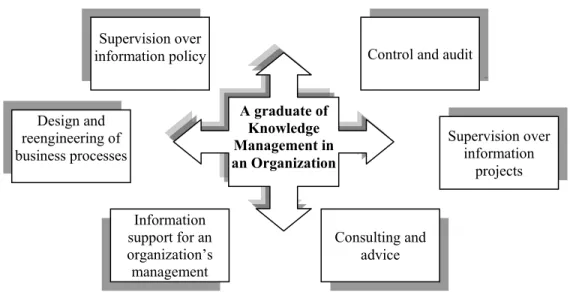
Such competences are nowadays indispensable at numerous positions. Students may become high-class managers, advisers, analysts, tax administration controllers and auditors, who are not afraid of new concepts for information technologies management. In addition, they take advan-tage of any benefits these technologies offer. They are prepared to work for enterprises, consult-ing firms, research agencies, business intelligence agencies, banks and financial institutions and public administration offices. For instance, they gain competences in order to (Figure 1):
• manage an organization’s information resources;
• supervise an information policy and manage information in an organization;
• design and carry out reengineering of an organization’s information infrastructure;
• design and carry out reengineering of business processes;
• control and carry out audits of various areas of an organization’s activities;
• supervise information projects within an organization; and
Teaching Curriculum for the Specialization of Knowledge
Management in an Organization
In order to meet the aims of the specialization and achieve the teaching goals, in form of the de-scribed graduates’ competences, students’ education is based on the main thematic modules, such as:
• knowledge-based economy and information society;
• e-business strategies and models;
• information support for business processes using ERP software; and
• data analyses and information audit using IT tools.
The courses provided within these thematic modules are listed in Table 6 and described below (the academic year is divided into two semesters in Poland).
Table 6: Teaching curriculum for the specialization of
Knowledge Management in an Organization
No. of hours/a semester
No. Course class lecture Credits Completion Seme-ster Bachelor’s degree studies
1. Management of information re-sources in a knowledge-based or-ganization
30 30 5 final grade/ exam 3 2. Information collection methods and techniques 30 30 5 final grade/ exam 4 3. Information technology support for business processes 30 30 5 final grade/ exam 5 4. Use of the Internet in knowledge-based economy 30 30 5 final grade/ exam 5 5. Information processing methods 30 30 5 final grade/ exam 5 6. Business intelligence 30 30 5 final grade/ exam 6 7. Information technologies in knowl-edge management 30 30 5 final grade/ exam 6
A graduate of Knowledge Management in an Organization
Control and audit
Supervision over information projects Supervision over information policy Design and reengineering of business processes Information support for an organization’s management Consulting and advice
Figure 1. A place occupied by a graduate of
Master’s degree studies
1. Customer relationship management 30 30 6 final grade/ exam 3 2. Audit of information resources 30 30 6 final grade/ exam 3
3. Corporate portals for knowledge-based organization -- 30 4 final grade 4 4. Security and protection of informa-tion resources -- 30 4 final grade 4
The presented courses are obligatory for students who attend this specialization. Furthermore, students are obliged to complete so-called “optional” courses. Every student has to complete courses within this group by attending the total of 360 hours at the Bachelor’s level and 180 hours at the Master’s level. Students may be offered the following courses to choose from:
• Communication on the Internet (Bachelor’s degree studies);
• On-line information search systems (Bachelor’s degree studies);
• Trade and electronic markets (Bachelor’s degree studies);
• Business intelligence using computer tools (Bachelor’s degree studies);
• On-line business portals (Bachelor’s degree studies);
• E-business strategies and models (Master’s degree studies);
• Simulations and computer decision-making games (Master’s degree studies); and
• Information project management (Master’s degree studies).
Description of Degree Courses and Their Aims
Management of information resources in a knowledge-based
organization
The subject allows students to get acquainted with the issues of knowledge-based organizations, knowledge management and an organization’s competences related to knowledge management. Students obtain practical skills, allowing them to use the selected information technologies and systems (the Internet, databases, data warehouses) in knowledge management. They learn how to use knowledge when making strategic, tactical and operational decisions.
Information collection methods and techniques
The aim of the subject is to provide students with the knowledge of most modern methods and techniques for collection of information, which are required for decision-making processes. Stu-dents learn how to: diagnose decision-makers’ information needs, identify information sources and holders, select information search sources and methods (primary and secondary ones), collect information and prepare collected data for analyses (databases).
Information technology support for business processes
Students get acquainted with the notion and applications of process management and gain practi-cal skills, allowing them to carry out business processes using integrated information systems of ERP (Enterprise Resources Planning). They use different management information systems, made by such companies as SAP, SAS etc.
Use of the Internet in knowledge-based economy
The aim of the subject is to make students acquainted with the opportunities offered by the Inter-net in knowledge-based organizations. Students learn how to select and evaluate online
technolo-gies, used to manage knowledge in an organization. They get familiar with the issues of planning, design and use of online applications.
Information processing methods
Students learn about information processing methods, which are applicable to data from primary and secondary sources of information. A significant part of classes are devoted to SPSS software. The acquired knowledge and practical skills prove useful, in particular at analysts’ positions in organizations.
Business intelligence
The subject introduces students to the issues of business intelligence, including data analyses and exploration. Students learn how to use various information techniques and tools, e.g. SAS, ACL tools, in order to carry out business intelligence. In small teams, they work out approaches and rules for monitoring of a company and its environment.
Information technologies in knowledge management
Students get familiar with the processes of selection and introduction of information technologies and systems, designed for knowledge management, into organizations. In their project teams, they work out model strategies for the use and implementation of various IT solutions and adjust them to the needs of a given organization, a specific market or customers.
Customer relationship management
Students get familiar with the notion of customer relationship management. A significant part of classes are devoted to information systems, which are used to support customer relationship man-agement, and their practical applications. Many tasks are performed using the different CRM sys-tems. Students learn how to liaise and cooperate with customers with the help of different IT tools.
Audit of information resources
The aim of the subject is to familiarise students with the concept and types of audits, as well as the techniques used to perform them. Students learn how to identify an organization’s information resources, in order to effectively and smoothly perform an audit and analyse various types of data. They verify the theoretical audit issues in practice, by using ACL tools to analyse financial, freight forwarding and sales processes etc.
Corporate portals for a knowledge-based organization
The subject introduces students to the issues of corporate portal functionality and design in knowledge-based organizations. Students analyse practical examples of corporate portals and their applications in companies. The acquired knowledge and skills are used when designing of a corporate portal for a selected organization.
Security and protection of information resources
Students get familiar with threats, safety and protection of information resources, in particular, the e-business environment.The subject focuses on ensuring safety of information, IT equipment and software, as well as data transmission. Students learn about the aspects of knowledge-based economy. They learn how to establish a safety policy in a company. In their project teams, they work out rules and procedures for protecting information for selected organizations.
Conclusions
The developed concept of the specialization, Knowledge Management in an Organization, en-ables students to acquire knowledge and competences which are increasingly sought by organiza-tions and future employers. The specialization is targeted at meeting the assumporganiza-tions underlying knowledge-based organizations. As the curriculum is not specific for the situation in Silesia, in Poland, it, therefore, might be applicable to any universities in the world.
The empirical research conducted in the selected companies, which involved, first of all, finding out their expectations and competences related to knowledge management, had a big impact on the contents of the specialization. Lectures and classes are grouped in four modules: (1) knowl-edge-based economy and information society, (2) e-business strategies and models, (3) informa-tion technology support for business processes using ERP software, (4) data analyses and infor-mation audits using ACL tools. In should be emphasized that some courses are to be conducted together with business practitioners. The future aim for students is also to complete some of these modules, receiving appropriate certificates confirming their skills.
For the authors of the specialization of Knowledge Management in an Organization, the academic year of 2010/2011 means promotional activities, aimed at the dissemination of the new educa-tional offer, as well as enrolment activities. In the future it is also planned to start post-graduate studies and address the offer to various companies.
References
Awad, E. M., & Ghaziri, H. M. (2004). Knowledge management. New Jersey: Prentice Hall.
Backhouse, J., Liebenau, J., & Land, F. (1991). On the discipline of information systems: Conflict in the trenches. Journal of Information Systems, 1, 19-27.
Bell, D. (1973). The coming of post-industrial society: A venture in social forecasting. New York: Basic Books.
Davenport, T. H., & Prusak, L. (1998). Working knowledge. How organizations manage what they know. Boston: Harvard Business School Press.
Davydow, M. (2000). The second wave of EIP. Intelligent Enterprise, 3(4).
Gabberty, J. W., & Thomas J. D. E. (2007). Driving creativity: Extending knowledge management into the multinational corporation. Interdisciplinary Journal of Information, Knowledge, and Management, 2,
1-15. Retrieved October 30, 2009, from
.
Ignizio, J. (1991). Introduction to expert systems.
Johannessen, J. A., Olaisen, J., & Olsen, B. (2001). Mismanagement of tacit knowledge: The importance of tacit knowledge, the danger of information technology, and what to do about it. International Journal
of Information Management, 21(1).
Kirikowa, M., & Grundspenkis, J. (2000). Using knowledge distribution in requirements engineering. In C.T. Leondes (Ed.), Knowledge based systems, techniques and application (Vol. 1). San Diego: Aca-demic Press.
Liebowitz, J. (2000). Building organizational intelligence: a knowledge management primer. Florida: CRC Press.
Markkula, M. (2006). Creating favourable conditions for knowledge society through knowledge
manage-ment, eGovernance and eLearning. International Federation of Surveyors. Retrieved November 22,
2009, from
Nonaka, I., & Takeuchi, H. (1995). Knowledge creating organizations. New York: Oxford University Press.
Olszak, C. M., & Ziemba, E. (2003). Business intelligence as a key to management of an enterprise. In E. Cohen, & E. Boyd(Eds.), The Proceedings of Informing Science and IT Education Joint Conference
InSITE’2003. Pori: The Informing Science Institute & Tampere University of Technology. Retrieved
October 30, 2009, from
.
Olszak, C. M., & Ziemba, E. (2008a). Communities of practice in knowledge management and organiza-tional learning. In F. Burstein, G. Johanson, & H. Thompson (Eds.), The Proceedings of the 11th An-nual Australian Conference on Knowledge Management and Intelligent Decision Support -
ACK-MIDS08. Melbourne: The Monash University.
Olszak, C. M., & Ziemba, E. (2008b). A conceptual model of ICT for intellectual capital management. In J. Korczak, H. Dudycz, & M. Dyczkowski (Eds.), Management advanced information technologies for
management. Wroclaw: Publishing House of the University of Economics.
Sarvary, M. (1999). Knowledge management and competition in the consulting industry. California
Man-agement Review, 41.
Tiwana, A. (2000). The knowledge management toolkit. New Jersey: Prentice Hall. Toffler, A. (1980). The third wave. New York: Bantam Books.
Knowledge systems and Prolog:
Develop-ing expert, database and natural language systems. Massachusetts: Addison-Wesley.
WinklerK., & Mandl, H. (2007). Implementation of knowledge management in organizations. , 1(1). Retrieved November 30, 2009, from
Biographies
Celina M. Olszak is a Professor of Management Information Systems at University of Economics in Katowice Poland. She is Chair of the Department of Business Informatics and Vice-Dean in Charge of Re-search at the Faculty of Economics. She was scholarship holder at Swiss Federal Institute of Technology in Zurich, Switzerland and scholarship holder of Deutsche Akademische Austausch Dienst at Trier University in Germany.
She has published numerous articles in the areas of information sys-tems, decision support syssys-tems, systems development strategies. Her current research interests include knowledge management, Business Intelligence Systems, e-business and information society. She is a member of Informing Science Institute in California, USA.
Ewa Ziemba is a Professor of Management Information Systems at the University of Economics in Katowice, Poland. She is an author of numerous articles published in journals, conference proceedings and as book chapters. She has written three books on e-business systems, web designing and corporate portals for knowledge management. Her cur-rent research concentrates mostly on information systems development methodologies, e-business and information society, information sys-tems for knowledge management, especially designing corporate por-tals for knowledge-based organizations.
She has participated in several European research project relating to e-business systems and e-learning. Her academic qualifications have been combined with practical experience – she has been working as the IT Project Manager for over ten years. Furthermore, she is a member of Informing Science Insti-tute in California, USA.