in Software Defined Networks
Controller
By
Seyed Mohammad Mousavi
A thesis submitted to the Faculty of Graduate and Postdoctoral Affairs in partial fulfillment of the requirements for the degree of
Master of Applied Science
in
Electrical and Computer Engineering
Carleton University
Ottawa, Ontario
©2014
ii
the Faculty of Graduate and Postdoctoral Affairs acceptance of the thesis
Early Detection of DDoS Attacks
in Software Defined Networks
Controller
Submitted bySeyed Mohammad Mousavi
in partial fulfillment of the requirements for the degree of Master of Applied Science in Electrical and Computer Engineering
Chair, Roshdy Hafez, Department of Systems and Computer Engineering
Thesis Supervisor, Prof. Marc St-Hilaire
Carleton University May 2014
iii
Software Defined Networks (SDN) is a new network architecture that provides central control over the network. This control works as if it is an operating system that can send instructions and apply changes through its interface. This operating system is called the controller. Although central control is the major advantage of SDN, it is also a single point of failure if it is made unreachable by a Distributed Denial of Service Attack (DDoS).
Two main objectives of this study are utilizing the central control of SDN for attack detection and, proposing a solution that is effective and lightweight in terms of the resources that it uses.
This research shows how DDoS attacks can exhaust controller resources and provides a solution to detect such attacks based on entropy variation of destination IP address. This method is able to detect DDoS within the first five hundred packets of the attack traffic.
iv
First I thank GOD the almighty for helping me along the way giving me the strength to work on this research.
I would like to thank Prof. Marc St-Hilaire. He was the first to introduce the topic of this research and he supported me with his advice, supervision and support.
v
Acknowledgements ... iv
Table of Contents ...v
List of Tables ... vii
List of Figures ... viii
List of Appendixes ... ix
List of Acronyms ...x
Chapter 1 ... 1
Introduction ... 1
1.1 Problem Statement and Motivation... 1
1.2 Research Objectives ... 4
1.3 Research Contributions ... 4
1.4 Thesis Organization ... 5
Chapter 2 ... 6
Background and Related Work ... 6
2.1 Software Defined Networks ... 6
2.2 Openflow Protocol ... 7
2.3 Openflow Specifications ... 8
2.3.1 Openflow Switch ... 8
2.3.2 Secure Channel ... 11
2.4 Distributed Denial of Service Attack and its Mitigation ... 12
2.4.1 Types of DDoS Attacks... 12
2.4.2 Anomaly Detection for DDoS Mitigation ... 15
2.4.3 Types of Anomaly Detection Techniques ... 15
2.5 Effect of DDoS on Openflow Controller ... 17
2.5.1 Openflow Controller Performance ... 18
2.5.2 Openflow Controller for the Cloud ... 19
2.5.3 DDoS Mitigation in Openflow Networks ... 19
2.6 Entropy for DDoS Detection ... 24
2.7 Concluding Remarks ... 25
Chapter 3 ... 26
Early Detection of DDoS Using Entropy ... 26
3.1 Introduction ... 26
3.2 A Measure of Randomness ... 26
3.2.1 Why Entropy?... 27
3.3 Short-term Statistics for Early Detection ... 28
3.4 Early Detection in Openflow Controller ... 31
vi
Simulation and Results ... 39
4.1 Controller ... 39 4.2 Network Emulator ... 39 4.2 Packet Generation ... 40 4.3 Network Setup ... 40 4.4 Choosing a Threshold ... 42 4.5 Test Cases ... 43
4.5.1 Attack on One Host ... 45
4.5.2 Attack on a Subnet ... 48
4.6 Effects of the Added Functions on Resource Usage ... 51
4.7 Summary of the Results ... 53
Chapter 5 ... 55
Conclusion and Future Work ... 55
5.1 Conclusion ... 55
5.2 Future work ... 56
Bibliography ... 58
vii
TABLE 3.1 ENTROPY OF DIFFERENT WINDOW SIZES [33] ... 28
TABLE 3.2 WINDOW SIZE COMPARISON ... 29
TABLE 3.3 COMPARISON OF FIVE WINDOWS ... 30
TABLE 4.1 THRESHOLD VALUE CALCULATION ... 43
TABLE 4.2 ATTACK TRAFFIC PROFILE ... 44
TABLE 4.3 ENTROPIES OF TEST CASES ... 49
viii
FIGURE 1.1 SAMPLE ATTACK ON THE CONTROLLER ... 2
FIGURE 2.1 SDN STRUCTURE [1] ... 7
FIGURE 2.2 A SIMPLE NETWORK WITH AN OPENFLOW SWITCH ... 7
FIGURE 2.3 FLOW ENTRY PROCESS ... 10
FIGURE 2.4 DDOS ATTACK COMPONENTS ... 13
FIGURE 2.5 ATTACK ROUTE IN SOM DDOS DETECTION [25] ... 20
FIGURE 2.6 USING OPENFLOW FOR MONITORING NETWORK SECURITY [27] ... 22
FIGURE 2.7 TWO CONTROLLERS FOR RESILIENCY IN OPENFLOW [31] ... 22
FIGURE 2.8 EVENT BASED INTRUSION DETECTION DESIGN FOR SDN [32] ... 23
FIGURE 3.1 DDOS DETECTION FLOWCHART ... 34
FIGURE 3.2 LISTS ADDED TO THE CONTROLLER ... 35
FIGURE 3.3 FUNCTION TO COLLECT DESTINATION IP ADDRESS STATS ... 35
FIGURE 3.4 ENTROPY COMPUTATION FUNCTION ... 36
FIGURE 4.1 EXPERIMENT NETWORK WITH 9 SWITCHES AND 64 HOSTS ... 41
FIGURE 4.2 SUDDEN INCREASE OF TRAFFIC IN DDOS ... 45
FIGURE 4.3 25% RATE ATTACK ON ONE HOST ... 46
FIGURE 4.4 50% RATE ATTACK ON ONE HOST ... 47
FIGURE 4.5 75% RATE ATTACK ON ONE HOST ... 47
FIGURE 4.6 50% RATE ATTACK ON FOUR HOSTS ... 48
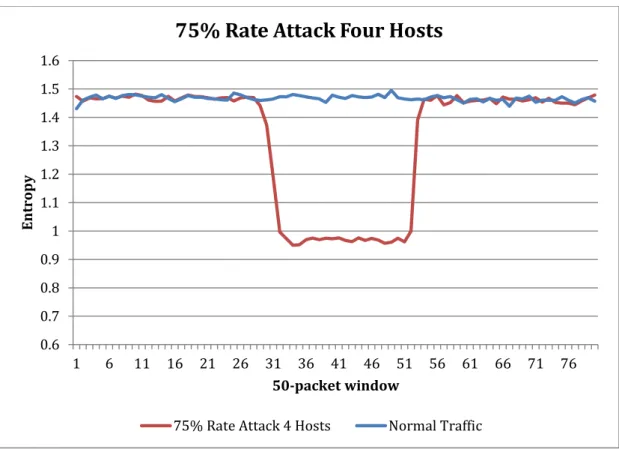
FIGURE 4.7 75% RATE ATTACK ON FOUR HOSTS ... 49
FIGURE 4.8 COMPARISON OF ENTROPY DROP, ONE HOST ... 50
FIGURE 4.9 COMPARISON OF ENTROPY DROP, FOUR HOSTS ... 50
FIGURE 4.10 CPU USAGE WITH NO DDOS DETECTION ... 52
ix
APPENDIX A: STATISTICS COLLECTION AND ENTROPY COMPUTATION CODE ... 62
APPENDIX B: NORMAL TRAFFIC GENERATION CODE ... 64
APPENDIX C: ATTACK TRAFFIC GENERATION CODE ... 66
x
DDoS Distributed Denial of Service
DNS Domain Name System
DoS Denial of Service
GAU Gaussian Classifier
HTTP Hypertext Transfer Protocol
ICMP Internet Control Message Protocol
IP Internet Protocol
MLP Multilayer Perception
NIDS Network Intrusion Detection System
OVS Open Virtual Switch
SDN Software Defined Networks
SOM Self-Organizing Maps
TCP Transmission Control Protocol
TLS Transport Layer Security
UDP User Datagram Protocol
Chapter 1
Introduction
This chapter will first cover the problem statement by looking at the threat of Distributed Denial of Service Attack (DDoS) in SDN architecture. Then, our motivation and the research objectives will be discussed. Finally, the contributions of this research are outlined followed by the thesis organization.
1.1 Problem Statement and Motivation
The idea of Software Defined Network architecture is a new and novel way of network management. In SDN, switches do not process incoming packets. They look for a match of the incoming packet in their forwarding tables and if there is none, it will be sent to the controller for processing. The controller is the operating system of SDN. It processes the packets and decides whether the packet will be forwarded in the switch or will be dropped. By applying this procedure, SDN separates the forwarding and processing planes.
SDN architecture can be a network of several controllers each of which is connected to a network of switches. Each of these networks and its controller can be seen as slice of the network. We are focusing on each of these slices to protect it against DDoS. If the connection between the switches and the controller is lost, the network will lose its processing plane. That means packet processing is no longer done in the controller and by losing the controller, the SDN architecture is lost.
One of the possibilities that can cause the controller to be unreachable is a DDoS attack. In DDoS attacks, a large number of packets are sent to a host or a group of hosts in a network. If the source addresses of the incoming packets are spoofed, which thery usually are, the switch will not find a match and has to forward the packet to the controller. The collection of legitimate and the DDoS spoofed packets can bind the resources of the controller into continuous processing that exhausts them. This will
make the controller unreachable for the newly arrived legitimate packets and may bring the controller down causing the loss of the SDN architecture. Even if there is a backup controller, it has to face the same challenge.
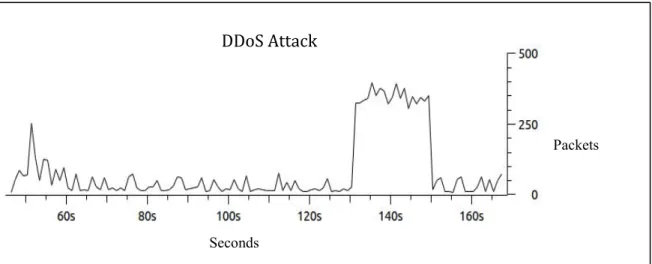
The main goal of this research is detecting a DDoS attack in its early stages. The term early depends on the network itself. Since the controller software can be run on a laptop or a powerful desktop, the term early would depend on the tolerance of the device and traffic properties. However, if the detection happens in the first few hundred packets, the mitigation is applied before the controller is completely swamped with the large number of malicious packets. Figure 1.1 shows a simple DDoS attack on the controller where the normal incoming packet rate is around100 packets per second. When the attack happens, the rate rises sharply to, approximately, 250 packets per second. The simulated DDoS attack was directed to a SDN controller that is connected to a network with 64 hosts and nine switches. The attack lasted for 40 seconds and sent 500 packets with spoofed source addresses all destined for one host. For the purpose of this research, all packets will have spoofed IP addresses. This way, the switches do not have a match and all the packets are sent to the controller. The network operating system and its persistent performance is the center of attention in this work.
One of the main objectives of this research is detecting the attack at the start of its launch. An ideal place for detection is where the blue line is shown in the Figure 1.1.
!
If DDoS is detected at this point, any mitigation techniques that follow, have enough time to secure the controller before it is overwhelmed by the attack and becomes unreachable.
To accomplish this goal, a fast and effective method is needed that works within the controller. At the same time, it must be lightweight to avoid excessive processing power usage, specially, at the peak of an attack.
Collecting statistics is one of the functions of the controller. In this study, this attribute is used for adding another set of statistics collection to the controller; destination IP addresses. In this research, we used IP address but SDN allows for any fields of the packet header to be collected.
In our solution, randomness of the incoming packets is measured. A good measure of randomness is entropy. Entropy measures the probability of an event happening with respect to the total number of events. For instance, in a network of 64 hosts, all hosts should have a reasonably close probability of receiving new incoming packets. This will results in, reasonably, high entropy. New packet, in the sense that there is no flow for it in the switch table and it has to be sent to the controller to be validated for a new flow. If one or a number of hosts starts to receive excessive incoming packets, the randomness decreases and entropy drops. This research makes use of this property of entropy to detect an attack at its early stages. Based on the tests that are done in this research, we choose a threshold for entropy and lower values will be considered as attacks. Being programmable is one of the major advantages of SDN. Any time the network configuration changes, the threshold can be adjusted. And, it can be adjusted while the network is running live traffic so there is no restriction. Depending on the network, the entropy can be of the destination IP address, VLAN tag, destination port or any other applicable field. If it is lower than the set threshold, it will be considered an attack.
The solution is, partially, based on a paper on DDoS detection proposed by Oshima et al. [33] where a small window of 50 packets is used to calculate the entropy of incoming packets. The paper is not done for SDN networks but considering the crucial role that controller has in SDN, short-term statistics with smaller windows are
ideal for SDN. This is due to the fact that the controller only processes the new incoming packets not the entire traffic. The method and calculation of the entropy will be further examined in Chapter 3 of the thesis.
1.2 Research Objectives
In this research, we studied SDN to find possible weak points with respect to DDoS attacks. This study led to the controller. We found that the controller is the weak link in a DDoS attack scenario. With protecting the controller in mind, we studied different methods in DDoS detection that could be used in the controller. However, the structure of SDN posed its limitation on the type of the solution and the way it was implemented. These limitations were:
i) Limited resources of the controller.
ii) The need to detect the attack before the controller is out of reach due to the large number of malicious packets.
The main objectives are:
a) To Find the weak link in SDN when DDoS happens.
b) Find a solution to detect DDoS in SDN before it overwhelms the controller.
1.3 Research Contributions
In this research, we were able to find the weak point of the SDN when a DDoS attack happens and, propose a solution that is, specifically, tailored for SDN.
The main contribution of this research is to show how DDoS can bind controller resource into processing malicious packets and add a DDoS detection mechanism to SDN controller. The contributions are as follows:
a) Show how DDoS attack can overwhelm the controller in SDN architecture. b) Propose a lightweight and simple DDoS detection mechanism based on
entropy, in order to protect the controller.
c) Implement the proposed mechanism using Mininet [39].
1.4 Thesis Organization
The thesis is structured in the following order:
Chaper 2 covers an overview of SDN and its components followed by DDoS attacks and their detection and mitigation techniques. Later, the effects of DDoS attacks and their effects on the controller will be discussed. At the last parte of the chapter, literature related to DDoS detection and mitigation in SDN will be covered.
Chapter 3 will examine the proposed solution for DDoS detection in the controller and compare it to other methods.
Chapter 4 presents the procedure of setting the experiment and experimental results of the solution.
Chapter 5 is the conclusion of the thesis. It presents an overview of the proposed method and the results obtained from simulation. Limitations of the solution and future work are also outlined.
Chapter 2
Background and Related Work
This chapter will first cover the background of Software Defined Networks, the Openflow protocol and its specification. In addition, it will cover DDoS and its detection techniques in non-SDN networks. Lastly, the SDN security related literature will be reviewed.
2.1 Software Defined Networks
Software Defined Network is a different way of looking at networks. The main purpose is greater control over network assets. In current production networks, both control and forwarding actions are configured in the hardware by vendors, and they are, mostly, proprietary software. The SDN architecture separates control plane and forwarding plane and allows network admins to take over the control plane [1]. This separation is done by restructuring the network so the switch will receive instructions for forwarding instead of using its resources for processing the incoming packets. The switch will contain tables with flows that instruct forwarding. Openflow is the protocol that orchestrates the SDN architecture. This architecture consists of Openflow enabled switches, a controller and a secure channel between the controller and switches. Figure 2.1 shows different layers of SDN structure. The application layer will have a single view of the network through the control layer and the whole system looks like one logical switch. The control layer is where the controller abstracts the network infrastructure from the application layer. By using the control layer, any configurations and modifications can be done in real-time. In the infrastructure layer, there is no need for each device to learn different protocols and the only task left is forwarding. The Open Networking Foundation is the main organization that promotes the adoption of SDN, works with several vendors, and has different groups that are working on Openflow specification [1].
2.2 Openflow Protocol
The Openflow protocol can be considered as the workhorse of SDN. It manages the switches in the network and allows an external entity like the controller to manipulate the flow of packets through the network. Openflow was designed as a tool focused on network research [2].
However, in recent years, several vendors started to offer their Openflow-enabled switches [3]. All switches have tables showing the ingress and egress paths of a packet for that switch. Openflow makes use of this property and makes these tables accessible by the controller. An Openflow switch will receive its flow table entries and deletion from the controller through a secure channel. A simple network is shown in Figure 2.2. " # %!%"! … !"!!"! … … " !"! %"2,2#!$' "'$! '#'$ %"2,1#$"%$%".1/
When a new packet arrives to an Openflow switch, it will look into the flow table to find a match. If there is no match in the table, the packet will be sent to the controller. The controller processes the packet and marks the packet with an action like:
Add a new flow for similar incoming packets Drop similar packets
Tag with a queue ID
2.3 Openflow Specifications
Lookup, matching, forwarding and requesting action from the controller are all done based on the Openflow specification that is published by the Open Networking Foundation. In this work, version 1.0 [1] has been used. Version 1.0 was the first set suitable for production networks. From time to time, version 1.3 specifications will be referenced for the new features. This section will cover the main areas of the specifications related to the topic of this research without dwelling in too many details.
2.3.1 Openflow Switch
An Openflow switch consists of a flow table or a group of them and a secure channel to the controller. Each table has a match field, counters, and a set of instructions for every entry. The matching process in the switch covers different fields of the packets' header. Table 2.1 shows the fields that a switch can use to find a match in its tables. In the table, there is a metadata field that is defined (second row in Table 2.1) as a maskable register to carry information from one table to the other when there is more than one table. It is a mean to carry header information from one table to the other. Often switches have multiple tables that are pipelined. The packet will move from one table to the other for a match and carry the metadata. If a match is found, the metadata tag will be updated accordingly.
Any packets entering the switch will be checked against all existing flows in the tables. If a match is found, the action assigned to that entry is applied and the counter
for the entry will be updated. Counters cover a number of components in the switch like counters per flow entry, per table, per port, per queue and other areas.
For instance, duration refers to the amount of time a flow spends in the table. The counters are all wrap around with no overflow. The controller can and will poll some of these counters for different reasons. It is worth mentioning that not all counters will be used because controllers are developed or configured to match the needs of the vendor. In version 1.3 counters can be disabled.
If a match is not found, the packet will be sent to the controller. In version 1.3 of the specifications, if there is no field that can be matched, the packet will be dropped. Since its header does not have any of the field mentioned in Table 2.1, it will be considered an invalid or illegal packet. Our solution works with IP address which exists in the table.
Table 2.1 Packet header match fields
Header Field Ingress Port Metadata Ether src Ether dst Ether type VLAN id VLAN priority MPLS label MPLS traffic class IPv4 src IPv4 dst
IPv4 proto / ARP opcode IPv4 ToS bits
TCP / UDP/ SCTP src port ICMP Type
TCP / UDP / SCTP dst ICMP code
New packets can be sent as a whole to the controller or the switch can buffer the payload and send only the header. The latter is the default mode.
When a packet is sent to the controller, it will be encapsulated and marked as OFPT_PACKET_IN message. We will refer to it as Packet_In. Considering the number of switches, time of day, length of packet, priority and other factors, the controller has to process these packets and send a response with an action to deal with that packet and the packets coming after from the same source. This is the point where the processing will be completely handled by the controller and the switch will only cover the forwarding.
There is a set of actions that the controller will send to the switch; forward, drop, push in a queue, quality of service and modifying a field, i.e., modifying VLAN tag, MAC address or IP address. The main actions, also called required actions, are forward and drop while queuing and modify fields are optional. The action is set for the packet in the controller and then sent back to the switch through Packet_Out message.
Yes No Packet_Out Packet_In %" $ Y " " "+ !#"! "" "#" &#"" "!" #" ! %#!# "") % %"2,3 '$")!" ##
Figure 2.3 shows the process of flow entry. If a packet is marked with drop action, a flow entry will be added. Any packet matching that flow will be dropped. If a flow does not receive packets, the flow entry will time out and it will be removed from the table after some time.
2.3.2 Secure Channel
A brief look at the specification of Openflow shows the single point where the forwarding plane and control plane are connected. It is the secure channel between the controller and the switch. If the connection to the controller is lost, a pure Openflow switch will not be able to deal with unknown incoming packets.
The secure channel is the lifeline of all Openflow switches in SDN. It is a TLS or TCP connection established between the controller and the switch. If the connection is lost, the switch will try to connect to a backup controller if there is one. This is the “fail secure mode” and all packets to the controller will be dropped.
In an Openflow switch, all new packets will be processed in the switch and will not be sent to the controller. If the switch is capable of working both in SDN and in none SDN then, it is called Hybrid switch. In this case, the switch will not follow the Openflow protocol and the network loses its SDN architecture.
The Openflow specification shows that without a controller in the network, we are dealing with a non-SDN network with no central control or separation of forwarding and control plane. This section shows the importance of detecting any threat that can make the controller unreachable.
2.4 Distributed Denial of Service Attack and its Mitigation
The Distributed Denial of Service (DDoS) attack is a well-known malicious attempt to exhaust the resources of a computer or a network of computers by sending heavy traffic to them [4]. The two main goals of the attacker are:
i) Bandwidth depletion.
ii) Resource exhaustion [5].
DDoS attack starts from an attacker planting a code in compromised PCs which are referred to as Botnet. At the time of the attack, these codes are run and a stream of traffic is directed towards the victim. A more sophisticated attack uses a thin layer of compromised PCs called handler to control a larger number of PCs called zombie hosts. The zombie hosts are responsible for generating the attack traffic [5]. Using botnets makes the attack more concentrated and keeps the perpetrator hidden behind the scene.
DDoS is one of the most common methods of overloading and disrupting service in a network. Each day, hackers launch more than 7000 such attacks and, statistics show that in the first quarter of 2013 average attack bandwidth reached 48.25 Gbps which is 718% higher than the last quarter of 2012 [6]. From May 2013 to Sep 2013, United States and China have suffered significant daily attacks. Google’s Digital Attack Map, captures these attacks in its website [7]. Not all attacks can be detected or documented but looking at the numbers, it is an imminent danger for every network. Figure 2.4 shows a simple example of DDoS Attack route.
2.4.1 Types of DDoS Attacks
Launching any attack requires an access to machines in the subnet of the victim to be used as zombies. Hackers use scanning to find vulnerable computers in the network. Scanning can be random, based on a hit list, local subnet scanning or based on an algorithm designed by the hacker [8].
The attacks can be categorized as application, host, resource, network and
infrastructure attacks [8].
1. Application: targeting an application on a host to deny legitimate use. 2. Host: making a host unreachable.
3. Resource: overwhelming a server to keep it bound to the continuous stream of fake requests.
4. Network: sending a large volume of traffic to a network to exhaust the bandwidth.
5. Infrastructure: simultaneously targeting a domain name server in different places. A few types of DDoS have been very frequent in recent years. The pattern of attacks shows that hacker have been using certain types of methods for launching attacks [6] [7]. Some of these methods will be looked at next.
Goolge and Arbor networks have dedicated a website that follows the attacks and collects statistics from all over the world [7]. The statistics show the type of attacks, duration of attacks, bandwidth used, mostly used source and destination ports, origin of attack and the victim’s country. The following paragraphs describe different types of attack. " " !' Î ' Î … … … %"2,4 $$ ! $#
1. UDP Flood is a type of attack that sends a large number of packets to random ports in the victim's machine causing the machine to look for applications on these ports. The machine has to send Destination Unreachable packets in response for each incoming packet. As the number of incoming packets increases, the delay increases and, eventually, the machine will be inaccessible.
2. SYN Flood is an attack using TCP connection initiation for targeting the victim's machine. Several SYN packets are sent to the victim but no ACK is returned to the victim causing the resources to be used up waiting for acknowledgement from the attacker. TCP Flood was the highest detected attack up to mid 2013 with 38.7% of perpetrated attacks [9].
3. DNS Reflection attack is sending spoofed IPs and asking for a response that is much larger than the request and directing it to the victim. The attacker changes the source IP address to the victim's IP and causes a heavy traffic to be directed to the victim. Spoofing packets is a common practice for DDoS attackers.
4. HTTP Flood consists in sending a huge number of requests to a server and overwhelming it to the point where it cannot respond to legitimate requests. This was the second highest type of attack with 37.2% [9].
5. ICMP Flood is another type of attack that exhausts the resources of the victim by sending a very large number of ICMP pings (echo request), which keeps the server bound in sending responses (echo replies).
The common factor in all of these attacks is pushing heavy traffic into the victim's network and exhausting its resources. The detection and mitigation of these heavy flows in current conventional networks will contribute to a better understanding of their effect on the SDN architecture.
2.4.2 Anomaly Detection for DDoS Mitigation
The common factor in different types of DDoS attack is the abnormal traffic sent to the victim. In normal circumstances, there is a pattern in the network activity and an accepted rate of bandwidth consumption. If there is a sudden increase in traffic, delay, CPU utilization, or sudden drop in performance of any of the network assets, this, often, will be considered abnormal. Any DDoS detection will be looking for such abnormalities in the network. In general, anomalies are related to the nature of data in the network [10]. The attack can be directed to the network layer to cause a bottleneck or an application layer type causing CPU resources exhaustion. Understanding the type of data and its characteristics in the network is the first step to detecting anomalies. These characteristics can be packet header information, delay, packet size, protocol, etc. For instance, in a server that responds to TCP SYN requests, attacks are, most likely, TCP SYN request flooding. And, this is where anomaly detection is likely to occur. In fact, the characteristics of the network dictate the type of intrusion. If a network is susceptible to a certain type of threat, then detection and mitigation of the threat has to be matched to it.
2.4.3 Types of Anomaly Detection Techniques
In IP networks, there is a certain bandwidth and certain processing power for carrying traffic. When some attributes of the network are subjected to statistical analysis, for each attribute a pattern will appear. The longer the time, the more reliable is the pattern. However, this is only true if the network has a steady traffic all the time. If there are variations that are accepted as normal traffic, in the long run, the statistics will stabilize and cannot be considered completely reliable.
Data collection, filtering and processing for anomaly detection are approached by a variety of techniques. Statistical analyses and machine learning are two of the common methods of anomaly detection.
1. Statistical analyses, like Entropy and Chi-Square techniques, have been suggested for detecting change in network traffic [11].
Entropy represents packet headers as independent information symbols with unique probability of occurrence. It is a common method for DDoS detection [12] [13] [14]. By selecting a window of some number, 10,000 for instance, and moving the window forward, a pattern will emerge with probabilities for each type of packet header. Drastic changes in the bins of each header that deviates from the average bin limits will alert the system of anomalies. This method will be explored further in the next chapter to examine its potential use in SDN.
If a certain type of intrusion is expected and the type of packet header is known, then Chi-Square is a better model. For instance, if TCP SYN flood is the expected type of attack, then sampling bin of data and measuring the number of TCP SYN headers will show a pattern of the average number of such headers. Any deviation beyond the recognized limits is assumed abnormal.
Equation 2.1 shows Chi-Square equation. Niis the number of packets for one
sample and ni is the expected number of packets in normal circumstance. The value of targeted packets per bin is updated as times passes and more samples are taken. B i i i i n n N X 1 2 2 ( ) (2.1)
2. Machine learning and cognitive detection is another method used for defending networks against intrusion. Instead of setting up a fixed filter an algorithm is trained to constantly update its filtering criteria based on the events of the network.
An example of such system is neural networks [15]. Neural networks consist of several nodes working in parallel to process data. They work like human brain. When they are trained or given a large amount of information, the collective knowledge of neurons or nodes develop a pattern for the processing of similar data. Three main layers of neural networks are input, output and hidden layers in the middle to process the input data. As time passes and more data is processed, the nodes are learning more and a clearer pattern emerges. An algorithm is the driving force behind the decision making of these networks. Some common algorithms in network intrusion and anomaly detection are Multilayer Perceptron (MLP), Gaussian Classifier (GAU), K-means Clustering (K-M) and Markov model [16] [17] [18].
In the first chapter, it was mentioned that entropy is the method that is used in this research for implementing a detection method in Openflow controller. Before looking into the entropy literature, the effect of DDoS on SDN and its detection techniques will be reviewed. Later on, entropy detection literature will be discussed.
In the previous sections, the nature of attack, its types and mitigation techniques were briefly covered. A more thorough investigation is beyond the scope of this research as it is more focused on the affect of DDoS on SDN. As a result, the next section will focus on the DDoS in SDN.
Being an ever present danger, DDoS attacks are a real threat to any network, especially, SDN. Being a new structure, and in the process of maturing, there is an opportunity for discovering weak points of the SDN for a better defense against such attacks.
2.5 Effect of DDoS on Openflow Controller
If Openflow is the protocol that is, currently, used for SDN structure, then, the controller is the brain or the operating system of SDN. It can modify network assets and dictate new rules to switches in real-time. However, SDN lifeline to the controller
is the secure channel. Once the secure channel is disconnected, the SDN structure loses its operating system and, in the best case, it has hybrid switches that can fall back to the normal operation mode (i.e. switches doing the processing and forwarding). This single point of failure is the where a DDoS attack can really hurt SDN. The other effect of DDoS attack is the filling of switch flow tables. For every incoming packet, the controller will add a new flow to the table. With a high volume of traffic coming, soon the flow tables will be filled with fake flows.
One serious scenario of DDoS that can directly affect the controller is swamping the controller with Packet_In events. Any new packets that do not have a match in the flow table will be sent to the controller for processing. Most DDoS attacks use spoofed source address, which translates into new incoming packet at the switch. This part is considered one of the advantages of SDN where the control plane is separated and manageable at the controller. It is also the main disadvantage when the number of new incoming packets is greater than the secure channel’s bandwidth and the controller’s processing power.
2.5.1 Openflow Controller Performance
Jarschel et al. [19] have shown that performance of the Openflow architecture is directly related to the processing power of the controller. As the number of new flows increases, the wait time and overall delay in the system rises. One reason for that is the buffering that happens in both the switch and the controller. In the event of any threats, these buffers are a death trap for the whole system. Packet_In events in large numbers fill up the queues. If the incoming events are spoofed packets, they will paralyze the network by limiting the access to legitimate flows.
Cai et al. [20] propose a solution for better performance by parallelism. This method makes use of the multicore feature of new CPUs. Recent CPUs have two, four or more cores. They are called dual or quad core processors. This method utilizes each core of the CPU for processing new packets. The performance improvement is achieved by using a threading program that they called Maestro. When a packet
arrives for processing, Maestro will pull the state of each core and forwards the packet to the idle core. This will reduce the wait time in the buffer for incoming packets.
2.5.2 Openflow Controller for the Cloud
Openflow has been a research topic for cloud networks and datacenters. Some areas of interest are network virtualization based on Openflow [21], resource control [22] and improving data center scalability using Openflow [23].
Cloud networks often deal with geographically distributed hosts. Applying SDN architecture to this type of networking will require a number of controllers to deal with scalability issue.
Bifulco et al. [24] show an example of multi-controller network where a mobile node travels from one network to another and its local network IP address is translated to a fixed IP in the controller. The local IP is called locator and fixed the IP is called identifier. When a connection to the node is requested, its fixed IP address is sent to the switch connecting to the local network. The Fixed IP address is an identifier of the mobile node and the switch can do the translation through a flow in its table. Controllers share the information and fill up switch tables of the network where the mobile node is connected. In this architecture, the mobile node is always known by its fixed IP address.
2.5.3 DDoS Mitigation in Openflow Networks
Production networks have been studied for a long time and the types of threats to them are mostly known. SDN however, is a new architecture and there are not many papers discussing the topic. Existing papers look at DDoS and apply the existing solutions to SDN. This means treating SDN as a normal production network where the role of the controller is ignored. In SDN, the switches have no control over incoming packets and they do not spend any time processing them. This also means, in an attack, the entity affected first and most is the controller.
Braga et al. [25], use Self-organizing Maps (SOM) [26] machine learning technique for DDoS detection. In this method, SOM is trained by collecting the flow statistics from Openflow switches. The parameters that are checked for training SOM are average packet per flow, average bytes per flow, average of duration per flow, percentage of pair flows (i.e. two flows one in switch A and the other in switch B, flow A destination is input port of Flow B), growth of single flow, and growth of single ports. The SOM will improve the statistics of its vectors as time passes and more statistics are gathered.
A look at Figure 2.5 shows the path of a DDoS attack to a host target and nothing goes through the controller. The red line shows the path of attack and NOX [27] is the controller. In a DDoS attack, the packets are always spoofed or coming from several zombie nodes. Hence, the packets have to go through the controller to get access to the target through a flow in the switch table. This case was not covered in this paper.
Other related work in security has been the use of SDN architecture for intrusion detection in cloud networks. Shin et al. [28] use Openflow as a flow regulation tool to monitor traffic in the cloud. The main idea is reconfiguring the flow of packets by using the Openflow protocol so it takes a path where a Network Intrusion Detection System (NIDS) is installed. By deploying the SDN architecture, there is no need to relocate and reinstall NIDS devices. Openflow will process the packets and add flow rules to routers and switches to go through a monitored path. Few algorithms are offered by the paper to find the shortest path for a secure route and each one is categorized by the time it takes for the controller to find it.
In this paper, the SDN controller computes the shortest path to a monitored link in the network and it is not involved in the detection process. A look at Figure 2.6 shows the structure of proposed detection system. In the figure, device and policy manager module contains a list of devices and the security policy of each device. The routing rule generator module first discovers the topology of the network and then collects status and cost information of the network to send it to the controller, NOX in this figure. The flow rule enforcer module is the controller that adds flows in the routers and switches. Network operating system is Openflow and its controller combined. Xing et al. [29] propose adding Openflow to SNORT [30], a common intrusion detection tool for cloud, to reconfigure the network when an attack is detected by SNORT.
Although above examples of cloud intrusion detection were not applied to detect DDoS on the SDN architecture itself, they show the potential of SDN for intrusion detection and mitigation in a complex network like a cloud. The main purpose of this research is to find a way to protect the structure of SDN, in particular, the controller. Fonseca et al. [31] discus the possibility of losing the controller and identify the need for a backup one. The paper proposes a second controller that runs in parallel to the current running controller. If the switches lose connection to the controller, they will look for the second controller, which is added to the configuration of the switch. One of the mentioned scenarios is losing the controller in a DDoS attack. The solution for such situation is to use a machine learning solution like SOM in [25] for attack mitigation while recovery is in process. Figure 2.7 shows running two controllers in parallel. The first controller will continuously send status updates to the backup controller announcing that it is alive. If the first controller goes to an unknown state or becomes unreachable, the second controller will take control and starts running the network normally.
Figure 2.7 Two controllers for resiliency in Openflow [31] Figure 2.6 Using Openflow for Monitoring network security [27]
Hu et al. [32] propose an intrusion detection system that works on top of Openflow and SDN. Figure 2.8 shows the structure of such system. The event processing software is a hyper controller that receives events for sub-controllers and processes them for possible attacks. The event bus in the figure is the link between sub-controllers and the event processor. The method is in the research phase and there are no experimental results.
In [28], SDN was used to discover shortest path and there was no mention of the effect of that attack on the controller itself. In [31], if an attack happens, and the primary controller is unreachable, the attack continues and the backup controller has to face the same problem. The event-based system employs a hyper controller to do the packet processing for the sub-controller. It seems that the events are processed twice in the system. Once when they arrive at the sub-controller and then when they are sent to the event processing engine. This overhead of processing can be removed by applying detection technique at the sub-controller level and mitigation at the hyper controller level.
To the best of our knowledge, there are not many papers discussing the security of SDN and Openflow in the event of an attack. This might be due to the fact that the structure is new and not widely used. The papers that are presented here are the most directly related papers. In fact, to the best of our knowledge, there is no paper addressing the issue of losing the controller in SDN and its solution.
2.6 Entropy for DDoS Detection
Entropy is the method used in this research to detect DDoS attacks in SDN. A look at the used methods in non-SDN networks is necessary before introducing it in SDN. Since there is no research in using this method in SDN, we have to rely on what is done in non-SDN research.
There are two essential components to DDoS detection using entropy; window size and a threshold. Window size is either based on a time period or number of packets. Entropy is calculated within this window to measure uncertainty in the coming packets. To detect an attack, a threshold is needed. If the calculated entropy passes a threshold or is below it, depending on the scheme, an attack is detected.
Qin et al. [12] propose a method with a window of 0.1 seconds and three levels of threshold. This method is concerned with avoiding false positive and false negatives in the network. However, as the authors themselves mention, the method is time consuming and uses more resources.
Ra et al. [13] propose a faster way of computing entropy by basing the calculation on both packet type and the volume of packets in the network. This method also uses a time period window. For the threshold, the authors ran several datasets to find a suitable threshold and it is a multiple of standard deviation of entropy values. In this method, the false negatives are higher than other methods and false positives are lower. No percentage of accuracy is indicated. There is also no mention of resources used for fast computation.
Entropy has been used in different ways to detect DDoS attacks in the network but, to the best of our knowledge, it has not been used in SDN.
In SDN, when passing packets to the controller, the limitation of available resources and the quick detection of attacks are key features of any detection scheme. In this research, we will apply entropy for DDoS detection with the above limitation of the controller in mind.
2.7 Concluding Remarks
In this chapter, it was shown that the operating system of Openflow networks is the controller and losing it means losing the advantages of broad control with SDN. The high frequency of DDoS occurrence will pose a challenge to SDN and it can be focused on just the controller bringing down the operating system. By examining DDoS attack and its mitigation, two main elements of detection stand out:
1. Packet header processing 2. Collecting statistics
At the same time, when looking at the tasks that the controller performs, we see two similar but very important elements:
1. Packet header processing and assigning actions 2. Collecting statistics from the switches
In [28] and [29], Openflow abilities were used for detecting DDoS attack on cloud networks. It seems that Openflow has all the elements that are needed for a successful detection. The next chapter will focus on utilizing these elements for an early detection of DDoS attacks within a SDN environment.
Chapter 3
Early Detection of DDoS Using Entropy
3.1 Introduction
In this chapter, the proposed method for early detection will be explained. Due to the limited resources of the controller, an early detection should be within the first few hundred packets of the attack. First, entropy, its formulas and computation will be discussed. Then, early detection will be examined, followed by our proposed detection method. Finally, the solution will be compared to other DDoS detection schemes.
3.2 A Measure of Randomness
In Chapter 2, we showed the use of entropy for DDoS detection and looked at its main components. Here, we will look at the formulation and computation. The main reason for choosing entropy is its ability to measure randomness in a network. The higher the randomness the higher is the entropy and vice versa.
Let W be a set of data with n elements and x is an event in the set. Then, the probability of x happening in W is shown in Equation 3.2. To measure the entropy, referred to as H, we calculate the probability of all elements in the set and sum that as shown in Equation 3.3. W ={x1,x2,x3,...,xn} (3.1) pi = xi n (3.2) n i i i p p H 1 log (3.3)
The entropy will be at its maximum if all elements have equal probabilities. If an element appears more than others, the entropy will be lower. The size of W is called the window size. If there is a continuous stream of incoming data, in our case the data is packet header, it will be divided into equal sets that are called windows. In the window, each element and its occurrence are counted.
For instance, if the window has 64 elements and, all elements appear only once, the entropy will be 1.80. If one element appears 10 times, the entropy will be 1.64. This property of entropy will be used for calculating the randomness in the SDN controller.
3.2.1 Why Entropy?
When packets arrive at the controller, the source address is always new. This is the reason they come to the controller. There has not been an instance of them in the table of the switch so they are passed on to the controller. It was shown in Chapter 2 that for every new incoming connection, the controller will install a flow in the switch so that the rest of the incoming packets will be directed to the destination without further processing. Hence, any time a packet is seen in the controller, it is new.
The other known fact about the new packets coming to the controller is that the destination host is in the network of the controller. The network consists of the switches and hosts that are connected to it. Knowing the packet is new and the destination is in the network, the level of randomness can be quantified by calculating the entropy based on a window size. The window size is the number of incoming new packets that are used for calculating entropy. In this case, maximum entropy occurs when each packet is destined to exactly one host. Minimum entropy occurs when all the packets in a window are destined for a single host.
Being able to quantify randomness and have minimum and maximum based on entropy makes it a suitable method for DDoS detection is SDN. Using entropy, it is possible to see its value drop when a large number of packets are attacking one host or a subnet of hosts.
In Chapter 2, we saw that machine learning methods needed extensive training to be able to detect anomalies. Also intrusion detection devices for DDoS detection had to be installed on different links in the network. Entropy does not have these limitations.
3.3 Short-term Statistics for Early Detection
Before discussing our solution, we will look at an entropy-based DDoS detection method that is used in a non-SDN network.
Oshima et al. [33] propose a short-term statistics detection method based on entropy computation. “Short-term” here refers to calculating entropy in small size windows. The study proposes a window size of 50 packets for gathering statistics. In this method, different window sizes where tested for optimal entropy measurement. Table 3.1 shows the results of the tests for different window sizes.
In Table 3.1, W is the window size, HNis the entropy in normal condition, HA is entropy during an attack, SNand SA are the standard deviation of entropy for normal and attack traffic conditions respectively. z is the test of significance. More precisely, it is a test of validity for the hypothesis between two averages of different populations. When it is higher than 1.64, the hypothesis is valid. In Table 3.1, it can be seen that for a window size of 50, z is 1.7. The value can be computed using Equation 3.4. r n H H z r n A N / / 2 2 (3.4)
σn and σr are the same as and . n is the population of normal traffic packets (value of n is not given) and r is set to 25. To test the hypothesis, a one-sided test of
SN SA
significance with 5% confidence interval was used. The formula for the one-sided test is shown in Equation 3.5 where x is the mean of the population, 0is the sample mean, σ is the standard deviation and n is the sample count.
n x
/
0 (3.5)
Instead of this test, we chose an experimental Threshold. In the previous section, we showed that the maximum and minimum values of entropy can be deterministic in the controller. This will give us the freedom to choose a suitable threshold by simulating the attacks on the controller. We run several attacks to choose a threshold within the difference between HNand HA. If the entropy value is below the threshold, an attack has happened and no attack otherwise.
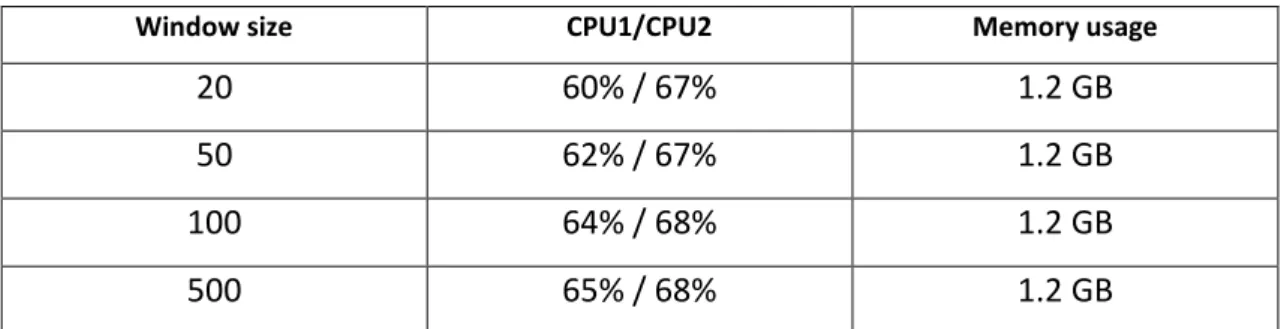
We have chosen the window size to be 50 for this research. The main reason for choosing 50 is the limited number of incoming new connection to each host in the network. In SDN, once a connection is established, the packets will not pass through the controller unless there is a new request. The other reason is the fact that a limited number of switches and hosts can be connected to each controller. The third reason for choosing this size is the computation that is done for each window. A list of 50 values can be computed much faster than 500 and, an attack in a 50-packet window is detected earlier. We also tested the entropy with three other window sizes and measured the CPU and memory usage. Table 3.2 shows that there is no difference in memory usage but CPU usage increases with window size.
Table 3.2 Window size comparison
Window size CPU1/CPU2 Memory usage
20 60% / 67% 1.2 GB
50 62% / 67% 1.2 GB
100 64% / 68% 1.2 GB
500 65% / 68% 1.2 GB
Table 3.3 shows the difference in entropy and the number of attack packets from each window size. HN is the normal traffic entropy, HAis the attack traffic entropy and
HN - HAis the difference. Last column shows the number of malicious packets when
the attack traffic is 25% of all incoming packets. This is the lowest attack traffic rate that our method can detect with accuracy.
In a window of size 20, the difference of entropies is less than 10% making it difficult to choose a threshold. With only five packets, probabilities of false positives will increases. On the other side, window of 500 does not offer a better difference of entropies and takes a much longer time than a window of 50 to compute entropy. The difference is 0.19 for 500 packet window size which is 11% drop in normal traffic entropy. The difference in the window size of 50 is 0.12 which 10% drop in normal traffic entropy. Difference of 1% does not justify choosing a 10 times bigger window size.
Window sized of 50 and 100 look close. Because the number of hosts in our test network is less than 100, we chose 50. It is very easy to change window size in the controller and this flexibility is the advantage of SDN.
Table 3.3 Comparison of five windows
Window size HN H A HN - HA HAPackets 25% 20 1.22 1.1 0.12 5 50 1.5 1.3 0.2 12 100 1.6 1.4 0.2 25 500 1.66 1.47 0.19 125
Looking at Table 3.1, the entropy of attack is higher than that of normal condition. In [33], the entropy is based on the destination port and source IP address. It is higher because the attack packets have different IP source addresses and they are, most likely, spoofed. In normal conditions, a connection between source and destination is established and the packets in these types of flows have the same IP source address. Since these packets have a higher number in the network, the entropy of normal condition is lower and an attack with several new source IP addresses increases entropy. However, in SDN, the packets are trying to establish a connection to the target by getting a flow rule in the controller. Thus, having different source IP addresses is a known fact that does not help in the detection of DDoS.
In SDN, the number of hosts and switches connected to the controller are known. Knowing the window size, the maximum entropy of the destination IP address is also known. It is happening when each packet is destined to exactly one host. What is left to be calculated is the number of packets that are targeting a specific host or a subnet. Hence, in our method, destination IP address is used for entropy computation and different that [33], where lower entropy indicates, possibly, an attack is in progress.
3.4 Early Detection in Openflow Controller
As it was shown before, one function of the controller is collecting statistics from all Openflow switches to detect inactive flows. These flows will be removed if they do not receive any packets for a period of time. This time period is called time-out in the Openflow specification and it can be set to different values.
For a lightweight solution, we propose adding another set of statistics to the controller. In this work, it is the entropy of the destination IP address in the controller. The function will determine if a higher than normal rate of incoming packets destined to the same destination.
In the previous section, the window size was set to be 50. The assumption is that the network has 50 or more hosts connected to it. One other component of DDoS detection by entropy is selecting an appropriate threshold, which will be discussed in the next chapter.
In the new function, every 50 Packet_In messages will be parsed for their destination IP address and the entropy of the list will be computed. The calculated entropy, then, will be compared to a threshold. If the calculated entropy is less than the threshold and it persists for a minimum of 5 consecutive entropy periods, it will be considered an attack. Detection within 5 entropy periods is 250 packets in the attack, which gives the network and early alert of attack. We tested with values one to five consecutive periods and five has the lowest false negative and positive for early detection. The results of these tests will be shown in Chapter 4.
With a window of 50 packets and a network of 50 hosts or more, maximum entropy,
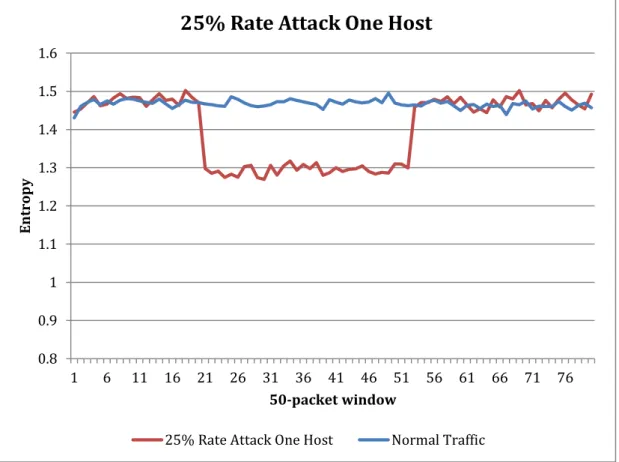
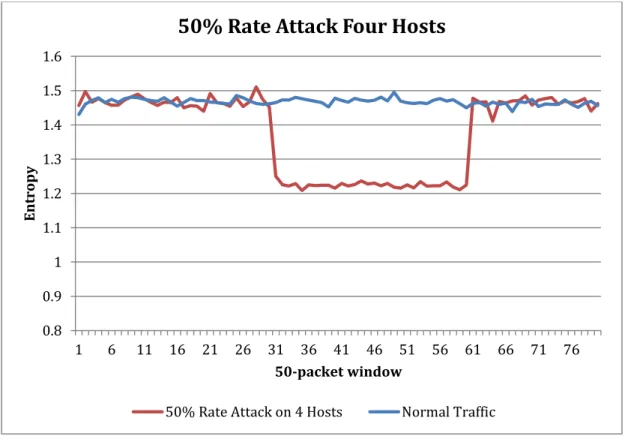
HMAX is when each of the 50 packets is equally distributed among all the hosts. When an attack happens, the number of packets going to the same destination host, or the same subnet, is much higher so it will make the target unreachable to legitimate traffic. This would be the main objective of the attack. The other factor in an attack is its flow to the target. The attack packets will be targeting a single host or a subnet. If the rate of attack to a host is higher than the normal traffic level, which is always the case, the number of packets to that particular host in a window will increase. Because of that, the entropy will fall with a certain percentage. If it falls below the threshold, it is an attack.
One advantage of our method is the liberty of testing the controller with different attack rates to calibrate a threshold. In SDN, the controller can be connected to a simulator and tested then be deployed in the field to accept production network traffic. This property allows for the threshold to be tested before applying it.
Let I be the IP addresses of all hosts connected to the network, see Equation 3.6, and
Wbe the window containing new packets’ destination IP address x and their number of occurrence y ,Equation 3.7.
I={x1,x2,x3,...,xN} (3.6)
W={(x1,y1),(x2,y2),(x3,y3),...} (3.7)
x I
(3.8)Then the entropy will be at its maximum if each destination IP is unique, see Equation 3.9:
x W:HMAX y 1 (3.9)
If the above condition does not hold, then some IP addresses have appeared more than once.
Two conditions are chosen to be the trigger for an attack in our method. One is the threshold and the other is the continuity of the attack. There might be glitches in the network that cause irregularity in normal traffic. If a link to a switch goes down or some hosts become temporarily unavailable, the entropy might fall and trigger a false positive. To avoid false positives of this type, we propose a limit for the number of consecutive low entropy windows. Based on that, the condition for declaring an attack is shown in Equation 3.10 where T is the threshold, S is an array of five windows with lower than T entropy. “ ” is the sign of negation. An attack happened if entropy of attackHA, is smaller than the threshold and, having five consecutive lower than threshold entropies is true. Otherwise, there is no attack:
. , , otherwise attack S T H attack A (3.10)
Figure 3.1 shows the flowchart of our detection method. Packet_In step shows that a new packet has arrived with new source address. First, we check the destination IP address to see if the destination IP address has an instance in our window. If it does, we increase the count for that IP address. Otherwise, it will be added as a new IP address. In the next step, we check if we have the 50th packet. If we do, the entropy of the window will be computed. Lastly, the entropy is compared to the threshold. If it is higher than the preset threshold, we go back to step one, waiting for new packets. Here, the count for consecutive lower-than-threshold entropies is set to 0. This is done to clear the count if there was lower entropy but had not reached five. If the entropy is lower than the threshold we increase the count for the consecutive lower-than-threshold entropies. If the count is five, an attack is detected.
The algorithm in Figure 3.1 is done with the addition of two function is the controller. The first one is called when a new Packet_In message arrives and it accepts the destination IP address as an argument, Figure 3.2. The second function is used to
computes the entropy, Figure 3.3. This is the only addition to the controller. Just to show the amount of code change in the controller the two functions are shown below.
Figure 3.2 Lists added to the controller
Figure 3.3 Function to collect destination IP address stats # Statistics Lists
count = 0 # Counting the number of incoming packets
entDic = {} # Hash table for the IP address and its occurrence
ipList = [] # List of IP addresses
dstEnt = [] # List of entropies
def statcolect(self, element):
# This function collects IP statistics l = 0
# Increments until we reach 50 self.count +=1
self.ipList.append(element)
# If the number of packets is 50, create a hash table of IP # addresses and number times they show up
if self.count == 50: for i in self.ipList: l +=1 if i not in self.entDic: self.entDic[i] =0 self.entDic[i] +=1 # call entropy self.entropy(self.entDic)
# print the hash table and clear all print self.entDic
self.entDic = {} self.ipList = [] l = 0
Figure 3.4 Entropy computation function
3.5 Comparison of Different Detection Methods to SDN Entropy
In [25], a machine learning method was used to learn the behavior of the network and based on that, decide whether an attack is in progress or not. This method is, mostly, used in non-SDN networks. When used in SDN networks it follows the same procedure and does not take into account the effect of DDoS on the controller. The solution has to run alongside SDN and has to be trained for a few hours before it can be used in the network. One other issue is the fact that SDN may reconfigure the network frequently. This means the Self-Organizing Maps solution has to be trained again for better protection. Finally, as the network expands, the neurons of the Self-Organizing Maps have to increase resulting in expansive neurons in the network and a lightweight solution turns into a heavy drag for the network. Our proposed solution runs within the controller and can be changed to fit the requirements as needed.Shin et al. [28], propose Openflow for finding the shortest path to Network Intrusion Detection System devices. The solution requires the addition of NIDS devices along def entropy (self, lists):
# this function computes entropy l = 50
elist = []
for p in lists.values(): c = p/l
elist.append(-c * math.log10(c))
print 'Entropy = ', sum(elist) self.dstEnt.append(sum(elist))
# collect 80 windows and print the entropy for a graph if (len(self.dstEnt)) == 80:
print self.dstEnt self.dstEnt = {}
the links of the network to monitor traffic for suspicious activity. In our solution, we propose using the controller itself for the detection of any attack. Although our solution is not tested on the cloud, the principle remains the same. The only difference is that the hosts are virtual hosts and the statistics can be changed from IP address to VLAN tag.
Like [28], Xing et al. [29] propose a DDoS detection method alongside SDN. SNORT is a DDoS detection tool itself and its combination with SDN is, again, using a non-SDN tool for non-SDN. The main purpose of our solution is making the detection process transparent by embedding it in the controller.
The closest solution to the one proposed in this thesis is [32]. This method adds an event processing module on top of the existing controllers and renames them to sub-controllers. The event processing module is considered a hyper controller receiving events from the sub-controllers and processes them for possible attacks. It seems that the hyper controller is supposed to have the bigger picture of the network for a better view of the attack. This, however, is the speculation of the writer. No algorithm is mentioned for the hyper controller attack detection and the solution has not been tested. The entropy method uses a different approach by assigning the detection task to each controller thus reducing the complexity.
In none of above solutions the controller has been the center of attention. Being the driving force of SDN and the operating system, it is the most essential component in the structure. This work is mainly concerned with detecting DDoS threats that are endangering the controller which is, in part, also protecting the hosts.
3.6 Concluding Remarks
In this chapter, it was shown how an attack can alter the entropy of normal traffic and how examining the entropy can be used to set a threshold. This principle is used as a way of detecting an attack in the controller.
We believe this is a lightweight and effective solution for SDN architecture with one controller. There are four major advantages that are worth mentioning:
1. Transparency: the statistics collection does not interfere with other function of the controller.
2. Limited resource usage: the collection of the statistics and its calculation is not heavy and does not use a considerable amount CPU power and memory. 3. Fully customizable: every parameter in the solution from window size to
threshold and statistics fields can be quickly changed to comply with new requirements if needed.
4. Minimal changes to the controller: the code that is added to the controller is minimal and has two functions.
Controllers are not ready-made unchangeable equipment. They are software running on a machine that can be a laptop. Vendors can build the desired controller to fit their needs. With this solution, any controller can be easily fitted with a lightweight DDoS detection functionality without additional equipment like NIDS, DDoS detection software like SNORT or machine learning techniques like SOM.
Most importantly, this solution shows the flexibility of SDN for accepting important functionalities like DDoS detection with small changes.
In the next chapter, results of the proposed DDoS detection method with entropy will be examined.
![Figure 2.8 Event based intrusion detection design for SDN [32]](https://thumb-us.123doks.com/thumbv2/123dok_us/9330940.2414944/33.892.267.623.809.1084/figure-event-based-intrusion-detection-design-sdn.webp)
![Table 3.1 Entropy of different window sizes [33]](https://thumb-us.123doks.com/thumbv2/123dok_us/9330940.2414944/38.892.244.637.586.736/table-entropy-of-different-window-sizes.webp)