Software Engineering
So(ware Evolu1on
1 Chapter 9 So(ware evolu1on
Software change
Software change is inevitable
New requirements emerge when the software is used; The business environment changes;
Errors must be repaired;
New computers and equipment is added to the system; The performance or reliability of the system may have to be
improved.
A key problem for all organizations is implementing and managing change to their existing software systems.
Importance of evolution
Organisations have huge investments in their software systems - they are critical business assets.
To maintain the value of these assets to the business, they must be changed and updated.
The majority of the software budget in large companies is devoted to changing and evolving existing software rather than developing new software.
3 Chapter 9 So(ware evolu1on
Evolution and servicing
Evolution
The stage in a software system’s life cycle where it is in operational use and is evolving as new requirements are proposed and implemented in the system.
Servicing
At this stage, the software remains useful but the only changes made are those required to keep it operational i.e. bug fixes and changes to reflect changes in the software’s environment. No new functionality is added.
Phase-out
Evolution processes
Software evolution processes depend on
The type of software being maintained; The development processes used;
The skills and experience of the people involved.
Proposals for change are the driver for system evolution.
Should be linked with components that are affected by the change, thus allowing the cost and impact of the change to be estimated.
Change identification and evolution continues throughout the system lifetime.
5 Chapter 9 So(ware evolu1on
Change identification and evolution processes
Change proposals New system
Change identification process
Software evolution process
The software evolution process
Release planning
Change implementation
System release Impact
analysis Change
requests
Platform
adaptation enhancementSystem Fault repair
7 Chapter 9 So(ware evolu1on
Change implementation
Requirements updating
Software development Requirements
analysis Proposed
Change implementation
Iteration of the development process where the revisions to the system are designed, implemented and tested.
A critical difference is that the first stage of change implementation may involve program understanding, especially if the original system developers are not responsible for the change implementation.
During the program understanding phase, you have to
understand how the program is structured, how it delivers functionality and how the proposed change might affect the program.
9 Chapter 9 So(ware evolu1on
Urgent change requests
Urgent changes may have to be implemented without
going through all stages of the software engineering process
If a serious system fault has to be repaired to allow normal operation to continue;
If changes to the system’s environment (e.g. an OS upgrade) have unexpected effects;
If there are business changes that require a very rapid response (e.g. the release of a competing product).
The emergency repair process
Modify
source code Deliver modifiedsystem
Analyze source code Change
requests
11 Chapter 9 So(ware evolu1on
Agile methods and evolution
Agile methods are based on incremental development so
the transition from development to evolution is a seamless one.
Evolution is simply a continuation of the development process based on frequent system releases.
Automated regression testing is particularly valuable when changes are made to a system.
Handover problems
Where the development team have used an agile
approach but the evolution team is unfamiliar with agile methods and prefer a plan-based approach.
The evolution team may expect detailed documentation to support evolution and this is not produced in agile processes.
Where a plan-based approach has been used for
development but the evolution team prefer to use agile methods.
The evolution team may have to start from scratch developing automated tests and the code in the system may not have been refactored and simplified as is expected in agile development.
13 Chapter 9 So(ware evolu1on
Program evolution dynamics is the study of the processes of system change.
After several major empirical studies, Lehman and Belady proposed that there were a number of ‘laws’ which applied to all systems as they evolved.
There are sensible observations rather than laws. They are applicable to large systems developed by large organisations.
It is not clear if these are applicable to other types of software system.
The system requirements are likely to change while the system is being developed because the environment is changing. Therefore a delivered system won't meet its requirements!
Systems are tightly coupled with their environment. When a system is installed in an
environment it changes that environment and therefore changes the system requirements.
Systems MUST be changed if they
are to remain useful in an environment.
Change is inevitable
15 Chapter 9 So(ware evolu1on
Lehman’s laws
Law Description
Continuing change A program that is used in a real-world environment must necessarily change, or else become progressively less useful in that
environment. Increasing
complexity
As an evolving program changes, its structure tends to become more complex. Extra resources must be devoted to preserving and simplifying the structure.
Large program evolution
Program evolution is a self-regulating process. System attributes such as size, time between releases, and the number of reported errors is approximately invariant for each system release. Organizational
stability
Over a program’s lifetime, its rate of development is approximately constant and independent of the resources devoted to system development.
Lehman’s laws
Law Description
Conservation of familiarity Over the lifetime of a system, the incremental change in each release is approximately constant.
Continuing growth The functionality offered by systems has to continually
increase to maintain user satisfaction.
Declining quality The quality of systems will decline unless they are modified to
reflect changes in their operational environment.
Feedback system Evolution processes incorporate multiagent, multiloop
feedback systems and you have to treat them as feedback systems to achieve significant product improvement.
17 Chapter 9 So(ware evolu1on
Applicability of Lehman’s laws
Lehman’s laws seem to be generally applicable to large, tailored systems developed by large organisations.
Confirmed in early 2000’s by work by Lehman on the FEAST project.
It is not clear how they should be modified for
Shrink-wrapped software products;
Systems that incorporate a significant number of COTS components;
Small organisations; Medium sized systems.
Modifying a program after it has been put into use.
The term is mostly used for changing custom software. Generic software products are said to evolve to create new versions.
Maintenance does not normally involve major changes to
the system’s architecture.
Changes are implemented by modifying existing
components and adding new components to the system.
Software maintenance
19 Chapter 9 So(ware evolu1on
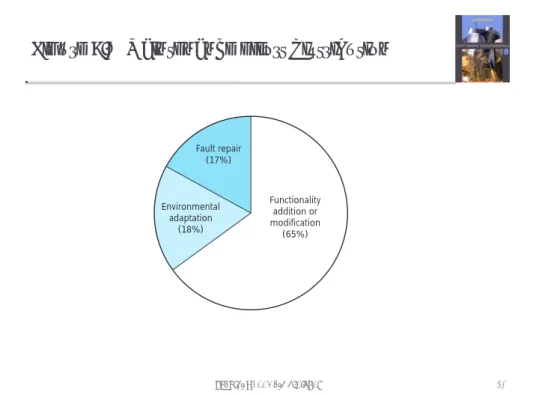
Maintenance to repair software faults
Changing a system to correct deficiencies in the way meets its requirements.
Maintenance to adapt software to a different operating environment
Changing a system so that it operates in a different environment (computer, OS, etc.) from its initial implementation.
Maintenance to add to or modify the system’s functionality
Modifying the system to satisfy new requirements.
Figure 9.8 Maintenance effort distribution
Functionality addition or modification
(65%) Fault repair
(17%)
Environmental adaptation
(18%)
21 Chapter 9 So(ware evolu1on
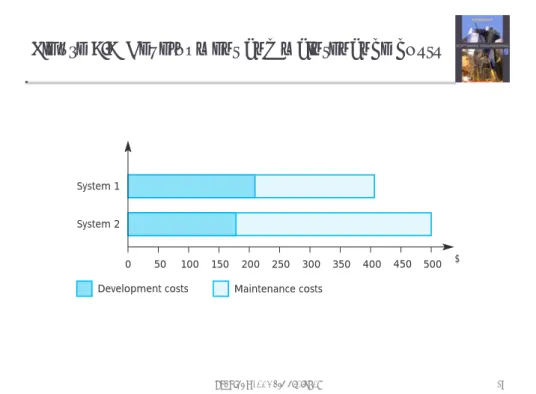
Usually greater than development costs (2* to 100* depending on the application).
Affected by both technical and non-technical factors.
Increases as software is maintained.
Maintenance corrupts the software structure so makes further maintenance more difficult.
Ageing software can have high support costs (e.g. old languages, compilers etc.).
Figure 9.9 Development and maintenance costs
0 50 100 150 200 250 300 350 400 450 500
System 1 System 2
Development costs Maintenance costs
$
23 Chapter 9 So(ware evolu1on
Team stability
Maintenance costs are reduced if the same staff are involved with them for some time.
Contractual responsibility
The developers of a system may have no contractual
responsibility for maintenance so there is no incentive to design for future change.
Staff skills
Maintenance staff are often inexperienced and have limited domain knowledge.
Program age and structure
Maintenance prediction
Maintenance prediction is concerned with assessing which parts of the system may cause problems and have high maintenance costs
Change acceptance depends on the maintainability of the components affected by the change;
Implementing changes degrades the system and reduces its maintainability;
Maintenance costs depend on the number of changes and costs of change depend on maintainability.
25 Chapter 9 So(ware evolu1on
Maintenance prediction
Predicting maintainability
Predicting system changes
Predicting maintenance
costs
What will be the lifetime maintenance costs of this
system?
What will be the costs of maintaining this system
over the next year? What parts of the system will be the most expensive
to maintain?
How many change requests can be What parts of the system are most likely to be affected by
Change prediction
Predicting the number of changes requires and understanding of the relationships between a system and its environment.
Tightly coupled systems require changes whenever the
environment is changed.
Factors influencing this relationship are
Number and complexity of system interfaces; Number of inherently volatile system requirements; The business processes where the system is used.
27 Chapter 9 So(ware evolu1on
Complexity metrics
Predictions of maintainability can be made by assessing the complexity of system components.
Studies have shown that most maintenance effort is spent on a relatively small number of system
components.
Complexity depends on
Complexity of control structures; Complexity of data structures;
Process metrics
Process metrics may be used to assess maintainability
Number of requests for corrective maintenance; Average time required for impact analysis;
Average time taken to implement a change request; Number of outstanding change requests.
If any or all of these is increasing, this may indicate a decline in maintainability.
29 Chapter 9 So(ware evolu1on
System re-engineering
Re-structuring or re-writing part or all of a legacy system without changing its
functionality.
Applicable where some but not all sub-systems of a larger system require frequent
maintenance.
Re-engineering involves adding effort to make them easier to maintain. The system may be re-structured and re-documented.
Advantages of reengineering
Reduced risk
There is a high risk in new software development. There may be development problems, staffing problems and specification problems.
Reduced cost
The cost of re-engineering is often significantly less than the costs of developing new software.
31 Chapter 9 So(ware evolu1on
The reengineering process
Reverse engineering
Program documentation
Data re-engineering
Original data
Program structure improvement
Program modularization
Restructured
program Re-engineereddata Re-engineered
program Original
program
Source code translation
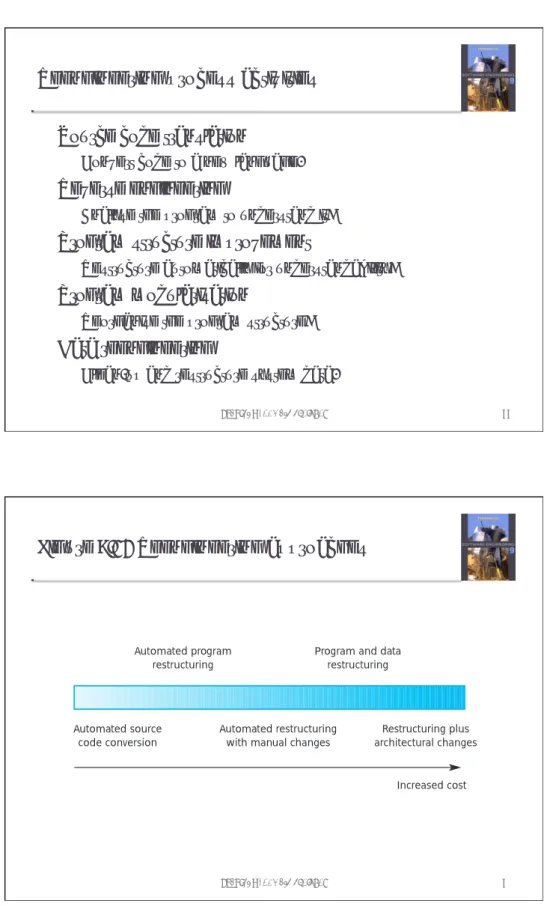
Reengineering process activities
Source code translation
Convert code to a new language. Reverse engineering
Analyse the program to understand it;
Program structure improvement
Restructure automatically for understandability; Program modularisation
Reorganise the program structure; Data reengineering
Clean-up and restructure system data.
33 Chapter 9 So(ware evolu1on
Figure 9.12 Reengineering approaches
Automated restructuring with manual changes Automated source
code conversion architectural changesRestructuring plus
Automated program
restructuring Program and datarestructuring
Reengineering cost factors
The quality of the software to be reengineered.
The tool support available for reengineering.
The extent of the data conversion which is required.
The availability of expert staff for reengineering.
This can be a problem with old systems based on technology that is no longer widely used.
35 Chapter 9 So(ware evolu1on
Preventative maintenance by refactoring
Refactoring is the process of making improvements to a program to slow down degradation through change.
You can think of refactoring as ‘preventative maintenance’ that reduces the problems of future change.
Refactoring involves modifying a program to improve its structure, reduce its complexity or make it easier to understand.
When you refactor a program, you should not add functionality but rather concentrate on program
Refactoring and reengineering
Re-engineering takes place after a system has been maintained for some time and maintenance costs are increasing. You use automated tools to process and re-engineer a legacy system to create a new system that is more maintainable.
Refactoring is a continuous process of improvement throughout the development and evolution process. It is intended to avoid the structure and code degradation that increases the costs and difficulties of maintaining a system.
37 Chapter 9 So(ware evolu1on
‘Bad smells’ in program code
Duplicate code
The same or very similar code may be included at different places in a program. This can be removed and implemented as a single method or function that is called as required.
Long methods
If a method is too long, it should be redesigned as a number of shorter methods.
Switch (case) statements
These often involve duplication, where the switch depends on the type of a value. The switch statements may be scattered around a program. In object-oriented languages, you can often
‘Bad smells’ in program code
Data clumping
Data clumps occur when the same group of data items (fields in classes, parameters in methods) re-occur in several places in a program. These can often be replaced with an object that encapsulates all of the data.
Speculative generality
This occurs when developers include generality in a program in case it is required in the future. This can often simply be removed.
39 Chapter 9 So(ware evolu1on
Legacy system management
Organisations that rely on legacy systems must choose a strategy for evolving these systems
Scrap the system completely and modify business processes so that it is no longer required;
Continue maintaining the system;
Transform the system by re-engineering to improve its maintainability;
Replace the system with a new system.
The strategy chosen should depend on the system
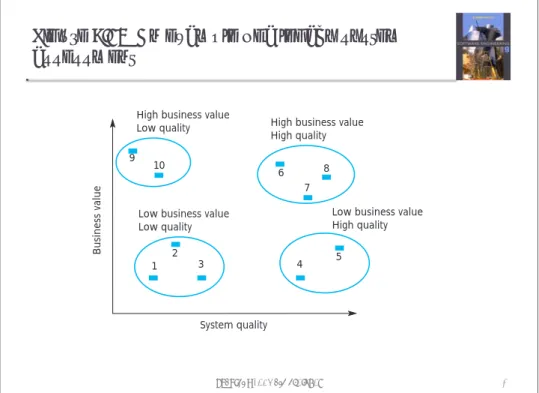
Figure 9.13 An example of a legacy system assessment
1 2 3 4 5
6 7
8 9
10
System quality
Business value
High business value
Low quality High business value
High quality
Low business value Low quality
Low business value High quality
41 Chapter 9 So(ware evolu1on
Legacy system categories
Low quality, low business value
These systems should be scrapped. Low-quality, high-business value
These make an important business contribution but are
expensive to maintain. Should be re-engineered or replaced if a suitable system is available.
High-quality, low-business value
Replace with COTS, scrap completely or maintain. High-quality, high business value
Business value assessment
Assessment should take different viewpoints into account
System end-users; Business customers; Line managers; IT managers; Senior managers.
Interview different stakeholders and collate results.
43 Chapter 9 So(ware evolu1on
Issues in business value assessment
The use of the system
If systems are only used occasionally or by a small number of people, they may have a low business value.
The business processes that are supported
A system may have a low business value if it forces the use of inefficient business processes.
System dependability
If a system is not dependable and the problems directly affect business customers, the system has a low business value. The system outputs
System quality assessment
Business process assessment
How well does the business process support the current goals of the business?
Environment assessment
How effective is the system’s environment and how expensive is it to maintain?
Application assessment
What is the quality of the application software system?
45 Chapter 9 So(ware evolu1on
Business process assessment
Use a viewpoint-oriented approach and seek answers
from system stakeholders
Is there a defined process model and is it followed?
Do different parts of the organisation use different processes for the same function?
How has the process been adapted?
What are the relationships with other business processes and are these necessary?
Is the process effectively supported by the legacy application software?
Example - a travel ordering system may have a low business value because of the widespread use of
web-Factors used in environment assessment
Factor Questions
Supplier stability Is the supplier still in existence? Is the supplier financially stable and
likely to continue in existence? If the supplier is no longer in business, does someone else maintain the systems?
Failure rate Does the hardware have a high rate of reported failures? Does the
support software crash and force system restarts?
Age How old is the hardware and software? The older the hardware and
support software, the more obsolete it will be. It may still function correctly but there could be significant economic and business benefits to moving to a more modern system.
Performance Is the performance of the system adequate? Do performance
problems have a significant effect on system users?
47 Chapter 9 So(ware evolu1on
Factors used in environment assessment
Factor Ques,ons
Support requirements What local support is required by the hardware and
software? If there are high costs associated with this support, it may be worth considering system replacement.
Maintenance costs What are the costs of hardware maintenance and support
software licences? Older hardware may have higher maintenance costs than modern systems. Support software may have high annual licensing costs.
Interoperability Are there problems interfacing the system to other systems?
Can compilers, for example, be used with current versions of the operating system? Is hardware emulation required?
Factors used in application assessment
Factor Questions
Understandability How difficult is it to understand the source code of the current
system? How complex are the control structures that are used? Do variables have meaningful names that reflect their function?
Documentation What system documentation is available? Is the documentation
complete, consistent, and current?
Data Is there an explicit data model for the system? To what extent is
data duplicated across files? Is the data used by the system up to date and consistent?
Performance Is the performance of the application adequate? Do performance
problems have a significant effect on system users?
49 Chapter 9 So(ware evolu1on
Factors used in application assessment
Factor Ques,ons
Programming language Are modern compilers available for the programming
language used to develop the system? Is the programming language still used for new system development? Configuration
management
Are all versions of all parts of the system managed by a configuration management system? Is there an explicit description of the versions of components that are used in the current system?
Test data Does test data for the system exist? Is there a record of
regression tests carried out when new features have been added to the system?
Personnel skills Are there people available who have the skills to maintain the
application? Are there people available who have experience with the system?
System measurement
You may collect quantitative data to make an assessment of the quality of the application system
The number of system change requests;
The number of different user interfaces used by the system; The volume of data used by the system.
51 Chapter 9 So(ware evolu1on