
DOI: 10.1534/genetics.106.061796
G72/G30
Genes and Schizophrenia: A Systematic Meta-analysis
of Association Studies
Dawei Li*
,†,‡,1and Lin He
†,§*Bio-X Center, Shanghai Jiao Tong University, Shanghai 200030, China,†Institute for Nutritional Sciences, Shanghai Institutes of Biological Sciences, Chinese Academy of Sciences, Shanghai 200031, China,‡Laboratory of Statistical Genetics, Rockefeller University, New York,
New York 10021 and§NHGG Bio-X Center, Shanghai Jiao Tong University, Shanghai 200030, China Manuscript received June 10, 2006
Accepted for publication December 4, 2006
ABSTRACT
Schizophrenia may result from a neurotransmission hypofunction of glutamatergic and N
-methyl-d-aspartate (NMDA) receptors. Linkage disequilibrium mapping has identified several promising and
novel positional candidates, including theG72/G30andd-amino-acid oxidase (DAAO) genes. Since the
first positive association report, many subsequent studies have attempted to replicate the association but the results have been mixed. To try to resolve this inconsistency and to elucidate the relationship between the important glutamate-related genes and schizophrenia, the current meta-analysis has combined samples involving 16 polymorphisms covering all published case-control and family-based association studies up to October 2005. The results suggest that there is weak evidence of association between the G72/G30genes and schizophrenia.
S
CHIZOPHRENIA is a serious psychiatric disease that affects up to 1% of the population worldwide (Cannon et al. 1998; Jablensky 2000). Studies havesuggested that schizophrenia might result from a neuro-transmission hypofunction of glutamatergic and N -methyl-d-aspartate (NMDA) receptors (Tsaiand Coyle
2002; Harrison and Owen 2003; Hall et al. 2004;
Owenet al.2004; Rapoportet al.2005). A number of
studies have provided evidence of linkage scans and mapping to chromosome 13q22–q34 (Lin et al.1997;
Blouinet al.1998; Shawet al.1998; Brzustowiczet al.
1999; Levinson et al. 2000). Chumakov et al. (2002)
found robust evidence of genetic association within the 13q linkage region for schizophrenia. Two overlapping genes,G72andG30, located at 13q34 and spanning a 65-kb segment, have been shown to be significantly associated with schizophrenia using both individual single nucleotide polymorphism (SNP) and haplotype analysis (Chumakovet al.2002).
G72has been hypothesized to produce protein PLG72, which is an agonist for the glycine-binding site of the NMDA glutamate receptors (Mothetet al.2000). The
postmortem analysis of schizophrenic patients has re-vealed overproduced G72 together with a lower NMDA glutamate receptor activity, which could result in gluta-mate-signaling hypofunction (Chumakov et al.2002).
Further expression and functional studies have also supported the role ofG72in the etiology of schizophre-nia (Mothet et al.2000; Chumakov et al.2002; Tsai
and Coyle 2002; O’Donovan et al. 2003; Shirts and
Nimgaonkar 2004). G72 protein interacts with the
gene for d-amino-acid oxidase (DAAO) on 12q24 to
regulate glutaminergic signaling through the NMDA re-ceptors pathway (Tsaiand Coyle2002), and variation
within G72 could affect NMDA signaling through the functional pathway (Chumakovet al.2002). The synergic
effect on the risk for schizophrenia was higher than the effect of each individual gene due to the interaction between the proteins of G72 and DAAO (Chumakov et al. 2002). The story of G72/G30 is quite complex, as set out in an article by Detera-Wadleigh and
McMahon(2006). G72/G30 is also believed to be
as-sociated with other psychiatric disorders, such as bi-polar disorder (Hattoriet al. 2003; Chenet al.2004;
Schumacheret al.2004).
Chumakov et al. (2002) initially reported strong
as-sociations between schizophrenia and dozens of SNPs in theG72/G30andDAAOgenes. The associations have been replicated independently in several, but not in all, studies. The available evidence shows inconsistency with regard to which alleles show association with the disease. In an attempt to clarify this inconsistency and to measure the magnitude of the effect of the putative risk alleles, the current meta-analysis has combined all available case-control and family-based association studies dealing with theG72/G30andDAAOgenes and schizophrenia.
MATERIALS AND METHODS
Literature search: The literature included in the analysis was selected using PubMed and focusing on the keywords ‘‘schizophrenia,’’ ‘‘G72,’’ ‘‘G30,’’ ‘‘d-amino-acid oxidase,’’ and 1Corresponding author:Shanghai Jiao Tong University, Bio-X Center, Hao
Ran Bldg., 1954 Hua Shan Rd., Shanghai 200030, China. E-mail: [email protected]
‘‘DAAO.’’ All references cited in these studies and published reviews were examined to identify additional work not indexed by MEDLINE. The analyzed data cover work from all English-language publications up to October 2005.
Inclusion criteria: Eligible studies had to meet all of the following criteria: (1) the studies were published in peer-reviewed journals and were independent studies using original data; (2) the studies provided sufficient data to calculate the odds ratio (OR) with confidence interval andP-value; (3) the studies investigated one or more of the 16 polymorphisms using either case-control or family-based approaches; (4) the studies described the genotyping primers, equipment, and protocols used or provided reference to them; (5) the studies diagnosed schizophrenia patients according to the Interna-tional Classification of Diseases,Diagnostic and Statistical Manual, orChinese Classification of Mental Disorders systems; and (6) the studies used healthy individuals as controls. Authors were con-tacted in cases where there were questions regarding their studies.
Quality assessments:For association studies with inconsis-tent results based on the same polymorphisms, the method-ological quality needed to be assessed using appropriate criteria to limit the risk of introducing bias into meta-analyses or systematic reviews. The classification method known as the ‘‘extended-quality score’’ (Liet al.2006; Liand He2006) was
used to assess the quality of association studies. The extended-quality score categorizes studies as ‘‘high,’’ ‘‘medium,’’ or ‘‘poor’’ quality.
Statistical analyses:Any study that contained data from dif-ferent ethnic populations (or genders) was considered effec-tively as several individual studies. Data from the case-control studies were summarized in two-by-two tables and transmission disequilibrium test (TDT) studies were summarized in two-by-one tables. From each table, a log-OR and its sampling variance were calculated (Choet al.2005). Cochran’s chi-square-based
Q-statistic test was used to assess possible heterogeneity among the individual studies. HeterogeneityQ-tests were also per-formed to test for differences in OR between design types (case controlvs.family based). A test for funnel plot asym-metry, described by Eggeret al.(1997), was used to assess
evi-dence for publication bias. ORs were pooled using the method of DerSimonianand Laird(1986), and 95% C.I.’s were
con-structed using Woolf’s method. The significance of the overall OR was determined by theZ-test. For the sensitivity analysis, each study in turn was removed from the total, and the remaining were reanalyzed. This procedure was used to ensure that no individual study was entirely responsible for a finding. The type I error rate was set at 0.05.P-values are two tailed. An R-project program was used to depict the degree of differences and trend of association of risk allele frequency from controls to patients. If the vector had the same direction, this indicated the same kind of association, and vice versa.
Haplotype construction, counting, and linkage disequilib-rium (LD) block defining were performed on 30 Centre d’Etude du Polymorphisme Humain trios (Utah residents) using Haploview software (http://www.hapmap.org). The mul-tiallelicD9was computed by performing a series of pairwiseD9 calculations using each haplotype in turn as an allele, with all other haplotypes at the locus serving as the other allele. This was then repeated for each haplotype at each locus and av-eraged by haplotype frequency. Maximum-likelihood haplo-type blocks were calculated using an EM algorithm.
Electronic database information: Accession numbers and URLs for data in this article are as follows: forG72/G30and DAAO, Online Mendelian Inheritance in Man at http:// www.ncbi.nlm.nih.gov/Omim; genotype data for G72/G30 and DAAO, http://www.hapmap.org/; and genome data for G72/G30andDAAO, http://genome.ucsc.edu/.
RESULTS
The combined search yielded 49 references. After discarding overlapping references and those that clearly did not meet the criteria, 14 studies were retained. These studies were then filtered to ensure conformity with the inclusion criteria. For theG72/G30genes, two studies (Hattori et al. 2003; Chen et al. 2004) were
excluded because they were concerned with bipolar affective disorders rather than schizophrenia; for the
DAAO gene, one study (Chumakov et al. 2002) was
excluded on the grounds of insufficient data. Finally, 11 studies, consisting of 6 case-control (1292 cases and 1392 controls) (Chumakovet al.2002; Korostishevsky et al.2004; Schumacheret al.2004; Wanget al.2004)
and 3 TDT studies (Addingtonet al.2004; Mulleet al.
2005; Zouet al.2005) for theG72/G30genes, and 2
case-control studies (846 cases and 836 case-controls) (Liuet al.
2004; Schumacheret al.2004) for theDAAOgene, met
our criteria for inclusion. The 11 studies included 2138 cases, 2228 controls, and 463 parent–offspring trios. They all fell into the category of medium-to-high quality, with no study falling into the ‘‘poor’’ category.
For M12 of theG72/G30genes, all studies showed a pooledP-value of 0.02 [overall OR¼1.12 (1.02, 1.24)] with evidence of heterogeneity between studies (P ¼
0.003) (Table 1). There was no evidence of heteroge-neity between design types (case controlvs.TDT) (P.
0.05) (supplemental Table 1 at http://www.genetics. org/supplemental/).
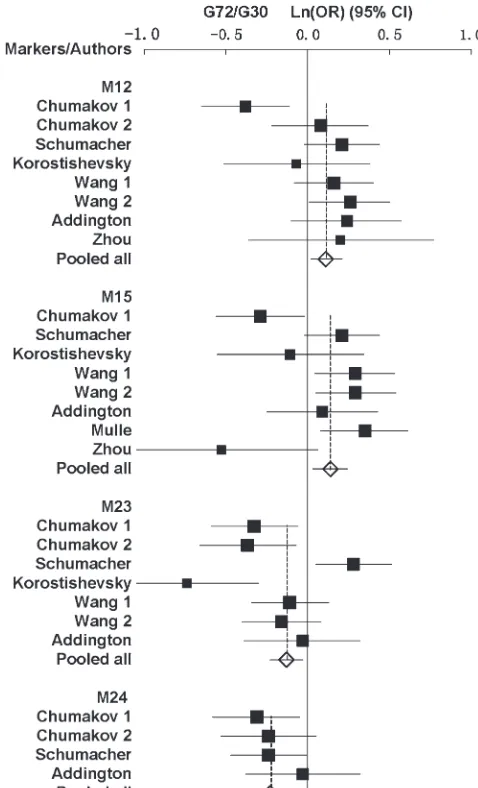
For M15, all studies showed a significant P-value of 0.0086 [overall OR¼1.15 (1.04, 1.27)] with evidence of heterogeneity (P¼0.003) (Table 1). There was no evi-dence of heterogeneity between design types (supplemen-tal Table 1 at http://www.genetics.org/supplemen(supplemen-tal/). For M23, all studies showed a pooled P-value of 0.01 [overall OR ¼0.88 (0.79, 0.97)] also with evidence of heterogeneity (P ¼ 0.0004) (Table 1). For M24, all studies showed a significant P-value of 0.001 [overall OR¼0.8 (0.69, 0.91)], and there was no evidence of heterogeneity (P¼0.64) (Table 1). The forest plots for the four SNPs are shown in Figure 1.
No statistically significant association was found in nine other SNPs (Table 1), and we found no significant association in the genotypic analyses for these SNPs whether the genotypes were combined with risk alleles or nonrisk alleles (Table 2).
As for the DAAO gene, there was no evidence of association in the allelic analysis for any of the three polymorphisms MDAAO-4, -5, or -6 (P . 0.05) (not shown) although positive evidence of haplotypes for the three SNPs was reported (P,0.00001) (Liuet al.2004).
For M24, the results showed consistency, with the largestP-value being 0.015. However, for M12, M15, and M23, evidence of sensitivity was found, with the largest
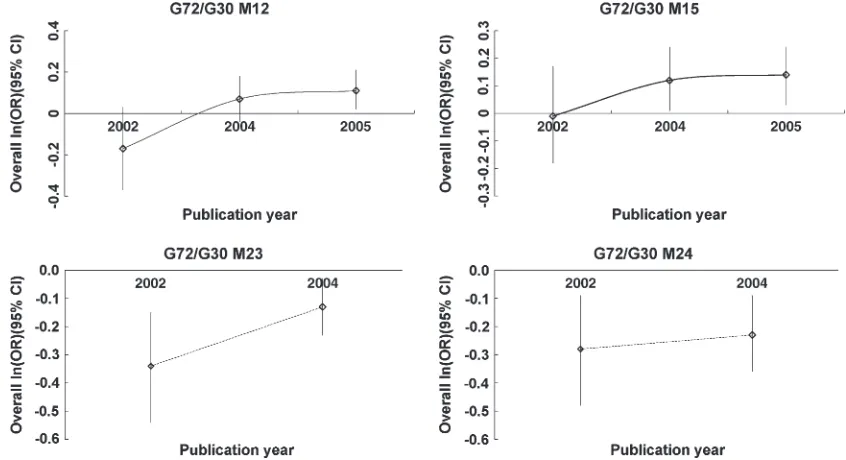
P-value . 0.05 (supplemental Table 2 at http://www. genetics.org/supplemental/). The retrospective asymp-tote lines of the analysis based on the publication year showed that a cumulative synthesis of M12 and M15 tended to be stable after 2004, in line with the meta-anal-ysis. However, more replications are suggested for M23 and M24 due to instability of asymptotic slopes (Figure 2). The funnel plots and trend of allele frequency by R project are shown forG72/G30as supplemental Figures 1 and 2 at http://www.genetics.org/supplemental/. Lack of space precluded the inclusion of the results of individual studies but these are available on request.
DISCUSSION
As for the LD and haplotype structure for theG72/ G30genes, the 13 polymorphisms, covering four blocks, were in two strong LD structures (Figure 3). Further-more, the M12 and M15 polymorphisms were located in one block, while M23 and M24 were in another strong block, which was consistent with results of the retro-spective analysis. For the DAAO gene, the three SNPs were in a strong LD block, as we have described else-where (Liuet al.2004).
Although previous individual studies have reported strong associations in the allelic, genotypic, or haplo-typic analyses using either family-based or case-control methods, the current meta-analysis confirmed only weak overall association with G72/G30, and there was considerable heterogeneity among the associated al-leles. First, for most SNPs with heterogeneity, different alleles, genotypes, or haplotypes seemed to be associ-ated in different studies. Heterogeneity is partly due to possible sampling bias, including population stratifi-cation due to ethnicities and diagnostic variations or considerable differences in allele frequencies. Second, theG72/G30genes may be under a complex expression control. It is likely that different regulatory elements respond to different cell types and developmental stages and that different SNP combinations affect the
TABLE 1
The overall results of all polymorphisms of the
G72/G30genes
Markers OR (95% C.I.) P(Z) P(Q)
M12 (A/G)a(8)b 1.12 (1.02, 1.24) 0.0225 0.0031
M13 (A/C) (4) 1.06 (0.9, 1.24) 0.4794 0.3857 M14 (A/G) (8) 0.99 (0.89, 1.1) 0.8909 0.1388 M15 (A/G) (8) 1.15 (1.04, 1.27) 0.0086 0.0030 M16 (A/G) (3) 1.12 (0.92, 1.35) 0.2521 0.7874 M18 (A/C) (3) 0.95 (0.79, 1.13) 0.5571 0.5008 M19 (A/G) (4) 0.98 (0.83, 1.16) 0.8451 0.2428 M20 (A/G) (3) 1.03 (0.86, 1.23) 0.7663 0.7641 M21 (C/T) (4) 1.14 (0.97, 1.34) 0.1090 0.7115 M22 (A/G) (7) 1.04 (0.93, 1.17) 0.5096 0.0151 M23 (C/T) (7) 0.88 (0.79, 0.97) 0.0136 0.0004 M24 (A/T) (4) 0.8 (0.69, 0.91) 0.0010 0.6421 rs1935062 (A/C) (4) 0.91 (0.79, 1.04) 0.1611 0.3605
P(Z),Z-test used to determine the significance of the over-all OR.P-values , 0.05 are in italics. P(Q), the Cochran’s
x2-basedQ-statistic test was used to assess the heterogeneity. P(T),T-test was used to evaluate the significance of publica-tion bias. NoP(T),0.05 (not shown). The NCBI rs ID for the M-SNPs (Chumakovet al.2002) are the following: M12
(rs3916965), M13 (rs3916966), M14 (rs3916967), M15 (rs2391191), M16 (rs3918341), M18 (rs947267), M19 (rs778294), M20 (rs3916970), M21 (rs3916971), M22 (rs778293), M23 (rs3918342), and M24 (rs1421292).
aThe first allele is the risk allele.
bThe number of studies included are indicated in
paren-theses.
Figure 1.—Forest plots of ln(OR) with 95% C.I. for the
regulation of expression. Third, environmental factors, such as the season of birth, may contribute to several psychiatric and neurological disorders, including schiz-ophrenia.(Chotai et al. 2003) Schizophrenia may be
characterized by genetic heterogeneity, and the genetic architecture in different populations can differ. Het-erogeneity may also be a factor in explaining the results of the sensitivity analysis.
Only one meta-analysis on G72 has previously been performed (Detera-Wadleighand McMahon2006),
and it combined data from different studies at the level ofP-values. Compared with that study, this meta-analysis uses more extensive statistical methods, which can systematically incorporate information on specific al-leles and genotypes. This study, therefore, is a valuable addition to the literature on G72. However, it has a number of limitations, principal among which is that no
real genotypes were available, which prevented compar-ison of haplotype frequencies. Other limitations include the possible effects of variables such as age, ethnicity, and gender, which can be dealt with only by using a greater range of studies. For subsequent meta-analyses, the sample size needed may depend on the degree of association, linkage disequilibrium, accuracy of pheno-typic data, and heterogeneity of allelic frequencies. More accurate phenotype definition, strict selection of samples, and uniformity of diagnosis and classification as well as use of standard demographic statistical methods would reduce the discrepancies and simplify collabora-tion and comparisons between studies.
Recent meta-analyses covering international popula-tions have pointed to glutamate-related genes such as theNRG1(Liet al.2006) andDTNBP1(our unpublished
results) as promising candidates for schizophrenia. It
TABLE 2
The overall results of genotypic analysis
Markers Combinations OR (95% C.I.) P(Z) P(Q)
M12 (A/G) (11112)/22 1.19 (0.89, 1.61) 0.2406 0.1207 11/(12122) 1.38 (0.91, 2.08) 0.1260 0.7559 M15 (A/G) (11112)/22 0.98 (0.48, 2) 0.9577 0.0436 11/(12122) 1.35 (0.89, 2.04) 0.1586 0.7418 M19 (A/G) (11112)/22 0.79 (0.59, 1.05) 0.0985 0.5385 11/(12122) 0.95 (0.55, 1.65) 0.8614 0.4701 M23 (C/T) (11112)/22 0.61 (0.12, 3.08) 0.5527 0.00003
11/(12122) 1.16 (0.84, 1.61) 0.3702 0.0524 MDAAO-4-5-6 (11112)/22 1.48 (1.09, 2.00) 0.012 0.7617 11/(12122) 1.42 (1.17, 1.71) 0.0003 0.7621
1 represents the first allele, and 2 represents the second allele. The NCBI rs ID for the MDAAO-SNPs are the following: MDAAO-4 (rs2111902), MDAAO-5 (rs3918346), and MDAAO-6 (rs3741775).
may be that these genes confer susceptibility to schizo-phrenia in interaction with one another in either an epistatic or a polygenic manner. Further investigations are required to identify if other at-risk polymorphisms withinG72/G30andDAAOconfer a risk of schizophre-nia and to clarify the role of theG72/G30genes.
We acknowledge the anonymous reviewers for their insightful comments and suggestions for our manuscript. This work was supported by grants from the Ministry of Education, People’s Republic
of China, the national 973 and 863 programs, the National Natural Science Foundation of China, the Shanghai Municipal Commission for Science and Technology, and research grant MH44292 from the National Institutes of Health, Bethesda, Maryland.
LITERATURE CITED
Addington, A. M., M. Gornick, A. L. Sporn, N. Gogtay, D.
Greensteinet al., 2004 Polymorphisms in the 13q33.2 gene
Figure3.—Representation of the LD structure. The LD structure for theG72/G30genes, spanning 282 kb, was constructed
G72/G30 are associated with childhood-onset schizophrenia and psychosis not otherwise specified. Biol. Psychiatry55:976–980. Blouin, J. L., B. A. Dombroski, S. K. Nath, V. K. Lasseter, P. S.
Wolyniecet al., 1998 Schizophrenia susceptibility loci on
chro-mosomes 13q32 and 8p21. Nat. Genet.20:70–73.
Brzustowicz, L. M., W. G. Honer, E. W. Chow, D. Little, J. Hogan
et al., 1999 Linkage of familial schizophrenia to chromosome 13q32. Am. J. Hum. Genet.65:1096–1103.
Cannon, T. D., J. Kaprio, J. Lonnqvist, M. Huttunen and
M. Koskenvuo, 1998 The genetic epidemiology of
schizophre-nia in a Finnish twin cohort. A population-based modeling study. Arch. Gen. Psychiatry55:67–74.
Chen, Y. S., N. Akula, S. D. Detera-Wadleigh, T. G. Schulze,
J. Thomaset al., 2004 Findings in an independent sample
sup-port an association between bipolar affective disorder and the G72/G30 locus on chromosome 13q33. Mol. Psychiatry9:87– 92; image 85.
Cho, H. J., I. Meira-Lima, Q. Cordeiro, L. Michelon, P. Shamet al.,
2005 Population-based and family-based studies on the seroto-nin transporter gene polymorphisms and bipolar disorder: a sys-tematic review and meta-analysis. Mol. Psychiatry10:771–781. Chotai, J., A. Serretti, E. Lattuada, C. Lorenzi and R. Lilli,
2003 Gene-environment interaction in psychiatric disorders as indicated by season of birth variations in tryptophan hydrox-ylase (TPH), serotonin transporter (5-HTTLPR) and dopamine receptor (DRD4) gene polymorphisms. Psychiatry Res.119:99– 111.
Chumakov, I., M. Blumenfeld, O. Guerassimenko, L. Cavarec,
M. Palicioet al., 2002 Genetic and physiological data implicating
the new human gene G72 and the gene ford-amino acid oxidase
in schizophrenia. Proc. Natl. Acad. Sci. USA99:13675–13680. DerSimonian, R., and N. Laird, 1986 Meta-analysis in clinical trials.
Control Clin. Trials.7:177–188.
Detera-Wadleigh, S. D., and F. J. McMahon, 2006 G72/G30 in
schizophrenia and bipolar disorder: review and meta-analysis. Biol. Psychiatry60:106–114.
Egger, M., G. Davey Smith, M. Schneider and C. Minder,
1997 Bias in meta-analysis detected by a simple, graphical test. BMJ315:629–634.
Hall, D., J. A. Gogosand M. Karayiorgou, 2004 The contribution
of three strong candidate schizophrenia susceptibility genes in demographically distinct populations. Genes Brain Behav. 3:
240–248.
Harrison, P. J., and M. J. Owen, 2003 Genes for schizophrenia?
Recent findings and their pathophysiological implications. Lancet361:417–419.
Hattori, E., C. Liu, J. A. Badner, T. I. Bonner, S. L. Christianet al.,
2003 Polymorphisms at the G72/G30 gene locus, on 13q33, are associated with bipolar disorder in two independent pedigree series. Am. J. Hum. Genet.72:1131–1140.
Jablensky, A., 2000 Epidemiology of schizophrenia: the global
bur-den of disease and disability. Eur. Arch. Psychiatry Clin. Neurosci.
250:274–285.
Korostishevsky, M., M. Kaganovich, A. Cholostoy, M. Ashkenazi,
Y. Ratner et al., 2004 Is the G72/G30 locus associated with
schizophrenia? Single nucleotide polymorphisms, haplotypes, and gene expression analysis. Biol. Psychiatry56:169–176.
Levinson, D. F., P. Holmans, R. E. Straub, M. J. Owen, D. B.
Wildenaueret al., 2000 Multicenter linkage study of
schizo-phrenia candidate regions on chromosomes 5q, 6q, 10p, and 13q: schizophrenia linkage collaborative group III. Am. J. Hum. Genet.67:652–663.
Li, D., and L. He, 2006 Further clarification of the contribution of
the tryptophan hydroxylase (TPH) gene to suicidal behavior using systematic allelic and genotypic meta-analyses. Hum. Genet.119:
233–240.
Li, D., D. A. Collierand L. He, 2006 Meta-analysis shows strong
positive association of the neuregulin 1 (NRG1) gene with schizo-phrenia. Hum. Mol. Genet.15:1995–2002.
Lin, M. W., P. Sham, H. G. Hwu, D. Collier, R. Murrayet al.,
1997 Suggestive evidence for linkage of schizophrenia to mark-ers on chromosome 13 in Caucasian but not Oriental popula-tions. Hum. Genet.99:417–420.
Liu, X., G. He, X. Wang, Q. Chen, X. Qianet al., 2004 Association
of DAAO with schizophrenia in the Chinese population. Neuro-sci. Lett.369:228–233.
Mothet, J. P., A. T. Parent, H. Wolosker, R. O. Brady, Jr., D. J.
Lindenet al., 2000 D-serine is an endogenous ligand for the
gly-cine site of theN-methyl-d-aspartate receptor. Proc. Natl. Acad.
Sci. USA97:4926–4931.
Mulle, J. G., K. V. Chowdari, V. Nimgaonkarand A. Chakravarti,
2005 No evidence for association to the G72/G30 locus in an independent sample of schizophrenia families. Mol. Psychiatry
10:431–433.
O’Donovan, M. C., N. M. Williamsand M. J. Owen, 2003 Recent
advances in the genetics of schizophrenia. Hum. Mol. Genet.12
(Spec. no. 2): R125–R133.
Owen, M. J., N. M. Williamsand M. C. O’Donovan, 2004 The
molecular genetics of schizophrenia: new findings promise new insights. Mol. Psychiatry9:14–27.
Rapoport, J. L., A. M. Addington, S. Frangouand M. R. Psych,
2005 The neurodevelopmental model of schizophrenia: up-date 2005. Mol. Psychiatry10:434–449.
Schumacher, J., R. A. Jamra, J. Freudenberg, T. Becker, S. Ohlraun
et al., 2004 Examination of G72 and d-amino-acid oxidase as
genetic risk factors for schizophrenia and bipolar affective disor-der. Mol. Psychiatry9:203–207.
Shaw, S. H., M. Kelly, A. B. Smith, G. Shields, P. J. Hopkinset al.,
1998 A genome-wide search for schizophrenia susceptibility genes. Am. J. Med. Genet.81:364–376.
Shirts, B. H., and V. Nimgaonkar, 2004 The genes for
schizophre-nia: Finally a breakthrough? Curr. Psychiatry Rep.6:303–312. Tsai, G., and J. T. Coyle, 2002 Glutamatergic mechanisms in
schizo-phrenia. Annu. Rev. Pharmacol. Toxicol.42:165–179.
Wang, X., G. He, N. Gu, J. Yang, J. Tanget al., 2004 Association of
G72/G30 with schizophrenia in the Chinese population. Bio-chem. Biophys. Res. Commun.319:1281–1286.
Zou, F., C. Li, S. Duan, Y. Zheng, N. Gu et al., 2005 A
family-based study of the association between the G72/G30 genes and schizophrenia in the Chinese population. Schizophr. Res.
73:257–261.
![trans Carbonylchlorobis[tris(2 methylphenyl)phosphito]rhodium(I)](data:image/gif;base64,R0lGODlhAQABAIAAAP///wAAACH5BAEAAAAALAAAAAABAAEAAAICRAEAOw==)