545
© 2017 by the Serbian Biological Society How to cite this article: Thongkantha S, Thongklam S, Pathom-Aree W, Lumyong S, Bussaban B. First record of Borofutus dhakanus (Boletaceae, Leccinoideae) in Thailand. Arch Biol Sci. 2017;69(3):545-52
First record of
Borofutus dhakanus
(
Boletaceae
,
Leccinoideae
) in Thailand
Sutheera Thongkantha1, Sulichet Thongklam2, Wasu Pathom-aree1, Saisamorn Lumyong1 and Boonsom Bussaban1,*
1Department of Biology, Faculty of Science, Chiang Mai University, Chiang Mai 50200, Thailand
2Highland Research and Development Institute (Public Organization), Chiang Mai 50200, Thailand
*Corresponding author: [email protected]
Received: March 15, 2016; Revised: September 14, 2016; Accepted: November 8, 2016; Published online: December 9, 2016
Abstract: A new record of Borofutus dhakanus Hosen & Zhu L. Yang is reported from Chiang Mai Province, northern Thai-land. The phylogenetic relationships of the Thai specimen were compared with those of the type species and allied genera from seven major subfamilies of Boletaceae. The trees were constructed using sequences of partial 28S rDNA combined with internal transcribed spacer (ITS) gene regions. The morphological characteristics of the fungus and its edibility are also discussed. Although many boletes have been documented from Thailand, most previous records are based only on morphological characters and there is an urgent need for taxonomic revision.
Keywords: Basidiomycete; Boletales; new record; phylogeny; taxonomy
INTRODUCTION
Over the past 100 years, the diversity of macrofungi in Thailand has been investigated all over the coun-try by foreign as well as Thai mycologists [1-11]. The most up-to-date checklist contains 1978 species of Thai mushroom (Basidiomycetes) and was published in 2011 [12]. Approximately 35 genera and 230 spe-cies of Boletales were recorded. This included 19 gen-era in the family Boletaceae: Aureoboletus Pouzar (3 spp.), Austroboletus (Corner) Wolfe (3 spp.), Boletel-lus Murrill (7 spp.), Boletus L. (104 spp.), Buchwal-doboletus Pilát (2 spp.), Chalciporus Bataille (2 spp.),
Heimioporus E. Horak (5 spp.), Ixechinus R. Heim (1 sp.), Leccinellum Bresinsky & Manfr. Binder (3 spp.),
Leccinum Gray (15 spp.), Phylloporus Quél. (8 spp.),
Porphyrellus E-J. Gilbert (2 spp.), Pulveroboletus Mur-rill (3 spp.), Retiboletus Manfr. Binder & Bresinsky (1 sp.), Rubinoboletus Pilát & Dermek (1 sp.), Spongi-forma Desjardin, Manfr. Binder, Roekring & Flegel (1 sp.), Strobilomyces Berk. (6 spp.), Tylopilus P. Karst (25 spp.) and Xerocomus Quél. (3 spp.). However, most reports have been based on morphological identifica-tion and they lack supporting molecular data. Some genera and species require revision with the aid of molecular techniques, alongside an examination of new collections.
During a field survey in 2010, small- to medium-sized basidiomata of a bolete with distinctly broad pores were collected from the forest area of Huai Hongkhrai Royal Development Study Center. The unique macro- and microcharacters, in combination with the molecular sequence of the large subunit ri-bosomal deoxyribonucleic acid (28S rDNA) and the internal transcribed spacer (ITS) gene region, indicate that the fungus is representative of the genus Borofutus
Hosen & Zhu L. Yang, which was recently introduced as a new genus in the Boletaceae [13]. The type spe-cies of the genus, Borofutus dhakanus Hosen & Zhu L. Yang, is known only from the Dhaka division of Bhawal National Park in Bangladesh. Description, illustrations, phylogenetic analysis within the Boleta-ceae as well as comparison of the nucleotide sequence alignment with the allied taxa are presented herein.
MATERIALS AND METHODS
Fungal collection and morphological identification
Chiang Mai, Thailand. Macroscopic characters were described from fresh basidiomata, and documented by photographs. Codes of color follow Kornerup and Wan-scher [14]. Basidiomes were sectioned using a sharp razor blade and revived in lactoglycerol. One hun-dred basidiospores were measured and their dimen-sions are presented as n=number of measured spores, Lm=average length, Wm=average width, E=length/width ratio range, and Q=average of length/width ratio from all spores measured. The amyloid reaction was exam-ined by Melzer’s reagent. Dried material of the fungus was deposited at the Research Laboratory for Excellence in Sustainable Development of Biological Resources, Department of Biology, Faculty of Science, Chiang Mai University (SDBR) and the Biology Department’s Her-barium of Chiang Mai University (CMUB).
DNA extraction
A small piece of fruit body, cut from the flesh section between the pileus and stipe, was placed into a 1.5-ml centrifuge tube containing 300 µl 2× cetyltrimethylam-monium bromide (CTAB) buffer and stored at -20°C for subsequent DNA extraction using a modified pro-cedure of Doyle [15]. The small piece of tissue was ground with a mini pestle and sterilized quartz sand (200 mg). The extraction buffer was adjusted to 600 µl and placed in a 60°C incubator for 30 min, with gentle swirling. The solution was then extracted un-til no interface was visible with an equal volume of chloroform:isoamyl alcohol (24:1) at 13000 rpm for 30 min, two or three times. The supernatant phase con-taining the DNA was precipitated by the addition of 2.5 volumes of absolute ethanol and kept at -20°C over-night. The DNA pellet was washed with 70% ethanol twice, dried under vacuum, resuspended in TE buffer (1 mM EDTA, 10mM Tris-HCl, pH 8) and mixed with RNase A (1 mg ml-1). Genomic DNA was checked by electrophoresis on 1% agarose gels stained with ethid-ium bromide and visualized under UV illuminator.
PCR amplification and sequencing
The partial 28S rDNA gene region was amplified by LROR (5’-ACCCGCTGAACTTAAGC -3’) and LR5 (5’-TCCTGAGGGAAACTTCG-3’) [16]. The ITS region contained a pair of ITS5 (5’-GGAAG-TAAAAGTCGTAACAAGG-3’) and ITS4
(5’-TC-CTCCGCTTATTGATATGC-3’) sequences [17]. Ge-nomic DNA (50 ng/1 µl) was used in a standard 50 µl PCR mixture (25 mM MgCl2, 10 Mg-free buffer, 2.5 µM dNTPs, 1.5 µM primers, and 1.5 unit of Taq
DNA Polymerase-BioLabs M0267-S). The thermal conditions were as follows: 94oC for 30s, 35 cycles of 94oC for 30 s, 50oC (ITS) or 60oC (28S rDNA) for 30 s, and 72oC for 1.5 min. Amplicons were checked on 1% agarose gels. Negative control reactions without DNA were included in all sets of amplifications to monitor for potential contamination by exogenous DNA. PCR products were purified using the NucleoSpin® Extract II PCR clean-up kit (Macherey-Nagel, USA) according to the manufacturer’s protocol. The amplified 28S rDNA and ITS fragments were directly sequenced. Sequencing reactions were performed and sequences determined automatically by the Pacific Science Company, Canada, using the PCR primers mentioned above.
Sequence alignment and phylogenetic analysis
The 28S rDNA and ITS sequences of the bolete CMUB39815 were compared with those available in the GenBank database. The sequences were 99% matches with all sequences of the same gene region of
Borofutus dhakanus (28S rDNA: JQ928615-JQ928617, NG042663, ITS: JQ928606, JQ928607, NR120117). Both gene region sequences of CMUB39815 and all those from GenBank (B. dhakanus, 99% and Spongi-forma spp., 94%) were checked in detail by multiple base pair alignment. In addition, the sequence datasets reported by Hosen et al. [13] and some other allied genera in the family Boletaceae were retrieved from GenBank and combined with our own sequences to analyze their phylogenetic relationship.
RESULTS AND DISCUSSION
Morphological studies
Borofutus Hosen & Zhu L. Yang
Borofutus dhakanus Hosen & Zhu L. Yang
Basidiomata epigeous, stipitate-pileate with tubular hymenophore, small to medium-sized (Fig. 1). Pileus 25-50 mm in diameter, convex when young becom-ing plane when mature, becombecom-ing rimose with age, margin occasionally uplifted, dry, slightly viscid, covered with light brown (6D3-4) to cocoa brown
(6E5-6) or grayish brown (6E3-4) squamules, which become grayish black (6F1) at maturity. Hymeno-phore broadly tubular subdecurrent, pallid to creamy to pale yellow (4A1-3), turning pale reddish to pale reddish purple on exposure to air for long time (1-2 h), becoming light brown (6D6-8) to golden brown (5D7-8) at maturity; pores 4-11 mm long, 2-4 mm wide, mostly hexagonal, with reddish powdery mass inside the tubes when aged. Stipe 24-62×4-8 mm, central, cylindrical, occasionally slightly swollen at the base, covered with purplish to grayish to cocoa brown (6E5-6) squamules, basal mycelium whitish. Context 4-12 mm thick in the center of the pileus, solid, creamy to yellowish (4A1-2), usually unchang-ing in color when cut but turnunchang-ing pale reddish to pale reddish purple in some areas after 1-2 h. Taste slightly bitter, odor mild. Basidiospores (8.6)10.3-12.0(13.8)×(4.4)4.8-5.9(7.3) µm (n=100; Lm=10.2±0.87 µm; Wm=5.4±0.62 µm; E=1.7–2.3; Q=2.0), boletoid to amygdaliform with slightly thickened wall (up to 0.5 μm), surface finely verrucose, brown-violet to purplish red (11E6-8, 11F5-8) in lactoglycerol (Fig. 1E), amyloid. Basidia (25)31-33(38)×(7)8-10(12) µm, narrowly clavate to clavate, hyaline to pale yellowish, thin-walled, 4-spored. Hymenophoral trama 100-140 μm wide, bilateral; hyphae 7-13 μm wide, cylindri-cal, hyaline. Cheilocystidia (50)70-80(97)×7-12 µm, lageniform to broadly lageniform, slightly thickened
Table 1 Specimens used in the ITS and 28S rDNA phylogenetic
study and their GenBank accession numbers.
Fungal name Specimen no. ITS 28S rDNA
Austroboletoideae
Austroboletus fusisporus HKAS75207 JX889719 JX889720
Boletoideae
Boletus edulis BD380 EU231984 HQ161848 Boletus satanas Bs2 DQ534567 AF336242 Boletus sinicus HKAS56304 KJ605666 KJ605673 Porphyrellus
porphyroporus MB 97023 DQ534563 DQ534643 Strobilomyces floccopus AFTOL 716 AY854068 AY684155
Chalciporoideae
Chalciporus piperatus HKAS 50214 JQ928610 JQ928621 Chalciporus piperatus MB04 001 AF074922 DQ534648
Leccinoideae
Borofutus dhakanus HKAS73785 NR120117 JQ928615 Borofutus dhakanus HKAS73789 JQ928606 JQ928616 Borofutus dhakanus HKAS73792 JQ928607 JQ928617
Borofutus dhakanus
(this study) CMUB39815 KU168045 KU168044
Leccinum scabrum KPM-NC0017840 KC552012 JN378515 Octaviania asterosperma Trappe 23377 JN257998 JN378497 Octaviania tasmanica OSC 132097 KP222909 JN378494 Rossbeevera vittatispora MEL 2329434 KJ001084 KJ001097 Spongiforma
squarepantsii LHFB 14 HQ724511 HQ724509 Spongiforma thailandica DED7873 EU685113 NG042464
Xerocomoideae
Boletellus projectellus AFTOL 713 AY789082 AY684158
Zangioideae
Zangia roseola HKAS52661 JQ928614 JQ928623
Other group of Boletaceae
Bothia castanella 28003 DQ867111 DQ867118 Bothia fujianensis HKAS82694 KM269195 KM269193
Out group (Paxillaceae)
Gyrodon lividus REGGl 1 DQ534568 AF098378 Paxillus vernalis AFTOL 715 DQ647827 AY645059
Fig. 1.Borofutus dhakanus CMUB39815 A – Mature basidiomata with broad-pored hymenophores in its natural habitat. B – Un-changing context after section. C, D – Pileus, stipe and hymeno-phoral surface. E – Boletoid to amygdaliform basidiospores. F, G
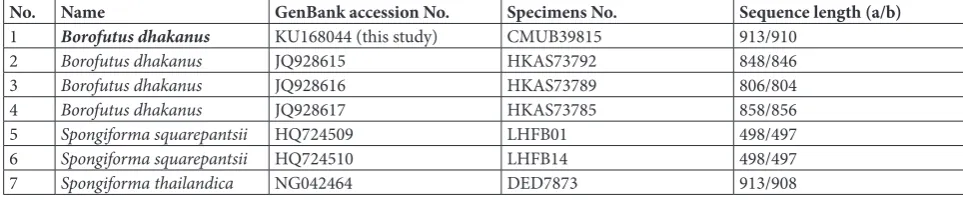
Table 2 The 28S rDNA sequence length of Borofutus dhakanus CMUB39815, HKAS73785, HKAS73789 and HKAS73792 compared with those of two Spongiforma species.
No. Name GenBank accession No. Specimens No. Sequence length (a/b)
1 Borofutusdhakanus KU168044 (this study) CMUB39815 913/910
2 Borofutus dhakanus JQ928615 HKAS73792 848/846
3 Borofutus dhakanus JQ928616 HKAS73789 806/804
4 Borofutus dhakanus JQ928617 HKAS73785 858/856
5 Spongiforma squarepantsii HQ724509 LHFB01 498/497
6 Spongiforma squarepantsii HQ724510 LHFB14 498/497
7 Spongiforma thailandica NG042464 DED7873 913/908
a − total bases including gap on the align sequences b − total bases of each sequences without gap
wall (0.7-1.2 μm thick), with an attenuate appendage, sometimes with a secondary septum. Pleurocystidia 80-108×11-18 µm, slightly thickened wall (0.5 μm), narrowly lageniform to broadly lageniform with an appendage-like apex. Pileipellis, a trichoderm when young, becoming a subcutis at maturity. Stipe trama composed of vertically arranged hyphae, hyphae 7-13 µm wide. Stipitipellis, a sterile hymenium-like struc-ture composed of subclavate or clavate to fusiform cells with projecting cystidia and yellowish brown to pale brown vacuolar pigmentation.
Specimens examined: Thailand, Chiang Mai Prov-ince, Doi Saket District, dry dipterocarp forest in Huai Hongkhrai Royal Development Study Center, 10 July 2010, S. Thongkantha CMUB39815 (SDBR-CMU-ST58-001); Thailand, Ubonratchathanee Province, Don Mot Daeng District, roadside market, 13 Septem-ber 2014, S. Vadthanarat SDBR-CMU-SV057.
Habitat: mostly solitary or often in small groups, usually found growing on red clay soil in dry dipte-rocarp forest dominated by Dipterocarpus spp. and
Shorea spp.
Molecular studies
Comparison of the highest percentage matched 28S rDNA sequence of the bolete CMUB39815 with three sequences of the type species of Borofutus dhakanus
[13] (99%: JQ928615-JQ928617) and Spongiforma
spp. (94%: S. squarepantsii: HQ724509, HQ724510 and S. thailandica: EU865108, NG042464) from Gen-Bank showed that a good quality nucleotide sequence of CMUB39815 (910 bases) is longer than those of
B. dhakanus JQ928617 (856), JQ928615 (846) and JQ928616 (804) with 54, 64 and 106 bases,
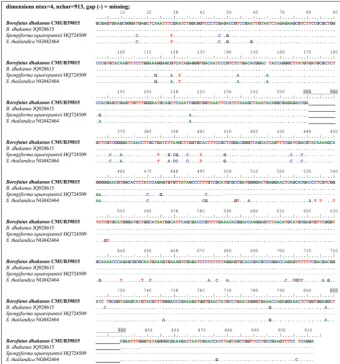
respec-tively. In addition, all are similar throughout their sequence alignment and only at a few positions the bases are not the same. The differentiation between the sequences of B. dhakanus and the two species of
Spongiforma were also investigated and the results are summarized in Table 2 and Fig. 2.
The combined dataset consisted of 851 and 652 nucleotides (including gaps) for 28S and ITS, respec-tively. In this alignment, 463 characters were constant, while 1040 characters were variable, of which 1343 were informative. For both datasets, phylogenetic trees generated from ML, MP and NJ analyses were almost identical, with minimal variation of the statisti-cal support values. Phylogenetic trees generated from both 28S (data not shown) and the combined datasets (Fig. 3) showed that Borofutus formed an independent clade in the family Boletaceae, clearly separated by ge-netic distance, and clustered with the gasteroid bolete
Spongiforma. The current phylogenetic relationship study of B. dhakanus CMUB39815 agrees well with the molecular analyses reported by Hosen et al. [13] and Wu et al. [22]. These results inply that Borofutus
is a member of Boletaceae with 99% bootstrap support in ML (Fig. 3) and it is sister to Spongiforma with high bootstrap support (100%).
The species complex of B. dhakanus/S. squarepan-tsii/S. thailandica clade with subfamily Austroboletoi-deae (Austroboletus fusisporus)/Boletoideae ( Porphyrel-lusporphyrosporus and Strobilomyces floccopus)/ Lecci-noideae (Leccinum scabrum, Octaviania asterosperma,
O. tasmanica, Rossbeevera vittatispora)/ Zangioideae
the subfamily Leccinoideae, one of seven subfamilies or major clades of Boletaceae supported by the multi-locus gene of 28S, translation elongation factor 1-al-pha (tef1-α), RNA polymerase largest subunit 1 and 2 (rpb 1) and (rpb 2) relationship analysis.
However, the ITS sequences of some other species of Austroboletus, Porphyrellus and Zangia,as well as those of Retiboletus spp. (Leccinoideae), need to be com-bined with 28S sequences to resolve their phylogenetic placement within subfamilies. Analysis of some other gene regions such as atp6, tef1-α, rpb 1, rpb 2 and/or the small subunit (18S) might be needed to clarify their genetic lineage within the complex species of Boletaceae
as well as at a higher taxonomic level [13, 22, 23-27].
Multiple base pairing of the ITS sequence of Boro-futus dhakanus CMUB39815 (800 bases) with those of three taxa, as reported by Hosen et al. [13], was observed: B. dhakanus JQ928606 (800), JQ928607 (745) and NR120117 (746) (Fig. 4). There is one site on the nucleotide sequence alignment that is shown as a deletion/insertion region at position 714-720.
The general morphological features combined with molecular evidence from the Thai specimen (CMUB39815) show that it is a best fit to B. dhaka-nus, which was described by Hosen et al. [13]. This species is characterized by a small- to medium-sized fruit body with grayish brown to cocoa brown pileus; subdecurrent hymenophore that changes from cream
Fig. 2. Multiple base pair indels in 28S rDNA sequence of Borofutus dhakanus CMUB39815
(910 bases), which is very similar to a sequence of JQ928615 but different from those of two
to golden brown, with broad and nearly hexagonal pores; basidiospores that are purple to purplish red in water [13] or brown-violet to purplish red in lac-toglycerol (this study), ornamented with irregular to regular shallow pits; cystidia lageniform and thick-walled. The Thai specimens have a slightly smaller pi-leus (25-50 mm vs. 30-65 mm) and the basidiospores are slightly shorter but equal in width (10.3-12.0×4.8-5.9 µm Q=2.0 vs. 10-14×4.5-6.5 μm, Q=2.3). The Thai specimen was found on red clay soil in a forest domi-nated by various species of Shorea and Dipterocarpus, features similar to the collection site of the holotype. However, the type specimen was reported as a mycor-rhizal bolete associated with Shorea robusta.
Tropical forests support a wide diversity of mac-rofungi, often including ectomycorrhizal fungi, which play a major role in nutrient cycling by mobilizing nitrogen and phosphorus [28]. Additionally, many species are also edible, for example, Boletus edulis, B.
griseus, B. nobilis, Phlebopusportentosus, Tylopilus balloui and T. virens. Edible mushrooms are not only appreciated for their texture, flavor and nutritional properties, but also for their bioactive compounds that have been demonstrated to possess antitumor, antimicrobial and other activities [29-32]. The present study also found that B. dhakanus is an edible species, an attribute not mentioned by Hosen et al. [13]. It is collected for cooking and for sale in northeastern
Fig. 4. Multiple base pairs of ITS sequences of Borofutus dhakanus CMUB39815, JQ928606, JQ928607 and NR120117. Numbers refer to the position in the align-ment from position 700-807 (1-700 are not shown because they are the same bases).
Fig. 3. Phylogenetic relationship among representative specimens of Boletaceae (Leccinoideae) and
Thailand (Fig. 1F and G). Further collections of B.
dhakanus are needed for additional studies on its ed-ibility as well as nutrition and content of bioactive compounds.
CONCLUSION
Basidiocarps of a small- to medium-sized bolete were collected during the rainy season (July, 2010) from dry dipterocarp forest areas of Huai Hongkhrai Royal Development Study Center in Chiang Mai Province. Based on both morphological and molecular analy-ses (28S rDNA and ITS sequences) this specimen (CMUB39815) was confidently identified as Borofu-tus dhakanus.
Acknowledgments: This work was partially supported by grants of the RTA5880006 program. Boonsom Bussaban thanks the Post-Doctoral Fellowship 2015, Faculty of Science, Chiang Mai Univer-sity for the 12-month financial support to Sutheera Thongkantha during March 2015 to February 2016. The authors are grateful to Mr. Santhiti Vadthanarat for information on the edibility of B.
dhakanus and photographs from the roadside market in Ubon-ratchathanee Province (Fig. 1F and G), and for lending the speci-men (SDBR-CMU-SV057). We thank Dr. Eric H.C. McKenzie for reading and editing the manuscript.
Conflict of interest disclosure: The authors have no conflict of interest.
REFERENCES
1. Chandrasrikul A, Suwanarit P, Sangwanit U, Morinaga T, Nishizawa Y, Murakami Y. Diversity of mushroom and mac-rofungi in Thailand. Bangkok: Kasetsart University Publish-ing; 2008. 514 p.
2. Chantorn K, Pachinburavan A, Sanoamuang N. Nine new records of boletes (Boletales, Hymenomycetes) from Nam Naw and Phu Rua National Parks, Thailand. KKU Res J. 2007;12(3):257-64.
3. Desjardin DE, Binder M, Roekring S, Flegel T. Spongiforma, a new genus of gasteroid boletes from Thailand. Fungal Div-ers. 2009;37:1-8.
4. Duengkae K. Diversity of macrofungi in Khek Watershed Area, Petchabun Province. Songklanakarin J Sci Tech. 2006;28(2):293-333. Thai.
5. Jones EBG, Hyde KD. Introduction of Thai fungal diversity. In: Jones EBG, Tanticharoen M, Hyde KD, editors. Thai fun-gal diversity. Pathum Thani: BIOTEC; 2004. p. 7-35. 6. Klinhom U. Edible Mushroom List of the survey in
2002-2007 from northeastern Thailand, (Part 2). Newsl Mush Grower. 2008;13(3):18-23. Thai.
7. Klinhom U, Klinhom W. Diversity of boletes in northeastern Thailand. Mahasarakarm: Apichart Printing; 2008. 139 p. Thai.
8. Rostrup E, Massee G. Fungi. In: Schmidt J, editor. Flora of Koh Chang: Contributions to the knowledge of the vegeta-tion in the Gulf of Siam. Copenhagen: Bianco Luno; 1902. p. 355-67.
9. Sanoamuang N.Wild Mushroom of Thailand: Biodiversity and utilization. Bangkok: Universal Graphic & Trading; 2010. 426 p. Thai.
10. Srihanan S, Petcharat V. Some species of wild boletes in Thailand. J Agric Technol. 2008;4(1):109-18.
11. Thongklam S. Diversity of boletes in some national parks of upper northern Thailand. [dissertation]. Chiang Mai: Fac-ulty of Sciences, Chiang Mai University. 2008. 143 p. 12. Chandrasrikul A, Suwanarit P, Sangwanit U, Lumyong S,
Payapanon A, Sanoamuang N, Phukahuta C, Petcharat V, Sardsud U, Duengkae K, Klinhom U, Thongkantha S, Thongklam S. Checklist of mushrooms (Basidiomycetes) in Thailand. Bangkok: Scand-Media Corporation; 2011. 432 p. 13. Hosen MI, Feng B, Wu G, Zhu XT, Li YC, Yang ZL. Borofu-tus, a new genus of Boletaceae from tropical Asia: phylogeny, morphology and taxonomy. Fungal Divers. 2013;58:215-26. 14. Kornerup A, Wanscher JH. Methuen Handbook of colour.
3rd ed. Sussex: Richard Clay; 1984. 252 p.
15. Doyle JJ. A rapid DNA isolation procedure for small quanti-ties of fresh leaf tissue. Phytochem Bull. 1987;19:11-5. 16. Vilgalys R, Hester M. Rapid genetic identification and
map-ping of enzymatically amplified ribosomal DNA from sev-eral Cryptococcus species. J Bacteriol. 1990;172(8):4238-46. 17. White TJ, Bruns T, Lee S, Taylor JW. Amplification and
direct sequencing of fungal ribosomal RNA genes for phy-logenetics. In: Innis MA, Gelfand DH, Sninsky JJ, White TJ, editors. PCR protocols: a guide to methods and applications. San Diego: Academic Press; 1990. p. 315-22.
18. Hall TA. BioEdit: a user-friendly biological sequence align-ment editor and analysis program for Windows 95/98/NT. Nucleic Acids Symp Ser. 1999;41:95-8.
19. Chenna R, Sugawara H, Koike T, Lopez R, Gibson TJ, Hig-gins DG, Thompson JD. Multiple sequence alignment with the clustal series of programs. Nucleic Acids Res. 2003;31(13):3497-500.
20. Tamura K, Stecher G, Peterson D, Filipski A, Kumar S. MEGA6 molecular evolutionary genetics analysis version 6.0. Mol Biol Evol. 2013;30(12):2725-9.
21. Swofford DL. PAUP* phylogenetic analysis using parsimony (* and others methods). version 4. Massachusetts: Sinauer Associates; 2002. 142 p.
22. Wu G, Feng B, Xu J, Zhu XT, Li YC, Zeng NK, Hosen MI, Yang ZL. Molecular phylogenetic analyses redefine seven major clades and reveal 22 new generic clades in the fungal family Boletaceae. Fungal Divers. 2014;69(1):93-115. 23. Binder M, Hibbett DS. Molecular systematics and biological
diversification of Boletales. Mycologia. 2007;98(6):971-81. 24. Dentinger BTM, Ammirati JF, Both EE, Desjardin DE,
Molec-ular phylogenetics of porcini mushrooms (Boletus section
Boletus). Mol Phylogenet Evol. 2010;57(3):1276-92. 25. Desjardin DE, Peay KG, Bruns TD. Spongiforma
squarepan-tsii, a new species of gasteroid bolete from Borneo. Mycolo-gia. 2011;103(5):1119-23.
26. Orihara T, Smith ME, Shimomura N, Iwase K, Maekawa N. Diversity and systematics of the sequestrate genus Octavi-ania in Japan: two new subgenera and eleven new species. Persoonia. 2012;28:85-112.
27. Zhao K, Wu G, Yang ZL. A new genus, Rubroboletus, to accommodate Boletus sinicus and its allies. Phytotaxa. 2014;188(2):61-77.
28. Read DJ, Perez-Moreno J. Mycorrhizas and nutrient cycling in ecosystems: a journey towards relevance? New Phytol. 2003;86:281-93.
29. Barros L, Ferreira M, Ferreira I, Queiros B, Baptista P. Total phenols, ascorbic acid, β-carotene, and lycopene in Portu-guese wild edible mushrooms and their antioxidant activi-ties. Food Chem. 2007;103(2):413-19.
30. Khumla J, Danell E, Bussaban B, Lumyong S. Suitable growth conditions and nutrition factors on in vitro cul-ture of Phlebopusportentosus (Boletales). Chiang Mai J Sci. 2011;38(1):156-9.
31. Vidovic S, Mujic I, Zekovic Z, Lepojevic Ž, Tumbas V, Mujic A. Antioxidant properties of selected Boletus mushrooms. Food Biophys. 2010;5(1):49-58.