Research Article
a
August
2017
Computer Science and Software Engineering
ISSN: 2277-128X (Volume-7, Issue-8)
Issues and Challenges Faced by Online Business Organizations
in Adopting Cloud Computing: A Research Agenda
1
Ahamed Lebbe Mohamed Ayoobkhan, 2David Asirvatham 1
Department of Accountancy and Finance, South Eastern University of Sri Lanka, Sri Lanka
2
School of Computing and IT, Taylor's University, Malaysia
DOI: 10.23956/ijarcsse/V7I8/01805
Abstract: With the rapid growth of processing and storage technologies and the success of the Internet, system resources are cheaper, more powerful and more advanced than ever. This technology helps to achieve a new computer model known as cloud computing, in which resources are provided as Internet applications that can be accessed and released from users on the Internet. Business organizations are increasing the cloud experience and they begin to change more important business functions onto cloud platforms. Cloud computing has been growing for companies around the world, but many are finding higher costs and more obstacles to cloud computing adoption than organization anticipated. As this is the latest trend in information technology, some companies are moving toward cloud computing. On the other hand, other companies cannot even take into consideration the idea of having their sensitive data outside their premises. Both of these cases represent companies that are just not very well informed. Over the past two decades, the online business organizations have been facing many commercial problems and challenges in their businesses such as managing available resources effectively, security threats in managing IT resources and high implementation cost. Therefore, this study reveal the literature review of the benefits can be served by cloud computing and the issues and challenges that Online business organizations (SME) faced, and how cloud computing is useful in solving these issues in Sri Lanka.
Keywords: Online business, issues, Cloud Computing, SMEs, challenges
I. INTRODUCTION
Nowadays, the growing of Information technology (IT) innovation led the online business organizations to make a decision regarding adoption of advanced technology to solve the organization‟s computing requirements, to support their services, products and to satisfy their business operation need to create a large infrastructure of Information technology and resources employment (Shah, 2014) . One of these technologies is “Cloud computing”. The cloud can give access to the business organizations in general and specifically for small and medium enterprises (SME‟s). There are several significant benefits to cloud computing with a specific reference to the reduction of cost savings benefits: hardware investment, maintenance costs, and low power consumption (Dwivedi and Mustafee, 2010; Garrison et al., 2012; Oliveira et al., 2014). The service is dynamically scalable (on-demand self-service and rapid elasticity) because users only have to consume the amount of online computing resources they actually need without human interaction with the provider (Cegielski et al., 2012; Brender and Markov, 2013). It is very useful for online business organizations that meet high and low demands of IT services and must pay only when it is paid for server usage increases. The service is based on a utility basis (pay-as-you-go service) and low investment result is no risk of immediate access to any fixed costs and cost savings improvements (Lin and Chen, 2012; Walterbusch et al., 2013; Oliveira et al., 2014).
II. CONCEPT OF CLOUD COMPUTING
Cloud computing is a computinginfrastructure and software model for enabling ubiquitous access to shared pools of configurable resources (such as computer networks, servers, storage, applications and services),which can be rapidly provisioned with minimal management effort, often over the Internet. Cloud computing allows users and enterprises with various computing capabilities to store and process data either in a privately-owned cloud, or on a third-party server located in a data center thus making data-accessing mechanisms more efficient and reliable.Cloud computing relies on sharing of resources to achieve coherence and economy of scale, similar to a utility(Peter Mell and Timothy Grance, 2011; M. Haghighat et at., 2015). National Institute of Standards and Technology (NIST) define the cloud computing as “Cloud computing is a model for enabling convenient, on demand network access to a shared pool of configurable computing resources (e.g. networks, servers, storage, applications, and services) that can be rapidly provisioned and released with minimal management effort or service provider interaction.”
III. CLOUD COMPUTING SERVICE MODEL
NIST clearly mentioned that, there are four key services classified as cloud services which are; Cloud providers and infrastructures, Cloud platforms, cloud software and Cloud data storages. But many researchers, focused on three classifications which are Infrastructure as a Service (IaaS), Platform as a Service (Paas) and Software as a Service (SaaS).
ISSN(E): 2277-128X, ISSN(P): 2277-6451, DOI: 10.23956/ijarcsse/V7I8/01805, pp. 260-264
consumer can deploy and run logical software, which can include operating systems (OS) and applications of it. The consumers do not manage or control the fundamental cloud infrastructure but has control over operating systems; storage capacities, deployed applications, and possibly limited control of select networking components i.e. host firewalls. Platform as a Service (PaaS) the capability provided to the consumer is to deploy on to the cloud infrastructure consumer-created or acquired applications made by using programming languages and tools supported by the service provider. The consumers do not manage or control the fundamental cloud infrastructure like network, servers, operating systems, or storage, but has control over the deployed applications and possibly application hosting environment configurations. Software as a Service (SaaS) the capability provided to the consumer is to use the service provider‟s applications running on a cloud infrastructure. The applications are accessible from various client devices through a thin client interface such as a web browser i.e. web-based email. The consumers do not manage or control the fundamental cloud infrastructure like network, servers, operating systems, storage, etc. application capabilities, with the possible exception of limited user-specific application configuration settings.
IV. DEPLOYMENT OF CLOUD COMPUTING TECHNOLOGY
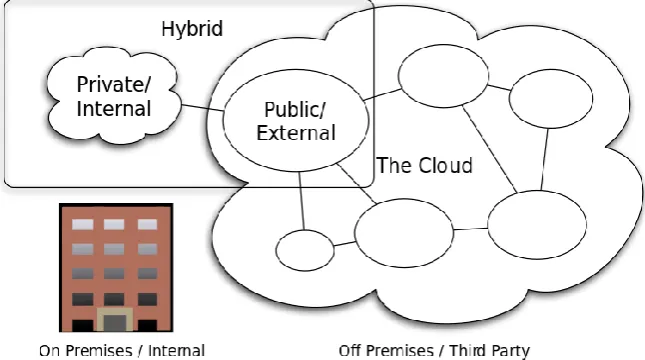
Cloud deployment consisting four models firstly Public cloud, secondly Private cloud, thirdly Hybrid cloud and fourth one is Community cloud.
A cloud is called a "public cloud" when the services are rendered over a network that is open for public use. Public cloud services may be free. There can be little or no difference between technically public and private cloud architecture, however, there may be considerable difference in the safety consideration of services (applications, storage, and other sources) available by the public viewer service provider, which may be in violation of an untrusted network.Generally, public cloud service providers like Amazon Web Services (AWS), Microsoft and Google own and operate the infrastructure at their data center and access is generally via the Internet (Rouse and Margaret, 2014).
Private cloud is cloud infrastructure operated solely for a single organization. It may be managed by the organization or a third party and may exist on premise or outside the premise. The major objective of private cloud is to share the data, services and resources between the employees within the business organization. Therefore, the efficient work environment to enhance the performance and efficiency of the company's effects through the private cloud and save both time and costs (M. Haghighat et at., 2015; Foley, John, 2010).Hybrid cloud is a composition of two or more clouds (private, community or public) that remain distinct entities but are bound together, offering the benefits of multiple deployment models. Hybrid cloud can also mean the ability to connect collocation, managed and/or dedicated services with cloud resources (Kaewkasi and Chanwit, 2015); Mell and Timothy Grance, 2011).
Figure 1: Cloud Computing Types
V. INTRINSIC WORTH OF CLOUD COMPUTING
The Vanson Bourne report identified some advantages of cloud computing that organizations are experiencing today, leading to quantifiable improvements in their businesses:
Fresh Software
With SaaS, the latest versions of the applications needed to run the business are made available to all customers as soon as they‟re released. Immediate upgrades put new features and functionality into workers‟ hands to make them more productive and also software enhancements are typically released quite frequently. This is in contrast to home grown or purchased software that might have major new releases only once a year or so and take significant time to roll out.
Do more with less
ISSN(E): 2277-128X, ISSN(P): 2277-6451, DOI: 10.23956/ijarcsse/V7I8/01805, pp. 260-264
Flexible costs
The costs of cloud computing are much more flexible than traditional methods. Companies only need to commission and thus only pay for server and infrastructure capacity as and when it is needed. More capacity can be provisioned for peak times and then de-provisioned when no longer needed. Traditional computing requires buying capacity sufficient for peak times and allowing it to sit idle the rest of the time.
Always-on availability
Most cloud providers are extremely reliable in providing their services, with many maintaining 99.99% uptime. The connection is always on and as long as workers have an Internet connection, they can get to the applications they need from practically anywhere. Some applications even work off-line.
Improved mobility
Data and applications are available to employees no matter where they are in the world. Workers can take their work anywhere via smart phones and tabletsroaming through a retail store to check customers out, visiting customers in their homes or offices, working in the field or at a plant, etc.
Improved collaboration
Cloud applications improve collaboration by allowing dispersed groups of people to meet virtuallyand easily share information in real time and via shared storage. This capability can reduce time-to-market and improve product development and customer service.
Cloud computing is more cost effective
Because companies don‟t have to purchase equipment and build out and operate a data center, they don‟t have to spend significant money on hardware, facilities, utilities and other aspects of operations. With traditional computing, a company can spend millions before it gets any value from its investment in the data center.
Expenses can be quickly reduced
During times of recession or business cut-backs (like the energy industry is currently experiencing), cloud computing offers a flexible cost structure, thereby limiting exposure.
Flexible capacity
Cloud is the flexible facility that can be turned up, down or off depending upon circumstances. For example, a sales promotion might be wildly popular, and capacity can be added quickly to avoid crashing servers and losing sales. When the sale is over, capacity can shrink to reduce costs.
Facilitate migrating activity
Cloud computing accommodates faster changes so that two companies can become one much faster and more efficiently. Traditional computing might require years of migrating applications and decommissioning data centers before two companies are running on the same IT stack.
Less environmental impact
With fewer data centers worldwide and more efficient operations, we are collectively having less of an impact on the environment. Companies who use shared resources improve their „green‟ credentials.
VI. CHALLENGES AND ISSUES IN ONLINE BUSINESS (E-BUSINESS)
Although cloud computing has many advantages, there are some significant constraints for adoption.
Security and Privacy
Cloud computing reflects a new computer model, since there is uncertainty about how security can be achieved at all levels.That uncertainty has consistently led information executives to state that security is their number one concern with cloud computing. The ability to address to the privacy rules and regulations of cloud computing is questionable. Organizations today face numerous different requirements attempting to protect the privacy of individuals‟ information, and it is not clear (Voorsluys W et at., 2011).
Connectivity and Open Access
The full range of cloud computing is available for fast access. Such connectivity, rather like electricity availability, globally opens the possibility for industry and a new range of consumer products. Connectivity and open access to computing power and information availability through the cloud promotes another era of industrialization and the need for more sophisticated consumer products (Buyya R et al., 2009).
Reliability
ISSN(E): 2277-128X, ISSN(P): 2277-6451, DOI: 10.23956/ijarcsse/V7I8/01805, pp. 260-264
begin with minimum disruption.Every aspect of authenticity should be addressed carefully as part of the Service Level Agreement (SLA) while testing with failed service providers.
Interoperability
Communication and portability between private clouds and public clouds provide criticalcapabilities to the broad adoption company of cloud computing. Many companies have made considerable progress toward standardizing their processes, data, and systems through implementation of Enterprises Resource Planning (ERP). This process has been enabled by scalable infrastructures to create single instances, or highly integrated connections between instances, to manage the consistency of master and transaction data and produce reliable consolidated information. Even with these improved platforms, the speed at which businesses change may still outpace the ability of IT organizations to respond to these changes (Buyya R et al., 2009).
Economic Value
The growth of cloud computing is predicated on the return on investment that accrues. It seems intuitive that by sharing resources to smooth out peaks, paying only for what is used, and cutting upfront capital investment in deploying IT solutions, the economic value will be there. There will be a need to carefully balance all costs and benefits associated with cloud computingin both the short and long terms. Hidden costs could include support, disaster recovery, application modification, and data loss insurance. There will be threshold values whereby consolidating investments or combining cloud services makes sense; for example, it might not be efficient or cost-effective to utilize multiple autonomous SaaS applications. Each may contract for disaster recovery program services. There is a point where economies of scale mean these functions should be combined in a similar service. Application usage may begin with a low volume of transactions that can be supported with semi-automated master data management (Zhang J et at., 2008).
Changes in the IT Organization
The IT organization will be affected by cloud computing, as has been the case with other technology shifts. There are two dimensions to shifts in technology. The first is acquiring the new skill sets to deploy the technology in the context of solving a business problem, and the second is how the technology changes the IT role. The speed of change will impact the adoption of cloud technologies and the ability to decompose mature solutions from hype to deliver real value fro m cloud technology; and the need to maintain the controls to manage IT risk in the business will increase (Buyya R et al., 2009).
Political Issues
Due to Global Boundaries In the cloud computing world, there is variability in terms of where the physical data resides, where processing takes place, and from where the data is accessed. Given this variability, different privacy rules and regulations may apply. Because of these varying rules and regulations, by definition politics becomes an element in the adoption of cloud computing, which is effectively multijurisdictional. For cloud computing to continually evolve into a borderless and global tool, it needs to be separated from politics. Currently, some major global technological and political powers are making laws that can have a negative impact on the development of the global cloud. Providers have been unable to guarantee the location of a company's information on specified set of servers in this issue (Parrilli DM, 2010; Mather T et at., 2008).
VII. CLOUD COMPUTING AND ONLINE BUSINESS (E-BUSINESS) IN SRI LANKA
Nowadays, both cloud computing and e-business (online business) are two bases of a coin, and there are two main factors. They are popular because they are both expensive. Cloud computing saves business organization‟s the cost of Information Technology infrastructure, on the other hand eBusiness allows traders to do business without renting or buying a business entity shop. Cloud provides positive opportunitiesfor online business organizations, but before adopting it, companies should have a trade-off between costs. Many researcher illustrate that cloudcomputing and E-business the most attractive industries has being developed at high rate in recent years, with the Political,Economic, Sociological and Technological factors have had a positive influence on its development. Online business and cloudcomputing can be explained as follow by several researchers:
The rapid growth of the global economy accelerates the developing of online web based business transactions.
Online shopping is becoming a new trend as it is more convenient comparing to traditional way of shopping.
The information security technologies are developing rapidly.
Due to this the level of education and IT skills of consumers have been improved.
The developing of telecommunications infrastructure accelerates the development of e-commerce Industry
across theworld.
Cloud Computing provides opportunities for small-sized and middle-sized companies to move to the Internet with lesseffort.
ISSN(E): 2277-128X, ISSN(P): 2277-6451, DOI: 10.23956/ijarcsse/V7I8/01805, pp. 260-264
Sri Lankans have an improved view of market conditions, according to the latest MasterCard consumer confidence index released in mid-January 2015, with a 2.1-point increase in sentiment levels from the previous year, taking the country‟s score on the index to 40.1.
This moves Sri Lanka from having a pessimistic outlook to a neutral one, and, while still well short of a positive score of 60, suggests a greater willingness to spend.The result of the latest survey marks a modest turnaround from the previous MasterCard report issued in August 2015, which recorded a 4.2-point fall in sentiment.
The incremental improvement in consumer sentiment was also reflected in the steady if unspectacular increase in retail and wholesale activity in the third quarter of 2016, the latest period for which data has been released by the Department of Census and Statistics.
Retail and wholesale trade posted a 4.6% increase year-on-year (y-o-y) in the third quarter. While this was in line with the 4.7% expansion of the wider services sector, it was above the 4.1% y-o-y rise recorded by the broader economy. Therefore, there is a chance to enhance and motivate business sector in Sri Lankan by adopting new technology.
VIII. CONCLUSION
Cloud computing provides opportunity to Small and Medium Enterprises (SMEs)particularly to Online business organizations to manage their valuable IT resources and infrastructure. However, cloud computing can be beneficial to the SMEs and in the same time there are several issues and challenges that should be taken into consideration whileapplying cloud. The adoption decision of cloud computing by online business organizations will make significant changes in the business. The aim of this research agenda is to investigate the behavioral intention of online business organizations whether to use or not use cloud computing technology in their business process.Adopting one or another technology should start by evaluating the economical processes of the organization. Information technology is, or supposed to be, an integrated part of a business and need technology to support or improve the economical processes. Before rushing into the cloud, the company should study their processes and evaluate the risks and advantages brought to their business. Since the small and mid-size companies have less complex processes, they should be the first category of businesses to use cloud computing services.
REFERENCE
[1] Amies, Alex; Sluiman, Harm; Tong, Qiang Guo; Liu, Guo Ning (July 2012). "Infrastructure as a Service Cloud
Concepts". Developing and Hosting Applications on the Cloud. IBM Press. ISBN978-0-13-306684-5.
[2] Bayrak, E., Conley, J.P., and Wilkie, S.: „The economics of cloud computing‟, The Korean Economic Review,
2011, 27, (2), pp. 203-230
[3] Buyya, R., Yeo, C.S., Venugopal, S., Broberg, J., and Brandic, I.: „Cloud computing and emerging IT platforms:
Vision, hype, and reality for delivering computing as the 5th utility‟, Future Generation computer systems, 2009, 25, (6), pp. 599-616.
[4] Chu, C., and Smithson: „Eıbusiness and organizational change: a structurational approach‟, Information Systems
Journal, 2007, 17, (4), pp. 369-389.
[5] Foley, John. "Private Clouds Take Shape". InformationWeek. Retrieved 2010-08-22. [6] Kaewkasi, Chanwit (3 May 2015). "Cross-Platform Hybrid Cloud with Docker".
[7] Mell, P., and Grance, T.: „The NIST definition of cloud computing. National Institute of Standards and Technology‟, Information Technology Laboratory, Version, 2009, 15, (10.07), pp. 2009.
[8] M. Haghighat, S. Zonouz, & M. Abdel-Mottaleb (2015). CloudID: Trustworthy Cloud-based and
Cross-Enterprise Biometric Identification. Expert Systems with Applications, 42(21), 7905–7916.
[9] Mather T, Kumaraswamy S, Latif S. ”Cloud Security and Privacy: An Enterprise Perspective on Risks and
Compliance”, O‟Reilly Media, 2009.
[10] Peter Mell and Timothy Grance (September 2011).The NIST Definition of CloudComputing (Technical
report). National Institute of Standards and Technology: U.S. Department of Commerce, Special publication 800-145.
[11] Parrilli DM. Legal Issues in Grid and cloud computing, Grid and Grid Computing (2010) 97–118.
[12] Rouse, Margaret."What is public cloud?". Definition from Whatis.com. Retrieved 12 October 2014.
[13] Shah, J. P. (2014). Challenges in Cloud Computing and Ecommerce in SME‟s. RESEARCH HUB –
International Multidisciplinary Research, 4-8
[14] Voorsluys W, Broberg J, Buyya R. Cloud Computing Principles and Paradigm, John Wiley and Sons, 2011
[15] Zhang J, Bandyopadhyay S, Piramuthu S. Real option valuation on grid computing, Decision Support Systems