ISSN-L: 2501 - 1235 Available on-line at: www.oapub.org/edu
doi: 10.5281/zenodo.3859054 Volume 6 │ Issue 4 │ 2020
ACUTE EFFECT OF INSPIRATORY MUSCLE WARM-UP PROTOCOL
ON KNEE FLEXION-EXTENSION ISOKINETIC STRENGTH
Cahit Kayar,
Mustafa Özdali,
Mehmet Vural
Gaziantep University, Sport Science Faculty, Gaziantep, Turkey
Abstract:
In this study, it was planned to investigate the acute effect of inspiratory muscle warm-up protocol on knee flexion-extension isokinetic strength. In our study, control and two different experimental applications were performed on sedentary individuals (n: 15, age: 22.25 ± 1.49 years). In the control application, the subjects participated in the 60os-1 180os-1 and 240os-180os-1 knee flexion-extension isokinetic test, respectively, without general warm-up. Isokinetic tests performed after general warm-up in one of the experimental trials. In the other experimental trial, in addition to general warming, the same isokinetic tests were performed after performing 30 breaths of respiratory muscle twice at 40% maximal inspiratory pressure intensity. One-way analysis of variance and LSD tests were performed for repeated measurements to determine the difference between trials. There were significant differences in 60o PT H / Q Ratio, 60o WH / Q Ratio, 60o PTEx, 60o WEx, 60o PTFlx, 60o FIFlx and 60o WFlx 180o PT H / Q Ratio (%), 180o PTEx (nm), 180o APEx (watts), 180o PTFlx (nm), 180o FIFlx (nm), 180o WFlx (nm / repeat) 240o PTEx (nm), 240o WEx (nm / repeat), 240o PTFlx (nm), 240o FIFlx (nm) and 240o WFlx (nm / repeat) parameters in favor of experimental applications (p <0.05). There was no significant difference between applications in other parameters measured (p> 0.05). As a result, it can be said that inspiratory muscle warm-up exercise lowers the fatigue index and therefore increases the peak torque, average power and total workforce, and it affects the knee flexion-exudate isokinetic strength acutely.
Keywords: warm-up, inspiratory, isokinetic strength respiratory muscle
1. Introduction
Warm-up is a important work done before training and competition. It tries to adapt to the training to be done by stimulating the warming muscles that vary according to the training to be applied (1). As long as the dosage and intensity of the warming are well adjusted, success affects success and injuries have a preventive effect (2). It is observed that warming, which is defined as maximizing the performance of the athlete, preventing possible injuries and preparing the athlete for training physically and mentally, increases the sports efficiency, and has an effect on minimizing the damage to the muscle as a result of the effects on movement angles, mental and nervous systems (3). As the studies on warming deepen, research involving inspiratory muscle warm-up, respiratory warm-up or respiratory muscle warm-up exercises has been revealed, and the positive effects on the efficiency of the athlete have been mentioned in these studies (4).
The respiratory system is very important for training. Due to this importance of the respiratory system, it has been stated that adequate heating of the inspiratory muscles before exercise is also extremely important to increase efficiency (5). Because these warm-up studies increase the duration of enduring the difficulty of the activity to be performed, and this leads to an increase in the efficiency to be obtained from the muscles of the left during this period (6). Doing so much work on this event reveals how directly the respiratory muscles are proportional to the efficiency in exercise. Although there are many studies on the respiratory muscles, there are very few studies on the warm-up exercises of the muscles of the left.
In the light of this information, the aim of this study is to determine the effects of respiratory muscle warm-up exercise on the flexion-extension isokinetic strength of the knee joint, which is one of the important joints of our movement system.
2. Method
Our study was designed according to the application-controlled cross-test design in repeated measurements. 15 sedentary male subjects in the 20-25 age group participated in the study (Table 1). No nutrition program was also applied to the subjects. GPower 3.1 for determining the number of subjects. program, power analysis was done. No nutrition program was also applied to the subjects. Necessary permissions were obtained from the Gaziantep University Clinical Research Ethics Committee for this study. Subjects visited the lab four times. Each visit was made at the same time of the day (13.00 - 18.00).
• Tests and warm-up types were introduced at the first visit and voluntary consent forms were taken.
• In the second visit, knee flexion and extension isokinetic force measurements were performed without warming up first.
applied rondomized, followed by knee flexion and extension isokinetic force measurement.
• All relevant measurements and tests were carried out at Gaziantep University Faculty of Physical Education and Sports Sciences Performance Laboratory.
Table 1: Descriptives
Minimum Maximum Mean Std. Dev.
Age (years) 21 25 22.25 1.49
Height (cm) 188 172 180.62 5.80
Weight (kg) 82 59 73.50 7.62
2.1 Isokinetic Strength Measurement
In the study, computer controlled isokinetic dynamometer (Humac Norm Testing and Rehabilitation System, CSMI, USA) was used to determine the isokinetic knee Ex and Flx forces of the subjects.
Immediately after the general warm-up protocol, subjects' dynamometer seat, dynamometer, adapter and other settings were adjusted according to the fixed protocol set for knee Ex and Flx forces (7).
2.2 Inspiratory Warm-up Protocol
Experiment and two different control applications were done. In the first application, general warming was performed in the second application and the inspiratory muscle warming was performed. Powerbreathe brand inspiratory muscle training device was used for inspiratory muscle warm-up exercise. The subjects were asked to perform normal inspiration and expiration with the device in the form of two sets of 30 breaths with the inspiratory muscle warming device set at 40% of the maximal inspiratory oral pressure (MIP). 1 minute rest will be given between 2 sets (8). A separate inspiratory muscle training device was used for each subject.
2.3 MIP measurement
For the calculation of MIP, M.E.C. Pocket Spiro MPM100 brand electronic respiratory pressure meter is used. Measurements were made using the nasal plug in a sitting position. For MIP; the person was given maximum expiration and was asked to perform maximum inspiration against the closed respiratory tract and maintain it for 1-3 seconds. The measurement was repeated until there was a difference of 5 cmH2O between the two best measurements and the best result was recorded in cmH2O (9).
2.4 Statistical method
3. Results
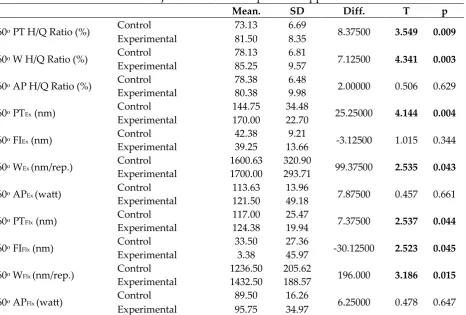
Table 2: Analysis of 60os-1 isokinetic force values between subjects' control and experiment applications
Mean. SD Diff. T p
60o PT H/Q Ratio (%) Control 73.13 6.69 8.37500 3.549 0.009
Experimental 81.50 8.35
60o W H/Q Ratio (%) Control 78.13 6.81 7.12500 4.341 0.003
Experimental 85.25 9.57
60o AP H/Q Ratio (%) Control 78.38 6.48 2.00000 0.506 0.629
Experimental 80.38 9.98
60o PTEx (nm) Control 144.75 34.48 25.25000 4.144 0.004
Experimental 170.00 22.70
60o FIEx (nm) Control 42.38 9.21 -3.12500 1.015 0.344
Experimental 39.25 13.66
60o WEx (nm/rep.) Control 1600.63 320.90 99.37500 2.535 0.043
Experimental 1700.00 293.71
60o APEx (watt) Control 113.63 13.96 7.87500 0.457 0.661
Experimental 121.50 49.18
60o PTFlx (nm) Control 117.00 25.47 7.37500 2.537 0.044
Experimental 124.38 19.94
60o FIFlx (nm) Control 33.50 27.36 -30.12500 2.523 0.045
Experimental 3.38 45.97
60o WFlx (nm/rep.) Control 1236.50 205.62 196.000 3.186 0.015
Experimental 1432.50 188.57
60o APFlx (watt) Control 89.50 16.26 6.25000 0.478 0.647
Experimental 95.75 34.97
SD: standard dev.. Ex: Extention. Flx: Flexion. PT: Peak Torque. FI: Fatigue index. W: Work. AP: Average power. H/Q: hamstring/quadriceps Ratio.
Table 2 shows the analysis of 60os-1 isokinetic force values between subjects' control and experimental applications. There was a significant difference in favor of experiment application between 60o PT H / Q Ratio, 60o W H / Q Ratio, 60o PTEx, 60o WEx, 60o PTFlx, 60o FIFlx and 60o WFlx in favor of experimental application (p <0.05). There was no significant difference between applications in other measured values (p> 0.05).
Table 3: Analysis of 180os-1 isokinetic force values
between subjects' control and experiment applications
Mean. SD Diff. T p
180o PT H/Q Ratio (%) Control 68.13 16.32 14.62500 2.452 0.044
Experimental 82.75 7.05
180o W H/Q Ratio (%) Control 75.63 24.99 11.75000 1.272 0.244
Experimental 87.37 6.76
180o AP H/Q Ratio (%) Control 70.00 18.39 113.62500 1.099 0.308
Experimental 183.63 286.70
180o PTEx (nm) Control 119.38 15.32 9.62500 2.715 0.030
Experimental 129.00 15.62
180o FIEx (nm) Control 32.88 8.17 -3.00000 0.843 0.427
180o WEx (nm/rep.) Control 1436.75 201.45 7.00000 0.115 0.912
Experimental 1443.75 230.67
180o APEx (watt) Control 207.88 27.25 14.75000 2.591 0.046
Experimental 222.63 29.99
180o PTFlx (nm) Control 87.25 23.14 11.75000 2.432 0.048
Experimental 99.00 17.74
180o FIFlx (nm) Control 16.38 18.12 -15.37500 2.509 0.042
Experimental 1.00 35.07
180o WFlx (nm/rep.) Control 1067.63 358.14 191.00000 2.482 0.046
Experimental 1258.63 205.58
180o APFlx (watt) Control 156.00 50.61 15.87500 0.838 0.430
Experimental 171.88 29.28
SD: standard dev.. Ex: Extention. Flx: Flexion. PT: Peak Torque. FI: Fatigue index. W: Work. AP: Average power. H/Q: hamstring/quadriceps Ratio.
Table 3 shows the analysis of 180os-1 isokinetic force values between subjects' control and experimental applications. In favor of experiment between control and experiment applications at 180o PT H / Q Ratio (%), 180o PTEx (nm), 180o APEx (watt), 180o PTFlx (nm), 180o FIFlx (nm), 180o WFlx (nm / repeat) there was a significant difference (p <0.05). There was no significant difference between applications in other measured values (p> 0.05).
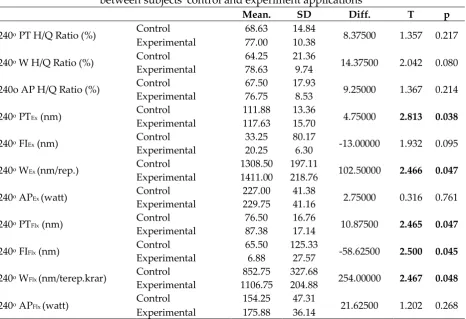
Table 4: Analysis of 240os-1 isokinetic force values between subjects' control and experiment applications
Mean. SD Diff. T p
240o PT H/Q Ratio (%) Control 68.63 14.84 8.37500 1.357 0.217
Experimental 77.00 10.38
240o W H/Q Ratio (%) Control 64.25 21.36 14.37500 2.042 0.080
Experimental 78.63 9.74
240o AP H/Q Ratio (%) Control 67.50 17.93 9.25000 1.367 0.214 Experimental 76.75 8.53
240o PTEx (nm) Control 111.88 13.36 4.75000 2.813 0.038
Experimental 117.63 15.70
240o FIEx (nm) Control 33.25 80.17 -13.00000 1.932 0.095
Experimental 20.25 6.30
240o WEx (nm/rep.) Control 1308.50 197.11 102.50000 2.466 0.047
Experimental 1411.00 218.76
240o APEx (watt) Control 227.00 41.38 2.75000 0.316 0.761
Experimental 229.75 41.16
240o PTFlx (nm) Control 76.50 16.76 10.87500 2.465 0.047
Experimental 87.38 17.14
240o FIFlx (nm) Control 65.50 125.33 -58.62500 2.500 0.045
Experimental 6.88 27.57
240o WFlx (nm/terep.krar) Control 852.75 327.68 254.00000 2.467 0.048
Experimental 1106.75 204.88
240o APFlx (watt) Control 154.25 47.31 21.62500 1.202 0.268
Experimental 175.88 36.14
Table 4 shows the analysis of 240os-1 isokinetic force values between subjects' control and experimental applications. There was a significant difference between 240o PTEx (nm), 240o WEx (nm / repeat), 240o PTFlx (nm), 240o FIFlx (nm), 240o WFlx (nm / repeat) in favor of experiment application (p <0.05) . There was no significant difference between applications in other measured values (p> 0.05).
4. Discussion
As a result of the literature study we have conducted, many studies have not been found on the effects of respiratory warming on knee isokinetic strength. However, as a result of my literature study, many domestic and foreign studies have been found on the effects of respiratory warming on leg strength, general strength or respiratory muscle strength.
In a study conducted by Özdal for the respiratory muscles in 2016, he examined the effect of warming the respiratory muscles on muscle strength and aerobic anaerobic power. According to the results obtained from the study, it has been revealed that respiratory muscle warm-up exercises have a positive effect on respiratory muscle strength and aerobic anaerobic performance, but have not much effect on anaerobic performance (10).
Romer et al. (2002), in his study on respiratory muscles, revealed that there was no noticeable difference in the VO2max values of the participants. Based on this study, it can be said that respiratory muscle training is not very important in increasing the VO2max value (11).
Lomax et al. (2011) In another study, twelve men were subjected to four experimental experiments. Two studies (trials 1 and 2) came before the 4-week 1x30 breath training period at 50% (experimental group) or 15% (control group) maximum inspiratory mouth pressure (pimax). Two more attempts (trials 3 and 4) were carried out after 4 weeks. A warm-up was performed before Trials 2 and 4. As a result of studies that performed 2x30 breaths in 40% pIMAx, it was found that when inspiratory muscle training and inspiratory muscle warming were applied separately, it was found to delay fatigue and it was found to be more beneficial when combined and applied as a combination (12).
In 2018, Vural's effect on respiratory functions and respiratory muscle strength in individuals with down syndrome inspiratory muscle training was investigated. In the study, 9 experiments were performed with 7 control groups for 5 days a month for 1 month, and as a result, inspiratory muscle training helped to eliminate the respiratory propagation because it strengthens the respiratory muscles and it has a positive effect on respiratory muscle strength (13).
Arend et al. (2015) did not achieve an increase in the VO2max parameter during the submaximal rowing performance of the respiratory muscle warm-up exercise in their study on 10 male rowers with an MIP average of 140.7 ± 46.6 cmH2O (15).
In another study conducted on young footballers, it was reported that there was no significant change in VO2max values after a four-week respiratory muscle training program (16).
In Volianitis et al (2011), 14 women were divided into two groups as subjects and placebo to examine their performance before and after 11 weeks of inspiratory muscle training in rowers. The placebo group consisted of 50 breaths with 50% of the MRP reference value twice a day and 60 breaths with a 15% equivalent inspiration resistance of the MRP once a day. While the inspiratory muscle strength of the exercise group increased by 45.3%, only 5.3% of the placebo group increased (17).
As a result of our work; as a result of this decrease, the duration of reaching peak torque decreased and the average power increased. As a result of the positive results in peak torque and averange power values, the total work value per increase also increases. As a result, it can be said that the respiration warming has a positive effect on knee isokinetic strength.
References
1. Alkaş E. (2006). Quantification of The Effect of Warm Up and Stretching on the
Oxygen Metabolism Using an İmproved Version of a Fnırs Device; Boğaziçi
Üniversitesi, Biyomedikal Mühendislik Enstitüsü, Yüksek Lisans Tezi, 11. İstanbul.
2. Karakurt A. (2000). Sporda Isınmanın, Isınma Öncesi Ve Isınma Sonrası Sıçrama Hareketine Etkisinin Araştırılması; Dicle Üniversitesi, Sağlık Bilimleri Enstitüsü,
Yüksek Lisans Tezi, 1. Diyarbakır.
3. Weerapong P. (2005). Preexercise Strategies: The Effect of Warm Up, Stretching and Massage on Symptoms of Eccentric Exercise İnduced Muscle Damage and
Performance; Auckland University of Technology, New Zeland, Doctoral Thesis, 24. 4. Volianitis S., McConnell A. K., Koutedakis Y., Jones D. A. (2001a). Specific respiratory
warm-up improves rowing performance and exertional dyspnea. Med Sci Sports Exerc.;33(7):1189–1193.
5. McConnell A. K., Caine M. P., Sharpe G. R. (1997). Inspiratory muscle fatigue following running to volitional fatigue: The influence of baseline strength. Int J Sports Med;18(3):169-173.
6. Volianitis S., McConnell A. K., Jones D. A. (2001b). Assessment of maximum
inspiratory pressure. Prior submaximal respiratory muscle activity (‘warm-up’)
enhances maximum inspiratory activity and attenuates the learning effect of repeated measurement. Respiration; 68:22–27.
8. Özdal M. (2016). Acute effects of inspiratory muscle warm-up on pulmonary function in healthy subjects. Respiratory Physiology & Neurobiology; 227:23-6.
9. Barğı G., Güçlü M. B., Arıbaş Z., Akı Ş. Z., Sucak G. T. (2016). Inspiratory muscle
training in allogeneic hematopoietic stem cell transplantation recipients: a randomized controlled trial. Supportive Care in Cancer; 24(2):647-59.
10.Özdal M. (2015). Solunum Kaslarına Yönelik Isınma Egzersizlerinin Aerobik ve
Ananerobik Güce Etkisi, Ondokuz Mayıs Üniversitesi Sağlık Bilimleri Enstitüsü
Beden Eğitini ve Spor Anabilimdalı, Doktora Tezi Samsun.
11.Romer L. M., McConnell A. K., Jones D. A. (2002). Effects of inspiratory muscle training on timetrial performance in trained cyclists. Journal of Sports Sciences; 20(7):547-562.
12.Lomax M., Grant I., Corbett J. (2011). Inspiratory muscle warm-up and inspiratory muscle training: seperate and combined effects on intermittent running to exhaustion; J Sports Sci. 29(6):563-569.
13.M. Vural (2018). İnspiratuar Kas Antrenmanının Down Sendromlu Bireylerde
Solunum Fonksiyonları Ve Solunum Kas Kuvvetine Etkisi 2018. Gaziantep
Üniversitesi.Gaziantep Üniversitesi Sağlık Bilimleri Enstitüsü Yüksek Lisans Tezi.
14.Volianitis S., McConnell A. K., Koutedakis Y., Jones D. A. (2001). Specific respiratory warm-up improves rowing performance and exertional dyspnea. Med Sci Sports Exerc. 33(7):1189–1193).
15.Arend M., Maestu J., Kıvastık J., Ramson R., Jürimae J. (2015). Effect of inspiratory muscle warm-up on submaximal rowing performance; J Strength Cond Res. 29(1):213-218).
16.Özgider C. Genç (2009). Futbolcularda Dört Haftalık Solunum Kası Antrenmanı Toparlanma Performansını Geliştirir Fakat Solunum Fonksiyonlarını Ve Maksimum
Oksijen Kullanım Kapasitesini (VO2max) Geliştirmez, Orta Doğu Teknik
Üniversitesi, Sosyal Bilimler Enstitüsü, Yüksek Lisans tezi, 56 sayfa, Ankara, (Prof.Dr. Feza Korkusuz).
Creative Commons licensing terms