MHD FLOW PAST AN IMPULSIVELY STARTED VERTICAL PLATE
WITH VARIABLE TEMPERATURE IN THE PRESENCE OF HALL CURRENT
U. S. RAJPUT
1, NEETU KANAUJIA*
11
Department of Mathematics and Astronomy, University of Lucknow, Lucknow – (U.P.), India.
(Received On: 20-10-15; Revised & Accepted On: 25-11-15)
ABSTRACT
I
n the present paper, MHD flow past an impulsively started vertical plate with variable temperature in the presence of Hall current is studied. The fluid considered is electrically conducting, absorbing-emitting radiation in a non-scattering medium. The Laplace transform technique has been used to find the solutions for the velocity profiles and Skin friction. The velocity profile and Skin friction have been studied for different parameters like Prandtl number, Hall parameter, magnetic field parameter, Thermal Grashof number, and time. The effect of parameters is shown graphically and the value of the skin-friction for different parameters has been tabulated.
Keywords: MHD, Heat transfer, Hall current, Skin friction.
INTRODUCTION
The study of MHD flow was first initiated by a Swedish electrical engineer Hannes Alfven [5]. MHD flow and Hall effect are encountered in power genertors, refrigeration coils, and electric transfers etc. The researchers have studied the effect of Hall current in various flow models. Ram et al. [10] have studied the Hall effects on heat and mass transfer flow through porous medium. Sulochana[13] have analyzed Hall effects on unsteady MHD three dimensional flow through a porous medium in a rotating parallel plate channel with effect of inclined magnetic field. Attia [6] studied the effect of variable properties on the unsteady Hartmann flow with heat transfer considering the Hall effect. Attia along with Ahmed [7] have further Studied the Hall effect on unsteady MHD Couette flow and heat transfer of a Bingham fluid with suction and injection. Ahmed et al. [9] have studied unsteady MHD free convective flow past a vertical porous plate immersed in a porous medium with Hall current, thermal diffusion and heat source. Rajput and Kumar [16] have studied MHD flow past an impulsively started vertical plate with variable temperature and mass diffusion. We are extending their [16] work to study the effect of hall current in the flow.
The effects of Hall current on the velocity have been observed with the help of graphs, and the skin friction has been tabulated.
MATHEMATICAL FORMULATION
We consider an unsteady viscous incompressible electrically conducting fluid past an impulsively started vertical plate. The plate is electrically non conducting. A uniform magnetic field
B
is assumed to be applied on the flow. Initially the fluid and plate are at the same temperatureT
∞. At time t>0, temperature of the plate is raised toT
w. Using the relation0
=
•
∇
B
, for the magnetic fieldB
=
(
B
x,
B
y,
B
z)
, we obtainB
y(sayB
0) = constant, forB
=
(
0
,
B
0,
0
)
, whereB
0is the externally applied transverse magnetic field. Due to the Hall effects there will be two components of the momentum equation, which are as under. The usual assumptions have been taken in to consideration.
),
(
)
1
(
)
(
22 0 2
2 2
mw
u
m
B
T
T
g
y
u
t
u
+
+
−
−
+
∂
∂
=
∂
∂
∞
ρ
σµ
β
υ
(1)
),
(
)
1
(
22 0 2
2
mu
w
m
B
y
w
t
w
−
+
−
∂
∂
=
∂
∂
ρ
σµ
υ
(2)
.
2 2y
T
C
k
t
T
P∂
∂
=
∂
∂
ρ
(3)The following boundary conditions have been assumed:
y,
of
values
the
all
for
,
0
,
0
:
0
=
=
=
∞≤
u
w
T
T
t
(
)
at
y
0,
,
0
,
:
0
2 00
=
=
+
−
=
=
>
∞ ∞υ
t
u
T
T
T
T
w
u
u
t
w (4)0,
0,
as y
0,
u
→
w
→
T
→
T
∞→
where u is the velocity of the fluid in x- direction, w - the velocity of the fluid in z- direction,
m
is the Hall parameter, g–acceleration due to gravity,β
-volumetric coefficient of thermal expansion, t- time,T
∞- the temperature of the fluid near the plate,T
w - temperature of the plate, T - the temperature of the fluid far away from the plate, k - the thermal conductivity,υ
is the kinematic viscosity,ρ
-the fluid density,σ
-electrical conductivity,µ
-the magnetic permeability, and CP the specific heat at constant pressure. Herem
=
ω
eτ
e withω
e- cyclotron frequency of electrons andτ
e- electron collision time.To write the equations (1) - (3) in dimensionless from, we introduce the following non - dimensional quantities:
,
,
Pr
,
,
,
2 0 0 0 0υ
µ
υ
tu
t
k
C
yu
y
u
w
w
u
u
u
=
=
=
=
P=
(5)
,
2 0 2 0u
B
M
ρ
υ
σ
=
(
3)
,
.
0 ∞ ∞ ∞
−
−
=
−
=
T
T
T
T
u
T
T
g
Gr
w wθ
βυ
Here the symbols used are:
u
-dimensionless velocity,w
-dimensionless velocity, Pr-Prandtl number, M-magnet field parameter,y
-dimensionless coordinate axis normal to the plate,θ
- dimensionless temperature, Gr - thermal Grashof number.The dimensionless forms of Equation (1), (2), and (3) are as follows:
),
(
1
2 2 2w
m
u
m
M
Gr
y
u
t
u
+
+
−
+
∂
∂
=
∂
∂
θ
(6)(
)
,
1
2 2 2m
u
w
m
M
y
w
t
w
−
+
−
∂
∂
=
∂
∂
(7).
Pr
1
2 2y
t
∂
∂
=
∂
∂
θ
θ
(8)
The corresponding boundary conditions are:
y,
of
values
all
for
,
0
,
0
,
0
,
0
=
=
=
≤
u
w
t
θ
0,
y
at
,
0
,
1
,
0
=
=
=
=
>
u
w
t
t
θ
(9).
y
as
0
,
0
,
0
→
→
→
∞
→
w
u
θ
Dropping the bars and combining the Equations (6) and (7), we get
,
)
1
(
1
2 2 2θ
Gr
mi
q
m
M
y
q
t
q
+
−
+
−
∂
∂
=
∂
∂
(10),
Pr
1
2 2y
t
∂
∂
=
∂
∂
θ
θ
(11)
where
q
=
u
+
iw,
with corresponding boundary conditionsy,
of
values
all
for
,
0
,
0
,
0
=
=
≤
q
θ
t
0,
y
at
,
,
1
,
0
=
=
=
>
q
t
t
θ
(12).
y
as
0
,
0
,
0
→
→
→
∞
→
w
q
θ
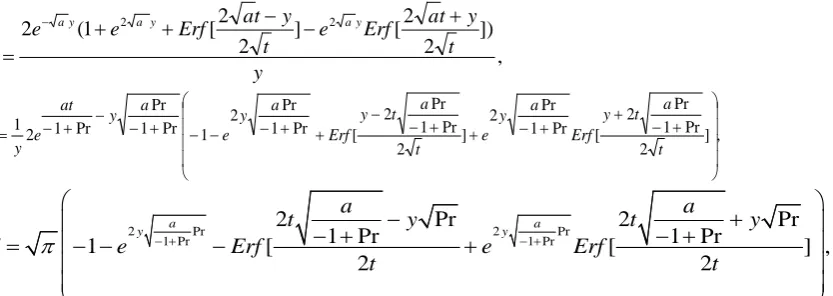
Solving the above equations analytically, we obtain
2 2 2 2 2 Pr 4 2
1
2
2
1
2
2
2
1
2
2
(1
)
1
(1 Pr)
Pr
4
2
2
1
Pr
2
1
2
2
a y a y
a y a y a y
y t
at
y
at
y
q
e
Erf
e
Erfc
t
t
at
y
at
y
y Gr A
a
a e
e
Erf
e
Erf
B
A
a
t
t
y
yGr a
e
t
y
Erf
a
π
π
t
− − −
−
+
=
+
+
−
+
+
− +
−
+
+
+
−
−
+
+
− +
Pr Pr1 Pr 1 Pr 1 Pr 1 Pr
Pr
( 1
Pr)
Pr
Pr
at a at a
y y
C
C
at
D
ye
− + − − +ye
− + − − +
+
−
+ − + +
(13)(
)
(
)
−
+
=
1
2
2Pr
Pr
2
Pr
−η2Prπ
η
η
η
θ
t
erfc
e
(14) The expressions for the constants involved in the above equations are given in the appendix.
Skin friction
The dimensionless skin friction at the plate y=0
0 =
ydt
dq
Separating 0 =
ydt
dq
into real and imaginary parts, the dimensionless skin friction component
0 =
=
y xdy
du
τ
and 0 =
=
y zdy
dw
τ
can be computed.DISCUSSION AND RESULTS
The numerical values of velocity and skin friction are computed for different parameters like, Thermal Grashof number Gr, Magnetic field parameter M, Hall parameter m, Prandtl number Pr, and time t. The values of the main parameters considered are Gr=10, 20, 30, magnetic parameter M= 1, 3, 5, Hall parameter 0.5, 1.0, 1.5, Prandtl number Pr = 2, 4, 7 and t=0.4, 0.6, 0.8.
From figure - 1, 2 and 5 it is observed that the primary velocity (u) increases when Hall parameter, Grashof number and time are increased. However, it decreases when Magnetic field parameter and Prandtl number are increased (figure - 3, 4). And from figure - 6, 7, 8, 9 and 10 it is observed that the secondary velocity (w) increases when Hall parameter, Grashof number, Magnetic field parameter, Prandtl number, and time are increased. The values of the skin frictions
τ
xand
τ
z are tabulated in table –1.τ
xdecreases when Grashof number, magnetic field parameter and time are increased.Figure-1: Velocity profiles u for differentvalues ofm.
Figure-2: Velocity profiles for differentvalues of Gr.
Figure-4: Velocity profiles for differentvalues of Pr.
Figure-5: Velocity profile u for different values oft.
Figure-7: Velocity profile w for differentvalues ofGr.
Figure-8: Velocity profile w for differentvalues ofM.
Figure-10: Velocity profile w for differentvalues oft.
Table – 1: for the skin friction
CONCLUSION
Some conclusions of the study are as under:
1. Primary Velocity increases with the increase in Grashof number, hall parameter and time. 2. Primary Velocity decreases with the increase in magnetic field parameter and Prandtl number.
3. Secondary velocity increases with increase in Grashof number, time, Hall parameter, Prandtl number and magnetic field parameter.
4.
τ
x decreases with increase in Grashof number, magnetic field parameter and time, and it increases when Prandtl number and Hall parameter are increased.5.
τ
z increases with increase inGrashof number, time and magnetic, Hall parameter, field parameter, and it decreases when Prandtl number is increased.APPENDIX , ]) 2 2 [ ] 2 2 [ 1 (
2 2 2
y t y t a Erf e t y t a Erf e e A y a y a y
a + + − − +
= − , ] 2 Pr 1 Pr 2 [ Pr 1 Pr 2 ] 2 Pr 1 Pr 2 [ Pr 1 Pr 2 1 Pr 1 Pr Pr 1 2 1 + − + + − + + − − + + − − − + − − + − = t a t y Erf a y e t a t y Erf a y e a y at e y B
2 Pr 2 Pr
1 Pr 1 Pr
2
Pr
2
Pr
1 Pr
1 Pr
1
[
[
] ,
2
2
a a
y y
a
a
t
y
t
y
C
e
Erf
e
Erf
t
t
π
− + − +
−
+
− +
− +
=
− −
−
+
M m Gr Pr T
x
τ
τ
zPr
2
1
2
,
Pr
y
Erf
t
D
y
π
− +
=
(
)
2
1
, .
1
2
M
y
a
im
m
η
t
=
−
=
+
REFERENCES
1. Abo. Eldahab, EM (2001), The Hall effect on magneto hydrodynamic free convective flow at stretching surface with a uniform free stream, physics scripta, 63; 29-35.
2. A. Raptis and C. Perdikis, Flow of a viscous fluid through a porous medium bounded by a vertical surface, Int. J. Eng. Sci. 21 (1983), 1327–1330. Zbl 527.76090.
3. Crammer K .P. and Pai.S.I. (1973) magneto fluid Dynamics for engineers and Applied physicist. MC Graw. Hill Book.
4. Debnath L. Ray, S.C. and Chatterjee, A.K (1979) effect of Hall current on unsteady hydro magnetic flow past a porous plate in a Rotating fluid system. Zeitschrift für Angewandte Mathematik and Mechanik, 59, 469-471. 5. H. Alfven, Existence of electromagnetic-hydrodynamic waves, Nature, 150, No. 3805 (1942), 405-406. 6. H.A. Attia, The effect of variable properties on the unsteady Hartmann flow with heat transfer considering the
Hall effect, Appl. Math. Model. 27 (7) (2003) 551–563.
7. Hazem Ali Attia, Mohamed Eissa Sayed- Ahmed, the Hall effect on unsteady MHD Couette flow and heat transfer of a Bingham fluid with suction and injection, applied Mathematical Modelling 28 (2004) 1027-1045. 8. Haider Zaman, Murad Ali Shah, Farhan Khan, Qaiser Javed, Effects of Hall Current on MHD Boundary
Layer Second-Order Viscoelastic Fluid Flow Induced by a Continuous Surface with Heat Transfer, American Journal of Computational Mathematics, 2014, 4, 143-152.
9. N. Ahmed, H. Kalita and D. P. Barua ,Unsteady MHD free convective flow past a vertical porous plate immersed in a porous medium with Hall current, thermal diffusion and heat source, International Journal of Engineering, Science and Technology Vol. 2, No. 6, 2010, pp. 59-74.
10. P.C. Ram, C.B. Singh, U. Singh, Hall effects on heat and mass transfer flow through porous medium, Astrophysics Space Science, 10 (1984), 45-51.
11. POP, I.: The effect of Hall currents on hydro magnetic, flow near an accelerated plate, J. Math. Phys. Sci.5, 375-379.
12. Prasada Rao, D.R.V., Krishna, D.V. and Debnath. L. (1982) Hall Effects on Free and Forced Convective Flow in a Rotating Channel. Acta Mechanica, 43, 49-59. http://dx.doi.org/10.1007/BF01175815.
13. P. Sulochana Hall Effects on Unsteady MHD Three Dimensional Flow through a Porous Medium in a Rotating Parallel Plate Channel with Effect of Inclined Magnetic Field, American Journal of Computational Mathematics, 2014, 4, 396-405.
14. R.B. Hetnarski, algorithm for generating some inverse Laplace transforms of exponential form, ZAMP, 26 (1975), 249-253.
15. R.K. Deka*, Hall effect on MHD flow past an accelerated plate Theoret. Appl. Mech. Vol.35, no. 4, pp. 333-346, Belgrade 2008.
16. U.S. Rajput and Surendra Kumar, MHD flow past an impulsively started vertical plate with variable temperature and mass diffusion, Applied Mathematical sciences, vol.5, 2011.no 3,149-157.
Source of support: Nil, Conflict of interest: None Declared
[Copy right © 2015. This is an Open Access article distributed under the terms of the International Journal of Mathematical Archive (IJMA), which permits unrestricted use, distribution, and reproduction in any medium, provided the original work is properly cited.]