CRYSTAL STRUCTURES OF
1-BENZOYL-2-HYDROXY-7-METHOXYNAPHTHALENE ANALOGUES: DIMERIC
FEATURES OF THE MOLECULAR PACKING
Akiko Okamoto
[a], Atsushi Nagasawa
[a], and Noriyuki Yonezawa
[a]Keywords: Intra- and intermolecular hydrogen bonds, Dimeric aggregates, Molecular packing
Molecular alignments of 1-aroyl-2-hydroxy-7-methoxynaphthalene analogues are classified into two groups, i.e., molecular stacking standing one behind another and dimeric aggregates. In single molecular structures, the 1-aroyl-2-hydroxy-7-methoxynaphthalene analogues show apparently same spatial organizations. The carbonyl groups in these molecules form intramolecular O–H…O=C hydrogen bonds with the adjacent hydroxy groups, affording six-membered cyclic structures. The aroyl groups constrained by the intramolecular hydrogen bonds essentially induce dimeric aggregates via formation of a pair of intermolecular O–H…O=C hydrogen bonds. When interactions led by the substituents of the benzene rings reduce the stability by the intermolecular O–H…O=C hydrogen bonds, the molecular packing should turn one-behind-one type piling.
Corresponding Authors Phone: +81-42-388-7601 E-Mail: [email protected]
[a] Department of Organic and Polymer Materials Chemistry, Tokyo University of Agriculture and Technology, 2-24-16 Naka-machi, Koganei, Tokyo 184–8588, Japan
Introduction
Molecules with non-coplanarly aligned aromatic rings, such as binaphthyl and biphenyl compounds, have been in the limelight because of their unique spatial shapes affording characteristic optic and electronic properties and asymmetric molecular environments. In consequence, various applications have been undertaken such as optically active polymers and catalysts, organic fluorescent dyes and light-emitting diodes, and so on.1-5 Naphthalene compounds
bearing peri-substituents have also received much attention as compounds of characteristic structured aromatic core for a variety of functional materials.6-8 Therefore, structure
analyses have been actively performed.9-11 Recently, we
have revealed that aroylation at the 1- and 8-positions of naphthalene proceeds smoothly via conventional electrophilic aromatic aroylation on condition that suitable acid mediator employed.12,13 According to X-ray crystal
structure studies, the resulting 1,8-diaroylated naphthalene derivatives, such as 1,8-dibenzoyl-2,7-dimethoxynaphthalene,14 have a non-coplanar organization
of the aromatic rings. Almost all 1,8-diaroylnaphthalene compounds form the stacking structures standing one behind another in the molecular packing via intermolecular (phenyl)C–H…O=C interactions between the aroyl groups of the adjacent molecules. On the other hand, the ether-cleaved 1,8-dibenzoylnaphthalene analogue, 1,8-dibenzoyl-2,7-dihydroxynaphthalene, shows dimeric aggregates composed of two types of independent molecules in the crystal.15 Inter- and intramolecular O–H…O=C hydrogen
bonds between the hydroxy groups and the carbonyl ones seem to relate with the formation ability of dimeric aggregates. In this consequence, the authors have planned to clarify the dimeric feature of the molecular packing with more simplified molecules.
Herein, the X-ray crystal structure of 1-benzoyl-2-hydroxy-7-methoxynaphthalene is reported, and the structure-determining factors are discussed through comparison with the methoxy-retained analogue, 1-benzoyl-2,7-dimethoxynaphthalene. Furthermore, the stability of the molecular packing concerning dimeric feature is estimated relatively by comparing with the 1-(4-substituted benzoyl)-2-hydroxy7-methoxynaphthalene analogues.
Results and discussion
Synthesis of 1-aroyl-2-hydroxy-7-methoxynaphthalene analogues 2 were performed by reference to AlCl3-mediated
methyl ether-cleavage reaction of 1-(4-chlorobenzoyl)-2,7-dimethoxynaphthalene (1d) (Table 1).16
1-Aroyl-2,7-dimethoxynaphthalenes 1 satisfactorily gave the corresponding 2-methyl ether cleaved-compounds (2) (entries 1, 2, and 5), with exception of a rather moderate yield of compound 2c in the reaction of 1-(4-methoxybenzoyl)-2,7-dimethoxy-naphthalene (1c) (entry 3). By increasing of the amount of AlCl3 from five equimolar amounts to 7.5 equimolar amounts,
the methyl ether cleavage was slightly accelerated (entry 4). AlCl3-mediated alkyl–oxygen bond cleavage reaction
presumably proceeds smoothly by the assist of the neighbouring effect of the aroyl group. In the case of 1-aroylnaphthalene analogue (1c), the oxygen atom of methoxy group in the aroyl group should coordinates to AlCl3. As a
result of virtually decreased AlCl3 around the carbonyl moiety,
the ether cleavage reaction of the 1-aroylnaphthalene analogue (1c) might be retarded.
Figures 1 and 2 show crystal structures of 1-benzoyl-2,7-dimethoxynaphthalene (1a)17 and
1-benzoyl-2-hydroxy-7-methoxynaphthalene (2a).18 There are three independent
Table 1. AlCl3-mediated methyl–oxygen bond cleavage reaction of 1-aroyl-2,7-dimethoxynaphthalene (1)a
aReaction conditions: 1-aroyl-2,7-dimethoxynaphthalene 1, AlCl
3 [5 or 7.5 equimolar amounts
(against substrate 1)], dichloromethane, reflux, 30 min. b Isolated yields.
The crystal structure is stabilized by intermolecular hydrogen bonds among three independent molecules and between same types of the independent molecules (Figure 3). Among three independent molecules, hydrogen bonds between independent molecules (A) and (B) [C36– H36…O2 = 2.564 Å], between independent molecules (B) and (C) [C56–H56A…O5 = 2.544 Å], and between independent molecules (C) and (A) [C52–H52…O3 = 2.460 Å] are observed.
Figure 1. Molecular structures of independent molecules (A)(left), (B)(center), and (C)(right) of 1-benzoyl-2,7-dimethoxynaphthalene (1a), with the atom-labeling scheme and displacement ellipsoids drawn at the 50% probability level.
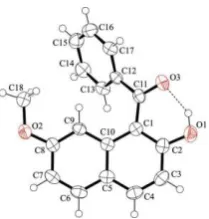
Figure 2. Molecular structure of 1-benzoyl-2-hydroxy-7-methoxynaphthalene (2a), with the atom-labeling scheme and displacement ellipsoids drawn at the 50% probability level.
In addition, the independent molecules (B) are connected to each other by intermolecular hydrogen bonds between the
benzene ring and the carbonyl group [C34–H34…O6 =
2.413 Å]. The independent molecules (C) are also linked
with intermolecular hydrogen bonds between the benzene ring and the carbonyl group [C54–H54…O9 = 2.576 Å].
The independent molecules (B) and (C) are stacked along the b axis and form the columnar structures, respectively. On the other hand, the independent molecules (A) have no effective interactions with themselves. They have only
weak interactions with independent molecules (C) [C19– H19…O9 = 2.593 Å] and are piled in the gap of the two
different columnar structures of independent molecules (B) and (C) (Figures 4 and 5).
Figure 3. The intermolecular C–H…O hydrogen bonds among independent molecules (A), (B), and (C) of 1-aroylnaphthalene 1a.
Figure 4. The partial crystal packing diagram of 1-aroylnaphthalene 1a, viewed down the a axis.
Figure 5. The molecular arrangement of 1-aroylnaphthalene 1a, viewed down the b axis: molecules (A) (green), (B) (red), and (C) (blue).
In the molecule of 1-benzoyl-2-hydroxy-7-methoxynaphthalene (2a), there is an intramolecular O–
Entry Substrate Molar ratio Product Yield, (X) substrate:AlCl3 (X) %b
1 1a (H) 1 : 5 2a (H) 52 2 1b (CH3) 1 : 5 2b (CH3) 63 3 1c (OCH3) 1 : 5 2c (OCH3) 42 4 1c (OCH3) 1 : 7.5 2c (OCH3) 56 5 1d (Cl) 1 : 5 2d (Cl) 75
0
a
H…O=C hydrogen bond between the hydroxy group and the carbonyl one on the naphthalene ring. The angles between the C=O bond vector and the least squares planes of the naphthalene ring and the phenyl ring are 30.58(6)˚ and 42.82(7)˚, respectively, while the dihedral angle between the naphthalene ring and the phenyl ring is 58.65(5)˚. In the crystal, the molecules are connected by pairs of
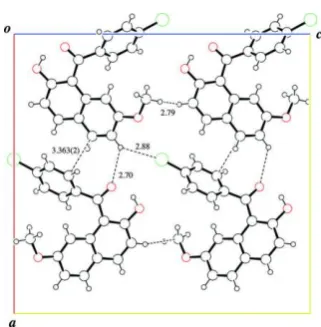
intermolecular O–H…O=C hydrogen bonds, forming centrosymmetric dimers (Figure 6). The dimeric aggregates are related to each other through four kinds of interactions: (methoxy)oxygen…carbon(methoxy) interaction along the a
axis [O2…C18 = 3.060(2) Å], (naphthalene) carbon…oxygen(carbonyl) interaction along the b axis [C4…O3 = 3.036(18) Å], (naphthalene)carbon…hydrogen (naphthalene) along the b axis [C6…H6 = 2.891 Å], and (benzene)carbon…hydrogen (methyl) along the c axis [C16…H18A = 2.88 Å].
Figure 6. The partial crystal packing diagram of
1-aroylnaphthalene 2a, viewed down the b axis. Square-shaped cyclic O–H…O=C hydrogen bonds are shown as dashed lines.
The dihedral angle between the benzene ring and the naphthalene one of 1-benzoyl-2-hydroxy-7-methoxynaphthalene (2a) is smaller than that of the methoxy-retained precursor (1a). The data indicates that the intramolecular O–H…O=C hydrogen bond in 1-benzoyl-2-hydroxy-7-methoxynaphthalene (2a) determines the orientation of the aroyl group and thus promotes the formation of the cyclic intermolecular O–H…O=C interactions involving the same donor and acceptor groups in pairs of molecules. In other words, the aroyl groups without fixation are aligned in the specific orientations as represented in three independent molecules of methoxy-retained precursor 1a.
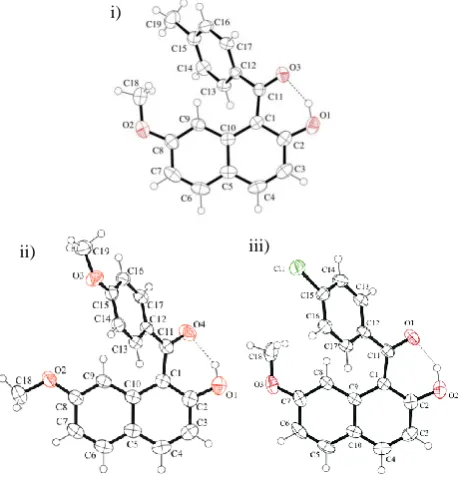
Figure 7 shows molecular structures in the crystal of the 1-aroyl-2-hydroxy-7-methoxynaphthalene analogues 2b-2d. These analogous compounds have essentially similar spatial organizations. The nonbonding distances of 1-benzoyl-2-hydroxy-7-methoxynaphthalene 2a and the analogues 2 are listed in Table 2 with the methoxy-retained molecule 1a.
In a similar manner of 1-benzoyl-2-hydroxy-7-methoxynaphthalene 2a, the analogues 2b-2d forms intramolecular O–H…O=C hydrogen bonds between the hydroxy groups and the adjacent carbonyl groups. Furthermore, the methyl group-bearing analogue 2b19 also
form two intermolecular O–H…O=C hydrogen bonds affording centrosymmetric dimers as well as 1-aroylnaphthelene 2a (Figure 8). The molecular packing features C–H… interactions involving the centroid of the C5–C10 ring (CT1) and the centroid of the C12–C17 phenyl ring (CT2). On the other hand, no dimeric pairs are
observed in the molecular packing of methoxy group-bearing analogue 2c and chloro group-bearing one 2d.20
Figure 7. Molecular structures of 1-aroyl-2-hydroxy-7-methoxynaphthalene analogues: i) Analogue 2b (X= CH3); ii) Analogue 2c (X= OCH3), and iii) Analogue 2d (X= Cl), with the atom-labelling schemes and displacement ellipsoids drawn at the 50% probability level.
Figure 8. A crystal packing of analogue 2b (X= CH3), viewed down the b axis. Intermolecular hydrogen bonds are shown as dashed lines. H atoms not involved in hydrogen bondings have been omitted for clarity.
The methoxy group-bearing analogue forms two types of
interactions such as (hydroxy)O–H…O–
CH3(4-methoxyphenyl) and (hydroxy)H–O…H–C(phenyl) in
crystal (Figure 9). These interactions make infinite O…H
chains along the ac diagonal. In the case of chloro group-bearing analogue 2d, a three-dimensional molecular network is formed by loose van der Waals interactions such as
(naphthalene)C–H…O=C and (hydroxy)H–O…H–
C(phenyl). The alternate arrangement of (R)- and (S )-configurated molecules makes us naturally envision that the molecules align to avoid electrostatic repulsions of Cl against Cl of the adjacent molecule (Figure 10).
iii) ii)
Table 2. Nonbonding distances of 1-benzoyl-2,7-dimethoxynaphthalene (1a) and 1-aroyl-2-hydroxy-7-methoxynaphthalene analogues 2.
Symmetry codes: for molecule 1:(i) x, y+1, z-1, (ii) x, y+1, z-1, (iii) x, y, z+1; for molecule 2a: (i)-x+1, -y+1, -z+1; for molecule 2b (CT1 and CT2 are the centroids of the C5–C10 and C12–C17 rings, respectively): (i) -x+1, -y+1, -z+1, (ii) –x+1, y-1/2, -z+1/2, (iii) x, y+1, z, (iv) –x+2, -y+1, -z+1; For molecule 2c: (i) x−1/2, −y+3/2, z−1/2; (ii) x+1/2, −y+3/2, z+1/2.
Figure 9. A crystal packing of analogue 2c (X= OCH3), viewed down the a axis. Intermolecular O…H hydrogen bonds are shown as green dashed lines.
Conclusively, the single molecular spatial organizations of 1-aroyl-2-hydroxy-7-methoxynaphthalene analogues are essentially the same regardless of its substituent on the benzene ring. On the other hand, it is entirely dependent on
the balance between intermolecular O–H…O=C hydrogen
bonds and interactions of the substituents whether the molecular packing shows dimeric features or not. 1-Aroyl-2-hydroxy-7-methoxynaphthalene analogues are susceptible to form a pair of intermolecular O–H…C=O hydrogen bonds
between the hydroxy groups and the carbonyl groups.
As a result, they induce dimeric aggregates in crystal. On the other hand, the molecular packing turns one-behind-one type piling when the intermolecular O–H…O=C hydrogen
bonds are weaken by the interactions of the substituents of the benzene rings.
Figure 10. A crystal packing of analogue 2d (X=Cl), viewed down the b axis. Intermolecular hydrogen bonds are shown as dashed lines.
D–X…A D–X (Å) X…Aintra (Å) X…A (Å) D…A (Å) D–X…A (˚)
1-H-2-OCH3 1a
C36–H36…O2 0.95 2.56 3.4116(18) 149
C56–H56A…O5 0.98 2.54 3.4862(19) 161
C52–H52…O3i 0.95 2.46 3.395(2) 168
C34–H34…O6ii 0.95 2.41 3.143(2) 133
C54–H54…O9ii 0.95 2.58 3.2451(19) 128
C19–H19B…O9iii 0.98 2.59 3.116(2) 113
1-H-2-OH 2a
O1–H1…O3 0.92(2) 1.77(2) 2.5792(14) 145(2)
O1–H1…O3i 0.92(2) 2.32(2) 3.0088(16) 132.4(18)
1-CH3-2-OH 2b
O1–H1…O3 0.95(2) 1.70(2) 2.5618(14) 148(2)
O1–H1…O3i 0.95(2) 2.33(2) 3.0083(16) 128(1)
C6–H6…CT1ii 0.95 2.71 3.5203(13) 144
C17–H17…CT1iii 0.95 2.76 3.5492(12) 141
C19–H19…CT2iv 0.98 2.88 3.7834(16) 154
1-OCH3-2-OH 2c
O1–H1…O4 0.92(2) 1.79(3) 2.6193(14) 147.8(19)
O1–H1…O3i 0.92(2) 2.55(2) 3.0924(13) 118.1(16)
C14–H14…O1ii 0.95 2.599(1) 3.4118(15) 144
1-Cl-2-OH 2d
O2–H2…O1 0.94(2) 1.71(2) 2.5573(16) 148(2)
0
a
Experimental
All reagents were of commercial quality and were used as received. Solvents were dried and purified using standard techniques.
Measurements
1H NMR spectra were recorded on a JEOL JNM-AL300
spectrometer (300 MHz) and a JEOL ECX400 spectrometer (400 MHz). Chemical shifts are expressed in ppm relative to internal standard of Me4Si (0.00). 13C NMR spectra
were recorded on a JEOL JNM-AL300 spectrometer (75 MHz). Chemical shifts are expressed in ppm relative to internal standard of CDCl3 (77.0). IR spectra were
recorded on a JASCO FT/IR-4100 spectrometer. Elemental analyses were performed on a Yanaco CHN CORDER MT-5 analyzer. High-resolution FAB mass spectra were recorded on a JEOL MStation (MS700) ion trap mass spectrometer in positive ion mode.
X-ray Crystallography
For the crystal structure determination, the single-crystals of the compound 1 and 2 were used for data collection on a four-circle Rigaku RAXIS RAPID diffractometer (equipped with a two-dimensional area IP detector). The graphite-mono-chromated Cu Kα radiation (λ = 1.54187 Å) was used for data collection. The lattice parameters were determined by the least-squares methods on the basis of all reflections with F2>2σ(F2). The data collection and cell refinement
were performed using PROCESS-AUTO software. The data reduction was performed using CrystalStructure. The structures were solved by direct methods using SIR2004 and refined by a full-matrix least-squares procedure using the program SHELXL97. All H atoms were found in a difference map and were subsequently refined as riding atoms, with the aromatic C–H = 0.95 Å and methyl C–H = 0.98 Å, and with Uiso(H) = 1.2Ueq(C).
Synthetic procedures of 1-benzoyl-2,7-dimethoxynaphthalene (1a)
To a mixture of benzoyl chloride (8.10 mmol, 0.923 mL) and AlCl3 (10.4 mmol, 1.38 g) in dichloromethane (19.0
mL), dichloromethane solution of 2,7-dimethoxynaphthalene (2,7-2,7-dimethoxynaphthalene/dichloro- (2,7-dimethoxynaphthalene/dichloro-methane: 7.50 mmol, 1.37 g/19 mL) was added by portions at 0˚C under nitrogen atmosphere. After the reaction mixture was stirred at 0˚C for 6 h, it was poured into iced water (100 mL) and the mixture was extracted with CHCl3 (30 mL×3).
The combined extracts were washed with 2 M NaOH aq. and brine, and dried over anhydrous magnesium sulfate. The solvent was removed under reduced pressure to give powdery product (98 % yield). The crude product was purified by recrystallization (hexane–chloroform, isolated yield 65 %). Yellow platelet single-crystals suitable for X-ray diffraction were obtained by crystallization from hexane–dichloromethane.
1-Benzoyl-2,7-dimethoxynaphthalene (1a)
Yellow platelet (hexane/dichloromethane), Mp 358.5– 362.0 K; IR (KBr): 1663, 1627 cm-1; 1H NMR (300 MHz,
CDCl3): 7.84-7.89 (m, 3H), 7.72 (d, J = 8.7 Hz, 1H), 7.57 (t, J = 7.2 Hz, 1H), 7.43 (t, 2H, J = 7.8 Hz), 7.16 (d, J = 9.0 Hz,
1H), 7.01 (dd, J = 2.4, 8.7 Hz, 1H), 6.79 (d, J = 2.4 Hz, 1H), 3.78 (s, J = 8.6 Hz, 3H), 3.71 (s, 3H), ppm; 13C NMR (75
MHz, CDCl3): 198.07, 158.77, 154.93, 137.98, 133.31,
132.98, 130.96, 129.62, 129.44, 128.48, 124.29, 121.67, 117.01, 110.17, 102.02, 56.24, 55.09 ppm; HRMS (FAB; m -nitrobenzyl alcohol [m-NBA]) m/z: [M+H]+: calcd for
C19H17O3 293.3365, found 293.1185.
Methyl–oxygen bond cleavage of 1-benzoyl-2,7-dimethoxy-naphthalene (1a)
To a solution of 1-benzoyl-2,7-dimethoxynaphthalene (1a, 10.0 mmol, 2.92 g) in dichloromethane (100 mL), AlCl3
(50.0 mmol, 6.65 g) was added by portions at r.t under nitrogen atmosphere. After the reaction mixture was refluxed for 30 min, the resulting dark red solution was poured into iced-water (100 mL). The aqueous layer was extracted with chloroform (30 mL×3). The combined organic layers were washed with brine (30 mL×3), and dried over anhydrous magnesium sulfate overnight. The solvent was removed under reduced pressure to give powdery product (quant.). The crude product was purified by repeated recrystallization from hexane to give compound 2 as yellow platelets (52 %).
1-Benzoyl-2-hydroxy-7-methoxynaphthalene (2a)
Yellow platelet (hexane), Mp 371.8–372.3 K;IR (KBr): 3446, 1617, 1572, 1511, 1200 cm-1; 1H NMR (300 MHz,
CDCl3): 11.64 (s, 1H), 7.85 (d, J = 9.0 Hz, 1H), 7.62 (d, J
= 8.7 Hz, 1H), 7.62 (dt, J = 1.7, 7.5 Hz, 2H), 7.55 (tt, J = 1.7, 7.5 Hz, 1H), 7.43 (tt, J = 1.7, 7.5 Hz, 2H) 7.08 (d, J = 9.0 Hz, 1H), 6.89 (dd, J = 2.4, 8.7 Hz, 1H), 6.59 (d, J = 2.4 Hz, 1H), 3.27 (s, 3H) ppm; 13C NMR (75 MHz, CDCl
3): 200.8,
162.8, 158.2, 140.8, 136.5, 134.1, 132.3, 130.1, 129.14, 128.8, 123.7, 116.5, 115.9, 113.7, 106.5, 54.5 ppm; HRMS (FAB; m-NBA) m/z: [M+H]+: calcd for C
18H15O3 279.1021,
found 279.0999.
Other aroylation and ether cleavage reactions affording 1 and 2 were undertaken by essentially the same procedure as above.
Spectral data and elemental analyses
1-(4-Methylbenzoyl)-2,7-dimethoxynaphthalene (1b)
Pale yellow powder [PTLC; hexane : AcOEt = 2:1 (w/w)], Mp 392.6–394.1 K; IR (KBr): 1656, 1627, 1604, 1512, 1251 cm-1; 1H NMR (300 MHz, CDCl
3): 7.86 (1H, d, J = 9.0
Hz), 7.76 (2H, d, J = 8.1 Hz), 7.72 (1H, d, J = 8.7 Hz), 7.22 (2H, d, J = 8.1 Hz), 7.16 (1H, d, J = 8.7 Hz), 7.01 (1H, dd, J
= 9.0, 2.4 Hz), 6.78 (1H, d, J = 2.4 Hz), 3.80 (3H, s), 3.71 (3H, s), 2.41 (3H, s) ppm; 13C NMR (75 MHz, CDCl
3):
197.67, 158.71, 154.76, 144.25, 135.53, 132.98, 130.72, 129.67, 129.57, 129.23, 124.32, 122.04, 116.98, 110.23, 102.10, 56.30, 55.11, 21.69 ppm; HRMS (FAB; m-NBA) m/z: [M+H]+: calcd for C
20H19O3 307.1334, found 307.1302.
1-(4-Methoxybenzoyl)-2,7-dimethoxynaphthalene (1c)
Colorless platelet (methanol), Mp 368.5–368.9 K; IR (KBr): 1659, 1624, 1599, 1510, 1251 cm-1; 1H NMR (300
MHz, CDCl3): 7.83 (3H, d, J = 9.0 Hz), 7.70 (1H, d, J = 9.0
6.89 (2H, d, J = 9.0 Hz), 6.78 (1H, d, J = 2.4 Hz), 3.83 (3H, s), 3.79 (3H, s), 3.70 (3H, s) ppm; 13C NMR (75 MHz,
CDCl3): 196.54, 163.81, 158.69, 154.60, 132.98, 131.98,
131.09, 130.61, 129.56, 124.34, 122.15, 116.98, 113.73, 110.28, 102.17, 56.36, 55.41, 55.14 ppm; HRMS (FAB; m -NBA) m/z: [M+ H]+: calcd for C
20H19O4 323.1283, found
323.1332.
1-(4-Chlorobenzoyl)-2,7-dimethoxynaphthalene (1d)
Colorless needle (hexane), Mp 394.7–395.2 K; IR (KBr): 1667, 1628, 1586, 1512 cm-1; 1H NMR δ (300 MHz,
CDCl3): 7.87 (1H, d, J =9.0 Hz), 7.78 (2H, d, J = 8.4 Hz),
7.72 (1H, d, J = 9.0 Hz), 7.39 (2H, d, J = 8.4 Hz), 7.16 (1H, d, J = 9.0 Hz), 7.02 (1H, dd, J = 2.4, 9.0 Hz), 6.78 (1H, d, J
= 2.4 Hz), 3.79 (3H, s), 3.73 (3H, s) ppm; 13C NMR δ (75
MHz, CDCl3): 196.81, 158.96, 155.02, 139.71, 136.45,
132.94, 131.28, 130.87, 129.72, 128.86, 124.34, 121.06, 117.15, 110.05, 101.88, 56.239, 55.168 ppm; calcd for C19H15O3Cl: C, 69.83%; H, 4.63%; found: C, 69.61%; H,
4.74%.
1-(4-Methylbenzoyl)-2-hydroxy-7-methoxynaphthalene (2b)
Yellow platelet (hexane), Mp 385.6–386.1 K; IR (KBr): 3443, 2929, 1620, 1561, 1514, 1233 cm-1; 1H NMR (300
MHz, CDCl3): 11.40 (s, 1H), 7.83 (d, J = 8.9 Hz, 1H), 7.61
(d, J = 8.6 Hz, 1H), 7.52 (d, J = 7.9 Hz, 2H), 7.22 (d, J = 7.9 Hz, 2H), 7.07 (d, J = 8.9 Hz, 1H), 6.89 (dd, J = 2.4, 8.9 Hz, 1H), 6.64 (d, J = 2.4 Hz, 1H), 3.31 (s, 3H), 2.41 (s, 3H) ppm; 13C NMR (75 MHz, CDCl
3): 200.0, 162.3, 158.1,
143.2, 138.0, 136.1, 134.2, 130.0, 129.5, 129.3, 123.8, 116.5, 115.8, 114.0, 106.6, 54.5, 21.7 ppm; HRMS (FAB; m-NBA) m/z: [M+H]+: calcd for C
19H17O3 293.1178, found 293.1189.
1-(4-Methoxybenzoyl)-2-hydroxy-7-methoxynaphthalene (2c)
Yellow platelet (hexane), Mp 375.0–376.5 K;IR (KBr): 3420, 2929, 1618, 1596, 1576, 1511, 1246, 1220 cm-1; 1H
NMR (300 MHz, CDCl3): 10.94 (s, 1H), 7.82 (d, J = 8.9
Hz, 1H), 7.67–7.61 (m, 3H), 7.07 (d, J = 8.9 Hz, 1H), 6.92– 6.88 (m, 3H), 6.73 (d, J = 2.4 Hz, 1H), 3.86 (s, 3H), 3.39 (s, 3H) ppm; 13C NMR (75 MHz, CDCl
3): 199.0, 163.4,
161.4, 158.1, 135.6, 134.2, 132.8, 132.1, 130.0, 123.8, 116.5, 115.8, 114.3, 113.9, 106.5, 55.6, 54.7 ppm; HRMS (FAB;
m-NBA) m/z: [M+H]+: calcd for C
19H17O4 309.1127, found
309.1107.
1-(4-Chlorobenzoyl)-2-hydroxy-7-methoxynaphthalene (2d)
Yellow platelet (hexane), Mp 391–391.5 K; IR (KBr): 3434, 1623, 1583, 1513, 1214, 843 cm-1; 1H NMR δ (300
MHz, CDCl3): 11.35 (s, 1H), 7.85 (d, 1H, J = 9.0 Hz), 7.63
(d, 1H, J = 9.0 Hz), 7.58 (d, 2H, J = 8.7 Hz), 7.40 (d, 2H, J
= 8.7 Hz), 7.07 (d, 1H, J = 9.0 Hz), 6.91 (dd, 1H, J = 2.4,
9.0 Hz), 6.58 (d, 1H, J = 2.4 Hz), 3.37 (s, 3H) ppm; 13C
NMR δ (75 MHz, CDCl3): 199.1, 162.6, 158.2, 138.8, 138.7,
136.5, 133.8, 130.7, 130.2, 128.9, 123.7, 116.4, 115.8, 113.4, 106.5, 54.5 ppm; Anal. Calcd for C18H13ClO3: C 69.13, H
4.19. Found: C 69.11, H 4.09.
Acknowledgement
This work was partially supported by the Ogasawara Foundation for the Promotion of Science & Engineering, Tokyo, Japan.
References
1Alfonso, I., Burguete, M. I., Galindo, F., Luis, S. V., Vigara, L., J.
Org. Chem.,2007, 72, 7947.
2Zhang, F. R., Song, H. B., Zi, G. F., Dalton Trans2011, 40, 1547. 3Lackner, A. D., Samant, A. V., Toste, F. D., J. Am. Chem. Soc.,
2013, 135, 14090–14093.
4Lee, Y., Lee, M., J. Org. Chem.,2013, 117, 12878–12883. 5Takashima, H., Fukuda, M., Nakagaki, F., Ogata, T., Tsukahara, K.,
J. Phys. Chem. B., 2013, 117, 2625-2635.
6Jiang, Y. L., Gao, X. N., Zhou, G. N., Patel, A., Javer, A., J. Org.
Chem.,2010, 75, 324–333.
7Shinamura, S., Miyazaki, E., Takiyama, K., J. Org. Chem.,2010,
75, 1228–1234.
8Frischmann, P. D., Würthner, F., Org. Lett.,2013,15, 4674–4677. 9Cohen, S., Thirumalaikumar, M., Pogodin, S., Agranat, I., Struct.
Chem.,2004, 15, 339–346.
10Gore, P. H., Henrick, K., Acta Cryst.,1980, B36, 2462–2465. 11Jing, L.-H., Qin, D.-B., He, L., Gu, S.-J., Zhang, H.-X., Lei, G..,
Acta Cryst.,2005, E61, o3595–o3596.
12Okamoto, A., Yonezawa, N., Chem. Lett.,2009, 38, 914. 13Okamoto, A., Mitsui, R., Yonezawa, N., Chem. Lett.,2011, 40,
1283.
14Nakaema, K., Noguchi, K., Okamoto, A., Yonezawa, N., Acta
Cryst.,2008, E64, o2497.
15Mohri, S., Yoshiwaka, S., Isozaki, K., Yonezawa, N., Okamoto, A., Acta Cryst.,2013, C69, 1541-1544.
16Okamoto, A., Mitsui, R., Watanabe, S., Tsubouchi, T., Yonezawa, N., Int. J. Org. Chem.,2012, 2, 194–201.
17Kato, Y., Nagasawa, A., Hijikata, D., Okamoto, A., Yonezawa, N.,
Acta Cryst.,2010, E66, o2659.
18Nagasawa, A., Mitsui, R., Kato, Y., Okamoto, A., Yonezawa, N.,
Acta Cryst.,2010, E66, o2677.
19Nagasawa, A., Mitsui, R., Okamoto, A., Yonezawa, N., Acta
Cryst.,2010, E66, o2820-o2821.
20Mitsui, R., Nakaema, K., Noguchi, K., Yonezawa, N., Acta Cryst. 2008, E64, o2497.