SPECTROPHOTOMETRIC DETERMINATION OF
AMINOPHENOL ISOMERS USING 9-CHLOROACRIDINE
REAGENT
Theia'a N. Al-Sabha,
[a]Shireen O. Ismael
[b]and Suzan A. Ali
[b]Keywords: spectrophotometric determination; o-aminophenol; m-aminophenol; p-aminophenol; 9-chloroacrididne
A simple, sensitive and accurate spectrophotometric method is developed for the quantitative determination of aminophenol isomers, i.e. o -aminophenol, m-aminophenol and p-aminophenol. The method is based on the interaction between these amines and 9-chloroacridine reagent (9-CA). The spectra of the products show maximum absorption at 436 nm. Beer’s law is obeyed in the concentration range of 0.25-12, 0.2-10 and 0.0-10 µg mL-1 with molar absorptivity values 7.20х103, 7.67х103 and 5.93 х103 L mol-1 cm-1 for the above mentioned
isomers respectively. The mean percent recoveries are ranged between 97.3 % and 101.07 % with relative standard deviation (RSD) ≤ 4.7 % for all the isomers. In addition, the stability constant has been determined and the mechanism is proposed for the 9-CA-aminophenol products.
* Corresponding Authors
E-Mail: [email protected]
[a] Chemistry department, College of Education, Mosul University, Mosul, Iraq
[b] Chemistry department, College of Sciences, Zakho University, Zakho, Iraq
Introduction
Aminophenol isomers are primarily used as intermediates in the manufacture of dyes and pigments. Also used as a vulcanization accelerator and as an antioxidant in rubber compounds. These are crystalline solids of low volatility and cause contact dermatitis, which appears to be the greatest hazard arising from their use in industry.1 These compounds are also the main metabolites of aniline both in vivo and in vitro.2
Several spectrophotometric methods using various reagents such as 4-aminoantipyrine,3 2-methyl-5-vinylpyridine4 and salicylaldehyde5 are used for determination of o-aminophenol. Potassium iodate,6,7 crowned 2,4-dinitrophenolazophenol-barium (Π) complex8 and 2,4-dinitrofluorobenzene9 are used for determination of m-aminophenol. Resorcinol,10sodium sulphide,11 4-nitro- or 2,4-dinitrobenzaldehyde12 and 5,7-dichloro-4,6-dinitrobenzofuroxan13 have been described for the determination of p-aminophenol. Charge transfer complex formation reactions have been widely used for determination of aminophenol isomers as n-donors with different π-acceptors such as chloranil,14 bromanil,15 fluoranil16 and DDQ.17 Also, 1,2-naphthoquinone-4-sulphonate (NQS) reagent has been used for determination of aminophenol isomers.18 However; most of these methods are either insufficiently sensitive or tedious and required an extraction step. Various analytical techniques have been reported for determination of aminophenol isomers such as thin layer chromatography.19 adsorptive stripping voltammetry.20,21 liquid chromatography.22-25 potentiometry26 and fluorimetry.27 These methods needed of highly sophisticated instruments. The present work describes a simple and
sensitive spectrophotometric method for analyses of aminophenol isomers. The method is based on the formation of coloured products from the reaction of these isomers with 9-chloroacridine reagent in ethanolic medium.
Experimental
Apparatus
Spectra and absorbance measurements were made with UV-Visible double beam spectrophotometers (Perkin-Elmer, lambda 25). with 1-cm matched silica cells. The pH measurements were made by using both Cyber Scan 510 pc. pH meter with a combined glass electrode. Heating of solutions is carried out on a water bath of frost instruments, LTD). Weighing is carried out on a sensitive balance type of Mettler H 54AR. All calculations in the computing process were done in Microsoft Excel for Windows.
Reagents
All chemicals used are of the highest purity available which are provided by BDH, Fluka and Molekula companies. 9-Chloroacridine (Eastman chemical Co.) was used as the chromogenic reagent. Absolute ethanol is used (ROTH Co.). Sodium hydroxide (1×10⁻² M) and hydrochloric acid (1×10⁻² M) solution are prepared by appropriate dilution of the concentrated NaOH (1 M) or HCl (1 M) solutions with distilled water.
9-chloroacridine reagent (1×10⁻³ M) (9-CA). The 25 ml
solution is prepared by dissolving 0.0053 g of 9-chloroacridine in ethanol absolute and then the volume is completed to 25 ml in a volumetric flask. The solution is prepared daily and used immediately28.
Recommended procedure
Appropriate volumes containing 0.25-12, 0.20-10 and 0.00-10 µg mL-1 of oA, mA and pA standard solutions followed by addition of 2.0, 2.5 and 2.0 ml of 9-CA reagent solution into separated 5-ml volumetric flasks; respectively. The solutions were diluted to the mark with absolute ethanol, and were left for 30 min at 50 °C for oA and for 30 and 15 min at 40 °C for each of mA and pA respectively. A portion of the solution was transferred into a 1cm silica cell to measure the absorbance at 436 nm against their respective reagent blank.
Results and Discussion
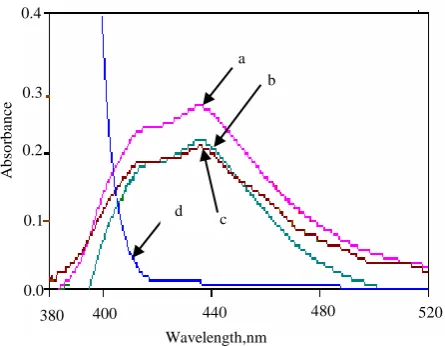
The reagent 9-CA was reacted quantitatively with aminophenol isomers in alcoholic medium and produce yellowish-green colored solutions immediately. The intensity of this colour increased when the reaction mixtures were heated in contrast to the reagent blank and show a maximum absorption at 436 nm, which was used in all subsequent experiments, where as blank reagent shows no absorption at this wavelength (Figure 1).
Figure 1. Absorption spectra of 2.5 µg ml-1of a) pA, b) oA, c)
mA and d) Reagent blank against ethanol at optimum conditions
Selecting optimum reaction conditions
Preliminary experiments were carried out to choose the best solvent from water, methanol, ethanol, acetone and acetonitrile, optimum pH of the reaction mixtures, concentration of 9-CA, temperature of the reaction mixture and time allowed to the reaction mixture to develop highest colour intensity of the final product at 436 nm.
It was observed that a reaction mixture prepared from mixing 1 ml solution containing 2.5 µg mL-1 of pA , as typical sample, with 1 ml of 1×10⁻³ M 9-CA in 5 ml of the reaction mixture prepared in ethanol absolute as solvent gave maximum absorbance compared to reaction mixtures prepared with other solvents (Table 1).
Table 1. Effect of solvent on colour intensity of pA-9-CAproduct.
The pH of the reaction mixture was varied between pH 2.5 and 11.5 by adding 0.01 M of HCl or NaOH. It was found that the sensitivity of products were decreased. However; the pH of final solutions were measured in the absence of HCl and NaOH and found 9.50, 9.48 and 9.60 for oA, mA
and pA respectively. Different buffer solutions (bicarbonate, borate and phosphate of pH 9.6) were also examined. These showed a negative effect on the absorbance of the products.
It was found that 2.0, 2.5 and 2.0 ml of 1×10⁻³ M solution of 9-CA in 5 ml of the reaction mixtures, containing 2.5 µg mL-1 of each isomer in ethanol medium separately, showed maximum absorbance at 436 nm after 10 min at room temperature for oA, mA, and pA respectively.
The effect of temperature on the maximum absorbance of the reaction products for aminophenol isomers was studied at temperatures 24 ○C, 40 ○Cand 50 ○C at the above stated optimum conditions. It was found that the maximum absorbance was obtained at 50 ○C after 30 min for oA, 40 ○C after 30 min for mA and 40 ○C after 15 min for pA. The absorbance remained constant over an appreciable time period ranging from 40-55 mins but decreased thereafter indicating dissociation of the product.
Quantitation
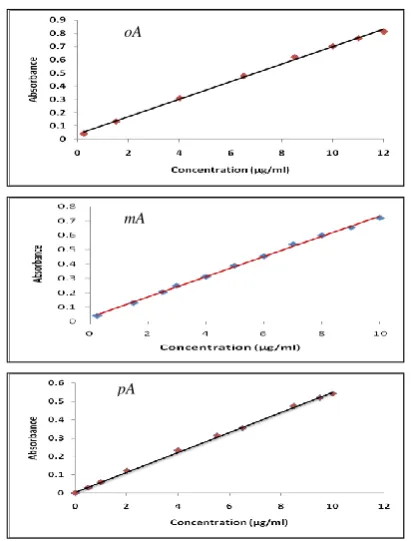
Under the experimental conditions described above, standard calibration graphs of products for aminophenol isomers with 9-CA reagent were constructed by plotting absorbance versus concentration as shown in Figure 2. The linear regression coefficient of the plot were 0.999, 0.999 and 0.999 with molar absorptivity values 7.202×10³, 7.671×10³ and 5.936×10³ for oA, mA and pA respectively indicating the high sensitivity of the method
Limit of detection (LOD), which is the smallest
concentration that can be measured, and limit of quantitation
(LOQ), which is the level above which quantitative results may be obtained with a specified degree of confidence, are determined by taking the ratio of standard deviation of the blank with respect to water and the slope of calibration curve by applying the following equations:
Absorbance Final
dilution with 9-CA 1 ml of 1×10⁻³
M dissolved in pA, 5 μg mL-1
dissolved in
--- Water
Water Water
--- Water
Ethanol Water
0.189 Ethanol
Ethanol Water
0.349 Ethanol
Ethanol Ethanol
--- Water
Methanol Water
0.326 Methanol
Methanol Water
0.143 Methanol
Methanol Methanol
0.274 Water
Acetone Water
0.025 Acetone
Acetone Water
--- Acetone
Acetone Acetone
0.027 Water
Acetonitrile Water
0.276 Acetonitrile
Acetonitrile Water
--- Acetonitrile Acetonitrile
Acetonitrile
400 440 480 520
Wavelength,nm
A
b
so
rb
an
ce
a b
c 0.4
0.3
0.2
0.1
0.0 380
whereas:
σB= standard deviation for six determinations of blank
S= slope of calibration graph for each isomer
LOQ is approximately 3.3 times LOD. Naturally, the LOQ
slightly crosses the lower limit of Beer's law range, (Table 2). Sandell's sensitivity was determined by 0.001/slope.
Figure 2. Calibration graphs of 9-CA-aminophenol isomers products
Table 2. Summary of optical characteristics and statistic data for the proposed method
Parameter oA mA pA
Beer's law limits, μg mL-1
0.25 -12 0.20 -10 0.00 -10 Molar absorptivity
L mol-1 cm-1
7.20х103 7.67х103 5.93х103
LOD, μg mL-1 0.233 0.133 0.177
LOQ, μg mL-1 0.706 0.404 0.539
Sandell's sensitivity μg cm-2
0.0151 0.0142 0.0183 Average recovery, %* 98.83 97.33 101.07 Correlation coefficient 0.998 0.998 0.999 Regression equation,
Y**
Slope, a 0.066 0.070 0.054 Intercept, b 0.037 0.030 0.007 RSD** ≤4.6 ≤4.7 ≤1.36
*Average of six determinations.
**Y = aX + b, where X is the concentration of isomer in μg mL-1.
Interferences
The interference from various organic nitrogenous compounds including primary, secondary, tertiary aliphatic amines, amides, phenols and n-hexane on the determination of 5 µg mL-1 of pA (as example for aminophenol isomers) was examined by using recommended procedure. It was found that these compounds did not affect the accuracy of the determination of the above compound indicating the method is selective for the determination of aminophenol isomers which are containing primary aromatic amino group. An error of ± 5.0 % in the absorbance readings was considered tolerable. The results are summarized in Table 3.
Table 3. Effect of foreign compounds on the determination of 5 µg mL-1 pA
Recovery, % Amount added , µg mL-1
Foreign compound
98.90 98.18 93.80 40
100 300 Hexylamine
97.82 96.73 93.09 40
100 300 Di-n-propylamine
97.46 97.09 93.46 40
100 300 Tri-butylamine
100.00 96.36 94.91 250
500 800 Phenol
101.46 103.64 105.09 250
500 1000 Acrylamide
98.91 95.30 94.20 250
500 1000 Benzamide
102.50 96.40 94.50 250
500 1100 Toluene
103.63 97.10 94.57 250
500 1100 n-Hexane
Stoichiometry and Stability constant
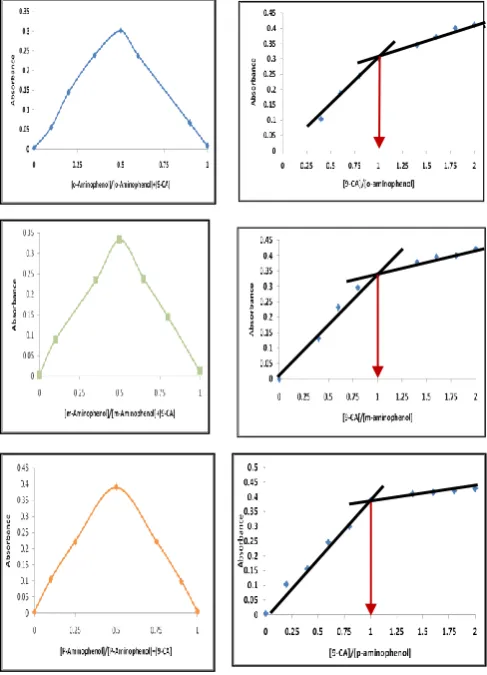
The stoichiometry of the reaction of aminophenol isomers with 9-CA reagent was studied by the molar ratio and Job methods,29 using solutions of 1x10⁻⁴ M for each isomer and 9-CA reagent. As shown in Figure 3, the results indicate that 1:1 aminophenol to reagent was formed using both above methods. This indicates that amino group present in the isomer is responsible for the formation of the products.
oA
mA
pA
3.3 B
LOD S
LOQ
Figure 3. Job and mole ratio plots for aminophenolisomer–9-CA products.
According to the results obtained from above stoichiometry, the apparent stability constant was estimated by comparing the absorbance of a solution containing stoichiometric amounts of the each isomer and 9-CA (As) to one containing an excessive amount of 9-CA reagent (Am). The average conditional stability constants of the complexes are calculated by the following equation :
where
Kc is the association constant (L mol -1
)
α is the dissociation degree and
C is the concentration of the product which is equal to the concentration of aminophenol and
The results shown in Table 4 indicate that the products are relatively stable.
Table 4. Association constants of the 9-CA-aminophenol isomer products.
Mechanism
The colored products produced from the reaction of aminophenol isomers with 9-chloroacridine suggested that the amino functional group present in the molecule is necessary for the reaction. Aromatic nucleophihc substitution is enhanced in structures which contain an electronegative heteroatom.30 This ease of nucleophihc substitution can be harnessed for the purposes of analytical chemistry when the 9-position of the acridine ring bears a facile leaving group and substituted by amino group in this reaction to form 9-aminoacridinium derivatives. However; the chemical reaction mechanism is proposed in Scheme 1.
Scheme 1. Proposed chemical reaction mechanism
Comparison of the proposed method with reported methods
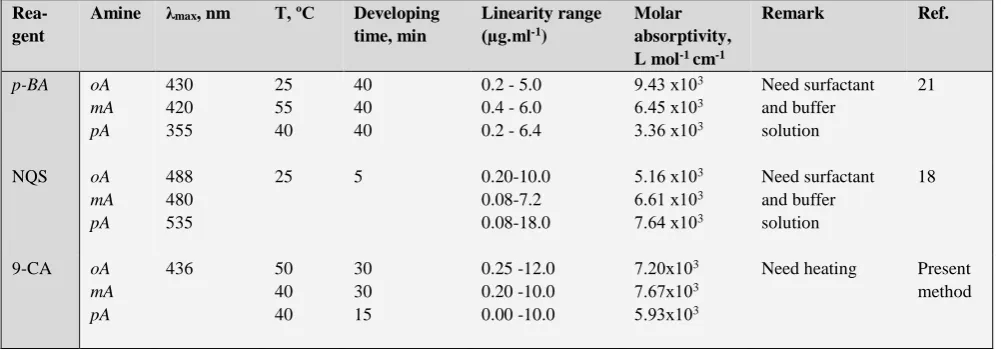
The proposed method compared favourably with other reported spectrophotometric methods as shown in Table (5). However, the present method is simpler than other methods as no pH adjustment or use of buffer solutions and no need of surfactants, moreover the proposed method is more sensitive than other methods.
Conclusion
The proposed method is simple, rapid, selective, sensitive and economical compared to previously reported methods as it does not require any pretreatment or extraction procedure and has good accuracy and precision. The method, in terms of simplicity and expense, is considered superior to the previously reported methods.
Average Kst,
L mol-1
α Absorbance Volume
of 1x10⁻⁴
M, ml
Iso-mer
Am
As
3.06×10⁴
0.4792 0.4488 0.4426 0.409
0.557 0.601 0.213
0.307 0.335 0.5
1.0 1.5
oA
1.61×10⁵
0.07213 0.1674 0.1595 0.305
0.430 0.533 0.283
0.358 0.448 0.5
1.0 1.5
mA
3.7 104
0.3500 0.2564 0.2112 0.400
0.511 0.535 0.260
0.380 0.422 0.5
1.0 1.5
pA
Aminophenol isomer
Phenoxyaminoacridine
1
c 2
K
C
m s
m
A A
A
Table 5. Comparison of spectrophotometric methods with the proposed method
References
1Stellman, J. M., Encyclopedia of Occupational Health and Safety,
1998, 104, 96.
2Parke, D. V., Biochem.J., 1960, 77, 493.
3Mohammed, H. J. and Hassen, H. S., Islam. Univ. J., (Ser. Natural
Stud. Engg.), 2009, 17, 25.
4Nelson, K. H. and Grimes, M. D., Anal. Chem., 1958, 30, 1928. 5Izao, A., Yasao, Y. and Kuuihiro, W., Japan Analyst., 1989, 38,
674.
6Deodher, R. D. and Metha, R. C., Indian J. Pharm., 1976, 38, 131. 7Hashmi, M. H., Adil, A. S. and Ajmal, A. I., Mikrochim. Acta,
1969, 92, 1.
8Nakashima, K., Maraki, K., Nakatsuji, S. and Akiyama, S.,
Analyst, 1989, 114, 501.
9Al-Sabha, T. N. and Hamody, I. A., Arab. J. Chem., Article in
press.
10Van, B. J. F., Clauwart, K. M., Lambert, W. E. and Deleenheer,
A. P., Clin.Chem., 1997, 43, 627.
11Mohamed, F. A., AbdAllah, M. A. and Shammat, S. M., Talanta,
1997, 44, 61.
12Kalatzis, E. and Zarbi, I., J. Pharm. Sci., 1976, 65, 71.
13Bakeeva, R. F., Gorbunova, T. S., Vakhitova, O. E., Gaisina, A. I.
and Yusupova, L. M., Pharm. Chem. J., 2010, 44, 282.
14Al-Sabha, T. N., Spectrophotometric microdetermination of some
organic nitrogen compounds (amines and aldoximes) and their binary mixtures with chloranil, M.Sc. Thesis, Mosul University, 1984.
15Al-Sabha, T. N., The use of charge-transfer complex in selective
spectrophotometricdetermination of amines and application to pharmaceutical preparations, Ph.D. Thesis, Mosul University, 1997, 6, 25.
16Al-Mtaiwti, S. M., The use of charge transfer complex formation
in selective spectrophotometric determination of some amines and drugs compounds, Ph. D. Thesis, Mosul University, 2004, 30.
17Hanna, G. K., Application of charge transfer technique in the
trace analysis, M. Sc., Thesis, Mosul University, 1986,
21,77.
18Kouimtzisa, Th. A., Papadoyannisa, I. N. and Sofoniou, M. C.,
Microchem. J., 1981,26, 51.
19Huang, W., Hu, W. and Song, J., Talanta, 2003, 61, 411. 20Zhang, X., Wang, Sh. and Shen, Q., Microchim. Acta, 2004, 149,
37.
21Sakurai, H. and Shunjiro, O., J. Chromatogr. Sci., 1976, 14, 499. 22Penner, N. A. and Nesterenko, P. N., Analyst, 2000, 125, 1249. 23Narita, M., Murakami, K. and Michel, J., Anal. Chim. Acta, 2007,
588, 316.
24Wany, S. P. and Huany, T. H., Anal. Chim. Acta, 2005, 534, 207. 25Zayed, M. A., El-Dien, H. K. and Nour, F. A., Microchem. J.,
1986, 34, 204.
26Rafael, J. A., Jabor, J. R., Casagrande, R., Georgetti, S. R.,
Vieira B. M. F and Fonseca, M. J. V., Braz. J. Pharm. Sci., 2007, 43, 97-103.
27Street, K. J., Schenk, G., J. Pharm. Sci., 1979, 68, 1306.
28Albert, A., The Acridines, 2nd ed., St. Martin,s press, New York,
N. Y., 1966, 254.
29Willard, H. H., Merrit, L. M. and Dean, J. A., Instrumental
Methods of Analysis, 5th ed., D. van Nostr and company New
York, 1974,121.
30Scriven, E. F. V Katritzky, M. A. R. and Rees, C. W.,
Comprehensive Heterocylic Chemistry, Vol. 2, Pergamon Press, Oxford, 1984, 166.
Received: 15.11.2013. Accepted: 05.01.2014.
Rea-gent
Amine λmax, nm T, ºC Developing
time, min
Linearity range (µg.ml-1)
Molar absorptivity, L mol-1 cm-1
Remark Ref.
p-BA oA
mA pA
430 420 355
25 55 40
40 40 40
0.2 - 5.0 0.4 - 6.0 0.2 - 6.4
9.43 х103
6.45 х103
3.36 х103
Need surfactant and buffer solution
21
NQS oA mA pA
488 480 535
25 5 0.20-10.0 0.08-7.2 0.08-18.0
5.16 х103
6.61 х103
7.64 х103
Need surfactant and buffer solution
18
9-CA oA mA pA
436 50 40 40
30 30 15
0.25 -12.0 0.20 -10.0 0.00 -10.0
7.20х103
7.67х103
5.93х103