Computer Science and Software Engineering
ISSN: 2277-128X (Volume-7, Issue-6)
2017
Averting Grey Hole Attacks Using Secure Data Protocol in
Mobile Ad-Hoc Networks
Mohammed Abdul Bari* Ph.D. Research Scholar Department of Computer Science Kalinga University, Raipur, India
Shahanawaj Ahamad College of Computer Science & Engineering, University of Hail
Kingdom of Saudi Arabia
Sanjay Kalkal Assistant Professor & Head
Dept. of Computer Science Kalinga University, Raipur, India
DOI: 10.23956/ijarcsse/V7I6/01622
Abstract— MANETs (Mobile Ad-hoc networks) are a group of self-forming and self-healing mobile hosts communicating with each other, which do not require central authority or fixed infrastructure. MANETs are mobile and heterogeneous networks. Due to their mobility and heterogeneity, they are more vulnerable to attacks. Grey hole attack is an attack, in which all the packets in a network are forwarded to the attacker node by neighbour nodes and are intentionally dropped. In this work, we proposed a secure data protocol which intends to identify and avert the grey hole attacks by considering the causes of packet drop in promiscuous mode. We improved an existing AODV based routing protocol for detection and prevention of grey hole attacks. The results of this experiments show that MANETs are secure against grey hole attacks with our proposed algorithm with AODV based routing protocol. Keywords— MANET, Mobile Computing, AODV, Grey Hole Attack, Network Protocol
I. INTRODUCTION
Mobile Ad-hoc networks are designed to provide the internet access anytime and anywhere to support the user mobility by placing network intelligence in every mobile device. The nodes in these networks are forming and self-healing networks and do not require a fixed infrastructure. These characteristics of MANETs lead to various types of applications like Conferencing, military operations, rescue operations, law enforcements security operations and even home networks.
These networks do not have a fixed infrastructure and hence, nodes can move freely and deploy themselves in an arbitrary approach. These nodes can be deployed in a standalone approach and the nodes can have multiple links for communication between them. MANETs are convenient for cost effective and time saving environment and a condition where it is difficult to setup an infrastructure.
Security in MANETs is grueling because of their properties such as Operating without the requirement of core coordinator, peer-to-peer architecture, insecure operational medium, dynamic network topology and frequent dropping of links due to mobile nodes, computational capacity, battery lifetime and heterogeneity.
Nodes in MANETs communicate through a single-hop link layer protocol and multi-hop network layer protocol, according to assumption that all network nodes are coordinative and cooperative. However, this assumption cannot be applied in a hostile medium. Malicious attacks violate specifications of protocol and can easily distort network traffic. The performance of network layer in MANETs relies upon the two operations vulnerable to malicious threats i.e., routing and packet forwarding.
Routing in MANETs is divided into Proactive routing (Table driven) and Reactive routing (on demand). The proactive routing protocol monitors the contemporary and consistent tables containing routing data between each node where as reactive routing protocol establishes routes whenever required. In this work, we consider AODV, the reactive routing protocol that provides no security mechanism. Hence, malicious nodes can perform malicious attacks by defying the protocol specifications. Deceptive increment of sequence numbers and decrement of hop count are the major vulnerabilities in AODV. In Grey hole attacks, all the packets are redirected to a particular node which falsely claims to have fresher routes. When a malicious nodes receives the packets, it drops them eventually or absorbs them without forwarding to the other nodes. Our work concentrates on alleviation of grey hole attacks by considering the causes of packet drop in AODV.
We arranged this paper as follows, Section 2 defines Grey hole attack and AODV based routing protocol. In section 3, we discussed the related work on schemes in MANETs for alleviation of Grey hole attacks. Section 4 consists of our proposed protocol known as Secure Data Protocol for detection and mitigation of Grey hole attacks in MANETs. Section 5 consists of results of simulation and analysis and Section 6 ends up with conclusion of our work.
II. BACKGROUND WORK
A. AODV based routing protocol
ISSN: 2277-128X (Volume-7, Issue-6)
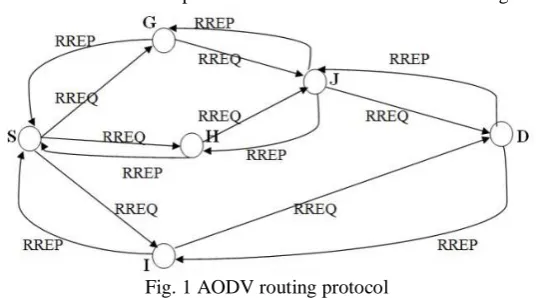
RREP (Route reply) and RERR (Route error). To find a path, the source establishes RREQ packets to the nodes in a network. The nodesthat receive RREQ packet from the source, keep forwarding it until it discovers a fresh route towards the destination. When a destination node receives RREQ, it sends RREP packets if a node has a fresh route towards the destination. When RREQ message is received, hop count of each node is increased by one and route entry is updated with a new information by intermediate nodes. Whenever the new RREQ, RREP and RERR messages are sent, the sequence number of a node is increased. A node initiates a route discovery process whenever a node tends to communicate with the other nodes.
B. AODV route discovery process
RREQ packets are established from source S to initiate a route from source to destination D. The packet nodes G, H and I receive RREP packet nodes and perform one of the following functions:
1) Send back RREP packet if a packet has a fresh route to destination node
2) Update routing table and establish RREQ again
The destination node sends back RREP towards the source when it receives RREQ messages. Intermediate nodes forward RREP messages towards the source nodes, which updates its routing table upon receiving the packets. The conditions in which RREP accepts the source nodes are:
i. Dest_seq number of a node is larger than the one in routing table
ii. Dest_seq numbers are identical and hop count is smaller than the one in routing table
Fig. 1 AODV routing protocol
C. Grey hole attack
Grey hole attackis practicably one of the active attacks on MANETs. When a source node sends the RREQ message, Grey hole node falsely claims to have fresher route. When this node receives RREQ message from the source, it sends the false RREP with larger sequence number towards the source. When a source receives RREP, it assumes that the node has a fresher route towards the destination and creates a route towards a grey hole. Further, it sends the data packet to the grey hole node. The grey hole node in turn absorbs the data packets without forwarding them and hence performs grey hole attack.
III. RELATED WORK
The researchers attract a considerable attention over the security and cooperation enforcement problems in MANETs environment. This section describes some of these researches carried out to mitigate grey hole attacks. Hu et al [1], Papadimitratos and Hass [2], Yang et al [8] and Sanzgiriet. Al [3] proposed a protocol to secure MANETs routing layer using cryptographic techniques. Zhou and Haas [4] proposed a scheme for authentication handling in MANETs by trusted certificate authorities (trusted CAs).
A self-organized PGP based scheme was proposed by Hubaux et al [5] for node authentication using certificate chain and transitivity of trust. Some research was also focused on detection and reporting of misleading node routing misbehaviour. In particular, Watchdog and Pathrater [6] used observation based approach to recognize misbehaving node and report back to the source. However, instead of punishing malicious node, they avert their packet-forwarding burden.
Researchers also investigated the means of discouragement of routing misbehaviour through payment systems [7]. These schemes require either central bankers or tamper-proof hardware to account securely, which makes the schemes not appropriate for Mobile ad-hoc network scenario.
IV. PROPOSED WORK
A. Secure Data Protocol to Mitigate Grey Hole Attack
grey hole nodes. If a neighbour drops the packets then the node instantly checks the other cause of packet dropping, stated in our algorithm. When packet dropping reaches its threshold value, the node is considered as malicious node and detached from the route selection. Initially, node checks the TTL of the next node and check whether it is destination node or not. If the TTL value is same, then it checks the properties of a node such as residual energy (ce).
Reference table contains the information of most recently transmitted packets. When a node recognizes a grey hole node, it broadcasts its identity to the other nodes to prevent malicious activities in routing. We created an algorithm based on AODV, in which the best path depends upon maximum sequence number and minimum hop count.
When a source needs to send the packets towards the destination, it establishes a control packet RREQ to all the neighbouring nodes. The destination node generates RREP only through trusted nodes. If a node finds any malicious node during the process of route discovery, it transmits the information to all the other nodes. If a route is already established and a grey hole node is later recognized, then the source node cuts off the grey hole node and re-establishes the routing process.
Where S=Source node, M=Malicious node, I=Intermediate node and D=Destination node Stage 1: Each node maintains a table containing the fields „fm‟ and „rm‟ in a promiscuous mode
fm rm
Packet forwarded from node „m‟ to node „i‟
Information of packet forwarded by node „i‟ forwarded by node „m‟
Where „fm‟ maintains packets recently forwarded and „rm‟ maintains neighboring node information related to recently forwarded packets.
Stage 2: Compare „fm‟ and „rm‟
If fm≠rm and reaches the threshold value, then attack is recognized otherwise a node is trusted.
If „rm‟ is not found, check packet properties:
o Destination address
o TTL (Time to live)
If ok, check properties of node (such as energy)
If no „rm‟ and reaches threshold value, grey hole attack is recognized.
V. ANALYSIS, SIMULATION AND RESULTS
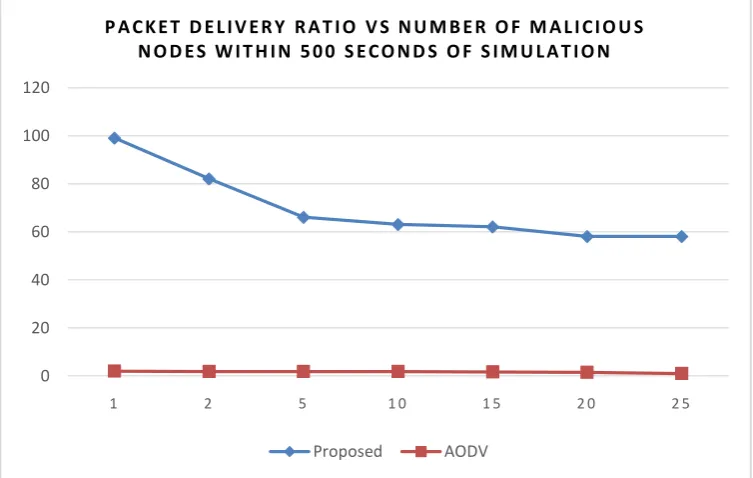
Grey hole nodes are created and analyzed, the simulation results in a table given below for 100 and 500 seconds in NS-2 simulator. Packet delivery ratio is our simulation performance matrix. MANETs are of dynamic nature, which makes the network open to attackers. Routing is the fundamental problem inviting malicious attacks but is the most significant process in which a node works and cooperates with the other nodes. The misbehavior of a node (selfish & malicious) degrade the network performance significantly and affect QoS parameters such as packet delivery ratio. Therefore, we test the packet delivery ratio of the algorithm proposed with the nodes having selfish and malicious conduct.
We used NS-2 (Network simulation version: 2) for simulation of our proposed model. We implemented secure data protocol to make AODV based routing protocol secure against grey hole attacks with NS-2.35.
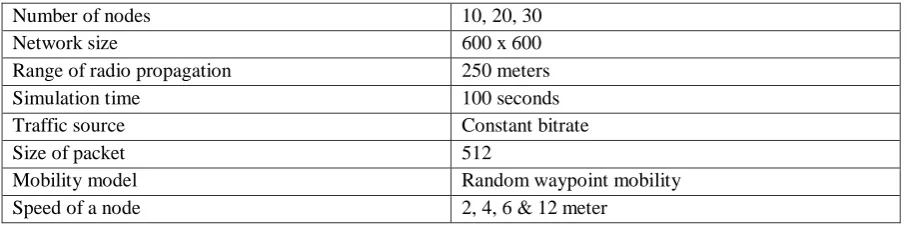
Compared to existing AODV routing protocols, this approach provides better performance in terms of throughput and delay. The primary objective of our simulation is to prove that our proposed method properly secures existing AODV based protocols with all the aspects of security in terms of grey hole attack. The conditions for simulation is count of number of varying misbehavior node. All the mobile node components in a network have their obligation values, like link layer, like interface queue and MAC layer. For all mobile nodes considered, MAC trace property is turned OFF. Router, movement traces properties and agent properties are turned ON. The table given below shows the considered network scenario.
Table I Simulation
Number of nodes 10, 20, 30
Network size 600 x 600
Range of radio propagation 250 meters
Simulation time 100 seconds
Traffic source Constant bitrate
Size of packet 512
Mobility model Random waypoint mobility
Speed of a node 2, 4, 6 & 12 meter
S
M
I
D
ISSN: 2277-128X (Volume-7, Issue-6)
Fig. 2 Packet delivery ratio Vs number of malicious nodes within 100 seconds of simulation
Fig. 3 Packet delivery ratio Vs number of malicious nodes within 500 seconds of simulation
VI. CONCLUSION
We proposed a secure data protocol for averting grey hole attacks in AODV based routing protocol. The protocol maintains the packets that are transmitted in a promiscuous mode to ensure the delivery of packets towards the destination node. If any of the node drops the packets, our protocol checks for the cause of packet drop to recognize the grey hole node. This prevents a trusted node from being listed as a grey hole node.
REFERENCES
[1] Y. Hu, A. Perrig, and D. Johnson, “Ariadne: A secure on-demand routing protocol for ad-hoc networks,” In Proceedings of the 8th Annual International Conference on Mobile Computing and Networking (MobiCom 2002), pp. 12-23, ACM Atlanta, GA, September 2002.
[2] P. Papadimitratos, and Z. Haas, “Secure routing for mobile ad hec networks,” In Proceedings of SCS Communications Networks and Distributed Systems Modeling and Simulation Conference (CNDS 2002), San Antonio, TX, January 2002.
[3] K. Snazgiri, B. Dahill, B. Levine, C. Shields, and E.A. Belding-Royer, “Secure routing protocol for ad hoc networks,” In Proceedings of International Conference on Network Protocols (ICNP), Paris, France, November 2002.
0 20 40 60 80 100 120
1 2 5 1 0 1 5 2 0 2 5
P A C K E T D E L I V E R Y R A T I O V S N U M B E R O F M A L I C I O U S N O D E S W I T H I N 1 0 0 S E C O N D S O F S I M U L A T I O N
Proposed AODV
0 20 40 60 80 100 120
1 2 5 1 0 1 5 2 0 2 5
P A C K E T D E L I V E R Y R A T I O V S N U M B E R O F M A L I C I O U S N O D E S W I T H I N 5 0 0 S E C O N D S O F S I M U L A T I O N
[4] L. Zhou, and Z. Haas, “Securing ad hoc network,” IEEE Network Magazine, Special issue on network security, Vol. 13, No. 6, November/December 1999, pp. 24-30.
[5] L. Buttyan, and J. Hubaux, “Enforcing cooperation in self-organizing mobile as hoc networks,” In Proceedings
of IEEE/ACM Workshop on Mobile Ads Hoc Networks, Technical report DSC/2001/046, EPFL-DIICA, August 2002.
[6] S. Marti, T. Guili, K. Lai, and M. Baker, “Mitigating routing misbehaviour in mobile ad hoc networks,” In Proceedings of MOBICOM 2000, pp. 255-265, 2000.
[7] M. Jackobsson, J. Hubaux, and L. Buttyan, “A micro-payment scheme encouraging collaboration in multi-hop
cellular networks,” In Proceedings of Financial Crypto 2003.
[8] H. Yang, J. Shu, X. Meng, and S. Lu, “SCAN: Self-organized network layer security in mobile ad hoc networks,”