Shared Responsibility and Reverse Logistics
Systems for e-Waste in Brazil
João Ernesto Brasil Migliano
[email protected] CENTRO UNIVERSITÁRIO DA FEI
Jacques Demajorovic
CENTRO UNIVERSITÁRIO DA FEI
Lucia Helana Xavier
[email protected] FUNDAJ
ABSTRACT: The National Policy for Solid Waste (NPSW), passed in 2010, established a system of shared responsibility for waste management in Brazil, including Waste of Electrical and Electronic Equipment (WEEE). This law requires the collection and disposal of technological waste through the implementation of Reverse Logistics Systems (RLS). In this study we discuss the main challenges and prospects in implementing WEEE reverse logistics in Brazil. The research was conducted through doc-ument analysis and interviews with different players, who are participants in the process of establish -ing a sector agreement. The find-ings suggest that the shared responsibility model proposed by the NPSW is not comprehensive enough to deal with the complexity of the Brazilian WEEE reverse chain. Based on this research we were able to propose a broader model covering the interrelationships among all the agents that interfere directly, indirectly, locally and abroad with the implementation of reverse logistics chain practices for electrical and electronic consumer goods in Brazil.
Keywords: Reverse logistics. Shared responsibility. Recycling. Waste picker cooperatives. Socio-environmen-tal risks.
1. INTRODUCTION
The expansion of the Information and Communi-cation Technology (ICT) market is the result of an unprecedented technological development. It was coupled with significant investments in technologi -cal innovation and marketing, and improvement in distribution systems, favoring the sales of electron-ic products in a worldwide scale. At the same time, the large revenues generated by these products were made possible because this system succeeded in promoting rapid obsolescence through the short-ening of product life cycle (Kiddee et al., 2013). Widemer et al. (2005) report that, between 1992 and 2005, computers’ average lifespan has decreased from 4.5 to 2 years. As a result, there is increasing consumption of non-renewable natural resources and generation of e-waste, which contains toxic substances such as mercury, chromium, cadmium and lead, with significant potential to harm human health and the environment when improperly dis-posed of. In order to face this challenge, Extended Producer Responsibility (EPR) gained popular-ity as a public policy in several developed coun-tries, mostly in Europe, and in a few developing countries such as India and China (Gottberg et al., 2006; Milanez & Bührs, 2009; Manomaivibool, 2009; Xiang & Ming, 2011). It is expected that, by forcing manufacturers to take back products after usage, managers will increase investments in Design for the Environment (Atasu & Wassenhove, 2012; Birch et al., 2012), stimulating the use of more recyclable and less toxic materials in electronics components. However, the current scenario for electronic waste management is not very different from the one proposed by Wagner (2009). According to this au-thor, there is no evidence that manufacturers will work towards producing equipment with greater recycling potential while there is an exponential in-crease in consumption and disposal, and also low rates of technological waste recyclability. These aspects contribute to compromise environmental safety around the world (Li et al., 2013).
On the other hand, reverse logistics, as one of the key elements of the EPR approach, has made re-markable progress in different countries and has become a subject of a growing interest for managers and academics. Legislation and increasing pressure from consumers for corporate social responsibility (Jayaraman & Lou, 2007) may be perceived as the drivers in this process. As a result, the expansion of Reverse Logistics Systems (RLS) is observed in
sev-eral developed countries. On the contrary, in de-veloping countries RLS are still in their preliminary stages (Schluep et al., 2009; Lau & Wang, 2009). Schluep et al. (2009), Manomaivibool and Vassana-dumrongdee, (2011) and Wang et al. (2012) argue that in those countries initiatives to implement RLS are challenged by the lack of legislation, the low level of public awareness about WEEE environ-mental impacts, and the existence of informal waste pickers, who are responsible for the expansion of collecting and processing materials, although un-prepared to prevent environmental and health im-pacts. In Brazil, the major step taken to overcome such challenges was the approval of the National Policy for Solid Waste (NPSW) in 2010. According to this law, all the 5,570 Brazilian municipalities must define waste management plans and reverse logistics systems for six main waste categories: (i) batteries; (ii) agrochemical packagings; (iii) used lubricants and lubricant packagings; (iv) tires; (v) lamps and (vi) electrical and electronic equipment waste (WEEE).
Demajorovic and Migliano (2013) highlight as the main merits of the new legislation the recogni-tion of shared responsibility for the product life cycle through sector agreements, which should be agreed upon and signed until 2014, and the inclu-sion of Reverse Logistics for WEEE. Furthermore, the authors emphasize the legislation’s innovative character in encouraging the integration of waste pickers organizations as providers of Reverse Lo-gistics Programs for manufacturers. Even consider-ing such improvements, the authors point out that challenges already mentioned in previous research (Thierry et al., 1995; Braga Junior et al., 2006; Stock and Mulki, 2009) still remain in the current Brazil-ian scenario.
decision-makers engaged, directly or indirectly, in the segment.
2. REVERSE LOGISTICS: CHALLENGES AND OPPORTUNITIES
The NPSW was timely passed, as there has been a significant increase in the Brazilian technological in -dustry, favored by the recent increase in household income (Araújo et al., 2012). Thus, collection of elec-tronic equipment at the end of its life cycle and its proper disposal are essential to prevent the potential environmental impacts caused by the increased gen-eration of this kind of waste. However, as it is a rela-tively new issue in the country, there is a lack of re-search focusing on the consequences of the law and the effectiveness in implementing reverse logistics. Nowadays, logistics issues are usually included in business strategy discussions; important decisions are involved, as shipping and inventory manage-ment have become fundamanage-mental activities that affect competitiveness. Over the years, companies realized that buying, producing and delivering goods to the point of sale require a multidisciplinary team ap-proach. The complex decisions involved in the logis-tics processes and management of materials, quanti-ties, costs and prices require a strategic vision. Thus, business activities have become much more com-plex than the simple decision to make, negotiate and deliver (McElhone, 1994).
From the 1980’s on, new concepts such as green lo-gistics and reverse lolo-gistics, which seek possibilities to recover materials and to value rejects, caused an increase in the number of studies on direct flows and returns, requiring additional and more specific considerations (Kokkinaki et al., 1999; Gungor & Gupta, 1999; Fleischmann et al., 2000). At that time, the concept of green logistics was seen as a fad, even as a mere marketing appeal, or simply as a means to find a destination for waste, as observed by Rog -ers and Tibben-Lembke (1998), Gungor and Gupta (1999), and Fleischmann et al. (2000). Future stud-ies should include the damage caused to the planet by the incorrect disposal of products, particularly those containing dangerous, harmful substances to
humans and the environment. Rogers and Tibben-Lembke (2001) also emphasize reverse logistics as a profit generating function, which means that RL may be seen as a trade-off between economic and environmental sustainability.
Thierry et al. (1995) state that the objective of prod-uct recovery management “is to recover as much of the economic (and ecological) value as reasonably possible, thereby reducing the ultimate quantities of waste”. According to this author, typically manufac-turers simply ignore what their customers do with the purchased products after use. Many products are designed in such a way as to minimize produc-tion, manufacture, sales and distribution costs, and there is not even the slightest concern for reuse, re-pair or disposal of waste, because “manufacturers generally believed that the costs of incorporating these requirements would outweigh the benefits.” (Thierry et al., 1995, p. 114). Besides, the higher costs of reverse logistics are emphasized by Leite et al. (2009) and Kaynak et al. (2014), as follows:
“The cost of RL is 9 times higher than the cost of forward logistics because the distribution of the new manufactured goods can be consolidated but as pro-posed earlier the consolidation of reverse delivery/ shipment is possible with the involvement of mul-tiple firms and shared resources (e.g. trucks, inspec -tion units, technology, equipment, facility).”
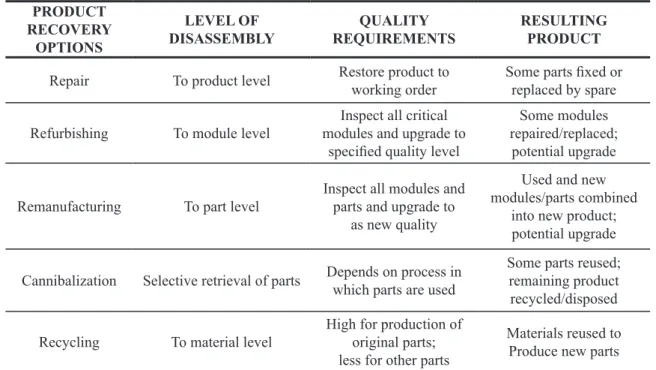
Table 1. Product recovery options. PRODUCT
RECOVERY OPTIONS
LEVEL OF
DISASSEMBLY REQUIREMENTSQUALITY RESULTINGPRODUCT
Repair To product level Restore product toworking order Some parts fixed orreplaced by spare
Refurbishing To module level modules and upgrade toInspect all critical specified quality level
Some modules repaired/replaced;
potential upgrade
Remanufacturing To part level Inspect all modules andparts and upgrade to as new quality
Used and new modules/parts combined
into new product; potential upgrade
Cannibalization Selective retrieval of parts Depends on process inwhich parts are used Some parts reused;remaining product recycled/disposed
Recycling To material level High for production of original parts; less for other parts
Materials reused to Produce new parts
Source : Thierry et al., 1995.
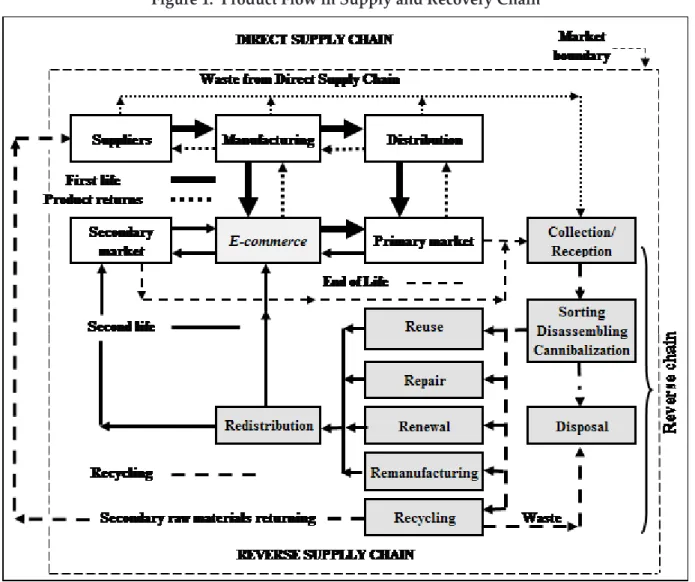
Economic issues, along with social and environmen-tal conditions, tend to favor the reuse of products and materials as a way of maintaining sustainability standards. In this context, Kokkinaki et al. (1999), based on the model of Integrated Supply Chain and the taxonomy of reverse flow processes proposed by Thierry et al.(1995), expand the reuse (second life) approach according to the model in Figure 1. The
Figure 1. Product Flow in Supply and Recovery Chain
Source: Adapted by the authors from Kokkinaki et al. (1999).
Direct logistics activities are represented by the first sequence of blocks on the upper half of Figure 1. The second row of blocks represents interactions among market players: primary market (first buyer), sec -ondary market (two or more subsequent purchas-ers), e-commerce and waste collection/reception. The bottom half features the activities of reverse logistics and recycling in general, namely: reuse, re-pair, refurbishment, remanufacturing, recycling and proper disposal of waste.
Expanding on the work by Kokkinaki et al., (1999), Figure 1 also describes the primary and secondary markets, expanding the product Life Cycle Assess-ment (LCA) approach (González-García et al., 2012). We consider a new taxonomy, not only the bound-aries of ‘cradle to gate’ or ‘cradle-to-point’ of con-sumption (cradle to site) and ‘cradle to grave’, but
reverse logistics in closed loop or ‘cradle to cradle®’
as per McDonough and Braugart (2002).
Clearly, some concepts have changed, such as post-consumer waste, which may be seen as secondary raw materials. New paradigms emerged or gained force in the legal, operational and managerial fields, such as the alternatives of reuse, refurbishing, re-cycling, remanufacturing, etc. In this regard, some cases were highly successful in Brazil, such as post-consumer aluminum cans (Shinzato and Hypolito, 2005; Almeida et al., 2010), agrochemicals (Sato et al., 2006; Duarte et al., 2009) and lubricant packag -ing recycl-ing (Gomes et al., 2008).
man-agers’ distrust in the opportunities arising from re-verse logistics. Braga Júnior et al. (2006) argue that companies do not have appropriate systems for measuring the economic impact of product return and possible reuse, and that reverse logistics is un-derstood as a high-cost, non-essential, non-strategic operation. Other authors explain business lack of interest in reverse logistics not only because of the costs involved, but also due to the complexity in co-ordinating different supply chain stakeholders, such as distributors, retailers, consumers, and collecting and recycling organizations. To Jayaraman and Luo (2007), this complexity is associated with the need to establish new relationships between several players in the production chain, which requires additional coordination efforts by companies.
As demonstrated by Demajorovic et al. (2012), the need to develop an infrastructure to collect post-con-sumer waste, to identify alternatives to ensure the reuse of materials, or to securely dispose of waste are strange activities to most companies. Thus, when evaluating and implementing a reverse logistics pro-gram, the challenges are seen more clearly than the opportunities - such as anticipating the legislation (Stock & Mulki, 2009), reaping benefits to company image (Ravi et al., 2008; Leite et al., 2009) and gain -ing opportunities to reduce costs and increase com-petitiveness through product and process re-design (Jayaraman & Luo, 2007). In this context, the law continues to be the major stimulus for the develop-ment of reverse logistics in business managedevelop-ment, as stated by Lau and Wang (2009). However, the same authors add that, even in developed countries, it is also necessary to proceed with tax incentives for re-cycling post-consumer waste.
The challenges discussed above are also the reality in developing countries. However, in addition to the strategic, economic and technical aspects, the social issues in managing reverse chains in devel-oping countries gain importance, because many of such chains are sustained by the actions of informal agents. It is important to remember, as shown by Ribeiro et al. (2009), that the largest share of waste returned for recycling in Brazil is the work of waste and recyclable materials pickers.
It is estimated that, in Brazil, there are 1 million waste pickers, of whom only ten percent work at recycling cooperatives (MNCR, 2014). The other 90 percent are self-employed and perform their daily tasks with little regard to health, safety and environ -mental protection (Schluep et al., 2009). The NPSW
is an advancement in recognizing these workers as one of the country’s essential elements in achieving effective reverse logistics for materials such as plas -tics, paper, aluminum cans and e-waste.
However, it should be noted that WEEE requires special care for its reuse. Unlike most materials handled by scavengers, such as plastics, metal, paper and PET bottles, WEEE has the potential to cause severe problems to human health and to the environment during its dismantling and separation. In terms of the prospects for reusing this material, “roughly speaking, WEEE consists of three major parts: 40:30:30 - metal, plastics and refractory oxides, respectively” (Sodhi & Reimer, 2001, p. 99). Several authors emphasize mobile phone and computer elec-tronic circuit boards as the components with higher added value in proportion to their weight, due to the higher concentrations of precious and strategic met-als. (Leite et al., 2009; Franco et al., 2011; Yamane et al., 2011; Zeng et al., 2012; Henrique Júnior et al., 2013; Petter et al., 2014).
Nevertheless, properly recovering valuable mate-rials also requires training and expertise. Various kinds of materials are complex, sometimes harm-ful and toxic, and cannot be handled by untrained workers, as they pose great risks to all involved in this process (ABNT NBR 16.156:2013). Substances such as lead, barium, beryllium, cadmium, chromi-um and mercury from computers have the potential to both pollute water, soil and air, and to severely in-toxicate workers who handle them improperly, even causing death in some specific cases. Shane (2011) argues that burning electronic components for recy-cling and disposal in open areas near poor popula-tions are common practices in developing countries, which cause serious health problems to these com-munities.
An important strategy to prevent and/or mitigate these potential socio-environmental risks is the adoption of Green IT or CIT Sustainable Design con-cepts, as promoted by the Institute of Electric and Electronics Engineers (IEEE), referred to by Mureg-uesan and Laplante (2011): “designing, manufactur-ing, usmanufactur-ing, and disposing of computers, servers, and associated subsystems - such as: monitors, printers, storage devices, networking and communications systems - efficiently and effectively with minimal or no impact on the environment”.
(NPSW) was passed in 2010. Besides introducing some of the concepts and strategies already de-scribed, this law established a system of shared responsibility for managing various kinds of post-consumer waste, including Waste of Electrical and Electronic Equipment (WEEE).
3 NATIONAL POLICY FOR SOLID WASTE (NPSW) FEATURES
The NPSW established a new regulatory framework for the Brazilian society, providing an appropriate destination for solid waste generated by manufac-turing and disposing of several goods, including electro-electronic equipment, which is the focus of the present work. It also established the obligation to implement and operate Reverse Logistics Systems (RLS) aimed to collect, assign, reintegrate and reuse waste along supply chains. The NPSW instructs on how to dispose of the waste resulting from these processes in environmentally correct ways, and it promotes the social inclusion of legally constituted picker groups.
Although the passing of the new law has been quite a slow process, taking about 20 years, Reveilleau (2011, p. 164) highlights its importance for Brazil, because “one of the obstacles was the lack of a na-tionwide standard focusing primarily on waste management, and assigning responsibilities to gen-erators, consumers and government authorities”. In this context, we highlight some of the main ad-vances that are of interest for this research. The first point is the recognition that the proper management of post-consumer waste must be shared by the many players involved in the recycling chain:
XVII - shared responsibility for product life cy-cle: a set of individual and chained assignment of manufacturers, importers, distributors, retailers, consumers, and members of public urban sanita-tion and solid waste management, to minimize the volume of waste and solid waste generated, as well as to reduce the impacts to human health and the environment resulting from product life cycles, in the terms of this Act (Brazil, 2010a);
The recognition of the need for shared responsibil-ity is essential to the advancement of waste manage-ment in the country, as the proper disposal of waste depends on the collaboration of all the chain players, including manufacturers, the public sector, retailers and consumers.
The NPSW also breaks new ground by recognizing groups of recyclable materials as legally relevant to RLS actors, and by encouraging their involvement in various initiatives to expand waste collection and disposal. Still, perhaps, the main innovation is the definition of tools to operationalize reverse logistics, among which is the establishment of sector agree-ments, which are defined as:
I - sector agreement: contract signed between the government and manufacturers, importers, distributors or retailers, with a view to imple-ment shared responsibility for the product life cycle (Brazil, 2010a);
It is expected that the target of improving solid waste management in the country will be achieved with the sector agreements, since they are the result of dialog among all the players involved in the reverse chain. Proposals for implementing reverse logistics are set in various sector agreements, based on the concern for social and environmental management contained in the legal reverse logistics definition:
XII - Reverse logistics: instrument character-ized by a set of actions, procedures, and means included in economic and social development programs, aimed to enable the collection and re-turn to the business sector of solid waste either for reuse in their production cycle, or in other production cycles, or for final disposal in envi-ronmentally appropriate ways (Brazil, 2010a);
Reverse logistics is considered one of the most con-troversial issues of the new law, because there was great resistance from the business sector to accept re-sponsibility in managing post-consumer waste, due to the complexity and costs involved in this activ-ity (Demajorovic & Migliano, 2013). Article 33 in the national policy states that: post-consumer electronic products and their components should be recovered by manufactures, importers, distributors or retail-ers, independently of public urban cleaning ser-vices. The hierarchy of requirements for using and processing post-consumption products and materi-als among the different players in the supply chain, who are co-responsible for the shared management of product life cycle is: no generation, reduction, re-use, recycling, treatment and final disposal.
Rev-eilleau (2011), one of its greatest contributions was a nationwide waste regulation. The hierarchy of post-consumer materials and products, as stated by the NPSW, is based on previous international legal documents and also on the work of leading authors such as Thierry et al. (1995), Rogers and Tibben-Lembke (1998) and Kokkinaki et al. (1999), to name a few. In its Article 9, besides its Regulations (De-cree 7.404/2010, Title IV, Articles 35 to 39), the NPSW considers both the concepts of reverse logistics in open-loop (similar to direct logistics) and closed-loop (closed-closed-loop supply chain), giving rise to the fundamental ‘3Rs’ of reverse logistics, namely: a) reduce: either the consumption of raw materials, recycled materials, energy, or the actual generation of waste, by improving or developing processes;
b) reuse: extending product or component life cycle, or developing a market for second-hand goods, ei-ther repaired or refurbished, through the reuse of post-consumption goods or components obtained by means of cannibalization or recycling processes; c) recycle: reusing materials and energy when techni-cal, economic and environmental processes permit re-ducing the volume of waste requiring final disposal. To this end, the NPSW in its Article 54 establishes deadlines for implementing sector agreements among all the players involved. For the electro-electronics industry, the deadline for the sector agreement was established within 4 years after the NPSW enactment. In Figure 2, Corrêa and Xavier (2013) propose an in-terpretation of the responsibilities assigned to stake-holders involved in the implementation of RLS.
Figure 2. NPSW stakeholders’ shared responsibility for RLS.
Consumer
Cooperatives Return of products or packagings, whether or not considered as dangerous waste, for retailers or distributors
Maintenance and information sharing about development of activities
Design and implement the Reverse Logistics System
in charge of May take charge of distributor, dealer, manufacturer, and importer responsibilities, provided they receive
payment as agreed upon by the parties Return products and packagings to manufacturers
or importers
Distributor/Retailer Public Urban Cleaning Services
Provide envinronmentally adequate disposal of products and packagings collected and returned.
Rejects must be sent to final disposal as determined by the competent environmental authority or estabilished in the municipal waste
management plan
Establish partnerships with manufacturers, importers, distributors or retailers to process recyclable and
reusable materials
Manufacturer/Importer
Figure 2 shows that consumers’ sole responsibility is to deliver post-consumer waste. On the other hand, public cleaning services only responsibility in the system is to collect post-consumption materials and products, to the extent that they are paid for it. Associations and cooperatives should work to es-tablis partnerships. In a nutshell, manufacturers, importers, distributors and retailers should be ac-countable for effectively implementing the Reverse Logistics System. This interpretation represents a new dimension to the proposal of shared responsi-bility, defining the degree of responsibility of each agent in the reverse chain.
The discussion above raises important issues re-garding the implementation of reverse logistics in Brazil. Lau and Wang (2009) sustain that in develop-ing countries it is essential to promote cooperation between companies, public sector and non- gov-ernmental organizations, in order to reduce the re-sistance of the private sector to implement reverse logistics. The NPSW has as one of its key points to promote cooperation among reverse logistics chain members. But guaranteeing this cooperation is not an easy task, even when required by law. Rotter et al. (2011) show that, despite demands from the Europe-an Directive, a shared responsibility model to imple-ment a system for WEEE collection and treatimple-ment raised conflicts among manufacturers and retailers about transportation costs - even in developed coun-tries. Augusto (2014) also identified the same con -flict in the Brazilian scenario in her research on the national model for shared responsibility in WEEE. In Brazil, another important challenge in complying with the legislation is to make producers and waste picker organizations work effectively together. Jesus and Barbieri (2013) sustain that waste pick-er organizations tend to reduce their vulnpick-erability when they are successfully incorporated into man-ufacturer reverse logistics flows as suppliers of re -cyclable materials. But, building such partnerships faces a series of problems, because many waste picker organizations lack professional management processes and a legal business structure. Also,
mis-understandings and conflicts are common in the re -lationship between the two stakeholders (Souza et al., 2012; Demajorovic and Migliano, 2013; Jesus & Barbieri, 2013). Therefore, it is important to question whether the Brazilian legislation, based on shared responsibility, has been effective to motivate mem -bers of the WEEE reverse chain to engage in reverse logistics initiatives. It should be noticed that some articles on WEEE consumption and reverse logistics in Brazil have been published (Silveira & Chang, 2010; Araújo et al., 2012; Mazon et al., 2012; Oliveira et al., 2012; Zanghelini et al., 2014). Nevertheless, few of them address the issue of deploying WEEE processes. As it is a fairly recent topic in the Brazil-ian literature, we decided to run a qualitative study to explore the operational, managerial and legal re-quirements.
4 METHOD
As previously mentioned, few authors have consid-ered the application of WEEE management in Brazil. In this paper, we propose an interpretative, qualitative study in order to evaluate stakeholders’ perceptions. Therefore, we chose to discuss this process from the perspective of the players involved in the WEEE re-verse logistics chain and in the development of sec-tor agreements. The researchers’ participation in the meetings held by the Brazilian Association for Tech-nical Standards (ABNT) was crucial to witness the discussions precisely when they were being held by key decision makers from all the segments involved in the construction of Reverse Logistics Systems (RLS) for waste management. These discussions oc-curred along one year and were the basis for out-lining the sector agreements, which have not been formalized yet.
Table 2. Codification and distribution of interviewees
PLAYERS QUANTITY PARTICIPATION %
Government (G1 to G3) 3 14,3
Manufacturers (M1 to M5) 5 23,8
Recyclers (R1 to R6) 6 28,6
Cooperatives (C1 to C4) 4 19,0
Academia (A1 to A3) 3 14,3
Total of interviews 21 100,0
Source: Developed by the authors.
The individuals to be interviewed were chosen us-ing an intentional samplus-ing procedure. This meth-odological approach was considered important in order to guarantee that the key sectors and agents involved in the sector agreement were represented in the survey. The researchers’ participation in the ANBT forum, as stated above, helped to select the first individuals to be interviewed. After that, using the snow-ball technique, additional subjects were identified to join the final sample (Bailey, 1994). Still, according to Bailey (1994), such a small and non-probabilistic sample does not permit further statisti-cal analyses, even though it is adequate in a prelimi-nary exploratory approach that could be followed by a more extensive survey.
We promised the interviewees and their organiza-tions that their identities would be kept confidential (Bailey, 1994; Godoi & Balsini, 2010).
A set of seven open-ended questions were prepared based on the literature review, the NPSW study and discussions form the ABNT forum. They included
themes such as: the importance of the new law, its effectiveness in handling WEEE, the proposed time -table for its implementation, and the participation of waste picker cooperatives in RLS, among others. These questions were pre-submitted to the selected stakeholders before the interview.
The interviews were taped whenever agreed upon. The transcripts omitted any information that could identify individuals, companies or organizations, and were submitted for interviewee approval after being properly coded and numbered according to their chronological order of execution.
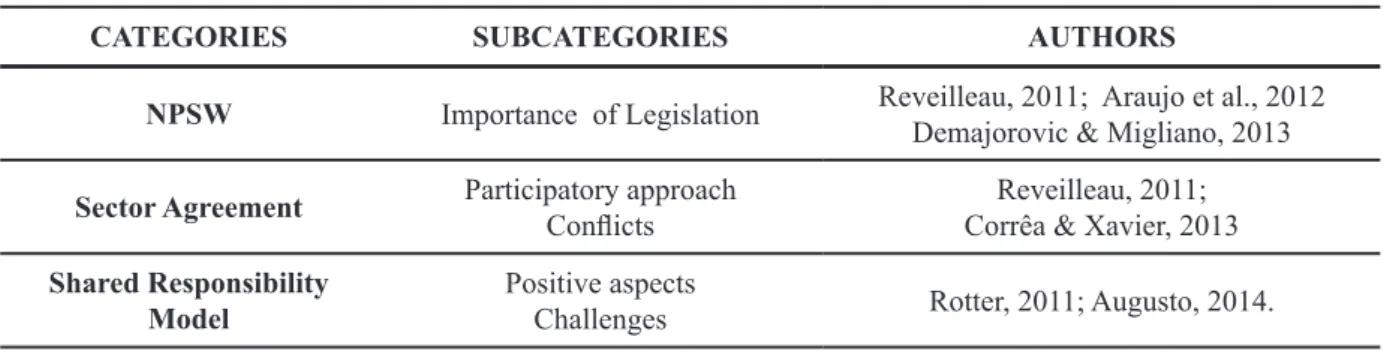
We chose the method of content analysis as proposed by Bardin (2002). It is defined as a set of analytical techniques that enable communications to reach logical and justified conclusions from the content of sender messages. A key element in content analysis is the creation of categories. Based on the literature review, the following categories and sub-categories were defined, as presented in table 3.
Table 3. Categories, subcategories and corresponding authors
CATEGORIES SUBCATEGORIES AUTHORS
NPSW Importance of Legislation Reveilleau, 2011; Araujo et al., 2012Demajorovic & Migliano, 2013
Sector Agreement Participatory approachConflicts Corrêa & Xavier, 2013Reveilleau, 2011;
Shared Responsibility
Reverse Logistics
Costs Technological aspects
Transportation Tax system
Thierry et al., 1995; Braga Junior et al., 2006; Stock & Mulki, 2009; Wagner, 2009;
Lau & Wang, 2009
Waste pickers Health and environmental risksConflicts Challenges
Schluep et al., 2009; Shane, 2011; Wang et al., 2012; Souza et al., 2012;
Jesus & Barbieri, 2013
Source: Developed by the authors.
Then the transcripts were examined, seeking for full elements or themes corresponding to the context. They were subsequently categorized and listed to identify agreements, contrasts and disagreements among respondents from the same group of actors, but also between different players.
The analysis of the transcripts also included a verti-cal analysis of materials collected from the different players, in order to identify conflicts and different views or positions on the researched themes. The most important findings from this process are brief
-ly commented in the next topic.
Additionally, after concluding the above tasks, all the transcripts (more than 72,000 typed words) were screened using Microsoft Office tools. The content analysis method considers a word and its possible variants, for example, “to process” and “process-ing”. About 897 very frequent words were identified after a systematic screening of the universe. A rel-evant fragment of this list of words and their corre-sponding distribution among interviewees is shown in Table 4:
Table 4. Fragment of the list of most relevant words
Most frequent
words
Total Government Manufacturer Recycler Cooperative Academia
Q1
897 100% CF2 163Q 100% 238Q 100% 241Q 100% 153Q 100% 101Q 100%
Process 190 21.2 21.2 37 22.7 65 27.3 44 18.3 31 20.3 13 12.9
Consumption 123 13.7 34.9 13 8.0 27 11.3 38 15.8 28 18.3 17 16.8
Discussion 84 9.4 44.3 25 15.3 32 13.4 15 6.2 10 6.5 2 2.0
Costs 79 8.8 53.1 5 3.1 17 7.1 38 15.8 16 10.5 3 3.0
Information 58 6.5 59.6 5 3.1 7 2.9 27 11.2 7 4.6 12 11.9
Education 51 5.7 65.3 16 9.8 9 3.8 6 2.5 15 9.8 5 5.0
Technology 46 5.1 70.4 24 14.7 4 1.7 3 1.2 8 5.2 7 6.9
Control 27 3.0 73.4 2 1.2 9 3.8 9 3.7 7 4.6 0 0.0
Awareness 26 2.9 76.3 7 4.3 10 4.2 3 1.2 0 0.0 6 5.9
Investment 26 2.9 79.2 4 2.5 6 2.5 6 2.5 6 3.9 4 4.0
Resources 26 2.9 82.1 8 4.9 5 2.1 4 1.7 4 2.6 5 5.0
Source: Developed by the authors.
A few of the most representative words in Table 4, in decreasing levels of importance, are commented below:
- Process: with a 21.2 percent frequency, it expresses the most important concerns of Government offi -cials, Manufacturers, Recyclers and Cooperatives regarding the NPSW implementation process, the distribution of responsibility among the players, the WEEE reverse logistic process, the inclusion of waste pickers in these tasks, and so on. For the Aca-demicals, it was the second most important point of concern;
- Consumption: in the sense of consumer, consump-tion and similar meanings, with a 13.7 frequency, but not so relevant for the Government representa-tives, reaching only 8.0 percent;
- Discussion: in the sense of discussion, discussing processes and similar terms, with 9.4 percent. It is important to stress that the word dialog did not ap-pear in the amount of more than 72,000 words; - Costs: in the sense of processing cost, logistics costs involved in returning goods and other similar mean-ings, with 8.8 percent;
- Technology: it appears only in the 6th position, but
it is a strong concept in Government officials’ dis -course. It may be related to the importance of tech-nology in providing sustainable solutions for WEEE management.
And finally, the word information, with a 6.5 per -cent frequency, was mostly related to information on how consumers should proceed with end-of-life electric and electronic equipment.
5 CHALLENGES AND PERSPECTIVES FOR WEEE REVERSE LOGISTICS IN BRAZIL: PERCEPTIONS OF STAKEHOLDERS
Our research showed that, for the respondents, NPSW adoption represents one of the most impor-tant events in the evolution of solid waste manage-ment models in Brazil, because it established a uni-form, national rule, thus eliminating isolated actions, regulatory discrepancies, or omissions by state gov-ernments. Regional differences were leading com -panies to make deployment decisions or to migrate to geographical areas with less restrictive public policies. This aspect of the NPSW was unanimously mentioned by the subjects, who emphasized the
importance of establishing country-level rules and deadlines for solid waste management. Although most states still lack a specific regulation for WEEE management, it is noteworthy that the federal gov-ernment is now committed to it, due to the private sector’s engagement. Companies have become in-terested in WEEE management as a way to improve their corporate image, and also as an alternative to get profits from secondary raw materials.
Also, very relevant aspects in the adoption of NPSW are the obligation to implement reverse logistics and the recognition of the need for shared responsibil-ity among all the stakeholders in different produc -tion chains (the manufacturers, the public sector, retailers, consumers and waste pickers). The survey revealed that the sector agreements are valued by different chain stakeholders, as they promote dia -log and contribute to shared accountability for the product life cycle. However, in the case of electronic waste many obstacles remain to be overcome, de-spite such advancements.
First, it is clear for all participants that encouraging a dialog among e-waste reverse chain members gives rise to new challenges caused by conflicting inter -ests and the difficulty to reach a consensus. This obstacle to NPSW implementation is evidenced by the slow evolution of sector agreements, especially in the area of technological waste, as mentioned by allrespondents. It appears that, although the sector agreement may provide a valuable collective com-mitment, conflicts of interest and disagreements prevent reverse logistics programs from advancing faster in Brazil. So, the deadline established in the NPSW will probably be compromised due the ex-tension of the debate.
interviews have shown that, although the legisla-tion requires a shared responsibility model, manu-facturers and retailers fail to reach an agreement as to whom should bear transportation costs to recy-cling centers. As the NPSW does not clearly state who shall be responsible for this, both sectors use the gaps in the legislation to transfer accountability and to postpone a final agreement.
A third and important issue is the gray market. It comprises irregular, but not always illegal, prod-ucts that represent a significant part of the Brazilian computer market. The main question here is who should be in charge of this kind of post-consumer waste. Manufacturers tend to avoid handling post-consumption gray market products, because they entered the country without paying the required imports duties and local taxes.
Fourth, the large size of the Brazilian territory is also a challenge for the success of local logistics initia-tives, as collection activities become even harder outside major cities. It cannot be overemphasized that the volume of recyclable materials available and their financial value are essential to generate econo -mies of scale and to ensure the financial feasibility of reverse logistics. In the Brazilian context, the prob-lem with long distance transportation costs and the technological gaps should also be considered. The recycling technology available in the country is for lower-value components only, such as plastic and metal. Printed Circuit Boards (PCB) can only be sep-arated locally, and then shipped abroad for recov-ery, thus transferring to developed countries most of the value generated by recycling.
It is worth noting that the current Brazilian tax structure does not offer any kind of tax exemption or compensation for recyclable products; also, there is a lack of financial instruments to promote reverse logistics, as confirmed recently in a report published by the National Industry Federation (CNI, 2014). Lau and Wang (2009) sustain that tax incentives for recycling post-consumer waste is an essential tool for the success of reverse logistics initiatives. The CNI supports creating a fee for the purchase of elec-trical and electronic goods to cover the recycling costs at the end of their life cycle, which consumers
should be informed of at the moment of purchase. In fact, this proposal was already included in the sector agreement. But the interviewees showed low opti-mism that, given the current Brazilian tax system, this visible fee could be effectively implemented. . Therefore, it is very unlikely that feasible WEEE col-lecting and recycling programs are implemented by the manufacturers.
Finally, one of the main obstacles to implementing NPSW is precisely one of its most innovative fea-tures: the recognition of the key role played by waste picker organizations in reverse logistics initiatives (Souza et al., 2012). Selling directly to recyclers can substantially impact waste pickers’ income (Jesus & Barbieri, 2013) It can be argued that reverse logis-tics in the computer and electronics markets may foster social inclusion in developing countries. But the characteristics of e-waste and companies’ low interest in working together with waste picker orga-nizations are a challenge to this. As previously dis-cussed, electronics are not hazardous to the environ-ment or to human health throughout their product life cycle, but disassembling e-waste for reuse poses a series of environmental threats, and thus require a well-trained workforce, and special care.
The interviewees, including waste picker organiza-tions and government representatives, agreed that few cooperatives possess the necessary qualifica -tions to do WEEE recycling. In this sense, although the legislation is an important step, skill building and training efforts appear as essential complemen -tary actions, reinforcing the results of the research by Schluep et al. (2009) and Shane (2011).
Based on the challenges presented above, we argue that the model for shared responsibility constructed by means of sector agreements, as proposed by the NPSW (as shown in Figure 3), is not comprehensive enough to deal with the complexity of the Brazilian WEEE reverse chain.
Figure 3. Hypothetical closed-loop supply chain model for WEEE in Brazil
External SUPPLY DEMAND Internal
Market Upstream Intermediaries Downstream Market
Agents
External Internal Production Sales
Supplier Supplier Unit System
External Internal Collection or
Treatment Treatment Reception
Final Final
Disposal Disposal
Consumer
Source: Developed by the authors.
The diagram in Figure 3 illustrates the complexity of the Brazilian situation, starting with the element on the upper left side: the external market, limited by the customs barrier represented by the dash-dotted line on its right side. The internal suppliers are po-sitioned upstream along the production chain; mov -ing downstream we find the demand system, and finally the end consumers in the internal market. The central block at the top of the diagram corre-sponds to intermediaries, who are involved in vari-ous processes. Examples are providers of support-ing services, usually outsourced by the companies, such as: customs brokers, transportation services, financial support and market research, among oth -ers (Lambert & Cooper, 2000). The interactions of these service providers with the other agents that participate directly in the activities, whether direct or reverse, are represented by a single dotted line. The blocks on the middle line, from left to right, cor-respond to: the foreign supplier, its domestic equiv-alent, the production unit, the sales system and the end consumer. They comprise the set of players who participate in the direct supply chain. As an example of the Brazilian case, an outside vendor can directly provide a finished product to the client via e-com
-merce, with home delivery; this situation is repre -sented in the diagram by the first set of direct arrows from left to right, representing a direct flow.
As illustrated by the arrows in the diagram, an ex-ternal supplier can also directly provide a local com-pany, a manufacturer, one of their suppliers, or even the sales system, with modules that perform spe-cific functions or assemblies, subassemblies, compo -nents, or even isolated parts. The arrows and dot-ted lines between the blocks reflect the interactions among the supply chain players for (i) value add-ing transactions in the direct flow and (ii) treatment of both non-conformities and post-consumption goods in the reverse flow.
The sales system includes sales and after-sales ser-vices, as well as the internet. The web permits, for instance, that an end user re-sells and returns a used product to the market, thus extending its life cycle. This possibility is represented by the first arrow in the reverse direction connecting the distribution sys-tem to the end customer.
or for maintenance and repairs after the warranty period has expired. Thus, a variety of stakeholders involved in the electronics reverse chain need to be considered for planning and executing a RLS, in or-der to effectively implement NPSW.
6 CONCLUSIONS
Today, Brazil is one of the world’s major IT markets. This industry generates increasing amounts of post-consumer waste, which require proper disposal to minimize their environmental impacts. This is nec-essary to comply with the NPSW requirements and, more specifically, to contribute to RLS implementa -tion. The findings from this research show that the new legislation is an important step in this direction. Respondents agree that the sector agreements fos-ter a dialog between different stakeholders in the reverse logistics chain, which is essential to build a shared responsibility model for the electrical and electronic equipment life cycle.
However, this participatory approach faces several challenges and threats to reaching its objective. We argue that the model of shared responsibility be-ing developed is not comprehensive enough to deal with the complexity of the Brazilian WEEE reverse logistics chain. Therefore we presented a broader model covering all the different players involved in both the direct and reverse flow of goods, according to the closed-loop concept.
This model represents the managerial aspects in-volved in coordinating the necessary interactions and transactions among the players in the direct and reverse logistics flows. The proposed model high -lights the complexity of the reverse logistics flow, because it shows that end-of-use products are not al-ways processed within the original delivery system. WEEE requires workers with specific information and operational training, as well as a technological infrastructure to process waste in an environmental-ly appropriate way. Another point of paramount im-portance to succeed in implementing RLS in Brazil is consumer awareness of the hazardous substances contained in WEEE, and their potential risks. There-fore, clear information on how consumers should properly handle WEEE is mandatory to stimulate their participation in reverse logistics initiatives. However, consumer participation in RLS poses sev-eral other challenges in Brazil. Consumers are the final link on the direct chain and also the first one on the reverse flow. Nevertheless, they are spread out
in more than 5,500 cities, most of them very far from the few recycling companies already existing in the country. Shipping services costs in Brazil are prohib-itive in terms of transport modes and fuel consump-tion, as distances among the cities are normally long. The results suggest that, in the absence of legal requirements, the higher costs of reverse logistics, coupled with the long distances to be covered in a country like Brazil and with inefficiencies in trans -portation modes, tend to discourage manufacturers from investing in their own projects. In this context, our model contributes by providing an integrated overview of the interactions under the closed-loop concept. The relationships represented in the model both demonstrate the complexity of RL and help de-signing strategies for an integrated management of the reverse chain, according to legal and corporative requirements. We consider that the broader view on the stakeholders, their relationships and interdepen-dence along the reverse logistics chain in Brazil, as shown in the model, could help the government fos-ter reverse logistics initiatives. By providing fiscal incentives, tax exemption or compensation mecha-nisms, government policies could free the reverse logistics processes from the extra costs generated by cumulative taxes, thus generating new business opportunities. As discussed in this article, including waste pickers into RLS requires a coordinated effort that may benefit from the model’s conjoint view on the players’ activities
Financial incentives are also essential, because of the cultural and technological barriers also Financial incentives are also essential, because of the cultural and technological barriers also identified in our re -search. Brazilian managers still perceive RL as an extra cost imposed by legislation, and not as an op-portunity to develop new business models. Also, the lack of technology and facilities in Brazil to recov-er the most valuable matrecov-erials in electronic waste, which are shipped abroad, limits most of the poten-tial revenues that could be generated locally by fully processing WEEE.
inves-tigated in future research as a way to increase the benefits of RL.
No previous research done in Brazil has considered WEEE deployment propositions, according to the stakeholder’s opinion, through a qualitative analy-sis. In this context, future research should focus on two key elements for improving RL in developing countries. First, a tax exemption for recycling pro-cesses of low value-added electrical and electronic products may be economically viable, increasing interest and incentives. Secondly, the current tax structure does not offer any tax incentive or com -pensation to organizations dedicated to work with the recovery of post-consumer waste, thus ignoring the social and environmental benefits generated by this economic activity.
Finally, we argue that, in developing countries, RL legislation may be innovative not only in terms of economic and environmental gains, but also in in-creasing income and social inclusion. The Brazilian legislation is the first one in the world to include waste picker organizations as potential suppliers of RL services. But considering the environmental and health risks involved in the activity of separat-ing and dismantlseparat-ing WEEE, and the low interest and distrust from manufacturers and recyclers in work-ing in partnership with waste pickers, they are not expected to participate in the reverse logistics flow without proper financial and training support.
7 REFERENCES
ABINEE - Associação Brasileira da Indústria Eletro Eletrônica. <www.abinee.org.br> (retrieved 06.05.2012).
ABNT - Associação Brasileira de Normas Técnicas. ABNT CB-03:111 <http://www.abntonline.com.br> (retrieved 09.11.2012).
ABNT NBR 16156:2013. Resíduos de Equipamentos Eletroeletrô -nicos. Requisitos para a Atividade de Manufatura Reversa. <http://www.abntonline.com.br> (retrieved 09.04.2013). Almeida, C. M. V. B, Rodrigues, A. J. M., Bonilla, S. H.,
Giannet-ti, B. F. (2010). Emergy as a tool for Ecodesign: evaluating materials selection for beverage packages in Brazil. Journal of Cleaner Production, v. 18, i. 1, pp. 32-43
Araújo, M. G., Magrini, A., Mahler, C. F., Bilitewski, B. (2012). A model for estimation of potential generation of waste of elec-tric and electronic equipment in Brazil. Waste Management, v. 32, i. 2, pp. 335-42.
Atasu, A., Van Wassenhove, L. N. (2012). Operations Perspec-tive on Product Take-Back Legislation for E-Waste: Practice, Trends and Research Needs. Production and Operations Man-agement, v. 1, i. 3, pp. 407-422
Augusto, E. E. F. (2014). Logística reversa de computadores e
celulares: desafios e perspectivas para o modelo brasileiro.
Dissertação de mestrados. Programa de Pós-graduação em ad-ministração. Centro Universitário da FEI. São Paulo. Brasil. Bailey, K. D. (1994). Methods of social research. Fourth ed. The
Free Press, New York.
Bardin, L. (2002). Análise de Conteúdo. São Paulo: Editora Ed-ições.
Birch, A., Hon, K. K. B., Short, T. (2012). Structure and output mechanisms in Design for Environment (DfE) tools. Journal of Cleaner Production, v. 35, pp. 50-58.
Boukherroub, T., Ruiz, A., Guinet, A., Fondrevelle, J. (2014). An integrated approach for sustainable supply chain plan-ning. Computers & Operations Research, In Press, Corrected Proof, Available online.
Braga Junior, S. S., Costa, P.R.; Merlo, E. M. (2006). Logística Re -versa como alternativa de ganho para o varejo:um estudo de caso em um supermercado de médio porte. Simpósio de Administração da Produção, Logística e Operações Internacionais - SIMPOI, ninth ed. FGV, São Paulo.
Brazil. Presidência da República. Casa Civil (2010a). Política Na-cional de Resíduos Sólidos - NPSW Lei 12.305 de 02 de agos-to de 2010. < http://www.planalto.gov.br/ccivil_03/_Ato2007-2010/2010/Lei/L12305.htm> (retrieved 24.02.2011).
Brazil. Presidência da República, Casa Civil. (2010b).
Políti-ca Nacional de Resíduos Sólidos - NPSW Decreto 7.404 de
23 de dezembro de 2010. <http://www.planalto.gov.br/ ccivil03/Ato2007-2010/2010/Decreto/D7404.htm> (retrieved 24.02.2011).
CNI - Confederação Nacional da Indústria. (2014). Proposta de implementação dos instrumentos econômicos previstos na
lei n° 12.305/2010 por meio de estímulos à cadeia de recicla
-gem e apoio aos setores produtivos obrigados à logística re -versa. Brasília, 141 p.: il.
Corrêa, H. L., Xavier, L. H. (2013). Concepts, design and imple-mentation of Reverse Logistics Systems for sustainable sup-ply chains in Brazil. Journal of Operations and Supply Chain Management, v. 6, n. 1, pp. 1-25
Demajorovic, J., Huertas, M.K.Z., Boueres, J.A., Silva, A.G., Sota -no, A.S. (2012). Logística reversa: como as empresas comuni-cam o descarte de baterias e celulares? Revista de Administra-ção de Empresas,FGV, São Paulo, v. 52, n. 2, pp.
Demajorovic, J., Migliano, J. E. B. (2013). Política Nacional de síduos Sólidos e suas implicações na cadeia da logística re-versa de microcomputadores no Brasil. Gestão e Regionalidade,
USCS, São Caetano do Sul, v. 29, n. 87, pp. 63-79.
Duarte, C. L., Mori, M. N., Oikama, H., (2009). Simultaneous Re-moval of Various Pesticides from Contaminated HDPE Pack-aging by Radiation Processing: Electron Beam and Gamma Radiation Comparison. Revista Brasileira de Ciências Ambien-tais. i. 12, pp. 23-27
pp. 653-666.
Franco, R. G. F., Lange, L. C. (2011). Estimativa do fluxo dos re -síduos de equipamentos elétricos e eletrônicos no município de Belo Horizonte, Minas Gerais, Brasil. Engenharia Sanitária e Ambiental, v.16, n.1, pp.73-82.
Godoi, C. K., Balsini, C. P. V. (2010). A pesquisa qualitativa nos estudos organizacionais brasileiros: uma análise bibliométri-ca. In: Godoi, C. K., Bandeira-de-Mello, R., Silva, A. B. Pesqui-sa qualitativa em estudos organizacionais: paradigmas, estratégias e métodos, second ed. Saraiva, São Paulo, c. 3, pp. 89-112. Gomes, C. F. S., Nunes, K. R. A., Xavier, L. H., Cardoso, R., Valle,
R. (2008). Multicriteria decision making applied to waste re-cycling in Brazil. Omega, v. 36, i. 3, pp. 395-404
González-García, S., Lozano, R. G., Buyo, P., Pascual, R. C., Ga-barrell, X., Pons, J. R., Moreira, M. T., Feijoo, G. (2012). Eco-in-novation of a wooden based modular social playground: ap-plication of LCA and DfE methodologies. Journal of Cleaner Production, v. 27, pp 21-31
Gottberg, A., Morris, J., Pollard, S., Mark-Herbert, C., Cook, M. (2006). Producer responsibility, waste minimisation and the WEEE Directive: Case studies in eco-design from the Euro-pean lighting sector. Science of The Total Environment, v. 359,
n. 1-3, pp. 38-56
Govindan, K., Soleimani, H., Kannan, D. (2014). Reverse logistics and closed-loop supply chain: A comprehensive review to explore the future. European Journal of Operational Research, v.
240, n. 3, pp. 603-626
Gungor, A., Gupta, S. (1999).Issues in environmental conscious manufacturing and product recovery: a survey. Computers & Industrial Engineering, n. 36, pp. 811-853.
Hashemi, V., Mingyuan, C., Fang, L. (2014). Process planning for closed-loop aerospace manufacturing supply chain and environmental impact reduction. Computers & Industrial En-gineering, v. 75, pp. 87-95
Henrique Júnior, S. S., Moura, F. P., Correa, R. S., Afonso, J. C., Vianna, C. A. (2013). In: Mantovano, J. L. Processamento de placas de circuito impresso de equipamentos eletroeletrôni-cos de pequeno porte. Química Nova, v.36, n.4, pp.570-576. Jayaraman, V., Luo, Y. (2007). Creating competitive advantages
through new value creation: a reverse logistics perspectives.
Academy of Mangement Perspectives,v. 21, n. 2, pp. 56-73,
Jesus, F. S. M., Barbieri, J. C. (2013) Atuação de cooperativas de catadores de materiais recicláveis na logística reversa empre-sarial por meio de comercialização direta. Revista de gestão Social e Ambiental, v. 7, n. 3, out./dez, p. 20-36
Kaynak, R., Koçoglu, I., Akgün, A.E. (2014). The Role of Reverse Logistics in the Concept of Logistics Centers. Procedia - Social and Behavioral Sciences, v. 109, pp. 438 - 442.
Kiddee, P., Naidu, R., Wong, M. H. (2013). Electronic waste man-agement approach: an overview. Waste Management, v. 33, i.
5, pp. 1237-1250.
Kokkinaki, A. I., Dekker, R., van Nunen, J., Pappis, C. (1999). An exploratory study on electronic commerce for reverse logis-tics. REVLOG Report EI-9950/A. Rotterdam: Erasmus Univer
-sity, Econometric Institute.
Lambert, D. M., Cooper, M. C. (2000). Issues in supply chain management. Industrial Marketing Management,
North-Hol-land, New York, n. 29, p. 65-83.
Lau. K. H., Wang, Y. (2009). Reverse logistics in the electronic
industry of China: a case study. Supply Chain Management: An International Journal, v. 14, i. 6, pp. 447-465.
Leite, P. R., Lavez, N., Souza, V. M. (2009). Fatores da logística
reversa que influem no reaproveitamento do lixo eletrônico:
um estudo no setor da informática. In: XII Simpósio de Ad-ministração da Produção, Logística e Operações Internacionais - SIMPOI. São Paulo, FGV
Li, J., Lopez, B., Liu, L., Zhao, N., Yu, K., Zheng, L. (2013). Re-gional or global WEEE recycling. Where to go? Waste Man-agement, v. 33, i. 4, pp. 923-934.
Manomaivibool, P. (2009). Extended producer responsibility in a non-OECD context: The management of waste electrical and electronic equipment in India. Resources, Conservation and Re-cycling, v. 53, n. 3, pp 136-144
Manomaivibool, P., Vassanadumrongdee, S. (2011). Extended Producer responsibility in Thailand prospects for Policies on Waste Electrical and Electronic Equipment. Journal of Indus-trial Ecology. Vol. 15, No. 2, pp. 185-205
Mazon, M. T., Azevedo, A. M. M., Pereira, N. M., Silveira, M. A. (2012). Does Environmental Regulation Foster the Diffusion
of Collaborative Innovations? A Study on Electronics Waste Regulation on Brazil. Procedia - Social and Behavioral Scienc-es, vol. 52, pp. 259-268.
McDonough, W., Braungart, M. (2002). Cradle to cradle:
remak-ing the way we make thremak-ings. North Point Press, New York.
McElhone, J. M. (1994). Logistics Management, in: Hampton, J.J. American Management Association - AMA Handboock, third edition, s. 10, pp. 31-33.
Milanez, B., Bührs, T. (2009). Extended producer responsibility.
Journal of Cleaner Production, v. 17, n. 6, pp 608-615
MNCR, (2014). Movimento Nacional de Catadores de Materiais Recicláveis < www.mncr.org.br> (retrieved 16.02.2014).
Mureguesan, S., Laplante, P. A. (2011). IT for a greener planet. IT Professional, v. 3, n. 1. Sidney, IEEE.
Oliveira, C. R., Bernardes, A. M., Gerbase, A. E. (2012). Collec-tion and recycling of electronic scrap: A worldwide overview and comparison with the Brazilian situation. Waste Manage-ment, vol. 32, Issue 8, pp. 1592-1610.
Petter, P. M. H., Veit, H. M., Bernardes, A. M. (2014). Evaluation of gold and silver leaching from printed circuit board of cell-phones. Waste Management, v. 34, i. 2, pp. 475-482.
Ravi, V., Shankar, R., Tiwari, M. K. (2008). Selection of a reverse logistics project for end-of-life computers: ANP and goal programming approach. International Journal of Production Research, v. 26, i. 17, pp. 4849-4870.
do ciclo de vida do produto. Revista Internacional de Direito e Cidadania, n. 10, pp. 163-174 < www.reid.org.br/print/php/ CONT=00000272.htm> (retrieved 26.02.2012).
Ribeiro, H., Jabobi, P. R., Besen, G. R., Günther, W. M. R., Dema -jorovic, J., Viveiros, M. (2009). Coleta seletiva com inclusão social: cooperativismo e sustentabilidade. São Paulo: Anna-blume.
Rogers, D. S., Tibben-Lembke, R. S. (1998). Going backwards: re-verse logistics trends and practices. Reverse Logistics Executive Council. Reno: University of Nevada.
Rogers, D. S., Tibben-Lembke, R. (2001). An examination of re-verse logistics practices. Journal of Business Logistics. v. 22, i. 2, pp. 129-148
Rotter, V.S., Chancerel P., Schill, Wolf-Peter. (2011). Practicalities
of individual producer responsibility under the WEEE direc-tive: experiences in Germany. Waste Management & Research, v. 29, i. 9, pp. 931-944
Sato, G. S., Carbone, G. T., Moori. R. G. (2006). Reverse logistics
of agrochemical package in Brazil: Operational Practices. Re-vista de Gestão Integrada em Saúde do Trabalho e Meio Ambiente.
São Paulo, InterfacEHS.
Schluep, M., Hagelueken, C., Kuehr, R., Magalini, F., Maurer, C., Meskers, C., Mueller, E., Wang, F., (2009). Recycling - from e-waste to resources, Sustainable innovation and tech-nology transfer. Industrial sector studies. United Nations Environment Programme.
Shane, F. Z. (2011) GREEN-IT: Why Developing Countries
Should Care? International Journal of Computer Science Issues,
v. 8, n. 4, p. 424-427,
Shinzato, M. C., Hypolito, R. (2005). Solid waste from aluminum recycling process: characterization and reuse of its economi-cally valuable constituents. Waste Management, v. 25, i. 1, pp.
37-46
Silveira, G. T. R., Chang, S-Y. (2010). Cell phone recycling in the
United States and potential recycling options in Brazil. Waste Management, i. 30, pp. 2278-2291.
Sodhi, M. S., Reimer, B. (2001). Models for Recycling Electronics End-Of-Life Products. Industrial and Manufacturing Enginee-ring, v. 23, pp. 97-115.
Souza, M. T. S., Paula, M. B., Souza-Pinto, H. (2012), ”O papel das cooperativas de reciclagem nos canais reversos pós-con-sumo”, Revista de Administração de Empresas- RAE, São Paulo, Vol.. 52, No. 2, pp. 246-262.
Stock, J. R., Mulki, J. P. (2009). Product returns processing: an examination of practices of manufacturers, wholesalers, dis-tributors and retailers. Journal of Business Logistics, v. 30, n. 1,
pp. 33-62.
Thierry, M., Salomon, M., van Nunen, J., van Wassenhove, L. (1995). Strategic issues in product recovery management.
California Management Review, v. 37, n. 2, pp. 114-135.
UMICORE. Electronic Scrap <http://www.preciousmetals.umi
-core.com/recyclables/eScrap/> (retrieved 22.02.2014). Vermeulen, W. J. V., Kok, M. T. J. (2012). Government
interven-tions in sustainable supply chain governance: Experience in Dutch front-running cases. Ecological Economics, v. 83, pp
183-196
Xiang, W., Ming, C. (2011). Implementing Extended Producer Responsibility: vehicle remanufacturing in China. Journal of Cleaner Production, v. 19, n. 6-7, pp. 680-686
Yamane, L. H., Moraes, V. T., Espinosa, D. C. R., Tenório, J. A. S.
(2011). Recycling of WEEE: characterization of spent printed circuit boards from mobile phones and computers. Waste Management, v. 31, i. 12, pp. 2553-2558.
Wagner, T. P. (2009). Shared responsibility for managing elec-tronic waste: A case study of Maine, USA. Waste Management. v. 29, i. 12, pp. 3014–3021.
Wang, F., Huisman, J., Meskers, C. E. M., Schluep , M., Stevels,
A., Haglüken, C. (2012). The Best-of-2-Worlds philosophy:
Developing local dismantling and global infrastructure net-work for sustainable e-waste treatment in emerging econo-mies. Waste Management, Volume 32, Issue 11, pp. 2134-2146.
Widemer, R., Oswald-Krapf, H., Sinha-Khetriwalb, D., Schnell-mannc, M., Heinz Bönia, H. (2005). Global perspectives on e-waste. Environmental Impact Assessment Review, v. 25 pp.
436-458.
Zanghelini, G. M., Cherubini, E., Orsi, P., Soares, S. R. (2014).
Waste management Life Cycle Assessment: the case of a re-ciprocating air compressor in Brazil. Journal of Cleaner Pro-duction, v. 70, pp. 164-174.
Zeng, X., Zheng, L., Xie, H., Lu, B., Xia, K., Chao, K., Li, W., Yang,
AUTHOR’S BIOGRAPHY:
João Ernesto Brasil Migliano: Mechanical and Production Engineer from FEI. Extensions in Finance and Marketing at USP and FGV. Specialist and Master (Stricto Sensu)in Business Administration with focus on Innovation and Sustainability from University Center of FEI. Professor of Ergonomics at FEI and FBRH, among of other institutions from 1975 up to 1991. Executive career at middle sized national and multinational companies.
Jacques Demajorovic: has a Bachelor degree in Economics, a master’s degree in urban planning and is PhD in education . Since 1990 has been working in the field of environmental management and sustainability90. From 2000 to 2009 worked as the coordinator of the following undergraduate courses: environmental man-agement and Business administration and environmental manman-agement