ISSN: 2501 - 1235 ISSN-L: 2501 - 1235 Available on-line at: www.oapub.org/edu
doi: 10.5281/zenodo.1472962 Volume 4 │ Issue 12 │ 2018
HİGH SCHOOL STUDENTS' ANXİETİES
ON PHYSİCAL EDUCATİON AND SPORTS
Hüdaverdi Mamaki
Niğde Ömer Halisdemir University, High School of Physical Education and Sports, Turkey
Abstract:
Physical education is an important part of general education. Ensures the right of the child's right to play and free movement within the school life; provides physical and spiritual training to enjoy sporting activities. Every student has the right to develop his / her skills and to eliminate the unbalanced development within the physical education course. Planned activities gathered in skills, strength and physical education support development in a significant way and make a healthy life possible. The physical education teacher should know the effective means of communication to infuse all these features with the child. In addition to professional knowledge, it should also have the ability to express emotions and thoughts effectively. Healthy communication between teacher and student affects the quality of education in a positive way. The scale was developed by Vassilis Barkoukis, Angelos Rodafinos, Eirini Koidou and Haralambos Tsorbatzoudis in 2012. The Turkish version of the form was obtained from Varol (2014). The aim of this study is to determine the anxiety of high school students against physical education. 8% of the students are 15 years old, 20% are 16 years old, 53% are 17 years old, 19% are 18 years old; 41% were female, 59% were male; 9% in 9th grade, 19% in 10th grade, 53% in 11th grade and 19% in 12th grade. Students' cognitive process sub-dimension scores were 2.08 ± 85, somatic anxiety subscale scores were 2.02 ±, 72, and anxiety subscale scores were 1.78 ± 59. Within the scope of the study, the questionnaire was applied to the participants face to face and analyzed by SPSS 22.0 package program.
Keywords: physical education lesson, anxiety, high school students
1. Introduction
In order to reduce the pressures brought on by the developing technology, rapid development and living conditions to the individuals, and to create a healthy society,
the applications in the physical education curriculum should be made indispensable in human life. Ensuring the participation of a large group of young people with high school students in sports activities is very important in terms of being able to grow physically, spiritually and intellectually with the future of these young people. In order to develop positive attitudes and behaviors about physical education and sports in young people, attitudes and habits towards physical education course should be determined. Physical education activities developed in line with planned and systematic programs in schools are the biggest factor in the formation of a healthy, balanced and productive society. The place where the positive behaviors will be won is undisputed school. In physical education curriculums in schools, students can participate in the lesson lovingly and voluntarily given the wishes and requirements of the students. It is hoped that the results of this research will provide data for the development of physical education curriculum. In this way, the curriculum will cover the expectations and behaviors of student problems (Başar, 2001: 14).
In accordance with the basic principles of National Education, the body, spirit and idea development is to provide. Human beings, human rights, respectful, honest, intelligent, mental and physical structure is related to being healthy. Physical education plays an important role in the socialization of the human being and his / her personality. In short, physical education is a broad-based activity that involves all the exercises, exercises, exercises, sports, games, gymnastics, sports based on flexible rules that can be changed according to the environmental conditions and the characteristics of the participants.
Physical education, physical, spiritual and intellectual development of the individual, to prepare for the conditions of daily life and work life, national consciousness and citizenship is called to strengthen the sense of all the works (Keten, 1972: 18). In other words, physical education is an integral part of general education and is aimed at physical, mental, affective and social development of people through physical activities. In other words, physical education is a part of general education and physical activities and exercises contribute to the development of the individual.
Many studies and research have been conducted on physical education. When these studies are examined, the topic or the topic of research, which starts with physical education in most studies, is called sports training and the subject in the same study is
called physical education and sports research. (Senemoğlu, 2002: 40). It is a process of
deliberate change in the behavior of the person by participating in physical movements in accordance with the purposes of physical education (Temel et al., 2001: 5).
The aim of this study is to determine the anxiety of high school students against physical education.
2. Materials
Anatolian High School. The scale was developed by Vassilis Barkoukis, Angelos Rodafinos, Eirini Koidou and Haralambos Tsorbatzoudis in 2012. The Turkish version of the form was obtained from Varol (2014).
Within the scope of the study, the questionnaire was applied to the participants face to face and analyzed by SPSS 22.0 package program.
3. Results
Table 1: Personal information of students
Variable N %
Age
15 8 8,0
16 20 20,0
17 53 53,0
17 19 19,0
Gender Kız 41 41,0
Erkek 59 59,0
Grade
9th grade 9 9,0
10th grade 19 19,0
11th grade 53 53,0
12th grade 19 19,0
According to the table, 8% of the students are 15 years old, 20% are 16 years old, 53% are 17 years old and 19% are 18 years old; 41% were female and 59% were male; 9% in 9th grade, 19% in 10th grade, 53% in 11th grade and 19% in 12th grade.
Table 2: Grade anxiety scale scores of students
Lower dimension X ss
Cognitive Processes 2,08 ,85
Somatic Anxiety 2,02 ,72
Worry 1,78 ,59
According to the table, the cognitive processes sub-dimension scores of the students were 2.08 ± 85, somatic anxiety scores were 2.02 ±, 72, and the anxiety subscale scores were 1.78 ± 59.
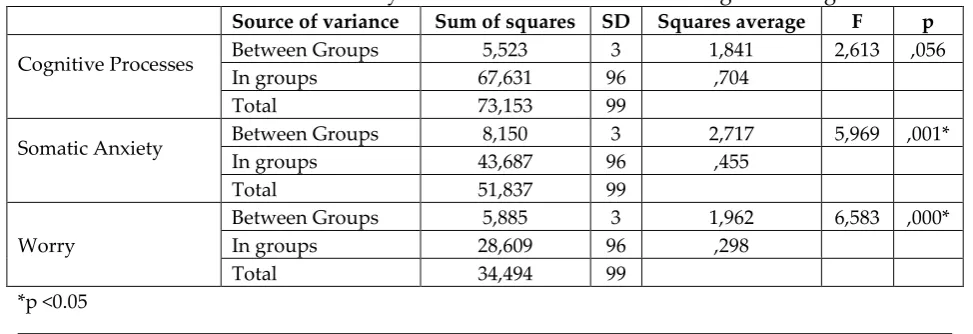
Table 3: Continuous anxiety scale scores of students according to their age
Source of variance Sum of squares SD Squares average F p
Cognitive Processes Between Groups 5,523 3 1,841 2,613 ,056
In groups 67,631 96 ,704
Total 73,153 99
Somatic Anxiety Between Groups 8,150 3 2,717 5,969 ,001*
In groups 43,687 96 ,455
Total 51,837 99
Worry
Between Groups 5,885 3 1,962 6,583 ,000*
In groups 28,609 96 ,298
Total 34,494 99
According to the table, no statistically significant difference was found between the ages of the participants and the cognitive process subdimension scores at p <0.05, and somatic anxiety and anxiety subscales were statistically different at p <0.05.
Table 4: Continuous anxiety scale scores according to the gender of the students
Gender N X ss t p
Cognitive Processes Woman 41 1,85 ,49 -2,351 ,021*
Man 59 2,25 1,01
Somatic Anxiety Woman 41 2,32 ,80 3,738 ,000*
Man 59 1,80 ,57
Worry Woman 41 1,78 ,28 -,087 ,931
Man 59 1,79 ,73
*p <0.05
According to the table, there was no statistically significant difference between the gender and the anxiety subscale scores of p <0.05.
Table 5: Continuous anxiety scale scores by students' classes
Source of variance Sum of squares SD Squares average F p
Cognitive Processes Between Groups 5,353 3 1,784 2,527 ,062
In groups 67,800 96 ,706
Total 73,153 99
Somatic Anxiety Between Groups 7,941 3 2,647 5,789 ,001*
In groups 43,895 96 ,457
Total 51,837 99
Worry
Between Groups 5,783 3 1,928 6,445 ,001*
In groups 28,711 96 ,299
Total 34,494 99
*p <0.05
According to the table, there was no statistically significant difference between the classes of the participants and the cognitive process subscale scores, and there was a statistically significant difference in somatic anxiety and anxiety subscales at p <0.05.
4. Discussion and Conclusion
The aim of this study is to determine the anxiety of high school students against physical education.
8% of the students are 15 years old, 20% are 16 years old, 53% are 17 years old, 19% are 18 years old; 41% were female, 59% were male; 9% in 9th grade, 19% in 10th grade, 53% in 11th grade and 19% in 12th grade. Students' cognitive process sub-dimension scores were 2.08 ± 85, somatic anxiety subscale scores were 2.02 ±, 72, and anxiety subscale scores were 1.78 ± 59.
anxiety and anxiety subscales showed a statistically significant difference at p <0.05 level. No statistically significant difference was found between the gender subscale and anxiety subscale scores of p <0.05, and somatic anxiety and cognitive processes were statistically significant at p <0.05 level. There was no statistically significant difference between the classes and cognitive process subscale scores at p <0.05 level and somatic anxiety and anxiety subscales were statistically different at p <0.05 level.
Demirhan and Hünük (2003), according to the literature in his study, bil Comparison of Attitudes of Physical Education and Sports for Eighth Grade, Elementary, High School and University Students ları: Tut In Van Wersch, Trew and Turner (1992), they showed more interest in physical education than boys, whereas after 14 years of age this interest was found to be higher in boys than in girls. In Luke and Sinclair (1991), they argue that high school girls' negative attitudes towards physical education are physical education teachers and that the most important determinants of positive and negative attitudes of boys and girls are similar L. Kangalgil et al. (2006), Comparison of the Attitudes of Primary, High School and University Students to Physical Education and Physical Education; Students, teachers and programs should be conducted in order.These three elements are the most important phenomena that direct and shape the Physical Education course. It is emphasized that the importance of physical education teacher in terms of physical education lesson is emphasized by the fact that physical education course can be made more effective and widespread, children develop as a whole, and the relationship between these elements is healthy and compatible.
Ryan et al. (2003), secondary school students' attitudes towards physical education teachers and physical education courses were determined and the attitudes of the secondary school students were measured. Act. Kangalgil et al., 2006)
According to research by Falsam and Sherry (1992), there is no significant difference between boys and girls in physical education and sports attitudes of second grade students in secondary school (Şişko and Demirhan, 2002).
References
Aracı, H. (2001). Physical Education in Schools for Teachers and Students. Ankara: Bağırgan Publishing.
BaŞar H. (2001). Classroom Management. Ankara: Pegem Publishing
Demirhan, G., D. Hünük, Eighth Grade, Elementary, High School First Class and University Students' Physical Education and Sports Attitude Comparison, Journal of Sports Sciences, 14 (4), 175-184, 2003
Kangalgil, M., D. Hünük, G. Demirhan, Comparison of Attitudes of Primary, High School and University Students to Physical Education and Sports,, Journal of Sports Sciences, 17th issue, pp.48-57, 2006.
Senemoğlu, N. (2002). Development Learning and Teaching from Theory to Practice. Ankara: Gazi Bookstore
Şişko, M. and G. Demirhan, Öğ Attitudes Towards Physical Education and Sport Course of Female and Male Students Studying in Primary Schools and High Schools Gör, Hacettepe University Faculty of Education Journal, p: 205, number: 23, 2002.
Temel, H., Oral, B. Avanoglu, Y. (2001). R Evaluation of the Relationship between Chemistry Students' Attitudes towards the Test and Their Knowledge and Skills Related to Planning and Implementation of Titrimeter Tests. Journal of Contemporary Education. Number: 264
Creative Commons licensing terms