European Journal of Physical Education and Sport Science
ISSN: 2501 - 1235 ISSN-L: 2501 - 1235 Available on-line at: www.oapub.org/edudoi: 10.5281/zenodo.2526340 Volume 5 │ Issue 2 │ 2018
THE EFFECT OF FITNESS
ON SOCIALIZATION
Fatih Eriş1i,
Kemal Sargin1,
Ergün Çakir2
1Van Yüzüncü Yıl University,
Sarikamis Physical Education and Sport Department, Van, Turkey
2Kafkas University,
Sarikamis Physical Education and Sport Department Kars, Turkey
Abstract:
The aim of this study is to investigate the effect of fitness on socialization. The universe of the research consists of individuals who make fitness sports in Van province. The sample consisted of 180 male and 72 female fitness workers in Van in 2017-2018. In this study was used the Socialization Scale developed by Şahan. The data were evaluated in IBM SPSS 22.0 package program. Frequency, percentage, arithmetic mean, standard deviation, one-way Anova, independent t-test were used to analyze the data. The level of significance of the statistical analyzes was evaluated (p<0,05). The participants significant changes were observed in the age, income levels and education of levels (p<0,05). According to gender and occupational variables there was no significant difference between the participant and their socialization levels (p>0,05). As a result, it is predicted that this study will help to better understand the importance of sports in education and to solve socialization problems of young people.
Keywords: fitness, socialization, indoor
1. Introduction
Sport is an important social phenomenon that has gained meaning as an indicator of cultural and welfare levels in modern societies of our time and affects all aspects of social life (Imamoglu, 1992). Game, distraction, the work of the sport as a means of departure from the scene of the sport, today, the economy, politics, education, leisure, international relations, propaganda, advertising, racism, violence, tourism, environment, organizations, masses, youth, women, disabled It has become a social
institution which has a multi-faceted and significant impact on the individual-society and international range, which is directly or indirectly associated with concepts such as occupationalization and division of labor. It is because of these characteristics that it has become a multi-faceted, very useful, multi-purpose and very effective dimension in our sport age and has become universal. To improve the physical (Pancar et al., 2017a; 2017b; 2018a; 2018b; Tahhan et al., 2018a; 2018b; Mayda et al., 2016; Yilmaz et al., 2016; 2017; Mahmood et al., 2017; Aktug et al., 2018; Biçer et al., 2015; Özer et al., 2017; ) and mental health (Cavusoğlu et al., 2017; Kabadayı et al., 2017; Özdal et al., 2013; Tuzcuoğullari et al., 2017) of the human being, which is the basic element of sports, economic, social and cultural development, to provide the development of personality, the development of character traits, to facilitate the adaptation to the environment by providing knowledge, skills and skills, to provide solidarity, union and people, In addition to increasing the combat power, it is the activities performed in order to fight in excitement, excitement and superiority in the competition according to certain rules. Sports, the individual's ability to develop the natural environment of the human environment, under certain rules with or without tools, individually or collectively in the scope of leisure activity or professionally by professionalizing, socializing, socializing, integrating into society, developing spirit and physics, competitive, solidarity and cultural is a phenomenon (Erkal, 1982).
Sport is a social phenomenon that contributes to the integrity, modernization, recognition and development of the society by providing a healthy structure to the society while contributing to the positive developments in the life of individuals and establishing a relationship with other social institutions. There is a need to explore the social aspects of sports in order to reveal the social functions of sports in individual and community life and to realize its goals.
meaningful, specific purpose, all social relations of people go through the social groups, people have to cooperate in order to continue their lives. Establishing a social relationship requires social grouping in the social life According to their characteristics, there are social groups such as family, school, mosque, work place, sports club, association, union, hospital etc. In this way, a group of relationships is formed between groups of people, functional, meaningful, social bonds and interactions between social groups are established (Nirun, 1986).
2. Material and Method
The universe of the research consists of individuals who make fitness sports in Van province. The sample consisted of 180 male and 72 female fitness workers (Table 1) in Van in 2017-2018. In the study, the questionnaire developed by Şahan was used and 34 questions were asked under the heading of socialization and 35 questions about sports and socialization were asked. A 5-point Likert-type scale was used in the questions (Şahan, 2007). Participants in the study responded to the questionnaire in an average of 15-20 minutes.
Table 1: Descriptive parameters of subjects
Gender N % Mean Standard dev. Min Max
Male 108 60.0
1.4 0.49 1 2
Female 72 40.0
Total 180 100.0
Income Rate N % Mean Standard dev. Min Max
1000 TL and under 69 38.3
1.91 0.95 1 5
1001-2000 TL 74 41.1
2001-3000 TL 26 14.4
3001-4000 TL 6 3.3
4001-5000 TL 5 2.8
Total 180 100.0
Age N % Mean Standard dev. Min Max
18-20 age 45 25.0
2.5 1.15 1 4
21-23 age 50 27.8
24-26 age 34 18.9
27 and over age 51 28.3
Total 180 100.0
Job N % Mean Standard dev. Min Max
Doctor 4 2.2
8.79 3.1 1 11
Nurse 17 9.4
Teacher 7 3.9
Lawyer 3 1.7
Pharmacist 1 .6
Student 58 32.2
Artisan 9 5.0
Other 81 45.0
Education Status N % Mean Standard dev. Min Max
İlliterate 1 .6
3.42 0.58 1 4
Primary education 6 3.3
High school 88 48.9
University 85 47.2
Total 180 100.0
Interested sport branch frequency N % Mean Standard dev. Min Max
Weekday everyday 55 30.6
2.4 1.13 1 4
Three days a week 35 19.4
Only weekends 52 28.9
Sometimes 38 21.1
Total 180 100.0
Dealing with specific sports N % Mean Standard dev. Min Max
Personal evolution 35 19.4
2.85 1.41 1 6
Healthy lifestyle 59 32.8
Professional career 12 6.7
Socio-cultural activities join 46 25.6
Personal and skills 27 15.0
Other 1 .6
Total 180 100.0
2.1.Statistical analysis
The data were evaluated in IBM SPSS 22.0 package program. Frequency, percentage, arithmetic mean, standard deviation, One-way Anova, Independent t-test were used to analyze the data. The level of significance of the statistical analyzes was evaluated as (p<0,05).
3. Results
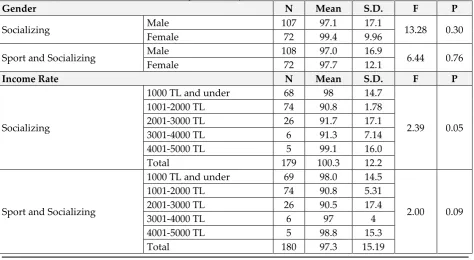
Table 2: Analysis of subjects socialization data
Gender N Mean S.D. F P
Socializing Male 107 97.1 17.1 13.28 0.30
Female 72 99.4 9.96
Sport and Socializing Male 108 97.0 16.9 6.44 0.76
Female 72 97.7 12.1
Income Rate N Mean S.D. F P
Socializing
1000 TL and under 68 98 14.7
2.39 0.05
1001-2000 TL 74 90.8 1.78
2001-3000 TL 26 91.7 17.1
3001-4000 TL 6 91.3 7.14
4001-5000 TL 5 99.1 16.0
Total 179 100.3 12.2
Sport and Socializing
1000 TL and under 69 98.0 14.5
2.00 0.09
1001-2000 TL 74 90.8 5.31
2001-3000 TL 26 90.5 17.4
3001-4000 TL 6 97 4
4001-5000 TL 5 98.8 15.3
Age N Mean S.D. F P
Socializing
18-20 age 45 98.1 8.94
3.14 0.02
21-23 age 49 95.9 15.6
24-26 age 34 104.5 11.8
27 and over age 51 95.6 18.2
Total 179 98 14.7
Sport and Socializing
18-20 age 45 94.1 13.3
3.08 0.02
21-23 age 50 98.8 15.0
24-26 age 34 103.2 14.1
27 and over age 51 94.8 16.5
Total 180 97.3 15.1
Job N Mean S.D. F P
Socializing
Doctor 4 105 10
0.97 0.44
Nurse 17 93.4 6.38
Teacher 7 94.5 17.9
Lawyer 3 88 0
Pharmacist 1 94 .
Student 58 96.6 14.2
Artisan 9 101.1 20.7
Other 80 100 15.5
Total 179 98 14.7
Sport and Socializing
Doctor 4 83 0
1.77 0.09
Nurse 17 101.4 10.0
Teacher 7 100.7 9.81
Lawyer 3 99 0
Pharmacist 1 98 .
Student 58 93.2 15.5
Artisan 9 95.4 19.4
Other 81 100 15.6
Total 180 97.3 15.1
Education status N Mean S.D. F P
Socializing
İlliterate 1 45 .
15.0 0.00 Primary education 6 76.3 33.4
High school 87 102.5 12.9
University 85 95.5 11.2
Total 179 98 14.7
Sport and Socializing
İlliterate 1 54 .
4.87 0.00 Primary education 6 84.3 27.3
High school 88 99 15.2
University 85 97 12.9
Total 180 97.3 15.1
4. Discussion
Ağkurt (2018), in his study on the effect of social inclusion of the participation of the sport in the university students, it was seen that the level of socialization of the students increased as the income levels increased. Another result of our study showed that there was a significant difference in socialization rate among people aged 24-26 years according to age distribution (p<0,05). The reason for this is that the people in this age group are the last year students of the university and their income levels are high and they are the interests of these sporting activities and the period they are the most productive. Şahan (2007), in his doctoral study on the role of sports activities in the socialization process of university students that he did in 2007 supports our findings in age variables.
This study shows that there is a significant difference in the distribution of educational levels. As education levels increase, it shows significance in socialization situations. This is directly proportional to the educational status of individuals. When we look at the social institutions, facts and events in which sports is intensively related, the importance and dimensions of the subject can be understood more easily. Social dimension of sport within the social dimension of family, family, youth, woman, child, education, culture, economy, policy, religion, management, law, social security, media, leisure, international relations, tourism, environment, morality, gentlemen, socialization social mobility, social status, personality, modernity, peace, production, advertising, propaganda, facility, material, nutrition, development, professionalism, amateurism, violence etc. social institutions, concepts and events can be shown. These show us how much the sport is intertwined with the social system and social life. As we have seen, sport is a social phenomenon integrated with all aspects of social life. In the life of modern societies, sports and sporting activities have become very important and hence have played an important role in the health, happiness and success of individuals. Ensuring that societies and their individuals consciously gain the understanding and opportunities of sports is considered as identical with modernity today. Societies that consciously make sports for individuals, on the one hand provide a great benefit to their individuals, on the other hand, as an important function for society as one of the elements of social development. The societies that are composed of healthy individuals in all respects are equally healthy, conscious, strong, discreet, moral, hardworking, national unity and integrity. As a result, the most general social objective of sport, knowing the duties and responsibilities towards society, the place of physical and mental health, constructive, creative, competitive, productive, moral, virtuous, strong, high morale, smooth behavior, personality, honorable, prudent, hardworking generations is to create a modern society with a high level of culture and a strong social structure and values.
References
Aktug, Z.B., Yilmaz, A.K., & Ibis, S. (2018). The Effect of 8-Week Nordic Hamstring Exercise on Hamstring Quadriceps Ratio and Hamstring Muscle Strength. World Journal of Education, 8(3), 162-169.
Biçer, M., Özdal, M., Akcan, F., Mendeş, B., & Patlar, S. (2015). Effect of strength training program with elastic band on strength parameters. Journal of Biology of Exercise, 11(2), 111-122.
Cavusoglu, G., Yılmaz, A.K., Kabadayı, M., Abacı, S.H., & Tasmekteplıgıl, M. Y. (2017). Comparison of narcissism levels of students in the faculty of sports sciences in terms of some demographic variables. Turkish Journal of Sport and Exercise, 19(2), 150-156.
Demir, Ö., Acar, M., (1997). Sosyal Bilimler Sözlüğü, Vadi Yayınları, Konya. Ergil, D., (1984). Toplum ve insan, Ankara.
Erkal, M., (1982). Sosyolojik Açıdan Spor, Ankara yayınları.
İmamoğlu, A.F., (1992). "İkibinli Yıllara Doğru Türk Sporu Üzerine Bazı -Gözlemler", Gazi Üniversitesi.Gazi Eğitim Fakültesi Dergisi, cilt 8, s. 1.
Kabadayı, M., Eski, T., Bayram, L., Yılmaz, A.K., & Mayda, M.H. (2017). Analysis of the factors which influence participation of university students in recreational activities. European Journal of Education Studies. 3(12), 161-171.
Mahmood, M.H., Özdal, M., Mayda, M.H., & Biçer, M. (2017). Acute effects of anaerobic exercise with different intensities on dynamic balance performance. European Journal of Education Studies. 3(8), 357-370.
Mayda, M.H., Karakoc, O., & Ozdal, M. (2016). The investigation of some physical, physiological and anthropometric parameters of visually impaired and non-impaired a national male judoka. Journal of Education and Training Studies, 4(6), 192-198.
Nirun, N., (1986). Sosyoloji, M.E.G.S.B. Yayınları, 592, İstanbul.
Özdal, M., Akcan, F., Abakay, U., & Dağlioğlu, Ö. (2013). Video destekli zihinsel antrenman programinin futbolda şut becerisi üzerine etkisi. Spor ve Performans Araştırmaları Dergisi, 4(2), 40-46.
Özer, Y., Bozdal, Ö., & Pancar, Z. (2017). Acute Effect of Circuit Aerobic and Traditional Aerobic Training on Hamstring Flexibility in Sedentary Women. European Journal of Physical Education and Sport Science. 3(12), 268-275.
Pancar, Z., Biçer, M., & Özdal, M. (2018b). 12–14 yaş grubu bayan hentbolculara uygulanan 8 haftalik pliometrik antrenmanlarin seçilmiş bazi kuvvet parametrelerine etkisi. Spor ve Performans Araştırmaları Dergisi, 9(1), 18-24. Pancar, Z., Bozdal, Ö., Biçer, M., & Akcan, F. (2017b). Acute effect of anaerobic exercise
on dynamic balance of sedentary young boys. European Journal of Physical Education and Sport Science. 3(12), 229-237.
Pancar, Z., Özdal, M., Sarikaya, M., & Çinar, V. (2018a). Effect of Physical Activity Program on Iron and Iron-Binding Capacity in Obese Children. Scholars Journal of Arts, Humanities and Social Sciences. 6 (6), 1299-1303.
Şahan H. ( 2007). Üniversite Öğrencilerinin Sosyalleşme Sürecinde Spor Aktivitelerinin Rolü Doktora Tezi, Selçuk Üniversitesi Sosyal Bilimler Enstitüsü, Konya.
Şahan H. (2007). Üniversite Öğrencilerinin Sosyalleşme Sürecinde Spor Aktivitelerinin Rolü. Doktora Tezi. Selçuk Üniversitesi Sosyal Bilimler Enstitüsü Halkla İlişkiler Ve Tanıtım Anabilim Dalı, Konya.
Tahhan, A.M.A.A., Özdal, M., Vural, M., & Mayda, M.H. (2018b). Acute effects of aerobic and anaerobic exercises on circulation parameters. European Journal of Physical Education and Sport Science.
Tahhan, A.M.A.A., Özdal, M., Vural, M., & Pancar, Z. (2018a). Influence of aerobic and anaerobic exercise on oxygen saturation. European Journal of Physical Education and Sport Science. 4(2), 188-196.
Tan, M., (1981). Toplum Bilimine Giriş, A.Ü.E.F. Yayınları, No: 97, Ankara.
Tuzcuoğullari, Ö.T., Pancar, Z., & Bozdal, Ö. (2017). A research on the role of relative age effectiveness in sports termination. European Journal of Physical Education and Sport Science. 3(12), 461-469.
Yilmaz, A.K., Kabadayi, M., Mayda, M.H., & Birinci, M.C. (2016). Examination of isokinetic strength rates of knee joint (h/q) in football players. Journal of Social Science Research, 10(4), 2248-2253.
Creative Commons licensing terms