International Journal Advances in Social Science and Humanities
Available Online at: www.ijassh.com
RESEARCH ARTICLE
Addressing GBV in Educational Institutions: The Counties’
Involvement
Judith Adikinyi Wafula
Lukenya University, Kenya
Abstract
Studies reveal that Gender-Based Violence (GBV) is increasingly becoming a crisis. This is despite the development spirit entrenched in making the world a global village, Education for All plans and Vision 2030. This paper examines the challenges faced by universities in Kenya in the fight against GBV experienced by their students. It emanates from a study that involved 662 students; 144 lecturers; five deans of students and heads of student counselling; four student leaders and vice chancellors from six universities in Kenya which revealed that universities face challenges that require concerted efforts in tackling. Universities in Kenya have been growing at a rapid pace, from one national university to university colleges and fully fledged universities at varied counties. This expansion bears challenges and the fight against GBV is not exempt. The challenges run from the family structure as evidenced by domestic quarrels, fights and even murders that render it dysfunctional. The genesis of GBV resides in the underlying norm and value systems that make it necessary and legitimate subverting prevention and response efforts [1]. Consequently, GBV is exposed as a display of socio-cultural tendencies that influence the perceptions of gender and is sustained by a culture of silence and denial [2]. Further revelations from UNFPA show that biological factors have no bearing in the intense differences in the behaviours of men and women indicating that the differences are based on the socialization process. The World Health Organization (WHO) estimates show that at least one in every three women experience GBV in their lifetime. Additionally, it was found that male survivors experience similar physical, social and psychological violations only that they are less likely to seek medical help due to stigma and prejudice regarding male sexuality or masculinity [3]. Therefore, the paper addresses the challenges and provides recommendations in dealing with the vice. Devolved governments are in a very strategic position of involvement in curbing the vice.
Introduction
GBV has myriad consequences in education some of these include absenteeism, severe mental and physical health issues, dropouts and in most severe cases, suicide [4]. This was emphasized by the Chancellor of Kabul University in Afghanistan following a report on the prevalence of GBV in three universities. The study exposed the presence of verbal abuse, physical abuse and sexual abuse.
These forms of GBV were experienced by both male and female students though they were more prominent among female students. Women were also photographed against their consent. In addition, abusive or degrading remarks were made about them. Gender discrimination was prevalent yet there was absence of well-structured gender-
sensitive systems to address grievances. There is therefore need for the inclusion of both genders to address issues of GBV. This affirmation is also supported by [5]. In the past, a lot of literature has unveiled the plight of women and girls. This is emphasized by King [6] who states that a lot of attention is focused on the problems affecting girls, sidelining those affecting boys.
This comment emphasizes the fact that both the male and female are affected even though the circumstances and magnitudes may vary. Therefore the male persons should not be viewed as perpetrators in all cases since perpetrators can be of any gender, male or female. Further, USAID findings show that violence against men and boys is increasing [8].
However, the observation that boys are sidelined are refuted by the view that it is not all about favoring girls over boys but rather an approach that gives priority to issues affecting girls in order to secure gains for both girls and boys [9]. Involvement of both genders in the fight against GBV will help to address this perception of non-inclusiveness of the male gender. The county government level is very strategic in ensuring inclusiveness not only of gender but also of people from diverse cultures within the counties in this fight. As a matter of concern, GBV violates fundamental rights such as the right to life, security, freedom of movement and expression, freedom from torture and ill-treatment and is based on the imbalance of power between the victim and the perpetrator [10]. The imbalance in power is seen as the perpetrator exercises authority over the victim in a way that the victim has no space for choice.
To understand GBV further, the African Sexual and Gender-Based Violence Population Council defines it as the physical, mental or social abuse directed against a person because of his/her gender or roles in a society or culture [11]. This definition brings out the connection between GBV and roles in a society or culture. A focus on the socialization process in different traditional cultures shows that boys are socialized to be tough and authoritative whereas girls are socialized to be nurturing [8]. Inadvertently, the cultural socialization of the male and female gender produces systematic GBV for males if they do not adhere to the domineering tendencies and for females, if they do not adhere to the nurturing tendencies.
Statistics from World Health Organization (WHO) show that at least one in every three women experience GBV in their lifetime
[12]. Correspondingly, one in six men was found to experience GBV in a South African University. The men undergo various forms of sexual violations such as forced circumcision and rape. Rape includes; perpetrators anally raping victims, use of objects, forcing a victim to rape a fellow victim, victims being made to masturbate their culprits orally, victims being forced to commit acts of incest, ’rape plus’ where the ‘plus’ is HIV positive with an aim of infecting the victim. Noteworthy is that victims’ ability to negotiate for safe sexual practices is limited [13].
As a result, GBV is increasingly viewed as a driving force of the HIV and AIDS epidemic globally and is a major public health concern particularly in sub-Saharan Africa [14]. The effects of GBV are quite extreme both at individual and societal levels. Besides, unhealthy individuals cannot have peace thus cannot realize their goals in life nor participate in national development. Consequently, it is important that GBV be dealt with decisively.
Consequently, the overall objective of the research was to establish the role that the public and private universities in Kenya play in the management of GBV affecting the students. The study examined the policies and programmes put in place by public and private universities to manage GBV affecting the students, assessed the public and private universities’ role in managing GBV affecting the students and evaluated the challenges encountered by the universities in their role of managing GBV among students. However, this paper focuses on the challenges encountered in the management of GBV at Universities.
Review of Literature
is perpetrated against a person’s will and that results from power inequalities that are based on gender roles [4]. Therefore differences in gender roles play a large part in defining the differences in the powers wielded by men and women and as a result, gender relations. Universally, gender roles and characteristics are learned and internalized by young generations from the older generations through the process of socialization [16]. GBV can therefore be perpetuated from one generation to another if not identified and eradicated.
A case is given of a gentleman, Vikas, whose mindset about GBV was changed after his sister was widowed. She was exposed to a life where GBV was a norm rather than an exception as she suffered beatings and ridicule from her in-laws. He began to understand GBV through this experience and concludes that GBV affects both the victims and aggressors whereby the victims are aggrieved while aggressors inhibit their mental and intellectual development [17]. He took the step of approaching men at his university in India to convince them to participate in eliminating GBV by carrying out awareness campaigns, capacity building, debates and discussions. Different authorities and bodies were also involved including the University of Sussex resulting in the creation of networks against GBV. This gave rise to open discussions among students and lecturers about GBV and a more gender-friendly and gender-sensitive university environment. Subsequently, the female students were provided with separate toilets; the anti-sexual harassment committee was formed and supported by the university; there was more awareness about rights; more respectful attitudes among students and reduced teasing of female students by male students.
The case given by Vikas is an example to learn from. The county governments have the capacity to organize open forums at grassroots where people can freely discuss about GBV, its impact in society at large and solutions to eradicate the vice. Being at the grassroots, the county governments are able to address gender roles and best practices in their implementation.
The traditional gender roles and culture play a part in promoting GBV by assigning certain expectations to gender and punishing perceived non-compliance in a way that violates human rights. For instance girls is expected to nurturing while boys are expected to show An international GBV conference held between 1st -3rd August
2012 with the theme “Creating safe spaces: A multi-disciplinary approach to GBV” was held at Kenyatta University. The findings from the conference reveal that one in five women and one in ten men experience sexual abuse in childhood, yet violence is a learned behavior that a child can observe or experience and perpetuate into adulthood [18]. Further, a study done in Kenya on GBV and specifically domestic violence showed that teachers were the second highest perpetrators at 25.7% after intimate partners (57.8%) followed by mothers at 23.8% and fathers at 14.5%. These figures reveal how much children, and by extension students observe and experience GBV. As a result, community leaders, administrators, teachers, and lecturers alongside parents have a key obligation to design gender roles and responsibilities that are effective in managing GBV [6]. The county governments have the capability of engaging these leaders.
Therefore the fight against GBV entails issues that challenge the traditional gender and sexuality culture. For instance, equal treatment of the male and female gender contrary to the traditional gender and sexuality culture. This calls for the involvement of the county governments for the local people to appreciate the GBV concerns and forge a way forward since the county leaders are elected by the people therefore wield authority which if properly utilized can successfully direct the course of action.
student complained that her marks were withheld by a lecturer unless she would have sex with him [20[. These cases show the authority the perpetrators have in the attempt to silence the victims.
Looking at Africa, there was a national outcry in South Africa over GBV where women were murdered by intimate partners. Other violations established include rape, beating, threatening and belittling. The report recognized that as violence becomes an everyday act, everyday campaigns are not sole solutions to them, neither are stricter law enforcement mechanisms or new laws. Further, the report explains that no evidence shows that protests, formation of new institutions against GBV or stricter sentences act as main deterrents. Some institutions established against GBV appear as if something was being done yet in actual sense nothing different was taking place. The report suggests that the major area of focus is the attitudes being built with the expression that “Some actions and attitude seen as acceptable and commendable are the same ones used to justify the abuse and murder”. This is a very important exposition as it opens our minds to the root of the vice which lies in the attitudes built through the socialization process.
In a proposal to reduce GBV at a South African University, measures were developed to change the underlying social norms and the overall institutional culture. The university management engaged the risk management services to create gender democracy. Additionally, a GBV lobby group which is a coalition between staff and students was developed in the year 2005 to tackle the issue of student safety and security paradigms.
A survey done at the university had revealed hidden problems such as sexual violence in residences, intimate partner murder, rape, attacks on men who reject dominant stereotypes and aggressive masculinity. Further findings at the university indicate that one in three women and one in six men were victims of sexual violence. These findings indicate that an exclusive focus on physical security is not effective in curtailing
GBV as it has more complex social underpinnings which include gender and social norms.
In the international arena, a research done by the Council for Women of Moscow State University shows that globally, six out of ten women experience physical and/or sexual violence in their lifetime [21]. Some of the consequences of GBV established were death and disability. The research cited a World Bank Study where GBV was found to be more dangerous than cancer, motor accidents, war and malaria in 1994.
The Council of Europe (COE) additionally found that one fifth to one quarter of women have undergone physical violence in their adult lifetime [11]. The COE then drew campaigns to combat violence in member states on television, radio, sports, pens, posters, campaign websites, meetings at focal points and publications to expand knowledge about GBV. This led to the realization that violence against women was not a private issue but a human rights violation.
In Kenya, there are no specific anti-GBV laws under which perpetrators can be charged hence they are charged under different laws such as the Penal Code, Sexual Offences Act and the Counter Trafficking Act [4]. As a result, victims of GBV do not get justice as expected.
However, Chapter 4 of the Constitution of Kenya contains the Bill of Rights where part 2, article 27, section 1 states that ‘every person is equal before the law and has the right to equal protection and equal benefit of the law’ [22]. The Bill of Rights further binds all state organs and persons as stipulated in Chapter 4, part 1, article 20, section 1. Hence both male and female students are to be protected from any form of harm. The Constitution of Kenya in Chapter 1, article 2, section 5 and 6 provides that the general rules of international law and any treaty or convention ratified by Kenya shall form part of the Kenyan law [23].
In this research the GBV variables considered are based on a report by the NCGD which identifies sexual exploitation and harassment; derogatory language; discrimination and class; non-responsive learning environments to gender; stereotypes and negative indoctrination as the major forms of GBV [16]. Confronting these issues is done in a bid to enhance peaceful and respectful interactions across gender boundaries for the achievement of Education for all goals, vision 2030 and development at large. Consequently universities have a role to impact communities and help to initiate change that is needed and counties are well placed in providing the requisite support from the grassroots.
Methodology
The research was done in three public and three private universities using a cross-sectional survey design. This design enables the status of a given characteristic to be determined at the time of the study. The target population of this study comprised students, student leaders, lecturers, deans of students, student counsellors and Vice Chancellors of private and public universities. There were seven public universities and twenty-five private universities (fully accredited and those with Letters of Interim Authority) in Kenya by the time of this research. The population of university students at the time of the research was 199,512 [22] with 151,600 students in the public universities and 47,912 in the private universities [24]. Probability and non-probability sampling methods were used namely simple random sampling and cluster sampling on one hand and convenience sampling on the other respectively. Simple random sampling was used to obtain the public and private universities to participate in the study from their clusters by applying the 10% minimum sample size for small populations [25-26]. The public university cluster was small (seven universities) yet had three times higher the number of students than the private university cluster (that is, a population ratio of 3:1). On the converse, the ratio of the number of public to private
private), 4 student leaders’, 5 deans of students’, 5 student counsellors’ and 144 lecturers’ questionnaires. Four vice chancellors also responded. Both qualitative and quantitative data were collected and were presented in tables, charts, graphs using frequencies, percentages and means.
Findings
The findings were organized thematically and analyzed quantitatively by looking at the challenges raised by the students, lecturers, student leaders, student counsellors, deans of student and Vice
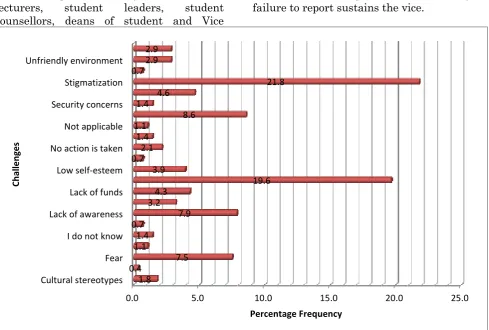
Chancellors in managing GBV affecting students per university category. In the public universities, results show that the major challenge experienced by students is stigmatization. This was unveiled by 21.8% of students (see figure 1). In being stigmatized the students expressed that the victims of GBV are laughed at, looked down upon, mocked and humiliated even by the perpetrators of GBV. They are also ignored by fellow students who happen to be aware of the ordeal. These revelations explain why students fail to report cases of GBV yet failure to report sustains the vice.
Figure 1: Public universities' challenges in managing GBV
Unfortunately, quite a number of students (19.6%) highlighted lack of administrative support as prohibitive to the management of GBV. This was despite the revelation by student counsellors, deans of students and vice chancellors that there were essential structures to assist the students. The students stated that “No one believes the victims” when they report. The difference in opinions is explained by the delay in taking action on offenders occasioned by difficulties in obtaining required evidences. Nevertheless, 0.7% of the respondents noted that some perpetrators of GBV are protected by fellow students from the same tribe.
This hindered the course of justice for the victims from taking effect.
Lack of a centralized office to report cases of GBV was underscored by 8.6% of the respondents. Here, there was no central office where students could report GBV cases since some reported to the security office, in addition to deans of students, gender institute, counsellors and police. The channel followed in prosecuting the cases was similarly not clear to students. Additionally, there was general lack of awareness on GBV among students as cited by 7.9% of the respondents.
0.0 5.0 10.0 15.0 20.0 25.0 Cultural stereotypes
Fear I do not know Lack of awareness Lack of funds Low self-esteem No action is taken Not applicable Security concerns Stigmatization Unfriendly environment
1.8 0.4
7.5 1.1
1.4 0.7
7.9 3.2
4.3
19.6 3.9
0.7 2.1 1.4 1.1
8.6 1.4
4.6
21.8 0.7
2.9 2.9
Percentage Frequency
Ch
al
le
n
ge
Lack of awareness was occasioned by the small number of students who attend the awareness campaigns as clarified by student leaders.
Many fears were identified by 7.5% of the students. These include the fear of being isolated, being discontinued in case performance dropped due to trauma and “being identified as a victim”. There was also the fear of reporting the perpetrators due to unforeseen repercussions. 3.2% of the respondents indicated that there were no concerted efforts by the students to fight GBV and highlighted that some students did not support victims of GBV. This is magnified by 1.1% of students who expressed that the issues on GBV are not applicable to them. Silence of the victims of GBV (4.6%) is explained by the stigmatization conduct.
There was a feeling that male-based violence is never addressed as cited by 0.7% of respondents. The reason given was that dissemination of information on GBV does not put men into the picture. Although respondents mentioned the challenge of unavailability of funds (4.3%) for anti-GBV campaigns, some exposed inadequacy of funds to meet basic needs. Lack of funds makes them prone to GBV. Judgment by others, who include fellow students, was reported by 0.7% of the respondents. This is whereby there is victimization such as “They wanted it and are now pretending” especially in the cases of sexual exploitation and harassment.
The public university lecturers (14.4%) reported lack of communication about cases of GBV to them as a key challenge in providing assistance to the victims as shown in figure 2 on the next page. The students on the other hand did not want their cases to be known due to stigmatization. Stigmatization further explains the silence by victims of GBV as emphasized by lecturers (12.4%). However 13.4% of the lecturers clarified that there is limited time leaving them no allowance outside academic circles to deal with students’ issues. The teaching load was correspondingly wide affording inadequate time for student advisement and settling of issues affecting students. The problem is aggravated by the high number of students in public universities as expounded by 3.1% of the lecturers.
Lack of involvement by the university administration was illuminated by public university lecturers (8.2%) as had the students (19.6%). The lecturers expressed lack of empowerment by the university administration to deal with GBV issues. Lack of empowerment inevitably implied no direct role or mandate to deal with GBV. 9.3% of the public university lecturers exposed inadequate skills in guidance and counselling as a challenge. However in the support for victims of GBV, 44.8% of lecturers (see table on lecturers support for victims) counselled victims of GBV. 2.3% support them through awareness. Concerning awareness, the study found that there are challenges in relation to the understanding of GBV. The general perceptions were that GBV only applies to women as revealed by 10.3% of lecturers.
Figure 2: Lecturers’ responses on public universities' challenges
0.0 2.0 4.0 6.0 8.0 10.0 12.0 14.0 16.0
4.1 14.4
9.3 10.3 8.2 13.4
3.1 4.1 7.2 4.1 3.1 2.1 12.4
2.1 2.1
Per
ce
n
tage
Fr
e
q
u
e
n
cy
However 4.1% of the public university lecturers mentioned being misunderstood or falsely accused of GBV. This originates either from fellow lecturers or students. To add on this, another 4.1% of the lecturers cited that there are no specific policies to deal directly with GBV. This makes curbing the problem a challenge. The administration was also identified as being unwilling to act on cases of GBV.
Challenges of Private Universities
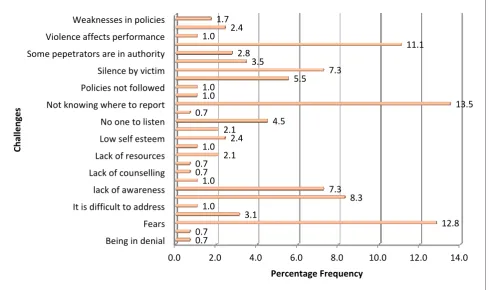
Similar to public universities, the students (13.5%) in private universities, reported being unaware of the office to report for assistance in GBV cases as shown in figure 3 in the next page. They explained that there was no department dealing with GBV or specific person they could report to. In some cases the office personnel were unable to act without fear of higher authorities within the universities. This was followed by the challenge of stigmatization (11.1%). Here, the victims are “Made laughing stocks of the day”, as per a respondent’s sentiments. They are looked down upon, given negative comments and names as in public universities. They feel intimidated, embarrassed, psychologically tortured and traumatized. To add on stigmatization, the students stated fear (12.8%) of different things. These include fear of “Being seen as
a sinner”, fear of conflicts in the family and criticism, isolation, discrimination, being beaten by the perpetrator, being branded a traitor by peers, ridicule and “Other people knowing the violation and talking negatively”.
Lack of support by the university administration (8.3%) was also mentioned as was the case with public universities, only that in public universities it was mentioned by 19.6% of the student respondents. The private university students indicated that the university administration takes sides when cases are forwarded to them. They expressed that it is worsened if one is in bad records with some university staff. Reports of interference by staff were also mentioned. This is corroborated by 2.8% of students who indicated that some perpetrators were in positions of authority. Lack of awareness and silence by the victims of GBV were each highlighted by 7.3% of the students. In the lack of awareness, private university students indicated that some students do not know that they can also be victims of GBV. Some students ignore victims of GBV in addition to not having enough forums to address GBV.
Figure 3: Students’ responses on private universities' challenges
0.0 2.0 4.0 6.0 8.0 10.0 12.0 14.0 Being in denial
Fears It is difficult to address lack of awareness Lack of counselling Lack of resources Low self esteem No one to listen Not knowing where to report Policies not followed Silence by victim Some pepetrators are in authority Violence affects performance Weaknesses in policies
0.7
0.7 12.8
3.1
1.0 8.3
7.3 1.0
0.7 0.7 2.1
1.0 2.4
2.1 4.5
0.7 13.5
1.0
1.0 5.5
7.3 3.5
2.8 11.1
1.0 2.4 1.7
Percentage Frequency
Ch
al
le
n
ge
Silence of victims of GBV is associated to the fears disclosed by 12.8% of the students. 4.5 % of the students felt that there was no one to listen to them while 2.1% of the students said no action is taken on perpetrators of GBV. Lack of action was expressed as the reason as to why the solution to the problem was not forthcoming. However, a look at the actions taken on perpetrators of GBV revealed that the universities had internal machinery as well as external through instituting legal actions on perpetrators of GBV.
Nevertheless, the conclusion of the cases took long as corroborated further in the highlighted challenges by 0.7% of respondents. Lack of confidentiality was a challenge to some students as they wanted their cases not to be exposed to other parties due to stigmatization. Another 0.7% of the students indicated lack of counselling as a challenge. In connection to this, one student gave the sentiments, that students had problems in relationships due to “Blind love”.
Therefore counselling was needed for students. Weaknesses in policies and lack of policies to address GBV were cited by 1.7% and 1.0% of students respectively.
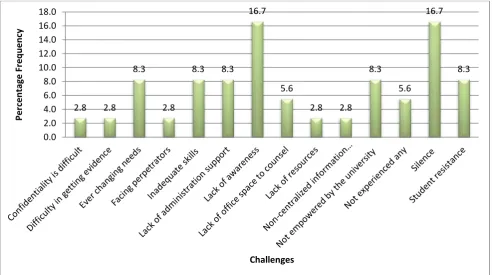
The private university lecturers divulged lack of awareness on GBV majorly (16.7%) followed by silence (16.7%) of victims of GBV as illustrated in figure 4. In awareness, they mentioned lack of a clearly defined definition of GBV and students not knowing their rights.
Thus, some students did not know that they had a right not to be violated against. Inadequate skills, lack of support by the university administration, lack of empowerment by the university administration and resistance from students were each revealed by 8.3% of lecturers. Concerning resistance from students, the lecturers indicated that students lacked confidence in sharing their personal issues with them. This is attributed to the need for confidentiality indicated by students.
Figure 4: Lecturers’ responses on private universities' challenges
2.8% of the respondents said they had challenges facing perpetrators. This is explained by the difficulty in getting the required proof to confront the perpetrators of GBV as illuminated by another 2.8% of
private university lecturers. The challenge of non-centralized information collection and confidentiality is additionally unveiled by 2.8% of the lecturers. 5.6% of the lecturers
2.8 2.8 8.3
2.8
8.3 8.3 16.7
5.6
2.8 2.8 8.3
5.6 16.7
8.3
0.0 2.0 4.0 6.0 8.0 10.0 12.0 14.0 16.0 18.0
Per
ce
n
tage
Fr
e
q
u
e
n
cy
cited lack of office space to counsel students confidentially.
Challenges Faced by the University
Leadership
The student leaders in public universities underscored that some students do not volunteer information when asked to. Failure to volunteer information makes dealing with the GBV cases an uphill task. Further, many students do not appreciate the forums organized for awareness. This explains why students cited lack of awareness as a challenge.
In private universities student leaders exposed inadequate resources and facilities for awareness. This was coupled with lack of support from the university administration. They noted that cases were still pending and needed to be concluded. In addition, some cases of GBV were related to drug abuse and this created a challenge in handling them. The student counsellors from both private and public universities noted that students hardly report cases of GBV and only do so when the cases are extreme. Some cases are only revealed as hearsays and therefore cannot be acted on. Additionally in private universities, some students drop the cases prematurely. This can be explained by the revelation that students do not like to be identified as “victims”. Moreover, there is stigmatization which was mentioned as a major challenge by students.
Deans of students stressed the revelation that most cases are not reported and that some students withdraw the cases. The fact that cases take long was also confirmed by the Deans of students as a challenge. However in public universities inadequacy of staff was as well cited. This clarifies why some offices were reported by students to be closed. Besides, the deans of students alluded to the high number of students that the office was in charge of in public universities. The high number of students made it impossible for the office to deal with all the cases adequately.
The vice chancellors in both public and private universities further confirmed the challenge that most cases are not reported.
Students approach the offices when the cases reach levels they can perceive as risky. The perception of GBV was also highlighted as a challenge as it was not clear to many. Nonetheless, in public universities it was reported that students vandalize security lights to create “Love lanes”. These findings explain why students in public universities expressed the need for security lights while citing unfriendly university environments (See section 6.2.1). There was also an expression that the disciplinary committees in some public universities had not addressed GBV issues as firmly as it ought to be handled.
Conclusion
The major challenge the universities face is stigmatization of victims of GBV. This leads to silence among students even when violated thus some cases are not reported. The students also remain silent in some cases where the perpetrator is in authority for fear of consequences. However the findings show that some staff members’ employment is terminated as a disciplinary measure. Moreover, some students are also not aware of the specific offices to report cases of GBV, therefore those who report approach varied offices such as security, police, dean of students and gender. Some students also seek treatment from health facilities outside the university, consequently such cases are not known to the university authorities. Some reported cases also take long to be addressed causing some students to withdraw the cases to avoid stigmatization.
required facilities, for instance, security lights even though some students vandalize them to create “love lanes” leading to dark areas within the university.
Recommendations
Active involvement of county leaders in the fight against GBV to support the university efforts.
National and county governments to have offices to deal entirely with gender issues
and receive reported cases as the universities also set up their GBV reporting and support centres.
Involvement of universities, county governments and the national government in addressing stigmatization at all levels in society.
GBV awareness drives that will involve university students and leadership, county governments and the national government.
References
1 http://www.ku.ac.ke. (2012) Conference Tracts. Retrieved 12 4, 2012, from Kenyatta University First International
GBV conference:
http://www.ku.ac.ke/conferences/genderconference/index.p hp?option=com_content&task=view&id=33&Itemid=41 2 UNFPA (2012) Gender Equality: Ending Widespread
Violence Against Women. Retrieved 2 26, 2013, from UNFPA: http://www.unfpa.org/gender/violence.htm 3 Population Council (2010) Comprehensive Responses to
Gender Based Violence in Low-Resource settings: Lessions Learned from Implementation. Lusaka: Population Council Inc.
4 HHRI (2010) Selected Links on Gender Based Violence. Retrieved 2 26, 2013, from Health and Human Rights Info: http://www.hhri.org/thematic/gender_based_violence.html 5 Smith R, Fincham K (2008) Transforming Policy and
Practice for Gender in Education: A Gender Review of 2009 EFA Global Monitoring Report. New York: UNICEF.
6 Kitetu C (2000) Gender in Education. Retrieved August 22,
2010, from
http://www.ling.lancs.ac.uk/groups/crile/docs/crile54
7 Scully P (2013) Thoughts on Gender-Based Violence and International Development. Retrieved February 23, 2013,
from Centre for Women at Emory:
http://www.womenscenter.emory.edu/services_resources/W omens_News_and_Narratives/gender_based_violence.html 8 USAID (2013) Gender-Based Violence. Retrieved 2 26,
2013, from USAID From the American People: http://www.usaid.gov/what-we-do/gender-equality-and-womens-empowerment/gender-based-violence.
9 Women Watch (2010) Education and Training of Women and the Girl-Child. Retrieved July 15, 2010, from http://www.un.org/womenwatch/forums/review/education/u nicef_bg_info.html
10 Euromed (2011) Gender-Based Violence Methodological Protocol: Harmonized Methodological and Concepts to Conduct GBV Surveys. Retrieved 3 1, 2013, from Euromed
Gender Equality Programme:
www.euromedgenderequality.org
11 Council of Europe (2008) The Council of Europe Campign to Combat Violence against Women, Including Domestic Violence. Retrieved 2 23, 2013, from Council of Europe: http://www.coe.int/t/dg2/equality/domesticviolencecampaig n/Fact_Sheet_en.asp
12 WHO (2005) Summary Report. Retrieved 2 25, 2013, from Who Multi-Country Study on Women's Health and
Domestic Violence against Women:
file:///C:/Documents%20and%20Settings/dennis/My%20Doc uments/ROLE%20OF%20UNI/gender_based_violence.html
13 Pepfar (2012) Addressing Gender and HIV/AIDS. Nairobi: U.S President's Emergency Plan for AIDS Relief.
14 Turan JM, Hatcher AM (2012) Addressing Gender-Based Violence in Pregnancy: A Clinical & Community Approach in Rural Kenya. Retrieved February 5, 2013, from Centre for AIDS Research University of Califonia, SanFrancisco Glandstone Institute of Virology and Immunology.
15 UNHCR. (2003). Report on The Gender Sensitivity and Planning Workshop for Male Trainers in Combating Gender-Based Violence inUNHRC Porgrammes of Guinea, Liberia, Coted'Ivoire, SierraLeone and Ghana. Nairobi: UNHCR.
16 NCGD (2006) Desk Survey on Gender Issues in Kenya, Final Draft. Nairobi: NCGD.
17 Vikas D (2011) A Gender Justice Information Network. Retrieved 2 19, 2013, from Engagement.net: http://www.engagingmen.net/blog/admin/2011/10/bringing-change-colleges-and-universities
18 Penn State University (2012) How to Determine a Sample Size. Retrieved August 15, 2012, from PennState Cooperative Extension: Programme Evaluation Tipsheet #60: extension.psu.edu/evaluation/pdf/TS60.pdf
19 Muiruri B, Owuor O (2006) When Students at University Trade Sex for Marks with their Teachers. Daily Nation, p. 1.
20 Sexual Aggression Peer Advocates (2011) Ecape University Probes 'Sex-For-Marks'. Retrieved March 1, 2011, from Times live: http://www.timeslive.co.za
21 Council for Women of Moscow State University. (2012) GBV Numbers: The Response to Gender-Based Violence in Eastern Europe and Central Asia. Retrieved February 23, 2013, from Strengthening Health Systems Responses to Gender-Based Violence in Eastern Europe and Central Asia: http://respondgbveeca.org/training-programme-for-health-care-providers/facts-on-gbv/gbv-in-numbers/23
22 Republic of Kenya (2010) Kenya Economic Survey. Nairobi: Government Printer.
23 Republic of Kenya (2010) The Constitution of Kenya. Nairobi: The Government Printer.
24 Education Insight (2010) Vision 2030 Targets Increased University Enrolment from 130,000 to 450,000 by 2015.
Retrieved August 24, 2010, from
http://www.educationinsight.net/20100712316
25 Salkind NJ (2004) Statistics for People Who (Think They) Hate Stastics (2nd ed.). London: Sage Publications. 26 Matthew S (2013) What's an Everyady Campaign on GBV.