Proceedings of the
Third International Workshop on Graph Based Tools
(GraBaTs 2006)
AGraphs
: Definition, implementation and tools
David D´eharbe, Anamaria Martins Moreira and Dem´ostenes Sena
13 pages
Guest Editors: Albert Z ¨undorf, Daniel Varr ´o
Managing Editors: Tiziana Margaria, Julia Padberg, Gabriele Taentzer
AGraphs
: Definition, implementation and tools
David D´eharbe1, Anamaria Martins Moreira1and Dem´ostenes Sena1
1Universidade Federal do Rio Grande do Norte — UFRN
Natal, RN, Brazil
david,anamaria,[email protected]
Abstract: AGraphsare a graph-based language representation, transformation and exchange format. In the same vein as XML,AGraphsform a general data represen-tation mechanism that needs to be instantiated in different specific applications. In this paper, we present theAGraphsdata structure, programming interface and related tools, identify their main features with respect to exchange format characteristics, and compare them to other existing exchange formats. These different features are illustrated on an instance ofAGraphsfor modular Petri nets.
Keywords: language representation, graph formats
1
Introduction
Tools that manipulate programs or specifications need some internal representation of the in-formation being manipulated as well as means of exchanging this inin-formation with other tools or among its own components. Some representation formats have been proposed and used in different tools. Of course, different needs tend to direct researchers and developers into differ-ent kinds of formats, usually terms or graphs [2,19,10]. In [14] a graph based representation for the algebraic specification languageCASL[1] is proposed, but this representation format is indeed much more general and can be used in the representation of different languages in dif-ferent contexts. Graph nodes and vertices represent respectively program elements and relations thereof. Moreover, nodes have attributes representing information specific to the corresponding program elements. We call this generic representation data structureAGraphs; a language (be it programming, specification or hardware description) is handled by a specificAGraphinstance.
The firstAGraphinstances were developed manually to represent hardware descriptions in a VHDL-based model checker [6] and algebraic specifications in two instances of the development toolFERUS[14,15]. The common characteristics of these first three instances were then formal-ized and led to the definition of anAGraphschema language, and to the development ofAGraph instance generators forCandJAVA.
Plan of the paper. The rest of the paper is organized as follows. Section2presents an example of an ad hoc language to describe modular Petri nets that will be used to illustrate AGraph concepts throughout the paper. Section3presentsAGraphs, their specification, design, interface, implementation. Section4describes the available tool support for developers wishing to employ AGraphs. Related work is discussed in Section5, and conclusions and future work are presented in Section6.
2
Example
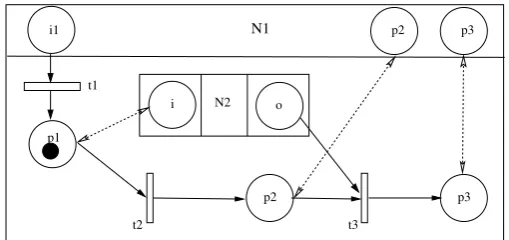
We present an ad-hoc modular Petri net description language [12] that will be used as a running example throughout the paper. For instance, consider the Petri net of Figure1. The main net is N1; it has one place import (i1), three places (p1, p2, p3) and three transitions (t1, t2, t3). Places p2 and p3 are exported. N1 instantiates a net N2, by instantiating N2’s import place with place p1. The place o exported by N2 is an input place of transition t3. There is one token in place p1 and none elsewhere. The corresponding textual description in our description language would be as in Figure2. The syntax of the language can be described in theSDFformalism [17], but this description is omitted by lack of space.
p3 p2
o i
t3 t2
N1
N2 t1
p1
p2 p3
i1
Figure 1: A simple Petri net N1 with an embedded net N2
3
AGraphs
net N1 =
places p1, p2, p3 subnets N2 (i:p1) imports i1
exports p2, p3 transitions
t1 : i1 -> p1 t2 : p1 -> p2
t3 : N2.o, p2 -> p3 tokens p1:1, p2:0, p3:0
Figure 2: Textual description of the Petri net N1 pictured in Figure1
3.1 Design of the AGraph representation
All modern program or specification languages have a notion of compilation unit which can ref-erence other units and can be compiled (or analyzed) independently from other units (although it may rely on some other units being already compiled). Moreover, in some languages, collections of related modules can be grouped into libraries. In general, a unit in a library may reference entities defined in another unit stored in a different library.
In the AGraph format, each unit is represented by a set of interconnected nodes. Roughly, each node is associated with a unit and represents an element of the abstract syntax of this unit. There are therefore several kinds of nodes, each corresponding to a non-terminal of the abstract grammar of the represented language. For instance, for our Petri net example, places, transitions and the net module itself, would be represented by three different kinds of nodes, sayplace,
transitionandnet.
Each kind of node has a different signature, composed of typed and labeled attributes and (outgoing) edges and hyperedges targeting other nodes. Attributes are atomic unstructured val-ues. For instance, a net node has an attribute labeledaIdentifier, storing its identifier, and several outgoing hyperedges pointing towards the different components of the net, such as places and transitions (hyperedges connect a node to a list of nodes).
The rationale of theAGraphformat is then that the representation of units (e.g. Petri nets) and libraries thereof are represented as a directed graph, where vertices correspond to entities in the units, and edges to relationships between those entities.
3.2 Interface provided for an AGraph representation
format from a file in the textual (resp. binary) format.
3.3 Schema specification
As explained in Section3.1,AGraphscontain different kinds of nodes, node attributes and edges. The general structure ofAGraphs, presented in Section3.1, has then to be instantiated for each language to be represented. Such instantiations are actually implemented to represent language units. An instantiation is defined by anAGraphschema, defining the available nodes, their
struc-ture (signastruc-ture), their relations and, indirectly, the corresponding API functions. In this section, we describe the specification ofAGraphschemas.
The node representing a unit in a given language is called RootNode in an AGraphschema. The specification of the AGraph schema defines which among the language specific nodes is root. It also specifies a label that identifies the language being represented and is prepended to theAGraphidentifiers. This label should be unique in an environment, so that if differentAGraph instantiations co-exist in the environment there won’t be name clashes.
The kinds of nodes of the instantiation described by the schema are then presented. Some of them have specific descriptions, as is the case with root nodes, list nodes and import nodes, but all node kinds are identified by a name and have specific basic node components. There are three types of node components:
Attributes maintain information of primitive (e.g., integer) or user defined enumerated
types. Each node attribute has its name and type defined in the schema.
Edges link the node to another node. The schema description of an edge contains its name
and the set of identifiers of the kinds of nodes to which an instance of this edge can point to.
Hyperedges link the node to a sequence of nodes. The schema description of a hyperedge
contains its name and the name of a list kind of nodes through which the different values will be linked to the edge.
The list nodes represent hyperedges. The schema description of a list kind of nodes identifies three edges, pointing respectively to the information node, the next node, and the previous node. The schema description of the root kind of node indicates the attribute that contains the identi-fiers of the represented units and the hyperedge pointing to the root nodes of the imported units. The import node kind contains information about imported units. These nodes contain com-mon and specific components. The schema description defines the name of the node kind and an edge to the root node of the imported unit.
3.4 Implementation of AGraph libraries
3.4.1 Implementation of the graph nodes
An example of the definition of the structure of a node is given in Table1. This node corresponds to a Petri net token specification (token), with the corresponding place (nPlace) and quantity ( aQuan-tity). The first four fields are mandatoryAGraphfields (i.e. they are present for all kinds of nodes and for any language representation), whereas the remaining correspond to data specific to the represented semantic domain (Petri nets in this example).
Cimplementation: JAVAimplementation:
typedef structf pnRef position; void * aToolInfo; pnKind aKind;
pnRef nRoot; pnRef nPlace; int aQuantity;
g token;
public class tokenf// class variables pnRef position; Object aToolInfo;
pnKind aKind; pnRef nRoot; pnRef nPlace;
int aQuantity; // class methods...g
Table 1: Examples of the definition of a node kind in C and Java
3.4.2 Unit dependencies
Our Petri net language is modular and supports hierarchical net composition. To reference ex-ternal modules is common place in most languages. An efficient representation shall not fully instantiate external modules in the representation, but provide instead mechanisms to refer to and access the representation of these modules. To support such interdependency,AGraphsinclude a mechanism to refer to external units, i.e. an edge (or a hyperedge) may point to a node outside the current unit. As a consequence, when a unit is loaded into memory, the imported units are recursively loaded. Note that the algorithm implementing this dynamic loading feature avoids duplicate representation of units.
The internal state of anAGraphlibrary contains the graph representing the nodes of the units loaded into memory as well as additional data needed to handle cross references between units. Each unit has a unique identifier (a natural number) and its representation is composed of two tables: the first contains the identifiers of the imported units, while the second stores the subgraph representing the unit. The file formats ofAGraphsare also based on those two tables.
3.4.3 AGraph API
The API of anAGraphlibrary has the elements described in Section3.2.
pnNode pnMakeToken (pnNode Place, int Quantity);, inC, and
public Token (pnNode Place, int Quantity);, inJAVA
Also, for each different attribute or edge label of each node, there are corresponding query and assignment functions. InC, each query function has a unique parameter (the queried node) and, as return type, that of the corresponding attribute or edge. InJAVA, the queried node is the object that invokes the query function and does not need parameter. Each assignment routine, inC, has two parameters: the node being modified, and the new value for the modified field. InJAVA, the assignment routine has a single parameter: the new value for the modified field. Examples of accessor declarations are:
pnNode pnGetPlace(pnNode n);, inC, and
public pnNode pnGetPlace();, inJAVA.
3.4.4 Persistent formats forAGraphs
EachAGraphinstance has corresponding binary and text-based formats used for file-based stor-age and exchange. The binary format stores a custom compression of the textual format. The textual format is composed of a header and structured elements. Each structured element stores one node, and is a sequence of integers and strings, as in:
<0 1 2 N1 0 0 0 0 0 0 >
which represents an empty Petri Net with name N1in anAGraph derived from the schema presented in the next section. The 6 positions to the right ofN1serve to indicate the position in the sequence of elements corresponding to the 6 hyperedges defined in the schema to represent the different items of a Petri Net.
Additionally to thisAGraphspecific format,AGraphlibraries contain a function to generate a GXL [19] output representantion of the graph. Through the GXL representation,AGraphsmay benefit from GXL tools, as for instance, graph visualization.
4
Automated generation of
AGraph
libraries
The implementation ofAGraph libraries follows a certain number of conventions. This set of strict conventions makes it easy, but cumbersome, to code a newAGraphlibrary. We have thus implemented two methods to automatically generateAGraphlibrary implementations:
In the first method, the user describes the different kinds of nodes in an XML-based
schema description language. This approach is presented in Section 4.1. The main ad-vantage of this method is its flexibility, at the expense of requiring additional work from the user.
In the second method, the representation schema is automatically generated from a
4.1 Customized generation
The first input format proposed for our generator is an XML-based description of its nodes and some additional information concerning, e.g., the identification of the root of the graph. Because the set of operations to manipulate the graphs is fixed for each kind of node (amakefunction for the node and asetand agetfor each attribute of the node) this information is enough to automatically generate theAGraphlibrary.
To describe the schemas for a given programming or specification language, we defined a simpleXMLelements syntax, described below.
Customized input format specification The XML-based schema description language has 9 different elements: Unit, Datatype, Attribute, Edge, Hyperedge, Node, RootNode, Import and List.
Unit is the main element delimiting the document. It contains XML-attributes1 identify-ing the language beidentify-ing represented (XML-attributelang) and the node kind of the graph root (XML-attributeroot), e.g.:
<Unit lang="pn" root="net" >
The Unit element contains a sequence of DataType elements, followed by exactly one
RootNodeelement, and any number ofNode,ImportandListelements.
The DataTypeelement may be used to declare named enumerated data types to be later
employed to define node attributes. For instance, assume that we want to represent a net with colored tokens, where the color may be white, grey or black, we can declare the corresponding data type:
<DataType name="TokenColor" value="White|Grey|Black" />
The Nodeelement specifies a node kind, identified by its name (XML-attributename), and embeds elements that can be eitherAttribute,EdgeorHyperedge.
TheAttributeelement specifies the characteristics of a node attribute. It has two manda-tory XML-attributes:name, to identify the attribute, andtypeto specify the type of the attribute values. For example, nodes that represent nets will have an attribute to represent their name:
<Attribute name="aIdentifier" type="string" />
Edgespecifies the characteristics of an edge. It has two mandatory XML-attributes: name, to identify the edge, andtypeto specify the legal types of the edge destination. For example, nodes representing tokens will have an edge towards the node of the corresponding place:
<Edge name="nPlace" type="place" />
Hyperedgespecifies the characteristics of a hyperedge (edge with several destination nodes). It inherits the XML-attributes ofEdge, with the further restriction that thetypeXML-attribute shall be the identifier of a list node kind. For example, nodes representing nets will have a hyperedge towards the list of places in the net:
1 To avoid confusion between AGraph node attributes and XML element attributes, we call the latter
<Hyperedge name="nPlaces" type="placelist" />
The elementsAttribute,EdgeandHyperedgeare then combined to define a node kind, as in:
<Node name="token">
<Edge name="nPlace" type="place" /> <Attribute name="aQuantity" type="int" /> </Node>
TheRootNodeelement specifies the node kind of the root. It is a specialization of theNode
element, and must additionally include arootIdentifierXML-attribute, that specifies the name of the attribute that contains the unit name, and a listImports XML-attribute, that specifies the name of the edge accessing the list of imported units (when relevant). For example, in our modular Petri net language, this element would be:
<RootNode name="net"
rootIdentifier="aIdentifier" listImports="nSubnets">
<Attribute name="aIdentifier" type="string"> <Hyperedge name="nPlaces" type="placelist"> <Hyperedge name="nSubnets" type="subnetlist"> <Hyperedge name="nImports" type="placelist"> <Hyperedge name="nExports" type="bindinglist">
<Hyperedge name="nTransitions" type="transitionlist"> <Hyperedge name="nTokens" type="tokenlist">
</RootNode>
The Importelement specifies an external unit reference mechanism. It is a specialization of theNodeelement with an additional XML-attributerootIdentifierspecifying the edge pointing to the root of the imported unit. The XML-attribute value must match that of an existing sub-element. In our example, we have a single external reference mechanism, which is the subnet:
<Import name="subnet" rootIdentifier="nSubnet"> <Edge name="nSubnet" type="net" />
<Hyperedge name="nPorts" type="bindinglist" /> </Import>
Finally, theListelement specifies a list of nodes. It has four mandatory XML-attributes to identify the name of the node class, the name of the edges leading to the value, the successor and the predecessor of the current cell. Additional edges and attributes or constraints on mandatory edges may also be specified:
<List name="bindinglist" next="nNext" previous="nPrevious" value="nValue"> <Edge name="nValue" type="binding" />
</List>
4.2 Generation from syntax descriptions
possible to extract the abstract graph representation from a description of the concrete syntax. Having this mapping automated allows us to: (1) use the syntax definition as documentation of the graph format; (2) quickly prototype new formalisms; and (3) react efficiently to new versions of a formalism.
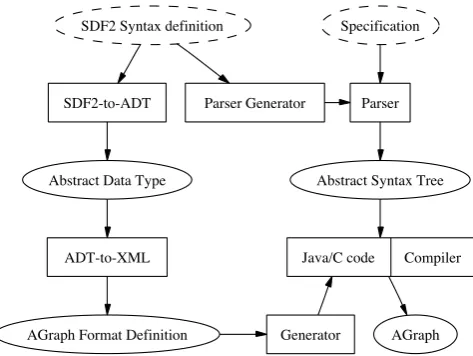
We reuse an existing tool that maps syntax definitions to abstract data-types [11]. From the abstract data-type generated by this tool, anAGraph format definitioncan be effectively generated. The generation process follows a linear flow: (1) the primary input is a syntax definition in SDF [17], from which two artifacts may be generated: a parser and a so-calledAbstract Data Type Definitionfile; (2) theAbstract Data Type Definitionfile is translated to an AGraph format definition(using the schema presented in Section 4.1), by rephrasing the original tree-oriented definition to a graph-oriented definition; (3) this graph definition is then used to generate an AGraphlibrary inCand/orJAVA.
The artifacts produced in this generation process may be employed to write a compiler for
L (or any kind of transformation tool). The parser resulting from the first step may be used to
generate the parse tree of any program in the language L (e.g. a Petri net description), and the AGraphlibrary may be used to construct an attributed graph from this parse tree. The overall architecture of this flow is represented in Figure3.
SDF2 Syntax definition
SDF2-to-ADT Parser Generator
Abstract Data Type
ADT-to-XML
AGraph Format Definition Generator
Specification
Parser
AGraph Abstract Syntax Tree
Java/C code Compiler
Figure 3: AGraph generation and deployment
5
Related work
AGraphsare primarily designed for the representation and manipulation of programming and specification languages. As they are based on a graph data structure, they can also be viewed as a graph-representation language. AGraphsare a generic data structure that can be instantiated for specific domains. A significant effort has been made to automate the implementation of each instance from high-level specifications (grammars or graph schemas).
In the following, we discuss the relationship ofAGraphwith other important graph formats and compare the automated generation capabilities against that of other (non graph-based) formats.
5.1 Graph formats
Several graph description languages and graph-based exchange formats have been proposed so far for specific applications [16,9] or with the intention of becoming defaults in some application domain [7,3,19]. Some of them, such as GDL [16] concentrate on visual characteristics of the graph being described, while others, such as GraphML [3] or GXL [19] are more flexible and general, and may be considered as standards in their respective domains.
GraphML, oriented to graph drawing, is an extensible and flexible graph-description language that provides mechanisms to describe the structure of graphs, as well as to include application-specific annotations. GXL, a standard for software reengineering tools, is also flexible and generic, subsuming many other existing graph formats. In the same vein as in the work pre-sented in [4], anAGraphcould be translated into GraphML for visualization. Also, GXL could be used as a more verboseAGraphpersistent format, extending GXL-based tools toAGraphs.
On the other hand,AGraphsprovide facilities for generating graph instances from programs or specifications and to manipulate these graph instances. Thus,AGraphscharacterise themselves as more than just an exchange format, also providing corresponding support tools. This, as far as we know, is out of the scope of most available formats.
A possible exception to this is the Meta Object Facility (MOF 2) with, e.g., its MetaData Repository (MDR3) implementation. However, although extremely powerful tools, and because of that, they are also very verbose, require a bigger initial investment for developing an applica-tion and tend to generate much bigger source code.
5.2 Automated generation
Code generation is an effective, and increasingly popular, method for software engineering [5]. The AGraph generator was developed in the tradition of code generators that take data-type definitions as input. There are many such systems that generate implementations for tree-like data-structures, e.g. ApiGen [11], ASDL [18], JJForester [13], andJAVA Tree Builder. Also, code generators such as Breeze XML Studio for binding XML files to an object hierarchy are based on similar principles.
The main advantage of AGraphswith respect to these works is that the generated code im-plements a graph data-structure instead of a tree. Since cross-references are very common in
2 http://www.omg.org/mof
applications that analyze and transform programs or specifications,AGraphsimmediately offer the data-structure that is actually needed during computation. This results in efficient and com-pact code. Tree-based data-structures need to be complemented with for example hash-tables to accomplish the same cross-referencing ability.
6
Conclusions and Future work
AGraphs are a graph-based language representation and data exchange format. They form a general data representation mechanism to be instantiated for each language to be represented. This characteristic, fully explored in its API, makesAGraphs simple to use. For instance, to get the value of a node attribute calledX, a function langGetXis to be called (wherelang
is a prefix given by the user at generation time). This approach differs from other known graph manipulation libraries, such as libGR, used in the Gr-Gen tool [8], which are usually generic.
Automated generation of the implementation of anAGraphinstance in the languages Cand JAVAcan be performed from a schema defined in a XML format or from a grammar inSDF. The file format can be used as a communication mechanism between tools built with bothCandJAVA instances of AGraphs. TheAGraph generator can be extended to support other programming languages.
Both manually and automatically generatedAGraphinstances have been effectively used in-house in different software development efforts and have proved an easy and practical mean to represent, manipulate and transform software artifacts (specifications and programs).
As future work, we plan to improve interoperability by taking several actions: port the gen-erator to other programming languages whenever needed, establish a bridge with GraphML and GXL. Currently, theAGraphgenerated library contains a function to write a GXL representation of the graph. It is also possible to generate a function that reads into memory a GXL represen-taion of anAGraph. This approach would loose in file size but would gain in interoperability. We also propose to improve programming support by adding visualization tools. Finally, we also plan to useAGraphsto support other research projects related to programming languages and software engineering.
Bibliography
[1] M. Bidoit and P. D. Mosses. CASL User Manual, volume 2900 (IFIP Series) of Lecture Notes in Computer Science. Springer Verlag, 2004. With chapters by Till Mossakowski,
Donald Sannella, and Andrzej Tarlecki.
[2] M. Brand, H. de Jong, P. Klint, and P. Olivier. Efficient annotated terms. Software-Practice
and Experience, 30:259–291, 2000.
[3] U. Brandes, M. Eiglsperger, I. Herman, M. Himsolt, and M. Marshall. Graphml progress report: Structural layer proposal. In Proceedings 9th International Symposium on Graph
[4] U. Brandes, J. Lerner, and C. Pich. GXL to GraphML and vice versa with XSLT. ENTCS, 127:113–125, 2005.
[5] K. Czarnecki and U. Eisenecker. Generative Programming: Methods, Tools, and
Applica-tions. Addison-Wesley, 2000.
[6] D. D´eharbe, S. Shankar, and E. Clarke. Model checking VHDL with CV. In G. Gopalakr-ishnan and P. Windley, editors, Formal Methods in Computer-Aided Design, volume 1522 of Lecture Notes in Computer Science, pages 508–514. Springer Verlag, 1998.
[7] J. Ebert, B. Kullbach, and A. Winter. Grax – an interchange format for reengineering tools. In F. Balmas, M. Blaha, and S. Rugaber, editors, Proceedings of the Sixth Working
Conference on Reverse Engineering, pages 89–98, 1999.
[8] R. Geiss, G. Batz, D. Grund, S. Hack, and A. Szalkowski. Gr-Gen: A Fast SPO-Based Graph Rewriting Tool. In Proceedings of the Third International Conference on Graph
Transformations, volume 4178 of LNCS, pages 383–397, 2006.
[9] M. Himsolt. Gml, a graph modelling language, 1997.
http://infosun.fmi.uni-passau.de/GraphLet/GML/.
[10] D. Jin. Exchange of software representations among reverse engineering tools. Technical report, Department of Computing and Information Science - Queens University, December 2001.
[11] H. d. Jong and P. Olivier. Generation of abstract programming interfaces from syntax definitions. Journal of Logic and Algebraic Programming, 59, 2004.
[12] E. Kindler and M. Weber. A universal module concept for petri nets: an implementation-oriented approach. Informatik Bericht 150, Institut f¨ur Informatik, Universit¨at zu Berlin, 2001.
[13] T. Kuipers and J. Visser. Object-oriented tree traversal with JJForester. In M. van den Brand and D. Parigot, editors, Electronic Notes in Theoretical Computer Science, volume 44. Elsevier Science Publishers, 2001. Proc. of Workshop on Language Descriptions, Tools and Applications (LDTA).
[14] A. M. Moreira, C. Ringeissen, D. D´eharbe, and G. Lima. Manipulating algebraic specifi-cations with term-based and graph-based representations. Journal of Logic and Algebraic
Programming, 59:63–87, 2004.
[15] A. M. Moreira, C. Ringeissen, and A. Santana. A Tool Support for ReusingELAN Rule-Based Components. Electronic Notes in Theoretical Computer Science, 86(2), 2003.
[16] G. Sander. Vcg – visualization of compiler graphs. Technical report, Universit¨at des Saar-landes, February 1995.
[18] D. Wang, A. Appel, J. Korn, and C. Serra. The Zephyr Abstract Syntax Description Lan-guage. In Proceedings of the Conference on Domain-Specific Languages, pages 213–227, 1997.
[19] A. Winter, B. Kullbach, and V. Riediger. An overview of the GXL Graph Exchange Lan-guage. In S. Diehl, editor, Revised Lectures on Software Visualization International