JPRHC
Research Article
DESIGN AND EVALUATION OF PECTIN BASED MATRIX FOR TRANSDERMAL PATCHES OF MELOXICAM
PALLAVI SRIVASTAVA, Dr. G.T.KULKARNI, MANISH KUMAR, SHARAD VISHT
For author affiliations, see end of text
This paper is available online at www.jprhc.in
ABSTRACT
Transdermal drug delivery system was developed using meloxicam as a model drug. Meloxicam is a non steroidal anti-inflammatory (NSAID) drug. The suitability of drug with respect to solubility, lower molecular weight and short half life makes this drug as a suitable candidate for administration by transdermal route. The polymer selected for the study is pectin. The polymer is non-toxic and biodegradable in nature. In the present investigation various concentration ratios of polymer were used for the fabrication of the matrix diffusion controlled transdermal drug delivery system by solvent evaporation technique. These transdermal drug delivery systems were characterized for their thickness, weight variation, folding endurance, swelling index, content uniformity, compatibility, in-vitro release and skin irritation studies of the drug from the polymeric matrix. Meloxicam was found to be compatible with pectin as revealed by Fourier Transform Infrared Spectroscopy (FTIR) studies and showed satisfactory physiochemical characteristics. In-vitro
release studies were carried out with modified Franz diffusion cell using pH 7.4 phosphate buffer as receptor medium and it showed controlled release of drug. Thus the prepared transdermal films can be used to achieve controlled release and improved bioavailability of meloxicam.
KEY WORDS: Transdermal Drug Delivery, Pectin, Meloxicam
INTRODUCTION
The systemic treatment of disease via transdermal route is not a recent innovation. But, in the last two decades, transdermal drug delivery has gained increasing interest. The delivery of drugs using skin as the port of entry is known as transdermal administration and the drug delivery systems are known as transdermal therapeutic systems or transdermal drug delivery systems or popularly known as transdermal patches.1 The success of this
approach is evidenced by the fact that there are currently more than 35 approved transdermal drug delivery products for the treatment of a wide variety of conditions including: hypertension, angina, motion sicknesses, and recently
contraception and urinary incontinence. There are also several products in late-stage development that will further expand transdermal drug delivery usage into new therapeutic areas, including Parkinson’s disease.1, 2, 3. Transdermal controlled
drug delivery systems have been investigated & developed in order either to avoid hepatic first-pass effect improving drugs bioavailability or to decrease the dosing frequency required for oral treatment.
Meloxicam is a non-steroidal anti-inflammatory drug preferably used for management of pain, inflammation, tenderness, swelling and stiffness of the joints in patients of osteoarthritis, rheumatoid arthritis, and juvenile rheumatoid arthritis. It has also been used to treat signs and symptoms of ankylosing spondylitis, acute low back pain, and acute sciatica. The mean elimination half-life (t½) ranges from 15 hours to 20 hours. The usual oral dosage regimen is 7.5 mg – 15 mg once daily. Patient compliance in the form reduced administration frequency can best be achieved by development of matrix type transdermal patches of meloxicam.
MATERIALS AND METHODS
Meloxicam was obtained from Unichem Labs, India as a gift sample. Pectin & other chemicals including Dimethylformamide, Polyethylene Glycol 400, Menthol & Glycerin were procured from Central Drug House, Delhi, India. All other chemicals & solvents used were of analytical grade.
INVESTIGATION OF PHYSIOCHEMICAL COMPATIBILITY OF DRUG & POLYMER
In order to evaluate the integrity and compatibility of the drug with the carrier polymer in the polymer-drug matrix formulations, IR spectra of the drug and its formulations were obtained using a potassium bromide pellet method. For determining drug-polymer compatibility (100 mg) of the hydrogel powder was mixed with potassium bromide (400 mg) and was compressed in a hydraulic press to form a pellet at 15 tons pressure. The pellets were scanned in the wavelength region between 4000 to 400 cm-1 by FTIR
JPRHC
Research Article
PREPARATION OF MELOXICAM-POLYMER FILMS
The transdermal films were prepared by solvent casting technique. The polymeric matrix was prepared by dissolving 6% w/v pectin in distilled water to which (0.1% v/v PEG) was added as plasticizer. The drug solution was prepared by
dissolving (50 mg) drug in 2 mL
dimethylformamide and shaken on a mechanical shaker for 30 min. to ensure complete solubilisation of the drug. Then the drug solution was added to polymeric solution and mixed thoroughly by
continuous stirring to ensure uniform distribution forming a homogenous mixture. To the prepared mixture (0.25% w/v and 0.5% w/v menthol) and (1% w/w and 1.5% w/w glycerin) were added as penetration enhancers. A measured volume of each of the polymeric solutions (10 mL) was poured into petri dish and dried at room temperature. To prevent fast evaporation from the patches an inverted funnel was placed on the mould. After ensuring the complete evaporation of the solvent, patches of 2 cm diameter were cut and stored for further study.
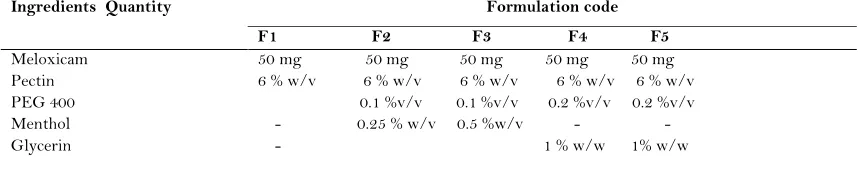
Table 1 Composition of Meloxicam-Polymer Films Ingredients Quantity Formulation code
F1 F2 F3 F4 F5
Meloxicam Pectin PEG 400 Menthol Glycerin
50 mg 50 mg 50 mg 50 mg 50 mg 6 % w/v 6 % w/v 6 % w/v 6 % w/v 6 % w/v 0.1 %v/v 0.1 %v/v 0.2 %v/v 0.2 %v/v 0.25 % w/v 0.5 %w/v
- 1 % w/w 1% w/w
FORMULATION VARIABLES Selection of Polymer Concentration
Pectin at different concentrations was used (1% w/v to 10% w/v) among which 6% w/v was found to give better results. Film properties (surface properties, thickness and folding endurance) at 6% w/v showed better results as compared to other concentrations.
Selection of Plasticizer
For pectin PEG 400 at different concentrations (0.1% v/v to 0.5% v/v) was used as plasticizer. It was observed that PEG 400 at (0.1% v/v and 0.2% v/v) showed better film properties with good plasticity.
Selection of Penetration Enhancers
Various penetration enhancers were used to modify the release profile of the drug. Menthol at different concentrations (0.1% w/v to 0.5% w/v) was added to the films, it was observed that menthol at (0.25% w/v and 0.5% w/v) modified the release pattern of the drug. Other penetration enhancer glycerin was used at (1% w/w to 3% w/w), it was found that glycerin at (1% w/w and 1.5% w/w) concentration showed better results and modified the release pattern of the drug.
EVALUATION OF FILMS Thickness4,5,6
The thickness of each film was measured using digital micrometer screw gauge at three different positions of the film and the mean value was calculated.
Weight Variation4,5,6
For determining weight of films, three films of each formulation were taken and weighed individually using digital balance. The average weight was calculated.
Folding Endurance4,6
The folding endurance of the films was determined by repeatedly folding one film at same place till it broke. The number of times the film could be folded at the same place without breaking / cracking gave the value of folding endurance.
Swelling Studies7
A drug loaded film of 2 cm2was weighed on a pre
JPRHC
Research Article
gives the weight increase due to absorption of water and swelling of films.
Surface pH8
For the determination of surface pH the patches were left to swell for 2 hours on the surface of agar plate, prepared by dissolving 2% (w/v) agar in warmed phosphate buffer (pH 7.4) under stirring and then pouring the solution into the petri dish till gelling at room temperature. The surface pH was measured by means of pH paper placed on the surface of swollen patches. The mean of three readings was recorded.
Drug content 4,9
For determining content uniformity each film of size 2 cm2was cut and placed in volumetric flask
and 10 mL of dimethylformamide was added. It was placed on a mechanical shaker and shaken for 3-4 hours. Then 1 mL of the solution was transferred to a 10 mL volumetric flask and diluted with dimethylformamide up to the mark. The absorbance of the solutions was measured against corresponding blank solution using UV-Visible spectrophotometer at 375 nm.
In-VitroRelease Study5,9,10,11
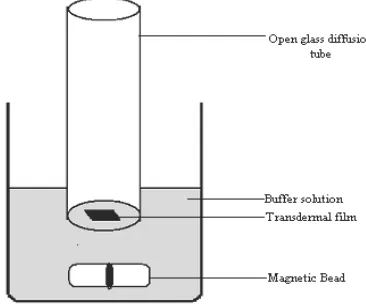
A modified Franz diffusion cell was used to study drug release from the transdermal films. Phosphate buffer pH 7.4 was used as the receptor fluid (200 mL). Dialysis membrane hydrated over a period of 24 hours was used as the barrier.
Figure 1 In-vitrodiffusion studies of transdermal film in pH 7.4 phosphate buffer
A film of 2 cm2 was placed on the donor
compartment with the film facing dialysis
membrane and placed in the receptor compartment. The cell was maintained at 37 ± 0.5 oC and
receptor fluid was agitated at 100 rpm by a magnetic stirrer. Samples were withdrawn at hourly intervals and filtered using whattman filter paper and analysed for the amount of drug release using UV spectrophotometer at 375 nm.
Skin Irritation Studies12
The skin irritation studies were done on Guinea pigs. The animals were observed for any sign of erythema or edema for a period of 7 days and scores as reported by Draize et al.
RESULTS AND DISCUSSION
JPRHC
Research Article
as compared to F1 due to absence of penetration enhancer.
Table 2 Characterization of transdermal films
Parameter F1 F2 F3 F4 F5
Avg. Thickness * (mm)
0.243 ± 0.009 0.263 ± 0.009 0.257 ± 0.007 0.311 ± 0.015 0.322 ± 0.0367
Avg. Weight * (mg)
111.6 ± 0.458
113.2 ± 0.655
113.0 ± 0.650
116.1 ± 0.757 117.9 ± 0.776
Folding Endurance *
73.6 ± 1.52 197.6 ± 0.57 182.3 ± 1.52 150.6 ± 2.08 141.3 ± 2.51
Swelling index* Increase in weight in (mg)
300.0 ± 1.563 315.8 ± 1.550
330.7 ± 2.577 289.1 ± 0.953 274.8 ± 2.170
Drug Content* (mg)
5.463 ± 0.041 5.223 ± 0.040
5.363 ± 0.041 5.996 ± 0.060 6.063 ± 0.041
* Average of three determinations ± S.D
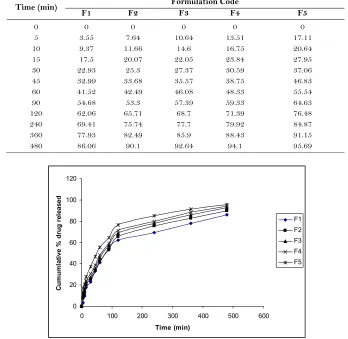
Table 3 Cumulative % drug release
Time (min) Formulation Code
F1 F2 F3 F4 F5
0 5 10 15 30 45 60 90 120 240 360 480
0 3.55 9.37 17.5 22.93 32.99 41.52 54.68 62.06 69.41 77.93 86.06
0 7.64 11.66 20.07 25.3 33.68 42.49 53.3 65.71 75.74 82.49 90.1
0 10.64
14.6 22.05 27.37 35.57 46.08 57.39 68.7 77.7 85.9 92.64
0 13.51 16.75 23.84 30.59 38.75 48.33 59.33 71.39 79.92 88.43 94.1
0 17.11 20.64 27.95 37.06 46.83 55.54 64.63 76.48 84.87 91.15 95.69
0 20 40 60 80 100 120
0 100 200 300 400 500 600
Time (min)
C
u
m
u
m
la
ti
ve
%
d
ru
g
r
el
ea
se
d
F1 F2 F3 F4 F5
JPRHC
Research Article
CONCLUSION
Pectin based matrix for transdermal patches of meloxicam can be developed for effective & controlled management of arthritis. From the present study it may be concluded that transdermal patches of meloxicam provides the convenience of self application and ease of removal whenever required and allow the luxury of more accurate dosing than primary dosage forms.
REFERENCES:
1. Yie WC. Novel drug delivery system. 2nd ed. New York: Marcel Dekker; 1992. p. 301-342.
2. Wise DL. Handbook of pharmaceutical controlled release technology. New York: Marcel Dekker; 2000. p. 332.
3. Jain NK. Advances in controlled and novel drug delivery. 1st ed. Delhi: CBS publishers; 2001. p. 426-448.
4. Dandagi PM, Manavi FV, Gadag AP, Mastiholimath VS, Jagdeesh T. Formulation of transdermal drug delivery of ketotifen fumarate. Indian Journal of Pharmaceutical Sciences. 2003; 65(3): 239-243.
5. Sankar V, Benito JD, Sivanand V, Ravichandran V. Design and evaluation of nifedipine transdermal patches. Indian Journal of Pharmaceutical Sciences. 2003; 65(5): 510-515.
6. Panigrahi L, Ghosal SK. Formulation and evaluation of pseudolatex transdermal drug delivery system of terbutaline sulphate. Indian Journal Pharmaceutical Sciences. 2002: 79-82.
7. Gua JH, Cooklock KM, Bioadhesive
polymer buccal patches for
buprenorphine controlled delivery: solubility consideration. Drug Development and Industrial Pharmacy. 1995; 21: 2013-2019.
8. Noha AN, Nabila AB, Fatima A, Lobna MM. Design and characterization of muchoadhesive buccal patches containing
cetypyridium chloride. Acta
Pharmaceutica. 2003; 53: 199-212. 9. Gupta SP, Jain SK, Effective and
controlled transdermal delivery of metoprolol tartrate. Indian Journal of Pharmaceutical Sciences. 2005; 67(3): 346-350.
10. Kulkarni RV, Mutalik S, Hiremath D. Effect of plasticizers on the permeability and mechanical properties of eudragit films for transdermal application. Indian Journal of Pharmaceutical Sciences. 2002; 64(1): 28-31.
11. Devi K, Paranjothy KLK. Development and evaluation of free films and transdermal patches of ketorolac tromethamine using polymers and pressure sensitive adhesives. The Eastern Pharmacist. 1998 (May); 41(485): 97-100. 12. Draize JH, Woodward G, Calvery HO.
Methods for the study of irritation and toxicity of substances applied topically to the skin and mucous membranes. Journal of Pharmacology and Experimental Therapeutics. 1944; 82: 377-379.
AUTHORS AFFILIATION AND ADDRESS FOR COMMUNICATION:
Department of Pharmaceutical Technology,
Meerut Institute of Engineering and Technology,
NH-58, Baghpat Crossing, Meerut, India.