International Journal Advances in Social Science and Humanities
Available Online at:
www.ijassh.com
RESEARCH ARTICLE
Contract Relationship Management: A Bridge for Service Delivery
in Serere District Local Government in Uganda
Robert Agwot Komakech
Uganda Management Institute P.O Box 20131, Kampala.
Abstract: The limited literature on contract relationship management and service delivery satisfactory level provided a basis for this study. The objectives of the study were to; establish the relationship between contract relationship management and service delivery and determine the service delivery satisfactory level in Serere District Local Government in Uganda. The data of the study was collected from ninety (90) key procurement stakeholders in the district. The respondents were selected using purposive and stratified sampling methods. Data were collected through pre-tested research questionnaires. The descriptive statistics used include; mean and standard deviation while Pearson correlation coefficient (p) and regression analysis was used to analyze and test hypothesizes. The result shows that there was a significant relationship between contract relationship management and service delivery (r=0.354, p<0.001) while service delivery satisfaction level in Serer District Local Government was at only 56.7%. The results also show low contract management review meetings between the parties leading to high bidders’ protest. Therefore, contract relationship management model is a very important component to successful delivery of services in local governments. The researcher recommends the district to establish Contract Management Forum to address the contract management related challenges between the entity and other stakeholders in an open and transparent manner.
Keywords: Contract Relationship Management, Service Delivery, Contract Management Forum, Local Government.
Article Received: 26 March 2020 Revised: 17 April 2020 Accepted: 24 April 2020
Introduction
Contracts are essential part of procurement in both developed and developing countries’ public organization. According to Commonwealth of Australia [1], contracting is an integral part of doing business in the public sector. Contracts can range significantly in value, in duration, and in complexity. Strand of literature shows that Government contracting for works, goods and services often involves a substantial amount of funds [2, 1, 3].
As a consequence, the nature and extent of contract management practices will vary depending on the size, nature, complexity and risk profile of each contract. Commonwealth of Australia [1] observed that, inadequate contract management practices will have an adverse impact on an agency’s capacity to meet its business objectives. Basingstoke and Deana Plan [4] defined contract management as the proactive monitoring, review and management of contractual terms secured through the procurement process to ensure
that what is agreed is actually delivered by suppliers or partners. Researchers, policy makers and donors agreed that contract management roles have carried lower status and profile than posts on major policy development or projects, and in procurement teams; for example, the World Bank procurement guidelines do not address the subject of contract management while United Kingdom and Uganda are among the few countries in 2014 to include contract management in their procurement strategy [5, 6, 7].
things and have more time to actually do the work [8]. It ensures (1) compliance agreed at the onset are delivered in a timely and cost effective manner, (2) issues of non compliance or variation are picked up early and either dealt with or appropriately escalated for resolution, (3) cost and risk are managed appropriately. It may also ensure that (4) reviews are undertaken and lessons leant during the procurement of goods, works or services can be applied when making future procurements.
Contact Relationship management improves contactor(s)/ service provider(s) performance; and ensures that parties to contract manage their resources while complying with procurement laws, guidelines and regulations. Commonwealth of Australia [1] noted that relationship management underpins overall successful contract management. Contributing to the same debate, Commonwealth of Australia [1] studies revealed that effective contract management is not only about holding contractor(s)/ service provider(s) to account for each minute detail of the contract but to promote a relationship that support the objectives of both parties.
According to Gummesson [9] as cited by Mandiyambira [10] relationship management is the asset of the organization through which an organization can gain access to the resources of others, acquire the supplies that it needs, or solve its problems and thus generate revenue. Davis & Walker [11] observed that relationship based procurement is dependent on joint problem solving activities. According to Jefferies, Rowlinson & Cheung [12] relational contracting approaches have become more popular than before. SIGMA [13] explains that among the many factors that influence contract relationship, mutual trust and understanding, openness and excellent communication, and a joint approach to managing delivery makes a more significant contribution to service delivery in local governments.
Basingstoke and Deana Plan [4] points contract procurement as an area subject to vendor protests and litigations. Consistent with Oluka & Basheka [7], relationship management may be constrained by dispute resolution by the courts which is costly and unreliable. As a result, relationships should
be managed in a professional manner and be based on cooperation and mutual understanding, taking into account the need for probity and ethical behavior [1, 14] so as to reduce the cost of managing risks associated with fraud, theft, corruption, and other improper behaviour, and enhance confidence in public contracting through better service delivery.
Smith, O’Keefe, Georgiou & Love [15] revealed shortage of necessary capital as the major cause of dispute and arbitration between the entity and the contractors leading to poor relationship. Both old and recent researches have shown lack of transparency, poor record keeping, time, cost and quality slippage as the major challenge in contractual relationship between the client and the contractor [15, 16, 17].
These findings are consistent with findings made by Komakech [3] in respect to procurement records. Komakech explained that lack of procurement records undermines the principles of transparency, accountability and fairness for instance; absence of consistent and reliable data will make it difficult to create an environment in which performance can be properly assessed.
According to Ahimbisibwe, Muhwezi & Eyaa [18], organizations should build collaborative and long term relationships with their suppliers to avoid opportunism. This is supported by Jefferies, et al., [12] research in the Australian construction industry which found collaboration and teamwork as crucial in sharing up-to-date information between contracting parties. Collaboration and increased professionalization of processes will increase the likelihood that public procurement will deliver reduced costs and appropriate service quality [14]. Queensland Audit Office [19] indicates that the reduction in the number of contracts in entities reduces administrative overheads and improves the consistency of contract management activities hence more effective and efficient use of resources (value for money) in entities.
trust accrue. Furthermore, William [21] has argued that purchasing has the ultimate responsibility of establishing and maintaining good supplier relationships. The author further contends that the type of relationship is often associated with the length of a contract between buyers and sellers.
Mandiyambira [10] found that managing long term relationship was better than adversarial relationship. Keeping good relations with suppliers provide high quality goods, (including works and services), save procurement time, eliminates unwanted procurement renewals, increased productivity, improves competition, reduces legal fees and reduce costs especially where the suppliers are reliable [21, 10, 14, 8]. Therefore, contract relationship management model is a very important component to successful service delivery in local government’s world over.
Service delivery refers to a relationship between policy makers, service providers, and consumers of those services, and encompasses both services and their supporting systems [22]. In other words, service delivery is a mechanism of policy implementation. However, the Government of Uganda has developed a number of approaches to local government for rendering services to the greater population. These approaches include; (1) direct provision by the local government, (2) Public-Private Partnerships (PPPs), (3) contracting/ outsourcing (letting individuals or companies to provide the services) and (4) participation of Civil Society Organisations (CSOs). Although much of the service provision is done by the stakeholders [12]; the overall performance of Serere district local government was moderately satisfactory with a weighted average risk rating of 31.7% of the procurement value.
The high risk and medium risk procurements were due to; delayed completion of works projects, failure to procure within the approved plan, payment for shoddy work or work not delivered, failure to appoint contract managers [23, 24] hence poor service delivery. Therefore, to reduce procurement risks and enhance service delivery in Serere District Local Government (SDLG), sound relationships with all relevant stakeholders is critical. Finally, it is important to note that
prior to this study, no information was found on relationship between contract relationship management and service delivery; and the service delivery level in Serere district local government hence the justification of the study.
Statement of the Problem
Contract relationship management between the contracting parties is a key ingredient to the successful delivery of the outcomes sought through the contract. Relationship based procurement is dependent upon and is reinforced by joint learning from joint problem solving activities. Jefferies, Rowlinson & Cheung [12], noted that relationship management cannot be legislated. This is evident from the fact that the World Bank procurement guidelines do not address the subject of contract management and relationship management since it is integrated into procurement process.
In Uganda, the procurement regulatory body, Public Procurement and Disposal of Public Assets Authority (PPDA) included contract management in the Public Procurement and Disposal of Public Assets Regulations, 2014 to ensure that all parties meet their obligations. Although contract management includes administration management, relationships management and ensuring that deliverables are provided to the required standard, within the agreed timeframe and achieve value for money, unfortunately, there is little collaboration between the entity and the contractor leading to delayed completion of projects hence poor service delivery.
This apprehension motivated the researcher to research into the relationships between contract relationship management and service delivery, and service delivery level in Serere District Local Government in Uganda. On the basis of the literature, it was hypothesized that:
H1
There is a significant positive relationship between contract relationship management and service delivery in Serere District Local Government in Uganda.
Research Methodology
The study used correlations and case study research designs. According to Sekaran [26] a correlation study is most appropriate to conduct the study in the natural environment of an organization with minimum interference by the researcher and no manipulation. The design enabled the researcher to find out the relationship between the studies variables.
A case study on the other hand was used describe, understand, and explain Yin [27] the relationship between contract relationship management and service delivery, and service delivery level in Serere District Local Government in Uganda. The case study design enabled the researcher to bring about an understanding of the complex issue and added strength to what was already known through previous research. Blends of quantitative and qualitative approaches were applied to analyze the empirical data on the relationship between contract relationship management and service delivery, and service delivery level in Serere District Local Government in Uganda.
Questionnaires and interview guide were used to collect quantitative and qualitative data from Accounting Officer/ Principal Assistant Secretary (PAS), Heads of Department, Procurement and Disposal Unit staff, Contracts Committee/ Evaluation Committee members, Contractors, Local Council V members, Local Council III members, Civil Society Organization representatives and User departments/ beneficiaries who were the target respondents for the study. The 23 itemized questionnaires were constructed on a five point Likert scale; with 1- Poor (P), 2- Fair
(F) 3- Good (G), 4- Very Good (VG) and 5- Excellent (E). The questionnaire was pilot tested on 14 non sampled respondents who provided suggestions on the wording of items. The result was then analyzed using descriptive statistics to determine the mean and standard deviation including the extreme values (minimum and maximum values). The pre-tested results were subjected to reliability test.
The test yielded a Cronbach’s Alpha Reliability Coefficient (α) of 0.959 or 95.9% far above the expected 0.70 or 70% value [28] hence the tool was appropriate for data collection. The minimum value for the mean on scale of 5 was 1 and 5 as maximum. This study also adopted Komakech (2020) decision rule constructed on the five point Likert scale with 0.00-1.49= Poor; 1.50-2.49= Fair; 2.50-3.49= Good; 3.50-4.49= Very Good; and 4.50-5.0= Excellent in analyzing the mean value of the contract relationship management and service delivery.
Qualitative data was also obtained through in-depth interviews. Each interview session with key informants lasted for a period of 45-60 minutes. The interview results were analyzed using thematic analysis and content analysis. Before administering and conducting interviews, all respondents were briefed on the research purpose and informed consent was sought and respondent’s names were withheld to ensure anonymity and confidentiality.
The analysis and interpretation of quantitative data was based on the mean and standard deviation. Quantitative data obtained from 90 well filled questionnaires was sorted using descriptive statistics in Statistical Package for Social Scientists (SPSS) Ver.20 so as to identify the missing variable(s), outliers and normality of data prior to the multivariate analysis of the questionnaire data.
These were used to analyze and test hypothesizes (relationship between contract administration and service delivery in Serere District Local Government in Uganda).
Empirical Findings
The data was analysed based on the ninety (90) returned completed questionnaires out of one hundred eight (108) samples from a population of one hundred fifty (150); giving a response rate of 83.3%. Out of the 90 respondents, 77.8% (70) were male while female were only 22.2% (20). The result shows that male dominate the workforce in the district top and middle level management as well as the business industry as evidenced with the procurement records which shows no single construction firm is headed by female director except in service sector where there were three (3) firms headed by female in the district.
This trend of gender distribution in public entities is now normal in Uganda because of weak enforcement of affirmative action at national and district level. The study also showed that 71 (78.9%) of the respondents were married, 17(18.9%) were single while divorced and widow respondents were 2 (2.2%). Since service delivery affects all categories of the population, knowing the marital status of the respondents was very important since each category has interest in
a particular procurement for instance the married couples especially female had more interest in health sector related procurement like the wards, maternity facilities, drugs, beds, placenta pits, washrooms while their male counterparts were interested in roads, schools while the single especially the youth were more interested at procurement of services for their social events during their (youth) celebration days.
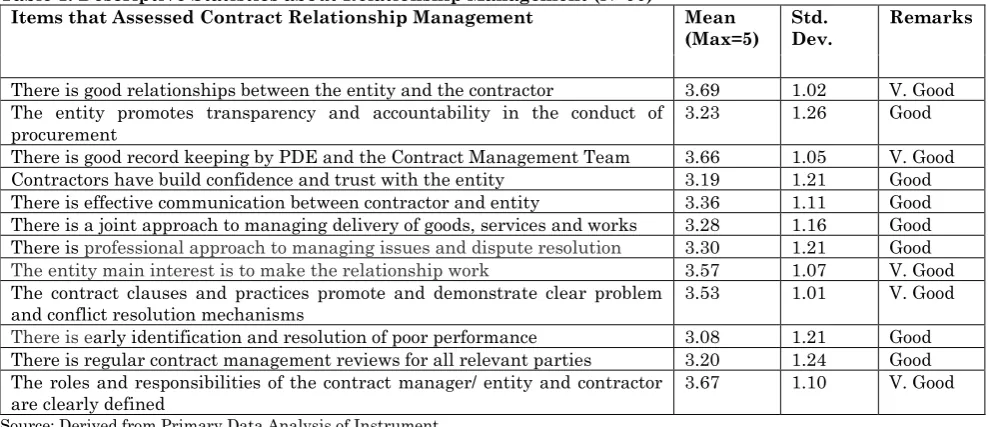
This implies that the majority of the respondents were able to evaluate service delivery level at the district, thus giving relevant response. The twelve (12) items on contract relationship management also yield Cronbach’s Alpha Reliability Coefficient of 0.904 or 90.4% implying the tool used was very reliable and appropriate for decision making. Table 1 shows the descriptive statistics of the research findings.
Contract Relationship Management and Service Delivery
The major objective of the study was to establish the relationship between contract relationship management and service delivery in Serere District Local Government (SDLG). In order to achieve the study objective, the researcher developed twelve (12) items that were relevant to contract relationship management and service delivery. This result is presented in Table 1.
Table 1: Descriptive Statistics aboutRelationship Management (N=90)
Items that Assessed Contract Relationship Management Mean
(Max=5) Std. Dev. Remarks
There is good relationships between the entity and the contractor 3.69 1.02 V. Good The entity promotes transparency and accountability in the conduct of
procurement 3.23 1.26 Good
There is good record keeping by PDE and the Contract Management Team 3.66 1.05 V. Good Contractors have build confidence and trust with the entity 3.19 1.21 Good There is effective communication between contractor and entity 3.36 1.11 Good There is a joint approach to managing delivery of goods, services and works 3.28 1.16 Good There is professional approach to managing issues and dispute resolution 3.30 1.21 Good
The entity main interest is to make the relationship work 3.57 1.07 V. Good The contract clauses and practices promote and demonstrate clear problem
and conflict resolution mechanisms 3.53 1.01 V. Good
There is early identification and resolution of poor performance 3.08 1.21 Good There is regular contract management reviews for all relevant parties 3.20 1.24 Good The roles and responsibilities of the contract manager/ entity and contractor
are clearly defined 3.67 1.10 V. Good
Source: Derived from Primary Data Analysis of Instrument
A comparative analysis of 12 items as shown in Table 1 reveals important information concerning relationship management and service delivery in Serere District Local
attention so as to improve service delivery for example, the findings shows that there is good relationships between the entity and the contractor (Mean=3.69, Sdv.=1.02). This is a very good indicator for contract relationship management and implying there are mutual respect and trust between the entity and some contractors. From the findings, the obtained mean of 3.23 and standard deviation of 1.26 revealed that, the entity promotes transparency and accountability in the conduct of procurement.
This implies that the level of transparency and accountability is still not very good as a result it creates avenue for corruption inform of bribery, nepotism, favoritism which will limit competition for the provision of high quality goods, services and works hence poor service delivery in the district. The majority of the respondents also agreed that record keeping by procuring and disposing entity and the Contract Management Team is very good as shown by 3.66 mean and 1.05 standard deviation.
The findings further indicates (Mean=3.41, Sdv.=1.08) that, there is a well-established good relationship between the entity and the contractors. One PDU staff argued that; “Contractors have more relationship with politicians than PDU which makes savings very difficult because before the bids is out, they already aware of the outcome and when contractor realize that the company is not getting the deal; the contractor will not participate in that procurement.”
This implies that there is high level of bid collusion and rigging in the district which is bad practice since it discourages competition as a result value for money is not obtained in the procurement. From the findings, average number of respondents (Mean=3.19, Sdv. =1.21) agreed that contractors have build confidence and trust with the entity. This level of confidence and trust is still low in Serere district implying both stakeholders focus on what is in the contract because each party is unpredictable hence cannot protect the interest of the other leading to high service delivery failure.
The results show that there is good (Mean=3.36, Sdv. =1.12) effective communication between contractor and entity. However some contractors for instance Contractor from Kateta Sub-County
in Serere District disagree with the statement and explain that, “Communication with the user and project management team is very good and prompt at the beginning of the contract but after delivery and submission of the demand note, all parties in the entity who have been responsible at the beginning begins to ignore your (contractors’) phone calls,”
This implies that the entity does not understand the value of open communication in promoting the relationship and understanding of the contracting parties. As a result, it is important for the entity to note that even if there is no money or information the contract manager and the PDU have to tell the contractor regarding their payments, they should not ignore the contractors’ call because it breeds mistrust. On whether there is a joint approach to managing delivery of goods, services and works in Serere district, the researcher found a mean of 3.30 with standard deviation of 1.21 which is not good enough.
This implies that since there are many stakeholders involved in monitoring the procurement, it is possible that there will be conflicting reports which will lead to waste of time by the parties involved in reconciling their reports. The study also demonstrates from the response that the entity has professional approach to managing issues and dispute resolution as indicated by 3.30 mean and 1.21 standard deviation. This implies that the entity has means of handling conflicts between in contract between the entity and the contractors as required by the PPDA Regulations or Act.
of relationship focus is for the entity to achieve cost reductions and flexibility in dealing with the contractor(s) during the period of inflations, change of contract terms, and increasing cost of raw materials or equipments.
The researcher also explored respondents’ views on whether contract clauses and practices promote and demonstrate clear problem and conflict resolution mechanisms including well defined and known escalation routes. The findings showed a mean of 3.53 with standard deviation of 1.01 which is an indication that the entity is in tandem with the procurement rules and regulations.
The findings also show that the level of entity involvement in early identification and resolution of poor performance is still not very good (Mean=3.078, Sdv.=1.211). This implies that the increasing cost of procurement through variations in Serere district is a result of poor risk identification hence low value for money. Also from the responses, it was further agreed (Mean=3.20, Sdv.=1.24) that there is regular contract
management reviews in the entity which is a good indicator of relationship management since the entity consider to improve and develop potential strategic relationships so as to deliver values for all relevant parties. The roles and responsibilities of the contract manager/ entity and contractor are clearly defined and differentiated in the contract documentation and well understood by all parties was agreed by (Mean=3.67, Sdv. =1.10) respondents. This indicates that the there is segregation of duties among the stakeholders as required by the PPDA Regulations or Act 2014 as amended.
Testing Hypothesis 1: There is
Significant Positive Relationship
between Contract Relationship
Management and Service Delivery
In order to determine the direction and strength of relationship between contract relationship management and service delivery in Serere District Local Government, the researcher used Pearson Correlation coefficient and the result is presented in Table 2.
Table 2: Correlations between relationship management and service delivery
Service Delivery Relationship Management
Service Delivery
Pearson Correlation 1 .354*
Sig. (2-tailed) .001
N 90 90
Relationship Management
Pearson Correlation .354* 1
Sig. (2-tailed) .001
N 90 90
*. Correlation is significant at the 0.01 level (2-tailed).
From the correlation analysis, the result shows that there is a significant positive relationship between contract relationship management and service delivery (r=0.354, p<0.01) hence H1 is supported. The result also indicates positive relationship between the variables. This implies that improvement in contract relationship management in Serere district local government will lead to improvement of service delivery. The researcher further conducted regression analysis to establish the cause and effect
relationship between the two variables using SPSS Ver. 20.
Regression Analysis on Relationship
between Contract Relationship
Management and Service Delivery
Regression analysis was performed to establish the nature of relationship between contract relationship management and service delivery and the extent independent variable explains the variance in service delivery. The results are shown in Table 3.
Table 3: Model summaryb
Model
1 R R Square Adjusted R Square Std. Error of the Estimate Change Statistics R Square Durbin-Watson
Change
F Change
df1 df2 Sig. F Change
3 .354a .125 .115 1.09816 .125 12.575 1 88 .001 1.631
a. Predictors: (Constant), Contract Relationship Management b. Dependent Variable: Service Delivery
Table 3 shows that contract relationship
service delivery. This implies that contract relationship management account for 12.5% variance in service delivery while the remaining 87.5% variation is caused by other factors such as institutional leadership, quality, time, cost, corruption, poor specifications, low motivation and remuneration compounded by mind set, negative attitude, and negligence of the roles.
Since the Durbin-Watson statistic of 1.631 is closer to 2.00, it implies that the assumption of independent error is tenable. The Analysis of Variance (ANOVA) was also used to test whether Model 1 was significantly better at predicting service delivery in SDLG than using the means as a best guess. This is shown in ANOVA Table 4.
Table 4: Analysis of variance (anovaa)
Model 1 Sum of Squares Df Mean Square F Sig.
Regression 15.165 1 15.165 12.575 .001b
Residual 106.124 88 1.206
Total 121.289 89
a. Dependent Variable: Service Delivery
b. Predictors: (Constant), Contract Relationship Management
The calculated F value = 12.575 was put into consideration with a p= 0.001. Since the p= 0.001 is less than the bench mark p= 0.01,
which are highly significant show that Model 1 significantly improve the researcher ability to predict service delivery in Uganda.
Table 5: Regression analysis (coefficienta)
Model 1 Unstandardized
Coefficients Standardized Coefficients T Sig. 95.0% Interval for B Confidence
B Std. Error Beta Lower
Bound Upper Bound
(Constant) 1.704 .407 4.181 .000 .894 2.513
Relationship
Management .386 .109 .354 3.546 .001 .170 .602
Dependent Variable: Service Delivery
The results in Table 5 show that the standardized Beta coefficient is more than 0.05 and tends towards the absolute value of +1 (positive correlation) implies that as relationship management increases, so does service delivery. Thus the set Hypothesis 1 was accepted which states that “there is significant positive relationship between contract relationship management and service delivery” because p value is less than the critical p< 0.01. The 95% confidence interval for the difference between the two means (0.170 or 0.602) which implies that the results is true, correct and since coordination and frequent communication is very important among the procurement stakeholders.
Service Delivery
The researcher presented ten (10) items about service delivery level in Serere District Local Government to respondents who rated their satisfaction level in a five-point Likert and results was computed using SPSS Ver. 20 and presented using descriptive statistics. The reliability of the instrument was computed using Cronbach’s Alpha Reliability Coefficient. The internal consistency for the ten (10) items was 0.867 or 86.7% which is acceptable for analysis. Table 6 shows the descriptive statistics of the dependent variable.
Table 6: Descriptive statistics about service delivery in serere district (N=90)
Items that Assessed Service Delivery Mean (Max=5)
Std. Dev.
Remarks
Table 6 shows the overall assessment of the respondent’s views/ perceptions on the 10 items that measured service delivery in SDLG. The empirical findings on Table 4.22 shows the means distribution of the 10 items ranged between 2.12 to 3.41 on the five Likert scales that was used in this study and they need urgent attention as a way of improving service delivery. From the findings, majority respondents agreed that there is involvement of public in assessing the quality of goods, services and works that are being implemented (Mean=3.13, Sdv. =1.41).
This implies that there is good (average) level of improvement. Although there is public involvement in assessing the value for money for goods, services and works procured, value for money is not fully attained since there is number of shoddy works, variations in prices, and delayed delivery as shown by the results (Mean=3.02, Sdv.=1.45) indicating poor service delivery in the entity. The researcher also found that timeliness is highly emphasized in contact management (Mean=3.41, Sdv. =1.25) which is good practices and it enabled the contract to be paid hence eliminating the recurrent situation where money is returned to the treasurer because of delayed delivery which has led to the declining service delivery in the district. On whether contracts are awarded to bidders with the lowest cost price while considering value for money, the minority (Mean=3.00, Sdv. =1.26) agreed while the majority disagree and could not decide.
This implies that the entity either consider low priced bid without consideration of quality, quantity, time and value the item will add on the wellbeing of the beneficiaries or the entity is only interested in quality but not the cost it will have on the tax payers. Regarding this statement, it is difficult conclude on whether low price means low quality and vis-à-vis.
From the study findings respondents disagreed to the aspect that, there is high level of quality of goods, services and works in the district (Mean=2.86, Sdv. =1.27). This indicates that there is low level of competition in the entity as demonstrated by low level of quality goods, services and works delivered at the district. The statement whether delayed payments to contractors
does not affect delivery of goods, services and works in the district had a Mean of 2.19 with Standard deviation of 1.10 implying delayed payment affects service delivery and will also lead to cost overrun. In an interview with the LC III Executive member from Kyere he added that; “Yeah, it affects because after the contractor is issued with Interim Certificated for what is done especially in ad-measurement contract, s/he expects to use the money for settling the suppliers and when this money is not paid the contractors moral to work will go down and sometimes will leave the site till the payment is settled as a result it will cause delay in the delivery of either works, service or supplies.”
From the findings, majority (Mean=2.12, Sdv. =1.17) of respondents agreed that delayed delivery of goods, services and completion of works does affect service delivery. This implies that the respondents understand what service delivery is and its effect to the user like increase in poverty if the procurement was to improve their wellbeing, deaths in case of delay delivery of medicine in hospitals, and mistrust to the leaders. The respondents (Mean=2.59, Sdv. =1.13) also lamented on delayed delivery of goods, services and works in the district.
According to works Contractor from Serere Town Council in Serere District, the contractor commented that; “… the delay in bidding is caused by the contractor(s) inform of asking extension time for submission especially when there was power fluctuation or when the entity failed to issue the bids as planned. The contractor also added that evaluation and wards of bidding also takes time which is deliberate tactic to solicit for bribes by the officials,” This implies that the contractors do not meet their obligation in the contract of timely delivery of goods, services and works since some of their time is wasted by the entity officials who are selfish hence delay in delivery in attempt to meet their expectations. On probing, if you don’t meet their expectations what will happen?
The contractor gave his quick respond that,
“… as long as you have not meet the
expectations of officers that come to you, just know you will not get the Certificate and your work will be regarded as substandard. Hence, kick back is now part of the withholding tax which they cater for when bidding in order to
indicators of bad practice, it means even if the contract is approved, its progress will depend on when the contractor meets the entity kick back demand even if funds for the activity are available. Furthermore, respondents (Mean = 2.94, Sdv. =1.18) indicates that goods, services and works procured at the district are not cost effective.
This is an indication that the entity is not able to attract adequate service providers so that they can compete to generate quality and cost effective procured items (goods/ supplies, works and services) as a result it will reduce procurement costs and promote greater service delivery in the entity because of reduced financial. Finally, the study revealed from the obtained mean of 3.09 and standard deviation of 1.167 that there is improved quality of service and customer focus in Serere District Local Government; this implies that service delivery level in the past was below average and has just inclined to about 56.7% which is still low and needs greater improvements.
Discussion
From the correlation analysis, the findings reveals that relationship management and service delivery have significant positive relationship (r=0.354, p<0.01). This implies that improvement in relationship management in local governments will lead to improvement of service delivery. The finding is consistent with [18, 29]. The study also found that there is good relationship between the entity and the contractor, though not well established. The respondents reveals that the existing relationship is on individual level not as institutions because of different interest and changes in the entity.
This is a good practice because PPDA Act and Regulations emphasis that procurement should be conducted in transparent, competitive and non-discriminative but not on relationship base. William, [21] adds that relationship between the entity and the contractor should be associated with the length of a contract between buyers and sellers. Implying when the work is done, then the parties can have arms length relationship. The majority of the respondents also agreed that there is very good record keeping by procuring and disposing entity and the Contract Management Team. The respondents noted that records are there but only limited to the
Heads of User Department, PDU, District Chairperson and Accounting Officers’ Office implying the process on how goods, works or services obtained was not transparent hence undermining service delivery. This is contrary to Section 56 of the PPDA Act 2003 and PPDA Regulations 2006 (46) which states that, all documentation relating to the procurement and disposal activities is required to be kept using standard formats and/or whether the Entity achieved value for money. In the study it was agreed that the entity main interest is to make the relationship work other than contract termination.
Smith, et al., [15] posits that the possibilities for disputes, arbitrations and other risks arising from time, cost and quality slippage are largely a result of or poor relationships between the client and the contractor. Furthermore, William, [21] argues that purchasing has the ultimate responsibility of establishing and maintaining good supplier relationships. By implication, long term relationship should be build for longer-term contracts or high-risk contracts like bridge construction, power dams or contracts under Public Private Partnership where the buying and supplying organisations will be working together for many years; and where the items being supplied have high sustainability impacts and are often essential purchases for the buying organisation.
Transparency and accountability in the conduct of procurement is still low implying the competition is restricted and avenue for corruption inform of bribery, nepotism, favoritism is created hence hindering the provision of high quality goods, services and works hence poor service delivery in the district. Both national and international scholars agree that contract management challenges are inevitable in any contractual relationship due to lack of transparency and poor record keeping [16, 7, 3].
Thus the entity should be careful with providers who quote low price for procurement items (such as works, services and goods/ supplies) because their intention is to get business and after getting the business they asked for price/ quantity variations in the next two weeks from contract commencement.
On the other hand, Komakech [17] study in Local Governments found that most contracts are renegotiated either by increasing the contract sum or scaling down the scope of work.
Therefore there is need for joint approach (involvement of all procurement stakeholders) in managing delivery of goods, services and works in Serere district in order to improve service delivery. Scholars such as [21, 10, 14, 8] revealed that on several benefits of keeping good relations with suppliers.
These benefits include: provision of high quality goods, works and services; saves procurement time; eliminates unwanted procurement renewals; increased productivity; improves competition; reduces legal fees and reduce procurement costs in terms of ordering.
The findings also show that the level of entity involvement in early identification and resolution of poor performance is still not very good. This could explain Principal of Agency Theory (PAT) where the entity delegates all the works to the agent and would expect the agent to perform the work as agreed in the contract.
The low level could also be what Oluka & Basheka, [7] pointed out. The authors opined that more often procuring entities give full attention to the contract selection process, but then walk away from the procurement once the contractor is in place. This would not be bad if relationships between the parties is solid and each party know the role.
According to Commonwealth of Australia [1] relationship management underpins overall successful contract management. Similarly, Gummesson [9] as cited by Mandiyambira [10] mentioned that relationship management is an asset of the organization. In this context, an organization can gain access to the resources of the contractor by
acquiring the supplies it needs to generate revenue.
Conclusion and Recommendations
The researcher concludes that, contract relationship management model is a very important component to successful delivery of services in local governments. From the findings, the researcher found that there is a positive significant relationship between contract relationship management and service delivery in local governments. Thus improvement in relationship management in local governments will lead to improvement in service delivery. The study also revealed that the increasing bidder’s protests in the district were caused by low level of transparency and accountability in the conduct of procurement in the entity.
The researcher also confirms that user departments at the sub-counties do not include supervision or monitoring cost in their procurement budget because they feel PDU will source for the provider(s) who will deliver base on the specifications or scope of works as a result they fail to monitor the contractors’ performance from the beginning to the end. The absence of contract monitoring and control in the entity has also led to increase in procurement cost by 45% which has led to 56.7% service delivery satisfaction level as perceived by tax payers in Serere District Local Government against the expected 81-100% target satisfactory level in Local Governments.
systems like invoicing, bidding and e-payment for instance installing Integrated Financial Management System (IFMS) for managing payments which will in turn save time, reduces interruptions, cost of travelling, limit the kick back demand during the issues of cheques where officers would want to delay the process with intention to talk with the supplier. In addition, the researcher recommends the district to establish Contract Management Forum to address the contract management related challenges between the entity and other stakeholders in an open and transparent manner.
References
1. Commonwealth of Australia, (2012) Developing and Managing Contracts: Getting the Right Outcome, Achieving Value for Money. Australian National Audit Office. Available at: https://www.anao.gov.au/.../2012_Developi ng_And_Managing_Contracts_BPG.pdf 2. State of Montana Performance Audit
Report (2011) Contract Management. Department of Military Affairs.
3. Komakech RA (2016) Public Procurement in Developing Countries: Objectives, Principles and Required Professional Skills. Public Policy and Administration Research, 6(8): 20-29.
4. Basingstoke and Deane Plan (2013) Procurement and Contract Management Strategy 2013-2017. Government of
United Kingdom. Available
at:https://www.basingstoke.gov.uk/.../Proc urement%20and%20Contract%20Manage ment
5. National Audit Office (2014) Transforming contract management. Ministry of Justice and the Home Office, UK Government.
Available at:
https://www.nao.org.uk/.../Home-office-ministry-of justice-transforming-contract- 6. Public Procurement and Disposal of Public
Assets Authority (PPDA) (2014) Annual Performance Report, the Republic of Uganda.
7. Oluka PN, Basheka CB (2014) Determinants and constraints to effective procurement contract management. Int. J. Logistics Systems and Management, 17(1): 104-124.
8. Higham D (2016) Worst and Best Contract Management Practices. Information Services Group (IGS). Available at: www.isg-one.com/docs/.../worst-and-best-contract-management-best-practices.pdf? 9. Gummesson E (2006) “Many-to-many
marketing as grand theory: A Nordic School Contribution”, in Lusch, R. F. and Vargo, S. L. (Eds.), Toward a Service-Dominant Logic of Marketing: Dialogue, Debate, and Directions, New York: M.E. Sharpe, 339-353.
10.Mandiyambira R (2012) Managing supplier relationships to improve public procurement performance. African Journal of Business Management, 6(1): 306-312. 11.Davis PR, Walker DHT (2004)
Relationship based procurement. In: Khosrowshahi, F (Ed.), 20th Annual
ARCOM Conference, 1-3, Heriot Watt University. Association of Researchers in Construction Management, 2: 887-895.
Available at:
www.arcom.ac.uk/docs/proceedings/ar2004 -0887-0895_Davis_and_Walker.pdf
12.Jefferies MC, Rowlinson S, Cheung YKF (2006) Relationship Management in the Australian Construction Industry: A Catalyst for Cultural Change. Joint International Conference on Construction Culture, Innovation and Management (CCIM2006) on Sustainable Development through Culture and Innovation held at Dubai Knowledge Village, Dubai, pp.474-483. Available at:
www.irbnet.de/daten/iconda/CIB4450.pdf 13.Support for Improvement in Governance
and Management (SIGMA) (2011) Public Procurement Contract Management. Policy Brief 22. Available at: www.sigmaweb.org/publications/Contract_ Managment_Public_Procurement_2011.pd f
14.Barrett A, Rees D (2016) Public Sector Procurement the Challenges Facing a Small Country. Available at: https://www.penzugyiszemle.hu/pfq/upload /pdf/...szemle.../barrett_2016_2_a.pdf 15.Smith J, O’Keefe N, Georgiou J, Love PED
16.Davison B, Sebastian RJ (2009) the relationship between contract administration problems and contract type. Journal of Public Procurement, 9(2):
261-285. Available at:
https://doi.org/10.1108/JOPP-09-02-2009-B005
17.Komakech RA (2020) Contract Management and Service Delivery in Local Governments in Uganda. International Journal Advances in Social Science and Humanities, 8(2), 1-23.
18.Ahimbisibwe A, Muhwezi M, Eyaa S (2012) Supplier Opportunism, Contract Management and Service Delivery in Public Procuring and Disposing Entities (PDEs’) in Uganda. Journal of Public Procurement and Contract Management, 1(1): 64-84.
19.Queensland Audit Office, (2013). Contract Management: Renewal and Transition.
Available at:
https://www.qao.qld.gov.au/.../rtp_contract _management_renewal_and_transition.pdf 20.Elsey RD (2007) Contract management guide. The Chartered Institute of Purchasing & Supply. Available at: https://www.cips.org/documents/CIPS_KI_ Contract%20Management%....pdf
21.William WW (2006) Capturing the dynamics of customer supplier relationships: An empirical
examination of the roles of IT, transaction economics and social exchange. Unpublished PhD Thesis. The University of Texas at Arlington. 22.Ministry of Local Government (2013) a
study of inconsistencies and best practices in service delivery and Programme Management approaches in Local Governments. Government of Uganda.
Available at:
www.ug.undp.org/.../uganda/.../UNDPUg20 14_Principles%20Service%20Delivery
23.Public Procurement and Disposal of Public Assets Authority, (PPDA) Report (2013) Procurement and Disposal Audit of Serere District Local Government for FY
2011/2012. The Republic of Uganda.
24.Office of the Auditor General (2014) Annual Report of the Auditor General for the Year Ended 30th June
Performance Report. The Republic of Uganda
25.Public Procurement and Disposal of Public Assets Authority (PPDA) (2009) Report on Compliance Checks undertaken on 25 Procuring and Disposing Entities Part I. The Republic of Uganda
.
26.Sekaran U (2003) Research Methods for Business: A Skill Building Approach. 4th
ed. United Kingdom: John Wiley & Sons Ltd.
27.Yin R (1989) Case study research: Design and methods. Newbury Park, CA: Sage.
28.Amin EM (2005) Social Science Research Conception, Methodology and Analysis, Kampala: Makerere University Printery. 29.Aluonzi G, Oluka PN, Nduhura A (2016)
Contract management and performance of road maintenance projects: The case of Arua Municipal. Universal Journal of Management, 4(10): 550-558.
30.Commonwealth of Australia (2001) Contract Management: Better Practice Guide. Australian National Audit
Office. Available at:
https://catalogue.nla.gov.au/Record/111357 8
31.Creswell JW (2003) Research design: qualitative, quantitative, and mixed method approaches. 2nd ed., USA: SAGE
publication Ltd.