ISSN: 2278-3369
International Journal of Advances in Management and Economics
Available online at:
www.managementjournal.info
RESEARCH ARTICLE
R & D and Internationalization: Effect on the Performance of
SMEs
David K. Chalmers
1*, Emily W. Mannetta
2, Luca Sensini
31. School of Strategy and Business, UT Toronto, Canada.
2. School of Business, CAU Atlanta, U.S.A.
3. Department of Management and Innovation System, University of Salerno, Italy.
*Corresponding Author: David K. Chalmers
Abstract: The purpose of this research is to study the impact of research and development activities on
the performance of SMEs operating in non-high-tech sectors. At the same time, this study also investigates the impact produced by internationalization on research and development activities and performance. This choice is driven by the fact that there are several studies focusing on large companies and high-tech companies, while only a few scholars have addressed this topic for non-high-tech SMEs. A sample of Italian companies was chosen to develop the survey. The companies interviewed were obtained from the Amadeus database, in accordance with the definition of SMEs of the European Commission. From all the population, we extracted a probabilistic sample based on stratified random sampling design. Data collection and information was carried out through a questionnaire. The use of this tool has made it possible to collect updated information on research and development, innovation, internationalization and other general aspects useful for research purposes. The results show that non-high-tech SMEs that invest in research and development get performance benefits up to an optimal level of investment. In addition, the results suggest that internationalization can increase performance.
Keywords:Innovation, R&D, Internationalization, Performance, SMEs.
Article Received: 27 March 2020 Revised: 17 April 2020 Accepted: 25 April 20
Introduction
In the current dynamism of the competitive context, innovation has become a crucial factor to compete in local and international markets [1, 2] for companies of all sizes. The literature has shown that innovative SMEs have higher productivity levels, growth rates, and profitability than other companies of the same size [3, 4]. Research and development activities play a fundamental role [5,6,7,8] in innovation processes as they favor the improvement of processes and products and competitiveness, increasing the chances of survival and development [9,10].
In this regard, investments in research and development represent a fundamental driver capable of increasing the wealth of knowledge and stimulating innovation and business growth [11, 12, 13]. In the face of this growing importance of innovation, some scholars have highlighted that only a part of SMEs is attentive to product and / or process innovation [14]. This makes them more vulnerable. This circumstance may depend
on the lack of managerial skills, human or financial resources [15] which make innovation more complex than larger companies or companies operating in the high-tech sectors. In the context briefly outlined, given the importance that SMEs have for the economic and social development of a country [16,17,18], this study investigates the impact of internationalization on companies innovation processes, focusing attention on SMEs that are not part of the high-tech sector.
organizations in research activities and development [23], informal relationships, stimuli deriving from internationalization and other factors [24,25]. Therefore, focusing attention on these companies is significant and also represents a field of investigation little explored by literature. Indeed, scholars and policymakers have focused mainly on the impact of innovation on the performance of high-tech SMEs [6, 8, 26, 27, 28, 29]. The aim of this research is to investigate the impact of research and development activities on the performance of SMEs operating in the non-high-tech sectors.
At the same time, this study also investigates the impact produced by internationalization on research and development activities and performance. This choice is driven by the fact that there are several studies that focus on large companies and high-tech companies, while only a few scholars have dealt with this topic for non-high-tech SMEs. A sample of Italian SMEs was chosen to develop the survey, as these companies represent the backbone of the economic system and have a strong impact on the country's employment and added value [30,31].
Therefore, this research seems appropriate to the Italian context [32]. The SMEs surveyed were obtained from the Amadeus database, consistent with the definition of SMEs from the European Commission. From the entire population, we extracted a probabilistic sample based on stratified random sampling design. This approach made it possible to improve the efficiency of the estimates and ensure the representativeness of the extracted sample.
The collection and information of the data were carried out through a questionnaire. The use of this tool made it possible to collect updated information on research and development activities, innovation, internationalization, and other general aspects useful for research purposes. The approach used is consistent with that used by other scholars [33, 34, 35].
The layout of the questionnaire was designed and implemented with the Survey Monkey program, in order to make the paper version of the questionnaire uniform. 128 companies participated in the research, equal to 25.6% of the total sample. The results show that non-high-tech SMEs that invest in research and development obtain performance benefits
up to an optimal level of investment. In addition, the results suggest that internationalization can increase performance. The paper is organized as follows. The second section examines the literature and develops the research hypotheses. The next section illustrates the research design and sampling procedures. Section 4 provides a brief overview of the main characteristics of the companies included in the sample. Section 5 develops the analysis and the last contains the concluding remarks.
Literature Review and Research
Hypotheses
The literature has widely described the positive impact that research and development investments have on productivity and business growth [5, 36, 37, 38, 39]. Some authors highlighted that these investments are more effective in the high-tech sectors [20, 26, 40, 41]. However, these positive effects of an investment in research and development do not seem to have the same effects in other SMEs [28, 29].
In this regard, the literature has shown that investments in R&D are easily imitable [20], risky [42], and excessively expensive. These circumstances lead companies not to invest or to invest moderately in research and development [43]. However, as anticipated, some scholars have highlighted that companies non-high-tech develop skills and competences through other tools, such as product development in collaboration with customers [22], collaboration with other organizations in the research and development [23], informal relationships, stimuli deriving from internationalization and other factors [24,25].
In other words, these companies are oriented first to organizational and market innovations and then to process and product innovations [29, 40]. In the context outlined, in accordance with recent research [44], we formulate the following research hypothesis:
HP 1-The relationship between R&D intensity and performance is inverted U-shaped.
David K. Chalmers et. al. | International Journal of Advances in Management and Economics | 2020| Vol. 09| Issue 03| 39-48
constraints on technological innovation, and the internationalization of businesses.
The reduction of the life cycle of products and services [45] requires attention to the continuous improvement of existing products and services and at the same time the constant search for new products and services to offer to the market.
In addition to the obvious advantages in terms of performance, competitiveness, and risk, internationalization also plays a fundamental role in the learning processes of companies [46, 47]. In the context briefly outlined, innovation [48] and internationalization represent a relevant factor for competing. Previous studies have studied this theme focusing mainly on large companies [49]. Given the major resource constraints of SMEs, internationalization can play a fundamental role [50].
Some researchers have studied the effect of innovation on internationalization, achieving mixed results [49, 51, 52 ,53]. In this regard, some authors have suggested that the industrial context affects the results [54]. Another group of scholars examined the impact of internationalization on innovation [55], highlighting that the International orientation increases the chances of innovation [56] and exports increase product and process innovations [57].
In this perspective, the know-how and skills developed with internationalization become an important driver of innovation generating a virtuous effect on companies with positive effects in the management of processes and products. These studies show that the degree of internationalization (DOI) can intensify the intensity of research and development activity by acting as moderator [50, 58, 59, 60]. Therefore, in accordance with the literature just cited, the second research hypothesis is the following:
H2 - DOI moderates the relationship between R&D intensity and business performance
Research Design
This section describes the phases and methodology used in the design and implementation of the sample statistical survey. First, we selected all the small and medium-sized companies headquartered in Italy from the Amadeus database. The number of companies selected was in line with the recommendations of the European Commission.
A probabilistic sample was selected on the whole population on which to collect data and information. In line with the literature [61,62], we considered it appropriate to favor a stratified random sampling design to improve the efficiency of the estimates and ensure the representativeness of the extracted sample, in order to highlight some factors of interest for the investigation. In terms of efficiency, this approach made it possible to reduce the variability of the estimates compared to the random sample.
In terms of representativeness of the sample, the domains of interest for the survey were identified based on geographical and economic criteria. The use of a criterion of nature geographical allowed to consider the structural diversity of the national territory. The use of an economic criterion made it possible to consider that the behavior and strategies of companies are strongly affected by the size of their organization. Therefore, small and medium-sized enterprises are adequately represented in the sample. The sample size was set at n = 500 units in such a way as to guarantee, with reference to the estimate of a hypothetical proportion p, an error | d | ≤ 0.055 with a probability of 0.95 based on the following:
Where N is the population size and is given by:
International Journal of Advances in Management and Economics
Available online at:
www.managementjournal.info
RESEARCH ARTICLE
The level of p has been fixed assuming a maximum level for the variability of any hypothetical dichotomous variable, reached for p=0.5. The samples units belong to each stratum have been selected according to the incidence of each sub-group within the population. After identifying the sample, we sent an email to all companies explaining the purpose of the study and providing other general information.
A total of 166 companies, accounting for 33.2% of the sample, agreed to participate in the research. Subsequently, we sent the questionnaire to all the companies that had joined. The use of the questionnaire allowed to collect updated data on innovation and internationalization and is consistent with the approach used by other scholars in research on the same topic [33, 34, 35].
The structure of the questionnaire was created according to the cognitive objectives and the research hypotheses. In particular, the questionnaire is organized in a modular way and is divided into 6 sections. The questionnaire included 80 questions, structured as multiple-choice questions. The sections were as follows: 1. General information on the company and the entrepreneur; 2. Organizational structure; 3.
Investments made; 4. Purchase, production, and sale cycle; 5. Research, development, and innovation; 6) Internationalization. To facilitate the data entry phase, the layout of the questionnaire was designed and implemented with the Survey Monkey program, in order to make the paper version of the questionnaire uniform. At the end of the survey, 128 companies completed the questionnaire, equal to 25.6% of the total sample. The Italian companies in our sample operate in various sectors such as the food and beverage industry, fashion, furniture and construction.
The prevailing literature suggests that investments in intangible assets, such as research and development, do not produce effects immediately but can only give benefits after a certain period of time [63] which varies according to the sector of activity.
Therefore, in accordance with the literature, to evaluate the impact of R&D investments on company performance, we verify the results two years after the investment. In line with the literature, the questionnaire was constructed to identify four constant performance indicators: turnover, profit margin, market share, and company value [64].
These main components served to create a Likert scale, which was reliable and showed a Cronbach α of 0.84 with single factor correlations over the total greater than 0.67 and correlations between factors greater than 0.52. To assess the intensity of research and development activities, we have considered an internal and external investment in research and development [65].
The two types of investment in research and development have been evaluated in the cases in which they present valid values for both of the constituent variables, including a linear term and a square to allow an inverted U-shaped relationship of the R&D intensity on performance company. To evaluate the DOI we used the percentage of the company's foreign turnover, in order to obtain the ratio between the foreign turnover and the total turnover. The literature has shown that the company's performance can be influenced by different variables. Among these variables, the sector, the corporate structure and age play a fundamental role [66].
Therefore, we have created a dummy variable to distinguish between manufacturing and service companies. At the same time, we created a dummy variable to distinguish a group's companies from individual companies. Finally, we created a dummy variable to distinguish between young and old businesses.
David K. Chalmers et. al. | International Journal of Advances in Management and Economics | 2020| Vol. 09| Issue 03| 39-48
Tabe1: The main characteristics of the companies Size
Small Firms 56,8%
Medium Firms 43,2%
Founder of the Company
Current owner 50,1%
Parents of the current owner 24,4% Grandparents of the current owner 6,3%
Current owner group 5,8%
Other founders 5,5%
Other answers 7,9%
Company Members/Shareholders
1 12,5%
2 42,4%
3-5 32,2%
6 or more 12,9%
Average turnover
<= 2 millions 10,5%
<= 10 millions 29,8%
>= 10 millions 42,5%
>50 millions 18,2%
Purpose of investments
Increase in production capacity 31,6%
Increase in product lines 21,8%
Market share increase / Entry into new markets 20,1%
Adaptation to regulations 10,2%
Others 16,3%
Factors driving innovations
Internal know-how and resources 25,5% Sources of information (conferences, fairs, trade magazines, etc.) 17,5%
Customer requests 16,1%
Suppliers 12,4%
Competitors 4,4%
Universities and research centers 2,9%
The companies in the sample are small (56.8 %) and medium (43.2 %) sized and were founded in most cases by the current owner (50,1%) or family members (30.7%). The number of members generally does not exceed 5 (87.1 %). Most of the companies have a turnover of between 2 and 50 million (72.3 %), while 18,2% of the companies have a turnover of more than 50 million Euros. Most of the investments are intended to increase production capacity (31.6%), product lines (21.8 %) or market share/Entry into new
markets (20.1%). Innovation derives mainly from the development of internal knowledge (25.5%). However, all players in the competitive environment (32.9 %) also play an important role in innovation processes.
Results and Discussion
To test the research hypotheses, we used a hierarchical multiple regression as it is the most suitable model for measuring different variables and incorporating the moderating effects and the control variables.
The Regression Model is as Follows
Where Y represents constant performance, R&D describes the intensity of R&D activities and DOI expresses the intensity of the level of internationalization. The other factors, services (SER), company of a group (GR), young age (YN), and company size
analysis. Given the variance inflation factors (VIF), we verified the absence of multicollinearity in our model.
The results of the analysis are shown in Table 2 and Table 3
Tabe 2: Descriptive Statistics
FP SER GR YN SIZE DOI R&DI
Mean 1.41 0.56 0.25 0.14 1.22 0.00 0.00
SD 0.981 0.487 0.438 0.431 0.518 0.414 27.857
Table3: Correlation Matrix
1 2 3 4 5 6 7
Firm performance (FP) 1
Services (SER) 0.043 1
Group (GR) 0.051 -0.039 1
Young Firm (YN) 0.023 0.076 -0.001 1
Size (SIZE) 0.039 -0.304 0.146 -0.147 1
DOI -0.043 -0.087 0.121 0.051 0.036 1
R&D intensity (R&DI) 0.218 -0.051 -0.002 0.019 0.011 0.024 1
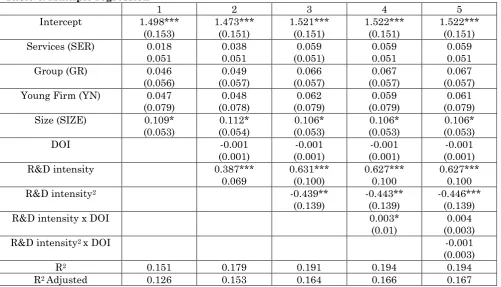
Table 4 highlights the different models. In particular, the former includes the control variables; the second includes predictive variables to evaluate the main effects; the
third and fourth include the quadratic term of the R&D and DOI intensity respectively; finally, the fifth includes all the variables considered.
Table 4: Multiple regression
1 2 3 4 5
Intercept 1.498***
(0.153) 1.473*** (0.151) 1.521*** (0.151) 1.522*** (0.151) 1.522*** (0.151) Services (SER) 0.018
0.051 0.038 0.051 (0.051) 0.059 0.059 0.051 0.059 0.051 Group (GR) 0.046
(0.056) (0.057) 0.049 (0.057) 0.066 (0.057) 0.067 (0.057) 0.067 Young Firm (YN) 0.047
(0.079) (0.078) 0.048 (0.079) 0.062 (0.079) 0.059 (0.079) 0.061 Size (SIZE) 0.109*
(0.053) (0.054) 0.112* (0.053) 0.106* (0.053) 0.106* (0.053) 0.106*
DOI -0.001
(0.001) (0.001) -0.001 (0.001) -0.001 (0.001) -0.001 R&D intensity 0.387***
0.069 0.631*** (0.100) 0.627*** 0.100 0.627*** 0.100
R&D intensity2 -0.439**
(0.139) -0.443** (0.139) -0.446*** (0.139)
R&D intensity x DOI 0.003*
(0.01) (0.003) 0.004
R&D intensity2 x DOI -0.001
(0.003)
R2 0.151 0.179 0.191 0.194 0.194
R2 Adjusted 0.126 0.153 0.164 0.166 0.167
Significance levels: *p < 0.05; **p < 0.01; ***p < 0.001;
As is evident, the 5 models are statistically significant (p <0.001). Among the different models, model four is the one that has the most significant improvements (p <0.05) compared to the others. Therefore, we use model 4 to test our research hypotheses. Hypothesis 1 suggests that the intensity of R&D has a negative inverted U-shaped impact on the company's performance.
David K. Chalmers et. al. | International Journal of Advances in Management and Economics | 2020| Vol. 09| Issue 03| 39-48
In this regard, models 4 and 5 show that research and development activities have a positive and significant impact (p <0.05), also indicating an insignificant level of interaction (p> 0.05). In particular, the increase in DOI produces a positive impact up to a certain level. To verify the solidity of the results and the inverted U-shaped relationship, we verified the regression behavior by dividing the data into two sets. The test confirmed our results by highlighting a positive relationship to the optimal point and a negative relationship afterward.
Conclusions
The purpose of this research is to study the impact of research and development on the performance of SMEs operating in non-high-
tech sectors, also considering the impact of internationalization. This research topic is still little explored by literature. A sample of Italian SMEs was chosen to develop the survey.
The European Commission definition was used to identify SMEs. Company data was extracted from the Amadeus database. From the whole population, we extracted a probabilistic sample based on stratified random sampling design, in order to improve the efficiency of the estimates and ensure the representativeness of the extracted sample.
The collection and information of the data were carried out through a questionnaire, allowing the collection of updated data and information. The approach used is consistent with that used by other scholars (Alegre et al., 2013; Bresciani and Ferraris, 2016; Tang et al., 2018). The layout of the questionnaire was designed and implemented with the SurveyMonkey program, in order to make the paper version of the questionnaire uniform. 128 companies participated in the research, equal to 25.6% of the total sample. The results show that non-high-tech SMEs that invest in research and development obtain performance benefits up to an optimal level of investment. These empirical results suggest that investing in research and development is convenient even for non-high-tech SMEs within certain optimal levels. Furthermore, the results also suggest that internationalization can improve performance.
This research contributes to the existing literature on the relationships between
research and development, internationalization, and performance. In addition, empirical results can help SME owners and managers to orient investments towards optimal values. Finally, the results can also be useful for policy-makers to guide incentives and support for research and development activities.
References
1. Zahra SA, George G (2002) Absorptive capacity: A review, reconceptualization, and extension. Academy of Management Review, 27(2):185-203.
2. Felício JA, Meiduté I, Kyvik O (2016) Global mindset, cultural context, and the internationalization of SMEs, Journal of Business Research, 11:4924-4932.
3. Geroski P, Makin S, van Reenen J (1993) the profitability of Innovating Firms, Rand Journal of Economics, 24(2):198-211.
4. Roper S, Hewitt-Dundas N (1998) Innovation, Networks and The Diffusion of Manufacturing Best Practice a Comparison of Northern Ireland and the Republic of Ireland, Centre’s research programme on Innovation and Industrial Change supported by the Department of Economic Development, Northern Ireland.
5. Dosi G (1988) Sources, procedures, and microeconomic effects of innovation, Journal of Economic Literature, 1120-1171.
6. Stam E, Wennberg K (2009) the roles of R&D in new firm growth. Small Business Economics, 33(1):77-89.
7. Cohen WM (2010) Chapter 4 - Fifty years of empirical studies of innovative activity and performance, B.H. Hall, N. Rosenberg (Eds.), Handboo k of the economics of innovation, volume 1 of Handbook of the Economics of innovation, 129-213. (North-Holland). 8. Ren S, Eisingerich AB, Tsai HT
9. De Jong JPJ, Freel M (2010) Absorptive capacity and the reach of collaboration in high technology small firms, Research Policy, 39(1):47-54.
10. Coad A, Segarra A, Teruel M (2016) Innovation and firm growth: Does firm age play a role?, Research Policy, 45(2):387-400.
11. Griliches Z (1979) Issues in assessing the contribution of research and development to productivity growth, The Bell Journal of Economics, 92-116. 12. Rosenberg N (1990) Why do firms do
basic research (with their own money)?, Research Policy, 19(2):165-174.
13. Mairesse J, Mohnen P (2002) Accounting for innovation and measuring innovativeness: An illustrative framework and an application, The American Economic Review, 92(2):226-230.
14. Ozer M, Dayan M (2015) Strategic, organizational and operational challenges of product innovation in emerging economies, Journal of Global Scholars of Marketing Science, 25(1): 5-16.
15. Lee H, Kelley D, Lee J, Lee S (2012) SME Survival: The Impact of Internationalization, Technology Resources, and Alliances, Journal of Small Business Management, 50 (1):1-19. 16. Ling Y, Simsek Z, Lubatkin MH, Veiga
JF (2008) Transformational leadership's role in promoting corporate entrepreneurship: Examining the ceo-tmt interface, Academy of Management Journal, 51(3):557-576.
17. McCann P, Ortega-Argilés R (2016) Smart specialisation, entrepreneurship and SMEs: issues and challenges for a results-oriented EU regional policy, Small Business Economics, 46(4):537-552. 18. Hossain M, Kauranen I (2016) Open innovation in SMEs: a systematic literature review, Journal of Strategy Management, 9(1):58-73.
19. Müller E, Zimmermann V (2009) the importance of equity finance for R&D activity, Small Business Economics, 33(3):303-319.
20. Nunes PM, Serrasquieiro Z, Leitão J (2012) is there a linear relationship between R&D intensity and growth?
Empirical evidence of non-high-tech vs. high-tech SMEs, Research Policy, 41 (1)36-53.
21. De Jong JPJ, Marsili O (2006) the fruit flies of innovations: A taxonomy of innovative small firms. Research Policy, 35(2):213-229.
22. Grimpe C, Sofka W (2009) Search patterns and absorptive capacity: Low- and high-technology sectors in European countries. Research Policy 38(3):495-506. 23. Whittaker DH (2016) Assembling
capabilities for innovation: Evidence from New Zealand SMEs. International Small Business Journal, 34 (1):123-143.
24. McEvily B, Zaheer A (1999) Bridging ties: A source of firm heterogeneity in competitive capabilities. Strategic Management Journal, 20(12):1133-1156. 25. Hervas-Oliver JL, Albors-Garrigós J, de-Miguel B (2012) the role of a firm’s absorptive capacity and the technology transfer process in clusters: How effective are technology centres in low-tech clusters? Entrepreneurship & Regional Development: An International Journal, 24(7-8):523-559.
26. Hoffman K, Parejo M, Bessant J (1998) Small firms, R&D, technology and innovation in the UK: A literature review. Technovation, 18 (1):39-55. 27. Jones MV (1999) the
internationalization of small high-technology firms, Journal of International Marketing, 7(4):15-41. 28. Del Monte A, Papagni E (2003) R&D and
growth of firms: Empirical analysis of a panel of Italian firms, Research Policy, 32 (6):1003-1014.
29. Lee SM, Lim S (2009) Entrepreneurial orientation and the performance of service business. Service Business, 3 (1):1-13.
30. SBA, Small Business Act for Europe (2018) Fact sheet, Italy, European Commission.
David K. Chalmers et. al. | International Journal of Advances in Management and Economics | 2020| Vol. 09| Issue 03| 39-48
International Journal of Advances in Management and Economics, 7 (4):20-33. 32. Kalinic I, Forza C (2012) Rapid internationalization of traditional SMEs: Between gradualist models and born globals, International Business Review, 21 (4):694-707.
33. Alegre J, Sengupta K, Lapiedra R (2011) Knowledge management and innovation performance in a high-tech SMEs industry, International Small Business Journal: Researching Entrepreneurship, 31 (4):454-470.
34. Bresciani S, Ferrari A (2016) Innovation-receiving subsidiaries and dual emblendness: impact of business performance, Baltic Journal of Management, 11 (1):108-130.
35. Tang C, Tang Y, Su S (2019) R&D internationalization, product diversification and international performance for emerging market enterprises: An empirical study on Chinese enterprises, European Management Journal.
36. Cohen WM, Levinthal DA (1990) Absorptive capacity: A new perspective on learning and innovation, Administrative Science Quarterly, 35 (1):128-152.
37. Beneito P (2003) Choosing among alternative technological strategies: An empirical analysis of formal sources of innovation, Research Policy, 32(4):693-713.
38. Rogers M (2004) Networks, firm size and innovation, Small Business Economics, 22 (2):141-153.
39. Becheikh N, Landry R, Amara N (2006) Lessons from innovation empirical studies in the manufacturing sector: A systematic review of the literature from 1993-2003, Technovation, 26 (5):644-664. 40. Eisingerich AB, Rubera G, Seifert M
(2009) Managing service innovation and interorganizational relationships for firm performance, Journal of Service Research, 11(4): 344-356.
41. Ortega-Argilés R, Piva M, Potters L (2010) is corporate R&D investment in high-tech sectors more effective? Contemporary Economic Policy 28 (3):353-365.
42. Rammer C, Czarnitzki D, Spielkamp A (2009) Innovation success of non-R&D-performers: Substituting technology by management in SMEs, Small Business Economics, 33 (1):35-58.
43. Hall BH (2002) the financing of research and development, Oxford Review of Economic Policy, 18(1): 35-51.
44. Booltink LWA, Saka-Helmhout A (2019) The effects of R&D intensity and internationalization on the performance of non-high-tech SMEs, International Small Business Journal: Researching Entrepreneurship, 36(1):81-103.
45. Hamel G (2000) Leading the Revolution, Harward Business School Press.
46. Rosenbusch N, Brinckmann J, Bausch A (2011) Is innovation always beneficial? A meta-analysis of the relationship between innovation and performance in SMEs, Journal of Business Venturing, 26:441-457.
47. O’Dwyer M, Gilmore A, Carson D (2009) Innovative marketing in SMEs: a theoretical framework, European Business Review, 21 (6):504-515.
48. Damanpour F (1991) Organizational Innovation: A Meta-Analysis of Effects of Determinants and Moderators, the Academy of Management Journal, 34 (3):555-590.
49. Golovko E, Valentini G (2011) exploring the complementarity between innovation and export for SMEs’ growth, Journal of International Business Studies, 42 (3):362-380.
50. Pangarkar N (2008) Internationalization and performance of small- and medium-sized enterprises, Journal of World Business, 43 (4); 475-485.
51. Knight GA, Cavusgil ST (2004) Innovation, organizational capabilities, and the born-global firm, Journal of International Business Studies, 35:124-141.
52. Filatotchev I, Piesse J (2009) R&D, internationalization and growth of newly listed firms: European evidence, Journal of International Business Studies, 40 (8):1260-1276.
differential roles of innovativeness, proactiveness, and risk-taking, Journal of Business Venturing, 29(4):511-524. 54. Lachenmaier S, Wößmann L (2006) Does
innovation cause exports? Evidence from exogenous innovation impulses and obstacles using German micro data, Oxford Economic Papers, 58(2):317-350. 55. Kafouros M, Buckley PJ, Sharp JA,
Wang C (2008) the role of internationalization in explaining innovation performance, Technovation, 28(1-2):63-74.
56. Love J, Ganotakis P (2013) Learning by exporting: Lessons from high-technology SMEs', International Business Review, 22(1):1-17.
57. Blind K, Jungmittag A (2004) Foreign Direct Investment, Imports and Innovations in the Service Industry, Review of Industrial Organization, 25 (2):205-227.
58. Lu JW, Beamish PW (2006) SME internationalization and performance: Growth vs. profitability, Journal of International Entrepreneurship, 4:27-48. 59. Musteen M, Francis J, Datta DK (2010)
the influence of international networks on internationalization speed and performance: A study of Czech SMEs. Journal of World Business 45 (3):197-205.
60. Teixeira AAC, Santos P, Delgado AP (2013) International regional patterns of R&D networks involving low tech SMEs, Journal of Technology Management & Innovation, 8 (2):1-20.
61. Cicchitelli G, Herzel A, Montanari GE (1997) Il campionamento statistico, Il Mulino, Bologna Frosini B, Montinaro M, Nicolini G (1994) Il campionamento da popolazioni finite, Il Mulino, Bologna.
62. Falk M (2012) Quantile estimates of the impact of R&D intensity on firm performance. Small Business Economics, 39 (1):19-37.
63. Shankar V (2012) Marketing strategy and firm value, Shankar, V, Carpenter, GS (eds) Handbook of Marketing Strategy, Edward Elgar Publishing, 415-439.
64. Tyler BB, Caner T (2016) new product introduction below aspirations, slack and R&D alliances: A behavioural perspective, Strategic Management Journal, 37 (5):896-910.
65. Hawawini G, Subramanian V, Verdin P (2003) is performance driven by industry or firm-specific factors? A new look at the evidence, Strategic Management Journal, 24 (1):1-16.