]
International Journal of Advances in Management, Economics and Entrepreneurship
Available online at: www.ijamee.info
RESEARCH ARTICLE
An Exploratory Study of Culture and Entrepreneurial Behaviour
of Muslim Women Managers: What is Their Impact on Business
Performance? The Case of Morocco
Fatima-Zohra Abousaïd
1*, Khadija Angade
2Laboratory Research in Business Performance of Organizations and Social Economy (MAPESS)/ ENCG
Agadir, Morocco.
*Corresponding Author: Email: [email protected]
Abstract:
This paper explores an under-investigated topic in the management sciences field, which isthe relationship of cultural context, entrepreneurial behaviour and firm performance, especially about women in emerging contexts. This exploration was realised through a qualitative data analysis, from both documentary study and semi-directive interviews with a sample of Moroccan women managers. In fact, highlighting cultural factors remains important to best understand the women’s entrepreneurial behaviour and assess their firm performance. The findings of this exploratory study show that cultural impasses affect negatively the entrepreneurial behaviour of women managers, thus it has a negative influence on the firm performance. In conclusion, practical implications of this study are discussed to increase the companies’ awareness of the implementation of gender proactive policies, in order to ensure the Moroccan women’s empowerment.
Keywords: Culture, Entrepreneurial behaviour, Muslim women managers, Cultural gender inequalities, Business performance, Morocco.
Article Received: 30 July 2018 Revised: 10 August 2018 Accepted: 22 August 2018
Introduction
In the management field, different topics related to entrepreneurial behaviour and firm performance have been discussed [1-4]. Indeed, Jones et al. suggest that improving entrepreneurial competencies of young students (16-19 secondary school ages) will conduct to highlight their entrepreneurial behaviour, thus may motivating them to start their businesses [1]. For Zahra, the firm’s growth-strategy is positively correlated to the intensity of entrepreneurial behaviour [4].
In turn, Lumpkin and Dess emphasised the critical relationship between entrepreneurial behaviour and firm's profitability [3]. Their results are consistent with Kellermanns et al. who found that some factors related to family firms could influence entrepreneurial behaviour and subsequent business performance [2].
However, to the authors’ knowledge, the relationship between culture, entrepreneurial behaviour and firm performance has not been explored yet, especially about women in
emerging contexts. Effectively, one of the most covered topics is related to the problematic of women’s emancipation, because of the gender stereotypes they face in all over the areas [5, 6].
Therefore, the context could be a real obstacle to develop a firm and reach the individuals’ objectives [7, 8]. According to the recent Moroccan General Population and Housing Census 2014, out of the 11 548 464 total employed population, only 2 517 691 are women, representing a rate of 20.4%. In parallel, 29.6% of the total unemployed population are women, while men represent just 12.4%.
Furthermore, the JICA’s study results show that 64% of Moroccan are persuaded that women work outside their residency has a negative impact on the children’s education; and 54% judge that men are best managers than women [9].
From this observation, a governmental strategy has been launched, in 2006, for the Moroccan women’s emancipation in all sectors. Notwithstanding, national survey studies provide the same constant than international research [10-14], that of the low presence of women in the highest positions in companies. If they were, women managers occupy support positions in the company’s board. Indeed, the relevance of the gender indicator determined by the World Bank emphasizes that Moroccan women are vastly underrepresented in decision-making positions at the top level in the private sector [15].
The World Bank stressed that economic losses occur when the female workforce is discriminated and underemployed, which prevents them from completing their education, exercising certain professions, and getting the same pay as men [16]. Therefore, limiting women's access to positions of responsibility has a negative impact on the economic growth. Subsequently, it remains unclear why women managers in different contexts are struggled to achieve their socioeconomic ascension, in spite of their relevant managerial and entrepreneurial skills.
Hence, the purpose of this study is to give an empirical start for the theorization of the relationship between culture, entrepreneurial behaviour and firm performance. Through an exploration of the different cultural impasses women face in the Moroccan context and its consequences on the firm performance, this paper aims to reveal the reasons to the lower representation of women in the decision-making positions.
The paper is structured into three main parts. First, an overview of the problematic and the related questions is presented. Second, the research methodology highlights both the documentary study and the interviews analysis. Third, the main results are discussed and propositions for future research are drawn.
The Problematic and Questions
All over the world, before the last two decades, “women did not have the right to vote, they were excluded from education, they were not just paid for their work, and had no voice in politics, and even the first Olympic Games not included women”, Watson (2016)1. In 2009, only 13 of the 500th largest companies in the world had a female CEO, that represented only 2.6% [11].
This report also refers that few women occupy the higher position of decision making, in 33 European countries. Moreover, women chaired the board of directors in only three countries, namely Bulgaria, Slovakia and Norway. Whereas, men are the Chairman of all listed companies in 2009 into 16 of the 33rd countries. Consequently, women are still underrepresented in the highest positions of decision making in most developed regions [11].
The same situation occurs in developing regions, such as the Middle East and North Africa (MENA), although statistical data is not sufficient to confirm or refute this hypothesis [11]. In these societies, the patriarchal system governs and limits women's functions to archaic traditions, e.g. the home maintenance, the procreation of male children (preferably) and the children’s education [17-19]. Men are responsible for ensuring food and materials to the household [20], while women are born to take care of their husband and children. In most regions of MENA, women are still deprived of their elementary right to education [7].
In parallel, it is a challenge for more than 30% of active women in MENA to find employment, compared with men [16]. In Morocco, women live the same situation in a patriarchal society characterised by traditions and mores [17, 19]. They were generally excluded from many social and cultural activities, qualified as a “masculine job” [19, 20].
However, if they were, they could not achieve their empowerment or accede to the top management positions [5, 17, 21]. Despite the
1 Watson Emma is the United Nations Women Goodwill
Moroccan women’s emancipation after the Independence period , when mentalities began changing, women still face difficulties to gain responsible positions in the professional and political arenas [19, 22]. In fact, Moroccan women have always worked on highly repetitive tasks, like administrative or social jobs; while men have the most mobile, decision making and operational jobs [5, 22]. For that reason, women managers have difficulty in adopting an entrepreneurial behaviour, by taking risks and discovering new opportunities, to improve the firm performance [21, 23]. Thus, culture is being considered as a discriminated factor for women managers in Morocco, who suffer cultural problems that leave them less productive and motivated. So, it is important to investigate on this problematic, since contextualized studies remain insufficient to analyse the situation in depth. Furthermore, to the authors’ knowledge, the relationship between the cultural dimension and its impact on the entrepreneurial behaviour of women managers and the firm performance has not been documented at all and no empirical study has been conducted thus far.
Consequently, this paper tries to conceptualise the impact of the cultural dimension on the female entrepreneurial behaviour and the firm performance, by answering the following questions:
What are the cultural hurdles that impede the women managers’ empowerment? How do women managers perceive their
entrepreneurial behaviour and its impact on firm performance?
Is there any significant correlation between cultural barriers, entrepreneurial behaviour and firm performance?
Research Methodology
An exploratory study was conducted to contextualise the relation between the Moroccan culture, the women entrepreneurial behaviours, and its impact on firm performance. In fact, this paper focuses on a qualitative research, in order to construct a conceptual model from primary and secondary data.
On the one hand, the primary data were collected from semi-directive interviews with a sample of 12 Moroccan women managers in
different sectors. Samples were selected based on three criteria.
Firstly, Leedy and Ormrod recommend that interviewing between 5 and 25 individuals is sufficient to collect and analyse qualitative information [24]. Secondly, the interviewees are women managers who inspire to the highest level in companies.
So, they are selected due to their entrepreneurial behaviour, their determination to effectively contribute to the firm performance and their availability to respond to this study. Thirdly, the qualitative information is gathered according to the “saturation” method [25], which means that the interviewer stopped interviewing individuals when the information began to be repeated. The initial number of the women managers’ interviewees was established at 20, but it reaches saturation point within twelve interviews, which is similar to the results of Guest et al. [25].
The Interview Guide was Divided Into Three Domains of Inquiry
Cultural impasses faced by Moroccan women managers;
Entrepreneurial behaviour perceived by women and its relation with the cultural factors;
Business performance assessed by women when they encounter cultural impasses. On the other hand, a documentary study was realized from many sources, such as academic research, historical comparative research, national documents and reports [26].
Therefore, the Study Targeted
Historical books related to the Moroccan culture;
National reports and studies about the Moroccan women’s situation;
The last Moroccan General Population and Housing Census.
entrepreneurial behaviours in the Moroccan context.
Result and discussion
The selected method to analyse this qualitative study is the “Content Analysis” method. Leedy and Ormrod define this method as “a detailed and systematic examination of the contents of a particular body of materials for the purpose of identifying patterns, themes, or biases” (p. 155) [24].
Therefore, this paper used the “Content Analysis” to analyse the semantic field of both the interviews and the documentary study - such as the language used, the occurrence’s number of words or phrases, …etc. - in order to classify the data into interpretable themes [28, 30]. In light of this analysis, it is possible to identify four propositions, which can be tested in an empirical in-depth study.
The Moroccan Culture
Analysing the historical documents about the Moroccan context showed that the emancipation of women has emerged because of the socio-economic and cultural changes Morocco has known, throughout the independence period [19, 22]. Indeed, the integration of women in the modern active life has become a necessity and an economic need nowadays [31].
In Morocco, culture is summarised in a set of mores and values, which were represented into three antagonistic and contradictory models: a) the Modernist vision with the feminisation of society; b) the Islamist vision, which requires a return to the ancestral sources; c) and the societal vision, which mitigates the “Islamisation” because of the social upheavals [20].
The results of the documentary analysis highlight three core values, which seem to be particularly important for understanding the women’s position in the Moroccan culture. These values are the logic of authority, the children’s socialisation, and the right to education. To begin with the logic of authority, the Moroccan culture stresses that husbands have the obligation to maintain the entire family and household; while wives are supposed to submit to the male authority as recognition’s expression [19, 20].
Nevertheless, men interpreted this sign of respect as an obligation for women to obey their husband [31]. Therefore, this principle of obedience has been the corollary of the concept of authority and it is becoming common to read, in some religious writings, that “the path to paradise for a woman is through the obedience to her husband” [32]. The second value consists on the children’s socialisation, that is to say that Moroccan children grow up into a traditional patriarchal education [22].
Because of this education, boys want to become authoritarian and respected fathers, while girls will be obeisant wives and accomplished mothers [20, 22]. Besides, the majority of Moroccan parents prefer boys than girls, since boys will honor them by providing valuable financial assistance; unlike daughters who are expected to leave their home to join the marital home [19, 20, 22]. In this context, there is a Moroccan proverb that says “When a boy is born, he brings the khaïma2 with him; but when a daughter is born, a khaïma falls”.
The third cultural value is the right to education, which includes the children’s schooling, the adult literacy and the home education. The historical data illustrate a shocking situation about the education in Morocco [19]. Between 1968 and 1975, approximately 100 women were graduated. El Khayat asserts that parents always sacrifice the little girls’ life, either by prohibiting them from attending formal schools, according to their ancestral beliefs, or by sending them to cities for working as domestics [19].
Nevertheless, national reports underline nowadays that the access to primary education is quasi-generalised, on the one hand [33]. On the other hand, education is a fundamental right for all citizens, guaranteed by the Moroccan Constitution [23]. Yet, Moroccan men benefit from education opportunities more than women, despite the literacy declination’s rate from 43.0% in 2004 to 32.0% (41.9% for women versus 21.1% for men) in 2014 [33].
2 In the true sense, “Khaïma” means a tent. However, in this
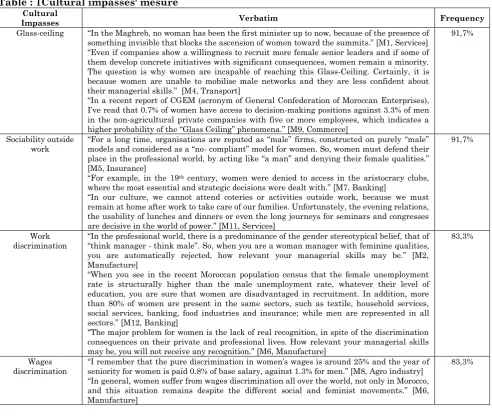
The Cultural Impasses’ Measurement The qualitative data have outlined the negative effect Moroccan traditions can manifest in the evolution of the women’s situation. In spite of being more active in the socio-economic life, Moroccan women are underrepresented in male-dominated sectors and their ascent to the responsibility’s positions faces cultural impasses, which delay their effective contribution to the firm performance [18, 21].
These cultural impasses are summarised in the Table below, according to the documentary analysis and the interviewees’ point of view. The majority of the respondents stressed the negative impact of the cultural dimension on their entrepreneurial behaviour and their productivity, with a particular emphasis upon the “Glass-Ceiling” barrier that prevents them from reaching the summit positions in the company. Concomitantly, research introduced two new terms in this subject.
The first one is the “Glass Box” concept, which alludes to all stakeholders, that women interact constantly with, who hinder their ascension from all sides [10, 34]. That said, the result of the complex interaction between organizational processes and women’s strategies leads women to protect themselves through a subtle construction made of prejudice; this is what authors called the “Glass Box”. The second concept is called the “Sticky-floor”, which illustrates the belief of an employee that he/she is condemned not evolve and stay blocked definitely in its current position in the company [14]. In fact, Yap and Konrad reported that women are particularly affected by this “sticky-floor” syndrome, because of their lack of self-confidence and motivation that keep them in the lower functions [14].
Consequently, the first proposition related to the cultural factors is:
Proposition 1
Cultural impasses will affect negatively the entrepreneurial behaviour of women rather than men.
Table : 1Cultural impasses' mesure
Cultural
Impasses Verbatim Frequency
Glass-ceiling “In the Maghreb, no woman has been the first minister up to now, because of the presence of something invisible that blocks the ascension of women toward the summits.” [M1, Services] “Even if companies show a willingness to recruit more female senior leaders and if some of them develop concrete initiatives with significant consequences, women remain a minority. The question is why women are incapable of reaching this Glass-Ceiling. Certainly, it is because women are unable to mobilise male networks and they are less confident about their managerial skills.” [M4, Transport]
“In a recent report of CGEM (acronym of General Confederation of Moroccan Enterprises), I’ve read that 0.7% of women have access to decision-making positions against 3.3% of men in the non-agricultural private companies with five or more employees, which indicates a higher probability of the “Glass Ceiling” phenomena.” [M9, Commerce]
91,7%
Sociability outside
work “For a long time, organisations are reputed as “male” firms, constructed on purely “male” models and considered as a “no- compliant” model for women. So, women must defend their place in the professional world, by acting like “a man” and denying their female qualities.” [M5, Insurance]
“For example, in the 19th century, women were denied to access in the aristocracy clubs,
where the most essential and strategic decisions were dealt with.” [M7, Banking]
“In our culture, we cannot attend coteries or activities outside work, because we must remain at home after work to take care of our families. Unfortunately, the evening relations, the usability of lunches and dinners or even the long journeys for seminars and congresses are decisive in the world of power.” [M11, Services]
91,7%
Work
discrimination “In the professional world, there is a predominance of the gender stereotypical belief, that of “think manager - think male”. So, when you are a woman manager with feminine qualities, you are automatically rejected, how relevant your managerial skills may be.” [M2, Manufacture]
“When you see in the recent Moroccan population census that the female unemployment rate is structurally higher than the male unemployment rate, whatever their level of education, you are sure that women are disadvantaged in recruitment. In addition, more than 80% of women are present in the same sectors, such as textile, household services, social services, banking, food industries and insurance; while men are represented in all sectors.” [M12, Banking]
“The major problem for women is the lack of real recognition, in spite of the discrimination consequences on their private and professional lives. How relevant your managerial skills may be, you will not receive any recognition.” [M6, Manufacture]
83,3%
Wages discrimination
“I remember that the pure discrimination in women’s wages is around 25% and the year of seniority for women is paid 0.8% of base salary, against 1.3% for men.” [M8, Agro industry] “In general, women suffer from wages discrimination all over the world, not only in Morocco, and this situation remains despite the different social and feminist movements.” [M6, Manufacture]
Lack of networking “To succeed in business, the philosophy is “who you know”, neither than “what you know”. Nevertheless, the challenge for women is where to find the right support network, because they have fewer opportunities to develop networking relationships.” [M2, Manufacture] “Informally, it is clear that Moroccan women lack access to many settings frequented by potential networks, such as men's clubs and sports activities.” [M11, Services]
75%
Mentoring problem “I think that some women cannot approach someone of the same sex, because of the fear of the gender expectations and the fewer opportunities to meet mentors.” [M10, Commerce] “Mentoring is essential to support women when they must talk business with mainly male managers; because they have to adopt “male” stereotypical attitudes, by becoming, for example, aggressive and too severe.” [M5, Insurance]
75%
Work-life balance “In Morocco, women encounter difficulties to find their work-life balance, because of the absence of childcare, the lack of work sharing between couples, the exigent attitude of husbands in respect of activities outside work, the internalized fears and prohibitions of women.” [M3, Manufacture]
“Work-life balance should be improved, through affordable infrastructures of childcare and a flexible organisation of work.” [M9, Commerce]
“There is a strange phenomenon in the workplace: more men have children, more they have access to higher status in the company; which does not apply to women who are penalized with the family tasks.” [M7, Banking]
75%
Politics perception “When I talk with my female colleagues about politics, the statement is the same: they are convinced that following a political path will put their families’ members in danger. Moreover, we are aware that the society considers women as unable to defend the country interests.” [M4, Transport]
“In my point of view, the main reasons that hinder women to access to political careers are: the type of the electoral method or the quotas system, the lack of financial support from the sponsors, the adaptation of several political institutions according to male standards, and the lack of coordination and support between women's organizations and NGOs.” [M6, Manufacture]
33,3%
Media perception “I am terribly angry when I see how women are represented by media. The fact of highlighting women’s physical skills rather than their mental faculties conducts to deepen patriarchal stereotypes that qualified women as the “weaker sex”.” [M3, Manufacture] “Media show most of the time that women’s role is limited to the procreation and the children’s education. Thus, the gender biases are emphasised and women are accused to be the principal responsible for social problems, such as the growth of divorce or juvenile crime.” [M11, Services]
33,3%
Lack of education “In Morocco, investing in women’s schooling was considered as time and money losses, in some traditional regions, because they end up getting married and taking out the acquired skills in their new families. Unfortunately, in spite of the society’s mutation, the women’s education did not, in general, allow them higher positions in companies.” [M10, Commerce] “It goes without saying that education will help women to wisely manage their private life, by avoiding getting married at an early age, controlling jointly their family’s size and best educating their children.” [M8, Agro industry]
25%
Note: The respondents were codified for confidentiality and pertinence reasons (e.g. [M1, services] refers to the first Moroccan women manager interviewed and her company sector …etc.)
The Entrepreneurial Behaviour
First of all, entrepreneurial behaviour is defined as “opportunistic, value-driven, value-adding, creative activity where ideas take the form of organizational birth, growth, or transformation” (page 37) [35]. In this context, entrepreneurial behaviour is related to the enterprise's development and growth. Indeed, managers are supposed to adopt an entrepreneurial behaviour, characterised by innovation, risk-taking and proactiveness [36, 37], to ensure a high-level of productivity and growth [3, 38].
According to half of the interviewees, Moroccan women managers are aware of the positive consequences of adopting an entrepreneurial behaviour, to reach an optimal performance: “I think that any employee in the enterprise should improve its proactiveness and its ability to explore opportunities, in order to be more implicated in the development enterprise process.”
[M3, Manufacture] “Adopting an entrepreneurial behaviour is necessary for a woman manager to improve her chance to be more creative and productive than a man manager.
In other words, she will be able to detect opportunities and anticipate environment and social changes, due to its entrepreneurial behaviour.” [M12, Banking] Nonetheless, the other respondents thought that it is possible to develop the company, without introducing new products or new methods, even without especially taking risks:“When we talk about innovation, we are not obliged to innovate throughout the entrepreneurial process.” [M11, Services] “Sometimes, maintaining an optimal level of production is sufficient for the firm’s durability. No risk-taking is essential for this
Indeed, you must be able to manage the employees, to coach them and to generate enthusiasm; this is the key to an optimal business performance.” [M4, Transport] In consonance with the interviewees’ reaction, the second proposition could be as following: Proposition 2
Entrepreneurial behaviour could have a positive impact on firm performance.
That said, all respondents were convinced that the cultural hurdles Moroccan women face in the enterprise have a negative impact on their motivation. Moreover, they thought that there is a direct relationship between cultural factors and entrepreneurial behaviour. In their opinion, women managers lose their proactiveness and innovativeness at the time their empowerment is hindered: “I am a risk-taker woman, with a strong willingness to explore new opportunities.
However, the lack of potential networking blocks me to reach my objectives. So, I prefer doing my job traditionally, without an entrepreneurial behaviour.” [M5, Insurance] “My behaviour into the company depends on my work-life balance. I have worked in a firm with a childcare structure; thus having permitted me to concentrate on the company’s development.
Therefore, I have succeeded in making major innovation in the company’s process, which became more flexible and proactive.” [M12, Banking] “When you encounter a “Glass-Ceiling” in the company, whatever you have an entrepreneurial behaviour, your performance will be less important and sufficient.” [M1, Services] Therefore, the third proposition about this exploratory study is the following:
Proposition 3
Cultural impasses will be negatively related to entrepreneurial behaviour.
The Impact of the Cultural Dimension on Business Performance
Taking as a whole, the notion of performance encompasses several facets, such as the financial performance, the commercial performance, the performance of human resources…etc. [39-41]. Therefore, this paper focuses on the relationship between the women presence in the company and the firm performance in general.
The interviews’ analysis emphasised the affluence of agreement on this subject. The myriad cultural obstacles Moroccan women face leads to decrease the productivity rate realised by women, because of their lack of motivation [5].
Consequently, the business performance is not attained and the stereotypes about women’s managerial skills persist, as two respondents stressed: “I am always in a competition with my men colleagues; because they are convinced that I am not a capable manager. Unfortunately, when the business performance is not reached, I am pointed at, whispered about, and discriminated against.” [M2, Manufacture]; [M5, Insurance] Furthermore, the interviewees discussed the strengths of the diversity concept and its effective role to reach an optimal performance. Isnard defines this notion of diversity as the company’s ability to employ a heterogeneous workforce, involving them to their maximum potential [42].
On the one hand, according to the documentary study, the key to an optimal performance is to ensure professional equality between men and women into leadership teams [6, 17, 33]. On the other hand, the women managers’ interviewees explained that diversity could provide better results to the company, due to the complementary between men and women’s innovation and creativity: “Most of the time, our female clients request an interaction with women decision-makers, who will better understand their needs and thus will adapt the company’s products or services to their expectations.” [M10, Commerce] “I believe that the management styles of men and women are complementary because the company needs to diversify its production to remain competitive in the market.
Thus, the enterprise will improve its performance by recruiting high-potential women and increasing its efficiency.” [M7, Banking] “Nowadays, everybody is conscious of the imminent importance of the women management style, which is different but complementary to men. As you know, women managers are more emotional and sensitive to employees’ needs. Moreover, our feminine qualities - such as loyalty, attention or understanding – lead to better results in terms of performance related to human resources.”
[M1, Services] Finally, the interviewees suggested that companies should promote the professional equality by introducing proactive feminisation’s policies, to boost women motivation and reduce rates of absenteeism and turnover: “Gender inequalities could be corrected without affecting the cost price and the company's competitiveness. Better yet, removing this discrimination will help women to improve their entrepreneurial skills, in order to contribute effectively to the business performance.
So, I am persuaded that introducing policies related to the professional equality between women and a man does not represent an additional cost to the company.” [M9, Commerce] As a result, the women managers’ respondents assessed that male-dominated culture has a negative impact on women attempting to best perform in the company, hence the fourth proposition suggested is: Proposition 4
Cultural impasses will be negatively related to firm performance.
Conclusion
This paper provides two essential contributions to the management sciences field. Firstly, this study focuses on an emerging context, such as Morocco, when traditions representations and cultural perceptions remain deep-rooted in society. Hence, it represents a thorough comprehension about new contexts all over the world. Secondly, the paper allows new reflections about an unexplored topic, which is the inter-relationship of cultural context, entrepreneurial behaviour and firm performance. Therefore, it responds to recent calls that stress the necessity to integrate cultural factors to best understanding the entrepreneurial behaviour of women
managers. In this perspective, the findings of this exploratory study clearly show the negative impact of Moroccan culture on the women managers’ empowerment and their entrepreneurial behaviour; which leads to decrease the firm performance.
In fact, the manner in which women have been socialised has influenced their entrepreneurial behaviour and their managerial attitudes. Similar findings have been discussed in international studies, which stress that women are socialised to give more emphasis to family affairs and tend to maintain traditional domestic roles, in spite of their professional life [12, 43, 44]. However, Poggesi et al. found in their study that there is any family influence on business performance in Italian firms [45]. Hence, an in-deep quantitative study should be conducted in the Moroccan context, to test the propositions mentioned earlier. Based on the findings of this paper, establishing feminisation’s policies could be advantageous for both Moroccan companies and women managers. Indeed, all respondents of the interviews are convinced that Moroccan women managers suffer from the lack of proactive policies that encourage the professional equality between men and women into the company, and prioritise the women needs for a better work-life balance. To conclude, this paper can be considered as an empirical start to construct a general conceptual model about cultural factors and their implication into women’s entrepreneurial behaviour and firm performance. Thus, this research model could facilitate the theorisation of the women’s empowerment problematic. Finally, this study could contribute to
Enhancing Organisations Practices, by suggesting the Following
Men must be involved actively in protecting women's rights and gender equality.
Schools and universities must inculcate the equal values between boys and girls, and teach girls how to reach upper echelons. Companies should recognise mentoring
activities in the performance evaluations and even sponsor various events, such as networking breakfasts and weekend retreats, to increase the number of potential mentors.
measures to encourage the women’s participation in politics. For example, the introduction of political, institutional and financial guarantees could ensure the equal participation of women candidates in the election campaigns. Besides, schools and universities must create educational programs designed to prepare women for a political career.
Educational contents (books) must erase all stereotypes’ representation of men and women's role.
Families have to be equal in their children’s education, without forgetting that couples must share housework regularly to ensure their work-life balance.
References
1. P Jones, A Colwill (2013) "Entrepreneurship
education: an evaluation of the Young
Enterprise Wales initiative," Education+
Training, 55:911-925.
2. FW Kellermanns, K A Eddleston, T Barnett, A
Pearson (2008) "An exploratory study of family member characteristics and involvement: Effects on entrepreneurial behavior in the family firm," Family Business Review, 21:1-14.
3. GT Lumpkin, GG Dess (1996) "Clarifying the
entrepreneurial orientation construct and linking it to performance," Academy of management Review, 21:135-172.
4. SA Zahra (1993) "Environment, corporate
entrepreneurship, and financial performance: A taxonomic approach," Journal of business venturing, 8:319-340.
5. Centre for Strategy, Evaluation Services (2003)
Méthodes et indicateurs mesurant le rapport coût-efficacité des politiques de diversité en
entreprise. Available:
http://ec.europa.eu/social/BlobServlet?docId=143 9&langId=fr
6. Catalyst (2004) the bottom line: Connecting
corporate performance and gender diversity: Catalyst.
7. R Menhas, N Jabeen, S Akhtar, M Yaqoob
(2013) "Cultural Barriers of Female
Empowerment," Afro Asian Journal of
Anthropology and Social Policy, 4:1-10.
8. A Fayolle, F Liñán (2014)"The future of
research on entrepreneurial intentions,"
Journal of Business Research, 67:663-666.
9. M. Yuko, "The opportunities and challenges for
female labor force participation in Morocco Global Economy and Development," Working Paper 862015.
10. ML Belcourt, RJ Burke, H Lee-Gosselin (1991)
the glass box: Women business owners in Canada: Canadian Advisory Council on the Status of Women.
11. United Nations (2010 12/01/2017). The World's
Women (2010) Trends and Statistics. . Available:
https://unstats.un.org/unsd/demographic/produc
ts/Worldswomen/WW_full%20report_color.pdf
12. W Mekonnen Tadesse(2017)"Women in
management: Challenges and gaps in public
institutions in Ethiopia," Journal of
International Women's Studies,18:105-117.
13. ORSE (2004) "L’Accès des femmes aux postes de
décisions dans les entreprises: entre nécessité et opportunité, une problématique dans la perspective de la Responsabilité Sociétale des Entreprises," Études ORSE.
14. M Yap, AM Konrad (2009) "Gender and racial
differentials in promotions: Is there a sticky floor, a mid-level bottleneck, or a glass ceiling?,"
Relations Industrial’s/Industrial Relations,
64:593-619.
15. World Bank (2013) Moroccan firms with female
top manager Available:
http://data.worldbank.org/indicator/IC.FRM.FE MM.ZS?end=2013&locations=MA&start=2013& view=map
16. World Bank (2010) Middle East and North
Africa: Women in the Workforce. Available: http://www.worldbank.org/en/news/feature/2010 /03/10/middle-east-and-north-africa-women-in-the-workforce
17. SH Almaki, AD Silong, K Idris, NWA Wahat
(2016) "Effective University Leadership
Practices among Muslim Women Academic Leaders," International Journal of Education and Training (InjET), 2:1-14.
18. M Badran (2005) "Between secular and Islamic
feminism/s: reflections on the Middle East and beyond," Journal of Middle East women's studies, 1:6-28.
19. R El Khayat, Les femmes dans l(1992) Union du
Maghreb Arabe: Eddif Edition.
20. K Mohsen-Finan, Z Daoud, H Khélil, G
Mouffok, P Vermeren (2007) L’image de la femme au Maghreb: Actes Sud/MMSH/Barzakh.
21. M Karshenas, VM Moghadam, N Chamlou
policies, ed: World Scientific,1-30.
22. J Combe (2001) La condition de la femme
marocaine: Editions L'Harmattan.
23. HCP (2006) Prospectives 2030 : La Femme
marocaine sous le regard de son environnement
social. Available:
http://www.hcp.ma/La- Femme-marocaine-sous-le-regard-de-son-environnement-social_a837.html
24. P Leedy, J Ormrod (2001) "Practical research: Planning and research," Upper Saddle.
25. G Guest, Bunce A, Johnson L (2006) "How
many interviews are enough? An experiment with data saturation and variability," Field methods, 18:59-82.
26. D Akonkwa(2012) "Méthode de recherches en
sciences sociales et de gestion.
27. M Blais, S Martineau(2006) "L’analyse
inductive générale: description d’une démarche visant à donner un sens à des données brutes," Recherches qualitatives, 26:1-18.
28. MB Miles, AM Huberman, MA Huberman, M
Huberman(1994) Qualitative data analysis: An expanded sourcebook: sage.
29. C Williams(2011) "Research methods," Journal of Business & Economics Research (JBER),5.
30. JLL Del Bayle(1997) Initiation pratique à la
recherche documentaire: l'Harmattan.
31. B Maddy-Weitzman(2005) "Women, Islam, and
the Moroccan state: The struggle over the personal status law," The Middle East Journal,59:393-410.
32. A Lamrabet (2012) A propos du concept de
"l'autorité" de l'époux ou "Al-Quiwamah".
Available:
http://www.asma- lamrabet.com/articles/a-propos-du-concept-de-l-autorite-de-l-epoux-ou-al-quiwamah/
33. HCP (2014) Moroccan General Population and
Housing Census [Online]. Available:
http://rgphentableaux.hcp.ma/Home/
34. L Bereni, C Marry, S Pochic, A Revillard(2011)
"Le plafond de verre dans les ministères: regards croisés de la sociologie du travail et de la science politique," Politiques et management public,28.
35. BJ Bird(1989) Entrepreneurial behavior: Scott
Foresman & Company.
36. BR Barringer, AC Bluedorn(1999) "The
relationship between corporate
entrepreneurship and strategic management," Strategic Management Journal, 20:421-444.
37. RC Becherer, JG Maurer(1999) "The proactive
personality disposition and entrepreneurial behavior among small company presidents," Journal of small business management,37-28.
38. DF Jennings, SL Seaman(1994) "High and low
levels of organizational adaptation: An empirical analysis of strategy, structure, and performance," Strategic management journal, 15:459-475.
39. O de La Villarmois(2001) "Le concept de
performance et sa mesure: un état de l’art," Les Cahiers de la Recherche,1-21.
40. S Landrieux-Kartochian(2005) "Femmes et
performance des entreprises," Travail et emploi, 11.
41. Y Pesqueux(2004) "La notion de performance
globale," in La notion de performance globale.
42. C Isnard(2003) "La performance par la
diversité," revue Ressources humaines et Management, octobre,11:22-23.
43. L Galloway, W Brown, P Arenius(2002)
"Gender-based differences in entrepreneurial behaviour: A comparative examination of Scotland and Finland," The International Journal of Entrepreneurship and Innovation, 3:109-119.
44. P McGowan, CL Redeker, SY Cooper, K
Greenan(2012) "Female entrepreneurship and the management of business and domestic roles:
Motivations, expectations and realities,"
Entrepreneurship & Regional Development, 24:53-72.
45. S Poggesi, M Mari, L De Vita(2015) "Family and