ISSN-L: 2501 - 1235 Available on-line at: www.oapub.org/edu
doi: 10.5281/zenodo.1294085 Volume 4 │ Issue 7 │ 2018
THE CONSUMPTION CULTURE OF
SPORTS AND ENERGY DRINKS AND THEIR EFFECTS
ON THE ATHLETE’S HEALTH
Guergour Mohamed1,
Baouche Khaled2i,
Baizid Abdelkader2,
Laidani Hakim2
1Institute of sciences and techniques
of physical and sport activities, Tissemsilt University Center, Algeria
2Institute of sciences and techniques of
physical and sport activities, Bouira University, Algeria
Abstract:
The consumption of energy drinks has grown considerably in recent years by virtue of which it occupies the beverage market today, and promoted its ability to promote energy levels and vigilance. It contains caffeine as an essential ingredient and other substances such as chlorine, enositol and glucuronolactone. The aim of this study is to understand the views of athletes and their awareness of the impact of energy drinks on
tools. Materials: The questionnaire was used to include two axes, the first of which is
the knowledge of athletes' awareness of the difference between sports drinks and energy drinks. The second is the health problems caused by energy drinks for athletes.
Research methods: The descriptive approach and the study sample included 32 athletes
who were deliberately selected. Results: The results were as follows: Most athletes do
not realize the difference between drinkers and do not know the risks of energy drinks
to their health and the risks they may pose. Conclusion: The results of the studies today
are to sensitize and educate the athletes about what may cause these drinks problems on their health, and the athlete to take all the necessary precautions and know the perfect drink that covers the needs without compromising his health.
Keywords: sports drinks, energy drinks, health
1. Introduction
Athletes always look for what enables them to compete and helps them achieve the best they can. Thus, it is obvious that the best efficient way to develop the natural sports abilities is through good training and ideal nutrition. However, in order to achieve the best results from a training program, it matters taking into account the complementary elements and the other products, these all elements are energy supplements for the body.
Generally, the aim of the complementary is raising the level of performance, and specifically it is alleged that these elements lead to increased muscle tissue utilization, increased endurance, enhanced fat burning operation and increased strength. (1) Nevertheless, the surveys show that most of the athletes think that the complementary elements are main elements for sports success, for example, Dr. Michael Triner of the British Olympic Medical Committee stated that ¾ of Olympic athletes use a kind of elements that work on enhancing the performance, and it is sure that the use of complementary elements has increased significantly since 1980s. (2)
It should be noted that the choice between the large numbers of the proposed products can be a tough task for the athletes, it can be hard to define which of them is beneficial especially when watching the convincing advertisements, moreover, the manufacturers of these products may use the scientific researches excessively or selectively in an attempt to advertise a product, and the famous athletes’ witnesses are considered common tricks to advertise products.
International and global intention towards nutrition issues has increased. Thus, four global organizations following to united nations have been created in order to pay more attention to nutrition and remedy and prevent malnutrition, and also work on Spreading health awareness and food culture. As a result, developed countries started paying more attention to human nutrition issue after consulting scientists and interested researchers in health and nutrition fields because of the positive effects that nutrition can do in athletes’ life. However, Athletes as others can suffer from many problems related to malnutrition because they are not aware or don’t understand well many principles and methods of balanced nutrition, or as a result of body inability to fully benefit from metabolic processes. (3)
As a result, selecting sports drinks or energy drinks mostly happens according to the bottle forms or products companies advertising ability without paying attention to the aim to which those drinks were produced or their suitability to the nature of physical activity or the required amount to achieve the sought aim or the right timing to use them, which leads in many times to negative results that reflect on the athletes’ health.
2. Objectives
Uncover the correct bases and principles for athletes’ nutrition.
Exposing the suitable liquids and drinks for athletes.
3.Research Methods and Research Organization
After stating a general introduction and proposing the hypothesis according to what suits the research variables, in which we attempted to shed the light on what concerns the subject of the study which is about the operation of The consumption culture of sports and energy drinks and their effects on the athlete’s health, in this section, we will move to the practical side and do a field study aiming to achieving the previous planned aims and to what extent the hypotheses can be true.
3.1 Research Sample
An intentional sample of 32 athletes from 160 athletes was selected representing the total research community.
3.2 Research Tools
We used in this research the questionnaires then we analyzed it according to statistical operations that confirms the credibility of our research hypothesis
3.3The Followed Scientific Method
The method is defined as a group of processes and ways that a researcher follow in
order to achieve his research (4) that is, the method is necessary for the research because it enlightens the way and helps the researcher in adjusting the dimensions, endeavors, questions and research hypotheses (5) and the researcher used in this study the descriptive method.
3.4Research Variables: they are two kinds; we mention them as follows:
Independent variable: it is the reason in the cause and effect relationship, which
is the factor by which we want to measure the results. (6) In this study, the
independent variable is represented in: the consumption culture of sports and
energy drinks.
Dependent variable: it is defined as whenever changes are made to the values of
the independent variable, they will appear on the dependent variable. (7)
3.5 Statistical Tool
Any researcher cannot depend on observations, but depending on statistics may lead him to the right method and right results…etc. The researcher relied on:
- Percentage (triple method).
4. Results and Discussion
4.1 Discussion and Presenting the Results of the First Partial Hypothesis
Table 1: The questions administered to athletes which are related to the first axis of the first hypothesis
Questions Answers Percentage Counted
X2
Scheduled X2
Statistical conclusion
Select the drink you are taking and classify it according to priority
Azero 50
13 7.81 Statistically significant
Redbull 25
TNT 18.75
another drink 6.25 Do you recognize the
difference between energy drinks and sports drinks?
yes 81.25
12.5 5.99 Statistically significant
no 18.75
How can energy drinks help you?
concentration 6.25
12.25 5.99 Statistically significant attention 37.5
vigilance 56.25 Do you think that these
drinks are suitable for you?
yes 62.5
20 3.84 Statistically significant
no 37.5
What is the time to take energy drinks for athletes?
morning 31.25
23 7.81 Statistically significant
midday 56.25
evening 12.5
night 0
From Table 1 which includes the questions administered to athletes that are related to the first axis of the first hypothesis which states that athletes do not recognize the difference between sports drinks and energy drinks, it is shown that there are
differences of statistical significance in all questions; this is through X2 test, at the level
of significance (0.05). We recorded the calculated values (X2) ranging from (12.25) and
(23) which are values bigger than the values of scheduled X2 which are ranging from
(3.84) and (7.82) respectively.
4.2 Discussing and Presenting the Results of the Second Partial Hypothesis
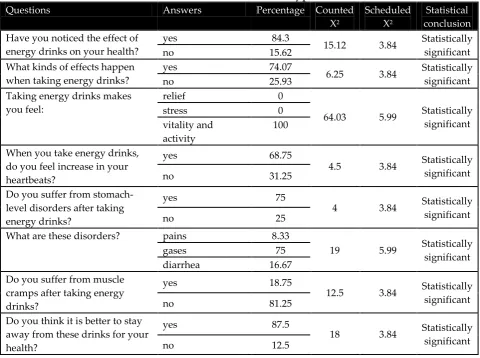
From Table 2 which includes the questions administered to athletes that are related to the second axis of the second hypothesis which states that there are health problems on athletes’ general health resulting from taking energy drinks, the table shows that there
are differences of statistical significance in all questions, this is through X2 test, at the
level of significance (0.05) we recorded values of counted X2 ranging between (4) and
(64.03) which are values bigger than the values of scheduled X2 which range between
Table 2: The questions administered to athletes concerning the second axis of the second hypothesis
Questions Answers Percentage Counted
X2
Scheduled X2
Statistical conclusion
Have you noticed the effect of energy drinks on your health?
yes 84.3
15.12 3.84 Statistically significant
no 15.62
What kinds of effects happen when taking energy drinks?
yes 74.07
6.25 3.84 Statistically significant
no 25.93
Taking energy drinks makes you feel:
relief 0
64.03 5.99 Statistically significant
stress 0
vitality and activity
100
When you take energy drinks, do you feel increase in your heartbeats?
yes 68.75
4.5 3.84 Statistically significant
no 31.25
Do you suffer from stomach-level disorders after taking energy drinks?
yes 75
4 3.84 Statistically significant
no 25
What are these disorders? pains 8.33
19 5.99 Statistically significant
gases 75
diarrhea 16.67
Do you suffer from muscle cramps after taking energy drinks?
yes 18.75
12.5 3.84 Statistically significant
no 81.25
Do you think it is better to stay away from these drinks for your health?
yes 87.5
18 3.84 Statistically significant
no 12.5
4.3 Discussion of the Results
Many athletes confuse energy drinks with sports drinks. Thus, sports drinks contain simple sugars and mineral salts such as potassium and sodium, thus, they work to compensate the lost liquids from the body and prevent the occurrence of dehydration and provides the body with calories during exercise, that what energy drinks cannot achieve so that they work to expel fluids from the body, therefore athletes should not use the energy drinks as an alternative to the sport drinks. It is noticed that most athletes fall victims to the lies that marketing companies place on packaging labels, so that they take drinks according to the fact that they find the elements they look for written on the bottles or selecting sports drinks or energy drinks is often done through seeing bottle form of the products companies advertising ability regardless to the aim on which those drinks are produced, or their relevance to the nature of the physical activity practiced or the quantity required to achieve their objectives. (9)
and potassium, which play a big role in the retention of water in the body and thus protect it from dehydration. (10)
When comparing the sports drinks to energy drinks, we find that there is a big difference between them. That is, sports drinks aim at compensating liquids and some lost wastes in sweat during training or working in hot weather for long time. However, energy drinks aim at providing the body with a large amount of metabolic energy (carbohydrates) and mental energy (caffeine and some stimulants, vitamins and herbs). (11)
As an explanation for the second axis, it can be said that taking energy drinks causes an increase in the loss of body fluids and decrease them from the normal level due to the fact that they contain a large amount of caffeine, which lead to dehydration. This last has a negative effect on cardiovascular functions and body temperature regulation, so that decreased performance and increased incidence of fever diseases. That what emphasized, that the occurrence of a slight degree of dehydration (loss of 1-2% of body weight) leads to an increase in internal body temperature, due to low blood flow to the skin and low rate of sweat secretion, resulting body's inability to get rid of excess heat caused by metabolism, thus the occurrence of early fatigue and inability to perform in endurance exercises of less than maximum. (12)
As we see, energy drinks have negative effects on athletes’ general health, in addition to the fact that they lead to high blood pressure and increased heartbeat rate, it is also said to have greater risks, such as the possibility of suffering heart attacks for stimulant drinks takers and taking drinks containing caffeine lead to increase in urination, therefore loss of fluids from the body, and this is what the studies have confirmed that the loss of 50% of liquids in urine within two hours only after taking energy drinks that contain caffeine.
5. Conclusion
The use of such energy substances negatively affects the health of the athletes, because they contain stimulants such as caffeine and high concentrated sugar. Therefore, the doctors, in cooperation with health scientists, launched a large media campaign. Thus, the manufacturers of these drinks were forced to write a statement showing the harm caused by these drinks and write a warning on the back of the box pointing out to the necessity to stay away of the use of these drinks, however, that has not applied yet in Algerian market for unknown reasons.
Therefore, athlete should take all the necessary precautions and know the perfect drinks that cover their needs without exposing their health to danger.
References
1. Mahmoud Ahmed Hamza, Introduction in Food and Nutrition Sciences, Aldar
Aljamia for Publishing, Cairo, 2003.p 17.
2. M. Triner, the use of energy drinks,
http://www.efsa.euroupa.eu/cs/blobserver/scientific_opinion
3. Mohamed Alhmahmi, Nutrition and health and sports life, Elkitab distribution
center, Cairo, 2000.pp 17- 312.
4. Rachid Zerouati, Training on the Methodology of Scientific Research in Social
Sciences, 1st eds, 2002.p119.
5. Jean Claude Combessie, The Method in Sociology (Approaches series), Ed
Casbah, Algiers- La Découverte, Paris,1996
.
p 09.6. Deslandes Neve, Introduction in Research, Ed, Paris, 1976, p20.
7. Moahamed Hassen Alaoui, Ossama Kamil Rateb, Scientific Research in Physical
Education, Sports and Psychology, Dar Alfikr Arabi, Cairo, 1999.p 219.
8. Farid Kamil Abu Zina et Al, Methods of Scientific Research Second Book
Statistics in Scientific Research, 1zt eds, Dar Almassira for Publishing and
Distribution, Arabic University of Aman for Higher Studies, Aman, Jordan, 2006. pp 212-213.
9. Amine Farouk, Food and Nutrition, National Academy for Publishing, Lebanon,
2005.p 57.
10.Shehatah Adel, Sports Drinks and Energy Drinks, Dar Almadani for Publishing
and Distribution, Djeddah, 2005.p 143.
11.Khaled Alamri, An Integrated Diet Program for Athletes, Dar Alfarouk for
Publishing and Distribution, Cairo, 2004.p 39.
12.Baha Eddine Salama, Food Health and Organs Functions, Dar Alfikr Alarabi,
Creative Commons licensing terms